

Linny's Pen Drawing Class
 |
Description
Book Introduction
Class 101, top tier for 5 consecutive years!
Satisfied thousands of students
'Lini's Pen Drawing Class' is finally published as a book!
Recording the small moments of daily life and travel moments that you want to cherish for a long time with a pen
Fall in love with your own special hobby: pen drawing.
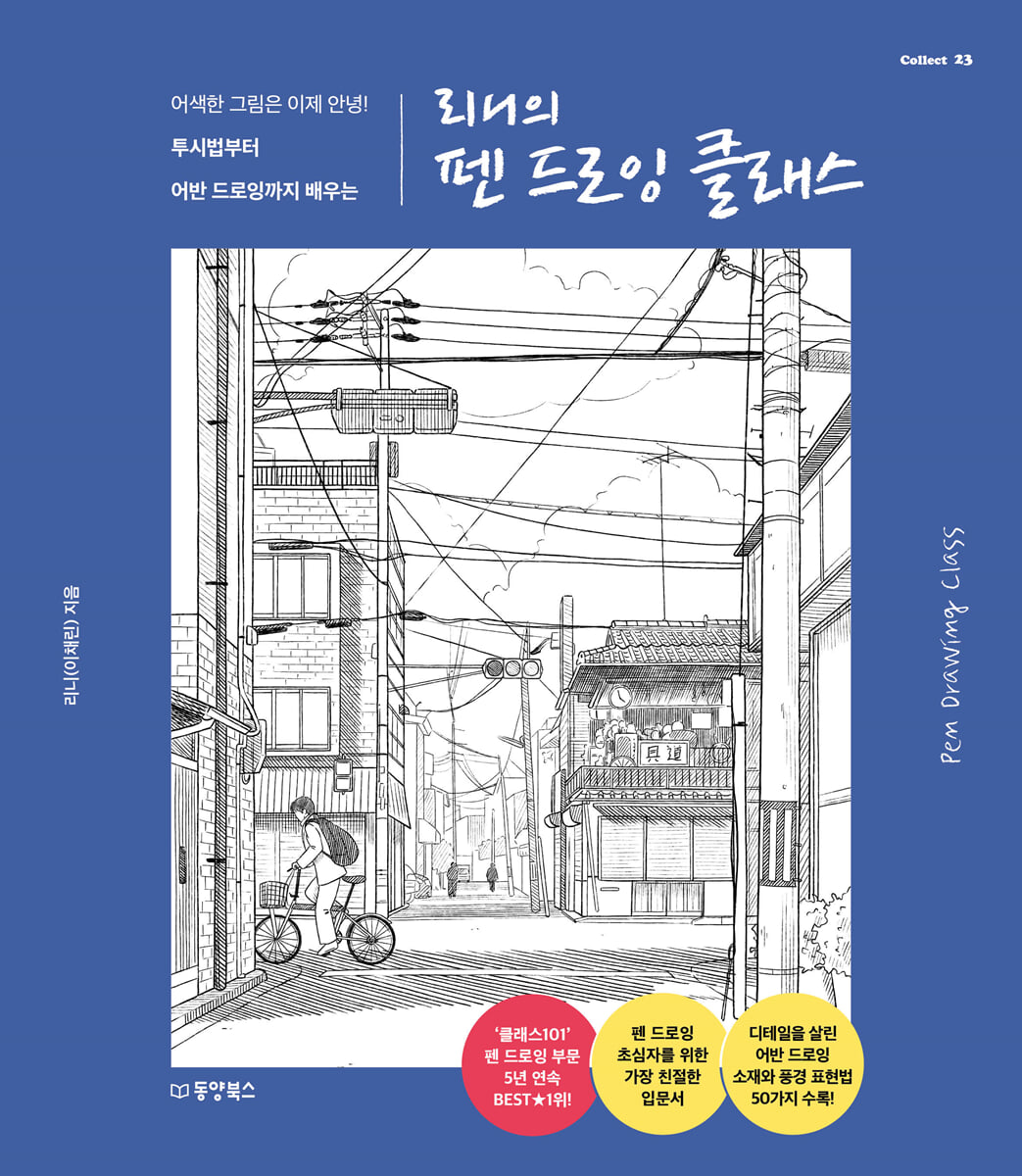
The course trusted and taken by absolute beginners who had never drawn before! "Lini's Pen Drawing," which has established itself as Class 101's flagship drawing class with its easy-to-follow and detailed explanations, has now been published as a book.
The author, Lee Chae-rin, wrote this book with the hope that more people would enjoy and easily learn pen drawing, which anyone can easily learn on their own with just a pen and paper.
This book is especially recommended to those who have felt that the drawings they usually draw with great effort are somehow awkward.
The reason why drawings turn out awkward is often because they were drawn without knowing the basics of drawing. This book provides detailed yet easy-to-understand introductions to the essential drawing basics that you need to know when drawing, such as two-dimensional and three-dimensional figures, proportions and slopes, light and shadow, and perspective.
Anyone who knows the basic drawing theory that Rini teaches will be able to draw anything more naturally, whether it's objects, landscapes, or the human body.
"Lini's Pen Drawing Class" is the most user-friendly introduction to urban drawing, helping you learn everything from the very basics to advanced landscape drawing, step by step.
It is packed with essential know-how for beginners who are just starting out with urban drawing, as well as intermediate users who want to improve their skills.
It contains over 50 urban drawing materials (natural objects, windows, streetlights, buildings, cars, people, etc.) and scenes and landscape expression methods that utilize Liny's delicate pen drawing style. The process is also described in great detail so that even beginners can follow along and complete the drawing without any burden.
Through this book, let's start drawing, something we've either forgotten about or have been meaning to try hundreds of times!
Satisfied thousands of students
'Lini's Pen Drawing Class' is finally published as a book!
Recording the small moments of daily life and travel moments that you want to cherish for a long time with a pen
Fall in love with your own special hobby: pen drawing.
The course trusted and taken by absolute beginners who had never drawn before! "Lini's Pen Drawing," which has established itself as Class 101's flagship drawing class with its easy-to-follow and detailed explanations, has now been published as a book.
The author, Lee Chae-rin, wrote this book with the hope that more people would enjoy and easily learn pen drawing, which anyone can easily learn on their own with just a pen and paper.
This book is especially recommended to those who have felt that the drawings they usually draw with great effort are somehow awkward.
The reason why drawings turn out awkward is often because they were drawn without knowing the basics of drawing. This book provides detailed yet easy-to-understand introductions to the essential drawing basics that you need to know when drawing, such as two-dimensional and three-dimensional figures, proportions and slopes, light and shadow, and perspective.
Anyone who knows the basic drawing theory that Rini teaches will be able to draw anything more naturally, whether it's objects, landscapes, or the human body.
"Lini's Pen Drawing Class" is the most user-friendly introduction to urban drawing, helping you learn everything from the very basics to advanced landscape drawing, step by step.
It is packed with essential know-how for beginners who are just starting out with urban drawing, as well as intermediate users who want to improve their skills.
It contains over 50 urban drawing materials (natural objects, windows, streetlights, buildings, cars, people, etc.) and scenes and landscape expression methods that utilize Liny's delicate pen drawing style. The process is also described in great detail so that even beginners can follow along and complete the drawing without any burden.
Through this book, let's start drawing, something we've either forgotten about or have been meaning to try hundreds of times!
- You can preview some of the book's contents.
Preview
index
Prologue
Step 0.
Before drawing, say, “It’s okay if it’s not perfect.”
Mindset: "If you draw consistently, with enjoyment, and to the end, your skills will improve."
6 Things to Know Before Drawing “Why Are My Drawings Awkward?”
Pen Drawing Supplies “Now, what should I prepare first?”
Step 1.
Pen Drawing Warm-up: "Let's start step by step, starting today."
The beginning and end of the drawing are drawn by lines
Rini's Counsel Drawing Posture and How to Hold a Pencil and Pen
Draw a long straight line at once
Rini's Counsel: Several Ways to Draw Long Lines
Draw a short straight line
Rini's Counsel: Breaking the Habit of Drawing Hairlines
Drawing lines using pressure
Rini's Counsel How to Draw Long Lines Without Distracting Using Pressure
Drawing lines using slope
Hatching ① Parallel hatching using the spacing of lines ② Cross hatching using overlapping lines ③ Hatching using the pressure and tilt of the pen
Rini's Counsel Differences in Drawings According to Hatching
Drawing curves and circles ① Curve ② Circle ③ Free curve
Contour drawing to boost your confidence
Advantages of Contour Drawing
How to draw contours
Step 2.
Getting Familiar with Pen Drawing - Part 1.
Drawing objects viewed from a flat surface
Simplify with shapes
[Pen Drawing 1] Camera
Draw with proportions
When drawing with reference to a photo
When drawing by looking at the actual object
Rini's Counsel How to 'Slope' with a Pencil or Pen
[Pen Drawing 2] Cocktail Glass
Learning the drawing order
[Pen Drawing 3] Japanese Restaurant
- Part 2: Drawing Objects in 3D
Simplify into a three-dimensional shape
Rini's Counsel Putting it in a hexahedral box and understanding it
Understanding Light and Shadow
Actual direction of light
Expression of light and shade in paintings
Light and shade expression of cubes, cylinders, and spheres
Rini's Counsel Shadow shape and length according to the angle and direction of light
Rini's Counsel: Shadow Changes Depending on the Situation
Applying perspective
Understanding Perspective ① Understanding 'Eye Level' ② Understanding Perspective According to 'Vanishing Point'
Rini's Counsel If you don't set the eye level consistently in your drawings
one-point perspective
[Pen Drawing 4] "Draw a cube in various positions using one-point perspective."
Rini's Counsel The faces that appear and those that do not appear when the position of the cube changes based on eye level and vanishing point
[Pen Drawing 5] Mailbox
[Pen Drawing 6] Side Table
[Pen Drawing 7] Hanok Cafe
Rini's Counsel One-point perspective that looks like a plane
two-point perspective
Rini's Counsel If the picture looks awkward depending on the distance between the vanishing points on either side
[Pen Drawing 8] "Draw a cube in various positions using two-point perspective."
[Pen Drawing 9] Chair
[Pen Drawing 10] Carrier
[Pen Drawing 11] Portuguese House
three-point perspective
Advantages of Rini's Counsel's Three-Point Perspective
Rini's Counsel If the picture looks awkward depending on the distance between the vanishing point located above or below the eye level 148
[Pen Drawing 12] "Draw a cube in various positions using three-point perspective."
[Pen Drawing 13] Piece of Cake
[Pen Drawing 14] Candy Box
[Pen Drawing 15] Arc de Triomphe
Multi-point perspective, which shows perspectives from multiple viewpoints together
Understanding the Cylinder Shape
[Pen Drawing 16] "Draw a cylinder placed at various locations below eye level."
[Pen Drawing 17] Candle
[Pen Drawing 18] Paper Cup
[Pen Drawing 19] Coffee Cup and Cookies
Rini's Counsel When the vertical line of a cylinder moves out of sight
Step 3.
Getting Started with Urban Drawing: "Draw a Variety of Materials with Detail"
Window: "What's an essential material for urban drawing? Draw a window."
[Pen Drawing 20] Lattice Window
[Pen Drawing 21] Sliding Window
[Pen Drawing 22] Window with Railing
[Pen Drawing 23] Decorated Window
Signboard/Signboard "Draw a signboard/signboard that is higher than a person's height."
[Pen Drawing 24] Traffic Signs
[Pen Drawing 25] Road Sign
[Pen Drawing 26] A Sign with a 3D Sense
Telephone poles/streetlights “Draw the telephone poles/streetlights that appear small in the landscape according to their proportions.”
[Pen Drawing 27] Utility Pole
[Pen Drawing 28] Streetlight
[Pen Drawing 29] Streetlight with Sign
Natural Objects 1 - Trees "Draw various types of trees using freehand curves."
[Pen Drawing 30] Round Tree 1
[Pen Drawing 31] Round Tree 2
[Pen Drawing 32] Pointed Tree
[Pen Drawing 33] Palm Tree
[Pen Drawing 34] Leafless Tree
Natural Objects 2 - Bushes/Plants "Draw various types of bushes/plants using freehand curves."
[Pen Drawing 35] Round Bush
[Pen Drawing 36] Long Bush
[Pen Drawing 37] Flowering Bush
[Pen Drawing 38] Plant with Long Leaves
[Pen Drawing 39] Plant with Large Leaves
Natural Objects 3 - Stones/Mountains and Lakes/Seas/Clouds "Draw stones/mountains and lakes/seas/clouds easily and naturally with freehand curves."
[Pen Drawing 40] Stone
[Pen Drawing 41] Mountains and Lakes
[Pen Drawing 42] Sea
[Pen Drawing 43] Clouds
Cars: "Drawing cars that energize cities."
[Pen Drawing 44] Car with front and side views
[Pen Drawing 45] Car with rear and side views
[Pen Drawing 46] A car viewed from above and from the side
Rini's Counsel Simplifying cars into various three-dimensional shapes
Figures in Landscapes: "I draw figures in landscapes, focusing on various human expressions."
human body proportions
Simplification of skeleton and joints
Character representations in various poses and styles
[Pen Drawing 47] Standing Person
[Pen Drawing 48] Walking Person (Front View)
[Pen Drawing 49] Walking Person (Back View)
[Pen Drawing 50] Walking Person (Side View)
[Pen Drawing 51] Sitting Person
Rini's Counsel: Drawing Figures in Perspective
Step 4.
Completing an Urban Drawing: "Adding Materials to Draw Multiple Scenes"
[Pen Drawing 52] A Quiet Alleyway in Japan Showing a Variety of Textures
[Pen Drawing 53] New York Central Park, a place with a relatively large amount of material.
[Pen Drawing 54] A Quiet Alley in Spain, Drawn Using Multi-Point Perspective
[Appendix] Practical! Urban Drawing: "Helpful Tips for Drawing Alone"
Epilogue
Step 0.
Before drawing, say, “It’s okay if it’s not perfect.”
Mindset: "If you draw consistently, with enjoyment, and to the end, your skills will improve."
6 Things to Know Before Drawing “Why Are My Drawings Awkward?”
Pen Drawing Supplies “Now, what should I prepare first?”
Step 1.
Pen Drawing Warm-up: "Let's start step by step, starting today."
The beginning and end of the drawing are drawn by lines
Rini's Counsel Drawing Posture and How to Hold a Pencil and Pen
Draw a long straight line at once
Rini's Counsel: Several Ways to Draw Long Lines
Draw a short straight line
Rini's Counsel: Breaking the Habit of Drawing Hairlines
Drawing lines using pressure
Rini's Counsel How to Draw Long Lines Without Distracting Using Pressure
Drawing lines using slope
Hatching ① Parallel hatching using the spacing of lines ② Cross hatching using overlapping lines ③ Hatching using the pressure and tilt of the pen
Rini's Counsel Differences in Drawings According to Hatching
Drawing curves and circles ① Curve ② Circle ③ Free curve
Contour drawing to boost your confidence
Advantages of Contour Drawing
How to draw contours
Step 2.
Getting Familiar with Pen Drawing - Part 1.
Drawing objects viewed from a flat surface
Simplify with shapes
[Pen Drawing 1] Camera
Draw with proportions
When drawing with reference to a photo
When drawing by looking at the actual object
Rini's Counsel How to 'Slope' with a Pencil or Pen
[Pen Drawing 2] Cocktail Glass
Learning the drawing order
[Pen Drawing 3] Japanese Restaurant
- Part 2: Drawing Objects in 3D
Simplify into a three-dimensional shape
Rini's Counsel Putting it in a hexahedral box and understanding it
Understanding Light and Shadow
Actual direction of light
Expression of light and shade in paintings
Light and shade expression of cubes, cylinders, and spheres
Rini's Counsel Shadow shape and length according to the angle and direction of light
Rini's Counsel: Shadow Changes Depending on the Situation
Applying perspective
Understanding Perspective ① Understanding 'Eye Level' ② Understanding Perspective According to 'Vanishing Point'
Rini's Counsel If you don't set the eye level consistently in your drawings
one-point perspective
[Pen Drawing 4] "Draw a cube in various positions using one-point perspective."
Rini's Counsel The faces that appear and those that do not appear when the position of the cube changes based on eye level and vanishing point
[Pen Drawing 5] Mailbox
[Pen Drawing 6] Side Table
[Pen Drawing 7] Hanok Cafe
Rini's Counsel One-point perspective that looks like a plane
two-point perspective
Rini's Counsel If the picture looks awkward depending on the distance between the vanishing points on either side
[Pen Drawing 8] "Draw a cube in various positions using two-point perspective."
[Pen Drawing 9] Chair
[Pen Drawing 10] Carrier
[Pen Drawing 11] Portuguese House
three-point perspective
Advantages of Rini's Counsel's Three-Point Perspective
Rini's Counsel If the picture looks awkward depending on the distance between the vanishing point located above or below the eye level 148
[Pen Drawing 12] "Draw a cube in various positions using three-point perspective."
[Pen Drawing 13] Piece of Cake
[Pen Drawing 14] Candy Box
[Pen Drawing 15] Arc de Triomphe
Multi-point perspective, which shows perspectives from multiple viewpoints together
Understanding the Cylinder Shape
[Pen Drawing 16] "Draw a cylinder placed at various locations below eye level."
[Pen Drawing 17] Candle
[Pen Drawing 18] Paper Cup
[Pen Drawing 19] Coffee Cup and Cookies
Rini's Counsel When the vertical line of a cylinder moves out of sight
Step 3.
Getting Started with Urban Drawing: "Draw a Variety of Materials with Detail"
Window: "What's an essential material for urban drawing? Draw a window."
[Pen Drawing 20] Lattice Window
[Pen Drawing 21] Sliding Window
[Pen Drawing 22] Window with Railing
[Pen Drawing 23] Decorated Window
Signboard/Signboard "Draw a signboard/signboard that is higher than a person's height."
[Pen Drawing 24] Traffic Signs
[Pen Drawing 25] Road Sign
[Pen Drawing 26] A Sign with a 3D Sense
Telephone poles/streetlights “Draw the telephone poles/streetlights that appear small in the landscape according to their proportions.”
[Pen Drawing 27] Utility Pole
[Pen Drawing 28] Streetlight
[Pen Drawing 29] Streetlight with Sign
Natural Objects 1 - Trees "Draw various types of trees using freehand curves."
[Pen Drawing 30] Round Tree 1
[Pen Drawing 31] Round Tree 2
[Pen Drawing 32] Pointed Tree
[Pen Drawing 33] Palm Tree
[Pen Drawing 34] Leafless Tree
Natural Objects 2 - Bushes/Plants "Draw various types of bushes/plants using freehand curves."
[Pen Drawing 35] Round Bush
[Pen Drawing 36] Long Bush
[Pen Drawing 37] Flowering Bush
[Pen Drawing 38] Plant with Long Leaves
[Pen Drawing 39] Plant with Large Leaves
Natural Objects 3 - Stones/Mountains and Lakes/Seas/Clouds "Draw stones/mountains and lakes/seas/clouds easily and naturally with freehand curves."
[Pen Drawing 40] Stone
[Pen Drawing 41] Mountains and Lakes
[Pen Drawing 42] Sea
[Pen Drawing 43] Clouds
Cars: "Drawing cars that energize cities."
[Pen Drawing 44] Car with front and side views
[Pen Drawing 45] Car with rear and side views
[Pen Drawing 46] A car viewed from above and from the side
Rini's Counsel Simplifying cars into various three-dimensional shapes
Figures in Landscapes: "I draw figures in landscapes, focusing on various human expressions."
human body proportions
Simplification of skeleton and joints
Character representations in various poses and styles
[Pen Drawing 47] Standing Person
[Pen Drawing 48] Walking Person (Front View)
[Pen Drawing 49] Walking Person (Back View)
[Pen Drawing 50] Walking Person (Side View)
[Pen Drawing 51] Sitting Person
Rini's Counsel: Drawing Figures in Perspective
Step 4.
Completing an Urban Drawing: "Adding Materials to Draw Multiple Scenes"
[Pen Drawing 52] A Quiet Alleyway in Japan Showing a Variety of Textures
[Pen Drawing 53] New York Central Park, a place with a relatively large amount of material.
[Pen Drawing 54] A Quiet Alley in Spain, Drawn Using Multi-Point Perspective
[Appendix] Practical! Urban Drawing: "Helpful Tips for Drawing Alone"
Epilogue
Detailed image

Publisher's Review
Highly recommended for beginners as well as intermediate level users who want to improve their drawing skills!
If you've decided to learn, from essential drawing theory to practical pen drawing works.
Let's learn properly with 『Lini's Pen Drawing Class』, which contains only the essential information.
[Pay attention to this book!]
◆ What if you've thought about drawing hundreds of times?
Let's start with Linnie! "It's okay if it's not perfect."
Why do we paint? We don't paint to become great artists or to be judged by others.
I draw to record the little things in my daily life, to dream of drawing while traveling, and to find joy in relieving the hardships of life.
If that's the case, isn't that mindset enough? This book's author, Leeni (Chaerin Lee), an illustrator and instructor of Class 101's #1 pen drawing class for five consecutive years, published it with the hope that more people will enjoy and be happy drawing.
It's okay if you don't draw it perfectly.
If you enjoy drawing through this book, drawing consistently until the end, your skills will improve and you will feel a sense of satisfaction beyond what you could have imagined.
◆ Have you ever thought, 'Why are my drawings so awkward?'
From line drawing to perspective! A solid drawing theory book.
If you have ever drawn pictures with so much effort, but they seem awkward for some reason, it may be because you don't know the basics of drawing.
Just by knowing the core drawing theories introduced in this book, you will be able to draw anything more naturally, whether it be objects, landscapes, or the human body.
First, we start by drawing lines, which can be considered the beginning and end of the drawing.
Even if you are a beginner or have neglected drawing lines, you should definitely practice before moving on.
Next is the diagram.
Most objects around us can be shaped into flat or three-dimensional figures.
It becomes much easier to draw if you start with geometric shapes like triangles, squares, and circles.
Proportions are also important.
Because even a slight difference from the generally known proportions can make the picture look awkward.
It tells you how to determine the proportions and inclination of the object you want to draw.
In addition, it introduces in detail and in an easy-to-understand way core drawing techniques such as light, shadow, and perspective that naturally express three-dimensionality in drawings.
◆ Are you curious about urban drawing materials and landscape expression methods?
Includes 50 detailed urban drawing materials and landscape expression techniques!
It includes 50 urban drawing materials and landscapes, including simple props, natural objects, streetlights, cars, buildings, and people, so that you can practice drawing them along.
In addition, the explanations and process cuts are organized in great detail so that anyone can complete a plausible work by simply following the steps.
"Huh? This works!? I drew this?" Her detailed pen drawings and easy-to-follow explanations have earned her much love. Reviews of her classes are particularly replete with exclamations like these.
Although it felt difficult, I was amazed at my drawing skills as I completed it without giving up.
Readers of "Lini's Pen Drawing Class" will also feel a growing sense of pride and accomplishment as they draw detailed pen drawings, from small props to travel scenes, and their skills will improve.
[This is how it was structured!]
◆ Step 0.
Before drawing
Here are some tips to keep in mind before you start drawing with pen.
Before drawing with a pen, we will examine the mindset and diagnose the reasons why your drawings were awkward. We will also introduce essential pen drawing tools such as pens, pencils, erasers, paper, and sketchbooks, as well as recommended products.
◆ Step 1.
Pen Drawing Warm-up
You can practice drawing lines and hatching, which can be considered the beginning and end of drawing.
It also teaches you the advantages and methods of contour drawing that will help you gain confidence in your drawing.
◆ Step 2.
Getting familiar with pen drawing (drawing objects viewed from a flat or three-dimensional perspective)
This is a full-fledged drawing theory class that introduces the essential drawing basics that you need to know when drawing, such as two-dimensional and three-dimensional figures, proportions and slopes, light and shadow, and perspective, in detail and in an easy-to-understand manner.
◆ Step 3.
Getting Started with Urban Drawing
Once you've mastered drawing theory, it's time to master urban drawing! Learn to delicately draw a variety of subjects, including windows, signs, poles, streetlights, natural objects, cars, and people.
◆ Step 4.
Complete the urban drawing
Let's draw several scenes using the urban drawing materials we learned earlier.
It contains a variety of urban drawing works that you will want to try drawing, such as a quiet alleyway in Japan with a variety of textures, New York's Central Park with its relatively abundant materials, and a quiet alleyway in Spain drawn using multi-point perspective.
◆ Free designs available through appendix and QR codes to help you draw on your own!
As an appendix, we introduce helpful tips for practical urban drawing.
To make things a little simpler, the author reveals his unique know-how for quickly and on-the-spot drawing of precious moments encountered in everyday life or while traveling.
We also provide free sketches of the works included in the book.
This is a completed pencil sketch, the step before pen drawing. If the sketch feels complicated or you want to start lightly, you can print it out in the size you want and enjoy pen drawing life anytime, anywhere.
“From drawing basics to perspective, from simple props to buildings and landscapes!
“Starting today, let’s start Lini’s easy and fun pen drawing class.”
If you've decided to learn, from essential drawing theory to practical pen drawing works.
Let's learn properly with 『Lini's Pen Drawing Class』, which contains only the essential information.
[Pay attention to this book!]
◆ What if you've thought about drawing hundreds of times?
Let's start with Linnie! "It's okay if it's not perfect."
Why do we paint? We don't paint to become great artists or to be judged by others.
I draw to record the little things in my daily life, to dream of drawing while traveling, and to find joy in relieving the hardships of life.
If that's the case, isn't that mindset enough? This book's author, Leeni (Chaerin Lee), an illustrator and instructor of Class 101's #1 pen drawing class for five consecutive years, published it with the hope that more people will enjoy and be happy drawing.
It's okay if you don't draw it perfectly.
If you enjoy drawing through this book, drawing consistently until the end, your skills will improve and you will feel a sense of satisfaction beyond what you could have imagined.
◆ Have you ever thought, 'Why are my drawings so awkward?'
From line drawing to perspective! A solid drawing theory book.
If you have ever drawn pictures with so much effort, but they seem awkward for some reason, it may be because you don't know the basics of drawing.
Just by knowing the core drawing theories introduced in this book, you will be able to draw anything more naturally, whether it be objects, landscapes, or the human body.
First, we start by drawing lines, which can be considered the beginning and end of the drawing.
Even if you are a beginner or have neglected drawing lines, you should definitely practice before moving on.
Next is the diagram.
Most objects around us can be shaped into flat or three-dimensional figures.
It becomes much easier to draw if you start with geometric shapes like triangles, squares, and circles.
Proportions are also important.
Because even a slight difference from the generally known proportions can make the picture look awkward.
It tells you how to determine the proportions and inclination of the object you want to draw.
In addition, it introduces in detail and in an easy-to-understand way core drawing techniques such as light, shadow, and perspective that naturally express three-dimensionality in drawings.
◆ Are you curious about urban drawing materials and landscape expression methods?
Includes 50 detailed urban drawing materials and landscape expression techniques!
It includes 50 urban drawing materials and landscapes, including simple props, natural objects, streetlights, cars, buildings, and people, so that you can practice drawing them along.
In addition, the explanations and process cuts are organized in great detail so that anyone can complete a plausible work by simply following the steps.
"Huh? This works!? I drew this?" Her detailed pen drawings and easy-to-follow explanations have earned her much love. Reviews of her classes are particularly replete with exclamations like these.
Although it felt difficult, I was amazed at my drawing skills as I completed it without giving up.
Readers of "Lini's Pen Drawing Class" will also feel a growing sense of pride and accomplishment as they draw detailed pen drawings, from small props to travel scenes, and their skills will improve.
[This is how it was structured!]
◆ Step 0.
Before drawing
Here are some tips to keep in mind before you start drawing with pen.
Before drawing with a pen, we will examine the mindset and diagnose the reasons why your drawings were awkward. We will also introduce essential pen drawing tools such as pens, pencils, erasers, paper, and sketchbooks, as well as recommended products.
◆ Step 1.
Pen Drawing Warm-up
You can practice drawing lines and hatching, which can be considered the beginning and end of drawing.
It also teaches you the advantages and methods of contour drawing that will help you gain confidence in your drawing.
◆ Step 2.
Getting familiar with pen drawing (drawing objects viewed from a flat or three-dimensional perspective)
This is a full-fledged drawing theory class that introduces the essential drawing basics that you need to know when drawing, such as two-dimensional and three-dimensional figures, proportions and slopes, light and shadow, and perspective, in detail and in an easy-to-understand manner.
◆ Step 3.
Getting Started with Urban Drawing
Once you've mastered drawing theory, it's time to master urban drawing! Learn to delicately draw a variety of subjects, including windows, signs, poles, streetlights, natural objects, cars, and people.
◆ Step 4.
Complete the urban drawing
Let's draw several scenes using the urban drawing materials we learned earlier.
It contains a variety of urban drawing works that you will want to try drawing, such as a quiet alleyway in Japan with a variety of textures, New York's Central Park with its relatively abundant materials, and a quiet alleyway in Spain drawn using multi-point perspective.
◆ Free designs available through appendix and QR codes to help you draw on your own!
As an appendix, we introduce helpful tips for practical urban drawing.
To make things a little simpler, the author reveals his unique know-how for quickly and on-the-spot drawing of precious moments encountered in everyday life or while traveling.
We also provide free sketches of the works included in the book.
This is a completed pencil sketch, the step before pen drawing. If the sketch feels complicated or you want to start lightly, you can print it out in the size you want and enjoy pen drawing life anytime, anywhere.
“From drawing basics to perspective, from simple props to buildings and landscapes!
“Starting today, let’s start Lini’s easy and fun pen drawing class.”
GOODS SPECIFICS
- Date of issue: August 22, 2023
- Page count, weight, size: 368 pages | 916g | 200*230*23mm
- ISBN13: 9791157689491
- ISBN10: 1157689493
You may also like
카테고리
korean


korean

![GQ KOREA Mark (Monthly): December [2025]](http://librairie.coreenne.fr/cdn/shop/files/8ef265dbbfbf186523ed75ba7319009d.jpg?v=1765340328&width=3840)


