

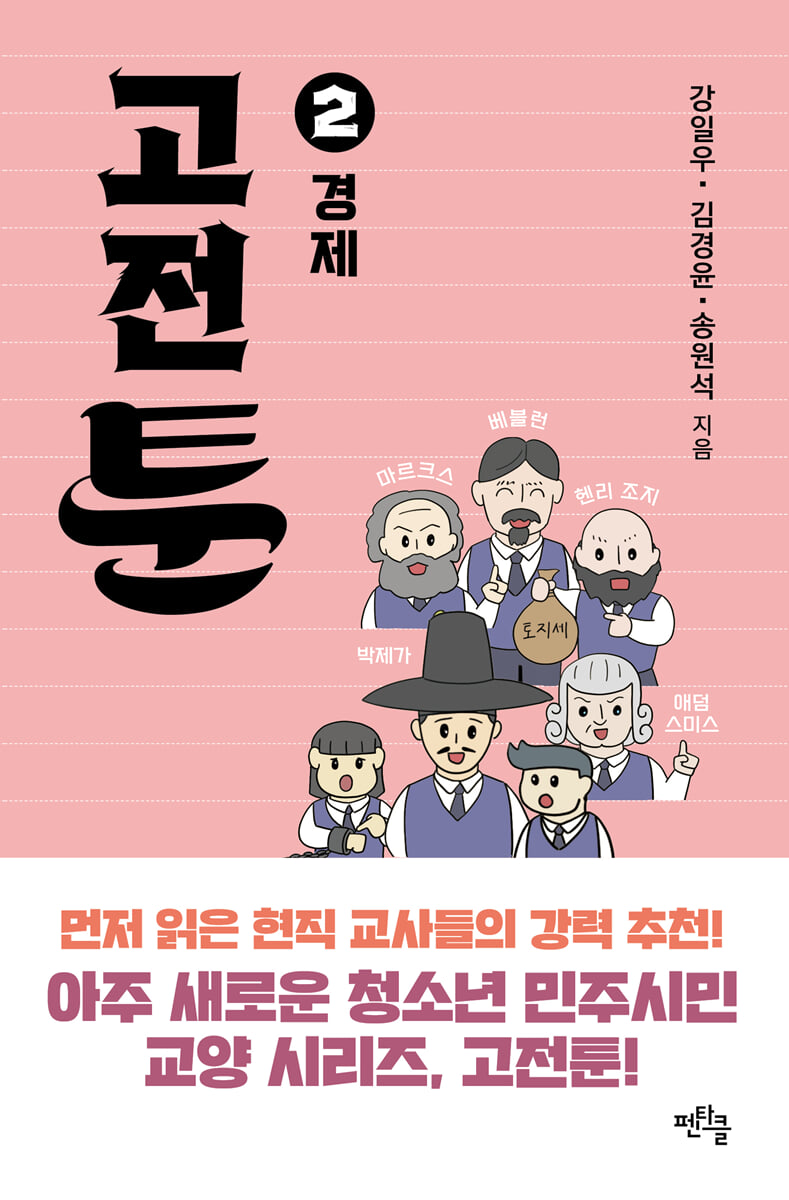
Classic Toon 2
 |
Description
Book Introduction
『Classical Toon 2 - Economy』 begins with Plato's 『Republic』 and, following the first volume that questioned the essence of politics, explores 'economy,' another axis that supports human life.
Adam Smith's "The Wealth of Nations," Karl Marx's "Das Kapital," Henry George's "Progress and Poverty," Thorstein Veblen's "The Theory of the Leisure Class," and Park Je-ga's "The Book of Northern Learning"—following the ideas and arguments contained in these five classics, selected after careful consideration and discussion by the authors, we reinterpret today's economy anew.
This book does not simply summarize the contents of the classics.
Through the four axes of history, digest, classic cartoon, and book talk, we examine the background, discussion, and context of the writing and explain the reasoning behind their arguments.
And their wisdom shows that the economy is not simply a matter of money, but a human problem that must be viewed from the perspective of human nature and social justice, and that it is an ongoing problem that has not yet been resolved.
In particular, in "The Square of Wisdom," thinkers such as Smith, Keynes, and Ricardo discuss various economic issues such as "Is the market truly omnipotent?" and "Does free trade make everyone rich?"
Readers need not simply observe their discussions and memorize 'economic theory'.
We listen to thinkers discuss various questions such as 'Where does wealth come from?', 'How is the value of labor created?', and 'In what balance should the market and the state coexist?', and think about these issues together.
This practice allows readers to participate in the discussion as a debater, refine their thoughts, and help them interpret the "economy" in their own words, ultimately enabling them to grow into citizens who can independently contemplate and think about the relationship between markets, humans, and the economy.
Adam Smith's "The Wealth of Nations," Karl Marx's "Das Kapital," Henry George's "Progress and Poverty," Thorstein Veblen's "The Theory of the Leisure Class," and Park Je-ga's "The Book of Northern Learning"—following the ideas and arguments contained in these five classics, selected after careful consideration and discussion by the authors, we reinterpret today's economy anew.
This book does not simply summarize the contents of the classics.
Through the four axes of history, digest, classic cartoon, and book talk, we examine the background, discussion, and context of the writing and explain the reasoning behind their arguments.
And their wisdom shows that the economy is not simply a matter of money, but a human problem that must be viewed from the perspective of human nature and social justice, and that it is an ongoing problem that has not yet been resolved.
In particular, in "The Square of Wisdom," thinkers such as Smith, Keynes, and Ricardo discuss various economic issues such as "Is the market truly omnipotent?" and "Does free trade make everyone rich?"
Readers need not simply observe their discussions and memorize 'economic theory'.
We listen to thinkers discuss various questions such as 'Where does wealth come from?', 'How is the value of labor created?', and 'In what balance should the market and the state coexist?', and think about these issues together.
This practice allows readers to participate in the discussion as a debater, refine their thoughts, and help them interpret the "economy" in their own words, ultimately enabling them to grow into citizens who can independently contemplate and think about the relationship between markets, humans, and the economy.
- You can preview some of the book's contents.
Preview
index
Foreword_Why Classic Cartoons?│06
Adam Smith, The Wealth of Nations│11
Karl Marx's "Capital"│57
Henry George, Progress and Poverty│113
Thorstein Veblen, The Theory of the Leisure Class│163
Park Jae-ga's "Bukhakui"│207
Recommendation_Classic Toon, Must Read!│250
Adam Smith, The Wealth of Nations│11
Karl Marx's "Capital"│57
Henry George, Progress and Poverty│113
Thorstein Veblen, The Theory of the Leisure Class│163
Park Jae-ga's "Bukhakui"│207
Recommendation_Classic Toon, Must Read!│250
Detailed image

Into the book
Agora: We go to work every morning, put in our best effort for a set number of hours, and receive a salary in return.
This process is so familiar that it feels as natural as breathing air.
But at the same time, this question arises:
"Why doesn't my life ever get better, no matter how hard I work?" "Why does my paycheck disappear so quickly after paying my credit card bill and rent?" Following these universal questions, we're confronted with more fundamental ones.
Does my salary truly reflect the value of my labor? What is value in the first place, and who determines it and how?
Marx: The value of labor comes directly from the sweat and time of the workers.
But the capitalist does not return all of that sweat as wages.
Let's assume a worker works 8 hours a day.
All it takes to feed your family is the value of four hours of labor.
But where does the value created by workers during the remaining four hours go? It goes straight into the pockets of the capitalists.
This is the secret of surplus value, or profit.
It is not an illusion that workers always feel that their wages are tight, but a reality.
In the first place, wages are not the entire value of labor, but only half, or even less.
SMITH: Just a moment, Mr. Marx.
There is no need to be so pessimistic.
Of course, I agree that labor is the source of all value.
But if free competition is properly implemented, wages will naturally find balance.
When labor is scarce, wages rise, and when there are many people wanting jobs, wages fall.
People may always feel underpaid, but in the long run, the invisible hand of the market balances this out.
Isn't the core of the problem not the greed of individual capitalists, but rather the monopolies, privileges, and unfair systems that distort market flow? I believe that's the more important point.
Schumpeter: Both of your comments are interesting.
But I don't think wages can be explained simply by whether they are exploitation or balance.
Wages depend above all on innovation and productivity.
Think back to when the steam engine was introduced.
Many workers feared losing their jobs, but over time, productivity increased significantly, creating new industries and jobs.
As a result, wage levels gradually improved.
Wages are not fixed, but rather like waves that constantly rise and fall depending on the situation.
Capitalism certainly creates crises and discontent, but it also has the power to raise living standards.
--- From the text, “Karl Marx’s ‘Capital’, Book Talk - Is Capitalism Really Doomed to Failure?”
Agora: Humanity is creating wealth on a scale unparalleled in the past.
Science and technology have advanced at a dazzling pace, and productivity has increased explosively.
But somehow, poverty has not disappeared, and problems such as urban poverty, youth unemployment, and housing inequality are actually getting worse.
How can we explain this contradiction?
George: That's the question I've spent my entire life exploring.
To conclude, the fruits of progress are monopolized by landowners.
As technology advances and society becomes wealthier, the value of land, that is, land prices and rents, skyrocket accordingly.
In the end, workers have to bear the burden of rents that rise even more steeply than wages.
Life doesn't get any better.
The core of the contradiction of poverty amid progress is the structure in which all the benefits of progress are sucked into the pockets of unemployed landowners.
Look at the prices of houses in Seoul or New York.
No matter how hard you work, you won't have anything left after paying rent or loan interest.
It's a vicious cycle of poverty.
Pain: I completely agree with Mr. George's point.
I would like to add the perspective of tax justice here.
What an individual creates through his or her labor and effort belongs to that individual, but values created by society as a whole, such as land, must be reclaimed by society.
So I think land tax and inheritance tax are just taxes.
The funds collected in this way are distributed to all citizens.
It should be distributed as a basic income to everyone.
Basic income is not simply a system of handing out money.
This signals that everyone is entitled to a minimum level of rights from the common resources.
Fewer children will have to give up on education or young people will have to give up on their dreams because of poverty, and everyone will be able to live a decent life.
Economically, basic income increases consumption, boosting the vitality of society as a whole, and strengthening community cohesion by reducing inequality.
Spencer: You two have a very mechanistic view of society.
Society is like an organism that develops through competition.
As society progresses, it is somewhat natural for inequality to appear.
Just as living things in nature compete fiercely with each other to survive, so too does society, through competition, stronger groups and individuals advance, while those who are less capable are left behind.
It's survival of the fittest.
Of course, it may seem inconvenient, but in the long run, it is also true that this competition has strengthened society as a whole.
The inequality that arises in the process of progress is also like the growing pains that society goes through to become stronger.
Attempting to forcibly correct this through taxes or artificial redistribution will not only infringe on individual freedom and property rights, but will also stifle the competitive dynamic that drives social development.
The solution to poverty is not through mandatory institutional reforms like a single tax or basic income, but rather through individuals developing their own capabilities through education, growing morally, and adapting to a changing environment.
George: Mr. Spencer's words are overly optimistic.
The gap between those who have land and those who do not is widening over time.
Inequality will never be alleviated naturally unless we intervene institutionally.
Pain: That's right.
I respect freedom and competition, but competition without a minimum safety net is close to violence.
It is empty to tell a hungry person to compete freely.
As I've said many times, basic income is not a favor, it's a right.
Every member of society is entitled to his or her share of the common resources.
It is to ensure that everyone has a minimum qualification to participate in the competition.
That is true equality of opportunity.
This process is so familiar that it feels as natural as breathing air.
But at the same time, this question arises:
"Why doesn't my life ever get better, no matter how hard I work?" "Why does my paycheck disappear so quickly after paying my credit card bill and rent?" Following these universal questions, we're confronted with more fundamental ones.
Does my salary truly reflect the value of my labor? What is value in the first place, and who determines it and how?
Marx: The value of labor comes directly from the sweat and time of the workers.
But the capitalist does not return all of that sweat as wages.
Let's assume a worker works 8 hours a day.
All it takes to feed your family is the value of four hours of labor.
But where does the value created by workers during the remaining four hours go? It goes straight into the pockets of the capitalists.
This is the secret of surplus value, or profit.
It is not an illusion that workers always feel that their wages are tight, but a reality.
In the first place, wages are not the entire value of labor, but only half, or even less.
SMITH: Just a moment, Mr. Marx.
There is no need to be so pessimistic.
Of course, I agree that labor is the source of all value.
But if free competition is properly implemented, wages will naturally find balance.
When labor is scarce, wages rise, and when there are many people wanting jobs, wages fall.
People may always feel underpaid, but in the long run, the invisible hand of the market balances this out.
Isn't the core of the problem not the greed of individual capitalists, but rather the monopolies, privileges, and unfair systems that distort market flow? I believe that's the more important point.
Schumpeter: Both of your comments are interesting.
But I don't think wages can be explained simply by whether they are exploitation or balance.
Wages depend above all on innovation and productivity.
Think back to when the steam engine was introduced.
Many workers feared losing their jobs, but over time, productivity increased significantly, creating new industries and jobs.
As a result, wage levels gradually improved.
Wages are not fixed, but rather like waves that constantly rise and fall depending on the situation.
Capitalism certainly creates crises and discontent, but it also has the power to raise living standards.
--- From the text, “Karl Marx’s ‘Capital’, Book Talk - Is Capitalism Really Doomed to Failure?”
Agora: Humanity is creating wealth on a scale unparalleled in the past.
Science and technology have advanced at a dazzling pace, and productivity has increased explosively.
But somehow, poverty has not disappeared, and problems such as urban poverty, youth unemployment, and housing inequality are actually getting worse.
How can we explain this contradiction?
George: That's the question I've spent my entire life exploring.
To conclude, the fruits of progress are monopolized by landowners.
As technology advances and society becomes wealthier, the value of land, that is, land prices and rents, skyrocket accordingly.
In the end, workers have to bear the burden of rents that rise even more steeply than wages.
Life doesn't get any better.
The core of the contradiction of poverty amid progress is the structure in which all the benefits of progress are sucked into the pockets of unemployed landowners.
Look at the prices of houses in Seoul or New York.
No matter how hard you work, you won't have anything left after paying rent or loan interest.
It's a vicious cycle of poverty.
Pain: I completely agree with Mr. George's point.
I would like to add the perspective of tax justice here.
What an individual creates through his or her labor and effort belongs to that individual, but values created by society as a whole, such as land, must be reclaimed by society.
So I think land tax and inheritance tax are just taxes.
The funds collected in this way are distributed to all citizens.
It should be distributed as a basic income to everyone.
Basic income is not simply a system of handing out money.
This signals that everyone is entitled to a minimum level of rights from the common resources.
Fewer children will have to give up on education or young people will have to give up on their dreams because of poverty, and everyone will be able to live a decent life.
Economically, basic income increases consumption, boosting the vitality of society as a whole, and strengthening community cohesion by reducing inequality.
Spencer: You two have a very mechanistic view of society.
Society is like an organism that develops through competition.
As society progresses, it is somewhat natural for inequality to appear.
Just as living things in nature compete fiercely with each other to survive, so too does society, through competition, stronger groups and individuals advance, while those who are less capable are left behind.
It's survival of the fittest.
Of course, it may seem inconvenient, but in the long run, it is also true that this competition has strengthened society as a whole.
The inequality that arises in the process of progress is also like the growing pains that society goes through to become stronger.
Attempting to forcibly correct this through taxes or artificial redistribution will not only infringe on individual freedom and property rights, but will also stifle the competitive dynamic that drives social development.
The solution to poverty is not through mandatory institutional reforms like a single tax or basic income, but rather through individuals developing their own capabilities through education, growing morally, and adapting to a changing environment.
George: Mr. Spencer's words are overly optimistic.
The gap between those who have land and those who do not is widening over time.
Inequality will never be alleviated naturally unless we intervene institutionally.
Pain: That's right.
I respect freedom and competition, but competition without a minimum safety net is close to violence.
It is empty to tell a hungry person to compete freely.
As I've said many times, basic income is not a favor, it's a right.
Every member of society is entitled to his or her share of the common resources.
It is to ensure that everyone has a minimum qualification to participate in the competition.
That is true equality of opportunity.
--- From the text, "Henry George's 'Progress and Poverty', Book Talk - Whose Land Does It Be?
Publisher's Review
An economics class that teaches people before learning about money.
Rereading the human face in the language of the market
We live in an economic structure where we produce, consume, cooperate, and compete every day.
However, in our lives, the word 'economy' still approaches us as an unfamiliar and difficult concept that is difficult to understand.
『Classic Toon 2 - Economy』breaks this familiar unfamiliarity by introducing the words of thinkers in an easily compilable manner.
It helps us understand that economics is ultimately a discipline that studies “how people can live well together” by explaining the concepts of money, markets, labor, and wealth as problems of human choice and value rather than difficult economic formulas.
The economy is not about numbers, it is about human society.
Adam Smith discovered the principle of the 'invisible hand' that leads to the interests of society from individual interests, and Marx criticized the alienation of labor and the contradictions of capital.
Henry George prioritized land inequality, Veblen prioritized conspicuous consumption, and Park Je-ga prioritized the lives of the people over the wealth of the nation.
From the "invisible hand" to the "structure of inequality" discussed by five thinkers, the economy ultimately demonstrates that it is no different from the human story.
So that you can think naturally,
Makes you think, not just read
Their thoughts, which transcend East and West, past and present, lead to a 'philosophy of economy' that questions freedom and competition, justice and coexistence.
This book helps young people understand and judge the core principles of economics for themselves by unfolding their thoughts through cartoons, dialogue, and commentary.
Learn about the author's life and times in the history and learn key concepts in the digest.
Classic cartoons open the door to understanding, and book talks invite readers to a space of thought.
In "Book Talk: Wisdom Square," you will encounter virtual conversations between thinkers.
Here, Smith, Keynes, and Ricardo engage in a timeless debate over the roles of markets and government, and the debate over free trade and protectionism.
Through discussion, readers learn economics as a "language of thought" rather than a "study of correct answers," and develop the ability to ask questions and create answers for themselves.
Learning economics is about developing a perspective on the world.
Helping young people understand the world through their thinking skills.
The economy is not just the flow of money, but the totality of human relationships.
Even as industries and technologies change, the meaning of labor and the ethics of coexistence remain challenges for us.
The questions posed to the thinker in this book, such as “Where does growth end?” and “What does a fair society look like?”, are not simply questions posed to the thinker in the book.
This book poses fundamental questions to the reader, challenging the philosophers and helping them move beyond simply "intellectualizing" the economy.
It helps readers think about the economy for themselves and realize that studying economics is the same as understanding the world.
It encourages reflection on questions, fosters new understanding and thinking skills, and teaches us that the power of thinking can bring about change.
Thinking students change the world.
The economics textbooks that teachers read first and most recommend to students
Teachers praised the book as "a textbook that re-learns the complexities of economics through human stories, not simple formulas," and students responded, "The more you read it, the more your perspective on the world changes." "Classic Toon 2 - Economics" can be expanded into a textbook for discussion classes in the classroom, a forum for conversations between parents and children at home, and a program that awakens civic knowledge in society.
『Classic Toon』 stands on a new path of study: not to read the world through economics and accumulate knowledge, but to understand and participate in the world.
The moment you close this book, readers will be forced to rethink 'how to live together' beyond the economy.
This series, which teaches humanity again through the world, is a strong companion for youth democratic citizenship education.
Rereading the human face in the language of the market
We live in an economic structure where we produce, consume, cooperate, and compete every day.
However, in our lives, the word 'economy' still approaches us as an unfamiliar and difficult concept that is difficult to understand.
『Classic Toon 2 - Economy』breaks this familiar unfamiliarity by introducing the words of thinkers in an easily compilable manner.
It helps us understand that economics is ultimately a discipline that studies “how people can live well together” by explaining the concepts of money, markets, labor, and wealth as problems of human choice and value rather than difficult economic formulas.
The economy is not about numbers, it is about human society.
Adam Smith discovered the principle of the 'invisible hand' that leads to the interests of society from individual interests, and Marx criticized the alienation of labor and the contradictions of capital.
Henry George prioritized land inequality, Veblen prioritized conspicuous consumption, and Park Je-ga prioritized the lives of the people over the wealth of the nation.
From the "invisible hand" to the "structure of inequality" discussed by five thinkers, the economy ultimately demonstrates that it is no different from the human story.
So that you can think naturally,
Makes you think, not just read
Their thoughts, which transcend East and West, past and present, lead to a 'philosophy of economy' that questions freedom and competition, justice and coexistence.
This book helps young people understand and judge the core principles of economics for themselves by unfolding their thoughts through cartoons, dialogue, and commentary.
Learn about the author's life and times in the history and learn key concepts in the digest.
Classic cartoons open the door to understanding, and book talks invite readers to a space of thought.
In "Book Talk: Wisdom Square," you will encounter virtual conversations between thinkers.
Here, Smith, Keynes, and Ricardo engage in a timeless debate over the roles of markets and government, and the debate over free trade and protectionism.
Through discussion, readers learn economics as a "language of thought" rather than a "study of correct answers," and develop the ability to ask questions and create answers for themselves.
Learning economics is about developing a perspective on the world.
Helping young people understand the world through their thinking skills.
The economy is not just the flow of money, but the totality of human relationships.
Even as industries and technologies change, the meaning of labor and the ethics of coexistence remain challenges for us.
The questions posed to the thinker in this book, such as “Where does growth end?” and “What does a fair society look like?”, are not simply questions posed to the thinker in the book.
This book poses fundamental questions to the reader, challenging the philosophers and helping them move beyond simply "intellectualizing" the economy.
It helps readers think about the economy for themselves and realize that studying economics is the same as understanding the world.
It encourages reflection on questions, fosters new understanding and thinking skills, and teaches us that the power of thinking can bring about change.
Thinking students change the world.
The economics textbooks that teachers read first and most recommend to students
Teachers praised the book as "a textbook that re-learns the complexities of economics through human stories, not simple formulas," and students responded, "The more you read it, the more your perspective on the world changes." "Classic Toon 2 - Economics" can be expanded into a textbook for discussion classes in the classroom, a forum for conversations between parents and children at home, and a program that awakens civic knowledge in society.
『Classic Toon』 stands on a new path of study: not to read the world through economics and accumulate knowledge, but to understand and participate in the world.
The moment you close this book, readers will be forced to rethink 'how to live together' beyond the economy.
This series, which teaches humanity again through the world, is a strong companion for youth democratic citizenship education.
GOODS SPECIFICS
- Date of issue: November 7, 2025
- Page count, weight, size: 256 pages | 140*210*20mm
- ISBN13: 9791199525900
- ISBN10: 1199525901
You may also like
카테고리
korean


korean

![GQ KOREA Mark (Monthly): December [2025]](http://librairie.coreenne.fr/cdn/shop/files/8ef265dbbfbf186523ed75ba7319009d.jpg?v=1765340328&width=3840)


