

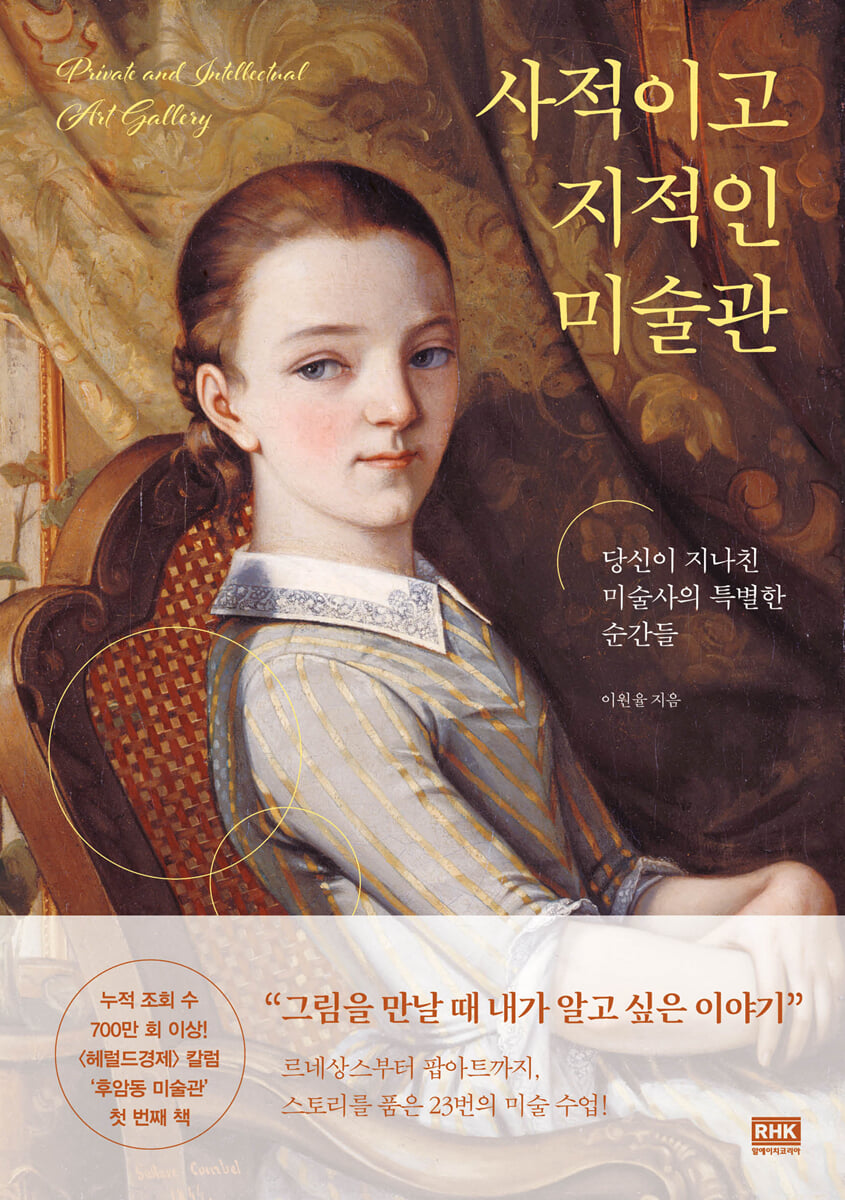
A private and intellectual art museum
 |
Description
Book Introduction
“The story I want to know when I encounter a painting”
From the Renaissance to Pop Art, 23 art classes with a story!
The first book of the Herald Economy's popular column, 'Huam-dong Art Museum'!
"The Lee Kun-hee Collection," "Maurizio Cattelan: WE," "600 Years of Habsburg: Masterpieces of Enchantment"... What do these exhibitions have in common? They were all only accessible through heated "picketing" (a bloody, war-like battle for tickets).
Interest in art, once thought to be fleeting and fleeting, shows no signs of abating.
《Private and Intellectual Art Museum》 is a book for those who want to ride this 'art craze'.
Art movements such as realism, romanticism, expressionism, and surrealism, which are confusing and difficult to understand even after studying, are explained in a storytelling style in an easy and fun way, allowing readers to get closer to the paintings.
This book has accumulated over 7 million views and is the first book in the Herald Economy's most popular column series, 'Huam-dong Art Museum.' Reporter Won-yool Lee has revised and rewritten the 'Theory' section, which opened the series, in response to readers' constant requests to compile the columns into a book.
In the process, the sentences became much richer and the historical facts became clearer after being re-examined.
The author covers a total of 23 movements from the Renaissance to Pop Art, and introduces the works of 23 pioneering artists who can be called the 'fathers' of each movement.
However, it does not stop at a fragmentary interpretation of the artist's representative works, but rather provides a comprehensive view of his life and the characteristics of his movements.
As you read along the table of contents, you will naturally memorize the flow of art styles and no longer be confused about who is your "senior" between Vincent van Gogh and Gustav Klimt.
Of course, you will be able to distinguish between Manet and Monet's paintings.
If you're looking for your first proper art history class, this book is perfect for you.
From the Renaissance to Pop Art, 23 art classes with a story!
The first book of the Herald Economy's popular column, 'Huam-dong Art Museum'!
"The Lee Kun-hee Collection," "Maurizio Cattelan: WE," "600 Years of Habsburg: Masterpieces of Enchantment"... What do these exhibitions have in common? They were all only accessible through heated "picketing" (a bloody, war-like battle for tickets).
Interest in art, once thought to be fleeting and fleeting, shows no signs of abating.
《Private and Intellectual Art Museum》 is a book for those who want to ride this 'art craze'.
Art movements such as realism, romanticism, expressionism, and surrealism, which are confusing and difficult to understand even after studying, are explained in a storytelling style in an easy and fun way, allowing readers to get closer to the paintings.
This book has accumulated over 7 million views and is the first book in the Herald Economy's most popular column series, 'Huam-dong Art Museum.' Reporter Won-yool Lee has revised and rewritten the 'Theory' section, which opened the series, in response to readers' constant requests to compile the columns into a book.
In the process, the sentences became much richer and the historical facts became clearer after being re-examined.
The author covers a total of 23 movements from the Renaissance to Pop Art, and introduces the works of 23 pioneering artists who can be called the 'fathers' of each movement.
However, it does not stop at a fragmentary interpretation of the artist's representative works, but rather provides a comprehensive view of his life and the characteristics of his movements.
As you read along the table of contents, you will naturally memorize the flow of art styles and no longer be confused about who is your "senior" between Vincent van Gogh and Gustav Klimt.
Of course, you will be able to distinguish between Manet and Monet's paintings.
If you're looking for your first proper art history class, this book is perfect for you.
- You can preview some of the book's contents.
Preview
index
prolog
Part 1: From the Renaissance to Impressionism
1.
"There are angels who cry like humans?" The first painter with human eyes
Renaissance Pioneer: Giotto di Bondone
2.
It's not a wall, it's a painting! The 3D scent of a 600-year-old painting.
Pioneer of Perspective: Masaccio
3.
Is it a wedding or an engagement? What matters is the seal!
Oil painting pioneer: Jan van Eyck
4.
Is this artist who made even Red Velvet dance, really the son of the devil?
Pioneer of Surrealism: Hieronymus Bosch
5.
Pretty blonde woman, whose head are you cutting?
Baroque pioneer: Caravaggio
6.
Leave the heavy stories behind on this elegant and beautiful island of love!
Rococo Pioneer: Jean-Antoine Watteau
7.
A man chosen by his time.
I wonder what the truth is!
Neoclassical pioneer: Jacques-Louis David
8.
"Was that thing on the raft really human?" The passionate romance of drifting
Romantic Pioneer: Théodore Géricault
9.
"An angel? Bring me one and I'll draw it for you." The most arrogant man in France.
Pioneer of Realism: Gustave Courbet
10.
"Am I a Merchant Who Will Become a Painter?" A Fact We Didn't Know About Joseon's Face
Special Edition on Realism: Yun Du-seo
11.
Why are you staring at this naked woman?
Pioneer of Impressionism⑴: Édouard Manet
12.
This painting, which was criticized for being “all about show without any skills,” is worth 390 billion won?
Pioneer of Impressionism⑵: Claude Monet
Part 2: From Neo-Impressionism to Pop Art
13.
New possibilities in art created with millions of dots
Pioneer of Neo-Impressionism: Georges Seurat
14.
Van Gogh's favorite work? It's not "Starry Night" or "Sunflowers," but "These People."
Expressionist Pioneer: Vincent van Gogh
15.
The world was turned upside down because of this 'apple'? Why on earth?
Pioneer of Modern Painting: Paul Cézanne
16.
The true identity of the "Thinking Man"—and his secrets.
Pioneer of Modern Sculpture: Auguste Rodin
17.
Who is the protagonist of this passionate kiss that shines golden?
Secessionist Pioneer: Gustav Klimt
18.
This jungle feels like something I've seen somewhere, but in fact, I saw it in a dream!
Pioneer of Modern Surrealism: Henri Rousseau
19.
This woman got Hulk-colored skin because of that damn husband!
Pioneer of Fauvism: Henri Matisse
20.
A handsome law professor who puts music on canvas
Pioneer of Abstract Painting ⑴: Wassily Kandinsky
21.
“I can draw this too!” No, I’ll probably run away while drawing it?
Pioneer of Abstract Painting⑵: Pieter Mondrian
22.
Isn't that spaghetti noodles? The painting sold for 131.5 billion won, and the shocking reason for it.
Action Painting Pioneer: Jackson Pollock
23.
A toned bodybuilder strikes a questionable pose while holding a giant lollipop.
Pop Art Pioneer: Richard Hamilton
Epilogue
References
Part 1: From the Renaissance to Impressionism
1.
"There are angels who cry like humans?" The first painter with human eyes
Renaissance Pioneer: Giotto di Bondone
2.
It's not a wall, it's a painting! The 3D scent of a 600-year-old painting.
Pioneer of Perspective: Masaccio
3.
Is it a wedding or an engagement? What matters is the seal!
Oil painting pioneer: Jan van Eyck
4.
Is this artist who made even Red Velvet dance, really the son of the devil?
Pioneer of Surrealism: Hieronymus Bosch
5.
Pretty blonde woman, whose head are you cutting?
Baroque pioneer: Caravaggio
6.
Leave the heavy stories behind on this elegant and beautiful island of love!
Rococo Pioneer: Jean-Antoine Watteau
7.
A man chosen by his time.
I wonder what the truth is!
Neoclassical pioneer: Jacques-Louis David
8.
"Was that thing on the raft really human?" The passionate romance of drifting
Romantic Pioneer: Théodore Géricault
9.
"An angel? Bring me one and I'll draw it for you." The most arrogant man in France.
Pioneer of Realism: Gustave Courbet
10.
"Am I a Merchant Who Will Become a Painter?" A Fact We Didn't Know About Joseon's Face
Special Edition on Realism: Yun Du-seo
11.
Why are you staring at this naked woman?
Pioneer of Impressionism⑴: Édouard Manet
12.
This painting, which was criticized for being “all about show without any skills,” is worth 390 billion won?
Pioneer of Impressionism⑵: Claude Monet
Part 2: From Neo-Impressionism to Pop Art
13.
New possibilities in art created with millions of dots
Pioneer of Neo-Impressionism: Georges Seurat
14.
Van Gogh's favorite work? It's not "Starry Night" or "Sunflowers," but "These People."
Expressionist Pioneer: Vincent van Gogh
15.
The world was turned upside down because of this 'apple'? Why on earth?
Pioneer of Modern Painting: Paul Cézanne
16.
The true identity of the "Thinking Man"—and his secrets.
Pioneer of Modern Sculpture: Auguste Rodin
17.
Who is the protagonist of this passionate kiss that shines golden?
Secessionist Pioneer: Gustav Klimt
18.
This jungle feels like something I've seen somewhere, but in fact, I saw it in a dream!
Pioneer of Modern Surrealism: Henri Rousseau
19.
This woman got Hulk-colored skin because of that damn husband!
Pioneer of Fauvism: Henri Matisse
20.
A handsome law professor who puts music on canvas
Pioneer of Abstract Painting ⑴: Wassily Kandinsky
21.
“I can draw this too!” No, I’ll probably run away while drawing it?
Pioneer of Abstract Painting⑵: Pieter Mondrian
22.
Isn't that spaghetti noodles? The painting sold for 131.5 billion won, and the shocking reason for it.
Action Painting Pioneer: Jackson Pollock
23.
A toned bodybuilder strikes a questionable pose while holding a giant lollipop.
Pop Art Pioneer: Richard Hamilton
Epilogue
References
Detailed image

Into the book
The goal of this book is to lead every reader to the mania stage.
To this end, we did not stop at fragmentary interpretations of famous paintings or fragmentary introductions to the stories of the popular artists who created them.
An organic interpretation of the most groundbreaking paintings that changed history, a relentless pursuit of the most innovative artists who shook up the times.
Through this, the flow of art history and the beauty of each movement are woven together in an easy-to-understand way.
So that you can look at an era by looking at one work.
For those who are just beginning to study art, I hope this book will serve as a "perfect first art history class," and for those who want to learn more about art beyond a moderate level, I hope this book will serve as a "proper first art history class."
---From "Prologue | 10p."
So what were the themes of medieval art? It's no exaggeration to say that it was almost entirely centered on Christian teachings.
“Atonement.
Fight and resist evil.
Otherwise, the only place you will go is hell, and that hell is a place like this.” The boss must have wanted to teach this with his painting.
Especially at a time when Europeans were dying in droves every day from wars, epidemics, and natural disasters.
Many people believed that the end of the world, which did not come in 1000, would come around 1500.
The boss had to tell them the horrors of hell faster and more effectively.
I had no choice but to use shock therapy.
He must have had a strong desire to resonate deeply with and educate humanity, which is full of original sin.
---「4.
From "Pioneer of Surrealism: Hieronymus Bosch | 80p."
Bateau was the founder of 18th-century Rococo art.
Rococo art is a style characterized by elegance and ornate decoration.
A representative genre is 'Fête Galante', derived from 'Pilgrimage to Cythera'.
The main subjects include elegantly dressed men and women, poses whispering love, a leisurely background resembling a rural landscape, and delicate and luxurious props.
This is still the most common painting style seen in antique shops.
The most intuitive expression of Rococo art is probably the saying, “It never rains in the garden of Bateau.”
That means it was just that bright, light, and playful.
---「6.
From "Rococo Pioneer: Jean-Antoine Watteau | 117p."
Courbet considered the neoclassicism and romanticism that were popular at the time to be hypocritical.
Courbet believed that painters should capture the 'real world' rather than 'their own world'.
Neoclassicism aims to “re-study the classical styles of ancient Greek and Roman culture!”
Romanticism aimed for “more dreamy, more dramatic!”
They may look quite different, but they have something in common.
It's like catching a cloud in the sky.
Painters who believed that the two styles were the answer also brought back mythological and historical paintings from the Renaissance of the 14th to 16th centuries.
They compete to see who can draw more tragically.
The painting was repeated to become holy again.
---「9.
From "Pioneer of Realism: Gustave Courbet | 179p."
He is a painter who opened the door to neo-impressionism with his unique pointillist technique.
Pointillism is a technique of painting by applying countless dots of pure color paint.
It's not about 'painting' with a brush, it's about 'stamping'.
This is a method that emerged after much thought to overcome the limitations of impressionism.
At that time, impressionist painters tried to sensually capture the impression of a moment that changed from moment to moment depending on the light.
The key was to capture that light, that moment, that scene.
For example, when drawing an apple, I didn't paint it in the usual red color.
I tried to paint the apple with colors that would look different depending on the brightness and angle of the light shining on it.
Apples could be orange, blue, or black.
But they soon hit a wall.
The more light is mixed, the brighter it becomes.
Painters mix various paints to follow the light, but the problem is that light and paint have different properties.
Unlike light, paints become cloudy as they are mixed.
It's become so dull that I don't want to look at it.
“How can we express all the light in the world as it is with paint?” was a major topic of discussion among the Impressionist painters.
---「13.
From "Pioneer of Neo-Impressionism: Georges Seurat | 253p."
Cézanne is not satisfied with the liberation of color.
In his view, Impressionism was a movement that had stopped midway on its path.
Cézanne thought that the Impressionists were obsessed with the colors of objects and neglected their forms.
For Cezanne, the forms of objects were as varied as their colors.
If light changed the color of an object, the direction and angle of view changed the shape of the object.
For example, apples do not always appear round.
Depending on how you look at it, the apple can appear flat or wide.
---「15.
From "Pioneer of Modern Painting: Paul Cézanne | 296p."
It is said that Rousseau, who was at the height of his artistic career, was once involved in a fraud case and was put on trial.
The conversation Rousseau had with the judge at that time is interesting.
"Your Honor! If I'm found guilty, it's not me who's going to suffer the most." "What do you mean? Then who's going to suffer the most?" "Art.
“Art itself will suffer!” It is also interesting that his words later turned out to be somewhat true.
Rousseau contributed to expanding the stage of painting from reality to fantasy, and further from a scene in the past or present to another dimension or a point in the future.
Moreover, the geometric compositions seen in Rousseau's surrealist paintings influenced Cubism and abstract painting, and the simplified forms even influenced pop art.
---「18.
From "Pioneer of Modern Surrealism: Henri Rousseau | 374p."
Pop Art is an abbreviation for popular art.
Hamilton gave rise to the term pop art.
Do you see the lollipop being held by the muscular man in Hamilton's work? The word "POP" is clearly written on it.
Art critic Lawrence Alloway saw this and called the work pop art.
The core of pop art is 'popularity', and its materials are popular culture such as advertisements, press photos, movies, and comics.
The agony of creation is also less.
If it looks good, just cut it out with scissors and use it.
You can get the same material in bulk.
Advertisements, posters, etc. will continue to appear as soon as they are printed.
If you put your mind to it, you can print infinitely.
It was a groundbreaking attempt for that time.
It showed me that art can be just fun, and that creative work doesn't have to be spent locked up in a room and hanging on for years.
It also proves that art can easily blossom from everyday materials that are both wonderful and vulgar, sometimes even seeming vulgar.
In this regard, Hamilton also claims that “there is no hierarchy between Elvis Presley and Picasso.”
In the first place, in the realm of art, it means that there is no distinction between who is good and who is bad.
To this end, we did not stop at fragmentary interpretations of famous paintings or fragmentary introductions to the stories of the popular artists who created them.
An organic interpretation of the most groundbreaking paintings that changed history, a relentless pursuit of the most innovative artists who shook up the times.
Through this, the flow of art history and the beauty of each movement are woven together in an easy-to-understand way.
So that you can look at an era by looking at one work.
For those who are just beginning to study art, I hope this book will serve as a "perfect first art history class," and for those who want to learn more about art beyond a moderate level, I hope this book will serve as a "proper first art history class."
---From "Prologue | 10p."
So what were the themes of medieval art? It's no exaggeration to say that it was almost entirely centered on Christian teachings.
“Atonement.
Fight and resist evil.
Otherwise, the only place you will go is hell, and that hell is a place like this.” The boss must have wanted to teach this with his painting.
Especially at a time when Europeans were dying in droves every day from wars, epidemics, and natural disasters.
Many people believed that the end of the world, which did not come in 1000, would come around 1500.
The boss had to tell them the horrors of hell faster and more effectively.
I had no choice but to use shock therapy.
He must have had a strong desire to resonate deeply with and educate humanity, which is full of original sin.
---「4.
From "Pioneer of Surrealism: Hieronymus Bosch | 80p."
Bateau was the founder of 18th-century Rococo art.
Rococo art is a style characterized by elegance and ornate decoration.
A representative genre is 'Fête Galante', derived from 'Pilgrimage to Cythera'.
The main subjects include elegantly dressed men and women, poses whispering love, a leisurely background resembling a rural landscape, and delicate and luxurious props.
This is still the most common painting style seen in antique shops.
The most intuitive expression of Rococo art is probably the saying, “It never rains in the garden of Bateau.”
That means it was just that bright, light, and playful.
---「6.
From "Rococo Pioneer: Jean-Antoine Watteau | 117p."
Courbet considered the neoclassicism and romanticism that were popular at the time to be hypocritical.
Courbet believed that painters should capture the 'real world' rather than 'their own world'.
Neoclassicism aims to “re-study the classical styles of ancient Greek and Roman culture!”
Romanticism aimed for “more dreamy, more dramatic!”
They may look quite different, but they have something in common.
It's like catching a cloud in the sky.
Painters who believed that the two styles were the answer also brought back mythological and historical paintings from the Renaissance of the 14th to 16th centuries.
They compete to see who can draw more tragically.
The painting was repeated to become holy again.
---「9.
From "Pioneer of Realism: Gustave Courbet | 179p."
He is a painter who opened the door to neo-impressionism with his unique pointillist technique.
Pointillism is a technique of painting by applying countless dots of pure color paint.
It's not about 'painting' with a brush, it's about 'stamping'.
This is a method that emerged after much thought to overcome the limitations of impressionism.
At that time, impressionist painters tried to sensually capture the impression of a moment that changed from moment to moment depending on the light.
The key was to capture that light, that moment, that scene.
For example, when drawing an apple, I didn't paint it in the usual red color.
I tried to paint the apple with colors that would look different depending on the brightness and angle of the light shining on it.
Apples could be orange, blue, or black.
But they soon hit a wall.
The more light is mixed, the brighter it becomes.
Painters mix various paints to follow the light, but the problem is that light and paint have different properties.
Unlike light, paints become cloudy as they are mixed.
It's become so dull that I don't want to look at it.
“How can we express all the light in the world as it is with paint?” was a major topic of discussion among the Impressionist painters.
---「13.
From "Pioneer of Neo-Impressionism: Georges Seurat | 253p."
Cézanne is not satisfied with the liberation of color.
In his view, Impressionism was a movement that had stopped midway on its path.
Cézanne thought that the Impressionists were obsessed with the colors of objects and neglected their forms.
For Cezanne, the forms of objects were as varied as their colors.
If light changed the color of an object, the direction and angle of view changed the shape of the object.
For example, apples do not always appear round.
Depending on how you look at it, the apple can appear flat or wide.
---「15.
From "Pioneer of Modern Painting: Paul Cézanne | 296p."
It is said that Rousseau, who was at the height of his artistic career, was once involved in a fraud case and was put on trial.
The conversation Rousseau had with the judge at that time is interesting.
"Your Honor! If I'm found guilty, it's not me who's going to suffer the most." "What do you mean? Then who's going to suffer the most?" "Art.
“Art itself will suffer!” It is also interesting that his words later turned out to be somewhat true.
Rousseau contributed to expanding the stage of painting from reality to fantasy, and further from a scene in the past or present to another dimension or a point in the future.
Moreover, the geometric compositions seen in Rousseau's surrealist paintings influenced Cubism and abstract painting, and the simplified forms even influenced pop art.
---「18.
From "Pioneer of Modern Surrealism: Henri Rousseau | 374p."
Pop Art is an abbreviation for popular art.
Hamilton gave rise to the term pop art.
Do you see the lollipop being held by the muscular man in Hamilton's work? The word "POP" is clearly written on it.
Art critic Lawrence Alloway saw this and called the work pop art.
The core of pop art is 'popularity', and its materials are popular culture such as advertisements, press photos, movies, and comics.
The agony of creation is also less.
If it looks good, just cut it out with scissors and use it.
You can get the same material in bulk.
Advertisements, posters, etc. will continue to appear as soon as they are printed.
If you put your mind to it, you can print infinitely.
It was a groundbreaking attempt for that time.
It showed me that art can be just fun, and that creative work doesn't have to be spent locked up in a room and hanging on for years.
It also proves that art can easily blossom from everyday materials that are both wonderful and vulgar, sometimes even seeming vulgar.
In this regard, Hamilton also claims that “there is no hierarchy between Elvis Presley and Picasso.”
In the first place, in the realm of art, it means that there is no distinction between who is good and who is bad.
---「23.
From "Pop Art Pioneer: Richard Hamilton | 458p."
From "Pop Art Pioneer: Richard Hamilton | 458p."
Publisher's Review
23 Art Stories to Enhance Your Life's Resolution
A love letter for fans and beyond.
Why do we need art? Why are more and more people going to exhibitions and becoming interested in art? It's just useless knowledge, with no practical application in life.
Won-Yul Lee, author of 『Private and Intellectual Art Museum』, often answers questions like this with the phrase, “Art is about increasing the resolution of life,” borrowing from the saying, “Study is about increasing the resolution of the world.”
After being exposed to the Rococo style, I was able to look at more moments with richer emotions, such as when browsing European antique shops, when watching a sunrise by the sea after studying Impressionism, and when looking at the fluttering stars and swaying wheat fields after understanding Expressionism.
It means that scenes from everyday life that we could have just passed by can become moments that touch our hearts, and that our lives can become richer because of them.
This is the moment when art acquires new value.
This may be the reason why many people want to create at least one ‘picture of their own’ in life.
There is a term called 'Stendhal Syndrome'.
It refers to the feeling of being captivated by a great work of art.
Won-Yul Lee, who is also a reporter for the Herald Economy, became engrossed in art after seeing Vermeer's "Girl with a Pearl Earring," which he encountered as if by fate.
It would not be an exaggeration to compare it to the Stendhal Syndrome, as a reporter who had worked in the social and political departments started writing about art without any particular reason.
Since then, the author has been writing about art for a full 10 years, and this book is the result of those 10 years.
This is why he called this book, which he completed after starting from a one-sided love, his 'love letter' to art.
Perhaps you, too, have a crush on art? But are you finding it hard to connect with it, and are just lamenting it? If so, I highly recommend reading this book.
This is because the author, who understands better than anyone else the position of someone who started studying with only a love for art, provides a stepping stone for advancing from an art lover to an art enthusiast.
Historical paintings become my own personal paintings!
Time to meet the immortal painters
Who is the subject of Klimt's "The Kiss," the world's most famous kiss? Who was the artist who forced the master Picasso to forgo participation in the Salon? Where did the word "Pop" in Pop Art originate? This book reveals fascinating, previously unknown behind-the-scenes stories about artists and works we're familiar with.
In addition, the explanation is not limited to the artist's major works or famous works.
Rather than stopping at fragmentary commentary or fragmented, interest-driven stories, it also offers organic interpretations of the most groundbreaking paintings that changed history, and persistently pursues the most innovative artists who shook up the times.
This is a part that fully demonstrates the tenacity and meticulousness of a reporter from the social affairs department.
Masaccio, the first painter to experiment with perspective in his paintings, said, “My paintings were like life.
“I captured the movements, passion, and soul of the characters,” he confessed.
As he said, this book also contains the lives, souls, passion, and perseverance of artists who left an indelible mark on art history.
What we can expect from this book is not just simple art knowledge.
Emotions such as hope, courage, dreams, and passion will naturally follow knowledge.
The author emphasizes that although the pioneers of each art movement had different personalities and lived in different environments, they had one thing in common.
It is the ‘unbreakable heart.’
None of them ever gave up, even when their work was criticized and ridiculed, and even when those around them turned their backs on them.
As we read through the kind of "art history of struggle" waged by these masters, it feels like we hear a voice encouraging us, living in the modern era, to push forward with our convictions, whatever they may be, as long as we have self-confidence.
When I discover a part of a painting with such historical significance that touches my life, that painting becomes a 'personal painting.'
Let's find more 'my own drawings' through this book.
A world with a different resolution than before will unfold.
A love letter for fans and beyond.
Why do we need art? Why are more and more people going to exhibitions and becoming interested in art? It's just useless knowledge, with no practical application in life.
Won-Yul Lee, author of 『Private and Intellectual Art Museum』, often answers questions like this with the phrase, “Art is about increasing the resolution of life,” borrowing from the saying, “Study is about increasing the resolution of the world.”
After being exposed to the Rococo style, I was able to look at more moments with richer emotions, such as when browsing European antique shops, when watching a sunrise by the sea after studying Impressionism, and when looking at the fluttering stars and swaying wheat fields after understanding Expressionism.
It means that scenes from everyday life that we could have just passed by can become moments that touch our hearts, and that our lives can become richer because of them.
This is the moment when art acquires new value.
This may be the reason why many people want to create at least one ‘picture of their own’ in life.
There is a term called 'Stendhal Syndrome'.
It refers to the feeling of being captivated by a great work of art.
Won-Yul Lee, who is also a reporter for the Herald Economy, became engrossed in art after seeing Vermeer's "Girl with a Pearl Earring," which he encountered as if by fate.
It would not be an exaggeration to compare it to the Stendhal Syndrome, as a reporter who had worked in the social and political departments started writing about art without any particular reason.
Since then, the author has been writing about art for a full 10 years, and this book is the result of those 10 years.
This is why he called this book, which he completed after starting from a one-sided love, his 'love letter' to art.
Perhaps you, too, have a crush on art? But are you finding it hard to connect with it, and are just lamenting it? If so, I highly recommend reading this book.
This is because the author, who understands better than anyone else the position of someone who started studying with only a love for art, provides a stepping stone for advancing from an art lover to an art enthusiast.
Historical paintings become my own personal paintings!
Time to meet the immortal painters
Who is the subject of Klimt's "The Kiss," the world's most famous kiss? Who was the artist who forced the master Picasso to forgo participation in the Salon? Where did the word "Pop" in Pop Art originate? This book reveals fascinating, previously unknown behind-the-scenes stories about artists and works we're familiar with.
In addition, the explanation is not limited to the artist's major works or famous works.
Rather than stopping at fragmentary commentary or fragmented, interest-driven stories, it also offers organic interpretations of the most groundbreaking paintings that changed history, and persistently pursues the most innovative artists who shook up the times.
This is a part that fully demonstrates the tenacity and meticulousness of a reporter from the social affairs department.
Masaccio, the first painter to experiment with perspective in his paintings, said, “My paintings were like life.
“I captured the movements, passion, and soul of the characters,” he confessed.
As he said, this book also contains the lives, souls, passion, and perseverance of artists who left an indelible mark on art history.
What we can expect from this book is not just simple art knowledge.
Emotions such as hope, courage, dreams, and passion will naturally follow knowledge.
The author emphasizes that although the pioneers of each art movement had different personalities and lived in different environments, they had one thing in common.
It is the ‘unbreakable heart.’
None of them ever gave up, even when their work was criticized and ridiculed, and even when those around them turned their backs on them.
As we read through the kind of "art history of struggle" waged by these masters, it feels like we hear a voice encouraging us, living in the modern era, to push forward with our convictions, whatever they may be, as long as we have self-confidence.
When I discover a part of a painting with such historical significance that touches my life, that painting becomes a 'personal painting.'
Let's find more 'my own drawings' through this book.
A world with a different resolution than before will unfold.
GOODS SPECIFICS
- Date of issue: June 30, 2023
- Page count, weight, size: 480 pages | 788g | 148*210*25mm
- ISBN13: 9788925576367
- ISBN10: 8925576368
You may also like
카테고리
korean


korean

![GQ KOREA Mark (Monthly): December [2025]](http://librairie.coreenne.fr/cdn/shop/files/8ef265dbbfbf186523ed75ba7319009d.jpg?v=1765340328&width=3840)


