

Read Greek and Roman mythology in one night
 |
Description
Book Introduction
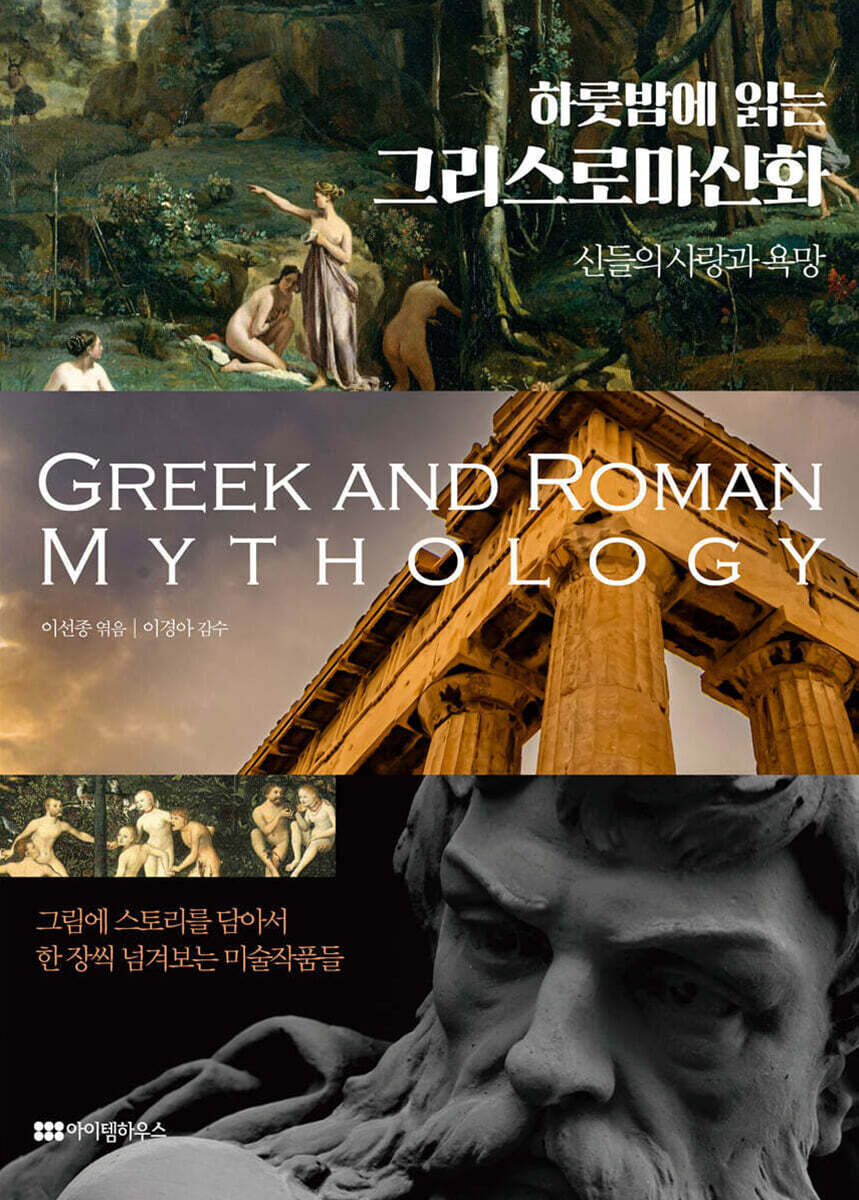
This book uses the works of Ovid (43 BC - 17 AD, ancient Roman poet) and Virgil (70 BC - 19 BC, ancient Roman poet) as text, but uses the names of Greek gods, which are more familiar and widely used, rather than the unfamiliar names of Roman gods.
The stories of the Greek and Roman gods are presented in a more systematic and clear manner through a basic chronological arrangement of the mythological stories and a thematic overview, and care has been taken to select each of the approximately 200 visual and tactile artworks.
Therefore, I hope that readers will enjoy the dynamic nature of the mythical story and the vividness of the magnificent paintings while reading this book.
The stories of the Greek and Roman gods are presented in a more systematic and clear manner through a basic chronological arrangement of the mythological stories and a thematic overview, and care has been taken to select each of the approximately 200 visual and tactile artworks.
Therefore, I hope that readers will enjoy the dynamic nature of the mythical story and the vividness of the magnificent paintings while reading this book.
- You can preview some of the book's contents.
Preview
index
Introduction / Greek and Roman Mythology: The Living and Breathing Archetypes of Western Civilization
|Part 1| The Age of Chaos
Chaos
Formation of the Earth
Golden Age
Silver Age
Bronze Age and Iron Age
Gigantomachia
Olympus Conference
King Lycaon transformed into a wolf
The great flood that destroys humanity
Deucalion and Pyrrha
Apollo defeating Python
Apollo and Daphne
Zeus and Io
Syrinx and Pan
Argos with peacock pattern
Phaethon driving the sun chariot
|Part 2| The Age of the Gods
The Transformation of Heliades and Cycnos
Callisto and Zeus
The history of crow feathers turning black
Okiro, which has become a topic of conversation
Old Man Batos Turned to Stone
Hermes and Herse
Zeus and Europa
|Part 3| The Age of Madness
Cadmus's construction of Thebes
Artemis and Actaeon
Zeus and Semele
Tiresias, who experienced both
Narcissus
Pentheus, who did not believe in God
|Part 4| The Age of Greed
Daughters of Minias
Pyramus and Thisbe
The Secret Meeting of Aphrodite and Ares
Leucothoe and Clytie
Salmacis and Hermaphroditus
Athamas, Ino, and Tisiphone
Perseus and Atlas
Andromeda and the sea monster Keto
medusa
Phineus's rebellion
|Part 5| The Age of Humiliation
Pyrenees, who tormented the Muses
The kidnapping of Persephone
Arethusa transformed into a spring
|Part 6| The Age of Retribution
Athena and Arachne
The Destruction of Niobe
Lycian farmers turned into frogs
Marsyas's Contest
Pelops' shoulder
The Revenge of Procne and Philomela
The Marriage of Boreas, God of the North Wind
|Part 7| The Age of Heroes
Argo Expedition
Jason and Medea
Aison's Rejuvenation
Pelias' Hope and Death
Media's Escape
Theseus, the hero of Athens
Minos and Aeacus
Plague of Aegina
Cephalus and Procris
|Part 8| The Age of Man
Nisus and Scylla
Minotaur
Daedalus and Icarus
Calydonian Boar Hunt
Philemon and Baucis
Erisichthon
|Part 9| The Hero's Song
Hercules' Choice
The Twelve Labors of Hercules
Hercules becomes a slave
Hercules becomes a god
Orpheus and Eurydice
Apollo and Hyacinthus
Pygmalion
Mirra and Kiniras
Aphrodite and Adonis
Atalanta and Hippomenes
The Death of Adonis
The Death of Orpheus
|Part 10| The Age of Transformation
Glaucus and Scylla
Biblis, who became a well
Iphis and Ianthe
Cakes and Alcyone
Acis and Galatea
Dryope turned into a poplar
The Hand of Midas
[supplement]
Comparison Table of Greek and Roman Gods
Family Tree of the Primordial Gods
Family Tree of the Twelve Titans
Family Tree of the Twelve Olympian Gods
|Part 1| The Age of Chaos
Chaos
Formation of the Earth
Golden Age
Silver Age
Bronze Age and Iron Age
Gigantomachia
Olympus Conference
King Lycaon transformed into a wolf
The great flood that destroys humanity
Deucalion and Pyrrha
Apollo defeating Python
Apollo and Daphne
Zeus and Io
Syrinx and Pan
Argos with peacock pattern
Phaethon driving the sun chariot
|Part 2| The Age of the Gods
The Transformation of Heliades and Cycnos
Callisto and Zeus
The history of crow feathers turning black
Okiro, which has become a topic of conversation
Old Man Batos Turned to Stone
Hermes and Herse
Zeus and Europa
|Part 3| The Age of Madness
Cadmus's construction of Thebes
Artemis and Actaeon
Zeus and Semele
Tiresias, who experienced both
Narcissus
Pentheus, who did not believe in God
|Part 4| The Age of Greed
Daughters of Minias
Pyramus and Thisbe
The Secret Meeting of Aphrodite and Ares
Leucothoe and Clytie
Salmacis and Hermaphroditus
Athamas, Ino, and Tisiphone
Perseus and Atlas
Andromeda and the sea monster Keto
medusa
Phineus's rebellion
|Part 5| The Age of Humiliation
Pyrenees, who tormented the Muses
The kidnapping of Persephone
Arethusa transformed into a spring
|Part 6| The Age of Retribution
Athena and Arachne
The Destruction of Niobe
Lycian farmers turned into frogs
Marsyas's Contest
Pelops' shoulder
The Revenge of Procne and Philomela
The Marriage of Boreas, God of the North Wind
|Part 7| The Age of Heroes
Argo Expedition
Jason and Medea
Aison's Rejuvenation
Pelias' Hope and Death
Media's Escape
Theseus, the hero of Athens
Minos and Aeacus
Plague of Aegina
Cephalus and Procris
|Part 8| The Age of Man
Nisus and Scylla
Minotaur
Daedalus and Icarus
Calydonian Boar Hunt
Philemon and Baucis
Erisichthon
|Part 9| The Hero's Song
Hercules' Choice
The Twelve Labors of Hercules
Hercules becomes a slave
Hercules becomes a god
Orpheus and Eurydice
Apollo and Hyacinthus
Pygmalion
Mirra and Kiniras
Aphrodite and Adonis
Atalanta and Hippomenes
The Death of Adonis
The Death of Orpheus
|Part 10| The Age of Transformation
Glaucus and Scylla
Biblis, who became a well
Iphis and Ianthe
Cakes and Alcyone
Acis and Galatea
Dryope turned into a poplar
The Hand of Midas
[supplement]
Comparison Table of Greek and Roman Gods
Family Tree of the Primordial Gods
Family Tree of the Twelve Titans
Family Tree of the Twelve Olympian Gods
Detailed image
Publisher's Review
The archetype of Western civilization is alive and breathing
Greek and Roman mythology
The simplest way to approach a myth is to look at its subject.
In the broadest sense, myths are traditional stories about gods, kings, heroes, etc.
Myths are often associated with the creation of the world, and sometimes with its future destruction.
Myths tell us how the gods created humans, describe the relationships between various gods and humans, and provide moral codes by which humans should live.
And it deals with the life of a hero who represents the ideals of society.
In short, myths primarily deal with important aspects of human and superhuman beings.
Greek and Roman mythology constitutes the richest and most fertile collection of stories in Western culture, aside from the Bible, and its basic threads are deeply rooted in the character of the Greeks.
The Greeks believed that since death was inevitable, life should be cherished and lived fiercely.
For Homer, for example, death was a gloomy state, but life itself was dangerous, tense, and glorious.
The idea that death was inevitable, whether for ordinary people or for great heroes, did not grieve the Greeks any more than it did the Mesopotamian scribes who recorded the Epic of Gilgamesh.
Rather, the Greeks responded enthusiastically.
They believed that the only answer to death was to carve an immortal legend through grand deeds.
Thus the Greeks pursued fame with astonishing energy for five centuries, from Homer to Alexander the Great.
They were a tough, restless, ambitious, hard-working and imaginative race.
Moreover, the Greeks' extraordinary desire for honor led them to seek a reputation that transcended death, for they were also ardent and vengeful.
The story of the Greeks richly displays all these characteristics.
The gods of Olympus faithfully reflected these characteristics of the Greeks; they were quarrelsome and unforgiving gods who enjoyed war, feasting, and fornication.
They were always depicted in human form, revealing beautiful and powerful bodies.
Therefore, they were not only humanly understandable, but also very pleasing to the eye.
The Greeks greatly admired strength, beauty, and intelligence.
Moreover, for them, the measure of all things was none other than man, and for this reason Greek mythology has a strong humanistic color.
Few mythologies have produced as many heroes as Greek mythology.
This was a very natural outcome, given the Greeks' tendency to pursue immortal fame.
Heroes tend to be adventurers and warriors.
Bold, experienced, fierce, strong, and often clever.
Their achievements far surpass those of ordinary mankind.
But they also have serious flaws that sometimes ruin them.
For example, flaws such as excessive pride, impatience, and cruelty arise from great ambition.
Greek heroes had strong ambitions, sometimes yearning for god-like power.
As excellent models of humanity, they provided a standard for Greek youth to emulate.
The legend of the tragic dynasty illustrates this duality.
For example, the royalty of Crete, Mycenae, Thebes, and Athens suffered from their own particular flaws: arrogance in power, ruthlessness in revenge, stubbornness in pursuing certain goals, and sexual conflicts.
No race understood more clearly than the Greeks how character determines destiny, or how our achievements can stem from sources as sinful as our own.
Ultimately, the ancient Greeks achieved the lasting fame they so passionately pursued.
And their myths have shaped the mainstream of Western art and literature for well over two thousand years.
This book uses the works of Ovid (43 BC - 17 AD, ancient Roman poet) and Virgil (70 BC - 19 BC, ancient Roman poet) as text, but uses the names of Greek gods, which are more familiar and widely used, rather than the unfamiliar names of Roman gods.
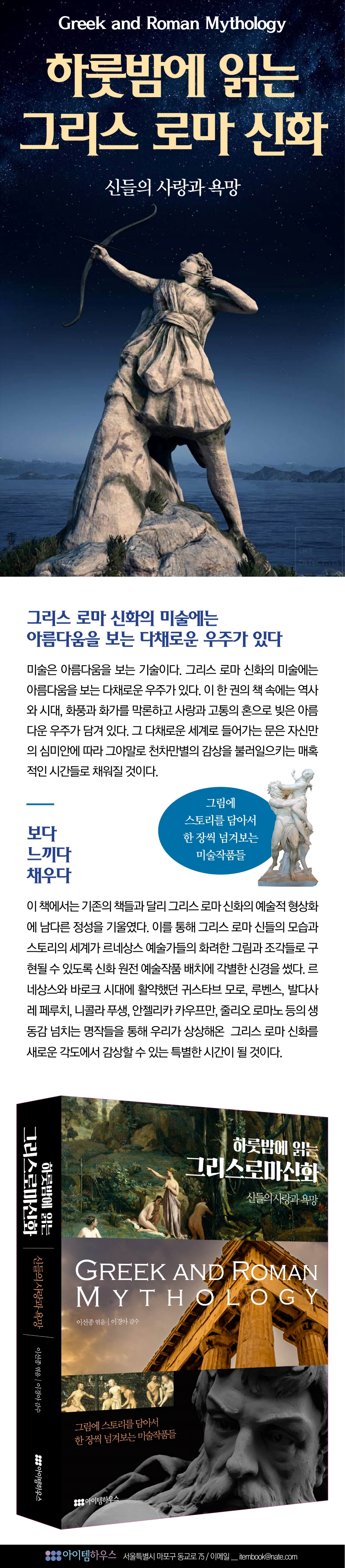
The stories of the Greek and Roman gods are presented in a more systematic and clear manner through a basic chronological arrangement of the mythological stories and a thematic overview, and care has been taken to select each of the approximately 200 visual and tactile artworks.
Therefore, I hope that readers will enjoy the dynamic nature of the mythical story and the vividness of the magnificent paintings while reading this book.
Greek and Roman mythology
The simplest way to approach a myth is to look at its subject.
In the broadest sense, myths are traditional stories about gods, kings, heroes, etc.
Myths are often associated with the creation of the world, and sometimes with its future destruction.
Myths tell us how the gods created humans, describe the relationships between various gods and humans, and provide moral codes by which humans should live.
And it deals with the life of a hero who represents the ideals of society.
In short, myths primarily deal with important aspects of human and superhuman beings.
Greek and Roman mythology constitutes the richest and most fertile collection of stories in Western culture, aside from the Bible, and its basic threads are deeply rooted in the character of the Greeks.
The Greeks believed that since death was inevitable, life should be cherished and lived fiercely.
For Homer, for example, death was a gloomy state, but life itself was dangerous, tense, and glorious.
The idea that death was inevitable, whether for ordinary people or for great heroes, did not grieve the Greeks any more than it did the Mesopotamian scribes who recorded the Epic of Gilgamesh.
Rather, the Greeks responded enthusiastically.
They believed that the only answer to death was to carve an immortal legend through grand deeds.
Thus the Greeks pursued fame with astonishing energy for five centuries, from Homer to Alexander the Great.
They were a tough, restless, ambitious, hard-working and imaginative race.
Moreover, the Greeks' extraordinary desire for honor led them to seek a reputation that transcended death, for they were also ardent and vengeful.
The story of the Greeks richly displays all these characteristics.
The gods of Olympus faithfully reflected these characteristics of the Greeks; they were quarrelsome and unforgiving gods who enjoyed war, feasting, and fornication.
They were always depicted in human form, revealing beautiful and powerful bodies.
Therefore, they were not only humanly understandable, but also very pleasing to the eye.
The Greeks greatly admired strength, beauty, and intelligence.
Moreover, for them, the measure of all things was none other than man, and for this reason Greek mythology has a strong humanistic color.
Few mythologies have produced as many heroes as Greek mythology.
This was a very natural outcome, given the Greeks' tendency to pursue immortal fame.
Heroes tend to be adventurers and warriors.
Bold, experienced, fierce, strong, and often clever.
Their achievements far surpass those of ordinary mankind.
But they also have serious flaws that sometimes ruin them.
For example, flaws such as excessive pride, impatience, and cruelty arise from great ambition.
Greek heroes had strong ambitions, sometimes yearning for god-like power.
As excellent models of humanity, they provided a standard for Greek youth to emulate.
The legend of the tragic dynasty illustrates this duality.
For example, the royalty of Crete, Mycenae, Thebes, and Athens suffered from their own particular flaws: arrogance in power, ruthlessness in revenge, stubbornness in pursuing certain goals, and sexual conflicts.
No race understood more clearly than the Greeks how character determines destiny, or how our achievements can stem from sources as sinful as our own.
Ultimately, the ancient Greeks achieved the lasting fame they so passionately pursued.
And their myths have shaped the mainstream of Western art and literature for well over two thousand years.
This book uses the works of Ovid (43 BC - 17 AD, ancient Roman poet) and Virgil (70 BC - 19 BC, ancient Roman poet) as text, but uses the names of Greek gods, which are more familiar and widely used, rather than the unfamiliar names of Roman gods.
The stories of the Greek and Roman gods are presented in a more systematic and clear manner through a basic chronological arrangement of the mythological stories and a thematic overview, and care has been taken to select each of the approximately 200 visual and tactile artworks.
Therefore, I hope that readers will enjoy the dynamic nature of the mythical story and the vividness of the magnificent paintings while reading this book.
GOODS SPECIFICS
- Date of issue: May 20, 2023
- Page count, weight, size: 520 pages | 154*215*35mm
- ISBN13: 9791157771653
- ISBN10: 1157771653
You may also like
카테고리
korean


korean

![GQ KOREA Mark (Monthly): December [2025]](http://librairie.coreenne.fr/cdn/shop/files/8ef265dbbfbf186523ed75ba7319009d.jpg?v=1765340328&width=3840)


