

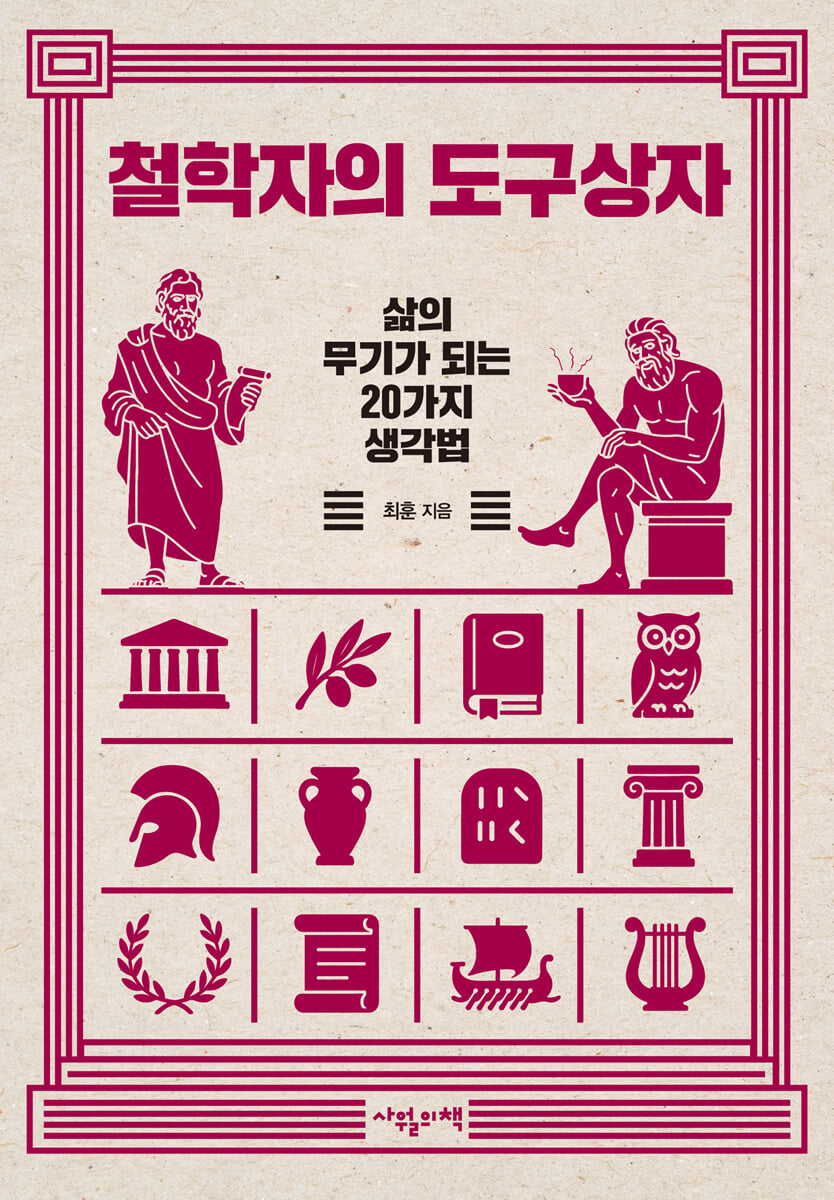
The Philosopher's Toolbox
 |
Description
Book Introduction
What are the tools of thought that philosophers use?
From Socrates' method of questioning to the method of reductio ad absurdum
From 'Slippery Slope' to 'Occam's Razor'
Is philosophy merely a difficult and abstract discipline? The thinking tools philosophers use are weapons for everyday life, readily available to us.
This book provides a "toolbox" of philosophers' approaches to problem solving, allowing readers to draw upon them and apply them directly.
Just as you need a hammer and a saw to build a house, your thoughts need tools.
This book goes beyond simply skimming the history of philosophy—the history of argument and logic—and puts the strategies and techniques philosophers actually employ in our hands.
In an age of fake news and distorted information, the tools of philosophy serve as a compass for discerning right from wrong.
The book features 20 thinking tools, ranging from Socrates' method of questioning and answer to thought experiments, the law of abduction, counterexamples and falsifications, the slippery slope, and Occam's razor.
By following common questions like “If the ground is wet, does it mean it rained?” and “If something is natural, is it right?”, we can see that philosophy is not just an abstract discourse, but a practical “way of thinking” that can be applied to debates, discussions, and decision-making right now.
At the end of each chapter, there is a "Philosophy Practice" section using actual exam questions, allowing readers to practice their own thinking.
The essence of philosophy lies in 'argumentation', which establishes and examines the basis for an argument.
Therefore, studying philosophy is not simply about memorizing what great philosophers argued.
To truly study philosophy, you must understand the argument behind the claims.
In math, it's like knowing the answer but not practicing the solution process, so it's useless.
This book is a practical, accessible guide to philosophy that can be used by anyone, from those new to philosophy to those seeking to develop their logical thinking skills.
From Socrates' method of questioning to the method of reductio ad absurdum
From 'Slippery Slope' to 'Occam's Razor'
Is philosophy merely a difficult and abstract discipline? The thinking tools philosophers use are weapons for everyday life, readily available to us.
This book provides a "toolbox" of philosophers' approaches to problem solving, allowing readers to draw upon them and apply them directly.
Just as you need a hammer and a saw to build a house, your thoughts need tools.
This book goes beyond simply skimming the history of philosophy—the history of argument and logic—and puts the strategies and techniques philosophers actually employ in our hands.
In an age of fake news and distorted information, the tools of philosophy serve as a compass for discerning right from wrong.
The book features 20 thinking tools, ranging from Socrates' method of questioning and answer to thought experiments, the law of abduction, counterexamples and falsifications, the slippery slope, and Occam's razor.
By following common questions like “If the ground is wet, does it mean it rained?” and “If something is natural, is it right?”, we can see that philosophy is not just an abstract discourse, but a practical “way of thinking” that can be applied to debates, discussions, and decision-making right now.
At the end of each chapter, there is a "Philosophy Practice" section using actual exam questions, allowing readers to practice their own thinking.
The essence of philosophy lies in 'argumentation', which establishes and examines the basis for an argument.
Therefore, studying philosophy is not simply about memorizing what great philosophers argued.
To truly study philosophy, you must understand the argument behind the claims.
In math, it's like knowing the answer but not practicing the solution process, so it's useless.
This book is a practical, accessible guide to philosophy that can be used by anyone, from those new to philosophy to those seeking to develop their logical thinking skills.
- You can preview some of the book's contents.
Preview
index
1. Getting Started: How Do Philosophers Think Differently from Scientists?
Part 1: The Philosopher's Way of Thinking
2. Incidents vs. Arguments
3 meetings
4 Common sense or intuition
5 Concept Analysis
6 Socrates' method of questioning
7 Thought Experiments
8 Naturalism
9 Reflective Equilibrium
10 Uses of the History of Philosophy
Part 2: The Philosopher's Argument
11. Fallacy of asking a prerequisite question
12. Law of Absurdity
13 Counterexamples and counterevidence
14 Slippery slope
15 Yubi
16 Consistency
17 Dilemma
18 Occam's Razor: The Principle of Simplicity
19 Ambiguous words
20 Inference to the Best Explanation
21 Deduction and Induction
Part 1: The Philosopher's Way of Thinking
2. Incidents vs. Arguments
3 meetings
4 Common sense or intuition
5 Concept Analysis
6 Socrates' method of questioning
7 Thought Experiments
8 Naturalism
9 Reflective Equilibrium
10 Uses of the History of Philosophy
Part 2: The Philosopher's Argument
11. Fallacy of asking a prerequisite question
12. Law of Absurdity
13 Counterexamples and counterevidence
14 Slippery slope
15 Yubi
16 Consistency
17 Dilemma
18 Occam's Razor: The Principle of Simplicity
19 Ambiguous words
20 Inference to the Best Explanation
21 Deduction and Induction
Into the book
There is something to note here.
First, since an argument consists of a claim and the evidence supporting it, you should not look at the claim alone.
But many people only look at what the philosopher argued.
If you look at a book that claims to introduce the humanities in an easy way, it lists the arguments that philosophers have made.
Reading this is not a study of philosophy at all.
Studying philosophy is studying the basis on which philosophers arrived at their claims.
What good is it to study math if you only know the answers without practicing the solution process?
--- p.22
Socrates' method of questioning is a method of making the other person realize their ignorance by following the other person's beliefs or claims and reaching a contradiction (aporia).
However, Socrates himself does not present his own definition of ‘piety’.
In that respect, Socrates' method of questioning can be considered as nothing more than a negative and destructive method.
At first glance, that seems correct.
However, it can also be seen as a constructive and productive method in that it reveals the other person's assumptions and makes them reflect on them.
--- p.75
If you take your first step on a slippery slope, you will slide all the way to the bottom.
Similarly, when the term slippery slope is used as an argument, it is used to show that a small thing allowed can lead to a chain reaction that leads to a very bad result.
Even very minor things can be tolerated.
But if we allow it, we are allowing something extremely serious, and in the end, we will end up with results that are simply difficult to accept.
Therefore, even the smallest thing should not be tolerated in the first place.
The slippery slope argument is used for this purpose.
--- p.171
Let's say you see a twinkling light in the night sky.
There are two possible explanations for what that identity is.
One is described as an airplane or satellite, the other as a UFO (unidentified flying object).
The explanatory power of the two assumptions is equal.
Even if we assume it is an airplane or a satellite, the flashing lights are explained, and even if we assume it is a UFO, the flashing lights are explained.
Which explanation is more plausible?
First, since an argument consists of a claim and the evidence supporting it, you should not look at the claim alone.
But many people only look at what the philosopher argued.
If you look at a book that claims to introduce the humanities in an easy way, it lists the arguments that philosophers have made.
Reading this is not a study of philosophy at all.
Studying philosophy is studying the basis on which philosophers arrived at their claims.
What good is it to study math if you only know the answers without practicing the solution process?
--- p.22
Socrates' method of questioning is a method of making the other person realize their ignorance by following the other person's beliefs or claims and reaching a contradiction (aporia).
However, Socrates himself does not present his own definition of ‘piety’.
In that respect, Socrates' method of questioning can be considered as nothing more than a negative and destructive method.
At first glance, that seems correct.
However, it can also be seen as a constructive and productive method in that it reveals the other person's assumptions and makes them reflect on them.
--- p.75
If you take your first step on a slippery slope, you will slide all the way to the bottom.
Similarly, when the term slippery slope is used as an argument, it is used to show that a small thing allowed can lead to a chain reaction that leads to a very bad result.
Even very minor things can be tolerated.
But if we allow it, we are allowing something extremely serious, and in the end, we will end up with results that are simply difficult to accept.
Therefore, even the smallest thing should not be tolerated in the first place.
The slippery slope argument is used for this purpose.
--- p.171
Let's say you see a twinkling light in the night sky.
There are two possible explanations for what that identity is.
One is described as an airplane or satellite, the other as a UFO (unidentified flying object).
The explanatory power of the two assumptions is equal.
Even if we assume it is an airplane or a satellite, the flashing lights are explained, and even if we assume it is a UFO, the flashing lights are explained.
Which explanation is more plausible?
--- p.225
Publisher's Review
■ What are the tools of thought that philosophers use?
From Socrates' method of questioning to the method of reductio ad absurdum
From 'Slippery Slope' to 'Occam's Razor'
Is philosophy merely a difficult and abstract discipline? The thinking tools philosophers use are weapons for everyday life, readily available to us.
"The Philosopher's Toolbox: 20 Ways of Thinking That Will Become Weapons for Life" provides a "toolbox" of philosophers' approaches to problem solving, guiding readers to use them themselves.
Just as you need a hammer and a saw to build a house, your thoughts need tools.
This book goes beyond simply skimming the history of philosophy—the history of argument and logic—and puts the strategies and techniques philosophers actually employ in our hands.
In an age of fake news and distorted information, the tools of philosophy serve as a compass for discerning right from wrong.
The book features 20 thinking tools, ranging from Socrates' method of questioning and answer to thought experiments, the law of abduction, counterexamples and falsifications, the slippery slope, and Occam's razor.
By following common questions like “If the ground is wet, does it mean it rained?” and “If something is natural, is it right?”, we can see that philosophy is not just an abstract discourse, but a practical “way of thinking” that can be applied to debates, discussions, and decision-making right now.
At the end of each chapter, there is a "Philosophy Practice" section using actual exam questions, allowing readers to practice their own thinking.
The essence of philosophy lies in 'argumentation', which establishes and examines the basis for an argument.
Therefore, studying philosophy is not simply about memorizing what great philosophers argued.
To truly study philosophy, you must understand the argument behind the claims.
In math, it's like knowing the answer but not practicing the solution process, so it's useless.
"The Philosopher's Toolbox" is a practical, accessible philosophy book for everyone, from those new to philosophy to those seeking to solidify their logical thinking skills.
■ How do philosophers think differently from scientists?
The Philosopher's Toolbox begins with the question, "How do philosophers think differently from scientists?"
It is often said that philosophers speculate.
Unlike scientists who present evidence through observation and experimentation, philosophers reason and develop logic in their heads.
But being a philosopher doesn't mean you just throw out any random idea.
When a philosopher makes a claim, he or she must provide evidence and justify it, and other philosophers continue the philosophical discussion by pointing out the flaws in the argument.
At this time, philosophers develop arguments using unique thinking tools such as 'skepticism', 'reflective equilibrium', 'thought experiments', 'conceptual analysis', and 'naturalism'.
For example, a thought experiment is a process of setting up a hypothetical situation and examining it logically.
Descartes' "omnipotent demon" and Putnam's "brain in a vat" are philosophical devices that show that we can even doubt the knowledge we believe we know for sure.
In these thought experiments, philosophers deconstruct existing common sense and examine the foundations of knowledge.
Just as nuclear power plants are designed to account for earthquakes that may occur only once in a thousand years, philosophers test truth by setting up extreme situations that are unlikely to occur.
■ In the age of fake news, thinking becomes a weapon for life.
Today, the tools of philosophical thought are more urgently needed than ever.
In an age where fake news and distorted information are commonplace, we must discern for ourselves what is valid and what is flawed logic.
Without the mental training to examine the evidence and expose the flaws in logic, it is difficult to even defend one's own thoughts.
One of the philosopher's thinking tools that can be utilized in this situation is 'concept analysis'.
We often justify claims by saying things are “natural” or “normal,” but philosophers break these concepts down and ask whether the underlying assumptions are valid.
By doing so, we can break free from thinking based on vague intuition or common sense, and transform ambiguous language into clear arguments.
Another example is 'reflective equilibrium', which means not believing that the principles you have are absolutely right, but 'reflecting' on them and trying to achieve 'equilibrium' with reality.
You could say that it's a balancing act between principles and reality.
It is a thinking tool that makes judgments flexible and sophisticated in a complex reality.
The 'law of reductio ad absurdum' exposes the contradiction that arises when you take the other person's words at face value and push that result through to the end.
Excellent at spotting flawed logic.
It can be used particularly effectively when critically examining false claims in online media.
Another example is the 'slippery slope' argument.
As the saying goes, “A needle thief becomes a cattle thief,” it is used to show that allowing something very trivial can lead to a chain reaction that can lead to very bad results.
Philosophical thinking training helps us discern when slippery slope arguments are valid and when they are merely warnings, propaganda, or fallacies.
In this way, the philosopher's tools of thought are not abstract discourses, but weapons of thought that can be practically used in everyday life.
The Philosopher's Toolbox uses these tools to clarify ambiguous language, find a balance between principle and reality, and cultivate the power to discern flawed logic and errors.
From Socrates' method of questioning to the method of reductio ad absurdum
From 'Slippery Slope' to 'Occam's Razor'
Is philosophy merely a difficult and abstract discipline? The thinking tools philosophers use are weapons for everyday life, readily available to us.
"The Philosopher's Toolbox: 20 Ways of Thinking That Will Become Weapons for Life" provides a "toolbox" of philosophers' approaches to problem solving, guiding readers to use them themselves.
Just as you need a hammer and a saw to build a house, your thoughts need tools.
This book goes beyond simply skimming the history of philosophy—the history of argument and logic—and puts the strategies and techniques philosophers actually employ in our hands.
In an age of fake news and distorted information, the tools of philosophy serve as a compass for discerning right from wrong.
The book features 20 thinking tools, ranging from Socrates' method of questioning and answer to thought experiments, the law of abduction, counterexamples and falsifications, the slippery slope, and Occam's razor.
By following common questions like “If the ground is wet, does it mean it rained?” and “If something is natural, is it right?”, we can see that philosophy is not just an abstract discourse, but a practical “way of thinking” that can be applied to debates, discussions, and decision-making right now.
At the end of each chapter, there is a "Philosophy Practice" section using actual exam questions, allowing readers to practice their own thinking.
The essence of philosophy lies in 'argumentation', which establishes and examines the basis for an argument.
Therefore, studying philosophy is not simply about memorizing what great philosophers argued.
To truly study philosophy, you must understand the argument behind the claims.
In math, it's like knowing the answer but not practicing the solution process, so it's useless.
"The Philosopher's Toolbox" is a practical, accessible philosophy book for everyone, from those new to philosophy to those seeking to solidify their logical thinking skills.
■ How do philosophers think differently from scientists?
The Philosopher's Toolbox begins with the question, "How do philosophers think differently from scientists?"
It is often said that philosophers speculate.
Unlike scientists who present evidence through observation and experimentation, philosophers reason and develop logic in their heads.
But being a philosopher doesn't mean you just throw out any random idea.
When a philosopher makes a claim, he or she must provide evidence and justify it, and other philosophers continue the philosophical discussion by pointing out the flaws in the argument.
At this time, philosophers develop arguments using unique thinking tools such as 'skepticism', 'reflective equilibrium', 'thought experiments', 'conceptual analysis', and 'naturalism'.
For example, a thought experiment is a process of setting up a hypothetical situation and examining it logically.
Descartes' "omnipotent demon" and Putnam's "brain in a vat" are philosophical devices that show that we can even doubt the knowledge we believe we know for sure.
In these thought experiments, philosophers deconstruct existing common sense and examine the foundations of knowledge.
Just as nuclear power plants are designed to account for earthquakes that may occur only once in a thousand years, philosophers test truth by setting up extreme situations that are unlikely to occur.
■ In the age of fake news, thinking becomes a weapon for life.
Today, the tools of philosophical thought are more urgently needed than ever.
In an age where fake news and distorted information are commonplace, we must discern for ourselves what is valid and what is flawed logic.
Without the mental training to examine the evidence and expose the flaws in logic, it is difficult to even defend one's own thoughts.
One of the philosopher's thinking tools that can be utilized in this situation is 'concept analysis'.
We often justify claims by saying things are “natural” or “normal,” but philosophers break these concepts down and ask whether the underlying assumptions are valid.
By doing so, we can break free from thinking based on vague intuition or common sense, and transform ambiguous language into clear arguments.
Another example is 'reflective equilibrium', which means not believing that the principles you have are absolutely right, but 'reflecting' on them and trying to achieve 'equilibrium' with reality.
You could say that it's a balancing act between principles and reality.
It is a thinking tool that makes judgments flexible and sophisticated in a complex reality.
The 'law of reductio ad absurdum' exposes the contradiction that arises when you take the other person's words at face value and push that result through to the end.
Excellent at spotting flawed logic.
It can be used particularly effectively when critically examining false claims in online media.
Another example is the 'slippery slope' argument.
As the saying goes, “A needle thief becomes a cattle thief,” it is used to show that allowing something very trivial can lead to a chain reaction that can lead to very bad results.
Philosophical thinking training helps us discern when slippery slope arguments are valid and when they are merely warnings, propaganda, or fallacies.
In this way, the philosopher's tools of thought are not abstract discourses, but weapons of thought that can be practically used in everyday life.
The Philosopher's Toolbox uses these tools to clarify ambiguous language, find a balance between principle and reality, and cultivate the power to discern flawed logic and errors.
GOODS SPECIFICS
- Date of issue: September 10, 2025
- Format: Paperback book binding method guide
- Page count, weight, size: 280 pages | 146*210*20mm
- ISBN13: 9791192092591
- ISBN10: 1192092597
You may also like
카테고리
korean


korean

![GQ KOREA Mark (Monthly): December [2025]](http://librairie.coreenne.fr/cdn/shop/files/8ef265dbbfbf186523ed75ba7319009d.jpg?v=1765340328&width=3840)


