

Is the IT world that difficult?
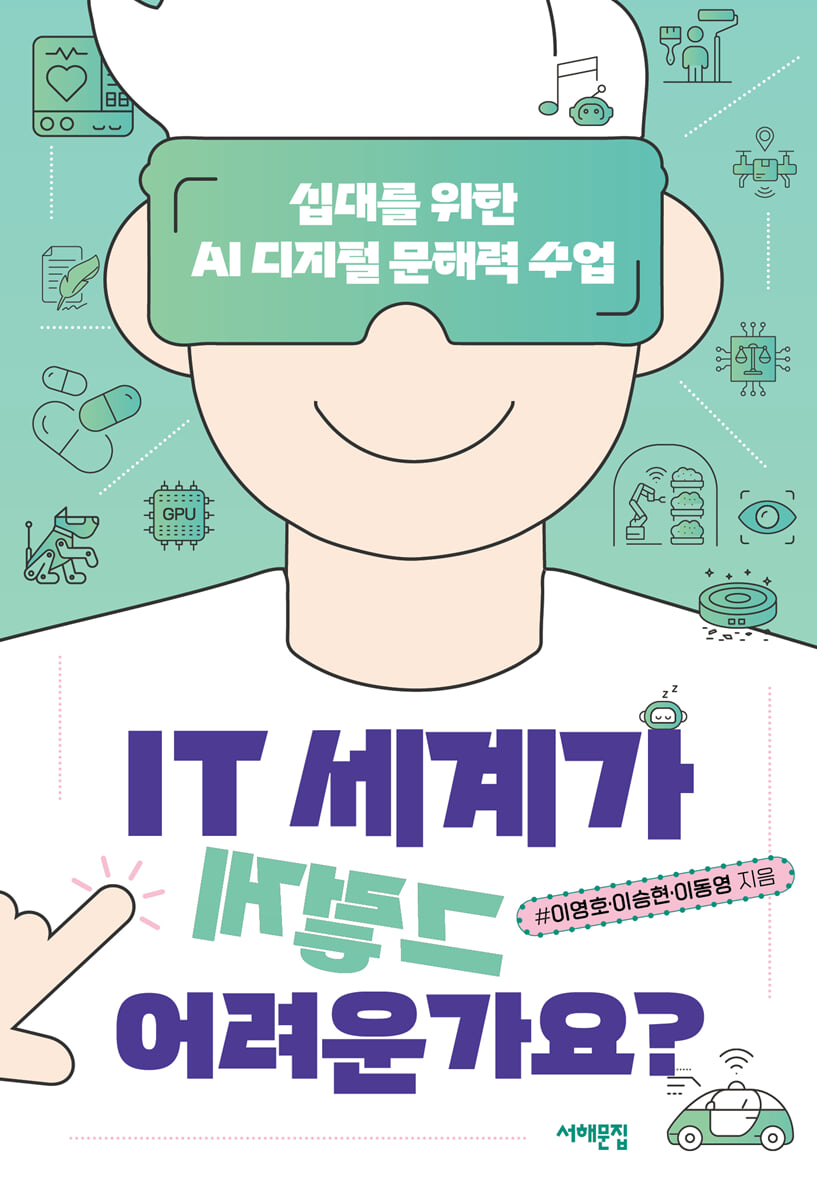 |
Description
Book Introduction
“AI won’t replace people; people who can effectively use AI will replace you.”
From semiconductors to virtual worlds, an IT literacy guide for citizens of the digital world.
As the IT world advances, there are gloomy predictions that artificial intelligence and machines will drive people out of the workplace, while at the same time, there are rosy hopes that humanity, freed from labor and disease, will evolve to a new level.
But the attitude we should have is neither helpless pessimism nor unfounded optimism.
The important thing is to develop digital literacy to read and understand the IT world.
To do that, we need to become close first.
We're talking about the mysterious "alien friends of the IT world" like nanotechnology, qubits, BCI, 6G, generative AI, deep learning, and digital twins.
This book divides the IT world we live in into five topics (computer science, data science, programming, artificial intelligence, and smart infrastructure), and introduces the core of each topic through current affairs news and everyday episodes.
At the end of each episode, four cookies (Relearning, Concept Matching, IT Common Sense, and Sharing Thoughts) will appear in order to guide you through the previously learned pieces of knowledge into digital literacy, a way to view the IT world.
From semiconductors to virtual worlds, an IT literacy guide for citizens of the digital world.
As the IT world advances, there are gloomy predictions that artificial intelligence and machines will drive people out of the workplace, while at the same time, there are rosy hopes that humanity, freed from labor and disease, will evolve to a new level.
But the attitude we should have is neither helpless pessimism nor unfounded optimism.
The important thing is to develop digital literacy to read and understand the IT world.
To do that, we need to become close first.
We're talking about the mysterious "alien friends of the IT world" like nanotechnology, qubits, BCI, 6G, generative AI, deep learning, and digital twins.
This book divides the IT world we live in into five topics (computer science, data science, programming, artificial intelligence, and smart infrastructure), and introduces the core of each topic through current affairs news and everyday episodes.
At the end of each episode, four cookies (Relearning, Concept Matching, IT Common Sense, and Sharing Thoughts) will appear in order to guide you through the previously learned pieces of knowledge into digital literacy, a way to view the IT world.
- You can preview some of the book's contents.
Preview
index
preface
Chapter 1: Computers Made by Man, Worlds Made by Computers: From Semiconductors to Quantum Computers
How NVIDIA Became the World's Leading Company: GPUs and AI
Why Are Semiconductors Getting Smaller? _The Invisible World of Nanoscience
How to solve a problem that would take 10 years in 5 minutes? _Quantum Computer
Infinite possibilities unfolding above the clouds _ Cloud computing
A Computer the Size of a Button? _Evolving Wearable Devices
Find the treasure hidden underground! _Rare Earth Wars
Chapter 2: The World is Made of Data: Data Science, the IT World's Goldmine
The Secrets of YouTube and Coupang: Targeting My Tastes _ Big Data Processing
Why Was TikTok Banned in the US? _Data Sovereignty and Web 3.0
An entire library in 0.1 seconds? _6th generation mobile communications
Sharks Cut Off the Internet? _The Undersea Cable Disruption in West and Central Africa
Internet access even in the desert? _Starlink transforms the world of satellite communications.
Chapter 3: Human-Computer Dialogue: Programming
Connecting for the Physically Disabled: BCI Connects the Brain to Computers
High-performance AI for free? _The world of open source shaken up by DeepSec.
Mining for gold with your computer? _The World of Bitcoin and Digital Currency
A painter who laughs while burning his own work - NFTs and digital art
From Convenient Tool to Trustworthy Companion: The Emergence of AI Assistants
Mirror, Tell Me Where It Hurts! _AI Doctor's Medical Revolution
Terminators Beyond the Screen: AI Weapons and the New Three Laws of Robotics
Chapter 4: Can Highly Advanced Artificial Intelligence Be Distinguished from Humans?: Artificial Intelligence Before the Singularity
People who were suddenly kicked out of their jobs _ The changes in jobs brought about by AI
Spotting Criminals Among Cloud Crowds: The Amazing Evolution of Facial Recognition AI
Rembrandt Releases New Work After 350 Years: How Generative AI Has Transformed the World of Creativity
Turning last night's dream into a novel? _Large Language Model
The Resurrected Voice of a Deceased Singer - Deep Voice and Voice AI
Deepfake technology that you can't believe even if you see it with your own eyes
Your own personal interpreter without the internet _ On-device AI
AI Judges Deciding on Human Disputes: AI and Fairness
Introducing our home robot vacuum cleaner - From a piece of junk to a culmination of IT technology.
Gifting Your Body to Artificial Intelligence: A New Coexistence Between Physical AI and Robots
Robot Dog Funeral: Filling the Void in Our Hearts with AI Companion Robots
Chapter 5: The Convergence of the Real and Virtual Worlds: Smart Infrastructure
You just stay still _Autonomous driving technology
AI Worker in a Dark Factory: Smart Manufacturing and Logistics Systems
Growing Potatoes on Mars? _Agritech and the Future of Agriculture
Medium-rare steak baked with a printer_3D food printing
Woven City and Neom: The Present and Future of Smart Cities
Seoul to Busan in 20 minutes? _Hypertube, an airplane on rails
Air taxis in the sky _ 3D urban air traffic
Another Earth _ Digital Twin
Chapter 1: Computers Made by Man, Worlds Made by Computers: From Semiconductors to Quantum Computers
How NVIDIA Became the World's Leading Company: GPUs and AI
Why Are Semiconductors Getting Smaller? _The Invisible World of Nanoscience
How to solve a problem that would take 10 years in 5 minutes? _Quantum Computer
Infinite possibilities unfolding above the clouds _ Cloud computing
A Computer the Size of a Button? _Evolving Wearable Devices
Find the treasure hidden underground! _Rare Earth Wars
Chapter 2: The World is Made of Data: Data Science, the IT World's Goldmine
The Secrets of YouTube and Coupang: Targeting My Tastes _ Big Data Processing
Why Was TikTok Banned in the US? _Data Sovereignty and Web 3.0
An entire library in 0.1 seconds? _6th generation mobile communications
Sharks Cut Off the Internet? _The Undersea Cable Disruption in West and Central Africa
Internet access even in the desert? _Starlink transforms the world of satellite communications.
Chapter 3: Human-Computer Dialogue: Programming
Connecting for the Physically Disabled: BCI Connects the Brain to Computers
High-performance AI for free? _The world of open source shaken up by DeepSec.
Mining for gold with your computer? _The World of Bitcoin and Digital Currency
A painter who laughs while burning his own work - NFTs and digital art
From Convenient Tool to Trustworthy Companion: The Emergence of AI Assistants
Mirror, Tell Me Where It Hurts! _AI Doctor's Medical Revolution
Terminators Beyond the Screen: AI Weapons and the New Three Laws of Robotics
Chapter 4: Can Highly Advanced Artificial Intelligence Be Distinguished from Humans?: Artificial Intelligence Before the Singularity
People who were suddenly kicked out of their jobs _ The changes in jobs brought about by AI
Spotting Criminals Among Cloud Crowds: The Amazing Evolution of Facial Recognition AI
Rembrandt Releases New Work After 350 Years: How Generative AI Has Transformed the World of Creativity
Turning last night's dream into a novel? _Large Language Model
The Resurrected Voice of a Deceased Singer - Deep Voice and Voice AI
Deepfake technology that you can't believe even if you see it with your own eyes
Your own personal interpreter without the internet _ On-device AI
AI Judges Deciding on Human Disputes: AI and Fairness
Introducing our home robot vacuum cleaner - From a piece of junk to a culmination of IT technology.
Gifting Your Body to Artificial Intelligence: A New Coexistence Between Physical AI and Robots
Robot Dog Funeral: Filling the Void in Our Hearts with AI Companion Robots
Chapter 5: The Convergence of the Real and Virtual Worlds: Smart Infrastructure
You just stay still _Autonomous driving technology
AI Worker in a Dark Factory: Smart Manufacturing and Logistics Systems
Growing Potatoes on Mars? _Agritech and the Future of Agriculture
Medium-rare steak baked with a printer_3D food printing
Woven City and Neom: The Present and Future of Smart Cities
Seoul to Busan in 20 minutes? _Hypertube, an airplane on rails
Air taxis in the sky _ 3D urban air traffic
Another Earth _ Digital Twin
Detailed image

Publisher's Review
“AI is not replacing people,
“Someone who is good at using AI will replace you.”
- 37 IT Knowledge for Citizens of the Digital World
Traveling in the Digital World in 2030
At 6 o'clock in the morning, as soon as I wake up, I stand in front of the mirror.
“Body temperature 36.6℃, blood pressure 70-110, weight, pulse, oxygen saturation, and stress index are all normal.
“Have a healthy day today.” In fact, this is not an ordinary mirror, but an AI doctor named ‘Faceheart’.
It's your own personal doctor who diagnoses your health status in real time.
Thanks to that, I can barely remember visiting the hospital.
The reason I woke up earlier than usual is because I have to catch a flight by 8 o'clock.
My first trip abroad alone.
I have a visual impairment, but I'm not afraid.
Last year, I was able to see the world again thanks to a chip called 'Blindsight' that was implanted in my head.
At 7 a.m., I board a driverless, autonomous village bus.
They'll drop me off at the nearest vertiport, or air taxi stand.
The airport is 50 kilometers away, but don't worry.
Because 10 minutes is enough for an air taxi that runs on the sky with four propellers.
Even at the airport, a smart pass powered by facial recognition AI will take care of all procedures.
No need to take out your passport or wait in line.
As I board the plane, a humanoid flight attendant greets me with a warm voice.
It's been an hour and a half since I opened my eyes at home.
I sit down and try out a wearable computer that looks like a pair of big sunglasses.
As expected, when I log in using facial recognition, the latest episode of the sitcom I watched last night is uploaded.
How did they know my tastes? It's a strange yet scary feeling, but my attention is drawn to the shopping information displayed in the corner of the screen.
Here's some information on how you can buy the backpack you've been eyeing for cheap at your travel destination.
Visit our virtual store, which replicates your local store, to touch and feel the backpacks and then place a purchase reservation.
The foreigner sitting next to me saw my excited expression and spoke to me.
There's no need to panic.
Because we have on-device AI that can translate any language without internet access on each other's smartphones.
As we were chatting, it was already lunchtime.
In-flight meals are prepared using a 3D food printer using food capsules requested in advance by passengers.
I ordered freshly baked toast and hot coffee, and my foreign friend ordered bibimbap.
They say it tastes exactly like the one they had in Jeonju.
After eating, I'm starting to feel sleepy.
After a quick nap, you'll arrive at your destination. What kind of experiences will you have there? I'll organize my experiences and impressions from the morning, store them in the latest ChatGPT-10, and then drift off to a deep sleep.
He is a trustworthy companion who will weave my travels into a documentary called 'A Blind Man's World Journey'.
Becoming Friends with Alien Languages in the IT World
Computer scientist and futurist Ray Kurzweil predicts that the "technological singularity"—the point at which machines surpass human capabilities in all fields—will begin in 2029.
It is said that after the singularity, there will be explosive progress that will make the technological advancements that humanity has achieved so far seem primitive.
In fact, some of the 2030 traveler episodes just introduced have already become reality, and most of the rest are on the verge of being put into practice.
In other words, we live in an IT world surrounded by artificial intelligence and digital technologies that are developing at a rapid pace.
Artificial intelligence and digital technologies are saving people time, providing convenience and entertainment, while also rapidly replacing roles previously performed by humans.
So, on the one hand, there is a gloomy outlook that artificial intelligence and machines will drive people out of work, while on the other hand, there is a rosy hope that humanity, freed from labor and disease, will evolve to a new level.
But the attitude we should have is neither helpless pessimism nor unfounded optimism.
“AI won’t replace you; it’ll be people who can effectively use AI to replace you,” says computer scientist Andrew Ng. As he puts it, the key is developing digital literacy, the ability to read and understand the IT world.
To do that, we need to become close first.
We're talking about those mysterious "alien friends of the IT world" like nanotechnology, qubits, BCI, 6G, generative AI, deep learning, and digital twins.
From rare earth elements to quantum computers
From one bit to another Earth,
IT Literacy for Citizens of the Digital World
This book divides the IT world we live in into five topics (computer science, data science, programming, artificial intelligence, and smart infrastructure), introducing key concepts and terms for each topic through current affairs news and everyday episodes.
You'll learn how Nvidia, one of many computer parts manufacturers, rose to become the world's leading company, what world lies hidden inside increasingly smaller semiconductor chips, and what quantum computers will do (Chapter 1: Computers Made by People, Worlds Made by Computers).
What are the secrets of YouTube and Coupang, which hit my taste, and how the Internet connects the world (Chapter 2: The World is Made of Data).
Furthermore, you will gain insight into the changes that computer programming has brought to the world, starting from a single line of code in a notepad and progressing to the level of connecting the brain and the computer (Chapter 3: Human-Computer Dialogue, Programming).
Finally, we will be able to speculate about the attitude we should have toward cutting-edge AI technologies that threaten human capabilities and positions (Chapter 4: Artificial Intelligence Before the Singularity), and how the technologies introduced above have changed and will change our food, clothing, shelter, and daily lives (Chapter 5: Convergence of Reality and Virtuality, Smart Infrastructure).
The four cookies (Relearning, Concept Matching, IT Common Sense, and Sharing Thoughts) that appear at the end of each episode are devices that expand the previously learned pieces of knowledge into digital literacy, an eye for viewing the IT world.
I hope this will be an opportunity to think about what a better IT world would be like and what a better life would be like in that world.
“Someone who is good at using AI will replace you.”
- 37 IT Knowledge for Citizens of the Digital World
Traveling in the Digital World in 2030
At 6 o'clock in the morning, as soon as I wake up, I stand in front of the mirror.
“Body temperature 36.6℃, blood pressure 70-110, weight, pulse, oxygen saturation, and stress index are all normal.
“Have a healthy day today.” In fact, this is not an ordinary mirror, but an AI doctor named ‘Faceheart’.
It's your own personal doctor who diagnoses your health status in real time.
Thanks to that, I can barely remember visiting the hospital.
The reason I woke up earlier than usual is because I have to catch a flight by 8 o'clock.
My first trip abroad alone.
I have a visual impairment, but I'm not afraid.
Last year, I was able to see the world again thanks to a chip called 'Blindsight' that was implanted in my head.
At 7 a.m., I board a driverless, autonomous village bus.
They'll drop me off at the nearest vertiport, or air taxi stand.
The airport is 50 kilometers away, but don't worry.
Because 10 minutes is enough for an air taxi that runs on the sky with four propellers.
Even at the airport, a smart pass powered by facial recognition AI will take care of all procedures.
No need to take out your passport or wait in line.
As I board the plane, a humanoid flight attendant greets me with a warm voice.
It's been an hour and a half since I opened my eyes at home.
I sit down and try out a wearable computer that looks like a pair of big sunglasses.
As expected, when I log in using facial recognition, the latest episode of the sitcom I watched last night is uploaded.
How did they know my tastes? It's a strange yet scary feeling, but my attention is drawn to the shopping information displayed in the corner of the screen.
Here's some information on how you can buy the backpack you've been eyeing for cheap at your travel destination.
Visit our virtual store, which replicates your local store, to touch and feel the backpacks and then place a purchase reservation.
The foreigner sitting next to me saw my excited expression and spoke to me.
There's no need to panic.
Because we have on-device AI that can translate any language without internet access on each other's smartphones.
As we were chatting, it was already lunchtime.
In-flight meals are prepared using a 3D food printer using food capsules requested in advance by passengers.
I ordered freshly baked toast and hot coffee, and my foreign friend ordered bibimbap.
They say it tastes exactly like the one they had in Jeonju.
After eating, I'm starting to feel sleepy.
After a quick nap, you'll arrive at your destination. What kind of experiences will you have there? I'll organize my experiences and impressions from the morning, store them in the latest ChatGPT-10, and then drift off to a deep sleep.
He is a trustworthy companion who will weave my travels into a documentary called 'A Blind Man's World Journey'.
Becoming Friends with Alien Languages in the IT World
Computer scientist and futurist Ray Kurzweil predicts that the "technological singularity"—the point at which machines surpass human capabilities in all fields—will begin in 2029.
It is said that after the singularity, there will be explosive progress that will make the technological advancements that humanity has achieved so far seem primitive.
In fact, some of the 2030 traveler episodes just introduced have already become reality, and most of the rest are on the verge of being put into practice.
In other words, we live in an IT world surrounded by artificial intelligence and digital technologies that are developing at a rapid pace.
Artificial intelligence and digital technologies are saving people time, providing convenience and entertainment, while also rapidly replacing roles previously performed by humans.
So, on the one hand, there is a gloomy outlook that artificial intelligence and machines will drive people out of work, while on the other hand, there is a rosy hope that humanity, freed from labor and disease, will evolve to a new level.
But the attitude we should have is neither helpless pessimism nor unfounded optimism.
“AI won’t replace you; it’ll be people who can effectively use AI to replace you,” says computer scientist Andrew Ng. As he puts it, the key is developing digital literacy, the ability to read and understand the IT world.
To do that, we need to become close first.
We're talking about those mysterious "alien friends of the IT world" like nanotechnology, qubits, BCI, 6G, generative AI, deep learning, and digital twins.
From rare earth elements to quantum computers
From one bit to another Earth,
IT Literacy for Citizens of the Digital World
This book divides the IT world we live in into five topics (computer science, data science, programming, artificial intelligence, and smart infrastructure), introducing key concepts and terms for each topic through current affairs news and everyday episodes.
You'll learn how Nvidia, one of many computer parts manufacturers, rose to become the world's leading company, what world lies hidden inside increasingly smaller semiconductor chips, and what quantum computers will do (Chapter 1: Computers Made by People, Worlds Made by Computers).
What are the secrets of YouTube and Coupang, which hit my taste, and how the Internet connects the world (Chapter 2: The World is Made of Data).
Furthermore, you will gain insight into the changes that computer programming has brought to the world, starting from a single line of code in a notepad and progressing to the level of connecting the brain and the computer (Chapter 3: Human-Computer Dialogue, Programming).
Finally, we will be able to speculate about the attitude we should have toward cutting-edge AI technologies that threaten human capabilities and positions (Chapter 4: Artificial Intelligence Before the Singularity), and how the technologies introduced above have changed and will change our food, clothing, shelter, and daily lives (Chapter 5: Convergence of Reality and Virtuality, Smart Infrastructure).
The four cookies (Relearning, Concept Matching, IT Common Sense, and Sharing Thoughts) that appear at the end of each episode are devices that expand the previously learned pieces of knowledge into digital literacy, an eye for viewing the IT world.
I hope this will be an opportunity to think about what a better IT world would be like and what a better life would be like in that world.
GOODS SPECIFICS
- Date of issue: August 29, 2025
- Page count, weight, size: 292 pages | 315g | 128*188*17mm
- ISBN13: 9791194413622
- ISBN10: 1194413625
You may also like
카테고리
korean


korean

![GQ KOREA Mark (Monthly): December [2025]](http://librairie.coreenne.fr/cdn/shop/files/8ef265dbbfbf186523ed75ba7319009d.jpg?v=1765340328&width=3840)


