

The most useful dentistry in the world
 |
Description
Book Introduction
The more I know, the more I get sucked in.
Understanding Dentistry Through Fun Questions
A useful study that naturally fills you with 'common sense' and 'history'!
In the Middle Ages, barbers extracted rotten teeth? General anesthesia was discovered in dentistry? Dentures were made from elephant ivory and cadaver teeth? Wars were started because of amalgams? Can you tell someone's identity just by looking at their teeth? This fascinating book, filled with such fascinating questions, allows you to quickly comprehend the entire history of dental treatment, from ancient times to the present.
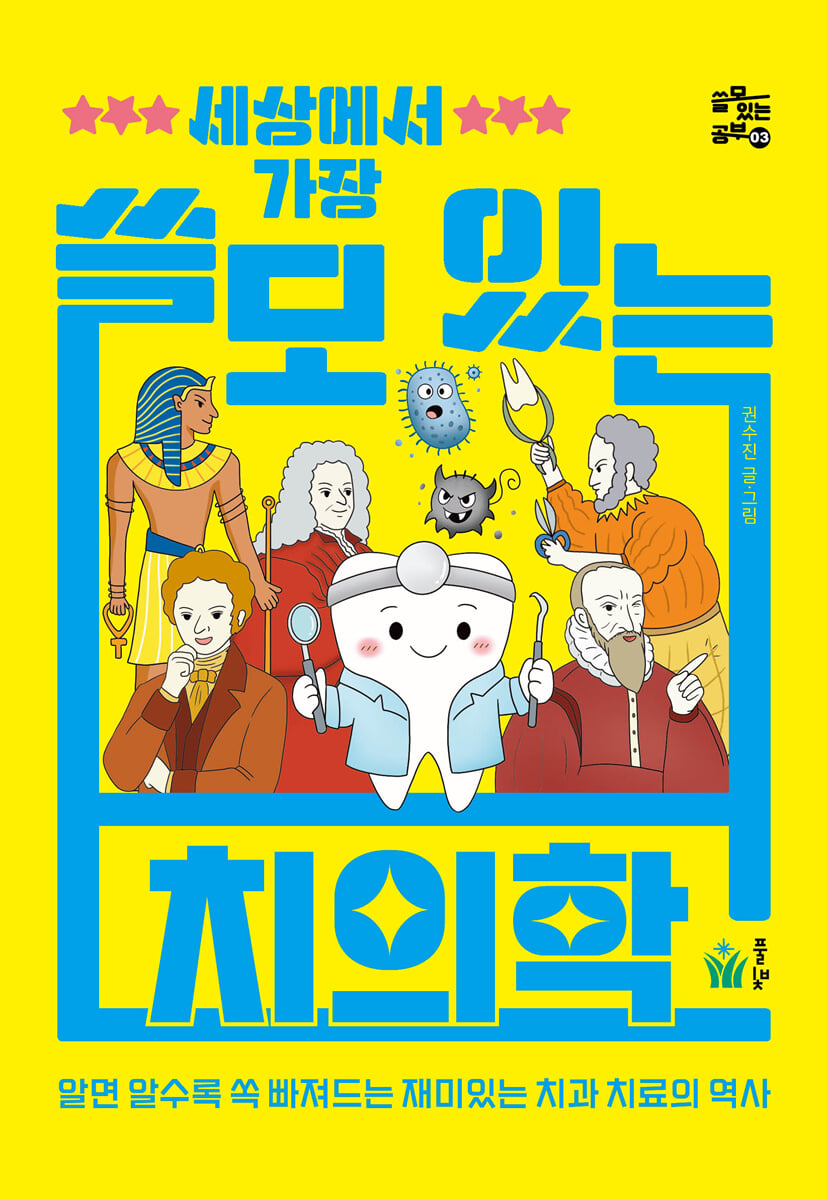
The greatest appeal of "The World's Most Useful Dentistry" is that the author, Sujin Kwon, a dental specialist, has used her expertise to compile "dentistry common sense" and "history" through 24 delightful questions and humorous illustrations, including interesting incidents related to dental treatment, behind-the-scenes stories of famous dentists, and controversies and inventions that have caused a stir in the world.
Not only does this book allow readers to understand how dentistry has transformed human life, but it also incorporates the latest information and issues, fostering a convergent thinking of humanities, science, and medicine. It's also a highly recommended book for exploring career paths in the medical field.
Understanding Dentistry Through Fun Questions
A useful study that naturally fills you with 'common sense' and 'history'!
In the Middle Ages, barbers extracted rotten teeth? General anesthesia was discovered in dentistry? Dentures were made from elephant ivory and cadaver teeth? Wars were started because of amalgams? Can you tell someone's identity just by looking at their teeth? This fascinating book, filled with such fascinating questions, allows you to quickly comprehend the entire history of dental treatment, from ancient times to the present.
The greatest appeal of "The World's Most Useful Dentistry" is that the author, Sujin Kwon, a dental specialist, has used her expertise to compile "dentistry common sense" and "history" through 24 delightful questions and humorous illustrations, including interesting incidents related to dental treatment, behind-the-scenes stories of famous dentists, and controversies and inventions that have caused a stir in the world.
Not only does this book allow readers to understand how dentistry has transformed human life, but it also incorporates the latest information and issues, fostering a convergent thinking of humanities, science, and medicine. It's also a highly recommended book for exploring career paths in the medical field.
- You can preview some of the book's contents.
Preview
index
Prologue: Into the World's Most Fun and Useful Dentistry
1.
Who was the first dentist? _ Hesira
2.
Did the father of medicine also treat teeth? _ Hippocrates
3.
The doctor prescribed, and the barber pulled the tooth? _ Medieval dentist
4.
The 'Father of Surgery' Was Originally a Barber Surgeon? _ Ambroise Pare
5.
Who is the father of modern dentistry? _ Pierre Fauchard
6.
Is Tartar the Main Cause of Periodontal Disease? _ Etienne Bourdet
7.
No more ivory and cadaver teeth! _ The discovery of porcelain teeth
8.
Anyone Could Be a Dentist? _ Colonial America
9.
Who first discovered flossing and the direction of cavity progression? _ Levi Spear-Pamley
10.
When was the world's first dental school founded? _ Eliezer Palmley, Sulliman Brown
11.
When did dental licensing begin? _ A systematic training system
12.
Setting the Standard for Dental Education! _ The Guys Report
13.
The Pros and Cons of Amalgam Use! _ The Dental Amalgam Wars
14.
Did dentures originally have a patent? _ Charles Goodyear's vulcanized rubber patent
15.
Did general anesthesia first appear in dentistry? _ Horace Wells
16.
When was the first painless surgery performed? _ William Morton
17.
What Cavity-Preventing Substance Was Discovered in Mines? _ Frederick Sumner McKay, Trendy Dean
18.
Microbes in your mouth cause cavities? _ Willoughby D.
Miller
19.
Did they experiment with tooth decay by feeding sugar to disabled people? _ Bifeholm tooth decay research
20.
Will Controlling Sugar Reduce Cavities? _ Hopewood House Study
21.
Should I Get an X-ray at the Dentist? _ Edmund Kells
22.
Who established the foundation of reconstructive plastic surgery? _ Barajtad Kazanjian
23.
Can you tell someone's identity just by looking at their teeth? _ The Birth of Forensic Dentistry
24.
The person who developed the implant wasn't a dentist? _ Per Ingvar Brennemark
Epilogue: Finding things that make you fall in love with them the more you know about them
1.
Who was the first dentist? _ Hesira
2.
Did the father of medicine also treat teeth? _ Hippocrates
3.
The doctor prescribed, and the barber pulled the tooth? _ Medieval dentist
4.
The 'Father of Surgery' Was Originally a Barber Surgeon? _ Ambroise Pare
5.
Who is the father of modern dentistry? _ Pierre Fauchard
6.
Is Tartar the Main Cause of Periodontal Disease? _ Etienne Bourdet
7.
No more ivory and cadaver teeth! _ The discovery of porcelain teeth
8.
Anyone Could Be a Dentist? _ Colonial America
9.
Who first discovered flossing and the direction of cavity progression? _ Levi Spear-Pamley
10.
When was the world's first dental school founded? _ Eliezer Palmley, Sulliman Brown
11.
When did dental licensing begin? _ A systematic training system
12.
Setting the Standard for Dental Education! _ The Guys Report
13.
The Pros and Cons of Amalgam Use! _ The Dental Amalgam Wars
14.
Did dentures originally have a patent? _ Charles Goodyear's vulcanized rubber patent
15.
Did general anesthesia first appear in dentistry? _ Horace Wells
16.
When was the first painless surgery performed? _ William Morton
17.
What Cavity-Preventing Substance Was Discovered in Mines? _ Frederick Sumner McKay, Trendy Dean
18.
Microbes in your mouth cause cavities? _ Willoughby D.
Miller
19.
Did they experiment with tooth decay by feeding sugar to disabled people? _ Bifeholm tooth decay research
20.
Will Controlling Sugar Reduce Cavities? _ Hopewood House Study
21.
Should I Get an X-ray at the Dentist? _ Edmund Kells
22.
Who established the foundation of reconstructive plastic surgery? _ Barajtad Kazanjian
23.
Can you tell someone's identity just by looking at their teeth? _ The Birth of Forensic Dentistry
24.
The person who developed the implant wasn't a dentist? _ Per Ingvar Brennemark
Epilogue: Finding things that make you fall in love with them the more you know about them
Detailed image

Into the book
In the 18th century, when a tooth became loose and fell out, 'tooth grafting', which involved transplanting another person's tooth, was common.
Bourdet was one of those who performed the procedure a lot, but the way teeth were obtained at the time was not ethical.
Usually, the teeth of soldiers who died on the battlefield were collected, and were called 'Waterloo teeth'.
However, it was difficult to obtain enough teeth for transplantation using this method alone, so teeth were purchased from people who did not have money, extracted, and transplanted on the spot.
--- From the text “Is tartar the main cause of periodontal disease?: Etienne Bourdet”
If plaque, called 'dental plaque', remains on the surface of the teeth, it becomes a home for bacteria, which has a negative impact on the teeth and gums.
You can clean the surface of your teeth with a toothbrush, but it's difficult to clean between your teeth.
Using dental floss can also prevent diseases such as cavities and gingivitis.
We all know now that not brushing your teeth properly can lead to cavities, right? But in the past, the exact cause of cavities wasn't known.
--- From the text "Who first discovered the direction of dental floss and tooth decay?: Levi Spear Palmley"
At the time, famous dentists said, “Materials containing mercury are harmful to the teeth and all parts of the mouth.”
I believe that we need to prevent unqualified people from indiscriminately administering rechargeable treatments when there is not much theoretical data yet to be reported.
Those who oppose amalgam claim that it is a dangerous material because it is not known how the mercury contained in amalgam will react in the body.
They even called those who used amalgams 'quacks'.
--- From the text “The Pros and Cons of Amalgam Use: The Dental Amalgam Wars”
He performed innovative surgeries on broken jaws and noses of soldiers injured by guns and grenades in the war, and was recognized by many for his dedicated efforts and outstanding skills.
At the time, there were soldiers who suffered injuries from under the eyes to under the chin, and Kazanjian was excellent at arranging and fixing the bone fragments.
When he entered the ward, the wounded would kiss his hand as a sign of respect and gratitude, as he played a major role in the physical and mental recovery of the wounded soldiers through creative methods.
Bourdet was one of those who performed the procedure a lot, but the way teeth were obtained at the time was not ethical.
Usually, the teeth of soldiers who died on the battlefield were collected, and were called 'Waterloo teeth'.
However, it was difficult to obtain enough teeth for transplantation using this method alone, so teeth were purchased from people who did not have money, extracted, and transplanted on the spot.
--- From the text “Is tartar the main cause of periodontal disease?: Etienne Bourdet”
If plaque, called 'dental plaque', remains on the surface of the teeth, it becomes a home for bacteria, which has a negative impact on the teeth and gums.
You can clean the surface of your teeth with a toothbrush, but it's difficult to clean between your teeth.
Using dental floss can also prevent diseases such as cavities and gingivitis.
We all know now that not brushing your teeth properly can lead to cavities, right? But in the past, the exact cause of cavities wasn't known.
--- From the text "Who first discovered the direction of dental floss and tooth decay?: Levi Spear Palmley"
At the time, famous dentists said, “Materials containing mercury are harmful to the teeth and all parts of the mouth.”
I believe that we need to prevent unqualified people from indiscriminately administering rechargeable treatments when there is not much theoretical data yet to be reported.
Those who oppose amalgam claim that it is a dangerous material because it is not known how the mercury contained in amalgam will react in the body.
They even called those who used amalgams 'quacks'.
--- From the text “The Pros and Cons of Amalgam Use: The Dental Amalgam Wars”
He performed innovative surgeries on broken jaws and noses of soldiers injured by guns and grenades in the war, and was recognized by many for his dedicated efforts and outstanding skills.
At the time, there were soldiers who suffered injuries from under the eyes to under the chin, and Kazanjian was excellent at arranging and fixing the bone fragments.
When he entered the ward, the wounded would kiss his hand as a sign of respect and gratitude, as he played a major role in the physical and mental recovery of the wounded soldiers through creative methods.
--- From the text "Why Dentists Are Needed on the Battlefield: Barajtad Kazanjian"
Publisher's Review
The more I know, the more I get sucked in.
Understanding Dentistry Through Fun Questions
A useful study that naturally fills you with 'common sense' and 'history'!
In the Middle Ages, barbers extracted rotten teeth? General anesthesia was discovered in dentistry? Dentures were made from elephant ivory and cadaver teeth? Wars were started because of amalgams? Can you tell someone's identity just by looking at their teeth? This fascinating book, filled with such fascinating questions, allows you to quickly comprehend the entire history of dental treatment, from ancient times to the present.
The greatest appeal of "The World's Most Useful Dentistry" is that the author, Sujin Kwon, a dental specialist, has used her expertise to compile "dentistry common sense" and "history" through 24 delightful questions and humorous illustrations, including interesting incidents related to dental treatment, behind-the-scenes stories of famous dentists, and controversies and inventions that have caused a stir in the world.
Not only does this book allow readers to understand how dentistry has transformed human life, but it also incorporates the latest information and issues, fostering a convergent thinking of humanities, science, and medicine. It's also a highly recommended book for exploring career paths in the medical field.
Satisfying history and medical nerds!
Read the behind-the-scenes stories and accidental discoveries of dentistry.
Human interest in teeth began a long time ago, in ancient times.
However, it took a long time for information about brushing teeth three times a day after meals, scaling, resin, dentures, implants, and orthodontic treatment to become known to the general public.
In the past, it was wrongly believed that if you had a toothache, you could pray to God to heal it or that you could cure it by exposing it to smoke like a smoked dish to get rid of bugs.
In reality, it was the powder from the smoke that fell out of his mouth.
The history of dentistry shows that it had very humble beginnings, with barbers extracting teeth as a side job. However, through the efforts and dedication of countless dentists, it has become a highly complete discipline, and with the addition of 'accidental discoveries', it has made remarkable progress.
Dentistry is not simply the study of treating damaged teeth.
Since the discovery of general anesthesia in dentistry, painless surgery has become possible, and the invention of small, precise films that can X-ray the inside of the mouth has influenced other medical advancements.
Furthermore, dentistry, as the foundational discipline of reconstructive plastic surgery, has helped with the aesthetic and psychological treatment of people whose appearance has changed due to war or accidents, and implant technology has given humanity the gift of second teeth.
In modern times, advances in forensic medicine have helped solve cold cases and excavate remains from accident scenes.
In this way, dentistry is an academic discipline that has developed while breathing alongside us and is 'incredibly useful and valuable to humanity.'
The author becomes a storyteller and tells interesting events, discoveries, and controversies related to dentistry throughout history, from ancient times, the Middle Ages, the Renaissance, and modern times.
If you want to experience dentistry indirectly in advance, are considering a career in dentistry, or are a history or medical nerd, you will enjoy this book.
Meet the 'hidden heroes' of dental advancement!
An unfamiliar but fun 'Humanities + Career' reading
Dentistry is still constantly evolving.
All these developments are thanks to the passionate efforts of countless dentists, including Hippocrates, who performed dental treatment based on the theory of the four humors in ancient times; Ambroise Pare, who transplanted the teeth of a maid into the place of a princess's missing front teeth; Pierre Fauchard, who orthodontically aligned the teeth of a twelve-year-old girl; Levi Spear-Pamley, who discovered dental floss and the direction of caries progression; Horace Wells, who successfully performed general anesthesia with laughing gas; Barajdad Kazandian, who treated soldiers on the battlefields of World War I; Edmund Kells, who made and experimented with dental X-ray film and was exposed to radiation, which eventually led to the amputation of one of his hands; and Per Ingvar Brenemark, who successfully performed dental implants.
This book will help you discover the footsteps of unsung heroes who, by immersing themselves deeply in what they love, not only achieved personal success, but also transformed the lives of humanity.
This type of humanities + career reading provides an experience that ignites curiosity and a passion for exploration about new fields of study and careers.
Among the readers of this book, there will be some who dream of becoming a dentist, and some who don't.
Some of you may have started reading it because you were curious about the topic, while others may have read it because someone recommended it to them.
No matter how you first encountered this book, I hope you enjoyed it.
And I hope that this book will be a starting point for you to look back on the history of other fields of study and develop an interest in those fields.
There is no such thing as a job that just appears in this world.
There are often moments when studying feels tedious and tiresome. If the path to your dreams feels like a long, dark tunnel, I hope this book will serve as a helpful guide.
_ From "Epilogue"
Understanding Dentistry Through Fun Questions
A useful study that naturally fills you with 'common sense' and 'history'!
In the Middle Ages, barbers extracted rotten teeth? General anesthesia was discovered in dentistry? Dentures were made from elephant ivory and cadaver teeth? Wars were started because of amalgams? Can you tell someone's identity just by looking at their teeth? This fascinating book, filled with such fascinating questions, allows you to quickly comprehend the entire history of dental treatment, from ancient times to the present.
The greatest appeal of "The World's Most Useful Dentistry" is that the author, Sujin Kwon, a dental specialist, has used her expertise to compile "dentistry common sense" and "history" through 24 delightful questions and humorous illustrations, including interesting incidents related to dental treatment, behind-the-scenes stories of famous dentists, and controversies and inventions that have caused a stir in the world.
Not only does this book allow readers to understand how dentistry has transformed human life, but it also incorporates the latest information and issues, fostering a convergent thinking of humanities, science, and medicine. It's also a highly recommended book for exploring career paths in the medical field.
Satisfying history and medical nerds!
Read the behind-the-scenes stories and accidental discoveries of dentistry.
Human interest in teeth began a long time ago, in ancient times.
However, it took a long time for information about brushing teeth three times a day after meals, scaling, resin, dentures, implants, and orthodontic treatment to become known to the general public.
In the past, it was wrongly believed that if you had a toothache, you could pray to God to heal it or that you could cure it by exposing it to smoke like a smoked dish to get rid of bugs.
In reality, it was the powder from the smoke that fell out of his mouth.
The history of dentistry shows that it had very humble beginnings, with barbers extracting teeth as a side job. However, through the efforts and dedication of countless dentists, it has become a highly complete discipline, and with the addition of 'accidental discoveries', it has made remarkable progress.
Dentistry is not simply the study of treating damaged teeth.
Since the discovery of general anesthesia in dentistry, painless surgery has become possible, and the invention of small, precise films that can X-ray the inside of the mouth has influenced other medical advancements.
Furthermore, dentistry, as the foundational discipline of reconstructive plastic surgery, has helped with the aesthetic and psychological treatment of people whose appearance has changed due to war or accidents, and implant technology has given humanity the gift of second teeth.
In modern times, advances in forensic medicine have helped solve cold cases and excavate remains from accident scenes.
In this way, dentistry is an academic discipline that has developed while breathing alongside us and is 'incredibly useful and valuable to humanity.'
The author becomes a storyteller and tells interesting events, discoveries, and controversies related to dentistry throughout history, from ancient times, the Middle Ages, the Renaissance, and modern times.
If you want to experience dentistry indirectly in advance, are considering a career in dentistry, or are a history or medical nerd, you will enjoy this book.
Meet the 'hidden heroes' of dental advancement!
An unfamiliar but fun 'Humanities + Career' reading
Dentistry is still constantly evolving.
All these developments are thanks to the passionate efforts of countless dentists, including Hippocrates, who performed dental treatment based on the theory of the four humors in ancient times; Ambroise Pare, who transplanted the teeth of a maid into the place of a princess's missing front teeth; Pierre Fauchard, who orthodontically aligned the teeth of a twelve-year-old girl; Levi Spear-Pamley, who discovered dental floss and the direction of caries progression; Horace Wells, who successfully performed general anesthesia with laughing gas; Barajdad Kazandian, who treated soldiers on the battlefields of World War I; Edmund Kells, who made and experimented with dental X-ray film and was exposed to radiation, which eventually led to the amputation of one of his hands; and Per Ingvar Brenemark, who successfully performed dental implants.
This book will help you discover the footsteps of unsung heroes who, by immersing themselves deeply in what they love, not only achieved personal success, but also transformed the lives of humanity.
This type of humanities + career reading provides an experience that ignites curiosity and a passion for exploration about new fields of study and careers.
Among the readers of this book, there will be some who dream of becoming a dentist, and some who don't.
Some of you may have started reading it because you were curious about the topic, while others may have read it because someone recommended it to them.
No matter how you first encountered this book, I hope you enjoyed it.
And I hope that this book will be a starting point for you to look back on the history of other fields of study and develop an interest in those fields.
There is no such thing as a job that just appears in this world.
There are often moments when studying feels tedious and tiresome. If the path to your dreams feels like a long, dark tunnel, I hope this book will serve as a helpful guide.
_ From "Epilogue"
GOODS SPECIFICS
- Date of issue: August 20, 2025
- Page count, weight, size: 160 pages | 140*203*20mm
- ISBN13: 9791194636502
- ISBN10: 1194636500
You may also like
카테고리
korean


korean

![GQ KOREA Mark (Monthly): December [2025]](http://librairie.coreenne.fr/cdn/shop/files/8ef265dbbfbf186523ed75ba7319009d.jpg?v=1765340328&width=3840)


