

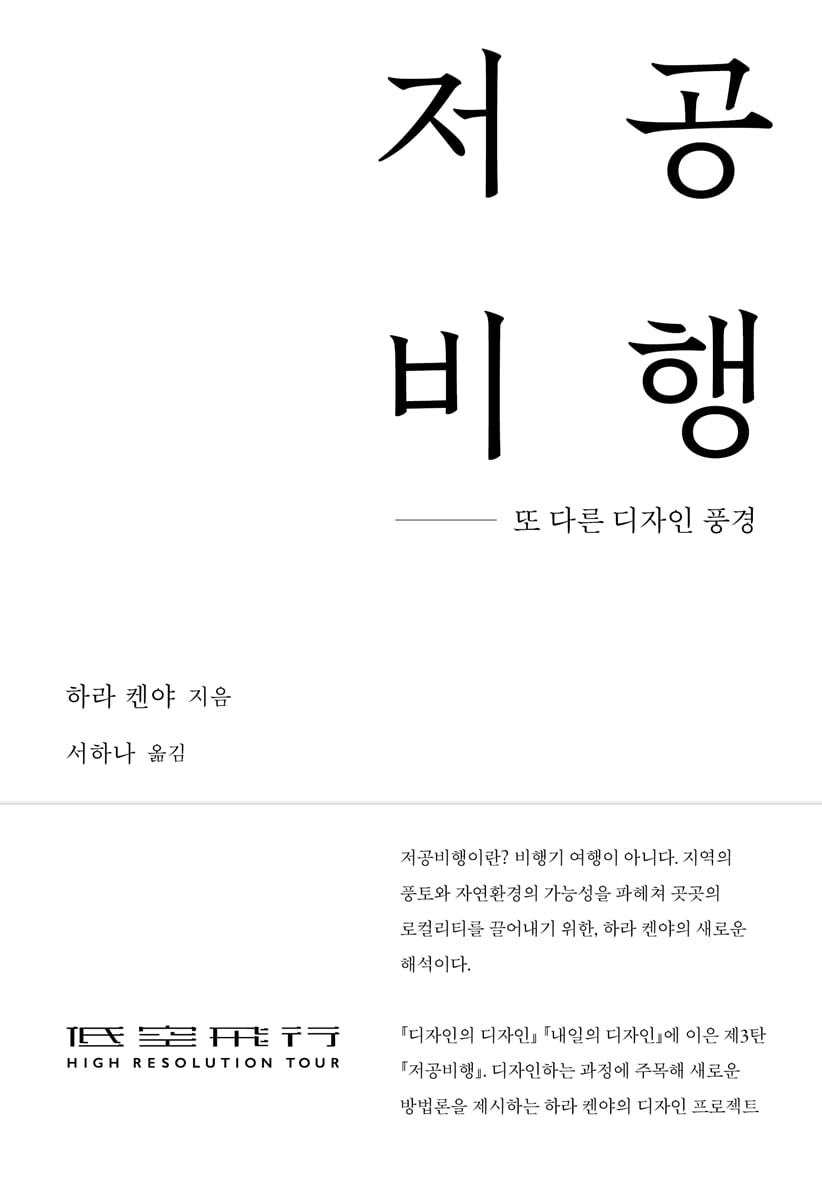
low-altitude flight
 |
Description
Book Introduction
Kenya Hara says, “Design is about creating value.” His constant exploration and challenge towards design may have led to the question, 'What is design?' His best-selling book, The Design of Design, was the beginning of an attempt to find an answer to this question. The question, “What is design?” is always followed by the question, “What is the essence of design?” In "Design of Tomorrow," Kenya Hara embarks on a journey to discover the essence of design, specifically revealing its potential and future path, and clearly sketching a vision that can be shared with many people. We live in an era where the value of design is also changing in line with the rapid changes in technology and trends. Kenya Hara asked another question to this era. 'What is the role of designers in valuing local culture and customs?' This question then leads to the question, 'What is the value of design?' Kenya Hara realized his role in facing new challenges in local and tourism, hotels and residential environments. That's how "Low-Altitude Flight: Another Design Landscape" began. If 『Design of Design』 was a theoretical book discussing design, 『Design of Tomorrow』 was a guide to activities for envisioning the future. The following book, "Low-Altitude Flight: Another Design Landscape," is Kenya Hara's ambition to take on a new challenge and create a new industry and its potential that utilizes the local culture and resources as future resources. |
- You can preview some of the book's contents.
Preview
index
Low-altitude flights in East Asia
Our design
Towards the destination
Chapter 1: Viewing from a Low-Altitude Flight
A world headed towards flow
Thinking in numbers
Tourism resources are future resources
Japan in the industrial age
Japan House
Low-altitude flight, another dimension of tourism
Peninsula Air
Chapter 2: A Look Around Asia
What is a hotel?
Architecture by Jeffrey Bawa
Born after colonial rule
Oberoi Bali
China in the Age of Exploration
Asia's frustrations
Japan and Manufacturing after World War II
How to look at the foundation
Being open
Chapter 3: Thinking from the Eastern Edge of Eurasia
Spices that will make the world stand out
What is luxury?
Classic and modern
Why Japanese Hotels Are Classic European Hotels
Schindler House
A view from outside
Chapter 4: Reflecting on Japanese Luxury
An attitude of fear toward nature
Communication inside and outside
Transition between the entrance and the floor
Form of rest
The polysemy of space
vertical and horizontal
Corners and borders - tatami, blinds, sliding doors
Corners and borders - boundaries of materials, boundaries of technology
Water and Hot Springs - The Blessings of a Volcanic Archipelago
Peter Zumthor's Vals Baths
Hot springs as they are
shining sleep
wetlands and rivers
Bay and horizon
Place living plants
Put a stone
cleaning
Chapter 5: Designing Movement
Food, clothing, shelter and movement
small airplane
self-driving cars
The comfort of the railway
perry
Setouchi Design Conference
Finishing the low-altitude flight
Our design
Towards the destination
Chapter 1: Viewing from a Low-Altitude Flight
A world headed towards flow
Thinking in numbers
Tourism resources are future resources
Japan in the industrial age
Japan House
Low-altitude flight, another dimension of tourism
Peninsula Air
Chapter 2: A Look Around Asia
What is a hotel?
Architecture by Jeffrey Bawa
Born after colonial rule
Oberoi Bali
China in the Age of Exploration
Asia's frustrations
Japan and Manufacturing after World War II
How to look at the foundation
Being open
Chapter 3: Thinking from the Eastern Edge of Eurasia
Spices that will make the world stand out
What is luxury?
Classic and modern
Why Japanese Hotels Are Classic European Hotels
Schindler House
A view from outside
Chapter 4: Reflecting on Japanese Luxury
An attitude of fear toward nature
Communication inside and outside
Transition between the entrance and the floor
Form of rest
The polysemy of space
vertical and horizontal
Corners and borders - tatami, blinds, sliding doors
Corners and borders - boundaries of materials, boundaries of technology
Water and Hot Springs - The Blessings of a Volcanic Archipelago
Peter Zumthor's Vals Baths
Hot springs as they are
shining sleep
wetlands and rivers
Bay and horizon
Place living plants
Put a stone
cleaning
Chapter 5: Designing Movement
Food, clothing, shelter and movement
small airplane
self-driving cars
The comfort of the railway
perry
Setouchi Design Conference
Finishing the low-altitude flight
Detailed image
.jpg)
Into the book
"Low-Altitude Flight" is a book about Japan and its future possibilities.
However, this was not written with the intention of praising Japan.
Rather, it is a rebuke containing the hope that Japan, which has been stagnant without a vision for post-industrialization, will now open its eyes.
While I was honored to have such a book published in Korean, I was also worried about how Korean readers would read it.
At the same time, there was also something I realized.
This book deals with the vision of East Asia as a whole after achieving industrialization.
---From "Low-Altitude Flight in East Asia"
In fact, the future is sleeping in activities that are not your main occupation.
Even if it doesn't seem to help right away, the essence of work is hidden in the act of throwing oneself into it.
Clearly, a new situation is beginning for ‘us’, including ‘me’.
---From "Our Design"
I think hotels don't steal the surrounding scenery to provide service.
If it weren't for the hotel, the landscape, scenery, food culture, and culture would be unrecognizable. It is the embodiment of aesthetics and wisdom, meticulously planned to visualize the land's latent charm.
In other words, staying at the hotel itself becomes the real purpose.
I would like to imagine a scene where such hotels are being built all over the country.
---From "Low-Altitude Flight, Tourism in Another Dimension"
If we consider the potential of 'tourism' as an 'industry' that will shoulder the future, we must maintain objectivity with a different resolution than before.
And we need to rethink the way we think about knowledge in order to understand and express that region.
Because tourism is the largest industry of the 21st century.
Japan achieved rapid growth and emerged as an economic powerhouse by reviving its postwar economy through manufacturing.
However, the first chapter of the story has already reached its end, and the next chapter, which uses our traditional culture and customs as resources, has begun.
I think so.
---From "What is a Hotel"
Of course, culture does not disappear just because it is used like a consumer good.
There is an undying spark at the heart of the emotions of those who inherit culture, like a gene that has the power to reproduce it if they set their mind to it.
Architecture, gardens, paintings and furniture, crafts, and the aesthetics of daily life—Japanese culture, whose momentum seemed to have waned around the Meiji period, is like an ancestral legacy buried deep in a warehouse.
I think it's time to carefully take them out, dust them off, and shine them again in a new world context.
The time has come to discover within our own culture the resources that will contribute to and enrich the diversity of world culture, including Asia, and to utilize them as future resources.
---From "How to Look at the Foundation"
There is a saying in Japan: “Half a tatami mat when you’re awake, one tatami mat when you’re asleep.”
As the saying goes, people can sleep and wake up with just a minimal amount of space.
Therefore, questioning the form of living space that has been completed over a long period of time may be the act of a mean futurist who only pursues novelty without looking at the essence.
---From "The Polysemy of Space"
It is not easy to answer the question, 'What is luxury?'
The expression "pursuit of excellence" or "essence" that transcends rankings and competition may also be listing only the positive aspects.
If there is luxury in Japan, isn't it not excessive extravagance, but a pious spirit that springs from the depths of an attitude of respect and reverence for the mystery of nature as a source of value?
---From "Place Living Plants"
I spoke with Hong Kong designer Alan Chan about what the fourth element after food, clothing and shelter would be.
At that time, Alan said that it would be 'Hanghang'.
Hong Kong is so small that Hong Kongers instinctively consider going to other places to be a pleasure.
I don't remember exactly what I said for the fourth element, so I don't think I came up with a very good answer, like 'rest' or 'creation'.
But 'Haeng' was convinced that it could be so.
Even if you are not a Hong Konger, people always yearn to move.
---From "Food, Clothing, Shelter, and Action"
Although we define "Setouchi" as "interlocal media" and use it as the name of the conference, the potential for resources and value does not lie solely in the Seto Inland Sea.
What kind of connections and value can be created across Japan through accommodation, food culture, transportation, media, architecture, design, and art? How will the government, local governments, investors, and businesses manage these? This is where the crucial moment will be.
However, this was not written with the intention of praising Japan.
Rather, it is a rebuke containing the hope that Japan, which has been stagnant without a vision for post-industrialization, will now open its eyes.
While I was honored to have such a book published in Korean, I was also worried about how Korean readers would read it.
At the same time, there was also something I realized.
This book deals with the vision of East Asia as a whole after achieving industrialization.
---From "Low-Altitude Flight in East Asia"
In fact, the future is sleeping in activities that are not your main occupation.
Even if it doesn't seem to help right away, the essence of work is hidden in the act of throwing oneself into it.
Clearly, a new situation is beginning for ‘us’, including ‘me’.
---From "Our Design"
I think hotels don't steal the surrounding scenery to provide service.
If it weren't for the hotel, the landscape, scenery, food culture, and culture would be unrecognizable. It is the embodiment of aesthetics and wisdom, meticulously planned to visualize the land's latent charm.
In other words, staying at the hotel itself becomes the real purpose.
I would like to imagine a scene where such hotels are being built all over the country.
---From "Low-Altitude Flight, Tourism in Another Dimension"
If we consider the potential of 'tourism' as an 'industry' that will shoulder the future, we must maintain objectivity with a different resolution than before.
And we need to rethink the way we think about knowledge in order to understand and express that region.
Because tourism is the largest industry of the 21st century.
Japan achieved rapid growth and emerged as an economic powerhouse by reviving its postwar economy through manufacturing.
However, the first chapter of the story has already reached its end, and the next chapter, which uses our traditional culture and customs as resources, has begun.
I think so.
---From "What is a Hotel"
Of course, culture does not disappear just because it is used like a consumer good.
There is an undying spark at the heart of the emotions of those who inherit culture, like a gene that has the power to reproduce it if they set their mind to it.
Architecture, gardens, paintings and furniture, crafts, and the aesthetics of daily life—Japanese culture, whose momentum seemed to have waned around the Meiji period, is like an ancestral legacy buried deep in a warehouse.
I think it's time to carefully take them out, dust them off, and shine them again in a new world context.
The time has come to discover within our own culture the resources that will contribute to and enrich the diversity of world culture, including Asia, and to utilize them as future resources.
---From "How to Look at the Foundation"
There is a saying in Japan: “Half a tatami mat when you’re awake, one tatami mat when you’re asleep.”
As the saying goes, people can sleep and wake up with just a minimal amount of space.
Therefore, questioning the form of living space that has been completed over a long period of time may be the act of a mean futurist who only pursues novelty without looking at the essence.
---From "The Polysemy of Space"
It is not easy to answer the question, 'What is luxury?'
The expression "pursuit of excellence" or "essence" that transcends rankings and competition may also be listing only the positive aspects.
If there is luxury in Japan, isn't it not excessive extravagance, but a pious spirit that springs from the depths of an attitude of respect and reverence for the mystery of nature as a source of value?
---From "Place Living Plants"
I spoke with Hong Kong designer Alan Chan about what the fourth element after food, clothing and shelter would be.
At that time, Alan said that it would be 'Hanghang'.
Hong Kong is so small that Hong Kongers instinctively consider going to other places to be a pleasure.
I don't remember exactly what I said for the fourth element, so I don't think I came up with a very good answer, like 'rest' or 'creation'.
But 'Haeng' was convinced that it could be so.
Even if you are not a Hong Konger, people always yearn to move.
---From "Food, Clothing, Shelter, and Action"
Although we define "Setouchi" as "interlocal media" and use it as the name of the conference, the potential for resources and value does not lie solely in the Seto Inland Sea.
What kind of connections and value can be created across Japan through accommodation, food culture, transportation, media, architecture, design, and art? How will the government, local governments, investors, and businesses manage these? This is where the crucial moment will be.
---From the "Setouchi Design Conference"
Publisher's Review
The third installment of 『Design of Design』 and 『Design of Tomorrow』 is 『Low-Altitude Flight』.
Kenya Hara presents a new methodology by focusing on the design process.
Another design project of his has begun!
The uniqueness of information and the purity of the season seen through low-altitude flight!
In 2019, Kenya Hara launched a project called "Low-Altitude Flight - High Resolution Tour."
This is a project in which he personally visits and introduces locations and facilities throughout Japan.
In an interview with a domestic media outlet, Kenya Hara said the following:
“Regardless of the coronavirus, the world is becoming increasingly globalized.
On the one hand, the more this happens, the more the 'originality' that exists only in individual places becomes relatively important.
In that sense, I started the "Low-Altitude Flight" project to introduce various places in my home country, Japan, while paying attention to the local environment.
(Omitted) So, I started thinking about making a hotel.
Rather than being interested in the hotel industry itself, I found value in the fact that hotels can create a place for locals to stay and, furthermore, create a new lifestyle.
Hotels can be seen as nothing more than accommodations in tourist destinations, but I see them as spaces with a truly interesting function, offering guests a condensed experience of the natural environment and cultural delights.”
So, what exactly is the "low-altitude flight" he's proposing? Is it air travel? No.
It is a metaphorical expression for a trip that involves exploring an area at a low altitude and looking around carefully to see the scenery on the ground.
In other words, Kenya Hara sought to bring out the locality of each place by exploring the potential of the value of the local customs and natural environment through 'low-altitude flights'.
This is the so-called new design perspective and methodology unique to Hara Kenya.
In “Low-Altitude Flight: Another Design Landscape,” Kenya Hara says that while encountering the customs and cultures of various places through “low-altitude flight,” he strangely felt at peace.
And this naturally shifted the focus to creating a chain of consciousness for more people.
The importance of creating entirely new values that sustain human dignity and pride in places and regions that feel wonderful—a constant dialogue with all social activities? Kenya Hara, seeking to discover with readers another form of value, another design, another resource.
What exactly do the local landscapes and aesthetics he capture look like?
What a low-altitude flight scene.
Humans are neglecting the future resources they originally possessed, such as traditions and customs.
The "Low-Altitude Flight" project began with questions about this.
In other words, it was an experience that opened my eyes to the potential of this land.
It also contains Hara Kenya's ambition to design a hotel that captures the unique characteristics of the region.
If you think about it, the view from a 'low-altitude flight' has never been provided before.
So-called resources and values that have not yet been touched by human hands remain in the realm of low-altitude flights.
What is the value of local?
Nature is colorful.
If you travel to many countries, each one has its own unique and colorful natural landscape.
There is no sea that is the same anywhere, and there is no mountain that is the same anywhere.
A country is like a tree whose branches are so full of fruit that they bend.
A region is a stem that represents the identity and locality of a country, and the culture and lifestyle that unfold within it are like branches that extend outward.
Realization of value.
Rather than leaving it as it is, we bring in artificial elements to enhance nature and present it beautifully along with the history and culture of the region to those who visit the place.
I think that 'hotels' are one means to that end.
A hotel can be said to be the best interpretation of the local culture, traditions, and food culture in which it stands.
If a nation is to take the next step toward its future, it must reinterpret its own territory and culture.
How will we embrace, interpret, and present our own customs, history, and culture? The quality of these interpretations will determine the prosperity of nations in the 21st century.
What is the designer's role in this?
The role of design is to ‘penetrate and visualize the essence.’
We must shift our perspective and mindset from the production of goods to the production of value, and seek ways to utilize the potential of this land as a resource.
The role of the designer, emphasized in this book, is to perceive the essence and potential of the value created by a region and culture, and to present it in the form of concrete ideas.
This book is about a designer climbing the tree of design and talking about the scenery he sees from above, and it is also about the future possibilities of a country.
Kenya Hara presents a new methodology by focusing on the design process.
Another design project of his has begun!
The uniqueness of information and the purity of the season seen through low-altitude flight!
In 2019, Kenya Hara launched a project called "Low-Altitude Flight - High Resolution Tour."
This is a project in which he personally visits and introduces locations and facilities throughout Japan.
In an interview with a domestic media outlet, Kenya Hara said the following:
“Regardless of the coronavirus, the world is becoming increasingly globalized.
On the one hand, the more this happens, the more the 'originality' that exists only in individual places becomes relatively important.
In that sense, I started the "Low-Altitude Flight" project to introduce various places in my home country, Japan, while paying attention to the local environment.
(Omitted) So, I started thinking about making a hotel.
Rather than being interested in the hotel industry itself, I found value in the fact that hotels can create a place for locals to stay and, furthermore, create a new lifestyle.
Hotels can be seen as nothing more than accommodations in tourist destinations, but I see them as spaces with a truly interesting function, offering guests a condensed experience of the natural environment and cultural delights.”
So, what exactly is the "low-altitude flight" he's proposing? Is it air travel? No.
It is a metaphorical expression for a trip that involves exploring an area at a low altitude and looking around carefully to see the scenery on the ground.
In other words, Kenya Hara sought to bring out the locality of each place by exploring the potential of the value of the local customs and natural environment through 'low-altitude flights'.
This is the so-called new design perspective and methodology unique to Hara Kenya.
In “Low-Altitude Flight: Another Design Landscape,” Kenya Hara says that while encountering the customs and cultures of various places through “low-altitude flight,” he strangely felt at peace.
And this naturally shifted the focus to creating a chain of consciousness for more people.
The importance of creating entirely new values that sustain human dignity and pride in places and regions that feel wonderful—a constant dialogue with all social activities? Kenya Hara, seeking to discover with readers another form of value, another design, another resource.
What exactly do the local landscapes and aesthetics he capture look like?
What a low-altitude flight scene.
Humans are neglecting the future resources they originally possessed, such as traditions and customs.
The "Low-Altitude Flight" project began with questions about this.
In other words, it was an experience that opened my eyes to the potential of this land.
It also contains Hara Kenya's ambition to design a hotel that captures the unique characteristics of the region.
If you think about it, the view from a 'low-altitude flight' has never been provided before.
So-called resources and values that have not yet been touched by human hands remain in the realm of low-altitude flights.
What is the value of local?
Nature is colorful.
If you travel to many countries, each one has its own unique and colorful natural landscape.
There is no sea that is the same anywhere, and there is no mountain that is the same anywhere.
A country is like a tree whose branches are so full of fruit that they bend.
A region is a stem that represents the identity and locality of a country, and the culture and lifestyle that unfold within it are like branches that extend outward.
Realization of value.
Rather than leaving it as it is, we bring in artificial elements to enhance nature and present it beautifully along with the history and culture of the region to those who visit the place.
I think that 'hotels' are one means to that end.
A hotel can be said to be the best interpretation of the local culture, traditions, and food culture in which it stands.
If a nation is to take the next step toward its future, it must reinterpret its own territory and culture.
How will we embrace, interpret, and present our own customs, history, and culture? The quality of these interpretations will determine the prosperity of nations in the 21st century.
What is the designer's role in this?
The role of design is to ‘penetrate and visualize the essence.’
We must shift our perspective and mindset from the production of goods to the production of value, and seek ways to utilize the potential of this land as a resource.
The role of the designer, emphasized in this book, is to perceive the essence and potential of the value created by a region and culture, and to present it in the form of concrete ideas.
This book is about a designer climbing the tree of design and talking about the scenery he sees from above, and it is also about the future possibilities of a country.
GOODS SPECIFICS
- Date of issue: March 14, 2023
- Format: Hardcover book binding method guide
- Page count, weight, size: 230 pages | 484g | 128*188*24mm
- ISBN13: 9791168230217
- ISBN10: 1168230217
You may also like
카테고리
korean


korean

![GQ KOREA Mark (Monthly): December [2025]](http://librairie.coreenne.fr/cdn/shop/files/8ef265dbbfbf186523ed75ba7319009d.jpg?v=1765340328&width=3840)


