

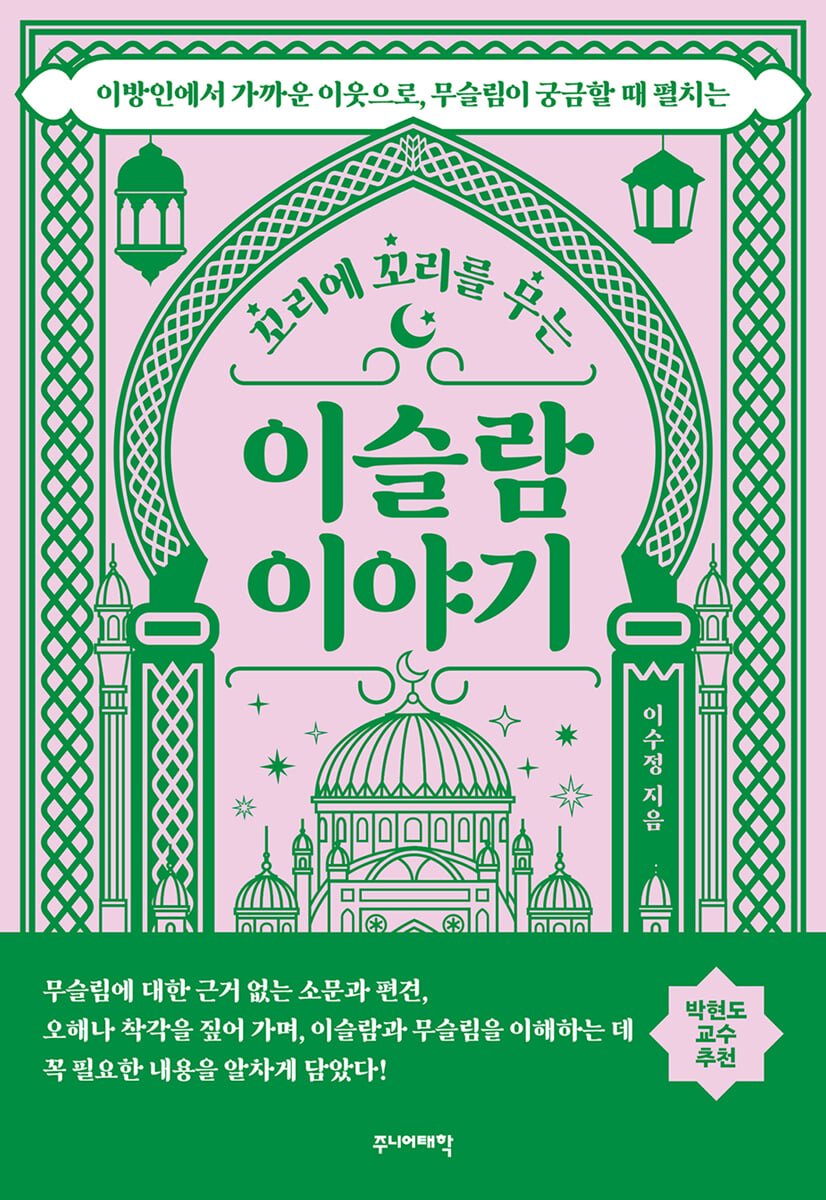
The Islamic story that keeps going on and on
 |
Description
Book Introduction
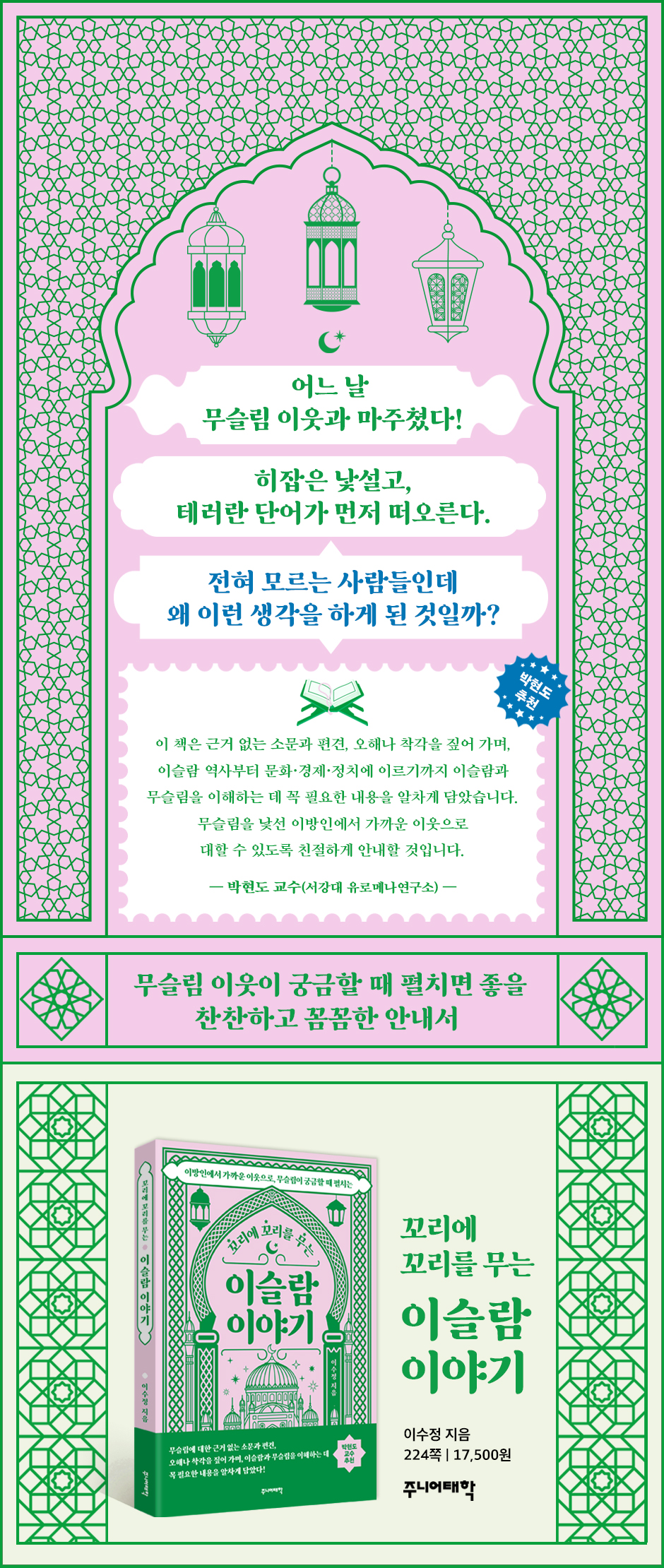
The hijab is strange,
Just look at Middle Eastern people
You think I'm a terrorist?
Starting from Islamophobia
Reaching out to Muslim neighbors
The story of Islam that goes on and on!
The number of immigrants coming to Korea is increasing.
Among them are Muslims.
People we once knew only as distant Middle Easterners are now living closer to us.
What do Koreans think of them?
According to a media interview, the reality is that they are still more cautious than other immigrants.
This is because the ‘hijab’ is unfamiliar and the prejudice that ‘Middle Eastern men = terrorists’ is strong.
This phenomenon may be another expression of fear that stems from not knowing Muslims well.
"The Story of Islam: A Tale of the Tail" is an introductory book on Islam and Muslims that begins with the origins of Islamophobia and reaches out to our Muslim neighbors.
It provides a thorough explanation of everything from the very basics of Islam and Muslims to the state of the modern Islamic world.
The 『Kokkomu Story』 series is basically a question-and-answer format.
The questions in this book are based on the assumption that you have Muslim neighbors.
The question I had when I happened to run into a Muslim neighbor was the starting point.
Just look at Middle Eastern people
You think I'm a terrorist?
Starting from Islamophobia
Reaching out to Muslim neighbors
The story of Islam that goes on and on!
The number of immigrants coming to Korea is increasing.
Among them are Muslims.
People we once knew only as distant Middle Easterners are now living closer to us.
What do Koreans think of them?
According to a media interview, the reality is that they are still more cautious than other immigrants.
This is because the ‘hijab’ is unfamiliar and the prejudice that ‘Middle Eastern men = terrorists’ is strong.
This phenomenon may be another expression of fear that stems from not knowing Muslims well.
"The Story of Islam: A Tale of the Tail" is an introductory book on Islam and Muslims that begins with the origins of Islamophobia and reaches out to our Muslim neighbors.
It provides a thorough explanation of everything from the very basics of Islam and Muslims to the state of the modern Islamic world.
The 『Kokkomu Story』 series is basically a question-and-answer format.
The questions in this book are based on the assumption that you have Muslim neighbors.
The question I had when I happened to run into a Muslim neighbor was the starting point.
- You can preview some of the book's contents.
Preview
index
Chapter 1.
Curious Neighbor
Islam and Muslims
Differences between the Western and Islamic calendars
What is the biggest holiday for Muslims?
What is the difference between Sunni and Shia?
A Brief History of the Rise and Fall of Islam
Arisong language, Arab and Middle Eastern
The three holiest sites of Islam
5 things you must keep in mind
6 Things You Must Believe
Halal and Haram
There are also halal cosmetics?
Read more
Monotheism and polytheism
Islamic civilization that ushered in the Renaissance
Al-Haram al-Sharif or the Temple Mount?
Things to keep in mind when traveling
Foods forbidden by each religion
Chapter 2.
This kind of misunderstanding, that kind of prejudice
fundamentalism and extremism
The lie that we fight for Islam
Why did Islamophobia arise?
Hijab that some wear and some take off
Why did France ban the hijab?
Which countries force women to wear burqas?
Why did the 'hijab protests' occur?
Islam vs. Christianity War
Why did the Israeli-Palestinian conflict begin?
What if I'm discriminated against because I'm Muslim?
Chapter 3.
The day Korea and the Islamic world met
The land of oil, the Middle East
construction workers in the Middle East
BTS performed in Saudi Arabia?
The Korean Wave in the Middle East
What else is there besides oil?
The United Arab Emirates is transforming!
Read more
Organization of Petroleum Exporting Countries
Bin Salman's visit to Korea
Chapter 4.
If you look closely, it's an old relationship
Still a stranger to the neighbors
Since when have you lived on the Korean Peninsula?
Why did King Sejong ban Muslim attire?
Muslims during the Japanese colonial period
Why is Turkey a "Brotherly Nation"?
Incidents of conflict between residents and Muslims
A case where the conflict was resolved well
Read more
Seoul Central Mosque
Dining Etiquette
Review: Let's study others!
Curious Neighbor
Islam and Muslims
Differences between the Western and Islamic calendars
What is the biggest holiday for Muslims?
What is the difference between Sunni and Shia?
A Brief History of the Rise and Fall of Islam
Arisong language, Arab and Middle Eastern
The three holiest sites of Islam
5 things you must keep in mind
6 Things You Must Believe
Halal and Haram
There are also halal cosmetics?
Read more
Monotheism and polytheism
Islamic civilization that ushered in the Renaissance
Al-Haram al-Sharif or the Temple Mount?
Things to keep in mind when traveling
Foods forbidden by each religion
Chapter 2.
This kind of misunderstanding, that kind of prejudice
fundamentalism and extremism
The lie that we fight for Islam
Why did Islamophobia arise?
Hijab that some wear and some take off
Why did France ban the hijab?
Which countries force women to wear burqas?
Why did the 'hijab protests' occur?
Islam vs. Christianity War
Why did the Israeli-Palestinian conflict begin?
What if I'm discriminated against because I'm Muslim?
Chapter 3.
The day Korea and the Islamic world met
The land of oil, the Middle East
construction workers in the Middle East
BTS performed in Saudi Arabia?
The Korean Wave in the Middle East
What else is there besides oil?
The United Arab Emirates is transforming!
Read more
Organization of Petroleum Exporting Countries
Bin Salman's visit to Korea
Chapter 4.
If you look closely, it's an old relationship
Still a stranger to the neighbors
Since when have you lived on the Korean Peninsula?
Why did King Sejong ban Muslim attire?
Muslims during the Japanese colonial period
Why is Turkey a "Brotherly Nation"?
Incidents of conflict between residents and Muslims
A case where the conflict was resolved well
Read more
Seoul Central Mosque
Dining Etiquette
Review: Let's study others!
Detailed image
Into the book
You've probably heard the words Islam and Muslim often.
What's the difference between these two words? Islam refers to the religion of Islam, and Muslim refers to people who follow Islam.
---p.
13
The Islamic calendar begins in 622 AD, when the capital was moved to Medina.
Because it is a special year.
Why is this so? Because only after moving to Medina did they establish an Islamic community, and on that basis, they were able to spread Islam.
---p.
19
Muslims who are financially able also practice charity during this period, called Zakat al-Fitr.
Zakat means 'charity', so Zakat al-Fitr means 'charity at the end of fasting'.
Donate grain or money to the poor, especially those who cannot enjoy the Eid al-Fitr festival.
So that we can all celebrate Ramadan together.
---p.
23
Ulugh Beg was a 15th-century ruler of the Timurid Empire.
He was also interested in astronomy and built the Ulugh Beg Observatory.
This was the best observatory of its time.
Equipped with a huge surveying instrument (the Parkley sextant) with a radius of 40.4 meters, it was possible to measure the positions of more than 1,000 stars with great accuracy.
The results of these measurements are summarized in 《Jiji-i Sultani》.
The Jiji-i Sultani was recognized as the most accurate astronomical table before the invention of the telescope.
---p.
29
When Muhammad died without appointing a successor, Muslims became divided over how to choose a successor.
Some argue for election and consent, that is, a small number of ruling men with the right to vote should elect a successor, and the successor should be chosen by the people through consent.
These are Sunnis.
Others claim that Muhammad actually chose a successor, and that this person was Ali, Muhammad's cousin and son-in-law.
Those who follow Ali are Shiites.
---p.
36~37
The relationship between Shia and Sunni does not end with them being different sects.
It's a competitive relationship in many ways.
For example, if a war breaks out, Iran will support the Shia forces because it is a representative Shia country, and Saudi Arabia will support the Sunni forces because it is a representative Sunni country.
External powers, such as the United States, often exploit this inter-sectarian rivalry.
---p.
44
The Kaaba existed before the founding of Islam.
It was a sanctuary for polytheistic worship.
After Muhammad conquered Mecca, he destroyed the idols in the Kaaba and declared it the holiest place in Islam.
Muhammad began construction of a mosque centered around the Kaaba, which was later completed to become the current Great Mosque (also known as Masjid al-Haram).
Muslims consider the Kaaba to be the most sacred, and this is the reason.
More than 4 million Muslims visit Mecca every year to perform the Hajj.
---p.
56
Al-Haram al-Sharif is a holy site for Muslims, Jews, and Christians.
Because the holy places overlap, conflicts sometimes arise between religious people.
To prevent such conflicts, the international community has stipulated that no country can possess Jerusalem.
But in reality, Israel controls Jerusalem.
Israel is a country with a large Jewish population.
For this reason, many excuses are used to prevent Muslims from visiting Al-Haram Al-Sharif.
During this process, armed conflicts occurred several times.
---p.
61
Of course, not everyone fasts.
Soldiers on active duty, long-distance travelers, children, the elderly, pregnant or lactating women, menstruating women, and the sick are exempt from fasting.
Children under ten years of age are not required to fast.
If you are unable to fast due to personal reasons, you may fast for the same number of days as you were unable to fast after Ramadan.
---p.
72
There are also foods that are forbidden in Judaism.
Judaism has dietary laws called Kosher.
Here are the rules for what you can and cannot eat.
Kosher is a Hebrew word meaning 'appropriate' or 'fit'.
Just as Muslims have halal certification, Jews also eat foods that have kosher certification.
---p.
96
Even halal food is widely recognized as healthy and good for one's well-being.
Halal cosmetics are made from natural ingredients rather than chemicals, so they are gentle on the skin and do not irritate it.
We do not test on animals and do not use any animal ingredients.
This is a very welcome product for vegetarians (vegans) and people who care about animal rights.
---p.
103
Islamic extremism goes beyond fundamentalism to reject everything other than Islam and the Islamic community.
It differs from fundamentalism in that it seeks to enforce its beliefs through violence such as terrorism and war.
Extremists believe that the world is in a state of war until Islam conquers the world, and they even interpret the Quran in their own way to justify terrorism.
---p.
108
Why did Islamophobia arise? The biggest reason is the terrorist attacks perpetrated by Islamic extremists, as mentioned earlier.
Seeing innocent people killed or injured in terrorist attacks here and there, including the 9/11 terrorist attacks, people feel a sense of crisis that they too could become victims.
Prejudices like “Islam is a religion that causes terrorism”, “If the number of people who believe in Islam increases, terrorism will inevitably occur”, and “Islam is a violent religion” are also engraved in our minds.
---p.
118~119
Islam, like any other religion, values life.
Suicide and harming others are prohibited.
For this reason, those who truly believe in and follow Islam strongly criticize the behavior of some extremists that is contrary to Islam.
Islam strives to minimize the pain of slaughtering animals, and even condemns terrorist attacks that kill people as an act of betrayal of Islam.
Extremists are fake Islamists who pretend to be real.
---p.
120
Another reason for not wearing the hijab is that it goes against one of the principles of a modern state: the separation of church and state.
Separation of church and state is the principle that politics and religion are separate.
The state must not support or oppress any particular religion, must treat all religions equally, and must treat religious and non-religious people equally.
---p.
126
Why did Islam and Christianity come into conflict? The main reason is that Christianity believes in the Trinity (God, Jesus, and the Holy Spirit), while Islam believes only in God.
It is not acknowledging the doctrine of the Trinity.
Christianity believes in the Trinity and therefore considers Jesus to be the Son of God, but Islam considers Jesus to be just one of many prophets.
Muhammad is considered the last prophet.
As Christians, it would be unwelcome to consider someone they have given divinity to be one of their prophets.
---p.
136
In Korea, a comprehensive anti-discrimination law has not yet been enacted.
Although bills have been proposed several times since 2007, they have not been properly discussed due to claims that social consensus is needed and opposition from conservative Christian circles.
Hate crimes are also on the rise in Korea.
Couldn't a comprehensive anti-discrimination law be the first step toward preventing such crimes?
---p.
150
Why are Middle Eastern countries so interested in the tourism industry? For a long time, Middle Eastern countries have relied on oil for their survival.
However, as the climate crisis worsens, there is a global movement to stop using fossil fuels.
Middle Eastern countries had to find other ways to boost their economies.
One of them is the tourism industry.
---p.
176
Seoul Central Mosque is Korea's first mosque.
It is located in Itaewon, Seoul.
This mosque opened on May 21, 1976, and is known as the largest mosque in Korea and the headquarters of Korean Islam.
Seoul Central Mosque was built in the 1970s as diplomatic relations between Korea and Middle Eastern countries became more active. The Korean government provided land (approximately 1,500 pyeong), and Islamic countries, including Saudi Arabia, provided support for construction costs.
---p.
189
Muslims definitely lived during the Goryeo Dynasty.
There is a record.
Goryeo was under the influence of the Yuan Dynasty for quite a long time.
In the process, Muslims from the Yuan Dynasty entered Goryeo.
For example, there were Muslims who followed princesses who married into the Goryeo Dynasty from the Yuan Dynasty.
---p.
195
In fact, before that, King Sejong had invited Muslims to important national events such as New Year's greetings and crowning of the crown prince, and he also liked them to give blessings through Islamic prayers.
But he made that decision because it was important for him to maintain Joseon society as a king.
---p.
199
Turkic Muslims lived in communities.
He built a mosque in Mugyo-dong, Seoul, and also ran an Islamic school.
They also published the Quran and held religious ceremonies.
The Japanese supported all of this.
Then the Muslims did as the Japanese wanted.
For example, it was a way of supporting Japan's anti-communist policy.
Is that all?
Our country, under Japanese rule, was considered a part of Japan.
So they didn't pay much attention to our independence movement.
---p.
201
Turkish soldiers continued to fight to end the war, suffering heavy casualties in the process, including some 900 casualties.
This is why we cannot help but regard Turkey not as a simple ally but as a ‘brotherly country.’
After the Korean War, the two countries became closer.
Turkey was also very important as a country connecting the Middle East and Europe.
---p.
205
The reason Muslims eat with their right hand is because, since ancient times, the right hand has been considered clean and the left hand unclean.
Because of this long-held belief, we extend our right hand when asking for a handshake, and we also use our right hand when handing over objects or food.
---p.
217
When you think of multiculturalism, the term 'multicultural family' immediately comes to mind, but these days, the term 'family with immigrant background' is used instead.
This is because the term multicultural family is mainly used to refer to people who have immigrated from Southeast Asia.
It is used as a language of discrimination.
I would like to recommend the term "immigrant family" as it is a neutral term that refers to a family where one or both parents came from a foreign country.
What's the difference between these two words? Islam refers to the religion of Islam, and Muslim refers to people who follow Islam.
---p.
13
The Islamic calendar begins in 622 AD, when the capital was moved to Medina.
Because it is a special year.
Why is this so? Because only after moving to Medina did they establish an Islamic community, and on that basis, they were able to spread Islam.
---p.
19
Muslims who are financially able also practice charity during this period, called Zakat al-Fitr.
Zakat means 'charity', so Zakat al-Fitr means 'charity at the end of fasting'.
Donate grain or money to the poor, especially those who cannot enjoy the Eid al-Fitr festival.
So that we can all celebrate Ramadan together.
---p.
23
Ulugh Beg was a 15th-century ruler of the Timurid Empire.
He was also interested in astronomy and built the Ulugh Beg Observatory.
This was the best observatory of its time.
Equipped with a huge surveying instrument (the Parkley sextant) with a radius of 40.4 meters, it was possible to measure the positions of more than 1,000 stars with great accuracy.
The results of these measurements are summarized in 《Jiji-i Sultani》.
The Jiji-i Sultani was recognized as the most accurate astronomical table before the invention of the telescope.
---p.
29
When Muhammad died without appointing a successor, Muslims became divided over how to choose a successor.
Some argue for election and consent, that is, a small number of ruling men with the right to vote should elect a successor, and the successor should be chosen by the people through consent.
These are Sunnis.
Others claim that Muhammad actually chose a successor, and that this person was Ali, Muhammad's cousin and son-in-law.
Those who follow Ali are Shiites.
---p.
36~37
The relationship between Shia and Sunni does not end with them being different sects.
It's a competitive relationship in many ways.
For example, if a war breaks out, Iran will support the Shia forces because it is a representative Shia country, and Saudi Arabia will support the Sunni forces because it is a representative Sunni country.
External powers, such as the United States, often exploit this inter-sectarian rivalry.
---p.
44
The Kaaba existed before the founding of Islam.
It was a sanctuary for polytheistic worship.
After Muhammad conquered Mecca, he destroyed the idols in the Kaaba and declared it the holiest place in Islam.
Muhammad began construction of a mosque centered around the Kaaba, which was later completed to become the current Great Mosque (also known as Masjid al-Haram).
Muslims consider the Kaaba to be the most sacred, and this is the reason.
More than 4 million Muslims visit Mecca every year to perform the Hajj.
---p.
56
Al-Haram al-Sharif is a holy site for Muslims, Jews, and Christians.
Because the holy places overlap, conflicts sometimes arise between religious people.
To prevent such conflicts, the international community has stipulated that no country can possess Jerusalem.
But in reality, Israel controls Jerusalem.
Israel is a country with a large Jewish population.
For this reason, many excuses are used to prevent Muslims from visiting Al-Haram Al-Sharif.
During this process, armed conflicts occurred several times.
---p.
61
Of course, not everyone fasts.
Soldiers on active duty, long-distance travelers, children, the elderly, pregnant or lactating women, menstruating women, and the sick are exempt from fasting.
Children under ten years of age are not required to fast.
If you are unable to fast due to personal reasons, you may fast for the same number of days as you were unable to fast after Ramadan.
---p.
72
There are also foods that are forbidden in Judaism.
Judaism has dietary laws called Kosher.
Here are the rules for what you can and cannot eat.
Kosher is a Hebrew word meaning 'appropriate' or 'fit'.
Just as Muslims have halal certification, Jews also eat foods that have kosher certification.
---p.
96
Even halal food is widely recognized as healthy and good for one's well-being.
Halal cosmetics are made from natural ingredients rather than chemicals, so they are gentle on the skin and do not irritate it.
We do not test on animals and do not use any animal ingredients.
This is a very welcome product for vegetarians (vegans) and people who care about animal rights.
---p.
103
Islamic extremism goes beyond fundamentalism to reject everything other than Islam and the Islamic community.
It differs from fundamentalism in that it seeks to enforce its beliefs through violence such as terrorism and war.
Extremists believe that the world is in a state of war until Islam conquers the world, and they even interpret the Quran in their own way to justify terrorism.
---p.
108
Why did Islamophobia arise? The biggest reason is the terrorist attacks perpetrated by Islamic extremists, as mentioned earlier.
Seeing innocent people killed or injured in terrorist attacks here and there, including the 9/11 terrorist attacks, people feel a sense of crisis that they too could become victims.
Prejudices like “Islam is a religion that causes terrorism”, “If the number of people who believe in Islam increases, terrorism will inevitably occur”, and “Islam is a violent religion” are also engraved in our minds.
---p.
118~119
Islam, like any other religion, values life.
Suicide and harming others are prohibited.
For this reason, those who truly believe in and follow Islam strongly criticize the behavior of some extremists that is contrary to Islam.
Islam strives to minimize the pain of slaughtering animals, and even condemns terrorist attacks that kill people as an act of betrayal of Islam.
Extremists are fake Islamists who pretend to be real.
---p.
120
Another reason for not wearing the hijab is that it goes against one of the principles of a modern state: the separation of church and state.
Separation of church and state is the principle that politics and religion are separate.
The state must not support or oppress any particular religion, must treat all religions equally, and must treat religious and non-religious people equally.
---p.
126
Why did Islam and Christianity come into conflict? The main reason is that Christianity believes in the Trinity (God, Jesus, and the Holy Spirit), while Islam believes only in God.
It is not acknowledging the doctrine of the Trinity.
Christianity believes in the Trinity and therefore considers Jesus to be the Son of God, but Islam considers Jesus to be just one of many prophets.
Muhammad is considered the last prophet.
As Christians, it would be unwelcome to consider someone they have given divinity to be one of their prophets.
---p.
136
In Korea, a comprehensive anti-discrimination law has not yet been enacted.
Although bills have been proposed several times since 2007, they have not been properly discussed due to claims that social consensus is needed and opposition from conservative Christian circles.
Hate crimes are also on the rise in Korea.
Couldn't a comprehensive anti-discrimination law be the first step toward preventing such crimes?
---p.
150
Why are Middle Eastern countries so interested in the tourism industry? For a long time, Middle Eastern countries have relied on oil for their survival.
However, as the climate crisis worsens, there is a global movement to stop using fossil fuels.
Middle Eastern countries had to find other ways to boost their economies.
One of them is the tourism industry.
---p.
176
Seoul Central Mosque is Korea's first mosque.
It is located in Itaewon, Seoul.
This mosque opened on May 21, 1976, and is known as the largest mosque in Korea and the headquarters of Korean Islam.
Seoul Central Mosque was built in the 1970s as diplomatic relations between Korea and Middle Eastern countries became more active. The Korean government provided land (approximately 1,500 pyeong), and Islamic countries, including Saudi Arabia, provided support for construction costs.
---p.
189
Muslims definitely lived during the Goryeo Dynasty.
There is a record.
Goryeo was under the influence of the Yuan Dynasty for quite a long time.
In the process, Muslims from the Yuan Dynasty entered Goryeo.
For example, there were Muslims who followed princesses who married into the Goryeo Dynasty from the Yuan Dynasty.
---p.
195
In fact, before that, King Sejong had invited Muslims to important national events such as New Year's greetings and crowning of the crown prince, and he also liked them to give blessings through Islamic prayers.
But he made that decision because it was important for him to maintain Joseon society as a king.
---p.
199
Turkic Muslims lived in communities.
He built a mosque in Mugyo-dong, Seoul, and also ran an Islamic school.
They also published the Quran and held religious ceremonies.
The Japanese supported all of this.
Then the Muslims did as the Japanese wanted.
For example, it was a way of supporting Japan's anti-communist policy.
Is that all?
Our country, under Japanese rule, was considered a part of Japan.
So they didn't pay much attention to our independence movement.
---p.
201
Turkish soldiers continued to fight to end the war, suffering heavy casualties in the process, including some 900 casualties.
This is why we cannot help but regard Turkey not as a simple ally but as a ‘brotherly country.’
After the Korean War, the two countries became closer.
Turkey was also very important as a country connecting the Middle East and Europe.
---p.
205
The reason Muslims eat with their right hand is because, since ancient times, the right hand has been considered clean and the left hand unclean.
Because of this long-held belief, we extend our right hand when asking for a handshake, and we also use our right hand when handing over objects or food.
---p.
217
When you think of multiculturalism, the term 'multicultural family' immediately comes to mind, but these days, the term 'family with immigrant background' is used instead.
This is because the term multicultural family is mainly used to refer to people who have immigrated from Southeast Asia.
It is used as a language of discrimination.
I would like to recommend the term "immigrant family" as it is a neutral term that refers to a family where one or both parents came from a foreign country.
---p.
220~221
220~221
Publisher's Review
The hijab is strange,
Just look at Middle Eastern people
You think I'm a terrorist?
Starting from Islamophobia
Reaching out to Muslim neighbors
The story of Islam that goes on and on!
The number of immigrants coming to Korea is increasing.
Among them are Muslims.
People we once knew only as distant Middle Easterners are now living closer to us.
What do Koreans think of them?
According to a media interview, the reality is that they are still more cautious than other immigrants.
This is because the ‘hijab’ is unfamiliar and the prejudice that ‘Middle Eastern men = terrorists’ is strong.
This phenomenon may be another expression of fear that stems from not knowing Muslims well.
I don't know, but why do I hate it?
"The Story of Islam: A Tale of the Tail" is an introductory book on Islam and Muslims that begins with the origins of Islamophobia and reaches out to our Muslim neighbors.
It provides a thorough explanation of everything from the very basics of Islam and Muslims to the state of the modern Islamic world.
The 『Kokkomu Story』 series is basically a question-and-answer format.
The questions in this book are based on the assumption that you have Muslim neighbors.
The question I had when I happened to run into a Muslim neighbor was the starting point.
Muslims, still unfamiliar neighbors
Chapter 1 [Curious Neighbor] asks basic questions about Islam and Muslims.
First, what is Islam and what is a Muslim?
Many people think that Islam and Muslim are the same thing, but Islam is the name of a religion, and Muslim refers to a person who believes in Islam.
It also explains what Sunni and Shia are, which are often confused, and how they differ.
It tells us what religious Muslims must observe and believe in, and what they are forbidden to eat, especially food.
Just knowing one chapter will ease your fear of your Muslim neighbors.
Chapter 2 [This Misunderstanding, That Prejudice] deals with pseudo-Muslims who have created hatred for Islam and Muslims.
When we think of Muslims, terrorism and suppression of women's rights are the first things that come to mind, but this is because of some extremists.
Islam, like other religions, values life and pursues peace.
While some countries, like Afghanistan and Iran, enforce the hijab, most Islamic countries do not treat women more harshly than other religious groups. It's simply that Islamic extremist groups like ISIS and the Taliban have misappropriated Islamic doctrine to suit their own needs.
Meanwhile, this book also historically traces the emergence of these Islamic extremist armed groups.
Looking back at Islamic history, Muslims have not only been in conflict with Judaism and Christianity, which represent the West, for a long time, but have also been persecuted as colonies of Western imperialist countries.
Even now, the West often intervenes in Islamic affairs for its own interests.
Many Muslims born in Europe experience discrimination and marginalization in society.
These things have piled up, and Muslims have come to view the West with fundamental disapproval.
-Page 109
Even the ongoing Israeli-Palestinian conflict began with the misguided intervention of the West, led by Britain.
Antipathy toward the West is being expressed through terrorism by some extremists, and the West is responding with a tense response by taking measures such as the 'hijab ban' under the pretext of preventing terrorism.
Korean Peninsula and Muslims,
If you look closely, it's an old relationship
Chapter 3, [The Day Korea and the Islamic World Met], examines when Korea and the Islamic world first connected and the process through which they reached the present.
Oil is what connected the two worlds.
Diplomacy began with the exchange of oil, and friendly relations were formed, allowing many Korean workers to go to the Middle East to work during the construction boom there.
The foreign currency earned by workers became the foundation for Korea's economic development.
Exchanges between the two worlds continued after that.
Cultural exchanges have also become more active.
This book provides a glimpse into the future of relations between the two worlds by showing not only their past history but also the current changes in the Middle East.
The Middle East grew rich from oil, but as the climate crisis becomes a global issue, it is looking for a different path.
One of the avenues discovered is tourism industry development.
The main purpose of Saudi Crown Prince Mohammed bin Salman's visit to Korea in 2022 was to attract investment funds needed for the construction of Neom City, one of the tourism projects.
Chapter 4 [If you look closely, it's an old relationship] examines the history of Muslims on the Korean Peninsula.
It tells the history of two worlds before they were connected by oil.
When did Muslims first arrive on the Korean Peninsula? While no definitive evidence has yet been discovered, some sources suggest they arrived during the Unified Silla period.
Muslims lived on the Korean Peninsula throughout the Goryeo, Joseon, and Japanese colonial periods.
During the Korean War, he participated in the UN forces (Turkish soldiers) and helped bring the war to an end.
In this way, Muslims are not foreigners from a distant country, but have been living close to us for a very long time.
As of June 2025, there are approximately 300,000 Muslims living in Korea.
Rather than pushing them away with the words “Korean people” or “a single ethnic group,” isn’t it time to ask what we can do to live together with them?
Just look at Middle Eastern people
You think I'm a terrorist?
Starting from Islamophobia
Reaching out to Muslim neighbors
The story of Islam that goes on and on!
The number of immigrants coming to Korea is increasing.
Among them are Muslims.
People we once knew only as distant Middle Easterners are now living closer to us.
What do Koreans think of them?
According to a media interview, the reality is that they are still more cautious than other immigrants.
This is because the ‘hijab’ is unfamiliar and the prejudice that ‘Middle Eastern men = terrorists’ is strong.
This phenomenon may be another expression of fear that stems from not knowing Muslims well.
I don't know, but why do I hate it?
"The Story of Islam: A Tale of the Tail" is an introductory book on Islam and Muslims that begins with the origins of Islamophobia and reaches out to our Muslim neighbors.
It provides a thorough explanation of everything from the very basics of Islam and Muslims to the state of the modern Islamic world.
The 『Kokkomu Story』 series is basically a question-and-answer format.
The questions in this book are based on the assumption that you have Muslim neighbors.
The question I had when I happened to run into a Muslim neighbor was the starting point.
Muslims, still unfamiliar neighbors
Chapter 1 [Curious Neighbor] asks basic questions about Islam and Muslims.
First, what is Islam and what is a Muslim?
Many people think that Islam and Muslim are the same thing, but Islam is the name of a religion, and Muslim refers to a person who believes in Islam.
It also explains what Sunni and Shia are, which are often confused, and how they differ.
It tells us what religious Muslims must observe and believe in, and what they are forbidden to eat, especially food.
Just knowing one chapter will ease your fear of your Muslim neighbors.
Chapter 2 [This Misunderstanding, That Prejudice] deals with pseudo-Muslims who have created hatred for Islam and Muslims.
When we think of Muslims, terrorism and suppression of women's rights are the first things that come to mind, but this is because of some extremists.
Islam, like other religions, values life and pursues peace.
While some countries, like Afghanistan and Iran, enforce the hijab, most Islamic countries do not treat women more harshly than other religious groups. It's simply that Islamic extremist groups like ISIS and the Taliban have misappropriated Islamic doctrine to suit their own needs.
Meanwhile, this book also historically traces the emergence of these Islamic extremist armed groups.
Looking back at Islamic history, Muslims have not only been in conflict with Judaism and Christianity, which represent the West, for a long time, but have also been persecuted as colonies of Western imperialist countries.
Even now, the West often intervenes in Islamic affairs for its own interests.
Many Muslims born in Europe experience discrimination and marginalization in society.
These things have piled up, and Muslims have come to view the West with fundamental disapproval.
-Page 109
Even the ongoing Israeli-Palestinian conflict began with the misguided intervention of the West, led by Britain.
Antipathy toward the West is being expressed through terrorism by some extremists, and the West is responding with a tense response by taking measures such as the 'hijab ban' under the pretext of preventing terrorism.
Korean Peninsula and Muslims,
If you look closely, it's an old relationship
Chapter 3, [The Day Korea and the Islamic World Met], examines when Korea and the Islamic world first connected and the process through which they reached the present.
Oil is what connected the two worlds.
Diplomacy began with the exchange of oil, and friendly relations were formed, allowing many Korean workers to go to the Middle East to work during the construction boom there.
The foreign currency earned by workers became the foundation for Korea's economic development.
Exchanges between the two worlds continued after that.
Cultural exchanges have also become more active.
This book provides a glimpse into the future of relations between the two worlds by showing not only their past history but also the current changes in the Middle East.
The Middle East grew rich from oil, but as the climate crisis becomes a global issue, it is looking for a different path.
One of the avenues discovered is tourism industry development.
The main purpose of Saudi Crown Prince Mohammed bin Salman's visit to Korea in 2022 was to attract investment funds needed for the construction of Neom City, one of the tourism projects.
Chapter 4 [If you look closely, it's an old relationship] examines the history of Muslims on the Korean Peninsula.
It tells the history of two worlds before they were connected by oil.
When did Muslims first arrive on the Korean Peninsula? While no definitive evidence has yet been discovered, some sources suggest they arrived during the Unified Silla period.
Muslims lived on the Korean Peninsula throughout the Goryeo, Joseon, and Japanese colonial periods.
During the Korean War, he participated in the UN forces (Turkish soldiers) and helped bring the war to an end.
In this way, Muslims are not foreigners from a distant country, but have been living close to us for a very long time.
As of June 2025, there are approximately 300,000 Muslims living in Korea.
Rather than pushing them away with the words “Korean people” or “a single ethnic group,” isn’t it time to ask what we can do to live together with them?
GOODS SPECIFICS
- Date of issue: July 30, 2025
- Page count, weight, size: 224 pages | 402g | 148*215*20mm
- ISBN13: 9791168103757
- ISBN10: 1168103754
You may also like
카테고리
korean


korean

![GQ KOREA Mark (Monthly): December [2025]](http://librairie.coreenne.fr/cdn/shop/files/8ef265dbbfbf186523ed75ba7319009d.jpg?v=1765340328&width=3840)


