

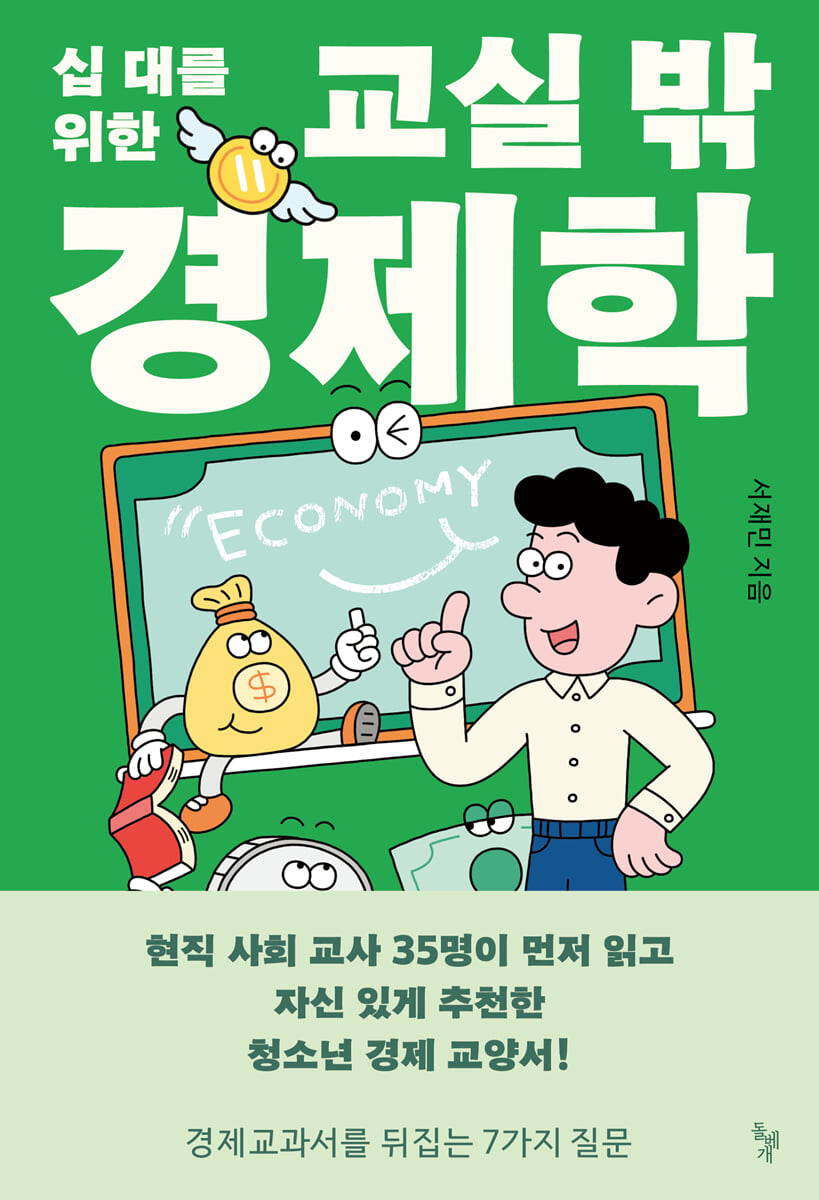
Economics Outside the Classroom for Teens
 |
Description
Book Introduction
★★★ A youth economics textbook that 35 current social studies teachers have read and confidently recommended! ★★★
Does the economics in textbooks accurately reflect reality?
The economic story that young people need to know in their daily lives, and the world will be seen differently once they know it.
Inflation, exchange rates, tariffs, stocks, virtual currency, real estate… … .
The news is full of economic terms every day.
At first glance, these may seem difficult and distant, but they are actually closely connected to the daily lives of teenagers.
"Why do I keep making impulse purchases?" "Why has the price of my favorite cup ramen gone up?" "Why is the US raising tariffs?" "Why is Bitcoin dangerous?" The economy impacts every aspect of young people's lives, from what's on the menu for dinner tonight to their parents' financial activities.
However, economics textbooks do not answer the questions that young people have while watching the news.
Author Jae-min Seo, a current middle school social studies teacher, has included real-world economic stories that textbooks fail to adequately reflect in his book, "Economics Outside the Classroom for Teenagers."
Does the economics presented in textbooks accurately reflect reality? This book begins with this question and examines whether economic knowledge accurately reflects our lives and provides the right direction.
From basic economic concepts like supply and demand, GDP, and capitalism to economic knowledge that young people need to know today, such as exchange rates, finance, labor, the environment, and globalization, we have carefully selected topics to help readers understand economic news in an easy and fun way.
Does the economics in textbooks accurately reflect reality?
The economic story that young people need to know in their daily lives, and the world will be seen differently once they know it.
Inflation, exchange rates, tariffs, stocks, virtual currency, real estate… … .
The news is full of economic terms every day.
At first glance, these may seem difficult and distant, but they are actually closely connected to the daily lives of teenagers.
"Why do I keep making impulse purchases?" "Why has the price of my favorite cup ramen gone up?" "Why is the US raising tariffs?" "Why is Bitcoin dangerous?" The economy impacts every aspect of young people's lives, from what's on the menu for dinner tonight to their parents' financial activities.
However, economics textbooks do not answer the questions that young people have while watching the news.
Author Jae-min Seo, a current middle school social studies teacher, has included real-world economic stories that textbooks fail to adequately reflect in his book, "Economics Outside the Classroom for Teenagers."
Does the economics presented in textbooks accurately reflect reality? This book begins with this question and examines whether economic knowledge accurately reflects our lives and provides the right direction.
From basic economic concepts like supply and demand, GDP, and capitalism to economic knowledge that young people need to know today, such as exchange rates, finance, labor, the environment, and globalization, we have carefully selected topics to help readers understand economic news in an easy and fun way.
- You can preview some of the book's contents.
Preview
index
prolog
Chapter 1: Are we really born as homo economicus?
Chapter 2 Can prices be explained solely by the laws of supply and demand?
Chapter 3: Is the market a free and equal meeting place?
Chapter 4: Is there another real reason why capitalism triumphed?
Chapter 5: Living in a rich country doesn't necessarily mean you're happy?
Chapter 6: Is globalization good for everyone on Earth?
Chapter 7: Will Finance Give Us the Goose That Lays the Golden Eggs?
Epilogue
Recommendation
Chapter 1: Are we really born as homo economicus?
Chapter 2 Can prices be explained solely by the laws of supply and demand?
Chapter 3: Is the market a free and equal meeting place?
Chapter 4: Is there another real reason why capitalism triumphed?
Chapter 5: Living in a rich country doesn't necessarily mean you're happy?
Chapter 6: Is globalization good for everyone on Earth?
Chapter 7: Will Finance Give Us the Goose That Lays the Golden Eggs?
Epilogue
Recommendation
Detailed image
.jpg)
Into the book
An investor who sees a long line of people in front of a franchise restaurant and buys the stock of that franchise company on the spot soon realizes that he has made an irrational choice.
The stock price continued to fall.
As I found out later, the long lines at the restaurant weren't because there were a lot of customers, but because the food took a long time to cook.
The investor made a wrong decision by exaggerating a scene that had nothing to do with the stock's value.
--- p.24
If that's the case, then the lives of the workers who create the value of products should also be enriched, right? Yet, their lives are harsh and without much leisure.
People start working as early as their late teens and continue to work until they retire in their 60s, or even well into their 60s, which exhausts them physically and mentally.
There are also many workers who suffer from chronic occupational diseases or industrial accidents.
Ultimately, we end up in a very confusing situation.
The material abundance of the economic system we live in, the capitalist economy, is all born from labor, so the status of labor is elevated to an unprecedented level.
But at the same time, the situation of the workers who created it with their own hands is not improving at all.
How does this happen?
--- p.57
Even without special circumstances or special policies, the government intervenes deeply in economic affairs.
The Bank of Korea sets the base interest rate every year, controls the money supply, and manages prices.
When stock prices fluctuate sharply, the Financial Supervisory Service may intervene in the financial market.
Economic ministries also monitor the consumption levels and trends of the people, and the Ministry of Health and Welfare also pays attention to unemployment and inequality.
--- p.111
However, not all citizens of countries with large GDP have a high quality of life or are happy.
While gross domestic product is a useful indicator of a country's economic size, it doesn't reveal people's actual lives, quality of life, or happiness.
Why is that?
First of all, there are limitations to the method of calculating GDP.
Housework, leisure, and relationships with others are all very important values in our daily lives, but they are not traded in the market and are therefore not included in gross domestic product.
On the other hand, when traffic accidents or natural disasters occur, the damage to life and property is significant, but the economic activities for treatment and recovery are actually included in the gross domestic product.
Isn't it surprising that things that make people happy aren't included in GDP, but things that make people unhappy are?
--- p.120
Currency is printed by the central banks of each country's government.
The government issues currency to ensure smooth transactions in the market.
And they print money to finance the implementation of their policies.
However, just by printing money, the government has the effect of lowering the value of all the currency held by the people.
The burden of currency issuance is shared by all citizens.
Even though no more taxes were collected, the government has the effect of collecting taxes simply by issuing currency.
So, we can see that it makes no sense to try to solve the price stability problem discussed earlier by placing the responsibility on the people.
--- p.141
Banana republics are countries that depend on banana exports and are dependent on the economies of Europe and the United States.
The United Fruits Company in the United States uses the corrupt government to get preferential treatment in the form of free farmland and low-wage indigenous labor.
Moreover, since bananas are prone to spoilage after just a week, pesticides are indiscriminately sprayed on them, exposing workers to toxic substances and even causing illness.
Plantations prevented the native people from growing crops to feed themselves.
Now we need to grow commodity crops to sell on the world market.
In the process, the mountains and waters of underdeveloped countries are polluted, the ecosystem is destroyed, and workers there are not paid their wages or are pushed to the brink of survival.
Cheap and sweet bananas were the product of enormous sacrifices made by the banana republics and their workers.
The stock price continued to fall.
As I found out later, the long lines at the restaurant weren't because there were a lot of customers, but because the food took a long time to cook.
The investor made a wrong decision by exaggerating a scene that had nothing to do with the stock's value.
--- p.24
If that's the case, then the lives of the workers who create the value of products should also be enriched, right? Yet, their lives are harsh and without much leisure.
People start working as early as their late teens and continue to work until they retire in their 60s, or even well into their 60s, which exhausts them physically and mentally.
There are also many workers who suffer from chronic occupational diseases or industrial accidents.
Ultimately, we end up in a very confusing situation.
The material abundance of the economic system we live in, the capitalist economy, is all born from labor, so the status of labor is elevated to an unprecedented level.
But at the same time, the situation of the workers who created it with their own hands is not improving at all.
How does this happen?
--- p.57
Even without special circumstances or special policies, the government intervenes deeply in economic affairs.
The Bank of Korea sets the base interest rate every year, controls the money supply, and manages prices.
When stock prices fluctuate sharply, the Financial Supervisory Service may intervene in the financial market.
Economic ministries also monitor the consumption levels and trends of the people, and the Ministry of Health and Welfare also pays attention to unemployment and inequality.
--- p.111
However, not all citizens of countries with large GDP have a high quality of life or are happy.
While gross domestic product is a useful indicator of a country's economic size, it doesn't reveal people's actual lives, quality of life, or happiness.
Why is that?
First of all, there are limitations to the method of calculating GDP.
Housework, leisure, and relationships with others are all very important values in our daily lives, but they are not traded in the market and are therefore not included in gross domestic product.
On the other hand, when traffic accidents or natural disasters occur, the damage to life and property is significant, but the economic activities for treatment and recovery are actually included in the gross domestic product.
Isn't it surprising that things that make people happy aren't included in GDP, but things that make people unhappy are?
--- p.120
Currency is printed by the central banks of each country's government.
The government issues currency to ensure smooth transactions in the market.
And they print money to finance the implementation of their policies.
However, just by printing money, the government has the effect of lowering the value of all the currency held by the people.
The burden of currency issuance is shared by all citizens.
Even though no more taxes were collected, the government has the effect of collecting taxes simply by issuing currency.
So, we can see that it makes no sense to try to solve the price stability problem discussed earlier by placing the responsibility on the people.
--- p.141
Banana republics are countries that depend on banana exports and are dependent on the economies of Europe and the United States.
The United Fruits Company in the United States uses the corrupt government to get preferential treatment in the form of free farmland and low-wage indigenous labor.
Moreover, since bananas are prone to spoilage after just a week, pesticides are indiscriminately sprayed on them, exposing workers to toxic substances and even causing illness.
Plantations prevented the native people from growing crops to feed themselves.
Now we need to grow commodity crops to sell on the world market.
In the process, the mountains and waters of underdeveloped countries are polluted, the ecosystem is destroyed, and workers there are not paid their wages or are pushed to the brink of survival.
Cheap and sweet bananas were the product of enormous sacrifices made by the banana republics and their workers.
--- p.173
Publisher's Review
“Why is triangle kimbap 1,000 won?”
“Why does the price of Jjajangmyeon keep rising?”
“When buying stocks, check if the company is eco-friendly?”
『Economics Outside the Classroom for Teens』 is divided into seven chapters based on questions about rational choice, the law of supply and demand, markets, economic systems, inflation, international trade (globalization), and finance that economic textbooks discuss.
Throughout the text, the author, a practicing teacher, brings up examples that teenagers might be curious about in their daily lives and poses questions to help teenagers naturally develop an interest in economics.
At the same time, it faithfully organizes the concepts in the textbook, points out each part that is far from real society, and questions numerous theories that we have accepted as truth.
"Is the market a free and equal place?" "Is trade beneficial to both countries?" "Will living in a rich country make you happy?"
As you turn each page of this book, readers will find themselves shedding the prejudice that economics is difficult and rigid, and reflecting on the meaning of labor, human dignity, and the direction of communal life that lie beyond graphs and numbers.
At the end of each chapter, we included a 'One Step Further' corner.
By reading the topics related to each chapter, such as human altruistic DNA, labor value theory, economic crises and war, the background of the dollar's circulation, and the duality of real estate, you will broaden your perspective on the world and develop a proper understanding of the economy.
Time to look at the economy with new eyes with a social studies teacher!
The first step toward becoming an 'economic citizen'
Recently, there has been a lot of interest in financial investment throughout society.
As evidenced by this trend, voices are growing louder that students are growing up 'financially illiterate' and that proper economic education, especially financial investment education, is needed.
It is clearly problematic that economics textbooks do not adequately reflect the real economy.
However, author Jae-min Seo, who teaches social studies at a middle school, questions whether the movement to bridge the gap between textbooks and reality is directed toward teaching young people how to make money.
"Economics Beyond the Classroom for Teens" brings to light the economic inequality that exists around the world but is obscured by the shadow of capitalism.
For example, economics supports the argument that trade is mutually beneficial through the theory of comparative advantage.
The theory of comparative advantage states that even if one country can produce both goods at a lower cost than another, both countries can benefit by specializing in the good they can produce at a lower cost and then trading.
However, this logic has the problem of obscuring the history of European invasions of Asia, Africa, and South America.
Moreover, although the colonial system appears to have ended on the surface as the countries under colonial rule established independent states after World War II, the relationship of economic dominance and subordination between developed and underdeveloped countries continues amid economic globalization.
Coltan, an essential mineral for electronic products including smartphones, is found in 80% of its reserves in the Democratic Republic of the Congo.
Miners, including children who cannot attend school amid civil war, are forced to work in mines without any protective equipment, while international capital and brokers purchase coltan at less than a tenth of the international price.
I hope that by reading "Economics Beyond the Classroom for Teens," young people will move beyond self-centered economic thinking and become democratic economic citizens who think about themselves, those around them, and even the community.
From the "Prologue"
How can economics education and classes become more relevant to our daily lives? Now, we'll begin to question the assertions made in economics textbooks.
The teacher wants to ask you seven questions that go beyond your economics textbook.
Questions about rational choice, the laws of supply and demand, economic entities, economic systems, economic growth, international trade (globalization), and financial markets, as discussed in economics.
As you create and answer questions, you will begin to see the economic world through new eyes.
As we journey through this time together, I hope we will become closer to becoming economic citizens who dream of a society where we all prosper together.
Now, shall we go on an economic exploration with the teacher?
“Why does the price of Jjajangmyeon keep rising?”
“When buying stocks, check if the company is eco-friendly?”
『Economics Outside the Classroom for Teens』 is divided into seven chapters based on questions about rational choice, the law of supply and demand, markets, economic systems, inflation, international trade (globalization), and finance that economic textbooks discuss.
Throughout the text, the author, a practicing teacher, brings up examples that teenagers might be curious about in their daily lives and poses questions to help teenagers naturally develop an interest in economics.
At the same time, it faithfully organizes the concepts in the textbook, points out each part that is far from real society, and questions numerous theories that we have accepted as truth.
"Is the market a free and equal place?" "Is trade beneficial to both countries?" "Will living in a rich country make you happy?"
As you turn each page of this book, readers will find themselves shedding the prejudice that economics is difficult and rigid, and reflecting on the meaning of labor, human dignity, and the direction of communal life that lie beyond graphs and numbers.
At the end of each chapter, we included a 'One Step Further' corner.
By reading the topics related to each chapter, such as human altruistic DNA, labor value theory, economic crises and war, the background of the dollar's circulation, and the duality of real estate, you will broaden your perspective on the world and develop a proper understanding of the economy.
Time to look at the economy with new eyes with a social studies teacher!
The first step toward becoming an 'economic citizen'
Recently, there has been a lot of interest in financial investment throughout society.
As evidenced by this trend, voices are growing louder that students are growing up 'financially illiterate' and that proper economic education, especially financial investment education, is needed.
It is clearly problematic that economics textbooks do not adequately reflect the real economy.
However, author Jae-min Seo, who teaches social studies at a middle school, questions whether the movement to bridge the gap between textbooks and reality is directed toward teaching young people how to make money.
"Economics Beyond the Classroom for Teens" brings to light the economic inequality that exists around the world but is obscured by the shadow of capitalism.
For example, economics supports the argument that trade is mutually beneficial through the theory of comparative advantage.
The theory of comparative advantage states that even if one country can produce both goods at a lower cost than another, both countries can benefit by specializing in the good they can produce at a lower cost and then trading.
However, this logic has the problem of obscuring the history of European invasions of Asia, Africa, and South America.
Moreover, although the colonial system appears to have ended on the surface as the countries under colonial rule established independent states after World War II, the relationship of economic dominance and subordination between developed and underdeveloped countries continues amid economic globalization.
Coltan, an essential mineral for electronic products including smartphones, is found in 80% of its reserves in the Democratic Republic of the Congo.
Miners, including children who cannot attend school amid civil war, are forced to work in mines without any protective equipment, while international capital and brokers purchase coltan at less than a tenth of the international price.
I hope that by reading "Economics Beyond the Classroom for Teens," young people will move beyond self-centered economic thinking and become democratic economic citizens who think about themselves, those around them, and even the community.
From the "Prologue"
How can economics education and classes become more relevant to our daily lives? Now, we'll begin to question the assertions made in economics textbooks.
The teacher wants to ask you seven questions that go beyond your economics textbook.
Questions about rational choice, the laws of supply and demand, economic entities, economic systems, economic growth, international trade (globalization), and financial markets, as discussed in economics.
As you create and answer questions, you will begin to see the economic world through new eyes.
As we journey through this time together, I hope we will become closer to becoming economic citizens who dream of a society where we all prosper together.
Now, shall we go on an economic exploration with the teacher?
GOODS SPECIFICS
- Date of issue: June 30, 2025
- Page count, weight, size: 220 pages | 360g | 140*204*18mm
- ISBN13: 9791194442295
- ISBN10: 1194442293
You may also like
카테고리
korean


korean

![GQ KOREA Mark (Monthly): December [2025]](http://librairie.coreenne.fr/cdn/shop/files/8ef265dbbfbf186523ed75ba7319009d.jpg?v=1765340328&width=3840)


