

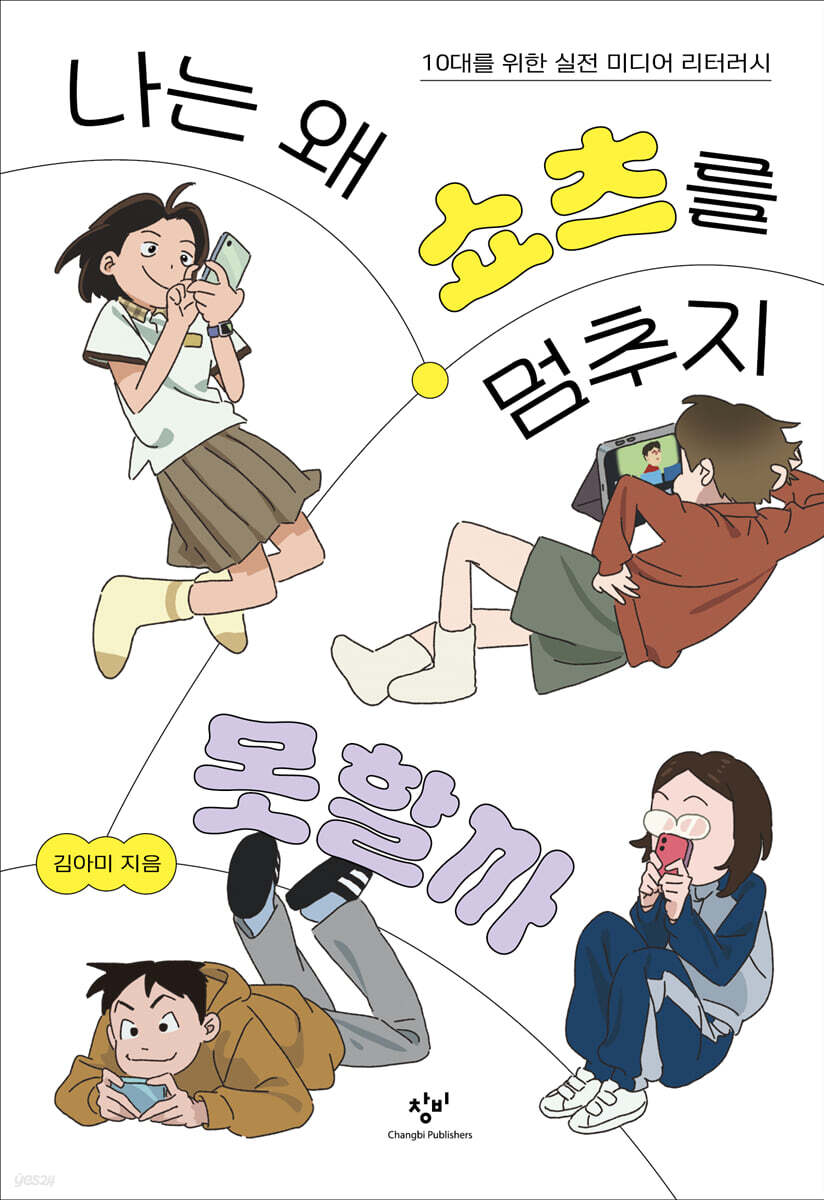
Why can't I stop wearing shorts?
 |
Description
Book Introduction
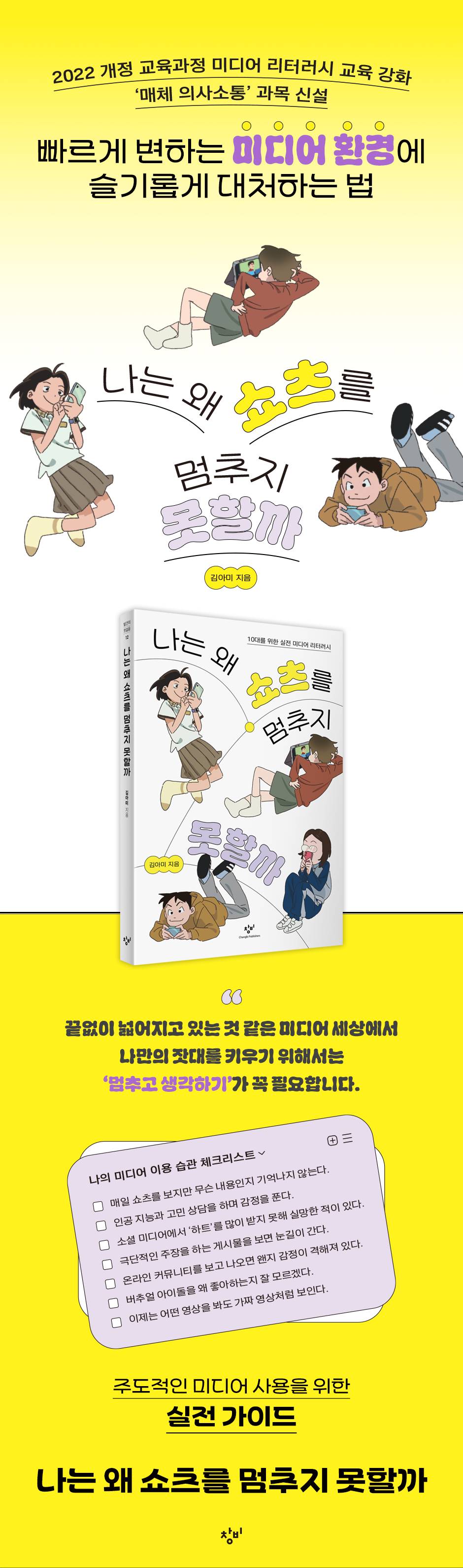
Strengthening Media Literacy Education in the 2022 Revised Curriculum
A practical guide to wisely adapting to the rapidly changing media environment: the newly launched 'Media Communication' course!
How can we overcome our addiction to shorts? Is it safe to consult with artificial intelligence? Kim A-mi, who has studied media culture by examining the media lives of children and adolescents, has published a media literacy textbook titled "Why Can't I Stop Wearing Shorts" (First Step to Discovery 12).
This is a heartwarming book written by a researcher who directly communicated with children and adolescents, reflecting on their media experiences and safe online environments, and who also participated in writing the 2022 revised curriculum textbook, "Media Communication."
In this book, the author discusses cutting-edge media environments that have not been well covered in media literacy books, such as short-form media, virtual idols, and interactive artificial intelligence.
It touches on topics that teenagers experience on a daily basis but have not yet thought about the meaning and problems of, such as why watching five shorts is more tiring than watching one long video of the same length, whether there are risks in consulting with conversational AI, and the background of the emergence of virtual idols.
This book is like a friend, kindly informing you on how to proactively use and enjoy media in a rapidly changing media environment where new technologies emerge every day.
A practical guide to wisely adapting to the rapidly changing media environment: the newly launched 'Media Communication' course!
How can we overcome our addiction to shorts? Is it safe to consult with artificial intelligence? Kim A-mi, who has studied media culture by examining the media lives of children and adolescents, has published a media literacy textbook titled "Why Can't I Stop Wearing Shorts" (First Step to Discovery 12).
This is a heartwarming book written by a researcher who directly communicated with children and adolescents, reflecting on their media experiences and safe online environments, and who also participated in writing the 2022 revised curriculum textbook, "Media Communication."
In this book, the author discusses cutting-edge media environments that have not been well covered in media literacy books, such as short-form media, virtual idols, and interactive artificial intelligence.
It touches on topics that teenagers experience on a daily basis but have not yet thought about the meaning and problems of, such as why watching five shorts is more tiring than watching one long video of the same length, whether there are risks in consulting with conversational AI, and the background of the emergence of virtual idols.
This book is like a friend, kindly informing you on how to proactively use and enjoy media in a rapidly changing media environment where new technologies emerge every day.
- You can preview some of the book's contents.
Preview
index
Entering
Checklist for Smart Media Use
Part 1: Me Online, Us Online
Part 2: Shorter, More Provocative
Part 3: What You'll Encounter in the Digital World
Part 4: New Technologies, New Questions
Coming out
References
Photo source
Checklist for Smart Media Use
Part 1: Me Online, Us Online
Part 2: Shorter, More Provocative
Part 3: What You'll Encounter in the Digital World
Part 4: New Technologies, New Questions
Coming out
References
Photo source
Detailed image
Into the book
I hope that media is not something that you "shouldn't use beyond a certain time," but something that you "use proactively and learn with purpose and intention."
To do so, we need to understand the characteristics of the media environment surrounding us and adopt an attitude that allows us to step back and view our experiences in the media.
--- pp.5-6
It's hard to see the number of "Likes" as simply evidence of how many people like what I say and sympathize with me.
When I post about my peaceful daily life, my friends who see it might think I'm doing well and just skip the like button.
A 'like' from a few people who care about me and are considerate of me can be more powerful than a 'like' from many people without much meaning, or even a 'like' from a few people who send me support.
--- pp.19-20
Online friends are met anonymously, away from the real-world environment.
So it might actually lead to a more genuine relationship.
Just as with offline friends, I hope you feel a sense of responsibility towards your online friends and try to resolve conflicts rather than avoiding them.
--- p.31
If you see problems occurring on social media and act and implement alternative solutions, it could become a new culture in the social media space.
If such a culture becomes widespread, media platform companies may be able to add new features to help solve the problem.
--- p.46
If you enjoy watching short-form videos so much that it's hard to set aside time, I recommend thinking back to the short-form videos you've seen.
Get into the habit of closing the window you're watching a short-form video in and then thinking back to what you remember.
If you don't remember anything, it means you've been watching short-form videos out of habit.
It's a little disappointing.
It might be worth considering whether the enjoyment that short-form video provides can be achieved through other media.
--- p.62
Recommendation algorithms are usually designed to keep users on media platforms for a long time.
It's about continuing to provide content that users will be interested in and spend time on.
In this way, there is a risk that the user's thoughts will be too biased to one side.
--- p.74
Most teenagers probably use memes for the fun of imitating and modifying them, rather than attaching any serious meaning to them.
But when individuals use memes, they can also collectively play a social role.
A socially influential meme can influence the behavior or thinking of the group that shares it.
This is why we need to be wary of memes that contain hateful elements.
--- p.88
Rather than viewing age-based barriers to content access as regulations or restrictions, why not examine our society's age standards and reflect on their implications? If you were to assign an age rating to the content you encounter, it might be worthwhile to discuss with your friends what rating you would give and why.
Perhaps age ratings can help you develop a critical eye for media.
--- pp.104-105
I hope we can think together about how we can prevent voices that attack specific targets, such as online hate speech.
Respecting other people's opinions, not excluding them just because they are different from mine, and sometimes having the courage to express my thoughts.
These efforts can come together to create an online communication culture where we can all comfortably voice our opinions.
--- p.115
When considering the connection to deepfake sexual exploitation crimes, one might think that deepfake technology is value-neutral, meaning it can be used for either good or bad purposes, depending on the user's intention.
On the other hand, it can be seen that the technology called deepfake has a tendency to guide human behavior, making it easier to violate the human rights of others, such as by creating fabricated materials using other people's information.
What do you guys think?
--- p.140
When we communicate with one another, we as humans maintain the minimum social standards that do not infringe upon the rights and dignity of others.
However, current artificial intelligence lacks or lacks such social good.
What does it mean to communicate with an irresponsible entity? What boundaries should we demand and guide AI technologies to follow?
--- p.151
The practice of imposing excessive standards of appearance on underage idols, encouraging them to engage in extreme dieting, is becoming a growing issue. Is it desirable to create unrealistic bodies and appearances through virtual idols? If virtual humans, like virtual idols, are created in greater numbers and coexist with us, we need to pay close attention to how they will be portrayed.
--- p.161
You are both a user of media and a creator of media.
In the future, you may become someone who plans or develops media platforms, or someone who creates and shares media content or information.
Some of you may already be doing that.
I hope and support that you, as the owners of the media environment, will not be swayed by trends, but rather create your own unique voice, and that we will dream of a healthy media environment where we respect each other's perspectives and communicate.
To do so, we need to understand the characteristics of the media environment surrounding us and adopt an attitude that allows us to step back and view our experiences in the media.
--- pp.5-6
It's hard to see the number of "Likes" as simply evidence of how many people like what I say and sympathize with me.
When I post about my peaceful daily life, my friends who see it might think I'm doing well and just skip the like button.
A 'like' from a few people who care about me and are considerate of me can be more powerful than a 'like' from many people without much meaning, or even a 'like' from a few people who send me support.
--- pp.19-20
Online friends are met anonymously, away from the real-world environment.
So it might actually lead to a more genuine relationship.
Just as with offline friends, I hope you feel a sense of responsibility towards your online friends and try to resolve conflicts rather than avoiding them.
--- p.31
If you see problems occurring on social media and act and implement alternative solutions, it could become a new culture in the social media space.
If such a culture becomes widespread, media platform companies may be able to add new features to help solve the problem.
--- p.46
If you enjoy watching short-form videos so much that it's hard to set aside time, I recommend thinking back to the short-form videos you've seen.
Get into the habit of closing the window you're watching a short-form video in and then thinking back to what you remember.
If you don't remember anything, it means you've been watching short-form videos out of habit.
It's a little disappointing.
It might be worth considering whether the enjoyment that short-form video provides can be achieved through other media.
--- p.62
Recommendation algorithms are usually designed to keep users on media platforms for a long time.
It's about continuing to provide content that users will be interested in and spend time on.
In this way, there is a risk that the user's thoughts will be too biased to one side.
--- p.74
Most teenagers probably use memes for the fun of imitating and modifying them, rather than attaching any serious meaning to them.
But when individuals use memes, they can also collectively play a social role.
A socially influential meme can influence the behavior or thinking of the group that shares it.
This is why we need to be wary of memes that contain hateful elements.
--- p.88
Rather than viewing age-based barriers to content access as regulations or restrictions, why not examine our society's age standards and reflect on their implications? If you were to assign an age rating to the content you encounter, it might be worthwhile to discuss with your friends what rating you would give and why.
Perhaps age ratings can help you develop a critical eye for media.
--- pp.104-105
I hope we can think together about how we can prevent voices that attack specific targets, such as online hate speech.
Respecting other people's opinions, not excluding them just because they are different from mine, and sometimes having the courage to express my thoughts.
These efforts can come together to create an online communication culture where we can all comfortably voice our opinions.
--- p.115
When considering the connection to deepfake sexual exploitation crimes, one might think that deepfake technology is value-neutral, meaning it can be used for either good or bad purposes, depending on the user's intention.
On the other hand, it can be seen that the technology called deepfake has a tendency to guide human behavior, making it easier to violate the human rights of others, such as by creating fabricated materials using other people's information.
What do you guys think?
--- p.140
When we communicate with one another, we as humans maintain the minimum social standards that do not infringe upon the rights and dignity of others.
However, current artificial intelligence lacks or lacks such social good.
What does it mean to communicate with an irresponsible entity? What boundaries should we demand and guide AI technologies to follow?
--- p.151
The practice of imposing excessive standards of appearance on underage idols, encouraging them to engage in extreme dieting, is becoming a growing issue. Is it desirable to create unrealistic bodies and appearances through virtual idols? If virtual humans, like virtual idols, are created in greater numbers and coexist with us, we need to pay close attention to how they will be portrayed.
--- p.161
You are both a user of media and a creator of media.
In the future, you may become someone who plans or develops media platforms, or someone who creates and shares media content or information.
Some of you may already be doing that.
I hope and support that you, as the owners of the media environment, will not be swayed by trends, but rather create your own unique voice, and that we will dream of a healthy media environment where we respect each other's perspectives and communicate.
--- p.166
Publisher's Review
To the youth who will create a better media world
Kind and thoughtful advice and encouragement
Adults often try to control and limit teenagers' use of media such as social media and YouTube.
However, the author of this book, Kim A-mi, hopes that young people will use media proactively with purpose and intention, rather than thinking of it as something that "should not be used beyond a certain time."
To use media proactively, it is necessary to step back from media experience and understand the characteristics and environment of the media.
Therefore, the author recommends that we develop the habit of stopping and thinking when experiencing media.
Media platforms, seeking to increase users' dwell time in pursuit of profit, provide endless information and content, making it difficult to 'stop'.
However, we can only lead a wise and useful media life by escaping the deluge of media algorithms and reflecting and contemplating.
The author urges us to proactively choose and control our media by asking ourselves why we like this media, what experiences we want to have from it, and what stories we are not exposed to through it.
Furthermore, I advise people to cultivate the habit of respecting others in the media world and to imagine how media could change in the future.
For young people who are creating a new media culture while using media, this book will serve as a practical guide for a fun and healthy media life.
The rapidly changing media environment
In the midst of emerging technologies
How to Live a Healthy and Proactive Media Life
Author Kim A-mi provides concrete and realistic guidance on the various problems and coping strategies surrounding youth in the media environment.
Part 1, “Online Me, Online Us,” covers online communities and online relationships familiar to young people.
It contains practical advice for a healthy online life, including how making friends online differs from making friends offline, and how to choose the social media you use.
Part 2, 'Shorter, More Provocative', discusses the latest online culture and environment, including short-form media and 'memes'.
A detailed guide to short-form media, including the problems of short-form videos and how to prevent addiction, and a vivid analysis of meme culture, including copyright issues regarding memes, provide an opportunity to reexamine the media we habitually use.
The emergence of new technologies like artificial intelligence chatbots and the development of new platforms like Netflix are creating a different media environment than before.
In this changing media environment, unexpected problems arise.
Part 3, "What We Encounter in the Digital World," addresses the issues of age distinctions becoming meaningless, exposing children and adolescents to harmful content, voices expressing extreme opinions gaining attention, and the rigidification of thinking due to recommendation algorithms.
Furthermore, it specifically explains how to overcome such problems and utilize media in a useful and ethical manner.
Part 4, "New Technologies, New Questions," delves into new media technologies that have emerged in our daily lives in recent years, such as deepfakes, conversational artificial intelligence, and virtual reality.
Recently, with the popularization of ChatGPTI, the number of people seeking advice from artificial intelligence has increased.
Meanwhile, virtual idol 'Playb' took first place on a music show, making virtual idols and their culture known.
These new technologies offer us new pleasures, but they also come with side effects.
Problems are emerging, such as people being incited to take their own lives while talking to artificial intelligence, or people severely harassing virtual idols who don't show their faces.
This book answers the new questions raised by new media technologies and meticulously considers a media culture that respects diversity from the perspective of young readers.
A colorful composition of checklists, comics, activities, etc.
A great book to read together during Korean language and social studies classes
"Why Can't I Stop Wearing Shorts" includes a "Checklist for Wise Media Use" in the introduction, allowing teenagers to review their media usage habits.
Additionally, we inserted interesting cartoons of episodes at the beginning of each chapter to help young people who are unfamiliar with reading easily approach the book.
From stories about meeting unexpected online friends to staying up all night watching shorts only to watch them again, Yoon Jae-an's witty comics vividly portray the media lives of today's youth.
Additionally, the questions in the 'Let's Think Together' activity inserted at the end of each chapter help young people practically examine and reflect on their media lives.
These are also perfect questions for discussion in the classroom during class time.
With its diverse composition and rich content, "Why Can't I Stop Wearing Shorts" is a great book to read and discuss together in classes like "Media Communication" or "Society and Culture."
Kind and thoughtful advice and encouragement
Adults often try to control and limit teenagers' use of media such as social media and YouTube.
However, the author of this book, Kim A-mi, hopes that young people will use media proactively with purpose and intention, rather than thinking of it as something that "should not be used beyond a certain time."
To use media proactively, it is necessary to step back from media experience and understand the characteristics and environment of the media.
Therefore, the author recommends that we develop the habit of stopping and thinking when experiencing media.
Media platforms, seeking to increase users' dwell time in pursuit of profit, provide endless information and content, making it difficult to 'stop'.
However, we can only lead a wise and useful media life by escaping the deluge of media algorithms and reflecting and contemplating.
The author urges us to proactively choose and control our media by asking ourselves why we like this media, what experiences we want to have from it, and what stories we are not exposed to through it.
Furthermore, I advise people to cultivate the habit of respecting others in the media world and to imagine how media could change in the future.
For young people who are creating a new media culture while using media, this book will serve as a practical guide for a fun and healthy media life.
The rapidly changing media environment
In the midst of emerging technologies
How to Live a Healthy and Proactive Media Life
Author Kim A-mi provides concrete and realistic guidance on the various problems and coping strategies surrounding youth in the media environment.
Part 1, “Online Me, Online Us,” covers online communities and online relationships familiar to young people.
It contains practical advice for a healthy online life, including how making friends online differs from making friends offline, and how to choose the social media you use.
Part 2, 'Shorter, More Provocative', discusses the latest online culture and environment, including short-form media and 'memes'.
A detailed guide to short-form media, including the problems of short-form videos and how to prevent addiction, and a vivid analysis of meme culture, including copyright issues regarding memes, provide an opportunity to reexamine the media we habitually use.
The emergence of new technologies like artificial intelligence chatbots and the development of new platforms like Netflix are creating a different media environment than before.
In this changing media environment, unexpected problems arise.
Part 3, "What We Encounter in the Digital World," addresses the issues of age distinctions becoming meaningless, exposing children and adolescents to harmful content, voices expressing extreme opinions gaining attention, and the rigidification of thinking due to recommendation algorithms.
Furthermore, it specifically explains how to overcome such problems and utilize media in a useful and ethical manner.
Part 4, "New Technologies, New Questions," delves into new media technologies that have emerged in our daily lives in recent years, such as deepfakes, conversational artificial intelligence, and virtual reality.
Recently, with the popularization of ChatGPTI, the number of people seeking advice from artificial intelligence has increased.
Meanwhile, virtual idol 'Playb' took first place on a music show, making virtual idols and their culture known.
These new technologies offer us new pleasures, but they also come with side effects.
Problems are emerging, such as people being incited to take their own lives while talking to artificial intelligence, or people severely harassing virtual idols who don't show their faces.
This book answers the new questions raised by new media technologies and meticulously considers a media culture that respects diversity from the perspective of young readers.
A colorful composition of checklists, comics, activities, etc.
A great book to read together during Korean language and social studies classes
"Why Can't I Stop Wearing Shorts" includes a "Checklist for Wise Media Use" in the introduction, allowing teenagers to review their media usage habits.
Additionally, we inserted interesting cartoons of episodes at the beginning of each chapter to help young people who are unfamiliar with reading easily approach the book.
From stories about meeting unexpected online friends to staying up all night watching shorts only to watch them again, Yoon Jae-an's witty comics vividly portray the media lives of today's youth.
Additionally, the questions in the 'Let's Think Together' activity inserted at the end of each chapter help young people practically examine and reflect on their media lives.
These are also perfect questions for discussion in the classroom during class time.
With its diverse composition and rich content, "Why Can't I Stop Wearing Shorts" is a great book to read and discuss together in classes like "Media Communication" or "Society and Culture."
GOODS SPECIFICS
- Date of issue: June 27, 2025
- Page count, weight, size: 172 pages | 306g | 135*195*13mm
- ISBN13: 9788936453329
You may also like
카테고리
korean


korean

![GQ KOREA Mark (Monthly): December [2025]](http://librairie.coreenne.fr/cdn/shop/files/8ef265dbbfbf186523ed75ba7319009d.jpg?v=1765340328&width=3840)


