

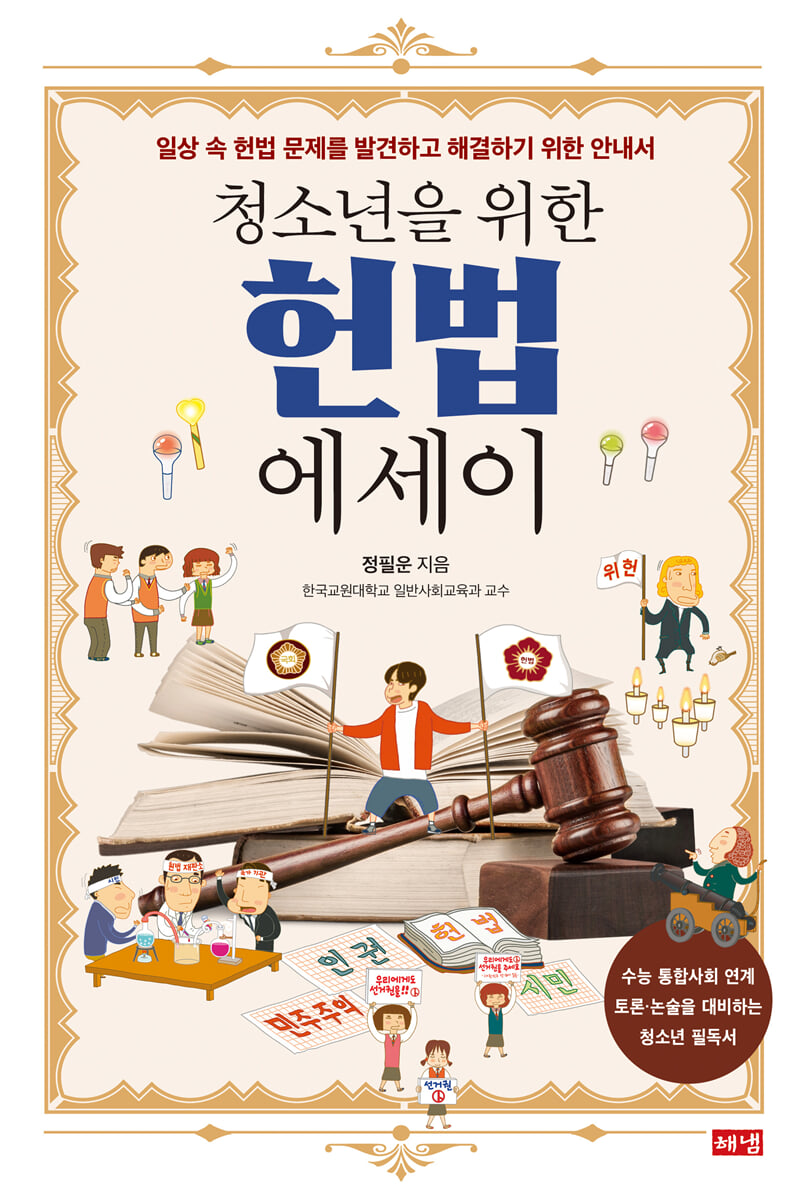
Constitutional Essay for Youth
 |
Description
Book Introduction
The President has no will to uphold the Constitution? What does the Constitutional Court do?
From the birth of the modern constitution to the history of the Constitution of the Republic of Korea and actual case law
Living Constitutional Stories from the Classroom and Everyday Life
“The benefit of protecting the Constitution by impeaching the accused is so great that it outweighs the national loss.” In 2017 and 2025, the Constitutional Court impeached two presidents.
The biggest reason was ‘lack of will to protect the Constitution.’
Citizens who felt Article 1, Paragraph 2 of the Constitution, which states, “The sovereignty of the Republic of Korea resides in the people, and all state authority emanates from the people,” realized the importance of the Constitution, and even held a copying meeting to purchase related books and copy each and every provision.
Some have argued that the Constitution should be included as an independent subject in the secondary education curriculum so that the youth who will lead the future of the Republic of Korea understand its importance.
Now, with the Constitution receiving more attention than ever, Professor Pil-Woon Jeong of the Department of General Social Education at Korea National University of Education has written “Constitutional Essays for Youth.”
The author, who is the president of the Korean Educational Law Association and has written textbooks such as “Middle School Social Studies” and “High School Politics and Law,” is working to improve the rights of youth in legal education.
This book was written with the hope that it would help young people discover problems in their daily lives and those of their communities, and develop the ability to understand and solve them from a constitutional perspective.
From the birth of the modern constitution to the history of the Constitution of the Republic of Korea and actual case law
Living Constitutional Stories from the Classroom and Everyday Life
“The benefit of protecting the Constitution by impeaching the accused is so great that it outweighs the national loss.” In 2017 and 2025, the Constitutional Court impeached two presidents.
The biggest reason was ‘lack of will to protect the Constitution.’
Citizens who felt Article 1, Paragraph 2 of the Constitution, which states, “The sovereignty of the Republic of Korea resides in the people, and all state authority emanates from the people,” realized the importance of the Constitution, and even held a copying meeting to purchase related books and copy each and every provision.
Some have argued that the Constitution should be included as an independent subject in the secondary education curriculum so that the youth who will lead the future of the Republic of Korea understand its importance.
Now, with the Constitution receiving more attention than ever, Professor Pil-Woon Jeong of the Department of General Social Education at Korea National University of Education has written “Constitutional Essays for Youth.”
The author, who is the president of the Korean Educational Law Association and has written textbooks such as “Middle School Social Studies” and “High School Politics and Law,” is working to improve the rights of youth in legal education.
This book was written with the hope that it would help young people discover problems in their daily lives and those of their communities, and develop the ability to understand and solve them from a constitutional perspective.
- You can preview some of the book's contents.
Preview
index
Introduction | Dive into the sea of the Constitution!
Chapter 1.
You want to know the identity of the Constitution?
1.
What we call the Constitution
2.
How the Constitution Differs from Other Laws
3.
A moment in world history when the Constitution was born
4.
Until the Constitution was created and developed
5.
From the state of nature to the rebirth of human beings as citizens
- Interesting Constitutional Cases: Is the Constitution Perfectly Wasteful? | Conventional Constitutional Cases
Chapter 2.
Introducing the Constitution of the Republic of Korea
1.
The day the Republic of Korea began to be called a democratic republic
2.
The highest value pursued by our Constitution
3.
Basic Principle of the Constitution 1: The Principle of Democracy
4.
Basic Principle of the Constitution 2: The Principle of the Rule of Law
5.
The three basic principles of the Constitution: the welfare state principle, the cultural state principle, and the pacifist principle.
Interesting Constitutional Case: Does the President's Entourage Sway the Nation? | Park Geun-hye's Impeachment
Chapter 3.
The Constitution that protects our human rights
1.
Basic human rights stipulated in the Constitution
2.
What the Constitution pursues as its top priority: human dignity and value, the right to pursue happiness, and the right to equality.
3.
Liberty and suffrage for free human beings
4.
Actively demand claims and social rights from the state
5.
If restrictions on fundamental rights are necessary
Interesting Constitutional Case: What is the Minimum Space Required for Inmates? | The Case of the Detention Center's Kaljam
Chapter 4.
The Constitution reveals the country.
1.
Let's share power to guarantee human rights: the principle of separation of powers
2.
Different government forms in different countries: parliamentary system, presidential system, and bicameral system
3.
The composition and operation of the National Assembly, where citizens' representatives determine national will.
4.
The President and the Executive Branch enforce the laws made by the National Assembly.
5.
The courts and the Constitutional Court resolve disputes by applying laws created by citizens and the National Assembly.
- Interesting Constitutional Cases: Who is the Guardian of the Constitution? | The Weimar Republic and the Republic of Korea
Chapter 5.
What if the Constitution and fundamental rights have been violated? Take it to the Constitutional Court!
1.
Why the Constitutional Court is So Often in the News
2.
Unconstitutionality judgment to determine whether a law violates the Constitution
3.
When you become aware of a violation of your fundamental rights, file a constitutional complaint
4.
Protecting the Constitution from High-ranking Officials through Impeachment Trials
5.
Protecting the Constitution from Unconstitutional Political Parties: Judgment on the Dissolution of Political Parties
6.
Resolve disputes between government agencies through adjudication of disputes over authority
- Interesting Constitutional Cases: Who is the Guardian of the Constitution? | The Weimar Republic and the Republic of Korea
Chapter 6.
The constitution we will participate in and create
1.
The systematic thinking method of a constitutional scholar
2.
A constitution in which youth are the main actors
3.
The sovereignty of the Republic of Korea resides in the people.
- Interesting Constitutional Case: Forcing Students to Attend Religious Ceremonies? | Religious Education in Private High Schools
Articles | Let's Swim Freely in the Sea of the Constitution
Americas | References | Index
Chapter 1.
You want to know the identity of the Constitution?
1.
What we call the Constitution
2.
How the Constitution Differs from Other Laws
3.
A moment in world history when the Constitution was born
4.
Until the Constitution was created and developed
5.
From the state of nature to the rebirth of human beings as citizens
- Interesting Constitutional Cases: Is the Constitution Perfectly Wasteful? | Conventional Constitutional Cases
Chapter 2.
Introducing the Constitution of the Republic of Korea
1.
The day the Republic of Korea began to be called a democratic republic
2.
The highest value pursued by our Constitution
3.
Basic Principle of the Constitution 1: The Principle of Democracy
4.
Basic Principle of the Constitution 2: The Principle of the Rule of Law
5.
The three basic principles of the Constitution: the welfare state principle, the cultural state principle, and the pacifist principle.
Interesting Constitutional Case: Does the President's Entourage Sway the Nation? | Park Geun-hye's Impeachment
Chapter 3.
The Constitution that protects our human rights
1.
Basic human rights stipulated in the Constitution
2.
What the Constitution pursues as its top priority: human dignity and value, the right to pursue happiness, and the right to equality.
3.
Liberty and suffrage for free human beings
4.
Actively demand claims and social rights from the state
5.
If restrictions on fundamental rights are necessary
Interesting Constitutional Case: What is the Minimum Space Required for Inmates? | The Case of the Detention Center's Kaljam
Chapter 4.
The Constitution reveals the country.
1.
Let's share power to guarantee human rights: the principle of separation of powers
2.
Different government forms in different countries: parliamentary system, presidential system, and bicameral system
3.
The composition and operation of the National Assembly, where citizens' representatives determine national will.
4.
The President and the Executive Branch enforce the laws made by the National Assembly.
5.
The courts and the Constitutional Court resolve disputes by applying laws created by citizens and the National Assembly.
- Interesting Constitutional Cases: Who is the Guardian of the Constitution? | The Weimar Republic and the Republic of Korea
Chapter 5.
What if the Constitution and fundamental rights have been violated? Take it to the Constitutional Court!
1.
Why the Constitutional Court is So Often in the News
2.
Unconstitutionality judgment to determine whether a law violates the Constitution
3.
When you become aware of a violation of your fundamental rights, file a constitutional complaint
4.
Protecting the Constitution from High-ranking Officials through Impeachment Trials
5.
Protecting the Constitution from Unconstitutional Political Parties: Judgment on the Dissolution of Political Parties
6.
Resolve disputes between government agencies through adjudication of disputes over authority
- Interesting Constitutional Cases: Who is the Guardian of the Constitution? | The Weimar Republic and the Republic of Korea
Chapter 6.
The constitution we will participate in and create
1.
The systematic thinking method of a constitutional scholar
2.
A constitution in which youth are the main actors
3.
The sovereignty of the Republic of Korea resides in the people.
- Interesting Constitutional Case: Forcing Students to Attend Religious Ceremonies? | Religious Education in Private High Schools
Articles | Let's Swim Freely in the Sea of the Constitution
Americas | References | Index
Detailed image

Into the book
A constitution is a contract that outlines the terms agreed upon by the people of a country to form and operate its national institutions.
Only on the basis of these contracts are national institutions established and operated.
(Omitted) The law has a step-by-step structure.
At the very top is the 'Constitution'.
Below that are the 'laws' enacted by the National Assembly.
And below that, there are orders enacted by the President of the executive branch to enforce the law (Presidential Decree, in practice mostly Enforcement Decree of the ○○ Act), and orders enacted by the Prime Minister or heads of administrative departments (the former is Prime Minister's Decree, the latter is Ministerial Decree, in legal practice mostly Enforcement Regulation of the ○○ Act).
The Constitution is the highest law of the country, so the idea that all state organs must be organized and operated in accordance with the Constitution is called constitutionalism.
This supremacy of the Constitution makes it more difficult to amend than ordinary laws.
---From "1-1 What We Call the Constitution"
The ability to enjoy the basic rights guaranteed by our Constitution is called ‘basic rights capacity.’
The constitutional scholars and the Constitutional Court recognize that not only Korean nationals but also foreigners without nationality have the capacity for fundamental rights in certain cases.
The ability of a person with this basic right capacity to specifically exercise basic rights is called the 'capacity to exercise basic rights.'
(Omitted) Our current law grants voting rights only to citizens aged 18 or older in elections for local council members, heads of local governments, and superintendents of education.
But to justify this, one must be able to justify not recognizing the exercise of voting rights by those who do not have the proper capacity to do so, even if they have the basic capacity to do so.
Do high school students have the ability to judge among the many candidates for superintendent of education who will do a good job for education? Furthermore, is it democratically justifiable to conduct superintendent elections that largely exclude students, who are most impacted by education policy?
---From "3-3 For Free Humans: Liberty and Suffrage"
At a meeting about forming a high school student council, Seongcheol said that if Sangyoon could do the job of the finance director well, even if he was the student council president, they could both take on the role.
However, Ha-yoon insisted that Sang-yoon should not be appointed as the head of the finance department as he was already the student body president.
If this meeting was about the composition and operation of our country's national institutions, Ha-yoon's words would be more appropriate than Seong-cheol's.
When members of one state organ become members of another state organ, power becomes concentrated and leads to abuse, and when power is abused, civil liberties are violated.
---From "4-1 Let's Share Power to Guarantee Human Rights: The Principle of Separation of Powers"
The Constitutional Court, as an institution empowered to authoritatively interpret the Constitution, has the authority and mission to faithfully implement the Constitution's functions in the process of resolving conflicts and confrontations.
(Omitted) In our country, constitutional trials are conducted by independent institutions distinct from general courts, such as the Constitutional Court or the Constitutional Committee.
Just as when a new school quarantine issue arises due to the COVID-19 pandemic, if a new school official is appointed to take charge of the task, the likelihood of that person carrying out the work systematically increases, an independent body dedicated to constitutional adjudication conducts various constitutional trials, including prior norm control, abstract norm control, and constitutional petitions, and formulates and adjudicates on procedural laws appropriate to each type of constitutional adjudication.
---From "5-1 Reasons Why the Constitutional Court Appears Frequently in the News"
We can read the following as we look at the process of granting the right to vote to 18-year-olds:
First, as time passes, the reality we live in changes, and our thoughts change as well.
We have an environment that respects young people and their opinions more than ever before.
Above all, young people do not hesitate to assert their rights.
(Omitted) Second, considering the reality that many advanced countries, including the United States, the United Kingdom, France, Germany, and Japan, grant voting rights to those over 18 years of age, we, as citizens of the Republic of Korea, need to live with the same sense.
(Omitted) Finally, you too must now become citizens who know what human rights you have and actively assert them.
---From “6-2 A Constitution Subject to Youth”
In our constitutional history, three candlelight vigils in recent years have changed the course of state affairs.
(Omitted) Candlelight vigils are in line with participatory democracy, which seeks to implement substantive democracy through citizen participation, and direct democracy, which seeks for citizens to directly decide national will.
This spirit is in line with the preamble of our Constitution, which states, “We will inherit the legitimacy of the Provisional Government of the Republic of Korea established through the March 1st Movement and the democratic ideology of the April 19 Revolution that resisted injustice.”
Therefore, there is no reason to view candlelight vigils like this negatively just because our Constitution upholds the principle of representative democracy.
Rather, it is necessary to view it positively as an act that concretizes and actualizes national sovereignty.
Only on the basis of these contracts are national institutions established and operated.
(Omitted) The law has a step-by-step structure.
At the very top is the 'Constitution'.
Below that are the 'laws' enacted by the National Assembly.
And below that, there are orders enacted by the President of the executive branch to enforce the law (Presidential Decree, in practice mostly Enforcement Decree of the ○○ Act), and orders enacted by the Prime Minister or heads of administrative departments (the former is Prime Minister's Decree, the latter is Ministerial Decree, in legal practice mostly Enforcement Regulation of the ○○ Act).
The Constitution is the highest law of the country, so the idea that all state organs must be organized and operated in accordance with the Constitution is called constitutionalism.
This supremacy of the Constitution makes it more difficult to amend than ordinary laws.
---From "1-1 What We Call the Constitution"
The ability to enjoy the basic rights guaranteed by our Constitution is called ‘basic rights capacity.’
The constitutional scholars and the Constitutional Court recognize that not only Korean nationals but also foreigners without nationality have the capacity for fundamental rights in certain cases.
The ability of a person with this basic right capacity to specifically exercise basic rights is called the 'capacity to exercise basic rights.'
(Omitted) Our current law grants voting rights only to citizens aged 18 or older in elections for local council members, heads of local governments, and superintendents of education.
But to justify this, one must be able to justify not recognizing the exercise of voting rights by those who do not have the proper capacity to do so, even if they have the basic capacity to do so.
Do high school students have the ability to judge among the many candidates for superintendent of education who will do a good job for education? Furthermore, is it democratically justifiable to conduct superintendent elections that largely exclude students, who are most impacted by education policy?
---From "3-3 For Free Humans: Liberty and Suffrage"
At a meeting about forming a high school student council, Seongcheol said that if Sangyoon could do the job of the finance director well, even if he was the student council president, they could both take on the role.
However, Ha-yoon insisted that Sang-yoon should not be appointed as the head of the finance department as he was already the student body president.
If this meeting was about the composition and operation of our country's national institutions, Ha-yoon's words would be more appropriate than Seong-cheol's.
When members of one state organ become members of another state organ, power becomes concentrated and leads to abuse, and when power is abused, civil liberties are violated.
---From "4-1 Let's Share Power to Guarantee Human Rights: The Principle of Separation of Powers"
The Constitutional Court, as an institution empowered to authoritatively interpret the Constitution, has the authority and mission to faithfully implement the Constitution's functions in the process of resolving conflicts and confrontations.
(Omitted) In our country, constitutional trials are conducted by independent institutions distinct from general courts, such as the Constitutional Court or the Constitutional Committee.
Just as when a new school quarantine issue arises due to the COVID-19 pandemic, if a new school official is appointed to take charge of the task, the likelihood of that person carrying out the work systematically increases, an independent body dedicated to constitutional adjudication conducts various constitutional trials, including prior norm control, abstract norm control, and constitutional petitions, and formulates and adjudicates on procedural laws appropriate to each type of constitutional adjudication.
---From "5-1 Reasons Why the Constitutional Court Appears Frequently in the News"
We can read the following as we look at the process of granting the right to vote to 18-year-olds:
First, as time passes, the reality we live in changes, and our thoughts change as well.
We have an environment that respects young people and their opinions more than ever before.
Above all, young people do not hesitate to assert their rights.
(Omitted) Second, considering the reality that many advanced countries, including the United States, the United Kingdom, France, Germany, and Japan, grant voting rights to those over 18 years of age, we, as citizens of the Republic of Korea, need to live with the same sense.
(Omitted) Finally, you too must now become citizens who know what human rights you have and actively assert them.
---From “6-2 A Constitution Subject to Youth”
In our constitutional history, three candlelight vigils in recent years have changed the course of state affairs.
(Omitted) Candlelight vigils are in line with participatory democracy, which seeks to implement substantive democracy through citizen participation, and direct democracy, which seeks for citizens to directly decide national will.
This spirit is in line with the preamble of our Constitution, which states, “We will inherit the legitimacy of the Provisional Government of the Republic of Korea established through the March 1st Movement and the democratic ideology of the April 19 Revolution that resisted injustice.”
Therefore, there is no reason to view candlelight vigils like this negatively just because our Constitution upholds the principle of representative democracy.
Rather, it is necessary to view it positively as an act that concretizes and actualizes national sovereignty.
---From “6-3 The sovereignty of the Republic of Korea resides in the people”
Publisher's Review
The President has no will to uphold the Constitution? What does the Constitutional Court do?
From the birth of the modern constitution to the history of the Constitution of the Republic of Korea and actual case law
Living Constitutional Stories from the Classroom and Everyday Life
“The benefit of protecting the Constitution by impeaching the accused is so great that it outweighs the national loss.” In 2017 and 2025, the Constitutional Court impeached two presidents.
The biggest reason was ‘lack of will to protect the Constitution.’
Citizens who felt Article 1, Paragraph 2 of the Constitution, which states, “The sovereignty of the Republic of Korea resides in the people, and all state authority emanates from the people,” realized the importance of the Constitution, and even held a copying meeting to purchase related books and copy each and every provision.
Some have argued that the Constitution should be included as an independent subject in the secondary education curriculum so that the youth who will lead the future of the Republic of Korea understand its importance.
Now, with the Constitution receiving more attention than ever, Professor Pil-Woon Jeong of the Department of General Social Education at Korea National University of Education has written “Constitutional Essays for Youth.”
The author, who is the president of the Korean Educational Law Association and has written textbooks such as “Middle School Social Studies” and “High School Politics and Law,” is working to improve the rights of youth in legal education.
This book was written with the hope that it would help young people discover problems in their daily lives and those of their communities, and develop the ability to understand and solve them from a constitutional perspective.
A must-read for becoming a wise democratic citizen
This book covers the history and basic principles of the Constitution of the Republic of Korea, the birth of the modern Constitution, the types of fundamental rights protected by the Constitution, youth voting rights and political participation, and interesting actual case law in six chapters.
Chapter 1, "Want to know the true nature of constitutions?" examines the emergence and development of modern constitutions, including France's "Declaration of the Rights of Man and of the Citizen," the United States' "Written Constitution," Germany's "Weimar Constitution," and the United Kingdom's "Petition of Rights," amidst the global historical shift from absolute monarchy to modern statehood.
Chapter 2, "Introducing the Constitution of the Republic of Korea," introduces the "Gimi Declaration of Independence," announced during the March 1st Movement in 1919, which played a decisive role in the establishment of the Provisional Government of the Republic of Korea. It also explains the fundamental principles of the Korean Constitution: democracy, the rule of law, a welfare state, a cultural state, and pacifism.
Chapter 3, “The Constitution That Protects Our Human Rights,” examines the most fundamental reason for the existence of the Constitution.
These are the 'fundamental rights' guaranteed in Articles 10 through 36, including human dignity and value, the right to pursue happiness, the right to equality, the right to freedom, and the right to vote.
We also carefully examine the right to life and the right to self-determination of personal information, which are not listed in the Constitution but are recognized as fundamental rights through interpretation.
Chapter 4, "The Constitution Shows the Nation," provides an understanding of the principle of separation of powers, and introduces government systems from around the world, including the parliamentary system, presidential system, and dual executive system. It also explores the history of the evolution of our country's government, which combines elements of the presidential system with the parliamentary system.
Chapter 5, "What if the Constitution and Fundamental Rights Have Been Violated? To the Constitutional Court!" discusses the importance of the Constitutional Court, which unifies social conflicts and confrontations.
It deals with constitutional review, constitutional petition review, impeachment review, political party dissolution review, and authority dispute review, which are executed to punish violations of citizens' basic rights or violations of the Constitution in the operation of state institutions.
The final chapter, Chapter 6, "The Constitution We Participate in and Create," is the core of this book, and deals with the story of a constitution that young people actively and proactively create.
In particular, with the age for joining a political party lowered from 18 to 16 in 2022, new challenges have emerged, such as comprehensive civic education in schools and the establishment of elaborate school regulations.
Each chapter begins with a high school student discussing a topic that young people are actually curious about, such as whether the student body president can also be the treasurer, naturally leading young readers to recognize it as their own problem.
At the end of each chapter, the "Interesting Constitutional Cases" section introduces actual precedents, such as the compulsory religious education in private high schools and the impeachment of President Park Geun-hye, providing an opportunity for individuals to reflect on constitutional issues that have been hotly debated in society.
In addition, the "Easy and Correct Reading of the March 1st Independence Declaration," which is a translation of the March 1st Independence Declaration, and the full text of the Constitution of the Republic of Korea are included as QR codes, allowing you to reflect on the meaning of each article.
If you know the Constitution well, you can design this society a little more beautifully.
The Constitution is no longer confined to a thick code of laws.
It is not the exclusive domain of constitutional experts or a specific class.
Concepts such as 'democracy,' 'rule of law,' 'fundamental rights,' and 'sovereignty' should not be legal terms divorced from the lives of individuals, but should become everyday language that we experience in our daily lives.
This is the 'normativity of life' that this book emphasizes as a characteristic of the Constitution that naturally permeates our daily lives.
The author hopes that through this book, young people will be able to develop a 'constitutional mindset.'
This constitutional mindset goes beyond simply accepting the provisions of the Constitution as knowledge; it is the ability to judge events that occur in class meetings, in relationships with friends, and in everyday life from a constitutional perspective.
A constitutional mindset allows young people to discern why inhumane and unreasonable actions, such as human rights violations by the state or illegal acts by politicians and high-ranking public officials, are wrong. Furthermore, it empowers young people to voice their opinions through various means, such as petitions and participation in rallies.
This book, the 27th book in the Haeneum Youth Essay Series, a representative domestic youth series that fosters creativity and thinking skills in youth, is written by an author who is an expert in constitutional education, and is introduced with commentary and abundant case law at a level suitable for youth, so any youth who wants to become familiar with the Constitution can read it.
Additionally, it can be used as a vivid legal education guide by social studies teachers who teach human dignity and values in educational settings, and it will be an invaluable guide not only for constitutional education but also for democratic citizenship education.
From the birth of the modern constitution to the history of the Constitution of the Republic of Korea and actual case law
Living Constitutional Stories from the Classroom and Everyday Life
“The benefit of protecting the Constitution by impeaching the accused is so great that it outweighs the national loss.” In 2017 and 2025, the Constitutional Court impeached two presidents.
The biggest reason was ‘lack of will to protect the Constitution.’
Citizens who felt Article 1, Paragraph 2 of the Constitution, which states, “The sovereignty of the Republic of Korea resides in the people, and all state authority emanates from the people,” realized the importance of the Constitution, and even held a copying meeting to purchase related books and copy each and every provision.
Some have argued that the Constitution should be included as an independent subject in the secondary education curriculum so that the youth who will lead the future of the Republic of Korea understand its importance.
Now, with the Constitution receiving more attention than ever, Professor Pil-Woon Jeong of the Department of General Social Education at Korea National University of Education has written “Constitutional Essays for Youth.”
The author, who is the president of the Korean Educational Law Association and has written textbooks such as “Middle School Social Studies” and “High School Politics and Law,” is working to improve the rights of youth in legal education.
This book was written with the hope that it would help young people discover problems in their daily lives and those of their communities, and develop the ability to understand and solve them from a constitutional perspective.
A must-read for becoming a wise democratic citizen
This book covers the history and basic principles of the Constitution of the Republic of Korea, the birth of the modern Constitution, the types of fundamental rights protected by the Constitution, youth voting rights and political participation, and interesting actual case law in six chapters.
Chapter 1, "Want to know the true nature of constitutions?" examines the emergence and development of modern constitutions, including France's "Declaration of the Rights of Man and of the Citizen," the United States' "Written Constitution," Germany's "Weimar Constitution," and the United Kingdom's "Petition of Rights," amidst the global historical shift from absolute monarchy to modern statehood.
Chapter 2, "Introducing the Constitution of the Republic of Korea," introduces the "Gimi Declaration of Independence," announced during the March 1st Movement in 1919, which played a decisive role in the establishment of the Provisional Government of the Republic of Korea. It also explains the fundamental principles of the Korean Constitution: democracy, the rule of law, a welfare state, a cultural state, and pacifism.
Chapter 3, “The Constitution That Protects Our Human Rights,” examines the most fundamental reason for the existence of the Constitution.
These are the 'fundamental rights' guaranteed in Articles 10 through 36, including human dignity and value, the right to pursue happiness, the right to equality, the right to freedom, and the right to vote.
We also carefully examine the right to life and the right to self-determination of personal information, which are not listed in the Constitution but are recognized as fundamental rights through interpretation.
Chapter 4, "The Constitution Shows the Nation," provides an understanding of the principle of separation of powers, and introduces government systems from around the world, including the parliamentary system, presidential system, and dual executive system. It also explores the history of the evolution of our country's government, which combines elements of the presidential system with the parliamentary system.
Chapter 5, "What if the Constitution and Fundamental Rights Have Been Violated? To the Constitutional Court!" discusses the importance of the Constitutional Court, which unifies social conflicts and confrontations.
It deals with constitutional review, constitutional petition review, impeachment review, political party dissolution review, and authority dispute review, which are executed to punish violations of citizens' basic rights or violations of the Constitution in the operation of state institutions.
The final chapter, Chapter 6, "The Constitution We Participate in and Create," is the core of this book, and deals with the story of a constitution that young people actively and proactively create.
In particular, with the age for joining a political party lowered from 18 to 16 in 2022, new challenges have emerged, such as comprehensive civic education in schools and the establishment of elaborate school regulations.
Each chapter begins with a high school student discussing a topic that young people are actually curious about, such as whether the student body president can also be the treasurer, naturally leading young readers to recognize it as their own problem.
At the end of each chapter, the "Interesting Constitutional Cases" section introduces actual precedents, such as the compulsory religious education in private high schools and the impeachment of President Park Geun-hye, providing an opportunity for individuals to reflect on constitutional issues that have been hotly debated in society.
In addition, the "Easy and Correct Reading of the March 1st Independence Declaration," which is a translation of the March 1st Independence Declaration, and the full text of the Constitution of the Republic of Korea are included as QR codes, allowing you to reflect on the meaning of each article.
If you know the Constitution well, you can design this society a little more beautifully.
The Constitution is no longer confined to a thick code of laws.
It is not the exclusive domain of constitutional experts or a specific class.
Concepts such as 'democracy,' 'rule of law,' 'fundamental rights,' and 'sovereignty' should not be legal terms divorced from the lives of individuals, but should become everyday language that we experience in our daily lives.
This is the 'normativity of life' that this book emphasizes as a characteristic of the Constitution that naturally permeates our daily lives.
The author hopes that through this book, young people will be able to develop a 'constitutional mindset.'
This constitutional mindset goes beyond simply accepting the provisions of the Constitution as knowledge; it is the ability to judge events that occur in class meetings, in relationships with friends, and in everyday life from a constitutional perspective.
A constitutional mindset allows young people to discern why inhumane and unreasonable actions, such as human rights violations by the state or illegal acts by politicians and high-ranking public officials, are wrong. Furthermore, it empowers young people to voice their opinions through various means, such as petitions and participation in rallies.
This book, the 27th book in the Haeneum Youth Essay Series, a representative domestic youth series that fosters creativity and thinking skills in youth, is written by an author who is an expert in constitutional education, and is introduced with commentary and abundant case law at a level suitable for youth, so any youth who wants to become familiar with the Constitution can read it.
Additionally, it can be used as a vivid legal education guide by social studies teachers who teach human dignity and values in educational settings, and it will be an invaluable guide not only for constitutional education but also for democratic citizenship education.
GOODS SPECIFICS
- Date of issue: June 20, 2025
- Page count, weight, size: 308 pages | 542g | 152*223*30mm
- ISBN13: 9791167141194
- ISBN10: 1167141199
You may also like
카테고리
korean


korean

![GQ KOREA Mark (Monthly): December [2025]](http://librairie.coreenne.fr/cdn/shop/files/8ef265dbbfbf186523ed75ba7319009d.jpg?v=1765340328&width=3840)


