

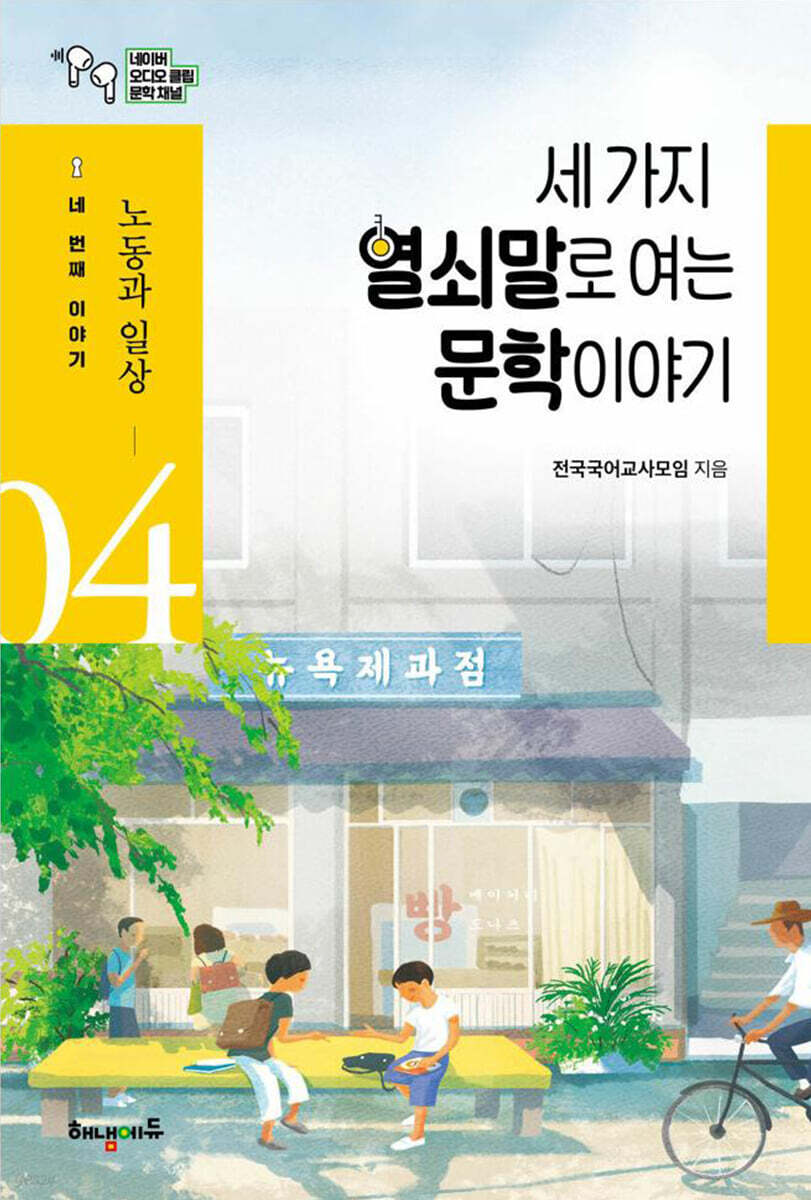
Literary Stories Opened with Three Keywords, Part 4
 |
Description
Book Introduction
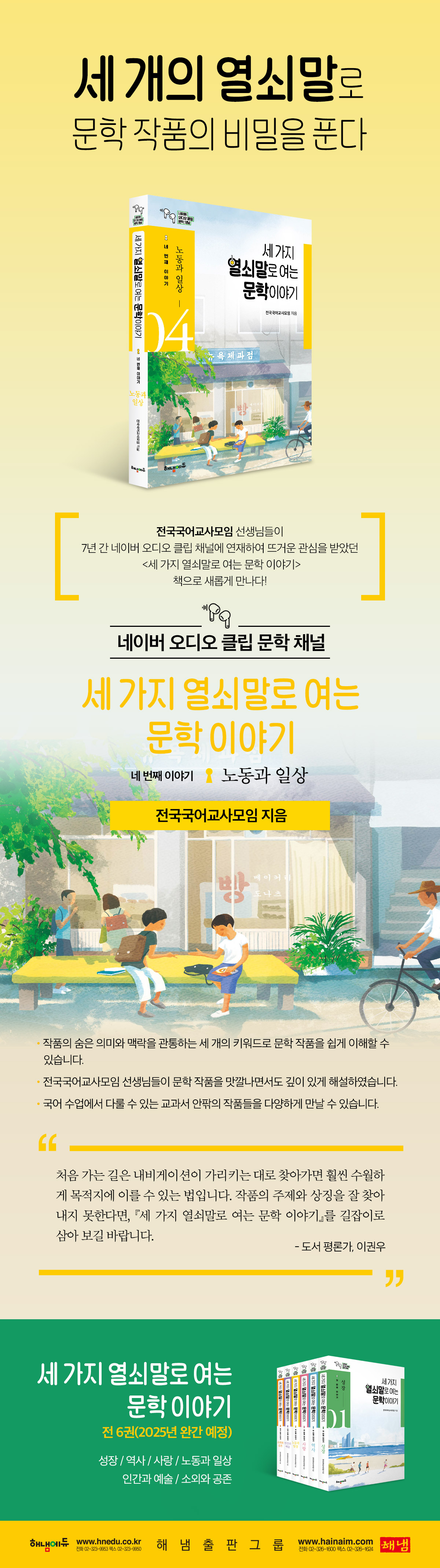
The National Association of Korean Language Teachers analyzed it with three keywords:
The Fourth Story in the Commentary on Must-Read Literature for Youth: "Labor and Everyday Life"
Since 2018, the National Korean Language Teachers Association has been consistently introducing various literary works through in-depth and engaging commentary on the Naver Audio Clip channel, "Literary Stories Opened with Three Keyword Words."
The series, “Literary Stories Opened with Three Keyword Words,” is a new compilation of recordings made over seven years for young people and general readers who enjoy literature.
This book extracts three keywords that are essential for understanding a literary work and develops the story around them.
Keywords extracted by Korean language teachers teaching literature in schools shine like stars, revealing the hidden meaning of literary works.
Even though it is a sharp and profound literary criticism and commentary, readers feel as if they are listening to a chatterbox, because the tone of conversation, as if sitting face to face with someone and having a lively conversation, is alive and well in the book.
The Fourth Story in the Commentary on Must-Read Literature for Youth: "Labor and Everyday Life"
Since 2018, the National Korean Language Teachers Association has been consistently introducing various literary works through in-depth and engaging commentary on the Naver Audio Clip channel, "Literary Stories Opened with Three Keyword Words."
The series, “Literary Stories Opened with Three Keyword Words,” is a new compilation of recordings made over seven years for young people and general readers who enjoy literature.
This book extracts three keywords that are essential for understanding a literary work and develops the story around them.
Keywords extracted by Korean language teachers teaching literature in schools shine like stars, revealing the hidden meaning of literary works.
Even though it is a sharp and profound literary criticism and commentary, readers feel as if they are listening to a chatterbox, because the tone of conversation, as if sitting face to face with someone and having a lively conversation, is alive and well in the book.
- You can preview some of the book's contents.
Preview
index
Part 1: The Weight of Everyday Life
Choi Jin-young / Sunday
Kim Yeon-su / New York Bakery
Lee Moon-gu / Our neighborhood Hwang clan
Yang Gui-ja/ On rainy days, you must go to Garibong-dong.
Jo Jung-rae / Magic Hand
Hyundeok/Namsaengi
Kim Seung-ok / History
Hwang Seok-yeong / The Road to Sampo
Im Seong-sun / Mall:Mall:沒
Seo Yu-mi/ That's not even a person
Jang Ryu-jin / I will live well
Kim Hoon / Bicycle Travel
Part 2: Labor Days
Kim Kyung-wook / McDonald's Shooting Operation
Yoon Heung-gil / Wings or Handcuffs
Jang Gang-myeong/Cutting part-time workers
Kim Hak-chan/ How about a full bun?
Choi Il-nam/ Two Mules
Seo Yu-mi/Snowman
Lee Byeong-seung / The Fox's Garden
Jo Se-hee / The thornfish that comes into my net
Kim Young-hyun / A long, long time ago
Pyeon Hye-young / 20th Century Resume
Jang Ryu-jin/ somewhat low
Move/Sand
Kim Geum-hee/Jo Jung-gyun's World
Metaphor/The Death of an Unknown Child
Part 3: The Face of Poverty
Jo Se-hee / A small ball shot by a dwarf
Jo Hae-il / People who die every day
Kim Ae-ran / A Proud Life
Hyun Jin-geon / Lucky Day
Gye Yong-muk / Henda the Star
Kim So-jin / Open Society and Its Enemies
Kim Jeong-han / Sandbar Story
Na Do-hyang/ Haengrang's child
Kang Kyung-ae/ Salt
Kim Yoo-jung/Manmubang
Choi Seo-hae / Escape
Kim Ae-ran / Goliath in the Water
Choi Jin-young / Sunday
Kim Yeon-su / New York Bakery
Lee Moon-gu / Our neighborhood Hwang clan
Yang Gui-ja/ On rainy days, you must go to Garibong-dong.
Jo Jung-rae / Magic Hand
Hyundeok/Namsaengi
Kim Seung-ok / History
Hwang Seok-yeong / The Road to Sampo
Im Seong-sun / Mall:Mall:沒
Seo Yu-mi/ That's not even a person
Jang Ryu-jin / I will live well
Kim Hoon / Bicycle Travel
Part 2: Labor Days
Kim Kyung-wook / McDonald's Shooting Operation
Yoon Heung-gil / Wings or Handcuffs
Jang Gang-myeong/Cutting part-time workers
Kim Hak-chan/ How about a full bun?
Choi Il-nam/ Two Mules
Seo Yu-mi/Snowman
Lee Byeong-seung / The Fox's Garden
Jo Se-hee / The thornfish that comes into my net
Kim Young-hyun / A long, long time ago
Pyeon Hye-young / 20th Century Resume
Jang Ryu-jin/ somewhat low
Move/Sand
Kim Geum-hee/Jo Jung-gyun's World
Metaphor/The Death of an Unknown Child
Part 3: The Face of Poverty
Jo Se-hee / A small ball shot by a dwarf
Jo Hae-il / People who die every day
Kim Ae-ran / A Proud Life
Hyun Jin-geon / Lucky Day
Gye Yong-muk / Henda the Star
Kim So-jin / Open Society and Its Enemies
Kim Jeong-han / Sandbar Story
Na Do-hyang/ Haengrang's child
Kang Kyung-ae/ Salt
Kim Yoo-jung/Manmubang
Choi Seo-hae / Escape
Kim Ae-ran / Goliath in the Water
Detailed image
Into the book
Material civilization is meant to make people's lives more abundant and comfortable.
However, we live without even realizing the irony that the development of this material civilization is actually alienating and making people unhappy.
It's a society where people who are having fun and communicating on their smartphones suddenly feel empty, where people feel powerless in front of kiosks and are shown to be inconsiderate, and where people who fail to adapt to the rapid changes of the times feel like they are each at fault.
Civilization continues to evolve, but the mind seems to be getting smaller and smaller.
---p.44 (from Jo Jeong-rae's "The Magic Hand")
Another Chinese character in the title, '沒 (mol)', is usually used to mean 'to fall into water'.
Why did the author use the Chinese character "沒" (沒) in the title? The novel features a scene where the protagonist pulls his hand through the rubble, reminiscent of someone grabbing the hand of someone drowning.
Although the body is not visible, the protagonist's desperate gesture of clasping his hands together and pulling them with a desperate heart, as if to say hello, seems like a desperate struggle to save a drowning person.
---p.71 (Im Seong-sun/Mall:Mall:沒)
Now that Hye-mi has everything she wants, will she ever be happy? She's afraid of losing her money, she's plagued by debt collectors, her ankles hurt, and there's no one around to comfort her.
This is where Hye-mi's situation comes into play.
The cunning side of me that desperately wanted to take care of what was mine may have been an inevitable choice for survival.
It's more like a survival skill that irregular young people have to learn while working various part-time jobs and being forced into unfair working conditions.
Have your thoughts on Hye-mi changed a little now?
---p.123 (Jang Kang-myeong/ Cutting part-time workers)
The author points out that in a work environment and culture where youth labor is not protected, no one's work is safe.
Anyone who is thrown into an unfamiliar environment, such as changing jobs, being assigned to a new department, or taking on a new job, becomes an intern, and at this time, everyone must go through a transition period called 'adaptation.'
The death of a field trainee is no longer something you only see in the newspaper.
The suffering of all beings is connected.
---p.204 (Metaphor/ From The Death of an Unknown Child)
When I talk about this work with students, they connect the novel so well with their current situation.
Just like the Yongsan disaster in 2009, the issue of displaced residents is being repeated, and the images of Young-soo and Young-ho can be seen in the images of workers climbing up cranes to protest the company's unfair employment practices.
When will the day come when we can explain the setting of this novel and say, "It used to be like this"? I hope that the day will come when, instead of reading this work as a mirror reflecting our own reflections on the slums of today's society, we will be able to live up to its name in Haengbok-dong, Nakwon-gu.
---p.215 (Jo Se-hee/ A small ball shot by a dwarf)
As is obvious, as times change, the standards for what constitutes 'normal' also change.
Even with a lot of effort, it has become difficult to live and maintain a life that meets the standards of 'normal'.
Even my mother, who seemed to be living a normal life, ultimately couldn't maintain that lifestyle.
Living in a time when the standards of 'normal' have changed from those of our parents' generation, 'I' and my sister may not even be able to live the 'normal' life that my mother gave 'me'.
However, it is clear that even though I may not be able to meet the standards of what people call 'normal' right now, I am trying hard to live a 'normal' life, hoping that tomorrow will be better than today.
However, we live without even realizing the irony that the development of this material civilization is actually alienating and making people unhappy.
It's a society where people who are having fun and communicating on their smartphones suddenly feel empty, where people feel powerless in front of kiosks and are shown to be inconsiderate, and where people who fail to adapt to the rapid changes of the times feel like they are each at fault.
Civilization continues to evolve, but the mind seems to be getting smaller and smaller.
---p.44 (from Jo Jeong-rae's "The Magic Hand")
Another Chinese character in the title, '沒 (mol)', is usually used to mean 'to fall into water'.
Why did the author use the Chinese character "沒" (沒) in the title? The novel features a scene where the protagonist pulls his hand through the rubble, reminiscent of someone grabbing the hand of someone drowning.
Although the body is not visible, the protagonist's desperate gesture of clasping his hands together and pulling them with a desperate heart, as if to say hello, seems like a desperate struggle to save a drowning person.
---p.71 (Im Seong-sun/Mall:Mall:沒)
Now that Hye-mi has everything she wants, will she ever be happy? She's afraid of losing her money, she's plagued by debt collectors, her ankles hurt, and there's no one around to comfort her.
This is where Hye-mi's situation comes into play.
The cunning side of me that desperately wanted to take care of what was mine may have been an inevitable choice for survival.
It's more like a survival skill that irregular young people have to learn while working various part-time jobs and being forced into unfair working conditions.
Have your thoughts on Hye-mi changed a little now?
---p.123 (Jang Kang-myeong/ Cutting part-time workers)
The author points out that in a work environment and culture where youth labor is not protected, no one's work is safe.
Anyone who is thrown into an unfamiliar environment, such as changing jobs, being assigned to a new department, or taking on a new job, becomes an intern, and at this time, everyone must go through a transition period called 'adaptation.'
The death of a field trainee is no longer something you only see in the newspaper.
The suffering of all beings is connected.
---p.204 (Metaphor/ From The Death of an Unknown Child)
When I talk about this work with students, they connect the novel so well with their current situation.
Just like the Yongsan disaster in 2009, the issue of displaced residents is being repeated, and the images of Young-soo and Young-ho can be seen in the images of workers climbing up cranes to protest the company's unfair employment practices.
When will the day come when we can explain the setting of this novel and say, "It used to be like this"? I hope that the day will come when, instead of reading this work as a mirror reflecting our own reflections on the slums of today's society, we will be able to live up to its name in Haengbok-dong, Nakwon-gu.
---p.215 (Jo Se-hee/ A small ball shot by a dwarf)
As is obvious, as times change, the standards for what constitutes 'normal' also change.
Even with a lot of effort, it has become difficult to live and maintain a life that meets the standards of 'normal'.
Even my mother, who seemed to be living a normal life, ultimately couldn't maintain that lifestyle.
Living in a time when the standards of 'normal' have changed from those of our parents' generation, 'I' and my sister may not even be able to live the 'normal' life that my mother gave 'me'.
However, it is clear that even though I may not be able to meet the standards of what people call 'normal' right now, I am trying hard to live a 'normal' life, hoping that tomorrow will be better than today.
---p.227~228 (Kim Ae-ran/A Dauntless Life)
Publisher's Review
The power of keywords that penetrate the core of a literary work!
In the revised 2022 curriculum, the purpose of literature courses is to cultivate students' ability to accept and produce works through diverse literary experiences and activities, broaden their understanding of humanity and the world, and cultivate an attitude that allows them to live as active participants in literary activities.
In schools, teachers aim to achieve this by providing students with various forms of literature classes and activities, but there are limitations to covering all the countless literary works available through numerous textbooks and media.
"Literary Stories Opened with Three Keyword Words" was planned to help schools like this.
In 2018, the National Association of Korean Language Teachers uploaded commentaries on literary works to Naver Audio Clip, ensuring that this content would be helpful not only for students but also for general readers to understand literary works.
There are many ways to interpret a literary work, but to avoid overwhelming readers, we have established a clear concept called 'three keywords', or 'key words'.
Keywords that penetrate the hidden meaning and context of the work guide readers to the core of the work.
In this process, readers develop the ability to extract their own keywords and interpret any literary work they encounter.
The recently published “Literary Stories Opened with Three Keyword” series, “The Fourth Story_Labor and Daily Life,” introduces literary works that explore the small joys and breakdowns of our daily lives in Part 1, the value and meaning of labor to maintain daily life in Part 2, and the lives of the socially disadvantaged in Part 3.
Through this book, readers will not only be able to enhance their literary appreciation skills, but will also be able to feel the warm comfort that literature offers.
In the revised 2022 curriculum, the purpose of literature courses is to cultivate students' ability to accept and produce works through diverse literary experiences and activities, broaden their understanding of humanity and the world, and cultivate an attitude that allows them to live as active participants in literary activities.
In schools, teachers aim to achieve this by providing students with various forms of literature classes and activities, but there are limitations to covering all the countless literary works available through numerous textbooks and media.
"Literary Stories Opened with Three Keyword Words" was planned to help schools like this.
In 2018, the National Association of Korean Language Teachers uploaded commentaries on literary works to Naver Audio Clip, ensuring that this content would be helpful not only for students but also for general readers to understand literary works.
There are many ways to interpret a literary work, but to avoid overwhelming readers, we have established a clear concept called 'three keywords', or 'key words'.
Keywords that penetrate the hidden meaning and context of the work guide readers to the core of the work.
In this process, readers develop the ability to extract their own keywords and interpret any literary work they encounter.
The recently published “Literary Stories Opened with Three Keyword” series, “The Fourth Story_Labor and Daily Life,” introduces literary works that explore the small joys and breakdowns of our daily lives in Part 1, the value and meaning of labor to maintain daily life in Part 2, and the lives of the socially disadvantaged in Part 3.
Through this book, readers will not only be able to enhance their literary appreciation skills, but will also be able to feel the warm comfort that literature offers.
GOODS SPECIFICS
- Date of issue: May 2, 2025
- Page count, weight, size: 296 pages | 540g | 152*225*17mm
- ISBN13: 9788964462676
- ISBN10: 896446267X
You may also like
카테고리
korean


korean

![GQ KOREA Mark (Monthly): December [2025]](http://librairie.coreenne.fr/cdn/shop/files/8ef265dbbfbf186523ed75ba7319009d.jpg?v=1765340328&width=3840)


