

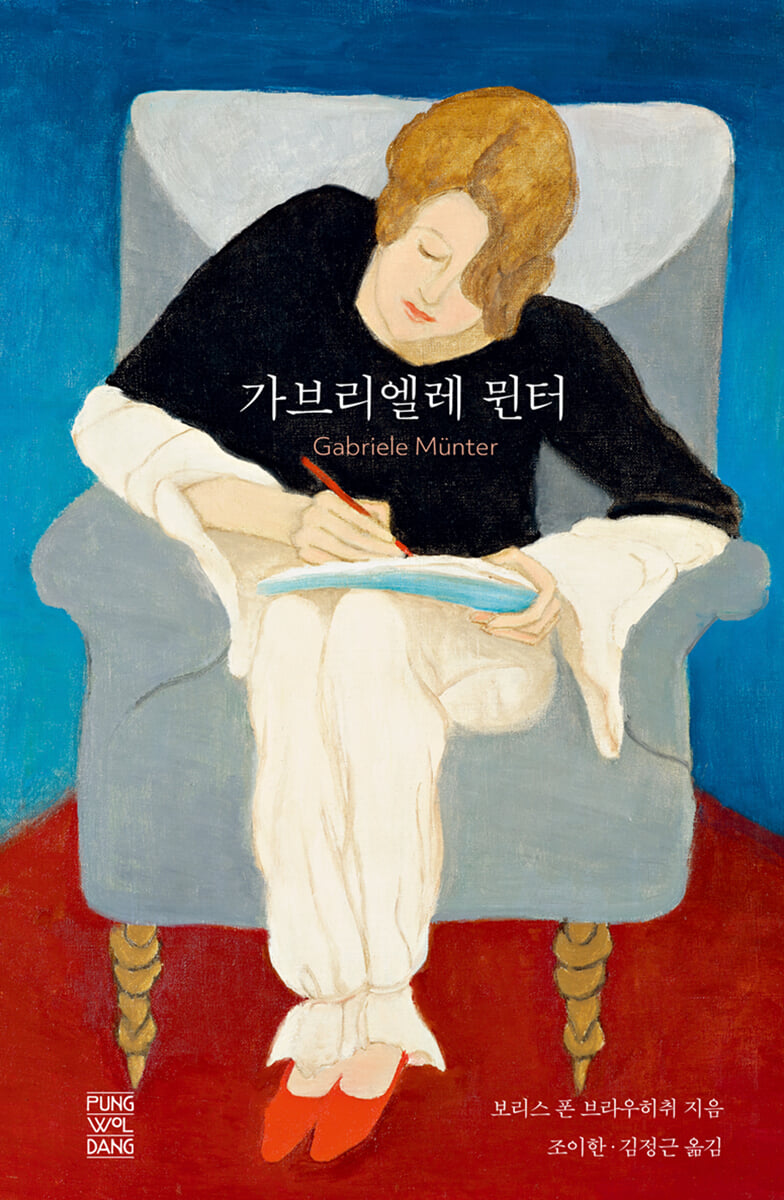
Gabriele Münter
 |
Description
Book Introduction
Alongside Kandinsky, Paul Klee, and Franz Marc
He led modern art and created his own figurative paintings.
The Life and Works of Gabriele Münter
“A true portrait is impossible without respect for humanity.”
Going through the great currents of modern art
The quiet power of unstoppable freedom
“There was a painter who, though outwardly unremarkable, could speak with certainty about art, raise serious questions, and withstand criticism with coolness.
She was strong, and she was a thorough artist, but her strength lay in her stillness.
“A dramatic appearance didn’t suit her.”
As Impressionism faded and a new era began, we shed light on the life and works of Gabriele Münter, a German female artist who spearheaded the birth of modern art.
Münter created a unique and distinctive world of figurative painting, without being swept away by the great current of modern art called abstraction.
Why did it take so long for these artists to be recognized as 'artists'?
Gabriele Münter lived in an era when female artists were disparaged as "female revellers" and "natural amateurs."
Moreover, art history still describes the meeting with Kandinsky as a major event, explaining that Münter was unilaterally influenced by Kandinsky.
It was not until the 1950s, when she was in her 70s, that she began to receive renewed attention and seemed to be at a turning point.
However, this reduces Münter to a peripheral figure in the German expressionist group 'Der Blaue Reiter' centered around Kandinsky.
This book dispels these misconceptions and negative assessments surrounding Gabriele Münter and focuses on her independent life.
Despite the limitations of her time and humanity, she silently but boldly experimented freely in her own way.
In particular, Münter, even while a student of Kandinsky, showed talents that surpassed his in drawing, photography, and printmaking.
Looking at Münter's works included in this book, one can clearly sense his eye for the unusual, his sense of humor, and his affection for everyday objects and landscapes.
This book reassesses Gabriele Münter's influence on later art, thereby giving her her rightful place in art history.
He led modern art and created his own figurative paintings.
The Life and Works of Gabriele Münter
“A true portrait is impossible without respect for humanity.”
Going through the great currents of modern art
The quiet power of unstoppable freedom
“There was a painter who, though outwardly unremarkable, could speak with certainty about art, raise serious questions, and withstand criticism with coolness.
She was strong, and she was a thorough artist, but her strength lay in her stillness.
“A dramatic appearance didn’t suit her.”
As Impressionism faded and a new era began, we shed light on the life and works of Gabriele Münter, a German female artist who spearheaded the birth of modern art.
Münter created a unique and distinctive world of figurative painting, without being swept away by the great current of modern art called abstraction.
Why did it take so long for these artists to be recognized as 'artists'?
Gabriele Münter lived in an era when female artists were disparaged as "female revellers" and "natural amateurs."
Moreover, art history still describes the meeting with Kandinsky as a major event, explaining that Münter was unilaterally influenced by Kandinsky.
It was not until the 1950s, when she was in her 70s, that she began to receive renewed attention and seemed to be at a turning point.
However, this reduces Münter to a peripheral figure in the German expressionist group 'Der Blaue Reiter' centered around Kandinsky.
This book dispels these misconceptions and negative assessments surrounding Gabriele Münter and focuses on her independent life.
Despite the limitations of her time and humanity, she silently but boldly experimented freely in her own way.
In particular, Münter, even while a student of Kandinsky, showed talents that surpassed his in drawing, photography, and printmaking.
Looking at Münter's works included in this book, one can clearly sense his eye for the unusual, his sense of humor, and his affection for everyday objects and landscapes.
This book reassesses Gabriele Münter's influence on later art, thereby giving her her rightful place in art history.
- You can preview some of the book's contents.
Preview
index
Introduction - Prince Yusuf and the Woman of Nothing 9
Places of Childhood and Adolescence 17
US Trip 29
Natural Amateur 43
Departing for Munich 51
Journey with Kandinsky 71
The Potential of Education for Women 93
Late Summer in Upper Bavaria 101
Munich 121, a paralyzing sight that leaves people unable to move
The Last Judgment 139
Freedom to Follow Your Own Laws 149
The Blue Knight and the Moth 155
The Long Farewell to Kandinsky 177
Abstraction, Irrepresentation, and Still Life with a Spotted Dog 189
Open your ears wide 199
Gray 1920s 213
Birds' Breakfast 233
Witnesses of the Times, Donors, and a Place in Art History 255
Reference 269
Author: Miju 273
Source of plates and photos 279
Translator's Note 281
Places of Childhood and Adolescence 17
US Trip 29
Natural Amateur 43
Departing for Munich 51
Journey with Kandinsky 71
The Potential of Education for Women 93
Late Summer in Upper Bavaria 101
Munich 121, a paralyzing sight that leaves people unable to move
The Last Judgment 139
Freedom to Follow Your Own Laws 149
The Blue Knight and the Moth 155
The Long Farewell to Kandinsky 177
Abstraction, Irrepresentation, and Still Life with a Spotted Dog 189
Open your ears wide 199
Gray 1920s 213
Birds' Breakfast 233
Witnesses of the Times, Donors, and a Place in Art History 255
Reference 269
Author: Miju 273
Source of plates and photos 279
Translator's Note 281
Detailed image
.jpg)
Into the book
She no longer belonged to the generation of physical and material pioneers who had risen through the social ladder on their own, free from the rigid social norms of the Kingdom of Prussia.
Rather, she becomes the protagonist of a generation that seeks inner and artistic renewal.
Although her family had little sensitivity to recognize her potential, her talent for capturing objects and people in her drawings was a given.
--- p.23~24
Gabriele Münter, while exploring photography and acquiring various materials, pondered not only the question of composition but also what photography clearly could not do.
The contrast of light and dark in her black and white photographs, which echoes her later print graphics, contrasts sharply with the contours and lines that have been her own intuitive means of expression since childhood.
While the use of cameras has led to a marked decrease in the number of meticulous pencil drawings, later in life, after his enlightenment as an artist, references to the colors he would choose appear for the first time in his sketches.
Although initially written only in words, it hints at the possibility that color could be another means of expression.
--- p.33~35
Only with the introduction of color did Gabriele Münter begin to understand his work as art.
But while this color was absent, she regarded both the pencil and the camera as recording media of choice, above all else, for processing what she saw, or for vividly capturing human impressions or cultural characteristics.
This does not mean that as soon as she learned photography, she did not start sketching photographs, that is, comparing and examining different media and their characteristics.
--- p.35
Ernst Gul asked this question in his authoritative 1858 book, Women in Art.
“Are women qualified to do art, and if so, how many are there?” This question should not be answered too easily.
Because women's artistic qualities are very outstanding.
“Women tend to work delicately and meticulously to master their craft rather than boldly capture great ideas, so they will end up in arts that utilize easy and comfortable techniques.” In this way, a hierarchy is already created from the proportion of women active in each field of art.
While there are virtually no women in architecture, and a very small group of women in sculpture, easily quantifiable, women are found in the overwhelming majority in painting and drawing.
In painting, women were able to establish themselves in fields that 'lovingly reproduce nature', such as still life, portrait, and landscape painting, but they failed to stand out in areas dominated by 'creative art', such as history painting.
To add a word purely according to the logic of the oyster, it is easy to find that the highest percentage of women is in the field of photography, which seems to be predetermined to be imitated from the beginning and is relatively easy to handle.
--- p.45~46
This book offers a comprehensive summary of traditional perspectives on creative women, but it's hard to say that these perspectives will significantly shift within the next 50 years.
Quite the opposite.
When Carl Scheffler published Women and Art half a century later, discrimination in many fields of art had only worsened.
The benevolent but subtly dismissive attitude seen in Gul's writings has now been replaced by open contempt.
He denied that women had any imagination or artistic impulse, and branded them as “imitation itself.”
Women were seen as “natural amateurs” and therefore incapable of being “productive artists,” and any notable artistic achievements by women were inevitably a betrayal of femininity, associated with “immaturity, sickness, or excessive sexual sensitivity, or with sexual perversion or impotence.”
This state of impotence is limited to women who simply reproduce, but for women who actually produce works of art, this state of perversion is bound to be severe and intense.
--- p.46
In this climate, it was by no means natural for gallery owners to recognize the true value of female artists by holding solo exhibitions or for academic papers on creative women to be published.
Even avant-garde artists like August Macke and Franz Marc essentially took it for granted that women would sacrifice their creativity for the sake of their husbands' success.
Painter Marianne von Werefkin temporarily gave up painting to support her boyfriend, Alexei von Jawlensky.
Yet, even in the years after 1900, examples that matched this hostile portrayal of female artists became increasingly rare.
Because female artists such as Werefkin, Münter, Juli Wolfthorn, Käthe Kollwitz, Jacoba van Heemskerk, and Paula Modersohn-Becker became key figures in German modern art.
--- p.48
Kandinsky spent the summer of 1903 trying to master the technique of woodcuts, but she, who was officially his student, was clearly more skilled in drawing, photography, and printmaking.
Even when evaluating Kandinsky's decorative and symbolic prints, Münter showed his confidence in line and openly criticized Kandinsky for using it incorrectly.
Münter had a remarkable ability to judge what he was good at and what he needed to learn more about.
She thought she had a natural talent for drawing.
--- p.65
If photography and woodcuts represented the path Gabriele Münter would take in the future, Kandinsky's impressionistic influence in painting seemed to have temporarily set back her artistic development.
That's not to say that by wrestling with his theoretical reflections, she didn't gain a clearer idea of how to proceed in condensing and simplifying her own subject.
As early as 1899, Kandinsky had clearly distanced himself from “the clear and detailed reproduction of nature.”
He also advocated extracting and condensing various natural phenomena in order to find “a grain of pure beauty” and to liberate himself from “a state of complete dependence on nature.”
Recognizing the new possibilities in art photography around 1900 and in particular in the sword print technique that Münter favored, he asked:
“Who would have imagined, even just ten years ago, that one could reproduce ‘one’s own’ gaze in a medium as clearly mechanical as photography?” Kandinsky said that the efforts of individual photographers had now proven that photography was not only a suitable medium for personal expression, but could also take its place in art exhibitions.
Through this “revolution of light particles,” photography was elevated to the realm of art.
--- p.67
More than ancient ruins or embroidery, what captured Münter's heart were the essence of Arab culture, the street life, and the alleyways that dotted the capital of that former French protectorate.
She took in the atmosphere of the safe alley.
As she did in America, she carefully focused her camera on the unfamiliar things that fit her way of looking at things.
Not only did those white, cubic houses fit perfectly with her vision of a reduced objectivity that increasingly emerged in her work, but they also resonated deeply with her in their light and color.
The small-scale oil and tempera paintings, sketches, and photographs retained the character of studies, and were intended to be produced on a larger scale later.
Like Kandinsky, Münter returned repeatedly to oriental themes in the years that followed.
--- p.77
Gabriele Münter realized that even before he had developed a vision for reducing objects in photography and graphics, there was already a famous pioneer in the field: the Nabis.
Through reduction, it was important to reveal more than meets the eye, to show emotions, the essence of things, and deeper relationships.
The means to show such things seemed clear.
These include simplification, abandonment of perspective effects, and luminous colors separated by black bands.
Like a church window, or an enamel work with each side divided by fine metal lines.
Then there are ways to break away from impressionism and pointillism, which deconstruct rather than summarize and condense, and to focus on the core questions.
It was achieved through integration (integralism), not decentralization.
--- p.87
But unlike most of his colleagues, Gabriele Münter developed a relationship with his objects that went beyond purely aesthetic stimulation.
She lived with things, and things lived with her.
At the same time, he developed a close relationship with the landscape, mountains, lakes and the small town of Murnau.
Just as the art world was fundamentally a male domain, so too was the mountain.
Heroism, danger, adventure, solitude, conquering peaks—all of these had masculine connotations.
A female member of the Alpine Association? It was unimaginable.
Gabriele Münter was not a liberated female mountaineer who conquered mountains in search of dangerous stimulation, but she built a monument to the mountains.
The wildness, beauty, and power of the mountain unfold like a panorama.
Mountain landscapes were a genre that the art world graciously tolerated for women.
--- p.111
Gabriele Münter participated in the comprehensive artistic ideology pursued by his life partner.
I was open to it and interested in it, but I wasn't completely captivated by it.
And later, he regretted not having developed his musical skills while maintaining close relationships with composers like Hartmann and Schoenberg, whose music had moved Kandinsky's heart.
Despite her attempts at abstract experimentation, rather than following Kandinsky's path toward abstraction, she still had a deep desire to maintain contact with the earth and a relationship with nature.
--- p.117
The house in Munich and the mansion in Murnau represented new experiences for Münter.
Finally, she had two homes where she could decorate the space she wanted and stay as long as she wanted.
Her collection of secular and religious folk art, including items from Bavaria and Russia, soon filled her cabinets and desks.
Taking pictures of a space was a kind of ritualistic act that showed that it was one's own.
--- p.124
The essential characteristic of the art she pursued was to attempt a single subject in series.
In other words, it is not a struggle to complete a final work, but rather a coexistence of multiple perspectives or color choices that specifically transform the same value.
This diversity extends to the realm of form.
She intentionally distorted the form.
Sometimes she outlined them with lines or unified planes of color, sometimes she transformed them into something mysterious and chaotic, sometimes into a folksy simplicity, sometimes, as she herself put it, “kitsch-like,” sometimes “more austere,” and sometimes “clearly influenced by Picasso.”
--- p.159
This may sound like a bit of a generalization, but there are clearly gender-specific 'constants' here.
Because female artists of this era received less attention from the art market than their male colleagues, they often exploited this initially negatively perceived situation to experiment more freely.
Male artists clearly placed more value on their own unique characteristics so that gallery owners and collectors could recognize their work and make it more sellable.
Women's works, on the other hand, often displayed a much wider range of stylistic diversity.
Gabriele Münter's work is a wonderful example of this trend.
“Who else paints as many pictures as I do?” she once asked Kandinsky in a letter, doubting her own talent.
Although she had some apprehensions, she always ultimately avoided being fixed on anything and decided to allow herself as much artistic freedom as possible.
This decision speaks volumes about her self-image and confidence.
For her, art meant testing herself.
--- p.159~160
From 1911 to 1913, the perception of her and her work among those around her was ambivalent.
She strengthened her independence by exhibiting more than 80 works at the Sturm Gallery in Berlin, run by Herbart Walden, from January 1913, and two months later at the Der Neue Kunstsalon exhibition run by Max Dietzel in Munich.
But on the other hand, I witnessed the hostility of my colleagues growing.
She had the impression that Franz Marc and August Macke's attitude towards her had changed, and her premonition was not wrong.
Above all, the wives who had given up their artistic ambitions for their husbands looked upon successful female painters with jealousy.
Münter, despite being close to the charismatic Kandinsky, went his own way without being greatly swayed by the abstract mysticism he advocated.
--- p.160
But Maket much preferred the role of judge.
Nevertheless, it is significant that the young painter Macke, who was enthusiastic about Münter, doubted Münter's artistic independence.
Because she highly valued and placed considerable value on her own artistic independence, she must have emphasized this from the moment she first met Macke.
“I really liked Münter.
I cannot agree with the idea that she worked entirely alone, as I believe that Kandinsky was the one who gave her work its mental stimulation.
“It’s just like I can’t think of myself without being heavily influenced by French painting.”
--- p.163
In response to that warning, Maria Frank was able to tell this story:
It was said that Kandinsky criticized her husband, saying that their once strong friendship had clearly cooled.
“This is complete delusion!” What else can I say?
Here again, the culprit was that 'moth'.
“The only answer is probably Münter.” Münter essentially ruined the spiritual union between Kandinsky and Marc that had led to the creation of the Blue Rider.
“We don’t think Franz will stay with the Blue Knight any longer.
Because his personal relationship with Kandinsky was more important to him than the Blue Rider.
He liked that exchange much better.”
--- p.167
August Macke was offended by this, but Gabriele Münter took it calmly.
The exhibition photos that have survived to this day were taken by Münter.
She considered her involvement with the Blue Knight and the Munich New Artists Association to be somewhat coincidental.
She was in the right place at the right time with the right people.
“In 1909, without doing much, I became a founding member of the New Artists Association in Munich.
The Munich New Artists Association formed the revolutionary avant-garde that, after the Bridge School in northern Germany, initiated the art of our time.
When the Blue Knights group was formed in 1912, I was there from the beginning.
The paintings represented my work alongside the works of famous masters, making it known throughout Germany and beyond, from Moscow to Chicago.
“I didn’t have to do anything until that happened.”
--- p.171
For the charming Gabriele Münter, now thirty-eight, this period was an opportunity to escape Kandinsky's shadow not only in terms of self-awareness but also in terms of the mirror of society.
Among Swedish artists, she was suddenly treated as the outstanding co-founder of the already legendary Blue Knight.
She was also considered a foreigner who had already lived in Paris for ten years, an expert in the art worlds of Munich, the Rhineland, and Berlin, and a woman who could discuss art clearly and distinctly.
She has taken on a role here that was previously played by Marie Anne Werefkin in Munich.
Although on a much more modest scale, he invited people to his salon to discuss art, attracting mainly a generation of young Swedish artists.
--- p.199
Open to experimentation and new influences, Münter experimented with a number of new techniques from 1916 onwards, from copperplate to lithography.
At the same time, he painted portraits of women, commissioned portraits of society members, and paintings of his female friends.
All of it shows beautiful women who are sophisticated and confident.
Her sensitivity and empathy opened doors for her.
She was convinced that “true portraiture is impossible without respect for humanity.”
If you ignore similarities, you will end up with only effective pictures.
If we exaggerate only the external and physiognomic similarities, the result will be a distorted picture like a caricature.
Both approaches are wrong.
Instead, empathy and sincerity are required.
“The task of depicting people is so important that I have never been tempted to go beyond it, to deconstruct the human form and record it in a unique composition, or to abandon it altogether and replace it with something abstract.
People believe that in this way they can grasp the spiritual itself, express the human aura to some extent, and create metaphors and symbols, but the physical appearance of a human being, especially the face, is already a symbol.” The physical seems to be a natural symbol of the spiritual.
--- p.206
What would have been Gabriele Münter's fate if she had gone to Kandinsky's side in the provincial towns of Weimar and Dessau? The wives of Bauhaus professors—Julia Feininger, Annie Albers, Gertrud Arndt, and Lily Klee—were promising artists with artistic ambitions, yet none of them could escape, even remotely, the shadow of their husbands.
In the end, most of them lived as housewives or mothers.
In this respect, Kandinsky's new wife Nina suited that look much better than Gabriele Münter.
She was a typical character and content with the role of a wife.
As early as 1914, the Berlin writer and social reformer Lou Merten concluded:
“A working man, especially one who is active in the mental or artistic fields, emphasizes and demands conformity from a young age.
For example, a man who protects his chosen field of work from interference and attack, and devotes or completely sacrifices everything to his work, his work, his special talents, is granted an indulgence from all social responsibility.” The opposite situation applies to women.
If marriage eases the burden on men, it is a burden on women.
Even winning creative space is socially evaluated differently depending on gender.
Creative men are said to realize themselves by pursuing their goals, while creative women are said to neglect their duties.
Although the Bauhaus gave itself a modern appearance, this way of thinking was also felt here.
Women and Art? For women, textiles were recommended as a suitable field of work, if possible.
The idea that women should be educated to earn a living if they are to remain single was already formalized in the 19th century, and this idea played a role here as well.
On the other hand, artistic development was considered a kind of luxury that women could rather give up.
--- p.217
While landscapes and still lifes had dominated her work during her time in Sweden, humans once again became the central subject of her art.
Above all, it was due to her surrounding circumstances.
When I was with Kandinsky, I tended to stay away from society, and because I had no living models, I ended up focusing on objects and natural phenomena.
Now the atelier is gone, but instead it was among the people at Hotel Schloss Elmau and in Berlin.
At the same time, my observation skills and curiosity about my neighbors, which had been a habit since childhood, were revived.
Now, I could express the essence with just a few clear lines.
At this time, she used the lines of the sketch to match the characteristics of the model, sometimes roughly, sometimes lightly, and sometimes flutteringly.
--- p.223
For a while she also tried to borrow this new direction from her own art, combining it with expressionistic colors.
She was able to preserve the explosive dynamism of her native expressionist art in her impromptu sketches to the end.
But the subtle adjustments and dissecting coldness of the new objectivism remained fundamentally alien to her until the very end.
--- p.227
But the sketchy nature continued to follow her.
“Gabrielle Münter always chose static elements to paint among those close to her during her turbulent times.
“Something about her essence that was complete proved its worth long after the Blue Knights group had disbanded,” Hartrauf recalled.
“G as a draftsman.
Münter has long been neither so simple nor so straightforward.
Clearly, her other potentials would not have been able to develop properly in the Blue Knight group.
Only during periods of more intense isolation was she able to carve out her own path, one suited to this more secretive and personal creative impulse.” Despite the flatness and intensity of color, for Münter the linear was always part of the painting.
“Anyone who looks closely at my paintings will discover a sketch artist there.”
--- p.227~228
During a trip to Switzerland in 1927, she photographed two girls at the swimming pool in Cademario, near Lugano.
One of them, the 'Java Woman', appears in several paintings.
Considered an homage to Gauguin, this woman breathes an exotic South Pacific air into the Alpine landscape that is a kind of home to Münter.
What moved this artist to "integrate" in his own way? The girl sits naked in an unfamiliar setting, crouched, her face turned to the side, yet never losing sight of the observer.
Why does she sit so defenseless in an unfamiliar place? Is she an exile, an image of someone uprooted? Or has she herself come to the Alps in search of the exotic? This seemingly lovely painting, while puzzling, raises questions that have persisted in Münter's paintings.
The combination of diverse objects, the combination of different cultures, the familiar and the unfamiliar, the secular and the sacred is a kind of constant.
The Javanese woman in the mountains was another turning point.
--- p.228~230
One could understand Gabriele Münter's unprecedented profusion of flower paintings, despite witnessing such a political situation, as a surrender.
If you look closely, her first painting contains only flowers.
Even as other paintings piled up, flower paintings sold like hotcakes.
So I created these pictures.
On the one hand, as Caroline Hille understood it, one might recognize “a very original, complex work of high quality, which speaks of her existential state” while following the Dutch tradition and expressed in a significant title like “Night Flowers.”
--- p.252
In 1947, in an attempt to drive out the evil spirits of Germany, an exhibition of French paintings from Impressionism to the present day was held, and the following year, the exhibition "The Blue Rider" was held with the subtitle "Munich and 20th Century Art."
To hold the Art of the Century exhibition in Munich in 1949, to completely obscure the time after 1933, was an extremely obsessive act of trying to banish the past from memory.
At the same time, the exhibition internally re-ranked the participating artists, a ranking that would have long-lasting effects.
Gabriele Münter, like Werefkin, was determined to be merely a peripheral figure, artistically “simple and natural” and who never raised “any questions” about art.
Completely misunderstanding her approach, I judged her to be “indifferent to principles, composition and drawing.”
This sounds like a 19th century division of labor.
Or perhaps it sounds like a purification of Wilhelm Lübke's 1862 thoughts on the role of women in art.
“According to the nature of things, women were assigned less valuable fields of painting, and their activities were restricted to areas where the natural depiction of objects was valued rather than the expression of spiritual content.”
--- p.255~257
This cover placed over Münter and Verefkin did not allow the woman any intellectual reflection.
The philosopher Johannes Eichner, in particular, protected her from Nazi persecution by wrapping her in the cloak of innocence, but on the other hand, he found no real passage into the essence of her work.
But his later assessment clearly shows that he actually believed in her true, unfaltering nature, her purity, and her positivity to life.
His book, Kandinsky and Münter.
In the introduction to “On the Origins of Modern Art,” he already apologized for his recklessness in simultaneously mentioning two artists so different “in temperament, development, achievements, influence, and value.”
He proved that the unique source of Münter's art lies in its “essential originality.”
It is said to be “a move towards simplicity, a fundamental human characteristic, living and acting independently, and being free from traditional prejudices, customs, and learned values.” It is both true and false, a recognition of value and a simplification at the same time.
Anyone who knew how open she was to new influences, how clearly yet respectfully and, if necessary, firmly expressed her opinions, how hard she worked to discover form, would immediately see that there was something more hidden within her than natural talent.
Even though she said this in 1948:
“I have always painted to suit the abilities of the brush.”
--- p.257~258
Gabriele Münter was a humble old woman who mingled among the visitors.
She was demoted from a leading lady to a witness, a witness of the times.
She felt that way herself.
“My job is to see and draw pictures and sketches, not to give speeches.
But people keep asking me to talk about myself and my work, and to tell them about the times when I was in the middle of the process of creating modern art.”
--- p.258
In 1957, Gabriele Münter donated his collection of Kandinsky works to the city of Munich to celebrate his 80th birthday.
The previous year, Kandinsky was awarded the Munich Cultural Prize.
Meanwhile, people began to vaguely know that Münter was keeping a box of art in the basement.
The box made this basement into a “basement where treasures worth millions of marks were stored.”
So people understood that Münter was also someone they had to flatter, like the wife of a deceased artist.
Hans Conrad Rötel, the astute conservator of the Bavarian State Picture Collection and later director of the Lenbach Museum, was a frequent guest in Murnau.
He personally took the initiative to bring those treasures into the light.
Her noble act of donating her works rather than selling them to American art dealers was generally admired.
But Münter's significance as a painter faded behind her new role as a donor.
--- p.260
For Gabriele Münter, the 1950s were a time of self-discovery.
But on the other hand, it was also a time when the Blue Knight was 'demoted' to a peripheral position in art history.
For Buchheim, Münter was a daring artist who courageously threw away conventions without any worries and achieved freedom through improvisation and spontaneity.
Such freedom was something that the contemplative Kandinsky had long struggled to achieve.
It sounds generally positive, but underneath it hides an act that defines the characteristic of female innocence.
“The unsystematic nature of women served her well.
“She painted ‘unstoppably,’ following her instincts without setting formal goals.” In this short sentence, the author condenses the common idea of femininity in art and Gabriele Münter’s approach into a concrete but misleading way.
Buchheim says that very masculine traits are paired with these feminine traits.
“With an almost masculine determination, she suppressed all the small combinations of materials that disturbed the figurative unity, and through strict simplification she obtained the structure of a clearly composed landscape.
“In such a combined structure, the cloud layer and the water column have essentially the same value as a hay barn or a hill with a forest.”
--- p.262
Until the very end, she remained true to her belief that painting must come from within, even if she received various inspirations from outside sources.
Because it was important to capture the experience in a painting rather than drawing the material.
On May 19, 1962, Gabriele Münter died in Murnau.
Almost 50 years have passed since my legendary meeting with Else Lasker Schiller.
The meeting strikingly revealed the essential characteristics of two fundamentally different artists.
There is a passionate poet who also draws pictures.
She was a poet who felt life as a kind of ups and downs, a tottering movement that revolved around herself above all else, a “drama of a spiral staircase.”
He was a poet who vacillated in a constant state of “joyful despair” or “hopeless joy,” and who considered it a demand to loudly defend his merits and his status as an artist.
Meanwhile, there was a painter who, though outwardly unremarkable, could speak with certainty about art, raise serious questions, and withstand criticism with cool composure.
She was strong, and she was a thorough artist, but her strength lay in her stillness.
Dramatic appearances didn't suit her.
Rather, she becomes the protagonist of a generation that seeks inner and artistic renewal.
Although her family had little sensitivity to recognize her potential, her talent for capturing objects and people in her drawings was a given.
--- p.23~24
Gabriele Münter, while exploring photography and acquiring various materials, pondered not only the question of composition but also what photography clearly could not do.
The contrast of light and dark in her black and white photographs, which echoes her later print graphics, contrasts sharply with the contours and lines that have been her own intuitive means of expression since childhood.
While the use of cameras has led to a marked decrease in the number of meticulous pencil drawings, later in life, after his enlightenment as an artist, references to the colors he would choose appear for the first time in his sketches.
Although initially written only in words, it hints at the possibility that color could be another means of expression.
--- p.33~35
Only with the introduction of color did Gabriele Münter begin to understand his work as art.
But while this color was absent, she regarded both the pencil and the camera as recording media of choice, above all else, for processing what she saw, or for vividly capturing human impressions or cultural characteristics.
This does not mean that as soon as she learned photography, she did not start sketching photographs, that is, comparing and examining different media and their characteristics.
--- p.35
Ernst Gul asked this question in his authoritative 1858 book, Women in Art.
“Are women qualified to do art, and if so, how many are there?” This question should not be answered too easily.
Because women's artistic qualities are very outstanding.
“Women tend to work delicately and meticulously to master their craft rather than boldly capture great ideas, so they will end up in arts that utilize easy and comfortable techniques.” In this way, a hierarchy is already created from the proportion of women active in each field of art.
While there are virtually no women in architecture, and a very small group of women in sculpture, easily quantifiable, women are found in the overwhelming majority in painting and drawing.
In painting, women were able to establish themselves in fields that 'lovingly reproduce nature', such as still life, portrait, and landscape painting, but they failed to stand out in areas dominated by 'creative art', such as history painting.
To add a word purely according to the logic of the oyster, it is easy to find that the highest percentage of women is in the field of photography, which seems to be predetermined to be imitated from the beginning and is relatively easy to handle.
--- p.45~46
This book offers a comprehensive summary of traditional perspectives on creative women, but it's hard to say that these perspectives will significantly shift within the next 50 years.
Quite the opposite.
When Carl Scheffler published Women and Art half a century later, discrimination in many fields of art had only worsened.
The benevolent but subtly dismissive attitude seen in Gul's writings has now been replaced by open contempt.
He denied that women had any imagination or artistic impulse, and branded them as “imitation itself.”
Women were seen as “natural amateurs” and therefore incapable of being “productive artists,” and any notable artistic achievements by women were inevitably a betrayal of femininity, associated with “immaturity, sickness, or excessive sexual sensitivity, or with sexual perversion or impotence.”
This state of impotence is limited to women who simply reproduce, but for women who actually produce works of art, this state of perversion is bound to be severe and intense.
--- p.46
In this climate, it was by no means natural for gallery owners to recognize the true value of female artists by holding solo exhibitions or for academic papers on creative women to be published.
Even avant-garde artists like August Macke and Franz Marc essentially took it for granted that women would sacrifice their creativity for the sake of their husbands' success.
Painter Marianne von Werefkin temporarily gave up painting to support her boyfriend, Alexei von Jawlensky.
Yet, even in the years after 1900, examples that matched this hostile portrayal of female artists became increasingly rare.
Because female artists such as Werefkin, Münter, Juli Wolfthorn, Käthe Kollwitz, Jacoba van Heemskerk, and Paula Modersohn-Becker became key figures in German modern art.
--- p.48
Kandinsky spent the summer of 1903 trying to master the technique of woodcuts, but she, who was officially his student, was clearly more skilled in drawing, photography, and printmaking.
Even when evaluating Kandinsky's decorative and symbolic prints, Münter showed his confidence in line and openly criticized Kandinsky for using it incorrectly.
Münter had a remarkable ability to judge what he was good at and what he needed to learn more about.
She thought she had a natural talent for drawing.
--- p.65
If photography and woodcuts represented the path Gabriele Münter would take in the future, Kandinsky's impressionistic influence in painting seemed to have temporarily set back her artistic development.
That's not to say that by wrestling with his theoretical reflections, she didn't gain a clearer idea of how to proceed in condensing and simplifying her own subject.
As early as 1899, Kandinsky had clearly distanced himself from “the clear and detailed reproduction of nature.”
He also advocated extracting and condensing various natural phenomena in order to find “a grain of pure beauty” and to liberate himself from “a state of complete dependence on nature.”
Recognizing the new possibilities in art photography around 1900 and in particular in the sword print technique that Münter favored, he asked:
“Who would have imagined, even just ten years ago, that one could reproduce ‘one’s own’ gaze in a medium as clearly mechanical as photography?” Kandinsky said that the efforts of individual photographers had now proven that photography was not only a suitable medium for personal expression, but could also take its place in art exhibitions.
Through this “revolution of light particles,” photography was elevated to the realm of art.
--- p.67
More than ancient ruins or embroidery, what captured Münter's heart were the essence of Arab culture, the street life, and the alleyways that dotted the capital of that former French protectorate.
She took in the atmosphere of the safe alley.
As she did in America, she carefully focused her camera on the unfamiliar things that fit her way of looking at things.
Not only did those white, cubic houses fit perfectly with her vision of a reduced objectivity that increasingly emerged in her work, but they also resonated deeply with her in their light and color.
The small-scale oil and tempera paintings, sketches, and photographs retained the character of studies, and were intended to be produced on a larger scale later.
Like Kandinsky, Münter returned repeatedly to oriental themes in the years that followed.
--- p.77
Gabriele Münter realized that even before he had developed a vision for reducing objects in photography and graphics, there was already a famous pioneer in the field: the Nabis.
Through reduction, it was important to reveal more than meets the eye, to show emotions, the essence of things, and deeper relationships.
The means to show such things seemed clear.
These include simplification, abandonment of perspective effects, and luminous colors separated by black bands.
Like a church window, or an enamel work with each side divided by fine metal lines.
Then there are ways to break away from impressionism and pointillism, which deconstruct rather than summarize and condense, and to focus on the core questions.
It was achieved through integration (integralism), not decentralization.
--- p.87
But unlike most of his colleagues, Gabriele Münter developed a relationship with his objects that went beyond purely aesthetic stimulation.
She lived with things, and things lived with her.
At the same time, he developed a close relationship with the landscape, mountains, lakes and the small town of Murnau.
Just as the art world was fundamentally a male domain, so too was the mountain.
Heroism, danger, adventure, solitude, conquering peaks—all of these had masculine connotations.
A female member of the Alpine Association? It was unimaginable.
Gabriele Münter was not a liberated female mountaineer who conquered mountains in search of dangerous stimulation, but she built a monument to the mountains.
The wildness, beauty, and power of the mountain unfold like a panorama.
Mountain landscapes were a genre that the art world graciously tolerated for women.
--- p.111
Gabriele Münter participated in the comprehensive artistic ideology pursued by his life partner.
I was open to it and interested in it, but I wasn't completely captivated by it.
And later, he regretted not having developed his musical skills while maintaining close relationships with composers like Hartmann and Schoenberg, whose music had moved Kandinsky's heart.
Despite her attempts at abstract experimentation, rather than following Kandinsky's path toward abstraction, she still had a deep desire to maintain contact with the earth and a relationship with nature.
--- p.117
The house in Munich and the mansion in Murnau represented new experiences for Münter.
Finally, she had two homes where she could decorate the space she wanted and stay as long as she wanted.
Her collection of secular and religious folk art, including items from Bavaria and Russia, soon filled her cabinets and desks.
Taking pictures of a space was a kind of ritualistic act that showed that it was one's own.
--- p.124
The essential characteristic of the art she pursued was to attempt a single subject in series.
In other words, it is not a struggle to complete a final work, but rather a coexistence of multiple perspectives or color choices that specifically transform the same value.
This diversity extends to the realm of form.
She intentionally distorted the form.
Sometimes she outlined them with lines or unified planes of color, sometimes she transformed them into something mysterious and chaotic, sometimes into a folksy simplicity, sometimes, as she herself put it, “kitsch-like,” sometimes “more austere,” and sometimes “clearly influenced by Picasso.”
--- p.159
This may sound like a bit of a generalization, but there are clearly gender-specific 'constants' here.
Because female artists of this era received less attention from the art market than their male colleagues, they often exploited this initially negatively perceived situation to experiment more freely.
Male artists clearly placed more value on their own unique characteristics so that gallery owners and collectors could recognize their work and make it more sellable.
Women's works, on the other hand, often displayed a much wider range of stylistic diversity.
Gabriele Münter's work is a wonderful example of this trend.
“Who else paints as many pictures as I do?” she once asked Kandinsky in a letter, doubting her own talent.
Although she had some apprehensions, she always ultimately avoided being fixed on anything and decided to allow herself as much artistic freedom as possible.
This decision speaks volumes about her self-image and confidence.
For her, art meant testing herself.
--- p.159~160
From 1911 to 1913, the perception of her and her work among those around her was ambivalent.
She strengthened her independence by exhibiting more than 80 works at the Sturm Gallery in Berlin, run by Herbart Walden, from January 1913, and two months later at the Der Neue Kunstsalon exhibition run by Max Dietzel in Munich.
But on the other hand, I witnessed the hostility of my colleagues growing.
She had the impression that Franz Marc and August Macke's attitude towards her had changed, and her premonition was not wrong.
Above all, the wives who had given up their artistic ambitions for their husbands looked upon successful female painters with jealousy.
Münter, despite being close to the charismatic Kandinsky, went his own way without being greatly swayed by the abstract mysticism he advocated.
--- p.160
But Maket much preferred the role of judge.
Nevertheless, it is significant that the young painter Macke, who was enthusiastic about Münter, doubted Münter's artistic independence.
Because she highly valued and placed considerable value on her own artistic independence, she must have emphasized this from the moment she first met Macke.
“I really liked Münter.
I cannot agree with the idea that she worked entirely alone, as I believe that Kandinsky was the one who gave her work its mental stimulation.
“It’s just like I can’t think of myself without being heavily influenced by French painting.”
--- p.163
In response to that warning, Maria Frank was able to tell this story:
It was said that Kandinsky criticized her husband, saying that their once strong friendship had clearly cooled.
“This is complete delusion!” What else can I say?
Here again, the culprit was that 'moth'.
“The only answer is probably Münter.” Münter essentially ruined the spiritual union between Kandinsky and Marc that had led to the creation of the Blue Rider.
“We don’t think Franz will stay with the Blue Knight any longer.
Because his personal relationship with Kandinsky was more important to him than the Blue Rider.
He liked that exchange much better.”
--- p.167
August Macke was offended by this, but Gabriele Münter took it calmly.
The exhibition photos that have survived to this day were taken by Münter.
She considered her involvement with the Blue Knight and the Munich New Artists Association to be somewhat coincidental.
She was in the right place at the right time with the right people.
“In 1909, without doing much, I became a founding member of the New Artists Association in Munich.
The Munich New Artists Association formed the revolutionary avant-garde that, after the Bridge School in northern Germany, initiated the art of our time.
When the Blue Knights group was formed in 1912, I was there from the beginning.
The paintings represented my work alongside the works of famous masters, making it known throughout Germany and beyond, from Moscow to Chicago.
“I didn’t have to do anything until that happened.”
--- p.171
For the charming Gabriele Münter, now thirty-eight, this period was an opportunity to escape Kandinsky's shadow not only in terms of self-awareness but also in terms of the mirror of society.
Among Swedish artists, she was suddenly treated as the outstanding co-founder of the already legendary Blue Knight.
She was also considered a foreigner who had already lived in Paris for ten years, an expert in the art worlds of Munich, the Rhineland, and Berlin, and a woman who could discuss art clearly and distinctly.
She has taken on a role here that was previously played by Marie Anne Werefkin in Munich.
Although on a much more modest scale, he invited people to his salon to discuss art, attracting mainly a generation of young Swedish artists.
--- p.199
Open to experimentation and new influences, Münter experimented with a number of new techniques from 1916 onwards, from copperplate to lithography.
At the same time, he painted portraits of women, commissioned portraits of society members, and paintings of his female friends.
All of it shows beautiful women who are sophisticated and confident.
Her sensitivity and empathy opened doors for her.
She was convinced that “true portraiture is impossible without respect for humanity.”
If you ignore similarities, you will end up with only effective pictures.
If we exaggerate only the external and physiognomic similarities, the result will be a distorted picture like a caricature.
Both approaches are wrong.
Instead, empathy and sincerity are required.
“The task of depicting people is so important that I have never been tempted to go beyond it, to deconstruct the human form and record it in a unique composition, or to abandon it altogether and replace it with something abstract.
People believe that in this way they can grasp the spiritual itself, express the human aura to some extent, and create metaphors and symbols, but the physical appearance of a human being, especially the face, is already a symbol.” The physical seems to be a natural symbol of the spiritual.
--- p.206
What would have been Gabriele Münter's fate if she had gone to Kandinsky's side in the provincial towns of Weimar and Dessau? The wives of Bauhaus professors—Julia Feininger, Annie Albers, Gertrud Arndt, and Lily Klee—were promising artists with artistic ambitions, yet none of them could escape, even remotely, the shadow of their husbands.
In the end, most of them lived as housewives or mothers.
In this respect, Kandinsky's new wife Nina suited that look much better than Gabriele Münter.
She was a typical character and content with the role of a wife.
As early as 1914, the Berlin writer and social reformer Lou Merten concluded:
“A working man, especially one who is active in the mental or artistic fields, emphasizes and demands conformity from a young age.
For example, a man who protects his chosen field of work from interference and attack, and devotes or completely sacrifices everything to his work, his work, his special talents, is granted an indulgence from all social responsibility.” The opposite situation applies to women.
If marriage eases the burden on men, it is a burden on women.
Even winning creative space is socially evaluated differently depending on gender.
Creative men are said to realize themselves by pursuing their goals, while creative women are said to neglect their duties.
Although the Bauhaus gave itself a modern appearance, this way of thinking was also felt here.
Women and Art? For women, textiles were recommended as a suitable field of work, if possible.
The idea that women should be educated to earn a living if they are to remain single was already formalized in the 19th century, and this idea played a role here as well.
On the other hand, artistic development was considered a kind of luxury that women could rather give up.
--- p.217
While landscapes and still lifes had dominated her work during her time in Sweden, humans once again became the central subject of her art.
Above all, it was due to her surrounding circumstances.
When I was with Kandinsky, I tended to stay away from society, and because I had no living models, I ended up focusing on objects and natural phenomena.
Now the atelier is gone, but instead it was among the people at Hotel Schloss Elmau and in Berlin.
At the same time, my observation skills and curiosity about my neighbors, which had been a habit since childhood, were revived.
Now, I could express the essence with just a few clear lines.
At this time, she used the lines of the sketch to match the characteristics of the model, sometimes roughly, sometimes lightly, and sometimes flutteringly.
--- p.223
For a while she also tried to borrow this new direction from her own art, combining it with expressionistic colors.
She was able to preserve the explosive dynamism of her native expressionist art in her impromptu sketches to the end.
But the subtle adjustments and dissecting coldness of the new objectivism remained fundamentally alien to her until the very end.
--- p.227
But the sketchy nature continued to follow her.
“Gabrielle Münter always chose static elements to paint among those close to her during her turbulent times.
“Something about her essence that was complete proved its worth long after the Blue Knights group had disbanded,” Hartrauf recalled.
“G as a draftsman.
Münter has long been neither so simple nor so straightforward.
Clearly, her other potentials would not have been able to develop properly in the Blue Knight group.
Only during periods of more intense isolation was she able to carve out her own path, one suited to this more secretive and personal creative impulse.” Despite the flatness and intensity of color, for Münter the linear was always part of the painting.
“Anyone who looks closely at my paintings will discover a sketch artist there.”
--- p.227~228
During a trip to Switzerland in 1927, she photographed two girls at the swimming pool in Cademario, near Lugano.
One of them, the 'Java Woman', appears in several paintings.
Considered an homage to Gauguin, this woman breathes an exotic South Pacific air into the Alpine landscape that is a kind of home to Münter.
What moved this artist to "integrate" in his own way? The girl sits naked in an unfamiliar setting, crouched, her face turned to the side, yet never losing sight of the observer.
Why does she sit so defenseless in an unfamiliar place? Is she an exile, an image of someone uprooted? Or has she herself come to the Alps in search of the exotic? This seemingly lovely painting, while puzzling, raises questions that have persisted in Münter's paintings.
The combination of diverse objects, the combination of different cultures, the familiar and the unfamiliar, the secular and the sacred is a kind of constant.
The Javanese woman in the mountains was another turning point.
--- p.228~230
One could understand Gabriele Münter's unprecedented profusion of flower paintings, despite witnessing such a political situation, as a surrender.
If you look closely, her first painting contains only flowers.
Even as other paintings piled up, flower paintings sold like hotcakes.
So I created these pictures.
On the one hand, as Caroline Hille understood it, one might recognize “a very original, complex work of high quality, which speaks of her existential state” while following the Dutch tradition and expressed in a significant title like “Night Flowers.”
--- p.252
In 1947, in an attempt to drive out the evil spirits of Germany, an exhibition of French paintings from Impressionism to the present day was held, and the following year, the exhibition "The Blue Rider" was held with the subtitle "Munich and 20th Century Art."
To hold the Art of the Century exhibition in Munich in 1949, to completely obscure the time after 1933, was an extremely obsessive act of trying to banish the past from memory.
At the same time, the exhibition internally re-ranked the participating artists, a ranking that would have long-lasting effects.
Gabriele Münter, like Werefkin, was determined to be merely a peripheral figure, artistically “simple and natural” and who never raised “any questions” about art.
Completely misunderstanding her approach, I judged her to be “indifferent to principles, composition and drawing.”
This sounds like a 19th century division of labor.
Or perhaps it sounds like a purification of Wilhelm Lübke's 1862 thoughts on the role of women in art.
“According to the nature of things, women were assigned less valuable fields of painting, and their activities were restricted to areas where the natural depiction of objects was valued rather than the expression of spiritual content.”
--- p.255~257
This cover placed over Münter and Verefkin did not allow the woman any intellectual reflection.
The philosopher Johannes Eichner, in particular, protected her from Nazi persecution by wrapping her in the cloak of innocence, but on the other hand, he found no real passage into the essence of her work.
But his later assessment clearly shows that he actually believed in her true, unfaltering nature, her purity, and her positivity to life.
His book, Kandinsky and Münter.
In the introduction to “On the Origins of Modern Art,” he already apologized for his recklessness in simultaneously mentioning two artists so different “in temperament, development, achievements, influence, and value.”
He proved that the unique source of Münter's art lies in its “essential originality.”
It is said to be “a move towards simplicity, a fundamental human characteristic, living and acting independently, and being free from traditional prejudices, customs, and learned values.” It is both true and false, a recognition of value and a simplification at the same time.
Anyone who knew how open she was to new influences, how clearly yet respectfully and, if necessary, firmly expressed her opinions, how hard she worked to discover form, would immediately see that there was something more hidden within her than natural talent.
Even though she said this in 1948:
“I have always painted to suit the abilities of the brush.”
--- p.257~258
Gabriele Münter was a humble old woman who mingled among the visitors.
She was demoted from a leading lady to a witness, a witness of the times.
She felt that way herself.
“My job is to see and draw pictures and sketches, not to give speeches.
But people keep asking me to talk about myself and my work, and to tell them about the times when I was in the middle of the process of creating modern art.”
--- p.258
In 1957, Gabriele Münter donated his collection of Kandinsky works to the city of Munich to celebrate his 80th birthday.
The previous year, Kandinsky was awarded the Munich Cultural Prize.
Meanwhile, people began to vaguely know that Münter was keeping a box of art in the basement.
The box made this basement into a “basement where treasures worth millions of marks were stored.”
So people understood that Münter was also someone they had to flatter, like the wife of a deceased artist.
Hans Conrad Rötel, the astute conservator of the Bavarian State Picture Collection and later director of the Lenbach Museum, was a frequent guest in Murnau.
He personally took the initiative to bring those treasures into the light.
Her noble act of donating her works rather than selling them to American art dealers was generally admired.
But Münter's significance as a painter faded behind her new role as a donor.
--- p.260
For Gabriele Münter, the 1950s were a time of self-discovery.
But on the other hand, it was also a time when the Blue Knight was 'demoted' to a peripheral position in art history.
For Buchheim, Münter was a daring artist who courageously threw away conventions without any worries and achieved freedom through improvisation and spontaneity.
Such freedom was something that the contemplative Kandinsky had long struggled to achieve.
It sounds generally positive, but underneath it hides an act that defines the characteristic of female innocence.
“The unsystematic nature of women served her well.
“She painted ‘unstoppably,’ following her instincts without setting formal goals.” In this short sentence, the author condenses the common idea of femininity in art and Gabriele Münter’s approach into a concrete but misleading way.
Buchheim says that very masculine traits are paired with these feminine traits.
“With an almost masculine determination, she suppressed all the small combinations of materials that disturbed the figurative unity, and through strict simplification she obtained the structure of a clearly composed landscape.
“In such a combined structure, the cloud layer and the water column have essentially the same value as a hay barn or a hill with a forest.”
--- p.262
Until the very end, she remained true to her belief that painting must come from within, even if she received various inspirations from outside sources.
Because it was important to capture the experience in a painting rather than drawing the material.
On May 19, 1962, Gabriele Münter died in Murnau.
Almost 50 years have passed since my legendary meeting with Else Lasker Schiller.
The meeting strikingly revealed the essential characteristics of two fundamentally different artists.
There is a passionate poet who also draws pictures.
She was a poet who felt life as a kind of ups and downs, a tottering movement that revolved around herself above all else, a “drama of a spiral staircase.”
He was a poet who vacillated in a constant state of “joyful despair” or “hopeless joy,” and who considered it a demand to loudly defend his merits and his status as an artist.
Meanwhile, there was a painter who, though outwardly unremarkable, could speak with certainty about art, raise serious questions, and withstand criticism with cool composure.
She was strong, and she was a thorough artist, but her strength lay in her stillness.
Dramatic appearances didn't suit her.
--- p.268
Publisher's Review
“Women are ‘natural amateurs’ and therefore cannot function as ‘productive artists,’ and any notable artistic achievements by women are necessarily acts of betrayal of femininity, associated with ‘immaturity, sickness, or excessive sexual sensitivity, or with sexual perversion or impotence.’”
Even in the 20th century, women were not treated as 'complete human beings'.
Needless to say, the possibility of women being recognized as 'artists' was slim.
Since the dawn of art, female artists and their works have always existed, but they have always remained anonymous.
At that time, women had no opportunity to pursue a career as an artist, let alone receive art education from public institutions.
In the late 19th century, private art schools opened their doors to women, but they still faced inequality and discrimination in terms of tuition and content.
Even after such outstanding women became active artists, the long-standing antipathy toward women receiving education and pursuing art did not easily disappear.
Even artists who prided themselves on being so-called progressive openly looked down on women's abilities and even displayed hostile attitudes.
They have subtly internalized the 'division of sexual roles' between men and women, the 'hierarchy' within the art system, and the 'gender-based ability gap' that were taken for granted in conservative society.
Also, Franz Marc, August Macke, Paul Klee, and Alexei von Jawlensky, who led German modern art in the early 20th century, took it for granted that their wives and companions would give up their artistic talents and support them as artists.
In the Blue Rider group, only Gabriele Münter and Kandinsky were not caught up in this unequal relationship.
“Even though she did not follow Kandinsky’s path toward abstraction and instead experimented with abstraction, she still had a deep desire to maintain contact with the earth and a relationship with nature.”
Gabriele Münter did not give up his art for Kandinsky.
She sympathized with Kandinsky's opinions, but never yielded to or became subservient to him.
Although she also attempted abstraction and left behind several works, she never abandoned her efforts to represent objects concretely and her attachment to everyday objects and landscapes that exist in reality until the end of her life.
In this way, Münter always tried to maintain an independent attitude in art and life.
Perhaps the most symbolic expression of this aspect of Münter is the bicycle and the camera.
Whenever she had the chance, she rode her bike with a camera, recreating the various aspects and landscapes of life through her own perspective.
He also carefully focused his camera on unfamiliar things that fit his way of looking at things.
At the time, many artists viewed cameras as mere means of recording, but Münter embraced photography with an open attitude and even attempted a photography style that advocated pictorialism.
Always open to experimentation and new influences, Münter experimented with many new techniques, including engraving, lithography, and portraiture.
Among them, the portraits of her female colleagues are filled with stylish, confident, and beautiful women.
She also challenged mountain landscapes, traditionally considered a male domain, and powerfully expressed the wildness and beauty of the mountains.
“Guys of the Blue Knights, be careful! A moth has appeared in the meantime.”
But even his colleagues in the Blue Knight group did not understand Münter's attitude of maintaining independence and uniqueness in life and art.
They tried to view Münter's work only through the lens of Kandinsky, and belittled her originality and 'ordinary' paintings.
Even her colleagues, who had initially been enthusiastic about her, compared Münter to a moth and blamed her for the disbandment of the Blue Knight.
After World War I broke out, painters belonging to the Blue Riders of various nationalities, including Russia, Germany, and France, turned from comrades to enemies and lost their lives fighting on the battlefield.
In this way, the Blue Knight was naturally disbanded, but Münter, who had escaped the clouds of war and crossed over to neutral Sweden, was treated as a co-founder of the Blue Knight and presented various works there.
“My job is to see and draw pictures and sketches, not to give speeches.
But people keep asking me to talk about myself and my work, and to tell them about the times when I was in the middle of the process of creating modern art.”
The Blue Riders disappeared, but their work was once again seen in Munich in 1949, a year swept by the Nazis.
But now Münter's role has changed from leading role to witness of the times.
The 1950s were a time of rediscovery for her, but also a time when she was 'relegated' to a peripheral figure in the history of art.
Post-war Germany was obsessed with highlighting modernist art, which had been persecuted by the Nazi regime, in an effort to erase the atrocities of the Nazis.
As a result, there was a side effect of art dealing with materials related to everyday life at the time being relatively neglected.
Münter was a victim of that very side effect.
By focusing on Münter's time in the Blue Rider era, particularly his association with Kandinsky, the work of Münter in Northern Europe and the 1920s and 1930s, when he worked with everyday subjects, has been overlooked.
This book does not deny the influence of Kandinsky on the life and work of Gabriele Münter.
Instead, we will try to remove the numerous adjectives that have obscured Münter so far and look at him again from various new perspectives.
In other words, Münter and Kandinsky influenced each other not unilaterally but reciprocally, worked freely and quietly according to their own rules, made efforts for their male and female fellow painters, and attempted various series on one theme.
These facts would amply answer Ernst Gul's rude question in the late 19th century: "Are women qualified to practice art?"
The move to re-accept Gabriele Münter could finally be considered a step in the right direction.
This work will allow not only Münter but also many other talented female artists to find their proper place in art.
Even in the 20th century, women were not treated as 'complete human beings'.
Needless to say, the possibility of women being recognized as 'artists' was slim.
Since the dawn of art, female artists and their works have always existed, but they have always remained anonymous.
At that time, women had no opportunity to pursue a career as an artist, let alone receive art education from public institutions.
In the late 19th century, private art schools opened their doors to women, but they still faced inequality and discrimination in terms of tuition and content.
Even after such outstanding women became active artists, the long-standing antipathy toward women receiving education and pursuing art did not easily disappear.
Even artists who prided themselves on being so-called progressive openly looked down on women's abilities and even displayed hostile attitudes.
They have subtly internalized the 'division of sexual roles' between men and women, the 'hierarchy' within the art system, and the 'gender-based ability gap' that were taken for granted in conservative society.
Also, Franz Marc, August Macke, Paul Klee, and Alexei von Jawlensky, who led German modern art in the early 20th century, took it for granted that their wives and companions would give up their artistic talents and support them as artists.
In the Blue Rider group, only Gabriele Münter and Kandinsky were not caught up in this unequal relationship.
“Even though she did not follow Kandinsky’s path toward abstraction and instead experimented with abstraction, she still had a deep desire to maintain contact with the earth and a relationship with nature.”
Gabriele Münter did not give up his art for Kandinsky.
She sympathized with Kandinsky's opinions, but never yielded to or became subservient to him.
Although she also attempted abstraction and left behind several works, she never abandoned her efforts to represent objects concretely and her attachment to everyday objects and landscapes that exist in reality until the end of her life.
In this way, Münter always tried to maintain an independent attitude in art and life.
Perhaps the most symbolic expression of this aspect of Münter is the bicycle and the camera.
Whenever she had the chance, she rode her bike with a camera, recreating the various aspects and landscapes of life through her own perspective.
He also carefully focused his camera on unfamiliar things that fit his way of looking at things.
At the time, many artists viewed cameras as mere means of recording, but Münter embraced photography with an open attitude and even attempted a photography style that advocated pictorialism.
Always open to experimentation and new influences, Münter experimented with many new techniques, including engraving, lithography, and portraiture.
Among them, the portraits of her female colleagues are filled with stylish, confident, and beautiful women.
She also challenged mountain landscapes, traditionally considered a male domain, and powerfully expressed the wildness and beauty of the mountains.
“Guys of the Blue Knights, be careful! A moth has appeared in the meantime.”
But even his colleagues in the Blue Knight group did not understand Münter's attitude of maintaining independence and uniqueness in life and art.
They tried to view Münter's work only through the lens of Kandinsky, and belittled her originality and 'ordinary' paintings.
Even her colleagues, who had initially been enthusiastic about her, compared Münter to a moth and blamed her for the disbandment of the Blue Knight.
After World War I broke out, painters belonging to the Blue Riders of various nationalities, including Russia, Germany, and France, turned from comrades to enemies and lost their lives fighting on the battlefield.
In this way, the Blue Knight was naturally disbanded, but Münter, who had escaped the clouds of war and crossed over to neutral Sweden, was treated as a co-founder of the Blue Knight and presented various works there.
“My job is to see and draw pictures and sketches, not to give speeches.
But people keep asking me to talk about myself and my work, and to tell them about the times when I was in the middle of the process of creating modern art.”
The Blue Riders disappeared, but their work was once again seen in Munich in 1949, a year swept by the Nazis.
But now Münter's role has changed from leading role to witness of the times.
The 1950s were a time of rediscovery for her, but also a time when she was 'relegated' to a peripheral figure in the history of art.
Post-war Germany was obsessed with highlighting modernist art, which had been persecuted by the Nazi regime, in an effort to erase the atrocities of the Nazis.
As a result, there was a side effect of art dealing with materials related to everyday life at the time being relatively neglected.
Münter was a victim of that very side effect.
By focusing on Münter's time in the Blue Rider era, particularly his association with Kandinsky, the work of Münter in Northern Europe and the 1920s and 1930s, when he worked with everyday subjects, has been overlooked.
This book does not deny the influence of Kandinsky on the life and work of Gabriele Münter.
Instead, we will try to remove the numerous adjectives that have obscured Münter so far and look at him again from various new perspectives.
In other words, Münter and Kandinsky influenced each other not unilaterally but reciprocally, worked freely and quietly according to their own rules, made efforts for their male and female fellow painters, and attempted various series on one theme.
These facts would amply answer Ernst Gul's rude question in the late 19th century: "Are women qualified to practice art?"
The move to re-accept Gabriele Münter could finally be considered a step in the right direction.
This work will allow not only Münter but also many other talented female artists to find their proper place in art.
GOODS SPECIFICS
- Publication date: June 10, 2022
- Format: Hardcover book binding method guide
- Page count, weight, size: 296 pages | 508g | 135*200*20mm
- ISBN13: 9791189346355
- ISBN10: 1189346354
You may also like
카테고리
korean


korean

![GQ KOREA Mark (Monthly): December [2025]](http://librairie.coreenne.fr/cdn/shop/files/8ef265dbbfbf186523ed75ba7319009d.jpg?v=1765340328&width=3840)


