

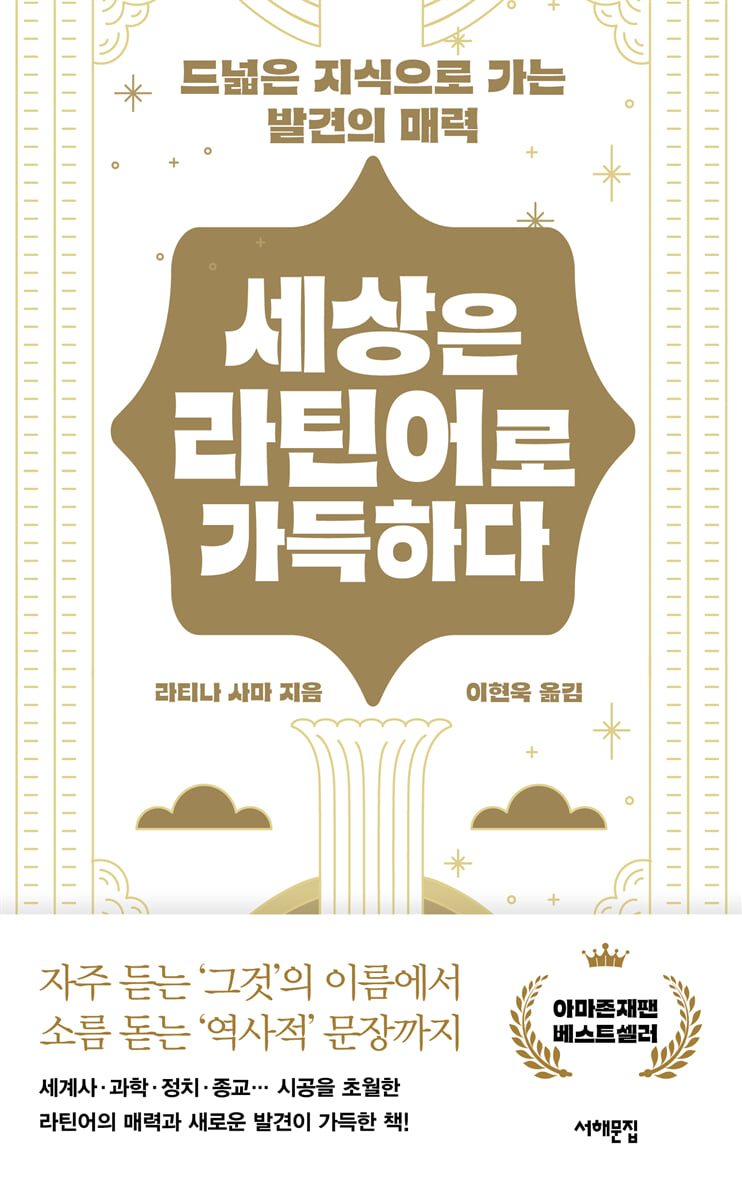
The world is full of Latin
 |
Description
Book Introduction
From the name of the thing we often hear to the chilling 'historical' sentence
World history, science, politics, religion... A book brimming with the charm of Latin and new discoveries that transcend time and space!
Is the world full of Latin? Is it really? This book traces the unexpected traces of Latin hidden everywhere around us, from the names of products and companies we often hear about to IT terminology. It also provides a wealth of fascinating knowledge on world history, science, politics, and religion.
A book full of the timeless charm and new discoveries of Latin, accessible to anyone, even beginners!
The fact that the email Re: doesn't come from reply, but from the Latin "in re" (about)! Alibi means "in another place" (alibi), facsimile means "make something similar" (fac simile), Audi means "listen" (audi), Volvo means "I drive" (Volvo), virus means "poison" (virus), vaccine means "cow" (vaccinus), medicine prescription (R) and food recipe means "take" (recipe)! From Harry Potter's magic spells to whiskey labels, from solar system constellations to scientific names of plants and animals, from the Statue of Liberty to astronauts, from comics, games, and animations to the Latin translation of "The Little Prince"... As you immerse yourself in the fun of discovery that leads to a vast knowledge, you will truly realize that "the world is full of Latin!"
World history, science, politics, religion... A book brimming with the charm of Latin and new discoveries that transcend time and space!
Is the world full of Latin? Is it really? This book traces the unexpected traces of Latin hidden everywhere around us, from the names of products and companies we often hear about to IT terminology. It also provides a wealth of fascinating knowledge on world history, science, politics, and religion.
A book full of the timeless charm and new discoveries of Latin, accessible to anyone, even beginners!
The fact that the email Re: doesn't come from reply, but from the Latin "in re" (about)! Alibi means "in another place" (alibi), facsimile means "make something similar" (fac simile), Audi means "listen" (audi), Volvo means "I drive" (Volvo), virus means "poison" (virus), vaccine means "cow" (vaccinus), medicine prescription (R) and food recipe means "take" (recipe)! From Harry Potter's magic spells to whiskey labels, from solar system constellations to scientific names of plants and animals, from the Statue of Liberty to astronauts, from comics, games, and animations to the Latin translation of "The Little Prince"... As you immerse yourself in the fun of discovery that leads to a vast knowledge, you will truly realize that "the world is full of Latin!"
- You can preview some of the book's contents.
Preview
index
prolog
Chapter 1: Latin and World History
History and story from an etymological perspective
The legacy of the Roman Empire in place names
The colonial activities of the Roman Empire, which became the origin of the word 'colony'
Rome and Romance
Did Caesar really say, “The die is cast”?
“Brutus, you too?”
Greek, Arabic, and Latin follow
Are businesses allowed to operate during lockdown?
The Travels of the Easterners and the Golden Land of Zipangu
The horrors of the epidemic are vividly conveyed
Traces of the Age of Exploration, Australia
The name of the Roman emperor that remained in the New World
Columbus's voyages revealed through Latin
Latin America and Latin
Edo period and Rome city citizenship
Latin used in the Treaty of Nerchinsk
What about that stone tablet with America's Independence Day inscribed on it?
'The Wonderful Year' and 'The Terrible Year'
Chapter 2 Latin and Politics
Traces of Ancient Rome in American Politics
The hill Thomas Jefferson admired
The Thoughts of Politicians Learned in Cincinnati
Roman politicians who hated bribery
Latin shouted by the assassin of the president
Learn from the tactics of the Punic Wars
Candidates must be 'sincere', and voting is a 'request'
Presidential Inauguration and New Year's Day
Fascism and Ancient Rome
Latin used in politics
Government, Cyber, and the Helmsman
Chapter 3 Latin and Religion
A trial influenced by Bible memorization
Passion fruit is not the "fruit of passion."
Latin for Christmas carols
Gloria in Excelsis Deo
Chapel, a cappella, and raincoat
The monastery that gave rise to the word cappuccino
Wasn't Requiem originally a 'requiem'?
The Lord's Prayer and the Creed
Is the origin of Valentine's Day true?
The Origin of the Godiva Chocolate Logo
Luther's Ninety-Five Theses written in Latin
Latin inscription on St. Peter's Basilica
Why did Moses have horns?
Chapter 4 Latin and Science
Pliny the Elder's Encyclopedia
The Last Days of Pompeii, an Ancient Time Capsule
The famous science book was written in Latin.
The law of inertia and the heliocentric theory were also published in Latin.
Notes left by Fermat
Latin for solar system
Latin for the 12 constellations
See the elements through Latin
Homo sapiens and Jimi Hendrix, interesting Latin scientific names
Knowing the scientific name can help you understand it more deeply.
Flounders and rats hidden in the human body
There's more! Latin for the human body
Nutrient names derived from Latin
Diseases and medicines derived from Latin
Latin word that became the name of the fungus
Chapter 5 Latin and Modernity
Digital, data, computers… The Latin hidden in IT technology
From Agenda to Mecenat, Latin Loanwords
There's more! Egoists, Curators, Proletarians
Product and company names derived from Latin
Audi, Volvo, Prius… The Automotive Industry and Latin
From whiskey labels to university emblems
Harry Potter's Magic Spells
Tokyo Disney Resort and Disneyland Paris
Latin is Alive! The World of Latin Conversation
From Alice in Wonderland to Winnie the Pooh, children's literature translated into Latin.
The Unexpected Benefit of the Latin Translation of The Little Prince
Ravioli, hot dog, bartender… Making Latin words
There's news in Latin!
Latin words you'll encounter on your trip to Japan
Comics, games, animation and Latin
Special Interview _ Yamazaki Mari x Latina Sama
Chapter 1: Latin and World History
History and story from an etymological perspective
The legacy of the Roman Empire in place names
The colonial activities of the Roman Empire, which became the origin of the word 'colony'
Rome and Romance
Did Caesar really say, “The die is cast”?
“Brutus, you too?”
Greek, Arabic, and Latin follow
Are businesses allowed to operate during lockdown?
The Travels of the Easterners and the Golden Land of Zipangu
The horrors of the epidemic are vividly conveyed
Traces of the Age of Exploration, Australia
The name of the Roman emperor that remained in the New World
Columbus's voyages revealed through Latin
Latin America and Latin
Edo period and Rome city citizenship
Latin used in the Treaty of Nerchinsk
What about that stone tablet with America's Independence Day inscribed on it?
'The Wonderful Year' and 'The Terrible Year'
Chapter 2 Latin and Politics
Traces of Ancient Rome in American Politics
The hill Thomas Jefferson admired
The Thoughts of Politicians Learned in Cincinnati
Roman politicians who hated bribery
Latin shouted by the assassin of the president
Learn from the tactics of the Punic Wars
Candidates must be 'sincere', and voting is a 'request'
Presidential Inauguration and New Year's Day
Fascism and Ancient Rome
Latin used in politics
Government, Cyber, and the Helmsman
Chapter 3 Latin and Religion
A trial influenced by Bible memorization
Passion fruit is not the "fruit of passion."
Latin for Christmas carols
Gloria in Excelsis Deo
Chapel, a cappella, and raincoat
The monastery that gave rise to the word cappuccino
Wasn't Requiem originally a 'requiem'?
The Lord's Prayer and the Creed
Is the origin of Valentine's Day true?
The Origin of the Godiva Chocolate Logo
Luther's Ninety-Five Theses written in Latin
Latin inscription on St. Peter's Basilica
Why did Moses have horns?
Chapter 4 Latin and Science
Pliny the Elder's Encyclopedia
The Last Days of Pompeii, an Ancient Time Capsule
The famous science book was written in Latin.
The law of inertia and the heliocentric theory were also published in Latin.
Notes left by Fermat
Latin for solar system
Latin for the 12 constellations
See the elements through Latin
Homo sapiens and Jimi Hendrix, interesting Latin scientific names
Knowing the scientific name can help you understand it more deeply.
Flounders and rats hidden in the human body
There's more! Latin for the human body
Nutrient names derived from Latin
Diseases and medicines derived from Latin
Latin word that became the name of the fungus
Chapter 5 Latin and Modernity
Digital, data, computers… The Latin hidden in IT technology
From Agenda to Mecenat, Latin Loanwords
There's more! Egoists, Curators, Proletarians
Product and company names derived from Latin
Audi, Volvo, Prius… The Automotive Industry and Latin
From whiskey labels to university emblems
Harry Potter's Magic Spells
Tokyo Disney Resort and Disneyland Paris
Latin is Alive! The World of Latin Conversation
From Alice in Wonderland to Winnie the Pooh, children's literature translated into Latin.
The Unexpected Benefit of the Latin Translation of The Little Prince
Ravioli, hot dog, bartender… Making Latin words
There's news in Latin!
Latin words you'll encounter on your trip to Japan
Comics, games, animation and Latin
Special Interview _ Yamazaki Mari x Latina Sama
Detailed image
.jpg)
Into the book
I started studying Latin when I was a sophomore in high school.
At the time, I often researched the etymology of English words to expand my vocabulary and raise my English score.
At that time, I became interested in Latin, which frequently appears as an etymology.
It was really fun to learn the etymology.
For example, we learned that the English word vessel comes from the Latin word vascellum (small vessel), which means that people in ancient times compared an empty vessel to a vessel.
This way I could understand the thoughts of people from long ago.
--- p.10
Words with etymologies related to 'Rome' can be found not only in place names but also in modern languages of various regions.
A representative example of this is romance.
(…) The etymology of romance is the Latin word romanice (slang).
(…) In the Roman Empire, in addition to classical Latin, the written language used in books and formal settings, there was also a slang language used by citizens in everyday conversation.
(…) So why do we associate words like “romance” and “romantic” with things like love? It’s because we’ve seen love depicted in literary works written in slang.
(…) French roman (novel) and German Roman (novel) are also related to this romance.
--- p.26~27
The vocative case is the form used when calling someone, and is usually the same as the nominative case (pater means 'father', Pater! means 'father!'), but the second declension masculine nouns whose nominative case ends in -us have different vocative and nominative forms.
For example, 'student' is 'discipulus', and 'student!' is 'Discipule!'
Brute, from the Latin “Et tu, Brute?” meaning “And you too, Brutus?”, is also a form of the vocative ‘Brutus!’
The nominative case is Brutus.
--- p.35
Although Magna Carta was established in the Middle Ages, it has actually been a topic of conversation even in modern times.
It was November 2020.
A hairdresser near Bradford in northern England has been fined a staggering £17,000 for continuing to operate her salon during the coronavirus lockdown.
At this time, the story goes that he resisted by citing Article 61 of Magna Carta and did not pay the fine.
(…) Is it possible to resist the business suspension order during the lockdown by using Article 61 as a shield? Let's examine some of the provisions, along with the original text.
--- p.41
Nerchinsk is a city located in southern eastern Siberia, today part of the Russian Federation.
(…) Border disputes began to arise between Russia and the Qing Dynasty.
This is called the 'Sino-Russian border dispute'.
The dispute continued for some time, but both countries wanted a peaceful resolution.
So the peace treaty that was concluded was the Treaty of Nerchinsk.
When this treaty was concluded, negotiations between the Qing and Russia were conducted in Latin.
And the treaty was written in Latin, Russian, and Manchu.
We can see that Latin was used in diplomatic circles in Asia as well in the late 17th century.
Let's look at some actual texts.
--- p.63
Now let's talk about annus horribilis (the terrible year).
(…) In fact, in 1992, dark events continued to occur in the royal family, such as the Queen's second son, Prince Andrew (Duke of York), separating from his wife, the eldest daughter, Princess Anne, divorcing, and even a fire breaking out at Windsor Castle.
(…) Prince Charles also separated from Princess Diana.
The Latin word horribilis (terrible) used in this phrase is a derivative of horreo (to be afraid), which is the root of the English words horror, horrid, horrific, horrendous, and abhorrent.
Somehow, I ended up giving the impression that 1992 was a 'terrible' year, but in fact, I, the person writing this, was also born in 1992.
It may be a bit complicated to hear such words about the year I was born, but let's say that it was a year with many good news that will go down in history, such as the restoration of Galileo Galilei's honor.
--- p.71
[This] obelisk's pedestal is inscribed in Latin with the Codex Fori Mussolini, a text praising Mussolini and Italian fascism.
(…) “At that time, a man appeared by God’s command or will.
He had a particularly brilliant mind and a strong spirit, and was determined to bravely accomplish and endure any task.
He planned and set about not only reversing the state of this country, which had been in decline and desolation, but also reviving in this country the Italy which the ancient Romans had made the 'light of the world'.
(…)”
--- p.102~104
Originally in Latin, requiem is a variation of requies (rest, rest), meaning 'rest, rest'.
The quies part of requies has the same etymology as the English words quiet and coy.
So why did "requiem" (rest, peace) come to represent a requiem? The answer can be found in the opening lyrics of the entrance hymn.
“Requiem aeternam dona eis, Domine, et lux perpetua luceat eis.
(Give them eternal rest, Lord, and shine upon them endless light.)”
--- p.123
Also interesting is the Latin name fluorum, from which the chemical symbol F for fluorine is derived.
Fluorum comes from fluo (to flow), which refers to fluorite, a compound of fluorine.
This is because adding fluorite to a substance lowers its melting point, making it easier to liquefy.
Words derived from fluo include the English word fluent.
You can see that his speaking was so fluent and uninhibited that it seemed like he was speaking with the flow of water.
And if you go back to the words fluid and influence, you get fluo.
--- p.169
There is an 'agenda' which refers to a plan or schedule.
It originally came from the Latin word agenda, meaning 'things to do'.
But here, -nd- contains the meaning of 'must be'.
So, the person's name, Amanda, structurally means 'a person who deserves to be loved.'
The English word legend, which refers to a legend or a legend of a map or diagram, originally meant 'something to be read.'
Propaganda was originally a Latin word meaning to spread.
--- p.195
J.K., author of the Harry Potter series
Since Rowling studied Latin in college, it would not have been difficult for her to combine Latin words to create spells.
Looking at the spells, the first one is 'Crucio', which is a spell that harasses the opponent.
This spell comes from the Latin crucio, meaning 'I crucify'.
(…) There is also Latin hidden in the character’s name.
The name of the strict teacher Snape is Severus Snape, and the Latin word severus, meaning 'strict', is the origin of the English word 'severe'.
The origin of the name of Remus Lupin, the man who transforms into a wolf, is easier.
The surname Lupin may be related to the Latin lupinus (of the wolf) or the English lupine (of the wolf) derived from it, and the given name Remus is spelled the same as Remus, who was raised by wolves in the aforementioned Roman founding legend.
Additionally, Latin is used in various places throughout the series, such as in the password required to enter the dormitory common room, so knowing Latin will help fans of the Harry Potter series understand the works more deeply.
At the time, I often researched the etymology of English words to expand my vocabulary and raise my English score.
At that time, I became interested in Latin, which frequently appears as an etymology.
It was really fun to learn the etymology.
For example, we learned that the English word vessel comes from the Latin word vascellum (small vessel), which means that people in ancient times compared an empty vessel to a vessel.
This way I could understand the thoughts of people from long ago.
--- p.10
Words with etymologies related to 'Rome' can be found not only in place names but also in modern languages of various regions.
A representative example of this is romance.
(…) The etymology of romance is the Latin word romanice (slang).
(…) In the Roman Empire, in addition to classical Latin, the written language used in books and formal settings, there was also a slang language used by citizens in everyday conversation.
(…) So why do we associate words like “romance” and “romantic” with things like love? It’s because we’ve seen love depicted in literary works written in slang.
(…) French roman (novel) and German Roman (novel) are also related to this romance.
--- p.26~27
The vocative case is the form used when calling someone, and is usually the same as the nominative case (pater means 'father', Pater! means 'father!'), but the second declension masculine nouns whose nominative case ends in -us have different vocative and nominative forms.
For example, 'student' is 'discipulus', and 'student!' is 'Discipule!'
Brute, from the Latin “Et tu, Brute?” meaning “And you too, Brutus?”, is also a form of the vocative ‘Brutus!’
The nominative case is Brutus.
--- p.35
Although Magna Carta was established in the Middle Ages, it has actually been a topic of conversation even in modern times.
It was November 2020.
A hairdresser near Bradford in northern England has been fined a staggering £17,000 for continuing to operate her salon during the coronavirus lockdown.
At this time, the story goes that he resisted by citing Article 61 of Magna Carta and did not pay the fine.
(…) Is it possible to resist the business suspension order during the lockdown by using Article 61 as a shield? Let's examine some of the provisions, along with the original text.
--- p.41
Nerchinsk is a city located in southern eastern Siberia, today part of the Russian Federation.
(…) Border disputes began to arise between Russia and the Qing Dynasty.
This is called the 'Sino-Russian border dispute'.
The dispute continued for some time, but both countries wanted a peaceful resolution.
So the peace treaty that was concluded was the Treaty of Nerchinsk.
When this treaty was concluded, negotiations between the Qing and Russia were conducted in Latin.
And the treaty was written in Latin, Russian, and Manchu.
We can see that Latin was used in diplomatic circles in Asia as well in the late 17th century.
Let's look at some actual texts.
--- p.63
Now let's talk about annus horribilis (the terrible year).
(…) In fact, in 1992, dark events continued to occur in the royal family, such as the Queen's second son, Prince Andrew (Duke of York), separating from his wife, the eldest daughter, Princess Anne, divorcing, and even a fire breaking out at Windsor Castle.
(…) Prince Charles also separated from Princess Diana.
The Latin word horribilis (terrible) used in this phrase is a derivative of horreo (to be afraid), which is the root of the English words horror, horrid, horrific, horrendous, and abhorrent.
Somehow, I ended up giving the impression that 1992 was a 'terrible' year, but in fact, I, the person writing this, was also born in 1992.
It may be a bit complicated to hear such words about the year I was born, but let's say that it was a year with many good news that will go down in history, such as the restoration of Galileo Galilei's honor.
--- p.71
[This] obelisk's pedestal is inscribed in Latin with the Codex Fori Mussolini, a text praising Mussolini and Italian fascism.
(…) “At that time, a man appeared by God’s command or will.
He had a particularly brilliant mind and a strong spirit, and was determined to bravely accomplish and endure any task.
He planned and set about not only reversing the state of this country, which had been in decline and desolation, but also reviving in this country the Italy which the ancient Romans had made the 'light of the world'.
(…)”
--- p.102~104
Originally in Latin, requiem is a variation of requies (rest, rest), meaning 'rest, rest'.
The quies part of requies has the same etymology as the English words quiet and coy.
So why did "requiem" (rest, peace) come to represent a requiem? The answer can be found in the opening lyrics of the entrance hymn.
“Requiem aeternam dona eis, Domine, et lux perpetua luceat eis.
(Give them eternal rest, Lord, and shine upon them endless light.)”
--- p.123
Also interesting is the Latin name fluorum, from which the chemical symbol F for fluorine is derived.
Fluorum comes from fluo (to flow), which refers to fluorite, a compound of fluorine.
This is because adding fluorite to a substance lowers its melting point, making it easier to liquefy.
Words derived from fluo include the English word fluent.
You can see that his speaking was so fluent and uninhibited that it seemed like he was speaking with the flow of water.
And if you go back to the words fluid and influence, you get fluo.
--- p.169
There is an 'agenda' which refers to a plan or schedule.
It originally came from the Latin word agenda, meaning 'things to do'.
But here, -nd- contains the meaning of 'must be'.
So, the person's name, Amanda, structurally means 'a person who deserves to be loved.'
The English word legend, which refers to a legend or a legend of a map or diagram, originally meant 'something to be read.'
Propaganda was originally a Latin word meaning to spread.
--- p.195
J.K., author of the Harry Potter series
Since Rowling studied Latin in college, it would not have been difficult for her to combine Latin words to create spells.
Looking at the spells, the first one is 'Crucio', which is a spell that harasses the opponent.
This spell comes from the Latin crucio, meaning 'I crucify'.
(…) There is also Latin hidden in the character’s name.
The name of the strict teacher Snape is Severus Snape, and the Latin word severus, meaning 'strict', is the origin of the English word 'severe'.
The origin of the name of Remus Lupin, the man who transforms into a wolf, is easier.
The surname Lupin may be related to the Latin lupinus (of the wolf) or the English lupine (of the wolf) derived from it, and the given name Remus is spelled the same as Remus, who was raised by wolves in the aforementioned Roman founding legend.
Additionally, Latin is used in various places throughout the series, such as in the password required to enter the dormitory common room, so knowing Latin will help fans of the Harry Potter series understand the works more deeply.
--- p.207~208
Publisher's Review
From the name of the thing we often hear to the chilling 'historical' sentence
World history, science, politics, religion… transcending time and space
A book full of the charm of Latin and new discoveries!
What comes to mind when you hear the word "Latin"? The language spoken by the ancient Romans? The language from which English derives? The language used as a scientific name? None of these are incorrect.
But as it turns out, Latin is much more familiar to us than we might imagine.
From the English alphabet (Latin letters) to the latest IT terms, many words we use without thinking are derived from Latin.
In fact, we often encounter and use Latin without even realizing it.
This book traces the 2,000-year history of Latin and humanity, introducing the vast world of Latin through five themes: world history, politics, religion, science, and modern times.
Latin is not a dead language, it is a door to knowledge!
Latin and Humanity: Following in the Footsteps of 2000 Years
Latin has left a significant mark on human history over a wide range of periods, even since the Roman era.
For example, place names that include '-chester' indicate that there were castles and fortresses built by the Roman army in the past, and Roman colonial rule left traces in the English word 'colony' and in the German city of Cologne and the perfume 'Eau de Cologne'.
The fear of the plague that swept through Europe and the traces of the 'Age of Exploration' are also conveyed intact in Latin.
Afterwards, the influence of Latin spread widely throughout the New World of America and even to Asian regions such as China, Russia, and Japan.
In addition, it introduces various aspects of Latin surrounding world history in an interesting way, such as words from Latin literature that resonate with the hearts of modern people, the secret of the stone tablet held by the Statue of Liberty in New York, and the 'wonderful year' (1665-1666) and the 'terrible year' (1992).
The traces of Latin are also abundant in the world of politics and religion.
Lincoln's assassin shouted in Latin just before the assassination, "This is how it always is with tyrants," the English word "vote" comes from the Latin word "votum" (request), the American presidential inauguration ceremony originated from the Roman custom of bird divination in temples, and the words "government" and "cyber-" both come from the Latin word "helmsman" who steers a ship.
Also, in 16th century England, the ability to recite a verse of the Psalms in Latin was a factor in the outcome of trials (which is why clergy were given lighter sentences than laymen), and the word requiem later came to mean 'requiem' for the simple reason that the first word in the hymn sung at the Mass for the Dead was requiem (meaning 'rest').
Latin has also had a huge influence on science.
Gauss, a famous 19th-century mathematician, also wrote his Arithmetic Investigations in Latin, and several works by Galileo, Kepler, Harvey, Leibniz, and Newton's Principia and Fermat's Last Theorem were also written in Latin.
Also, the names of the planets in the solar system, the sun (sol), moon (luna), Earth (Terra), which are named after Roman gods—the name of Spielberg's film ET is an abbreviation of 'extra+terrestrial' (life outside of Earth)—and the names of the twelve constellations are all of Latin origin.
Not only that, but the names of the substances that make up all things in the universe (the symbols for the elements are derived from the initials of their Latin names), the scientific names of plants and animals, the organs and nutrients of the human body, diseases and medicines, bacteria, etc., are countless and come from Latin.
A daily quest for those who love useful knowledge and new discoveries!
A Latin Journey with Popular Latinists
The same is true in our daily lives today.
There are many Latin words you can encounter at work, at the store, or on the street.
The names of ‘that product’ and ‘that company’ that we see every day may also have their origins in Latin.
In email, Re: is not a reply, and AM and PM are abbreviated Latin.
Digital, data, computer, ubiquitous, facsimile, alibi, agenda, propaganda, pro bono, bonus, mecenat, egoist, curator, proletariat, bus, etc. all come from Latin.
Also, pound (£) stands for libra, radius (r) stands for ray (radius), etc. stands for et cetera, Audi stands for listen (audi), Volvo stands for I roll (Volvo), ASICS stands for 'a sound mind in a sound body', virus stands for poison (virus), vaccine stands for cow (vaccinus), prescription (R) and food recipe stands for take (recipe)...
Beyond this, what do the magical spells Harry Potter chants mean? What Latin phrases are found on everything from whiskey labels to prestigious university emblems? What do the Latin words often encountered in comics, games, and animation mean? We also explore the ins and outs of Latin translations of works like "Alice in Wonderland," "Winnie the Pooh," "The Hobbit," and "The Little Prince," as well as the emerging world of modern Latin expressions.
And for those who are interested in Latin or want to learn it for the first time, we have helpful and practical information such as Latin conversation books, Latin news broadcasts, and Latin conversation channels.
Readers who have read this book will now see a different 'visible landscape'.
World history, science, politics, religion… transcending time and space
A book full of the charm of Latin and new discoveries!
What comes to mind when you hear the word "Latin"? The language spoken by the ancient Romans? The language from which English derives? The language used as a scientific name? None of these are incorrect.
But as it turns out, Latin is much more familiar to us than we might imagine.
From the English alphabet (Latin letters) to the latest IT terms, many words we use without thinking are derived from Latin.
In fact, we often encounter and use Latin without even realizing it.
This book traces the 2,000-year history of Latin and humanity, introducing the vast world of Latin through five themes: world history, politics, religion, science, and modern times.
Latin is not a dead language, it is a door to knowledge!
Latin and Humanity: Following in the Footsteps of 2000 Years
Latin has left a significant mark on human history over a wide range of periods, even since the Roman era.
For example, place names that include '-chester' indicate that there were castles and fortresses built by the Roman army in the past, and Roman colonial rule left traces in the English word 'colony' and in the German city of Cologne and the perfume 'Eau de Cologne'.
The fear of the plague that swept through Europe and the traces of the 'Age of Exploration' are also conveyed intact in Latin.
Afterwards, the influence of Latin spread widely throughout the New World of America and even to Asian regions such as China, Russia, and Japan.
In addition, it introduces various aspects of Latin surrounding world history in an interesting way, such as words from Latin literature that resonate with the hearts of modern people, the secret of the stone tablet held by the Statue of Liberty in New York, and the 'wonderful year' (1665-1666) and the 'terrible year' (1992).
The traces of Latin are also abundant in the world of politics and religion.
Lincoln's assassin shouted in Latin just before the assassination, "This is how it always is with tyrants," the English word "vote" comes from the Latin word "votum" (request), the American presidential inauguration ceremony originated from the Roman custom of bird divination in temples, and the words "government" and "cyber-" both come from the Latin word "helmsman" who steers a ship.
Also, in 16th century England, the ability to recite a verse of the Psalms in Latin was a factor in the outcome of trials (which is why clergy were given lighter sentences than laymen), and the word requiem later came to mean 'requiem' for the simple reason that the first word in the hymn sung at the Mass for the Dead was requiem (meaning 'rest').
Latin has also had a huge influence on science.
Gauss, a famous 19th-century mathematician, also wrote his Arithmetic Investigations in Latin, and several works by Galileo, Kepler, Harvey, Leibniz, and Newton's Principia and Fermat's Last Theorem were also written in Latin.
Also, the names of the planets in the solar system, the sun (sol), moon (luna), Earth (Terra), which are named after Roman gods—the name of Spielberg's film ET is an abbreviation of 'extra+terrestrial' (life outside of Earth)—and the names of the twelve constellations are all of Latin origin.
Not only that, but the names of the substances that make up all things in the universe (the symbols for the elements are derived from the initials of their Latin names), the scientific names of plants and animals, the organs and nutrients of the human body, diseases and medicines, bacteria, etc., are countless and come from Latin.
A daily quest for those who love useful knowledge and new discoveries!
A Latin Journey with Popular Latinists
The same is true in our daily lives today.
There are many Latin words you can encounter at work, at the store, or on the street.
The names of ‘that product’ and ‘that company’ that we see every day may also have their origins in Latin.
In email, Re: is not a reply, and AM and PM are abbreviated Latin.
Digital, data, computer, ubiquitous, facsimile, alibi, agenda, propaganda, pro bono, bonus, mecenat, egoist, curator, proletariat, bus, etc. all come from Latin.
Also, pound (£) stands for libra, radius (r) stands for ray (radius), etc. stands for et cetera, Audi stands for listen (audi), Volvo stands for I roll (Volvo), ASICS stands for 'a sound mind in a sound body', virus stands for poison (virus), vaccine stands for cow (vaccinus), prescription (R) and food recipe stands for take (recipe)...
Beyond this, what do the magical spells Harry Potter chants mean? What Latin phrases are found on everything from whiskey labels to prestigious university emblems? What do the Latin words often encountered in comics, games, and animation mean? We also explore the ins and outs of Latin translations of works like "Alice in Wonderland," "Winnie the Pooh," "The Hobbit," and "The Little Prince," as well as the emerging world of modern Latin expressions.
And for those who are interested in Latin or want to learn it for the first time, we have helpful and practical information such as Latin conversation books, Latin news broadcasts, and Latin conversation channels.
Readers who have read this book will now see a different 'visible landscape'.
GOODS SPECIFICS
- Date of issue: April 17, 2025
- Page count, weight, size: 248 pages | 314g | 130*210*17mm
- ISBN13: 9791194413301
You may also like
카테고리
korean


korean

![GQ KOREA Mark (Monthly): December [2025]](http://librairie.coreenne.fr/cdn/shop/files/8ef265dbbfbf186523ed75ba7319009d.jpg?v=1765340328&width=3840)


