

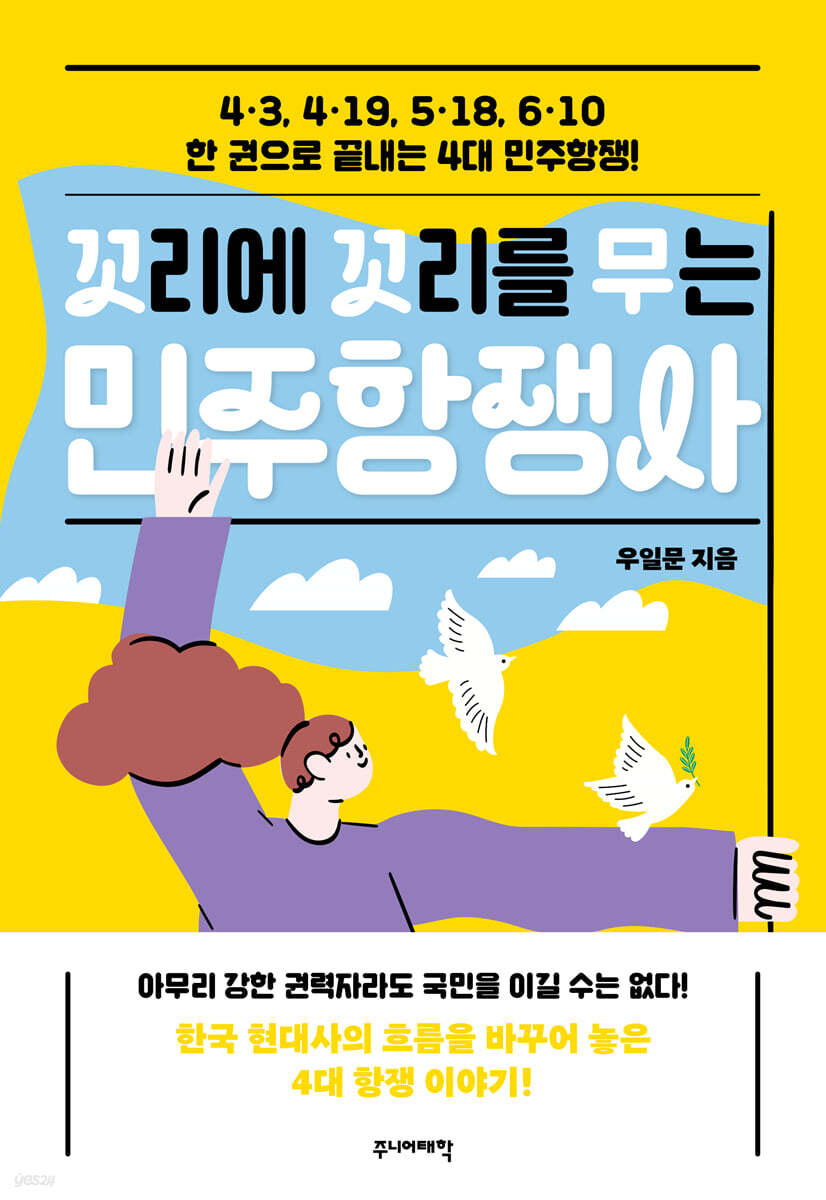
The history of democratic struggles that continues on and on
 |
Description
Book Introduction
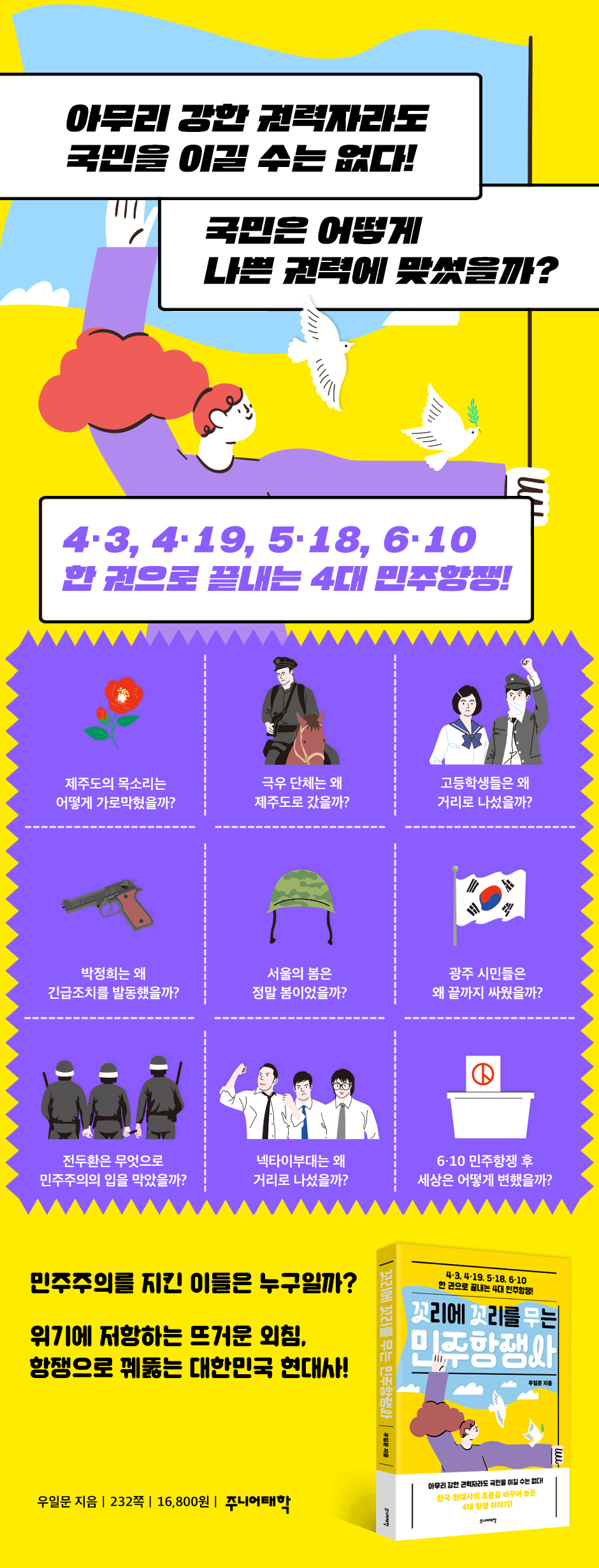
No matter how strong the power is, it cannot defeat the people!
A passionate cry to resist the crisis,
April 3, April 19, May 18, June 10
The four major democratic struggles in one volume!
The modern history of the Republic of Korea is a history of struggle and solidarity to protect democracy.
The mature democracy that exists in our society today did not come about suddenly one day, but is a historical achievement achieved by ordinary citizens who came together to fight against injustice and oppression.
From the Jeju April 3 Incident to the April 19 Revolution, the May 18 Democratization Movement, and the June 10 Democratic Uprising, at every moment in our history when democracy was on the verge of being erased, the people gathered their strength and raised their voices.
『The History of Democratic Struggles: A Chain of Struggles』 examines modern history, focusing on four struggles that changed the course of history, from the April 19 Revolution to the June 10 Democratic Struggle.
It vividly captures stories that textbooks fail to cover, such as why the struggle occurred and how it changed the world.
Readers will come to realize and be convinced that the people are the masters of history.
A passionate cry to resist the crisis,
April 3, April 19, May 18, June 10
The four major democratic struggles in one volume!
The modern history of the Republic of Korea is a history of struggle and solidarity to protect democracy.
The mature democracy that exists in our society today did not come about suddenly one day, but is a historical achievement achieved by ordinary citizens who came together to fight against injustice and oppression.
From the Jeju April 3 Incident to the April 19 Revolution, the May 18 Democratization Movement, and the June 10 Democratic Uprising, at every moment in our history when democracy was on the verge of being erased, the people gathered their strength and raised their voices.
『The History of Democratic Struggles: A Chain of Struggles』 examines modern history, focusing on four struggles that changed the course of history, from the April 19 Revolution to the June 10 Democratic Struggle.
It vividly captures stories that textbooks fail to cover, such as why the struggle occurred and how it changed the world.
Readers will come to realize and be convinced that the people are the masters of history.
- You can preview some of the book's contents.
Preview
index
Introduction - The Republic of Korea is a democratic republic.
Jeju April 3 Incident
What kind of island was Jeju Island?
- A long history of suffering
How did the Korean Peninsula become divided into North and South?
- The emergence of the US military government
How did pro-Japanese collaborators harass Koreans?
- Moribae and Gansangbae
Why did the March 1st Incident occur?
- Reckless shooting by police
Why did the cheerleading police gather in Jeju Island?
- The shadow that swept away Jeju Island
Why did the far-right group go to Jeju Island?
- The misconduct of the Northwest Youth League and the Daedong Youth League
Who attacked Jeju Island?
- The tragedy of April 3rd
How Peace Talks Fell to the Ground - The Orari Arson and the Atrocities of the SWAT Team
How Jeju Island's Voice Was Blocked - The Sleepless Southern Island
After April 3rd - Reveal the truth about April 3rd!
April 19 Revolution
How was the government of the Republic of Korea established?
- Liberation and independent government
How did Syngman Rhee get the constitutional amendment passed?
- The beginning of lies and manipulation
What is the four-way intersection?
- Strange logic and reasoning
Did high school students also participate in the democracy movement?
-The democratization movement that started in Daegu
How could I exchange makgeolli for a ticket?
- March 15th rigged election
What happened after Kim Joo-yeol's death?
- Become the spark of revolution
Who led the protests?
- April 19 Revolution
How was Syngman Rhee ousted?
- The president exiled to Hawaii
After April 19th - The Democratic Party, which couldn't take it even if it was given to them
May 18th Democratization Movement
How did the coup happen?
- May 16 military coup
Who is Park Chung-hee?
- Takagi Masao and the Communists
Was Park Chung-hee different from Syngman Rhee?
- Greed for long-term power
Why did Park Chung-hee declare emergency measures?
- A country of Yushin and emergency measures
Was spring in Seoul really spring?
- December 12 military rebellion
Why did they prepare for suppression first?
- The new military government's meticulous calculations
What happened in Gwangju?
- Soldiers who killed civilians
Why did the citizens of Gwangju fight to the end?
- The civil uprising is not over yet.
After May 18th - A Record of Remembering May 18th
June 10th Democratic Uprising
Who is Chun Doo-hwan?
- The emergence of a new military regime
What did the Constitution mean to the people?
- The struggle for a direct election constitutional amendment
How did Park Jong-cheol die?
- In search of the secrets hidden by the Grand Public Security Bureau
How was the truth manipulated?
- The cries of the people who took to the streets
How did Chun Doo-hwan silence democracy?
- Lee Han-yeol's death
How did the people stand up to dictatorship?
- June 10th Democratic Uprising
What happened at Myeongdong Cathedral?
- The Myeongdong Cathedral Fight and the June 29th Declaration
After June 10th - Direct Election System Created by the People
Democracy Movements You Should Know More About
Reviews
Image source
Jeju April 3 Incident
What kind of island was Jeju Island?
- A long history of suffering
How did the Korean Peninsula become divided into North and South?
- The emergence of the US military government
How did pro-Japanese collaborators harass Koreans?
- Moribae and Gansangbae
Why did the March 1st Incident occur?
- Reckless shooting by police
Why did the cheerleading police gather in Jeju Island?
- The shadow that swept away Jeju Island
Why did the far-right group go to Jeju Island?
- The misconduct of the Northwest Youth League and the Daedong Youth League
Who attacked Jeju Island?
- The tragedy of April 3rd
How Peace Talks Fell to the Ground - The Orari Arson and the Atrocities of the SWAT Team
How Jeju Island's Voice Was Blocked - The Sleepless Southern Island
After April 3rd - Reveal the truth about April 3rd!
April 19 Revolution
How was the government of the Republic of Korea established?
- Liberation and independent government
How did Syngman Rhee get the constitutional amendment passed?
- The beginning of lies and manipulation
What is the four-way intersection?
- Strange logic and reasoning
Did high school students also participate in the democracy movement?
-The democratization movement that started in Daegu
How could I exchange makgeolli for a ticket?
- March 15th rigged election
What happened after Kim Joo-yeol's death?
- Become the spark of revolution
Who led the protests?
- April 19 Revolution
How was Syngman Rhee ousted?
- The president exiled to Hawaii
After April 19th - The Democratic Party, which couldn't take it even if it was given to them
May 18th Democratization Movement
How did the coup happen?
- May 16 military coup
Who is Park Chung-hee?
- Takagi Masao and the Communists
Was Park Chung-hee different from Syngman Rhee?
- Greed for long-term power
Why did Park Chung-hee declare emergency measures?
- A country of Yushin and emergency measures
Was spring in Seoul really spring?
- December 12 military rebellion
Why did they prepare for suppression first?
- The new military government's meticulous calculations
What happened in Gwangju?
- Soldiers who killed civilians
Why did the citizens of Gwangju fight to the end?
- The civil uprising is not over yet.
After May 18th - A Record of Remembering May 18th
June 10th Democratic Uprising
Who is Chun Doo-hwan?
- The emergence of a new military regime
What did the Constitution mean to the people?
- The struggle for a direct election constitutional amendment
How did Park Jong-cheol die?
- In search of the secrets hidden by the Grand Public Security Bureau
How was the truth manipulated?
- The cries of the people who took to the streets
How did Chun Doo-hwan silence democracy?
- Lee Han-yeol's death
How did the people stand up to dictatorship?
- June 10th Democratic Uprising
What happened at Myeongdong Cathedral?
- The Myeongdong Cathedral Fight and the June 29th Declaration
After June 10th - Direct Election System Created by the People
Democracy Movements You Should Know More About
Reviews
Image source
Detailed image
Into the book
The Japanese exploitation of Jeju Island during the Japanese colonial period was no different from that of Joseon.
The protest, which began on January 7, 1932, by about 300 female divers from Sehwa-ri who could no longer bear the tyranny of the Japanese, later grew to include over 17,000 people, becoming recorded as the largest anti-Japanese movement on Jeju Island.
This is called the 'Jeju Haenyeo Anti-Japanese Movement'.
Although Jeju Island was liberated from Japanese colonial rule in 1945, its suffering did not end.
--- p.21
In January 1947, Korean residents in Japan from Beophwan-ri, Seogwipo, donated materials for installing electricity to their hometown.
However, the police detected the ship that entered Jeju Island carrying materials as a smuggling ship and confiscated the materials.
The Jeju Police Inspector General, who was in charge of the Jeju Police, was dismissed for his involvement in this incident, and US military government officers were also suspected.
The people of Jeju Island could not bear to see their property stolen by Morigan Sangbae in their liberated homeland, and they could no longer trust the police or the US military government.
--- p.
32
After the March 1st Incident and the general strike, many changes occurred in Jeju Island.
Yoo Hae-jin, a far-right figure from North Jeolla Province, was appointed governor of Jeju Island, and Kim Young-bae, from Seoul, was appointed chief of the Jeju Police Inspection Agency.
The executives of the wiretapping and inspection offices were also replaced with those from the mainland, excluding those from Jeju Island.
In particular, when Yoo Hae-jin took office, he brought seven members of the Northwest Youth Corps as bodyguards.
The Northwest Youth League is an extreme right-wing anti-communist group created by people who defected from the northwestern region, namely Pyeongan Province and Hwanghae Province.
These people later play a role in throwing Jeju Island into chaos.
--- pp.42-43
The scorched-earth operation targeting Jeju Island residents was carried out from November to March of the following year.
This is because President Syngman Rhee said at a cabinet meeting, “In order to receive aid from the United States, we must resolve the Jeju incident even if it means using harsh methods.”
The suppression force ordered residents living in mountain villages to come down to coastal villages and submit to police investigation.
Residents who came down to the coastal village innocently were subjected to harsh torture, demanding to know where the armed group was based.
--- p.64
Syngman Rhee appointed officials who had worked in the US military government as government officials, most of whom were former officials of the Japanese Government-General.
Because his domestic political base was weak due to his long period of living abroad, he joined hands with pro-Japanese collaborators after liberation, and this continued naturally even after he became president.
--- p.79
Even during the war, Syngman Rhee was hesitant to become president for life and was looking for a way to become the next president.
At that time, it was not a 'direct election' in which the people elected the president, but an 'indirect election' in which the National Assembly elected the president.
However, Syngman Rhee's relationship with the National Assembly was so strained that he had no chance of being elected through an indirect election.
The Syngman Rhee government, which was looking for a way, submitted a direct election constitutional amendment to the National Assembly.
--- p.84
The Daegu high school students' protest was the first student demonstration against a dictatorship in the country.
This is called the 'Daegu 2/28 Democracy Movement'.
Inspired by this, on March 1, a leaflet titled “Hold a fair election!” was distributed in Seoul under the name of the “National University Student Struggle Committee.”
The protests spread like wildfire across the country, starting in Seoul on March 5, Busan on March 7, Daejeon on March 8, and Suwon on March 10.
The "freedom of schools" slogan voluntarily chanted by high school students in the Daegu area spread nationwide and developed into a democratization movement calling for "fair elections" against the Syngman Rhee regime.
High school students planted the seeds of democracy that even adults could not.
--- pp.96-97
Citizens and students from Masan, Gyeongnam Province, who could not stand to see the fraudulent and violent election on March 15th, were the first to protest.
At 10:30 AM, during the election season, the Democratic Party of Masan City also took to the streets, declaring the election invalid and exposing election fraud.
At 7:30 p.m., 10,000 students and citizens flocked to City Hall where votes were being counted.
Police fired rifles and fired tear gas at the protesters.
In the end, eight people were killed by police bullets and hundreds were arrested.
There were also people who went missing.
--- p.102
The April 19 Revolution began on February 28th with high school students in the Daegu area, and continued through the March 15th Masan Uprising in Seoul.
College students responded, and citizens and faculty joined in to complete it.
However, the political world, including the opposition party, just watched from the back and then took over the government.
The politicians were completely unprepared.
Because of those incompetent politicians, the tragedy of our nation has arisen again.
--- p.119
The Democratic Republican Party used votes obtained through fraudulent elections to pass the '3rd term constitutional amendment' that allowed Park Chung-hee to serve as president for one more term, and issued an order to close all universities nationwide to prevent student protests.
However, as schools that had been closed reopened, student protests began again.
As these protests continued, an incident occurred that starkly revealed the working conditions in South Korea.
This is the 'Jeon Tae-il self-immolation incident'.
--- p.142
The May 18th Democratization Movement lasted for ten days, from May 18th to May 27th, 1980.
But that period was only a period in which soldiers suppressed good democratic citizens with guns and swords.
The emergence of Chun Doo-hwan and the new military junta, who attempted to seize power in the same way as Park Chung-hee, and the new military junta's lies in spreading the news that "Kim Dae-jung was behind the Gwangju Uprising" hurt the pride of Gwangju citizens and led to the civil uprising.
--- p.174
In a national referendum held on October 22, 1980, the Chun Doo-hwan regime's 'constitutional amendment' passed with a voter turnout of 95.5 percent and 91.6 percent in favor.
The pro-democracy movement could not hide its bewilderment at the overwhelming approval rating, but under martial law, the intervention of the military, police, and neighborhood chiefs in the election was expected.
In accordance with the 'revised constitution', Chun Doo-hwan dissolved the National Assembly and political parties, and created an absurd legislative body called the 'National Security Legislative Council', which functioned as a legislative body in place of the National Assembly for 156 days.
-- p.185
Even the most brutal Chun Doo-hwan regime could not have fought against Myeongdong Cathedral, the headquarters of Korean Catholicism.
The police retreated.
About 1,000 college students who supported and supported the Myeongdong Cathedral sit-in protested at Namdaemun Market.
The Sanggye-dong evictees living in tents inside the cathedral provided food to the protesters.
The National Convention, originally scheduled for one day on June 10th, evolved into the 'June 10th Democracy Movement', which was difficult for the National Headquarters leadership to handle.
The protest, which began on January 7, 1932, by about 300 female divers from Sehwa-ri who could no longer bear the tyranny of the Japanese, later grew to include over 17,000 people, becoming recorded as the largest anti-Japanese movement on Jeju Island.
This is called the 'Jeju Haenyeo Anti-Japanese Movement'.
Although Jeju Island was liberated from Japanese colonial rule in 1945, its suffering did not end.
--- p.21
In January 1947, Korean residents in Japan from Beophwan-ri, Seogwipo, donated materials for installing electricity to their hometown.
However, the police detected the ship that entered Jeju Island carrying materials as a smuggling ship and confiscated the materials.
The Jeju Police Inspector General, who was in charge of the Jeju Police, was dismissed for his involvement in this incident, and US military government officers were also suspected.
The people of Jeju Island could not bear to see their property stolen by Morigan Sangbae in their liberated homeland, and they could no longer trust the police or the US military government.
--- p.
32
After the March 1st Incident and the general strike, many changes occurred in Jeju Island.
Yoo Hae-jin, a far-right figure from North Jeolla Province, was appointed governor of Jeju Island, and Kim Young-bae, from Seoul, was appointed chief of the Jeju Police Inspection Agency.
The executives of the wiretapping and inspection offices were also replaced with those from the mainland, excluding those from Jeju Island.
In particular, when Yoo Hae-jin took office, he brought seven members of the Northwest Youth Corps as bodyguards.
The Northwest Youth League is an extreme right-wing anti-communist group created by people who defected from the northwestern region, namely Pyeongan Province and Hwanghae Province.
These people later play a role in throwing Jeju Island into chaos.
--- pp.42-43
The scorched-earth operation targeting Jeju Island residents was carried out from November to March of the following year.
This is because President Syngman Rhee said at a cabinet meeting, “In order to receive aid from the United States, we must resolve the Jeju incident even if it means using harsh methods.”
The suppression force ordered residents living in mountain villages to come down to coastal villages and submit to police investigation.
Residents who came down to the coastal village innocently were subjected to harsh torture, demanding to know where the armed group was based.
--- p.64
Syngman Rhee appointed officials who had worked in the US military government as government officials, most of whom were former officials of the Japanese Government-General.
Because his domestic political base was weak due to his long period of living abroad, he joined hands with pro-Japanese collaborators after liberation, and this continued naturally even after he became president.
--- p.79
Even during the war, Syngman Rhee was hesitant to become president for life and was looking for a way to become the next president.
At that time, it was not a 'direct election' in which the people elected the president, but an 'indirect election' in which the National Assembly elected the president.
However, Syngman Rhee's relationship with the National Assembly was so strained that he had no chance of being elected through an indirect election.
The Syngman Rhee government, which was looking for a way, submitted a direct election constitutional amendment to the National Assembly.
--- p.84
The Daegu high school students' protest was the first student demonstration against a dictatorship in the country.
This is called the 'Daegu 2/28 Democracy Movement'.
Inspired by this, on March 1, a leaflet titled “Hold a fair election!” was distributed in Seoul under the name of the “National University Student Struggle Committee.”
The protests spread like wildfire across the country, starting in Seoul on March 5, Busan on March 7, Daejeon on March 8, and Suwon on March 10.
The "freedom of schools" slogan voluntarily chanted by high school students in the Daegu area spread nationwide and developed into a democratization movement calling for "fair elections" against the Syngman Rhee regime.
High school students planted the seeds of democracy that even adults could not.
--- pp.96-97
Citizens and students from Masan, Gyeongnam Province, who could not stand to see the fraudulent and violent election on March 15th, were the first to protest.
At 10:30 AM, during the election season, the Democratic Party of Masan City also took to the streets, declaring the election invalid and exposing election fraud.
At 7:30 p.m., 10,000 students and citizens flocked to City Hall where votes were being counted.
Police fired rifles and fired tear gas at the protesters.
In the end, eight people were killed by police bullets and hundreds were arrested.
There were also people who went missing.
--- p.102
The April 19 Revolution began on February 28th with high school students in the Daegu area, and continued through the March 15th Masan Uprising in Seoul.
College students responded, and citizens and faculty joined in to complete it.
However, the political world, including the opposition party, just watched from the back and then took over the government.
The politicians were completely unprepared.
Because of those incompetent politicians, the tragedy of our nation has arisen again.
--- p.119
The Democratic Republican Party used votes obtained through fraudulent elections to pass the '3rd term constitutional amendment' that allowed Park Chung-hee to serve as president for one more term, and issued an order to close all universities nationwide to prevent student protests.
However, as schools that had been closed reopened, student protests began again.
As these protests continued, an incident occurred that starkly revealed the working conditions in South Korea.
This is the 'Jeon Tae-il self-immolation incident'.
--- p.142
The May 18th Democratization Movement lasted for ten days, from May 18th to May 27th, 1980.
But that period was only a period in which soldiers suppressed good democratic citizens with guns and swords.
The emergence of Chun Doo-hwan and the new military junta, who attempted to seize power in the same way as Park Chung-hee, and the new military junta's lies in spreading the news that "Kim Dae-jung was behind the Gwangju Uprising" hurt the pride of Gwangju citizens and led to the civil uprising.
--- p.174
In a national referendum held on October 22, 1980, the Chun Doo-hwan regime's 'constitutional amendment' passed with a voter turnout of 95.5 percent and 91.6 percent in favor.
The pro-democracy movement could not hide its bewilderment at the overwhelming approval rating, but under martial law, the intervention of the military, police, and neighborhood chiefs in the election was expected.
In accordance with the 'revised constitution', Chun Doo-hwan dissolved the National Assembly and political parties, and created an absurd legislative body called the 'National Security Legislative Council', which functioned as a legislative body in place of the National Assembly for 156 days.
-- p.185
Even the most brutal Chun Doo-hwan regime could not have fought against Myeongdong Cathedral, the headquarters of Korean Catholicism.
The police retreated.
About 1,000 college students who supported and supported the Myeongdong Cathedral sit-in protested at Namdaemun Market.
The Sanggye-dong evictees living in tents inside the cathedral provided food to the protesters.
The National Convention, originally scheduled for one day on June 10th, evolved into the 'June 10th Democracy Movement', which was difficult for the National Headquarters leadership to handle.
--- p.214
Publisher's Review
How did the people stand up to evil power?
The story of the four major struggles that changed the course of modern Korean history!
The people rose up and brought down those in power to restore the democratic order that had been damaged at every moment during the Japanese colonial period, division, and military regime.
But this is an 'incomplete' victory.
Although they succeeded in bringing down the powerful, the results of the revolution did not last long as military coups followed.
In this way, the Jeju April 3 Incident, the April 19 Revolution, the May 18 Democratization Movement, the June 10 Democratic Uprising followed, and the Candlelight Revolution is still ongoing.
Behind the Jeju April 3 Incident were Syngman Rhee and the US military government in power.
The people of Jeju Island, who had been exploited and living in poverty even after the Japanese colonial period, lost their lives due to the tyranny of the riot police sent by Syngman Rhee and the US military government and extreme right-wing groups.
The armed forces and residents resisted the authorities, but it was not enough.
The Jeju April 3 Incident became the catalyst for state violence to become a national trauma.
Syngman Rhee's oppression of Jeju Island is related to the establishment of the Republic of Korea's independent government.
Syngman Rhee, who wanted to seize power, committed election fraud during the process of establishing a single-party government.
The election fraud didn't end with just one incident.
Students rose up in anger at Syngman Rhee's actions, such as the '4-4-5' constitutional amendment, which sought to maintain permanent power.
Students rose up against evil power through the Daegu February 28th Democracy Movement and the Masan Uprising of March 15th.
This became the seed of the April 19 Revolution.
The April 19 Revolution brought down the Syngman Rhee regime, but Park Chung-hee staged the May 16 military coup.
This is the painful history of the Republic of Korea, the beginning of the military regime.
There were many people who called for democracy during the military regime.
The death of Jeon Tae-il, who had strived to improve working conditions, and the Busan-Masan Democratic Uprising, which rose up in resistance against emergency measures, were a cry of resistance to restore the damaged values of democracy.
Park Chung-hee was killed by Kim Jae-gyu's bullet, but the May 18th Democratization Movement occurred during the process of Chun Doo-hwan seizing power.
The shadow of brutal violence that swept through the Gwangju region left an incurable scar on the hearts of the people.
The wounds don't end there.
During the Chun Doo-hwan regime, the deaths of Park Jong-cheol and Lee Han-yeol turned the country upside down.
The people could not stand it and launched the June 10th Democracy Movement.
Every time a wrong historical mistake is repeated, the people step forward and correct it with their own hands.
Why should we know about democracy?
Modern history of the Republic of Korea pierced by struggle!
On December 3, 2024, a new tragedy shocked South Korea.
The state power has again violated the rights of the people, who are the masters of the state.
Citizens who remember the past struggles are gathering in the streets peacefully, holding cheering sticks and raising their voices.
This is why young people need to know about modern history and democracy.
Because we know exactly what democracy is from past experiences, and we must protect our own and others' rights.
If we look at the modern history of the Republic of Korea through struggles, we can see why democracy is important and what process it went through to become what it is today.
It also includes history that has not been covered in textbooks, allowing for a richer understanding of modern Korean history.
The story of the four major struggles that changed the course of modern Korean history!
The people rose up and brought down those in power to restore the democratic order that had been damaged at every moment during the Japanese colonial period, division, and military regime.
But this is an 'incomplete' victory.
Although they succeeded in bringing down the powerful, the results of the revolution did not last long as military coups followed.
In this way, the Jeju April 3 Incident, the April 19 Revolution, the May 18 Democratization Movement, the June 10 Democratic Uprising followed, and the Candlelight Revolution is still ongoing.
Behind the Jeju April 3 Incident were Syngman Rhee and the US military government in power.
The people of Jeju Island, who had been exploited and living in poverty even after the Japanese colonial period, lost their lives due to the tyranny of the riot police sent by Syngman Rhee and the US military government and extreme right-wing groups.
The armed forces and residents resisted the authorities, but it was not enough.
The Jeju April 3 Incident became the catalyst for state violence to become a national trauma.
Syngman Rhee's oppression of Jeju Island is related to the establishment of the Republic of Korea's independent government.
Syngman Rhee, who wanted to seize power, committed election fraud during the process of establishing a single-party government.
The election fraud didn't end with just one incident.
Students rose up in anger at Syngman Rhee's actions, such as the '4-4-5' constitutional amendment, which sought to maintain permanent power.
Students rose up against evil power through the Daegu February 28th Democracy Movement and the Masan Uprising of March 15th.
This became the seed of the April 19 Revolution.
The April 19 Revolution brought down the Syngman Rhee regime, but Park Chung-hee staged the May 16 military coup.
This is the painful history of the Republic of Korea, the beginning of the military regime.
There were many people who called for democracy during the military regime.
The death of Jeon Tae-il, who had strived to improve working conditions, and the Busan-Masan Democratic Uprising, which rose up in resistance against emergency measures, were a cry of resistance to restore the damaged values of democracy.
Park Chung-hee was killed by Kim Jae-gyu's bullet, but the May 18th Democratization Movement occurred during the process of Chun Doo-hwan seizing power.
The shadow of brutal violence that swept through the Gwangju region left an incurable scar on the hearts of the people.
The wounds don't end there.
During the Chun Doo-hwan regime, the deaths of Park Jong-cheol and Lee Han-yeol turned the country upside down.
The people could not stand it and launched the June 10th Democracy Movement.
Every time a wrong historical mistake is repeated, the people step forward and correct it with their own hands.
Why should we know about democracy?
Modern history of the Republic of Korea pierced by struggle!
On December 3, 2024, a new tragedy shocked South Korea.
The state power has again violated the rights of the people, who are the masters of the state.
Citizens who remember the past struggles are gathering in the streets peacefully, holding cheering sticks and raising their voices.
This is why young people need to know about modern history and democracy.
Because we know exactly what democracy is from past experiences, and we must protect our own and others' rights.
If we look at the modern history of the Republic of Korea through struggles, we can see why democracy is important and what process it went through to become what it is today.
It also includes history that has not been covered in textbooks, allowing for a richer understanding of modern Korean history.
GOODS SPECIFICS
- Date of issue: April 10, 2025
- Page count, weight, size: 232 pages | 340g | 148*215*15mm
- ISBN13: 9791168103474
- ISBN10: 1168103479
You may also like
카테고리
korean


korean

![GQ KOREA Mark (Monthly): December [2025]](http://librairie.coreenne.fr/cdn/shop/files/8ef265dbbfbf186523ed75ba7319009d.jpg?v=1765340328&width=3840)


