

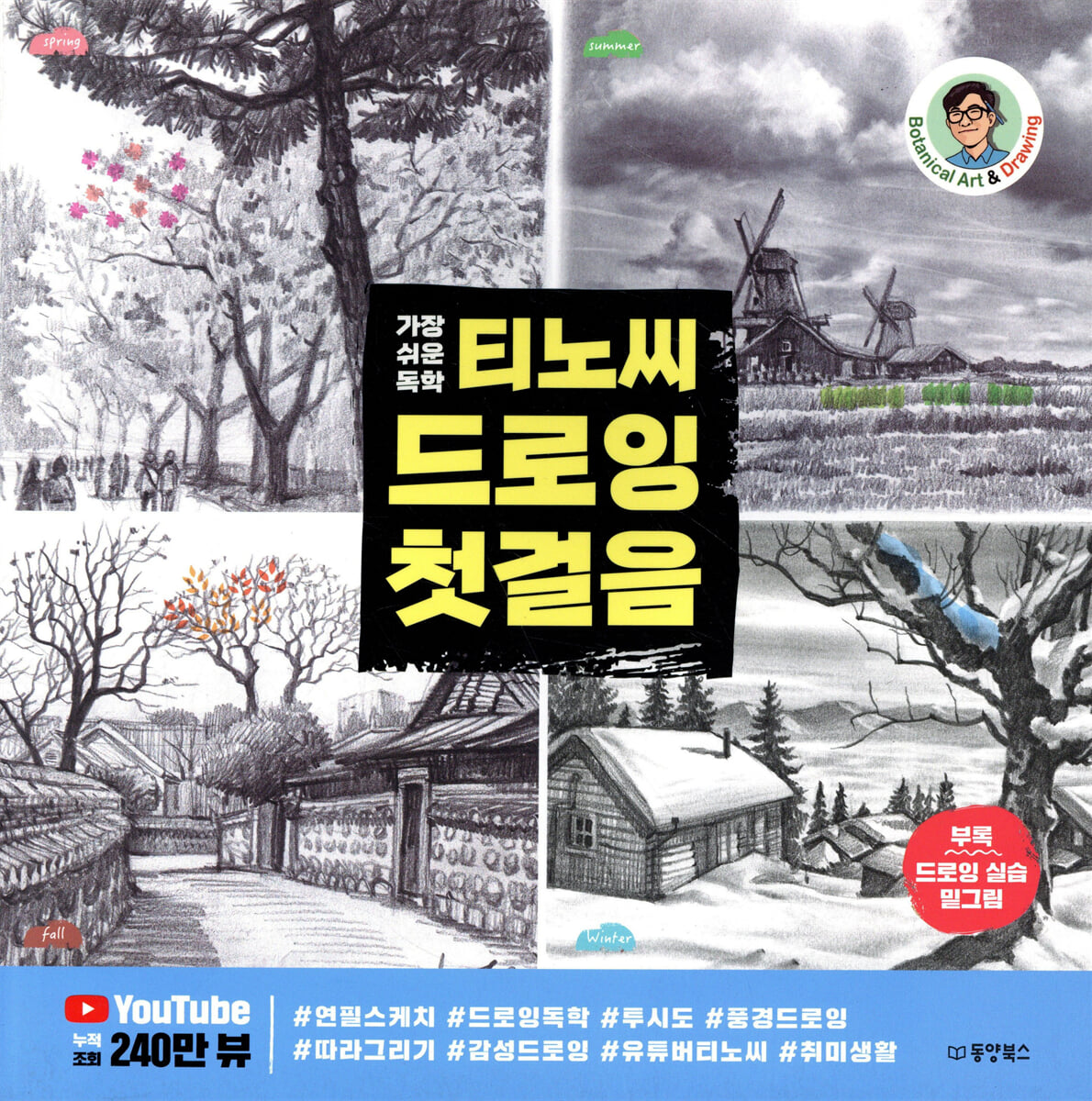
Tino's first steps in drawing
 |
Description
Book Introduction
The world's friendliest practical drawing class Completed with a piece of paper and a blunt pencil Delicate and unique landscape drawings Step by step from the basics Learn drawing principles and expressions Every time I practice drawing, I connect to YouTube With a video demonstration live on air Draw a great picture! This book teaches drawing step by step, starting with how to hold a pencil and draw lines for beginners, and moving on to detailed descriptions, perspective, and expressing light and shade and texture. The process of drawing is divided into four stages, from finding the vanishing point and eye level to sketching the composition and various expression methods, and each stage is systematically explained with pictures. It is full of useful information on effective expression and application methods according to the characteristics of the painting using various domestic and international landscapes as the subject matter, and even includes a practice space where you can improve your skills by directly drawing the finished work. |
- You can preview some of the book's contents.
Preview
index
Chapter 1: Basic Pencil Strokes
How to hold a pencil
Draw a horizontal line
Drawing a horizontal curve
Draw a short straight line
Drawing diagonal lines while adjusting pen pressure
Draw a circle
Chapter 2: Basic Pencil Drawing of Props
Drawing an apple
Drawing a teacup
Drawing a soda can
Drawing a watermill
Drawing a phone
Drawing a window
Drawing a chair
Drawing a fan
Drawing a bicycle
Drawing a car
Chapter 3: Basic Pencil Landscape Drawing
Drawing various types of trees
Drawing trees in the park
Drawing a palm tree
Drawing a cherry tree
Drawing the oak tree of Seooreung
Drawing the pine trees of Seooreung
Drawing a pine forest
Drawing a pine tree on Cafe Street
Drawing rocks by the stream
Drawing Jeju Island stone walls
Drawing rocks in the valley
Drawing a complex looking rock mountain
Drawing reservoir fog
Drawing a pavilion reflected in water
Drawing a forest valley
Drawing a puddle in a valley
Drawing waves reflecting buildings and landscapes
Drawing overlapping clouds
Drawing clouds and a lighthouse
Drawing clouds like fluttering cotton candy
Drawing clouds floating in a clear sky
Drawing cool clouds in a cool sky
Drawing colorful clouds and rocks
Chapter 4 Understanding Perspective
Understanding Perspective Drawing
Understanding One-Point Perspective Landscapes
Understanding Two-Point Perspective Landscapes
Understanding Three-Point Perspective Landscapes
Chapter 5 Landscape Painting Using Perspective
Draw from the front of Garosu-gil
Draw the roadside from the front
Draw the alley from the front
Drawing a building viewed from the front
Drawing perspective with perspective and pencil lines
Drawing a building from the side
Drawing the sperm from the side
Drawing a building in the shape of a letter
Drawing tall buildings
Drawing a house with a terrace
Chapter 6: Practical Domestic Landscape Painting
Draw by adjusting the ratio
Draw by moving objects randomly
Draw only the foreground in bold
Drawing a curved Hanok alley
Drawing trees connected like a tunnel
Drawing a tree using diagonal lines
Drawing light and dark trees
Drawing a snowy landscape
Drawing a deep valley
Drawing while looking at the sun in the shade of a tree
Draw by emphasizing only the important parts
Drawing with pencil rubbing
Draw richer than a photo
Drawing leaving white
Drawing with light direction in mind
Draw it by dividing it into two shades
Expressing the sense of height when looking up
Drawing to express the feeling of light
Drawing with emphasis on trees and grass
Draw the main character first
Drawing using surface division
Drawing a shady rock in a valley
Draw multiple photos as one
Draw with different textures
Drawing complex-looking landscapes easily
Drawing a building from above
Draw with the pencil as flat as possible
Draw at eye level
Drawing to emphasize the texture of the wooden gate
Chapter 7: Practical Overseas Landscape Painting
Drawing with an emphasis on contrasting expressions
Draw with variations according to the composition
Drawing a colorful picture of a monotonous building
Drawing a bright building in two-point perspective
Drawing a tower with rough, short lines
Drawing harmoniously with omission and addition
Draw with variation using various pencil strokes
Drawing without complex structures
Draw while paying attention to the direction of the circular curve
Drawing a building on the slope of a hill
Draw a building from the front
Drawing landscapes with perspective
Draw with only the building highlighted
Drawing with maximum use of line strength
Draw so that the lines are clearly visible
Expressing strength in the direction of the line
Drawing a landscape with cotton colors
Chapter 8 Drawing with Various Materials
Drawing landscapes with a pencil
Drawing landscapes with oil pencils
Drawing a landscape with charcoal
Drawing a landscape with an aqua pencil
Drawing a landscape with a liner pen
Drawing landscapes with colored pens and brush pens
supplement
Draw by yourself
How to hold a pencil
Draw a horizontal line
Drawing a horizontal curve
Draw a short straight line
Drawing diagonal lines while adjusting pen pressure
Draw a circle
Chapter 2: Basic Pencil Drawing of Props
Drawing an apple
Drawing a teacup
Drawing a soda can
Drawing a watermill
Drawing a phone
Drawing a window
Drawing a chair
Drawing a fan
Drawing a bicycle
Drawing a car
Chapter 3: Basic Pencil Landscape Drawing
Drawing various types of trees
Drawing trees in the park
Drawing a palm tree
Drawing a cherry tree
Drawing the oak tree of Seooreung
Drawing the pine trees of Seooreung
Drawing a pine forest
Drawing a pine tree on Cafe Street
Drawing rocks by the stream
Drawing Jeju Island stone walls
Drawing rocks in the valley
Drawing a complex looking rock mountain
Drawing reservoir fog
Drawing a pavilion reflected in water
Drawing a forest valley
Drawing a puddle in a valley
Drawing waves reflecting buildings and landscapes
Drawing overlapping clouds
Drawing clouds and a lighthouse
Drawing clouds like fluttering cotton candy
Drawing clouds floating in a clear sky
Drawing cool clouds in a cool sky
Drawing colorful clouds and rocks
Chapter 4 Understanding Perspective
Understanding Perspective Drawing
Understanding One-Point Perspective Landscapes
Understanding Two-Point Perspective Landscapes
Understanding Three-Point Perspective Landscapes
Chapter 5 Landscape Painting Using Perspective
Draw from the front of Garosu-gil
Draw the roadside from the front
Draw the alley from the front
Drawing a building viewed from the front
Drawing perspective with perspective and pencil lines
Drawing a building from the side
Drawing the sperm from the side
Drawing a building in the shape of a letter
Drawing tall buildings
Drawing a house with a terrace
Chapter 6: Practical Domestic Landscape Painting
Draw by adjusting the ratio
Draw by moving objects randomly
Draw only the foreground in bold
Drawing a curved Hanok alley
Drawing trees connected like a tunnel
Drawing a tree using diagonal lines
Drawing light and dark trees
Drawing a snowy landscape
Drawing a deep valley
Drawing while looking at the sun in the shade of a tree
Draw by emphasizing only the important parts
Drawing with pencil rubbing
Draw richer than a photo
Drawing leaving white
Drawing with light direction in mind
Draw it by dividing it into two shades
Expressing the sense of height when looking up
Drawing to express the feeling of light
Drawing with emphasis on trees and grass
Draw the main character first
Drawing using surface division
Drawing a shady rock in a valley
Draw multiple photos as one
Draw with different textures
Drawing complex-looking landscapes easily
Drawing a building from above
Draw with the pencil as flat as possible
Draw at eye level
Drawing to emphasize the texture of the wooden gate
Chapter 7: Practical Overseas Landscape Painting
Drawing with an emphasis on contrasting expressions
Draw with variations according to the composition
Drawing a colorful picture of a monotonous building
Drawing a bright building in two-point perspective
Drawing a tower with rough, short lines
Drawing harmoniously with omission and addition
Draw with variation using various pencil strokes
Drawing without complex structures
Draw while paying attention to the direction of the circular curve
Drawing a building on the slope of a hill
Draw a building from the front
Drawing landscapes with perspective
Draw with only the building highlighted
Drawing with maximum use of line strength
Draw so that the lines are clearly visible
Expressing strength in the direction of the line
Drawing a landscape with cotton colors
Chapter 8 Drawing with Various Materials
Drawing landscapes with a pencil
Drawing landscapes with oil pencils
Drawing a landscape with charcoal
Drawing a landscape with an aqua pencil
Drawing a landscape with a liner pen
Drawing landscapes with colored pens and brush pens
supplement
Draw by yourself
Detailed image

Publisher's Review
How to hold a pencil for beginners, starting with drawing lines!
Learn and practice how to handle the pencil, the main material of this book, from how to hold a pencil to practicing straight, curved, and diagonal strokes, expressing light and shade with lines, and even drawing circles.
A friendly, step-by-step explanation of the principles and expressions of drawing using basic prop drawings!
Divide various items in daily life into circular, square, and complex shape objects and draw them according to their shape.
Based on circles and squares, you can identify shapes and express details and light and shade in detail.
Systematically train yourself from composition to detailed description with basic landscape drawing!
Before starting to draw a full-fledged landscape, practice drawing trees, rocks, water, and clouds, which are essential elements of a natural landscape.
You will learn expressions and techniques for each material and also practice how to use auxiliary tools to enhance the effect.
You can complete a beautiful landscape painting by learning perspective, light and shade, and texture expression techniques!
Learn perspective drawing to express the perspective of landscapes and the three-dimensionality of buildings.
Divide it into 1-point perspective, 2-point perspective, and 3-point perspective landscapes, find the vanishing point, and draw the eye-level horizontal line, perspective slope line, and building center line.
You can draw domestic and international landscapes by looking at the 4-step process pictures and friendly explanations!
The process of drawing is divided into four stages, from finding the vanishing point and eye level to sketching the composition and various expression methods, and each stage is systematically explained with pictures.
Using various domestic and international landscapes as subjects, it provides useful tips on effective expression methods and application methods according to the characteristics of the painting.
You can experience it vividly by drawing directly on the rough sketch of the finished work!
There is a practice space filled with useful information where you can improve your skills by drawing the finished work yourself.
You can draw directly on top of the rough sketch of the finished work, or draw in the blank space while comparing it to the photo and the artist's finished work.
Learn and practice how to handle the pencil, the main material of this book, from how to hold a pencil to practicing straight, curved, and diagonal strokes, expressing light and shade with lines, and even drawing circles.
A friendly, step-by-step explanation of the principles and expressions of drawing using basic prop drawings!
Divide various items in daily life into circular, square, and complex shape objects and draw them according to their shape.
Based on circles and squares, you can identify shapes and express details and light and shade in detail.
Systematically train yourself from composition to detailed description with basic landscape drawing!
Before starting to draw a full-fledged landscape, practice drawing trees, rocks, water, and clouds, which are essential elements of a natural landscape.
You will learn expressions and techniques for each material and also practice how to use auxiliary tools to enhance the effect.
You can complete a beautiful landscape painting by learning perspective, light and shade, and texture expression techniques!
Learn perspective drawing to express the perspective of landscapes and the three-dimensionality of buildings.
Divide it into 1-point perspective, 2-point perspective, and 3-point perspective landscapes, find the vanishing point, and draw the eye-level horizontal line, perspective slope line, and building center line.
You can draw domestic and international landscapes by looking at the 4-step process pictures and friendly explanations!
The process of drawing is divided into four stages, from finding the vanishing point and eye level to sketching the composition and various expression methods, and each stage is systematically explained with pictures.
Using various domestic and international landscapes as subjects, it provides useful tips on effective expression methods and application methods according to the characteristics of the painting.
You can experience it vividly by drawing directly on the rough sketch of the finished work!
There is a practice space filled with useful information where you can improve your skills by drawing the finished work yourself.
You can draw directly on top of the rough sketch of the finished work, or draw in the blank space while comparing it to the photo and the artist's finished work.
GOODS SPECIFICS
- Date of issue: May 31, 2022
- Page count, weight, size: 334 pages | 1,142g | 250*250*20mm
- ISBN13: 9791157684687
- ISBN10: 1157684688
You may also like
카테고리
korean


korean

![GQ KOREA Mark (Monthly): December [2025]](http://librairie.coreenne.fr/cdn/shop/files/8ef265dbbfbf186523ed75ba7319009d.jpg?v=1765340328&width=3840)


