

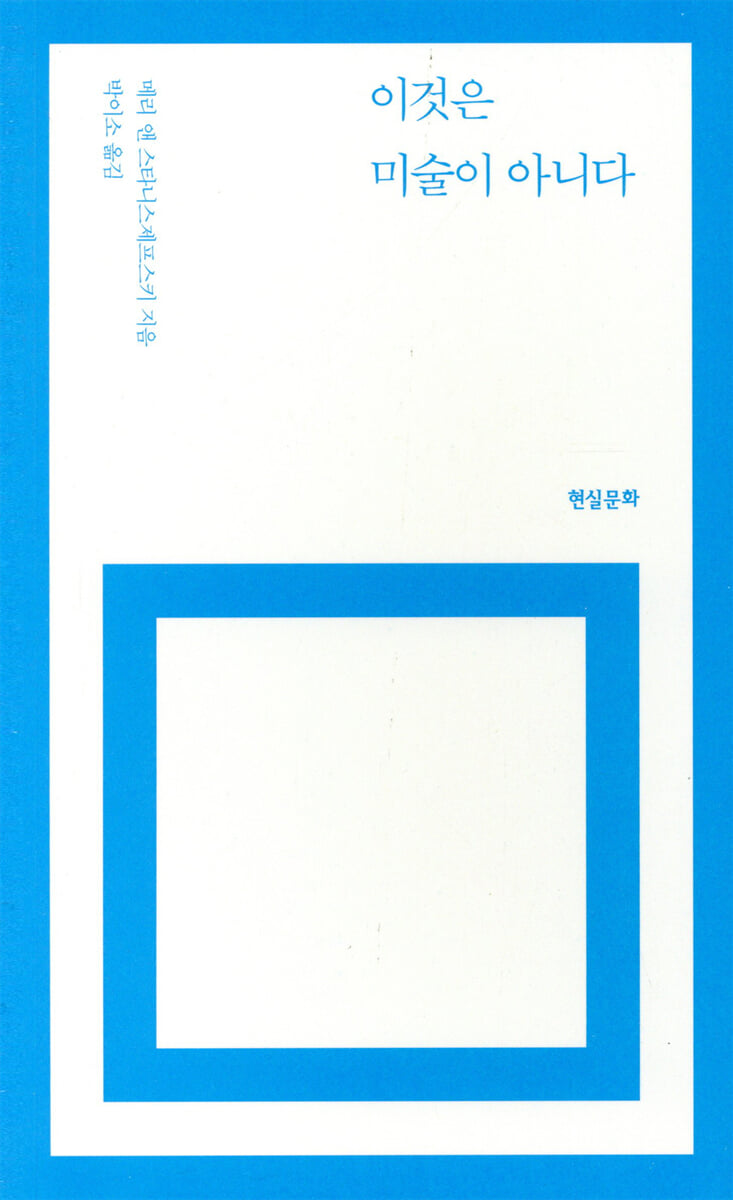
This is not art
 |
Description
Book Introduction
A revised edition (4th edition) of 『This is not art』, published in 1997, 2006, and 2013, with a new design.
It contains 'a study of how art, non-art, and other things acquire meaning and value.'
Through rich visual materials and panoramas, you can encounter ideologies and interpretations that allow you to evaluate individual works in a new way.
The author's profound and sharp insights into art provide a new perspective on artistic heritage.
It contains 'a study of how art, non-art, and other things acquire meaning and value.'
Through rich visual materials and panoramas, you can encounter ideologies and interpretations that allow you to evaluate individual works in a new way.
The author's profound and sharp insights into art provide a new perspective on artistic heritage.
- You can preview some of the book's contents.
Preview
index
While moving the text
How to read this book
1.
What is art?
2.
Art and the Modern Subject
3.
The term 'art'
4.
Aesthetics: Theory of Art
5.
The privilege of creating art
6.
Academy
7.
museum
8.
Art History and Modernism
9.
Avant-garde and popular culture
10.
Art and Culture Today
References
Illustration credit
index
How to read this book
1.
What is art?
2.
Art and the Modern Subject
3.
The term 'art'
4.
Aesthetics: Theory of Art
5.
The privilege of creating art
6.
Academy
7.
museum
8.
Art History and Modernism
9.
Avant-garde and popular culture
10.
Art and Culture Today
References
Illustration credit
index
Into the book
'Art' is an invention of the modern era—the last 200 years.
The outstanding buildings and objects produced by pre-modern peoples were 'borrowed' by our culture and transformed into art.
Art as we know it is a relatively recent phenomenon, something that is exhibited in art galleries, preserved in museums, purchased by collectors, and reproduced in the mass media.
(…) Everything that exists in the world is ultimately formed and defined by various institutions.
Institutions set boundaries and conventions for things.
This is like a picture frame making what is inside it look like a painting, and a pedestal making what is on top of it look like a sculpture.
--- p.28
The methods of creating objects that we now consider art were considered skills that anyone could acquire in the Middle Ages.
In the 13th century, Thomas Aquinas wrote about the arts of shoemaking, cooking, acrobatics, and grammar, in addition to the arts of sculpture and painting.
Painting, sculpture, and architecture were considered part of the mechanical arts.
The seven regular daily skills also included navigation, medicine, and agriculture.
--- p.113
The ancient Greek and Roman synonyms for the modern word 'beauty'—kalon (καλ?ν) and pulchrum—were indistinguishable from the concept of moral goodness.
Medieval and Renaissance theoretical discussions of beauty did not treat it as an independent, autonomous value.
Rather, beauty was understood as personal beauty or moral beauty.
Moreover, the term genius has traditionally been considered a characteristic of Renaissance culture.
However, the concept of genius as we understand it today became widely accepted only after the modern concept of free will and the dismantling of monarchical or ecclesiastical authority.
--- p.123
The use of the personal pronoun 'he', i.e. the assumption that the artist is male, excludes the fact that the other half of humanity, women, are also endowed with creative powers.
About 20 years ago, Gardner's writings and similar works by H.
When I first read influential textbooks like W. Jansen's A History of Western Art, I didn't realize that as a woman I was excluded from the possibility of contributing to the canon of great works created by great men.
I didn't realize that the language of these books was speaking of this exclusion by using the personal pronoun 'he'.
It is clear now, but this blindness was the work of ideology.
I accepted patriarchal language as natural, neutral, and taken for granted.
Gardner probably did the same when he wrote Art Through the Century.
--- p.134
As we entered the era of postmodern art museums in the 1980s, the way we viewed and appreciated art began to change.
Art museums were no longer facilities solely for the display and appreciation of aesthetic masterpieces, like Karl Friedrich Schinkel's Old Museum.
Compare the neoclassical façade of the Old Museum with the Metropolitan Museum of Art, which is covered with large banners advertising blockbuster exhibitions sponsored by various corporations.
Museums like the Metropolitan Museum of Art now feature gift shops, bookstores, restaurants, and cafes in addition to their exhibition halls.
--- p.178
Early 20th-century art must be understood in connection with the development of mass media.
During the first half of the 20th century, artists wanted to use new technologies associated with mass production—photography, advanced graphics, printing, radio, and film—to create a fundamentally new and better modern world.
The interest in the 'new era' and revolutionary cultural changes were not unrelated to the development of abstraction.
The outstanding buildings and objects produced by pre-modern peoples were 'borrowed' by our culture and transformed into art.
Art as we know it is a relatively recent phenomenon, something that is exhibited in art galleries, preserved in museums, purchased by collectors, and reproduced in the mass media.
(…) Everything that exists in the world is ultimately formed and defined by various institutions.
Institutions set boundaries and conventions for things.
This is like a picture frame making what is inside it look like a painting, and a pedestal making what is on top of it look like a sculpture.
--- p.28
The methods of creating objects that we now consider art were considered skills that anyone could acquire in the Middle Ages.
In the 13th century, Thomas Aquinas wrote about the arts of shoemaking, cooking, acrobatics, and grammar, in addition to the arts of sculpture and painting.
Painting, sculpture, and architecture were considered part of the mechanical arts.
The seven regular daily skills also included navigation, medicine, and agriculture.
--- p.113
The ancient Greek and Roman synonyms for the modern word 'beauty'—kalon (καλ?ν) and pulchrum—were indistinguishable from the concept of moral goodness.
Medieval and Renaissance theoretical discussions of beauty did not treat it as an independent, autonomous value.
Rather, beauty was understood as personal beauty or moral beauty.
Moreover, the term genius has traditionally been considered a characteristic of Renaissance culture.
However, the concept of genius as we understand it today became widely accepted only after the modern concept of free will and the dismantling of monarchical or ecclesiastical authority.
--- p.123
The use of the personal pronoun 'he', i.e. the assumption that the artist is male, excludes the fact that the other half of humanity, women, are also endowed with creative powers.
About 20 years ago, Gardner's writings and similar works by H.
When I first read influential textbooks like W. Jansen's A History of Western Art, I didn't realize that as a woman I was excluded from the possibility of contributing to the canon of great works created by great men.
I didn't realize that the language of these books was speaking of this exclusion by using the personal pronoun 'he'.
It is clear now, but this blindness was the work of ideology.
I accepted patriarchal language as natural, neutral, and taken for granted.
Gardner probably did the same when he wrote Art Through the Century.
--- p.134
As we entered the era of postmodern art museums in the 1980s, the way we viewed and appreciated art began to change.
Art museums were no longer facilities solely for the display and appreciation of aesthetic masterpieces, like Karl Friedrich Schinkel's Old Museum.
Compare the neoclassical façade of the Old Museum with the Metropolitan Museum of Art, which is covered with large banners advertising blockbuster exhibitions sponsored by various corporations.
Museums like the Metropolitan Museum of Art now feature gift shops, bookstores, restaurants, and cafes in addition to their exhibition halls.
--- p.178
Early 20th-century art must be understood in connection with the development of mass media.
During the first half of the 20th century, artists wanted to use new technologies associated with mass production—photography, advanced graphics, printing, radio, and film—to create a fundamentally new and better modern world.
The interest in the 'new era' and revolutionary cultural changes were not unrelated to the development of abstraction.
--- p.206
Publisher's Review
Who decides art?
New insights and perspectives on art
The work we think of is not art.
Michelangelo's "The Creation of Adam" in the Sistine Chapel, Leonardo da Vinci's "Mona Lisa," Jean-Antoine Watteau's "Pilgrimage to Cythera," the Venus of Willendorf and the Great Pyramids of Giza in Egypt.
These are things that most people have considered to be great works of art.
But here is a book that almost declares that all these works are not (were not) art!
This is not art, written by American art historian Mary Anne Staniszewski.
"This is not art" is a book that was previously published by the Reality Culture Research in 1997, 2006, and 2013, and has been redesigned and republished this time.
Although it was first published at a time when our reading community did not have as much interest in art and the arts as it does today, this book has continued to receive steady attention from readers.
This is a book that can be read and benefited by everyone, from those majoring in art and aesthetics to beginners.
The book makes a provocative statement from the outset.
In addition to the aforementioned works, he shows the readers photos of the Palace of Versailles, the Nike statue, and Chinese votive paintings, and claims that all of these works are not actually 'art.'
The author is asserting his thoughts by attempting to overturn the stereotypes about art that readers have had so far.
So why make this claim? The author argues that "art" as we know it is a modern invention, and that the works listed above have been "borrowed" by contemporary culture and transformed into art.
For example, Michelangelo's "The Creation of Adam" in the Sistine Chapel was not created as art.
This image was simply a visual metaphor for the authority and sacred rites of the Roman Pontiff.
However beautiful this fresco may be, it is not (was not) art in the sense we know it today.
The same goes for the Venus of Willendorf.
It was only in modern times that this five-inch statue was named the 'Venus of Willendorf' and that it began to be recognized as art.
This Venus statue would have been just an everyday item when it was created.
The author points out that calling this sculpture a work of art is, in a sense, a hasty judgment by modern people.
What is art, after all?
Then, interest shifts to what the author claims is ‘art’.
The author calls works from the post-modern era, such as Duchamp, Picasso, Mondrian, Pollock, and Warhol, art.
Art is a work of art created by a genius-talented artist through his or her own creative activities based on inspiration for art.
The concept of art as we know it today emerged after a revolutionary change in the individual's awareness of his or her humanity.
In other words, art revealed its existence simultaneously with the dissolution of the monarchy in Europe.
As a result, art no longer needed to serve the authority of the church (religion) or the monarchy (politics).
Only the author creates freely based on the inspiration he or she obtains.
The works created in this way gain meaning and value by being exhibited and exchanged within the ‘free market.’
A new perspective on art
The author's profound and sharp insights into art provide readers of "This Is Not Art" with a new perspective on artistic heritage.
As we stroll through the back alleys of art history with art historian Staniszewski, we encounter ideologies and interpretations that allow us to re-evaluate individual works through a wealth of visual materials and panoramas.
Chapter 1 of "This is not art" offers a new perspective on the old prejudices we have had about art so far.
Chapter 2 reveals that as individuals began to recognize their own existence during the modern era, the concept of art also began to emerge.
Chapters 3 and 4 describe the background of the emergence of the terms “art” and “aesthetics,” and Chapter 5 reveals that the field of art has been the exclusive domain of white men, and that female artists have been historically marginalized for a long time.
Chapters 6 and 7 discuss the emergence and history of the 'academy' and 'museum', and their influence on art, while chapters 8 through 10 conclude the book by describing modernism, the avant-garde, and contemporary art.
It is difficult for readers to encounter the works covered in this book in their daily lives.
However, the reason why understanding pure art and high art is important is because of the hidden stories that art, as an 'institutionalized perspective', contains.
These hidden stories constantly influence us today through mass media and popular culture.
In this sense, "This is Not Art" will provide refreshing insight into previously questionable issues for those interested in art and art theory, as well as cultural studies and the humanities.
New insights and perspectives on art
The work we think of is not art.
Michelangelo's "The Creation of Adam" in the Sistine Chapel, Leonardo da Vinci's "Mona Lisa," Jean-Antoine Watteau's "Pilgrimage to Cythera," the Venus of Willendorf and the Great Pyramids of Giza in Egypt.
These are things that most people have considered to be great works of art.
But here is a book that almost declares that all these works are not (were not) art!
This is not art, written by American art historian Mary Anne Staniszewski.
"This is not art" is a book that was previously published by the Reality Culture Research in 1997, 2006, and 2013, and has been redesigned and republished this time.
Although it was first published at a time when our reading community did not have as much interest in art and the arts as it does today, this book has continued to receive steady attention from readers.
This is a book that can be read and benefited by everyone, from those majoring in art and aesthetics to beginners.
The book makes a provocative statement from the outset.
In addition to the aforementioned works, he shows the readers photos of the Palace of Versailles, the Nike statue, and Chinese votive paintings, and claims that all of these works are not actually 'art.'
The author is asserting his thoughts by attempting to overturn the stereotypes about art that readers have had so far.
So why make this claim? The author argues that "art" as we know it is a modern invention, and that the works listed above have been "borrowed" by contemporary culture and transformed into art.
For example, Michelangelo's "The Creation of Adam" in the Sistine Chapel was not created as art.
This image was simply a visual metaphor for the authority and sacred rites of the Roman Pontiff.
However beautiful this fresco may be, it is not (was not) art in the sense we know it today.
The same goes for the Venus of Willendorf.
It was only in modern times that this five-inch statue was named the 'Venus of Willendorf' and that it began to be recognized as art.
This Venus statue would have been just an everyday item when it was created.
The author points out that calling this sculpture a work of art is, in a sense, a hasty judgment by modern people.
What is art, after all?
Then, interest shifts to what the author claims is ‘art’.
The author calls works from the post-modern era, such as Duchamp, Picasso, Mondrian, Pollock, and Warhol, art.
Art is a work of art created by a genius-talented artist through his or her own creative activities based on inspiration for art.
The concept of art as we know it today emerged after a revolutionary change in the individual's awareness of his or her humanity.
In other words, art revealed its existence simultaneously with the dissolution of the monarchy in Europe.
As a result, art no longer needed to serve the authority of the church (religion) or the monarchy (politics).
Only the author creates freely based on the inspiration he or she obtains.
The works created in this way gain meaning and value by being exhibited and exchanged within the ‘free market.’
A new perspective on art
The author's profound and sharp insights into art provide readers of "This Is Not Art" with a new perspective on artistic heritage.
As we stroll through the back alleys of art history with art historian Staniszewski, we encounter ideologies and interpretations that allow us to re-evaluate individual works through a wealth of visual materials and panoramas.
Chapter 1 of "This is not art" offers a new perspective on the old prejudices we have had about art so far.
Chapter 2 reveals that as individuals began to recognize their own existence during the modern era, the concept of art also began to emerge.
Chapters 3 and 4 describe the background of the emergence of the terms “art” and “aesthetics,” and Chapter 5 reveals that the field of art has been the exclusive domain of white men, and that female artists have been historically marginalized for a long time.
Chapters 6 and 7 discuss the emergence and history of the 'academy' and 'museum', and their influence on art, while chapters 8 through 10 conclude the book by describing modernism, the avant-garde, and contemporary art.
It is difficult for readers to encounter the works covered in this book in their daily lives.
However, the reason why understanding pure art and high art is important is because of the hidden stories that art, as an 'institutionalized perspective', contains.
These hidden stories constantly influence us today through mass media and popular culture.
In this sense, "This is Not Art" will provide refreshing insight into previously questionable issues for those interested in art and art theory, as well as cultural studies and the humanities.
GOODS SPECIFICS
- Publication date: April 20, 2022
- Page count, weight, size: 328 pages | 364g | 125*205*30mm
- ISBN13: 9788965642749
- ISBN10: 8965642744
You may also like
카테고리
korean


korean

![GQ KOREA Mark (Monthly): December [2025]](http://librairie.coreenne.fr/cdn/shop/files/8ef265dbbfbf186523ed75ba7319009d.jpg?v=1765340328&width=3840)


