

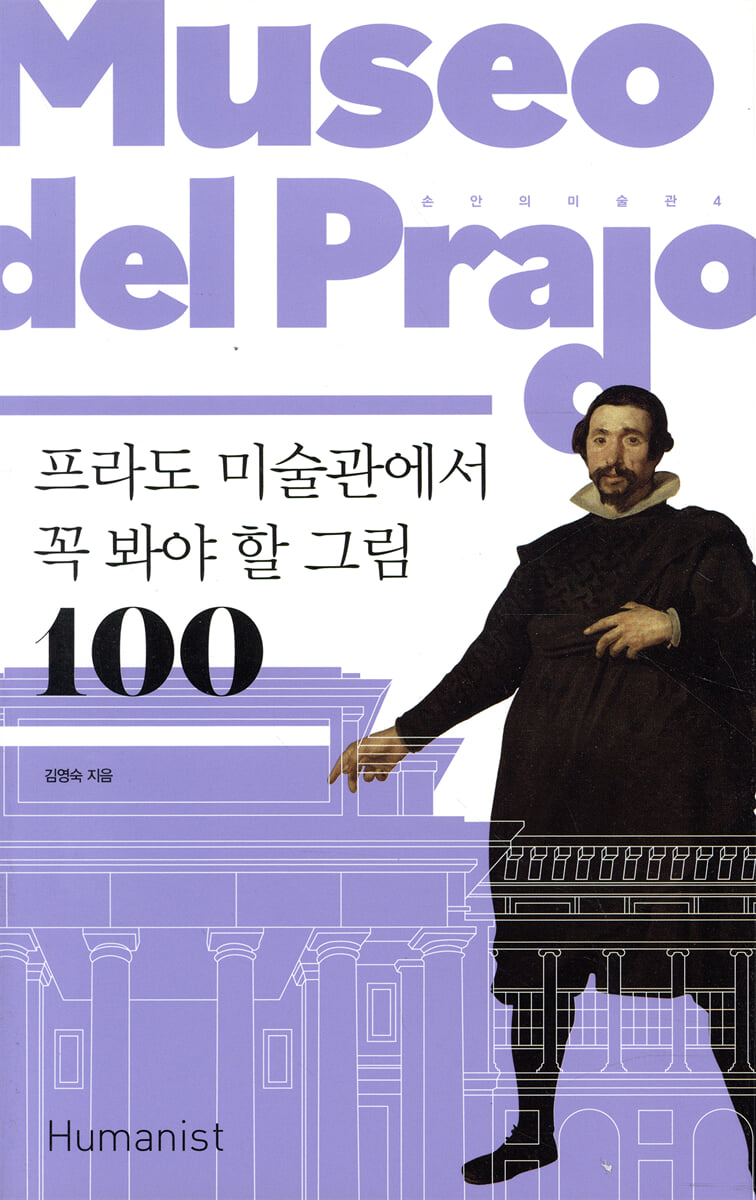
100 Must-See Paintings at the Prado Museum
 |
Description
Book Introduction
Art Museum in Your Hand, Volume 4.
Kim Young-sook, the best art storyteller who has taught us how to read paintings in an exciting way through “Art Books That Make You Want to Go to an Art Museum” and “1 Page Art 365,” points out 100 “must-see paintings” for travelers who are pressed for time and cannot properly see the paintings.
In the hope that travelers can easily view the paintings in European art museums as if looking into the palm of their hand, we recommend works that are easily digestible.
Spain, the land of bullfighting, flamenco, and siestas, is often ranked as the country where Europeans most want to live, thanks to its blessed natural environment and its center of various cultural arts.
The fourth place visited by the 'Museum in Your Hand' series, following the Louvre Museum, the Musée d'Orsay, and the National Gallery, is the Museo del Prado, located in Madrid, the heart of Spain.
It is the pride of Spain, the birthplace of El Greco and Velazquez, Goya and Picasso, Joan Miró and Dali, and is always ranked among the top three art museums in the world.
In "100 Must-See Paintings at the Prado Museum," you can see 100 paintings that you should not miss at the Prado Museum.
This book offers a new way to enjoy the paintings of Spanish masters to those who love them.
For those who have not yet been to the Prado Museum, it is also a gallery where you can open it and appreciate the paintings at any time.
Above all, it will be an essential guide when traveling to the Prado paintings, and a small album to remember the place when you return to your daily life.
Kim Young-sook, the best art storyteller who has taught us how to read paintings in an exciting way through “Art Books That Make You Want to Go to an Art Museum” and “1 Page Art 365,” points out 100 “must-see paintings” for travelers who are pressed for time and cannot properly see the paintings.
In the hope that travelers can easily view the paintings in European art museums as if looking into the palm of their hand, we recommend works that are easily digestible.
Spain, the land of bullfighting, flamenco, and siestas, is often ranked as the country where Europeans most want to live, thanks to its blessed natural environment and its center of various cultural arts.
The fourth place visited by the 'Museum in Your Hand' series, following the Louvre Museum, the Musée d'Orsay, and the National Gallery, is the Museo del Prado, located in Madrid, the heart of Spain.
It is the pride of Spain, the birthplace of El Greco and Velazquez, Goya and Picasso, Joan Miró and Dali, and is always ranked among the top three art museums in the world.
In "100 Must-See Paintings at the Prado Museum," you can see 100 paintings that you should not miss at the Prado Museum.
This book offers a new way to enjoy the paintings of Spanish masters to those who love them.
For those who have not yet been to the Prado Museum, it is also a gallery where you can open it and appreciate the paintings at any time.
Above all, it will be an essential guide when traveling to the Prado paintings, and a small album to remember the place when you return to your daily life.
- You can preview some of the book's contents.
Preview
index
First, for those who want to go to European art museums
Things to know before visiting the Prado Museum
Painting Gallery of the Prado Museum
Reading Spanish History
15th-16th century Italy and Flanders
Raphael Sanzio, The Cardinal, The Madonna and Child with Raphael, Tobias, and St. Jerome (Madonna and the Fish), and The Way to Calvary
Fra Angelico, Annunciation
Andrea Mantegna, The Burial of the Virgin
Antonello da Messina, Angels Carrying the Dead Christ
Joachim Patinir, Landscape with Charon Crossing the Styx; Joachim Patinir and Quentin Massy, The Temptation of Saint Anthony
Sandro Botticelli, The Tale of Nastagio degli Onesti, Part 1, The Tale of Nastagio degli Onesti, Part 2, The Tale of Nastagio degli Onesti, Part 3
Pedro Berruguete, Saint Dominic de Guzman Presiding Over the Inquisition
Robert Campin, John the Baptist and the Franciscan Henry von Berl, Saint Barbara
Rogier van der Weyden, The Descent from the Cross
Albrecht Dürer, Portrait of Dürer at Age Twenty-Six, Adam, Eve
Hans Baldung, The Three Ages of Man, The Three Graces
Hieronymus Bosch's Hay Cart
Hieronymus Bosch's The Seven Deadly Sins
Hieronymus Bosch's The Garden of Earthly Delights
Pieter Bruegel the Elder's The Triumph of Death
Antonis Mor, Portrait of Mary Tudor; Alonso Sánchez Coello, Princess Isabel Clara Eugenia and Magdalena Luis
16th-17th century Italy and France
Titian Vecellio, Equestrian Statue of Charles V
Titian Vecellio, "The Feast of the Goddess of Andros" and "The Adoration of Venus"
Titian Vecellio, Danae with the Golden Rain, Venus and Adonis
Titian Vecellio, Self-Portrait
Caravaggio's David and Goliath
Nicolas Poussin, Parnassus, Triumph of David
El Greco and 16th-Century Spain
El Greco's "Trinity"
El Greco's Annunciation, Baptism of Christ, Crucifixion, Pentecost, and Resurrection
El Greco, The Knight with His Hand on His Heart, Fable
Juan Sánchez Cotán, Still Life with Game, Fruit, and Vegetables
Francisco Ribalta, "The Vision of St. Bernard" and "St. Francis Comforted by an Angel"
Rivera, Murillo, Zurbaran
Jose de Ribera, The Martyrdom of Saint Philip
Francisco de Zurbarán, "Anus Dei (Lamb of God)", "Christ Crucified with Saint Luke the Painter", "Saint Peter Appearing to Saint Peter Nolasco"
Bartolome Esteban Murillo, The Immaculate Conception
Bartolome Esteban Murillo, Holy Family
Velázquez and 17th-century Spain
Diego Velázquez's "Las Meninas"
Diego Velázquez's Bacchus
Diego Velázquez, The Forge of Vulcan
Diego Velázquez, Equestrian Statue of Isabel de Borbon, Equestrian Statue of Prince Baltasar Carlos, Equestrian Statue of Philip III, Equestrian Statue of Queen Marguerite, Equestrian Statue of Philip IV, Equestrian Statue of Olivares
Diego Velázquez, "Philip IV" and "Portrait of the Queen"; Diego Velázquez and Juan Bautista Martínez del Maso, "Princess Doña Maria Margarita"
Diego Velázquez, Aesop, The Clown Pablo de Valladolid, and Dwarf Sitting on the Floor
Diego Velázquez's The Myth of Arachne
Diego Velázquez, The Surrender of Breda
Antonio de Pereda, The Salvation of Genoa; Juan Bautista Maino, The Recapture of Bahia
Juan Carreño de Miranda, "The Monster," "The Monster," "Portrait of Mariana de Austria"
Claudio Coello, The Triumph of St. Augustine and the Madonna and Child Adored by St. Louis
Rubens and 17th-century Flanders and the Netherlands
Peter Paul Rubens, The Judgment of Paris
Peter Paul Rubens, The Garden of Love and The Three Graces
Jan Brueghel the Elder and Peter Paul Rubens, Allegory of Sight and Smell, Hearing
Anthony van Dyck, The Arrest of Christ, The Insult of Christ, The Bronze Serpent
Rembrandt Harmans van Rijn, Artemisia
Goya and 18th-Century Spain
Luis Meléndez, Still Life
Francisco de Goya, The Parasol
Francisco de Goya, The Wounded Stonemason, Winter (Snowstorm), The Wedding, and The Puppet
Francisco de Goya, Charles IV and His Family
Raphael Mengs, Portrait of Maria Luisa of Parma, Portrait of Charles IV as Crown Prince
Francisco de Goya, The Naked Maja, The Clothed Maja
Francisco de Goya, "May 2" and "May 3"
Francisco de Goya, Saturn
Figure annotations
Things to know before visiting the Prado Museum
Painting Gallery of the Prado Museum
Reading Spanish History
15th-16th century Italy and Flanders
Raphael Sanzio, The Cardinal, The Madonna and Child with Raphael, Tobias, and St. Jerome (Madonna and the Fish), and The Way to Calvary
Fra Angelico, Annunciation
Andrea Mantegna, The Burial of the Virgin
Antonello da Messina, Angels Carrying the Dead Christ
Joachim Patinir, Landscape with Charon Crossing the Styx; Joachim Patinir and Quentin Massy, The Temptation of Saint Anthony
Sandro Botticelli, The Tale of Nastagio degli Onesti, Part 1, The Tale of Nastagio degli Onesti, Part 2, The Tale of Nastagio degli Onesti, Part 3
Pedro Berruguete, Saint Dominic de Guzman Presiding Over the Inquisition
Robert Campin, John the Baptist and the Franciscan Henry von Berl, Saint Barbara
Rogier van der Weyden, The Descent from the Cross
Albrecht Dürer, Portrait of Dürer at Age Twenty-Six, Adam, Eve
Hans Baldung, The Three Ages of Man, The Three Graces
Hieronymus Bosch's Hay Cart
Hieronymus Bosch's The Seven Deadly Sins
Hieronymus Bosch's The Garden of Earthly Delights
Pieter Bruegel the Elder's The Triumph of Death
Antonis Mor, Portrait of Mary Tudor; Alonso Sánchez Coello, Princess Isabel Clara Eugenia and Magdalena Luis
16th-17th century Italy and France
Titian Vecellio, Equestrian Statue of Charles V
Titian Vecellio, "The Feast of the Goddess of Andros" and "The Adoration of Venus"
Titian Vecellio, Danae with the Golden Rain, Venus and Adonis
Titian Vecellio, Self-Portrait
Caravaggio's David and Goliath
Nicolas Poussin, Parnassus, Triumph of David
El Greco and 16th-Century Spain
El Greco's "Trinity"
El Greco's Annunciation, Baptism of Christ, Crucifixion, Pentecost, and Resurrection
El Greco, The Knight with His Hand on His Heart, Fable
Juan Sánchez Cotán, Still Life with Game, Fruit, and Vegetables
Francisco Ribalta, "The Vision of St. Bernard" and "St. Francis Comforted by an Angel"
Rivera, Murillo, Zurbaran
Jose de Ribera, The Martyrdom of Saint Philip
Francisco de Zurbarán, "Anus Dei (Lamb of God)", "Christ Crucified with Saint Luke the Painter", "Saint Peter Appearing to Saint Peter Nolasco"
Bartolome Esteban Murillo, The Immaculate Conception
Bartolome Esteban Murillo, Holy Family
Velázquez and 17th-century Spain
Diego Velázquez's "Las Meninas"
Diego Velázquez's Bacchus
Diego Velázquez, The Forge of Vulcan
Diego Velázquez, Equestrian Statue of Isabel de Borbon, Equestrian Statue of Prince Baltasar Carlos, Equestrian Statue of Philip III, Equestrian Statue of Queen Marguerite, Equestrian Statue of Philip IV, Equestrian Statue of Olivares
Diego Velázquez, "Philip IV" and "Portrait of the Queen"; Diego Velázquez and Juan Bautista Martínez del Maso, "Princess Doña Maria Margarita"
Diego Velázquez, Aesop, The Clown Pablo de Valladolid, and Dwarf Sitting on the Floor
Diego Velázquez's The Myth of Arachne
Diego Velázquez, The Surrender of Breda
Antonio de Pereda, The Salvation of Genoa; Juan Bautista Maino, The Recapture of Bahia
Juan Carreño de Miranda, "The Monster," "The Monster," "Portrait of Mariana de Austria"
Claudio Coello, The Triumph of St. Augustine and the Madonna and Child Adored by St. Louis
Rubens and 17th-century Flanders and the Netherlands
Peter Paul Rubens, The Judgment of Paris
Peter Paul Rubens, The Garden of Love and The Three Graces
Jan Brueghel the Elder and Peter Paul Rubens, Allegory of Sight and Smell, Hearing
Anthony van Dyck, The Arrest of Christ, The Insult of Christ, The Bronze Serpent
Rembrandt Harmans van Rijn, Artemisia
Goya and 18th-Century Spain
Luis Meléndez, Still Life
Francisco de Goya, The Parasol
Francisco de Goya, The Wounded Stonemason, Winter (Snowstorm), The Wedding, and The Puppet
Francisco de Goya, Charles IV and His Family
Raphael Mengs, Portrait of Maria Luisa of Parma, Portrait of Charles IV as Crown Prince
Francisco de Goya, The Naked Maja, The Clothed Maja
Francisco de Goya, "May 2" and "May 3"
Francisco de Goya, Saturn
Figure annotations
Detailed image

Publisher's Review
Leading the world's art history
Spanish masters gathered together at the Prado Museum
Spain, the land of bullfighting, flamenco, and siestas, is often ranked as the country where Europeans most want to live, thanks to its blessed natural environment and its center of various cultural arts.
The fourth place visited by the 'Museum in Your Hand' series, following the Louvre Museum, the Musée d'Orsay, and the National Gallery, is the Museo del Prado, located in Madrid, the heart of Spain.
It is the pride of Spain, the birthplace of El Greco and Velazquez, Goya and Picasso, Joan Miró and Dali, and is always ranked among the top three art museums in the world.
The Prado Museum was built in 1785 during the reign of Carlos III to a design by the classical architect Juan de Villanueva, and was officially opened in 1819 during the reign of Ferdinand VII.
The Prado Museum, which was built to collect and exhibit the long-standing collection of the Spanish royal family and national treasures that had been scattered across monasteries and churches, suffered the humiliation of being used as an armory and stables during the Napoleonic era.
Picasso once served as director, but due to the ongoing turmoil, including the Spanish Civil War, it was closed and the collection was moved to the Museum of Fine Arts in Geneva, Switzerland.
The Prado Museum currently holds nearly 8,000 paintings, including thousands of drawings, prints, coins, medals, and decorative arts.
No matter how much space is expanded, it is not enough to display all of these massive works, so only about 1,300 of them are on display.
The museum displays masterpieces from the 12th to 19th centuries, divided by era and region, as well as works by Spanish masters such as El Greco, Velazquez, and Goya, allowing visitors to examine the flow of European art history and regional characteristics.
In "100 Must-See Paintings at the Prado Museum," you can see 100 paintings that you should not miss at the Prado Museum.
This book offers a new way to enjoy the paintings of Spanish masters to those who love them.
For those who have not yet been to the Prado Museum, it is also a gallery where you can open it and appreciate the paintings at any time.
Above all, it will be an essential guide when traveling to the Prado paintings, and a small album to remember the place when you return to your daily life.
A treasure trove of Spanish paintings from its golden age
What paintings should I see at the Prado?
The Prado Museum can be a maze for first-time visitors.
The exhibition halls, which are densely marked on the guide map, have entrances and exits in all four directions, so if you are immersed in the artwork, it is very likely that you will get confused about which direction to go.
The Prado Museum consists of the Jerónimos Building and the Villanueva Building. The Jerónimos Building mainly hosts temporary exhibitions, while the Prado Museum's permanent collection and major paintings are displayed by period and region on the 0th to 2nd floors of the Villanueva Building.
The Prado Museum is a must-see attraction on any European art tour, boasting a richer and more diverse collection of masterpieces than any other museum, including masterpieces by Spanish masters El Greco, Velazquez, Ribera, Murillo, and Goya, as well as those by Titian, Tintoretto, and Rubens, who directly or indirectly influenced them.
《100 Must-See Paintings at the Prado Museum》 is organized into seven chapters, based on the visitor's route: 〈15th-16th Century Italy and Flanders〉, 〈16th-17th Century Italy and France〉, 〈El Greco and 16th Century Spain〉, 〈Ribera, Murillo, Zurbarán〉, 〈Velázquez and 17th Century Spain〉, 〈Rubens and 17th Century Flanders and the Netherlands〉, and 〈Goya and 18th Century Spain〉.
One or two or three works are explained in a simple, clear, yet interesting way on one page, and works that would be helpful to read together are included in the 'illustrated footnotes' to help readers understand.
Additionally, 'Reading Spanish History', which briefly summarizes the Spanish chronology that greatly influenced the history of the Prado Museum, will further enrich your trip to the Prado Museum.
The first chapter, “Italy and Flanders in the 15th and 16th Centuries,” which organizes the works exhibited on the ground floor of the Prado Museum, shows at a glance how the Renaissance and Baroque styles developed with unique characteristics in each region of Europe through works such as Fra Angelico’s “Annunciation,” Albrecht Dürer’s “Portrait of Dürer at the Age of Twenty-Six,” and Hieronymus Bosch’s “The Garden of Earthly Delights,” which depicts a vast panorama of pleasure and punishment with explosive imagination.
The second chapter, “Italy and France in the 16th and 17th Centuries,” can be found immediately upon entering through the “Goya Gate” on the first floor.
Titian Vecellio's Equestrian Statue of Charles V was a work that had a great influence as a model for the equestrian statues of the emperor painted by many court painters later on.
Meanwhile, Titian's "Danae Under the Golden Rain" and Caravaggio's "David and Goliath" provide an opportunity to compare and appreciate the masterpieces of two masters who employed balanced depictions of the human body and a painting technique that maximizes light and shade.
On the first floor, organized along the viewing route, you can see numerous works by Spanish masters such as El Greco, Murillo, and Velazquez in the sections titled “El Greco and 16th-Century Spain,” “Ribera, Murillo, and Zurbarán,” and “Velazquez and 17th-Century Spain.”
The masterpiece “Trinity” by El Greco, a master of Mannerism, and contemporary Spanish works, as well as the works of José de Ribera, Francisco de Zurbarán, Bartolome Esteban Murillo, and Diego Velázquez, who fully displayed their skills in the rich artistic soil of 17th-century Spain, await readers one by one.
Looking at their paintings, you can understand why the Spanish people have such a high level of pride in art.
In particular, Velázquez's "Las Meninas," a pride of the Prado Museum, is a work that captivates the viewer with the feeling that the painting is looking at them, and has also provided inspiration for modern philosophers.
Velazquez's series of portraits of the Spanish royal family is also included, and reading 'Reading Spanish History' first will be of great help in understanding the series of portraits.
The last exhibition on the first floor, “Rubens and 17th-Century Flanders and the Netherlands,” includes Peter Paul Rubens’ “The Judgement of Paris,” Jan Brueghel the Elder’s “Allegory of Sight and Smell” and Rubens’ “The Arrest of Christ” by Antoni van Dyck, and Rembrandt Harmans van Rijn’s “Artemisia,” proving that the Prado Museum’s painting collection is truly world-class.
The final chapter, “Goya and 18th-Century Spain,” which contains the exhibits on the second floor, deals with the works of Francisco de Goya, who, despite his status as a royal painter, maintained his own artistic world with his love for the lives of the common people and the fierce spirit of the times.
Just appreciating Goya's representative works, including "The Second of May" and "The Third of May," which denounce Napoleon's invasion of Spain and the massacre of its citizens, as well as "Carlos IV and His Family," "The Naked Maja," "The Clothed Maja," and "Saturn," will make a trip to the Prado Museum worthwhile.
《100 Must-See Paintings at the Prado》 carefully selects the paintings that should never be missed at the Prado Museum, and guides readers on a journey through the Prado with refreshing illustrations and brief but detailed explanations.
For those reminiscing about their visit to the Prado Museum, or for those eagerly anticipating their return, this book will be an invaluable guide.
* The revised edition of “100 Must-See Paintings at the Prado Museum” offers even greater enjoyment of viewing the paintings with clearer picture quality and a more sophisticated layout than the previous edition.
We have also increased the font size of the image captions and simplified the content to greatly improve readability.
The figure annotations have also been refined to help you understand the figures more easily.
Spanish masters gathered together at the Prado Museum
Spain, the land of bullfighting, flamenco, and siestas, is often ranked as the country where Europeans most want to live, thanks to its blessed natural environment and its center of various cultural arts.
The fourth place visited by the 'Museum in Your Hand' series, following the Louvre Museum, the Musée d'Orsay, and the National Gallery, is the Museo del Prado, located in Madrid, the heart of Spain.
It is the pride of Spain, the birthplace of El Greco and Velazquez, Goya and Picasso, Joan Miró and Dali, and is always ranked among the top three art museums in the world.
The Prado Museum was built in 1785 during the reign of Carlos III to a design by the classical architect Juan de Villanueva, and was officially opened in 1819 during the reign of Ferdinand VII.
The Prado Museum, which was built to collect and exhibit the long-standing collection of the Spanish royal family and national treasures that had been scattered across monasteries and churches, suffered the humiliation of being used as an armory and stables during the Napoleonic era.
Picasso once served as director, but due to the ongoing turmoil, including the Spanish Civil War, it was closed and the collection was moved to the Museum of Fine Arts in Geneva, Switzerland.
The Prado Museum currently holds nearly 8,000 paintings, including thousands of drawings, prints, coins, medals, and decorative arts.
No matter how much space is expanded, it is not enough to display all of these massive works, so only about 1,300 of them are on display.
The museum displays masterpieces from the 12th to 19th centuries, divided by era and region, as well as works by Spanish masters such as El Greco, Velazquez, and Goya, allowing visitors to examine the flow of European art history and regional characteristics.
In "100 Must-See Paintings at the Prado Museum," you can see 100 paintings that you should not miss at the Prado Museum.
This book offers a new way to enjoy the paintings of Spanish masters to those who love them.
For those who have not yet been to the Prado Museum, it is also a gallery where you can open it and appreciate the paintings at any time.
Above all, it will be an essential guide when traveling to the Prado paintings, and a small album to remember the place when you return to your daily life.
A treasure trove of Spanish paintings from its golden age
What paintings should I see at the Prado?
The Prado Museum can be a maze for first-time visitors.
The exhibition halls, which are densely marked on the guide map, have entrances and exits in all four directions, so if you are immersed in the artwork, it is very likely that you will get confused about which direction to go.
The Prado Museum consists of the Jerónimos Building and the Villanueva Building. The Jerónimos Building mainly hosts temporary exhibitions, while the Prado Museum's permanent collection and major paintings are displayed by period and region on the 0th to 2nd floors of the Villanueva Building.
The Prado Museum is a must-see attraction on any European art tour, boasting a richer and more diverse collection of masterpieces than any other museum, including masterpieces by Spanish masters El Greco, Velazquez, Ribera, Murillo, and Goya, as well as those by Titian, Tintoretto, and Rubens, who directly or indirectly influenced them.
《100 Must-See Paintings at the Prado Museum》 is organized into seven chapters, based on the visitor's route: 〈15th-16th Century Italy and Flanders〉, 〈16th-17th Century Italy and France〉, 〈El Greco and 16th Century Spain〉, 〈Ribera, Murillo, Zurbarán〉, 〈Velázquez and 17th Century Spain〉, 〈Rubens and 17th Century Flanders and the Netherlands〉, and 〈Goya and 18th Century Spain〉.
One or two or three works are explained in a simple, clear, yet interesting way on one page, and works that would be helpful to read together are included in the 'illustrated footnotes' to help readers understand.
Additionally, 'Reading Spanish History', which briefly summarizes the Spanish chronology that greatly influenced the history of the Prado Museum, will further enrich your trip to the Prado Museum.
The first chapter, “Italy and Flanders in the 15th and 16th Centuries,” which organizes the works exhibited on the ground floor of the Prado Museum, shows at a glance how the Renaissance and Baroque styles developed with unique characteristics in each region of Europe through works such as Fra Angelico’s “Annunciation,” Albrecht Dürer’s “Portrait of Dürer at the Age of Twenty-Six,” and Hieronymus Bosch’s “The Garden of Earthly Delights,” which depicts a vast panorama of pleasure and punishment with explosive imagination.
The second chapter, “Italy and France in the 16th and 17th Centuries,” can be found immediately upon entering through the “Goya Gate” on the first floor.
Titian Vecellio's Equestrian Statue of Charles V was a work that had a great influence as a model for the equestrian statues of the emperor painted by many court painters later on.
Meanwhile, Titian's "Danae Under the Golden Rain" and Caravaggio's "David and Goliath" provide an opportunity to compare and appreciate the masterpieces of two masters who employed balanced depictions of the human body and a painting technique that maximizes light and shade.
On the first floor, organized along the viewing route, you can see numerous works by Spanish masters such as El Greco, Murillo, and Velazquez in the sections titled “El Greco and 16th-Century Spain,” “Ribera, Murillo, and Zurbarán,” and “Velazquez and 17th-Century Spain.”
The masterpiece “Trinity” by El Greco, a master of Mannerism, and contemporary Spanish works, as well as the works of José de Ribera, Francisco de Zurbarán, Bartolome Esteban Murillo, and Diego Velázquez, who fully displayed their skills in the rich artistic soil of 17th-century Spain, await readers one by one.
Looking at their paintings, you can understand why the Spanish people have such a high level of pride in art.
In particular, Velázquez's "Las Meninas," a pride of the Prado Museum, is a work that captivates the viewer with the feeling that the painting is looking at them, and has also provided inspiration for modern philosophers.
Velazquez's series of portraits of the Spanish royal family is also included, and reading 'Reading Spanish History' first will be of great help in understanding the series of portraits.
The last exhibition on the first floor, “Rubens and 17th-Century Flanders and the Netherlands,” includes Peter Paul Rubens’ “The Judgement of Paris,” Jan Brueghel the Elder’s “Allegory of Sight and Smell” and Rubens’ “The Arrest of Christ” by Antoni van Dyck, and Rembrandt Harmans van Rijn’s “Artemisia,” proving that the Prado Museum’s painting collection is truly world-class.
The final chapter, “Goya and 18th-Century Spain,” which contains the exhibits on the second floor, deals with the works of Francisco de Goya, who, despite his status as a royal painter, maintained his own artistic world with his love for the lives of the common people and the fierce spirit of the times.
Just appreciating Goya's representative works, including "The Second of May" and "The Third of May," which denounce Napoleon's invasion of Spain and the massacre of its citizens, as well as "Carlos IV and His Family," "The Naked Maja," "The Clothed Maja," and "Saturn," will make a trip to the Prado Museum worthwhile.
《100 Must-See Paintings at the Prado》 carefully selects the paintings that should never be missed at the Prado Museum, and guides readers on a journey through the Prado with refreshing illustrations and brief but detailed explanations.
For those reminiscing about their visit to the Prado Museum, or for those eagerly anticipating their return, this book will be an invaluable guide.
* The revised edition of “100 Must-See Paintings at the Prado Museum” offers even greater enjoyment of viewing the paintings with clearer picture quality and a more sophisticated layout than the previous edition.
We have also increased the font size of the image captions and simplified the content to greatly improve readability.
The figure annotations have also been refined to help you understand the figures more easily.
GOODS SPECIFICS
- Date of issue: April 11, 2022
- Page count, weight, size: 224 pages | 402g | 140*220*20mm
- ISBN13: 9791160808223
- ISBN10: 1160808228
You may also like
카테고리
korean


korean

![GQ KOREA Mark (Monthly): December [2025]](http://librairie.coreenne.fr/cdn/shop/files/8ef265dbbfbf186523ed75ba7319009d.jpg?v=1765340328&width=3840)


