

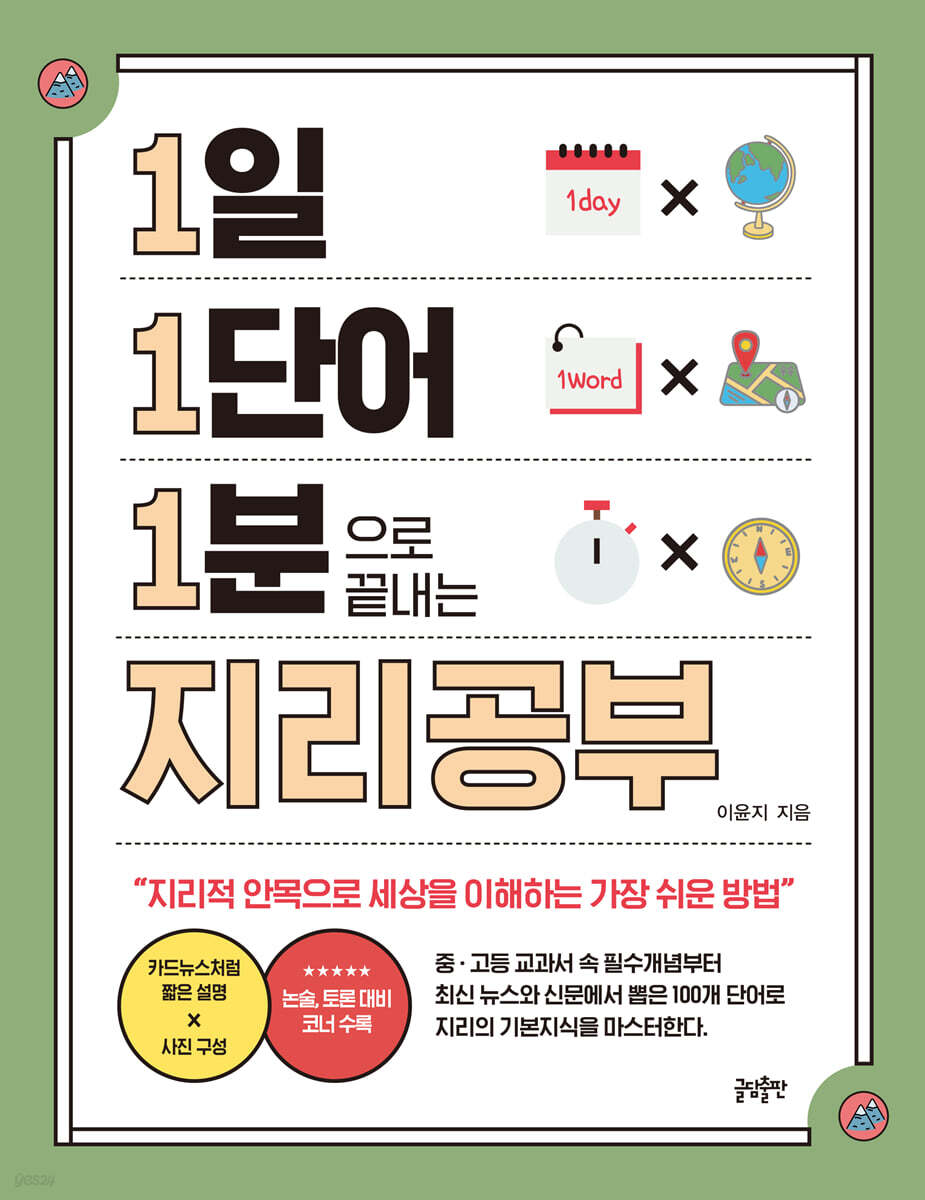
Geography study in one minute, one word a day
 |
Description
Book Introduction
“As the world we live in becomes more complex, geographical perspective will become increasingly important!”
Geography will account for 40% of the integrated social studies section introduced in the 2028 College Scholastic Ability Test.
A friendly and fun geography class by Lee Yun-ji, a current geography teacher who has taught at EBS for a long time.
The ninth book in the Geuldam Publishing Youth Culture Book [111 Series].
"One Word a Day, One Minute Geography Study" selects 100 essential core words for understanding geography and introduces them in 10 chapters: topography, climate, culture, population, city, politics, economy, disaster, environment, and map.
Although we often think that studying geography is only about learning how to read maps or memorizing the names of mountains and rivers, geography is the study of places, cultures, and people based on all visible geographical information.
Therefore, developing a geographical perspective can be an important tool for understanding the complex and intertwined world.
Additionally, with the abolition of elective subjects and the establishment of an integrated social studies section starting with the 2028 College Scholastic Ability Test (CSAT), interest in geography, which will account for a high proportion of the subjects, is also growing.
Author Lee Yoon-ji, a current geography teacher and long-time lecturer at EBS, has compiled this book to help readers enjoy geography, a subject that can be difficult and complex.
By providing concrete examples of everyday phenomena and events, such as sporting goods brand names like Patagonia and The North Face, glacial landforms, the Qatar World Cup and carbon neutrality, McDonald's French fries and the spatial division of labor in corporations, the concept of geography is brought closer to our lives, making it more familiar and acceptable to readers.
Covering a wide range of topics, from topography and climate to topics that might make you wonder, "Is this even related to geography?" As you read through them one by one, you'll naturally learn the basic concepts needed to understand geography and develop a keen eye for geography.
Geography will account for 40% of the integrated social studies section introduced in the 2028 College Scholastic Ability Test.
A friendly and fun geography class by Lee Yun-ji, a current geography teacher who has taught at EBS for a long time.
The ninth book in the Geuldam Publishing Youth Culture Book [111 Series].
"One Word a Day, One Minute Geography Study" selects 100 essential core words for understanding geography and introduces them in 10 chapters: topography, climate, culture, population, city, politics, economy, disaster, environment, and map.
Although we often think that studying geography is only about learning how to read maps or memorizing the names of mountains and rivers, geography is the study of places, cultures, and people based on all visible geographical information.
Therefore, developing a geographical perspective can be an important tool for understanding the complex and intertwined world.
Additionally, with the abolition of elective subjects and the establishment of an integrated social studies section starting with the 2028 College Scholastic Ability Test (CSAT), interest in geography, which will account for a high proportion of the subjects, is also growing.
Author Lee Yoon-ji, a current geography teacher and long-time lecturer at EBS, has compiled this book to help readers enjoy geography, a subject that can be difficult and complex.
By providing concrete examples of everyday phenomena and events, such as sporting goods brand names like Patagonia and The North Face, glacial landforms, the Qatar World Cup and carbon neutrality, McDonald's French fries and the spatial division of labor in corporations, the concept of geography is brought closer to our lives, making it more familiar and acceptable to readers.
Covering a wide range of topics, from topography and climate to topics that might make you wonder, "Is this even related to geography?" As you read through them one by one, you'll naturally learn the basic concepts needed to understand geography and develop a keen eye for geography.
- You can preview some of the book's contents.
Preview
index
Chapter 1: Topography and Geography
001 Weathering: How is soil made?
002 Folded Mountains: Why isn't there a lot of oil around the Korean Peninsula?
003 Stone Mountain and Earth Mountain: What kind of mountains are depicted in the “Inwangjesaekdo”?
004 Volcano: Why did it take 55 years to build the Ulleungdo Road?
005 Lake: Venice is a city built on a lake?
006 Coastline: Why is the west coast's coastline more complex than the east coast's?
007 Great Rivers: Which is longer, the Nile or the Amazon?
008 Tidal Flats: Why were Korea's tidal flats listed as a World Natural Heritage Site?
009 Karst Terrain: How were the boys trapped in the cave rescued safely?
010 Glacial Terrain: Why are glacial terrains so often used in outdoor gear brand names?
Reading the World through Geography Ⅰ What are the characteristics of places designated as national parks?_National Parks
Chapter 2: Climate and Geography
011 Climate: Weather and climate are not the same thing?
012 Four Seasons: Why are seasonal changes so distinct in temperate climates?
013 Equatorial Convergence Zone: Why is the Thai New Year's celebration held in April?
014 West Wind: Why are flight times different even though the sections are the same?
015 Temperate Climate: Is there a climate behind the birth of beer, wine, and makgeolli?
016 Temperature Inversion: What's the Secret to Cappadocia's World-Class Hot Air Ballooning Destination?
017 24 Solar Terms: Can you tell what our country's climate is like by looking at proverbs related to the solar terms?
018 Dry Climate: Why Are Science Fiction Movies Filmed in the Desert?
019 Spring Climate: Is there a place where it's spring weather all year round?
020 Weather Marketing: Is Weather Information Used for Product Marketing and Demand Forecasting?
Reading the World Through Geography II: Why Are Spring Wildfires on the East Coast So Difficult to Prevent? - The Foehn Phenomenon
Chapter 3 Culture and Geography
021 Globalization of Culture: When did Halloween parties begin to be enjoyed in our country?
022 Localization Strategy: Why Was BTS' Saudi Arabia Concert a Success?
023 Traditional Festivals: Geography Creates Festival Culture?
024 Cultural Coexistence: What is the secret to harmony and coexistence in New Zealand, a multicultural nation?
025 Halal: There's a Choco Pie with seaweed marshmallows?
026 Language Conflict: Can we live separately even though we don't speak the same language?
027 Traditional House: Can you tell which region a house is from just by looking at its shape?
028 Jerusalem: Why did the city of peace become the center of world conflict?
029 Middle East, Islam, Arab: What do Iran, Turkey, and Indonesia have in common and what are the differences?
030 Multicultural Society: What changes will occur when we become a multicultural society?
Reading the World Through Geography III: Learning Geography from the Olympics and World Cup?_Sports Culture
Chapter 4 Population and Geography
031 Population Theory: Why Pay Attention to Malthus's Theory, Which Deviated from Expectations?
032 Hispanics: Could the United States have a Hispanic president?
033 Population Distribution: What criteria should be applied to ensure fair Olympic rankings?
034 Population Pyramid: How will South Korea's population pyramid change in 2060?
035 Sex Ratio: What factors have led to the normalization of the sex ratio imbalance at birth in South Korea?
036 Fat Extinction: Is South Korea the fastest-aging country in the world?
037 Diaspora: Why did people around the world praise the film "Minari"?
038 Population Cliff: What problems will arise if the population cliff continues?
039 Family Planning: How can we solve the problems of low birth rates and an aging population?
040 Migrant Worker: There is a country where most of the population is foreigners?
Reading the World through Geography IV: Why We Can't Unconditionally Welcome Global Population Growth_8 Billion Day
Chapter 5: Cities and Geography
041 Urbanization: As the economy grows, people flock to cities?
042 Colonial Cities: Why is it so difficult to simply appreciate the exotic landscapes of Latin American metropolises?
043 World Cities: Why do they report U.S. stock market information on the news every morning?
44 Gentrification: Why do once-characteristic neighborhoods and alleyways lose their charm over time?
045 The Bilbao Effect: How Can We Revitalize Stagnant Cities?
046 Slow City: Pursuing the happiness of slowness instead of the convenience of speed?
047 Population Hollowing: Why Are Global Cities Resembling Donuts?
048 Urban Climate: Are there unique climate characteristics that only appear in large cities?
049 Spatial Inequality: Why Were Innovation Cities and Corporate Cities Created?
050 Eco-City: What would a city where people and the natural environment coexist look like?
Reading the World Through Geography V: Why Cities Need Brand Marketing?_City Brands
Chapter 6 Politics and Geography
051 Conflict: Will the world's conflicts also spread to space?
052 Kurdistan: There are people living in a country that is not on the map?
053 Refugee: There's a team that entered the Olympics with the Olympic rings instead of the national flag?
054 One China: Why did so many countries boycott the Beijing Winter Olympics?
055 Political Capital: Vancouver isn't Canada's capital?
056 NATO: Why did Russia attack Ukraine?
057 Demilitarized Zone: Isn't the DMZ only in our country?
058 Dokdo: Why is Japan trying to make Dokdo a disputed territory?
059 Barrier Politics: How Are Geographic Barriers Politically Utilized?
060 Resource Diplomacy: Why is China interested in African countries?
Reading the World Through Geography VI: What Role Can South Korea Play in Global Politics?_UN Security Council
Chapter 7: Economy and Geography
061 The Meaning of Resources: Will the Day Come When We Have to Buy Air to Breathe?
062 The Resource Curse: Even if you have abundant resources, you may not be economically prosperous?
063 World Trade Organization: Why can't even world powers easily break trade agreements?
064 Loconomy: What would be the benefits of having more consumers of local products?
065 CHOKE POINT: Why did China want to build a canal in Nicaragua, Central America?
066 Spatial Division of Labor: French Fries Disappeared Because of COVID-19?
067 Advancement of Industrial Structure: Looking at baseball history, can we see changes in our country's economic structure?
068 Economic Bloc: Why was the European Union created?
069 Fair Trade: Why Do Producing Countries Continue to Become Poor While Importing Countries Get Rich?
070 Why are oil-producing countries investing their oil money in the arts and sports in the post-oil era?
Reading the World Through Geography VII: Why Can China Pressure the US with Rare Earths? - Resource Nationalism
Chapter 8: Disasters and Geography
071 Heinrich's Law: Can we know when a natural disaster will occur?
072 Ring of Fire: Why do so many large earthquakes occur in Japan?
073 Dark Tourism: Is there a journey that leaves you with a memory of pain instead of pleasure?
074 Survival Bag: How to Prepare a Survival Bag for Disaster Preparedness
075 Typhoon: How are typhoon names decided?
076 Disaster Inequality: Why Do Similar Disasters Cause Different Damages?
77 Floods: Floods even occur in dry areas?
078 Tsunami: How can we avoid a tsunami?
079 The Two Faces of a Volcano: What does pizza baked in the heat of a volcanic lava taste like?
080 Secondary Disaster: Why is the 2011 Great East Japan Earthquake still being talked about?
Reading the World Through Geography Ⅷ Why Are Wildfires Growing in Size? _Heat Waves and Wildfires
Chapter 9 Environment and Geography
081 Paris Agreement: Can We Stop Glacier Funerals?
082 Fine Dust: What Lessons Does the Pandemic-Era Fine Dust Reduction Have?
083 Desertification: Is cashmere the cause of desertification in Mongolia?
084 Rainforest Destruction: What's the Connection Between Cell Phones and Gorillas, Ramen and Orangutans?
085 Greenwashing: Are Tumblers Really Eco-Friendly?
086 Environmental Footprint: What is the unit of measurement for calculating the damage humanity leaves on the Earth's environment?
087 Renewable Energy: Are Renewable Energy Only Advantages?
088 Eco-Vandalism: Why Did an Environmental Group Throw a Cake at the Mona Lisa?
089 Carbon Neutral: A World Cup Stadium Made of Stacked Shipping Containers?
090 Fast Fashion: Is There a Mountain of Used Clothing in the Atacama Desert?
Reading the World Through Geography IX: Has the Antarctic Ozone Hole Shrinked Thanks to Global Efforts? _Ozone Destruction
Chapter 10 Maps and Geography
091 Old Maps: Why do old maps look like interesting pictures?
092 Topic: Maps are for reading, not looking at?
093 Moon Map: Could the Moon Have Borders?
094 Geographic Information Technology: Can Geographic Information Technology Help You Find Your Lost Hometown and Family?
095 Ecological Map: Teaching ecological transition through map making?
096 International Date Line: Why is the International Date Line drawn crookedly on world maps?
097 Community Mapping: Are there any maps that users can create themselves?
098 Antipodes: What country is on the other side of the globe from our country?
099 Region: The boundaries of the region change depending on the criteria?
100 Antarctic Place Names: Is there a Ulsan Rock in Antarctica?
Reading the World Through Geography Ⅹ The Inside Story Behind Turkey's Renaming to Turkiye_Place Names
001 Weathering: How is soil made?
002 Folded Mountains: Why isn't there a lot of oil around the Korean Peninsula?
003 Stone Mountain and Earth Mountain: What kind of mountains are depicted in the “Inwangjesaekdo”?
004 Volcano: Why did it take 55 years to build the Ulleungdo Road?
005 Lake: Venice is a city built on a lake?
006 Coastline: Why is the west coast's coastline more complex than the east coast's?
007 Great Rivers: Which is longer, the Nile or the Amazon?
008 Tidal Flats: Why were Korea's tidal flats listed as a World Natural Heritage Site?
009 Karst Terrain: How were the boys trapped in the cave rescued safely?
010 Glacial Terrain: Why are glacial terrains so often used in outdoor gear brand names?
Reading the World through Geography Ⅰ What are the characteristics of places designated as national parks?_National Parks
Chapter 2: Climate and Geography
011 Climate: Weather and climate are not the same thing?
012 Four Seasons: Why are seasonal changes so distinct in temperate climates?
013 Equatorial Convergence Zone: Why is the Thai New Year's celebration held in April?
014 West Wind: Why are flight times different even though the sections are the same?
015 Temperate Climate: Is there a climate behind the birth of beer, wine, and makgeolli?
016 Temperature Inversion: What's the Secret to Cappadocia's World-Class Hot Air Ballooning Destination?
017 24 Solar Terms: Can you tell what our country's climate is like by looking at proverbs related to the solar terms?
018 Dry Climate: Why Are Science Fiction Movies Filmed in the Desert?
019 Spring Climate: Is there a place where it's spring weather all year round?
020 Weather Marketing: Is Weather Information Used for Product Marketing and Demand Forecasting?
Reading the World Through Geography II: Why Are Spring Wildfires on the East Coast So Difficult to Prevent? - The Foehn Phenomenon
Chapter 3 Culture and Geography
021 Globalization of Culture: When did Halloween parties begin to be enjoyed in our country?
022 Localization Strategy: Why Was BTS' Saudi Arabia Concert a Success?
023 Traditional Festivals: Geography Creates Festival Culture?
024 Cultural Coexistence: What is the secret to harmony and coexistence in New Zealand, a multicultural nation?
025 Halal: There's a Choco Pie with seaweed marshmallows?
026 Language Conflict: Can we live separately even though we don't speak the same language?
027 Traditional House: Can you tell which region a house is from just by looking at its shape?
028 Jerusalem: Why did the city of peace become the center of world conflict?
029 Middle East, Islam, Arab: What do Iran, Turkey, and Indonesia have in common and what are the differences?
030 Multicultural Society: What changes will occur when we become a multicultural society?
Reading the World Through Geography III: Learning Geography from the Olympics and World Cup?_Sports Culture
Chapter 4 Population and Geography
031 Population Theory: Why Pay Attention to Malthus's Theory, Which Deviated from Expectations?
032 Hispanics: Could the United States have a Hispanic president?
033 Population Distribution: What criteria should be applied to ensure fair Olympic rankings?
034 Population Pyramid: How will South Korea's population pyramid change in 2060?
035 Sex Ratio: What factors have led to the normalization of the sex ratio imbalance at birth in South Korea?
036 Fat Extinction: Is South Korea the fastest-aging country in the world?
037 Diaspora: Why did people around the world praise the film "Minari"?
038 Population Cliff: What problems will arise if the population cliff continues?
039 Family Planning: How can we solve the problems of low birth rates and an aging population?
040 Migrant Worker: There is a country where most of the population is foreigners?
Reading the World through Geography IV: Why We Can't Unconditionally Welcome Global Population Growth_8 Billion Day
Chapter 5: Cities and Geography
041 Urbanization: As the economy grows, people flock to cities?
042 Colonial Cities: Why is it so difficult to simply appreciate the exotic landscapes of Latin American metropolises?
043 World Cities: Why do they report U.S. stock market information on the news every morning?
44 Gentrification: Why do once-characteristic neighborhoods and alleyways lose their charm over time?
045 The Bilbao Effect: How Can We Revitalize Stagnant Cities?
046 Slow City: Pursuing the happiness of slowness instead of the convenience of speed?
047 Population Hollowing: Why Are Global Cities Resembling Donuts?
048 Urban Climate: Are there unique climate characteristics that only appear in large cities?
049 Spatial Inequality: Why Were Innovation Cities and Corporate Cities Created?
050 Eco-City: What would a city where people and the natural environment coexist look like?
Reading the World Through Geography V: Why Cities Need Brand Marketing?_City Brands
Chapter 6 Politics and Geography
051 Conflict: Will the world's conflicts also spread to space?
052 Kurdistan: There are people living in a country that is not on the map?
053 Refugee: There's a team that entered the Olympics with the Olympic rings instead of the national flag?
054 One China: Why did so many countries boycott the Beijing Winter Olympics?
055 Political Capital: Vancouver isn't Canada's capital?
056 NATO: Why did Russia attack Ukraine?
057 Demilitarized Zone: Isn't the DMZ only in our country?
058 Dokdo: Why is Japan trying to make Dokdo a disputed territory?
059 Barrier Politics: How Are Geographic Barriers Politically Utilized?
060 Resource Diplomacy: Why is China interested in African countries?
Reading the World Through Geography VI: What Role Can South Korea Play in Global Politics?_UN Security Council
Chapter 7: Economy and Geography
061 The Meaning of Resources: Will the Day Come When We Have to Buy Air to Breathe?
062 The Resource Curse: Even if you have abundant resources, you may not be economically prosperous?
063 World Trade Organization: Why can't even world powers easily break trade agreements?
064 Loconomy: What would be the benefits of having more consumers of local products?
065 CHOKE POINT: Why did China want to build a canal in Nicaragua, Central America?
066 Spatial Division of Labor: French Fries Disappeared Because of COVID-19?
067 Advancement of Industrial Structure: Looking at baseball history, can we see changes in our country's economic structure?
068 Economic Bloc: Why was the European Union created?
069 Fair Trade: Why Do Producing Countries Continue to Become Poor While Importing Countries Get Rich?
070 Why are oil-producing countries investing their oil money in the arts and sports in the post-oil era?
Reading the World Through Geography VII: Why Can China Pressure the US with Rare Earths? - Resource Nationalism
Chapter 8: Disasters and Geography
071 Heinrich's Law: Can we know when a natural disaster will occur?
072 Ring of Fire: Why do so many large earthquakes occur in Japan?
073 Dark Tourism: Is there a journey that leaves you with a memory of pain instead of pleasure?
074 Survival Bag: How to Prepare a Survival Bag for Disaster Preparedness
075 Typhoon: How are typhoon names decided?
076 Disaster Inequality: Why Do Similar Disasters Cause Different Damages?
77 Floods: Floods even occur in dry areas?
078 Tsunami: How can we avoid a tsunami?
079 The Two Faces of a Volcano: What does pizza baked in the heat of a volcanic lava taste like?
080 Secondary Disaster: Why is the 2011 Great East Japan Earthquake still being talked about?
Reading the World Through Geography Ⅷ Why Are Wildfires Growing in Size? _Heat Waves and Wildfires
Chapter 9 Environment and Geography
081 Paris Agreement: Can We Stop Glacier Funerals?
082 Fine Dust: What Lessons Does the Pandemic-Era Fine Dust Reduction Have?
083 Desertification: Is cashmere the cause of desertification in Mongolia?
084 Rainforest Destruction: What's the Connection Between Cell Phones and Gorillas, Ramen and Orangutans?
085 Greenwashing: Are Tumblers Really Eco-Friendly?
086 Environmental Footprint: What is the unit of measurement for calculating the damage humanity leaves on the Earth's environment?
087 Renewable Energy: Are Renewable Energy Only Advantages?
088 Eco-Vandalism: Why Did an Environmental Group Throw a Cake at the Mona Lisa?
089 Carbon Neutral: A World Cup Stadium Made of Stacked Shipping Containers?
090 Fast Fashion: Is There a Mountain of Used Clothing in the Atacama Desert?
Reading the World Through Geography IX: Has the Antarctic Ozone Hole Shrinked Thanks to Global Efforts? _Ozone Destruction
Chapter 10 Maps and Geography
091 Old Maps: Why do old maps look like interesting pictures?
092 Topic: Maps are for reading, not looking at?
093 Moon Map: Could the Moon Have Borders?
094 Geographic Information Technology: Can Geographic Information Technology Help You Find Your Lost Hometown and Family?
095 Ecological Map: Teaching ecological transition through map making?
096 International Date Line: Why is the International Date Line drawn crookedly on world maps?
097 Community Mapping: Are there any maps that users can create themselves?
098 Antipodes: What country is on the other side of the globe from our country?
099 Region: The boundaries of the region change depending on the criteria?
100 Antarctic Place Names: Is there a Ulsan Rock in Antarctica?
Reading the World Through Geography Ⅹ The Inside Story Behind Turkey's Renaming to Turkiye_Place Names
Detailed image

Into the book
Since the 1960s, when our country began to pursue industrialization in earnest, we have reclaimed many tidal flats and used them as farmland, residential land, and industrial land.
While creating reclaimed land can expand the national territory and bring significant economic benefits, it also has a greater negative impact on the environment, as it alters the existing coastal ecosystem and destroys the purifying function of tidal flats.
Today, the natural environmental value of tidal flats is being recognized as much as their economic value, with tidal flats being registered as natural monuments.
As interest in the environmental value of tidal flats grows, efforts are being made to protect tidal flats with excellent ecological environments by designating them as coastal wetland protection areas, and to restore damaged tidal flats to their original functions through reclamation and restoration projects.
--- p.31 From "Mudflat"
New Zealand is a representative country that advocates multiculturalism, which recognizes and respects various cultures within a single country.
Although the total population is only 5 million, it is a multicultural society where 120 ethnic groups live together.
A multicultural society is one in which people of different races, religions, and cultures live together.
Multiculturalism is also an attitude or policy that seeks to respect multiple cultures in order to recognize and exchange the diverse cultures of single nation-states as globalization progresses.
--- p.70 From “Cultural Coexistence”
The rapid population decline and low birth rate in our country's rural areas have created a new social problem called 'local extinction.'
Local extinction refers to a situation in which a community's population declines, making it difficult for the community to function properly due to a lack of social infrastructure and living services, and difficulties in living.
This loss of land is not limited to remote islands and mountainous regions.
This phenomenon has already begun in small and medium-sized cities as well as metropolitan autonomous bodies.
There are even predictions that a nationwide extinction will occur by 2047.
Now is the time to examine the social problems caused by the aging population and devise proactive measures to address the disappearance of local communities.
--- p.99 From "Local Extinction"
Territorial disputes typically arise in areas where borders are not clearly defined, where one country has a history of occupying another's territory by force, or where ethnic minorities with different religions seek independence.
In particular, in the process of gaining independence from colonial nations, borders were established based on the interests of powerful nations, ignoring cultural characteristics such as tribes and religions.
This resulted in various tribes being incorporated into one country, or one tribe being divided into two along a border.
Moreover, Africa's abundant underground resources are becoming a curse rather than a blessing due to the competition for power surrounding them.
As a result, conflicts are breaking out all over Africa, and refugees are constantly being created.
--- p.136 From "Dispute"
Disasters pose a greater threat to those living in developing countries than to those living in developed countries, and even to the poor within the same country.
In fact, most of those who died in the Haiti earthquake were people living in slums or poor farming areas.
The substandard housing they lived in collapsed in an earthquake, causing significant casualties.
On the other hand, in Haiti, the upscale residential areas where the wealthy live were not significantly damaged.
--- p.195 From “Disaster Inequality”
Publisher's Review
“With just a smartphone, it’s easy to find your way around and find information anywhere in the world.
“Why do we have to study difficult and complicated geography?”
As the world becomes more complex, geographical thinking and perspective will become increasingly important!
When we think of studying geography, we often think of it as learning how to read maps, understanding regional climate characteristics, and examining the different geographical conditions of various countries around the world.
However, geography is not just about learning the information immediately before our eyes; it is a discipline that studies natural and humanistic phenomena related to human activities by collecting and analyzing such information.
Through the environment and place, we take a deep look into the people and culture that live there.
Therefore, developing a geographical perspective will enable you to understand the world more colorfully and deeply.
"One Word a Day, One Minute Geography Study" is a book that helps develop a geographical perspective, an excellent tool for properly understanding the world we live in.
This book was written by current geography teacher Lee Yun-ji based on her expertise gained from teaching geography in middle and high schools for a long time and giving geography and convergence education lectures at EBS.
We've selected 100 essential words you need to know to understand geography, and provided a concise, two-page explanation of each word.
By adding rich visual materials such as maps, graphs, tables, illustrations, and photos, it is designed to help students gradually acquire basic concepts that may have been overlooked during school geography classes.
“South Korea is the fastest-aging country in the world?”
“There is a country where abundant underground resources have become a curse?”
“Why do oil-producing countries like the United Arab Emirates invest their oil money in the arts and sports?”
Knowing geography gives us a new perspective on the world we live in!
Teacher Lee Yoon-ji, who has been teaching children in the field for a long time, goes beyond textbooks and tells interesting geography stories by drawing on phenomena and events we experience in our daily lives.
This book, which consists of ten chapters on geography, climate, culture, population, cities, politics, economy, disasters, environment, and maps, shows just how closely geography is related to our lives just by looking at the table of contents.
Through the story of the boys who were trapped in Thailand's Tham Luang Cave in 2018 and safely rescued, we learn about the characteristics of karst topography, introduce the meaning behind outdoor brands like The North Face and Patagonia, and explain glacial topography.
The story of Cappadocia in Turkey becoming a world-renowned hot air balloon destination explains the phenomenon of temperature inversion, BTS's successful Saudi Arabian concert illustrates localization strategies, and the story of the multicultural New Zealand rugby team provides a glimpse into cultural coexistence.
The case of the athletes marching with the Olympic rings at the 2020 Tokyo Olympics provides a glimpse into the world's refugee crisis, and the disappearance of French fries from McDonald's during the COVID-19 pandemic illustrates the multinational corporations driving globalization.
Covering a wide range of topics, from geography and climate to topics that might make you wonder, "Is this even related to geography?" Reading through them one by one, as if reading an engaging story, will naturally help you master the basic concepts of geography and cultivate a keen eye for geography in everyday life.
If you are curious about the space, people, and culture that surrounds you
A friendly geography guide that anyone can read easily and enjoyably.
The path you walked this morning, the people you met throughout the day, the news from another country on the other side of the world—these are things you might pass by without noticing, but with just a little bit of geographical imagination, you can glean many stories from them.
Developing a geographical perspective is the same as developing an interest in the world.
It is about gaining the ability to see the world broadly, deeply, and colorfully.
As the world becomes increasingly interconnected, influencing and intricately intertwined, countless untold stories lie beneath, and a geographic perspective is essential to truly understanding this world.
This book is a friendly guide to geography that avoids complex theories and technical terms as much as possible, and presents interesting cases in the simplest possible language, making it easy for anyone to read.
Even readers who have always found geography difficult and unfamiliar can slowly and gradually discover the joy of unlocking the world's secrets using geography as a key.
"One Word a Day, One Minute Geography Study" will lead readers into a wider and more exciting world.
“Why do we have to study difficult and complicated geography?”
As the world becomes more complex, geographical thinking and perspective will become increasingly important!
When we think of studying geography, we often think of it as learning how to read maps, understanding regional climate characteristics, and examining the different geographical conditions of various countries around the world.
However, geography is not just about learning the information immediately before our eyes; it is a discipline that studies natural and humanistic phenomena related to human activities by collecting and analyzing such information.
Through the environment and place, we take a deep look into the people and culture that live there.
Therefore, developing a geographical perspective will enable you to understand the world more colorfully and deeply.
"One Word a Day, One Minute Geography Study" is a book that helps develop a geographical perspective, an excellent tool for properly understanding the world we live in.
This book was written by current geography teacher Lee Yun-ji based on her expertise gained from teaching geography in middle and high schools for a long time and giving geography and convergence education lectures at EBS.
We've selected 100 essential words you need to know to understand geography, and provided a concise, two-page explanation of each word.
By adding rich visual materials such as maps, graphs, tables, illustrations, and photos, it is designed to help students gradually acquire basic concepts that may have been overlooked during school geography classes.
“South Korea is the fastest-aging country in the world?”
“There is a country where abundant underground resources have become a curse?”
“Why do oil-producing countries like the United Arab Emirates invest their oil money in the arts and sports?”
Knowing geography gives us a new perspective on the world we live in!
Teacher Lee Yoon-ji, who has been teaching children in the field for a long time, goes beyond textbooks and tells interesting geography stories by drawing on phenomena and events we experience in our daily lives.
This book, which consists of ten chapters on geography, climate, culture, population, cities, politics, economy, disasters, environment, and maps, shows just how closely geography is related to our lives just by looking at the table of contents.
Through the story of the boys who were trapped in Thailand's Tham Luang Cave in 2018 and safely rescued, we learn about the characteristics of karst topography, introduce the meaning behind outdoor brands like The North Face and Patagonia, and explain glacial topography.
The story of Cappadocia in Turkey becoming a world-renowned hot air balloon destination explains the phenomenon of temperature inversion, BTS's successful Saudi Arabian concert illustrates localization strategies, and the story of the multicultural New Zealand rugby team provides a glimpse into cultural coexistence.
The case of the athletes marching with the Olympic rings at the 2020 Tokyo Olympics provides a glimpse into the world's refugee crisis, and the disappearance of French fries from McDonald's during the COVID-19 pandemic illustrates the multinational corporations driving globalization.
Covering a wide range of topics, from geography and climate to topics that might make you wonder, "Is this even related to geography?" Reading through them one by one, as if reading an engaging story, will naturally help you master the basic concepts of geography and cultivate a keen eye for geography in everyday life.
If you are curious about the space, people, and culture that surrounds you
A friendly geography guide that anyone can read easily and enjoyably.
The path you walked this morning, the people you met throughout the day, the news from another country on the other side of the world—these are things you might pass by without noticing, but with just a little bit of geographical imagination, you can glean many stories from them.
Developing a geographical perspective is the same as developing an interest in the world.
It is about gaining the ability to see the world broadly, deeply, and colorfully.
As the world becomes increasingly interconnected, influencing and intricately intertwined, countless untold stories lie beneath, and a geographic perspective is essential to truly understanding this world.
This book is a friendly guide to geography that avoids complex theories and technical terms as much as possible, and presents interesting cases in the simplest possible language, making it easy for anyone to read.
Even readers who have always found geography difficult and unfamiliar can slowly and gradually discover the joy of unlocking the world's secrets using geography as a key.
"One Word a Day, One Minute Geography Study" will lead readers into a wider and more exciting world.
GOODS SPECIFICS
- Date of issue: February 25, 2025
- Page count, weight, size: 253 pages | 534g | 170*225*16mm
- ISBN13: 9791191309782
- ISBN10: 1191309789
You may also like
카테고리
korean


korean

![GQ KOREA Mark (Monthly): December [2025]](http://librairie.coreenne.fr/cdn/shop/files/8ef265dbbfbf186523ed75ba7319009d.jpg?v=1765340328&width=3840)


