

Seoul Literary Tour
 |
Description
Book Introduction
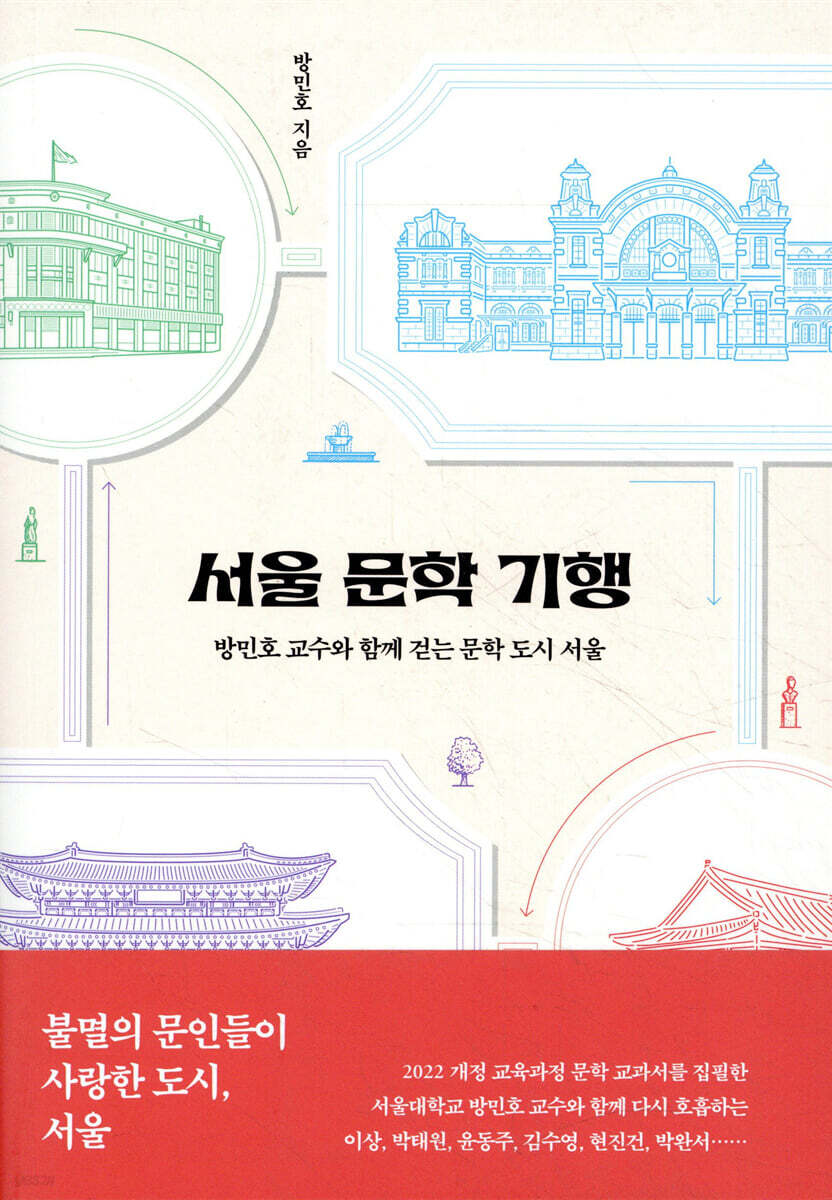
Seoul, the city loved by immortal writers
Wrote the 2022 revised curriculum literature textbook
Breathing again with Professor Bang Min-ho of Seoul National University
Lee Sang, Park Tae-won, Yun Dong-ju, Kim Su-yeong, Hyun Jin-geon, Park Wan-seo… …
Seoul is the city where our country's culture shines most brilliantly.
The revised and expanded edition of "Seoul Literary Journey," which established this symbolic space as an unshakable central axis and looked into the accumulated time of life here through a literary perspective, and showed a new way of reading life on "how to live," has been published by the comprehensive publishing brand "Bookda."
The newly introduced 『Seoul Literary Tour』 includes stories about the works of Hyun Jin-geon and Na Do-hyang, authors of famous short stories beloved by Koreans and whose works are essential for introduction in middle and high school Korean language and literature textbooks.
This book can be said to be a richer and expanded version of the stories of twelve writers who have interpreted 'Seoul' as both the backdrop of their lives and a symbolic space for literature.
The works of Lee Sang, Yun Dong-ju, Hyun Jin-geon, Park Tae-won, Park In-hwan, Kim Su-yeong, Lee Gwang-su, Na Do-hyang, Im Hwa, Son Chang-seop, Lee Ho-cheol, and Park Wan-seo included in this book transcend time and remain relevant even today, “like stars shining white in the dark night sky,” “poignantly revealing through writing what our lives are” (from “Starting the Book”).
Twelve immortal writers are brought back to life and breathing again close to us through the journey of Professor Bang Min-ho of the Department of Korean Language and Literature at Seoul National University, who has studied modern and contemporary Korean literature and has been deeply interested in the relationship between the space of Seoul, writers, and their works.
Author's Note
This book contains the names of Korean writers I learned while studying modern and contemporary Korean literature, the twists and turns of their lives, and stories from various places in Seoul related to them.
Lee Sang, Yun Dong-ju, Hyun Jin-geon, Park Tae-won, Park In-hwan, Kim Su-yeong, Lee Gwang-su, Na Do-hyang, Im Hwa, Son Chang-seop, Lee Ho-cheol, Park Wan-seo.
Let's memorize their names again.
He is a literary figure who shines beautifully like a white star in the dark night sky.
These are the people we know and love most.
They are also people who have revealed to us, through writing, poetry, and novels, what our lives are like.
Seoul is their home and the stage for their stories and songs.
Wrote the 2022 revised curriculum literature textbook
Breathing again with Professor Bang Min-ho of Seoul National University
Lee Sang, Park Tae-won, Yun Dong-ju, Kim Su-yeong, Hyun Jin-geon, Park Wan-seo… …
Seoul is the city where our country's culture shines most brilliantly.
The revised and expanded edition of "Seoul Literary Journey," which established this symbolic space as an unshakable central axis and looked into the accumulated time of life here through a literary perspective, and showed a new way of reading life on "how to live," has been published by the comprehensive publishing brand "Bookda."
The newly introduced 『Seoul Literary Tour』 includes stories about the works of Hyun Jin-geon and Na Do-hyang, authors of famous short stories beloved by Koreans and whose works are essential for introduction in middle and high school Korean language and literature textbooks.
This book can be said to be a richer and expanded version of the stories of twelve writers who have interpreted 'Seoul' as both the backdrop of their lives and a symbolic space for literature.
The works of Lee Sang, Yun Dong-ju, Hyun Jin-geon, Park Tae-won, Park In-hwan, Kim Su-yeong, Lee Gwang-su, Na Do-hyang, Im Hwa, Son Chang-seop, Lee Ho-cheol, and Park Wan-seo included in this book transcend time and remain relevant even today, “like stars shining white in the dark night sky,” “poignantly revealing through writing what our lives are” (from “Starting the Book”).
Twelve immortal writers are brought back to life and breathing again close to us through the journey of Professor Bang Min-ho of the Department of Korean Language and Literature at Seoul National University, who has studied modern and contemporary Korean literature and has been deeply interested in the relationship between the space of Seoul, writers, and their works.
Author's Note
This book contains the names of Korean writers I learned while studying modern and contemporary Korean literature, the twists and turns of their lives, and stories from various places in Seoul related to them.
Lee Sang, Yun Dong-ju, Hyun Jin-geon, Park Tae-won, Park In-hwan, Kim Su-yeong, Lee Gwang-su, Na Do-hyang, Im Hwa, Son Chang-seop, Lee Ho-cheol, Park Wan-seo.
Let's memorize their names again.
He is a literary figure who shines beautifully like a white star in the dark night sky.
These are the people we know and love most.
They are also people who have revealed to us, through writing, poetry, and novels, what our lives are like.
Seoul is their home and the stage for their stories and songs.
- You can preview some of the book's contents.
Preview
index
Beginning the book | In search of Seoul, the city steeped in the stories of our literature
Chapter 1 Let's fly, let's fly just one more time
Insight into an Age of Extremes - Lee Sang, Wings
Chapter 2 With a heart that sings of the stars
Into the Desperate Struggle for Purity - Yun Dong-ju, Seosi
Chapter 3: Where did Rickshaw Man Kim Cheom-ji's dream of paradise go?
A writer who never lost his integrity in dark times - Hyun Jin-geon, A Lucky Day
Chapter 4: Walking in Search of One Joy
The Breath and Emotions of Seoul - Park Tae-won, Novelist Gu Bo's Daily Life
Chapter 5: Time Comes and Goes
Breathing Deeply into the Vanity of Life - Park In-hwan, The Wooden Horse and the Lady
Chapter 6 The day is cloudy and the grass roots lie down.
Poetry of Being, Not Poetry of Participation - Kim Su-young, Full
Chapter 7: Is this good or evil?
Dual Citizens of Desire and Guilt - Lee Kwang-soo, Yoo Jeong
Chapter 8: The Hot Passion Congealed in My Heart
The Restoration of Human Emotions and Consciousness of the Lower Classes - Na Do-hyang, the Mute Samryongi
Chapter 9: The Lover of Every Working Woman
A song sung in Jongno, the heart of Seoul - Im Hwa, Sooni of the Intersection
Chapter 10: Those who live by selling their loyalty and conscience
Seoul as Seen Through the Eyes of an "Outsider" - Son Chang-seop, Human Classroom
Chapter 11: This is a decent job for me too
A City Without Surplus - Lee Ho-cheol, Seoul is Full
Chapter 12 I Want to Live, I Want to Die
The Meaning of Life Found in the Ruins of War - Park Wan-seo, Namok
Chapter 1 Let's fly, let's fly just one more time
Insight into an Age of Extremes - Lee Sang, Wings
Chapter 2 With a heart that sings of the stars
Into the Desperate Struggle for Purity - Yun Dong-ju, Seosi
Chapter 3: Where did Rickshaw Man Kim Cheom-ji's dream of paradise go?
A writer who never lost his integrity in dark times - Hyun Jin-geon, A Lucky Day
Chapter 4: Walking in Search of One Joy
The Breath and Emotions of Seoul - Park Tae-won, Novelist Gu Bo's Daily Life
Chapter 5: Time Comes and Goes
Breathing Deeply into the Vanity of Life - Park In-hwan, The Wooden Horse and the Lady
Chapter 6 The day is cloudy and the grass roots lie down.
Poetry of Being, Not Poetry of Participation - Kim Su-young, Full
Chapter 7: Is this good or evil?
Dual Citizens of Desire and Guilt - Lee Kwang-soo, Yoo Jeong
Chapter 8: The Hot Passion Congealed in My Heart
The Restoration of Human Emotions and Consciousness of the Lower Classes - Na Do-hyang, the Mute Samryongi
Chapter 9: The Lover of Every Working Woman
A song sung in Jongno, the heart of Seoul - Im Hwa, Sooni of the Intersection
Chapter 10: Those who live by selling their loyalty and conscience
Seoul as Seen Through the Eyes of an "Outsider" - Son Chang-seop, Human Classroom
Chapter 11: This is a decent job for me too
A City Without Surplus - Lee Ho-cheol, Seoul is Full
Chapter 12 I Want to Live, I Want to Die
The Meaning of Life Found in the Ruins of War - Park Wan-seo, Namok
Detailed image

Into the book
The protagonist of "Wings" did not die from falling from the rooftop.
As he leaves the Mitsukoshi department store, he contemplates whether he should re-enter the weary world of capitalist modernity, a life dominated by the mechanisms symbolized by his wife.
The 'me' of the past had the power to escape and overcome the difficulties and limitations of the real world through artistic life and passion.
But now, when I feel like I've lost all will and am being absorbed into reality, I want to shout out like this.
“Let’s fly just one more time.”
---p.37 From "Chapter 1 Let's Fly, Let's Fly Just One More Time - Ideal, Wings"
Although it was a short-lived boarding house before moving to a new residence, 9 Nusan-dong remains a problematic space.
This is because it served as a cradle for Yun Dong-ju's poetry, to the point where he wrote ten poems in about five months.
Considering the sheer volume of poetry he wrote, it can be seen that he put considerable effort into his creations while he was boarding.
He may have nurtured his passion for writing by closely observing the flow of the literary world through the writers who frequented Kim Song's house.
At that time, didn't Yun Dong-ju deeply contemplate what literary path he should take?
---p.61 From “Chapter 2: With a Heart that Sings of the Stars - Yun Dong-ju, Preface”
"A Lucky Day" is considered a work that vividly captures the image of Seoul in the early 1920s.
(……) Kim Cheom-ji, a rickshaw puller, was a member of the city's transportation team, and following his path reveals a concise glimpse into the lives of the various people living in Seoul at the time.
A variety of characters from various social classes and occupations appear, including a madam, a school teacher, a student, a young woman who may or may not be a gisaeng or a schoolgirl, and a man carrying a large suitcase, and they are connected to a single cityscape through Kim Cheomji.
---p.100 From “Chapter 3: Where did Rickshaw Man Kim Cheom-ji’s Dream of Paradise Go - Hyun Jin-geon, A Lucky Day”
Gubo heads to Gyeongseong Station with his university notebook in his hand, describing it as a "port of the city."
I think this expression has a very important meaning.
A port is a place to depart.
The image of a port symbolizes the possibility of 'leaving' at any time.
But interestingly, Kubo does not leave this port, but turns around.
(……) As he was walking along Cheonggyecheon Stream and reached Gwanggyo, he complained of headaches and nervous breakdown, showing that his mental fatigue was spreading to physical illness.
What is the source of this suffering? It is the colonial reality hidden yet openly visible in the city, and the political and economic gloom surrounding them.
---p.142 From “Chapter 4: Walking in Search of a Single Joy - Park Tae-won, Novelist Gu Bo’s Daily Life”
Now I'm leaving Myeongdong Street.
Here at the Dongbang Salon, Park In-hwan would have met with literary figures and engaged in heated discussions about the poetic themes of the times.
"As Time Goes By" may have been born in a tavern in this very alley.
(……) What kind of place was Myeongdong to Park In-hwan? Was it a place where he could feel life and culture even amidst the ruins of war? Or was it a place shining like a lighthouse in the darkness? I feel like Park In-hwan stood here, amidst the crowds of Myeongdong, reading Virginia Woolf and breathing deeply into the futility of life.
---p.189 From “Chapter 5 Time Comes and Goes - Park In-hwan, The Wooden Horse and the Lady”
Address 41 Gusu-dong was the point from which Kim Su-yeong could view the system he was in from the furthest distance, from the outskirts.
Why did he constantly seek to go outside? In his prose "Mosquitoes and Ants" (1966), Kim Su-yeong defined an intellectual as "a person who considers humanity's problems as his own and ponders humanity's concerns as his own."
Where can we view the problems of all humanity from? It's from the outside, at the edge.
---pp.211-212 From "Chapter 6: The Day is Cloudy and the Grass Roots Lie Down - Kim Su-young, Grass"
As I think about this, I think back to Lee Kwang-soo's life.
He too lived a life full of ups and downs.
Despite experiencing all the ups and downs of life and the twists and turns of the Japanese colonial period, he built a villa in the scenic Hongji-dong and enjoyed the style and scenery.
Even in the midst of suffering, he did not give up his passion for elegance.
(……) I sat on the bench in front of Tangchundae Fortress and reflected on the lives of King Yeonsangun and Lee Gwangsu.
'Spring is not just spring.
Even if you live your whole life and are already quite old, as long as you are still alive, life is still spring.'
---p.261 From "Chapter 7: Is This Good? Is This Evil? - Lee Gwang-su, Yoo Jeong"
A cold winter wind blows.
As the season deepens, the sadness and beauty of his literature become more vivid.
Just as Cheongpa-dong was a place of special significance to Na Do-hyang, beyond a simple hometown, it also serves as a literary space for us to look into the essence of life and the inner self of humanity.
(……) It seems that the deep winter of Nado-hyang is beginning once again.
---p.294 From “Chapter 8: Hot passion condensed in the heart - Na Do-hyang, the mute Samryongi”
The speaker of the poem names Jongno Intersection, the heart of Joseon and the center of Seoul, several times.
The street where Bosin Pavilion is located, before the Japanese invasion and exploitation, was where the red and blue flags of the Joseon government fluttered.
But now the street is dominated by trams and automobiles.
People, cars, animals, and modern machines mingle under a new civilization, and unfamiliar tall buildings overlook Bosin Pavilion.
Bosingak was probably originally the most magnificent building in old Seoul.
But now, it looks like a relic of an old dynasty, crushed by modern buildings.
Nevertheless, Im Hwa clearly recognizes the Jongno intersection where the Bosin Pavilion is located as his hometown.
---p.328 From “Chapter 9: The Lover of All Working Women - Im Hwa, Sooni of the Intersection”
Through Seoul Station, Hoehyeon-dong, Yongsan, and Heukseok-dong, Son Chang-seop portrayed various aspects of Korean society, represented by the world of Seoul that he saw and described, at various levels.
It was precisely because of this that I was able to develop a critical perspective that allowed me to coolly observe and examine the contradictions, problems, and absurdities inherent in Korean society.
And that stronghold was the house in Heukseok-dong, overlooking and overlooking the Han River.
---pp.368-370 From "Chapter 10: Those Who Sell Their Loyalty and Conscience - Son Chang-seop, Human Classroom"
Gilnyeo can be said to be close to the ideal woman who can maintain her own 'health' without being caught up in the spatial political economy of Seoul that demands corruption.
We can see that Lee Ho-cheol wanted to portray a woman who receives the light of new life as an untouched being in the cramped survival tunnel of a crowded Seoul.
---p.403 From Chapter 11, "This is a Proper Job for Me, Too - Lee Ho-cheol, Seoul is Full"
In "Namok," one feels the presence of eyes that intensely pierce through the ruins of war-torn Seoul.
From the US military PX, through Myeong-dong, past the window-lined streets to the Sudo Theater, or while taking the tram from Euljiro 3-ga to Gye-dong from Jongno, the silence seeping into your skin, the eerie cityscape, the empty, depopulated Seoul where refugees have not yet all returned.
(……) What kind of stories were the people who had to continue living and blossom at that time?
As he leaves the Mitsukoshi department store, he contemplates whether he should re-enter the weary world of capitalist modernity, a life dominated by the mechanisms symbolized by his wife.
The 'me' of the past had the power to escape and overcome the difficulties and limitations of the real world through artistic life and passion.
But now, when I feel like I've lost all will and am being absorbed into reality, I want to shout out like this.
“Let’s fly just one more time.”
---p.37 From "Chapter 1 Let's Fly, Let's Fly Just One More Time - Ideal, Wings"
Although it was a short-lived boarding house before moving to a new residence, 9 Nusan-dong remains a problematic space.
This is because it served as a cradle for Yun Dong-ju's poetry, to the point where he wrote ten poems in about five months.
Considering the sheer volume of poetry he wrote, it can be seen that he put considerable effort into his creations while he was boarding.
He may have nurtured his passion for writing by closely observing the flow of the literary world through the writers who frequented Kim Song's house.
At that time, didn't Yun Dong-ju deeply contemplate what literary path he should take?
---p.61 From “Chapter 2: With a Heart that Sings of the Stars - Yun Dong-ju, Preface”
"A Lucky Day" is considered a work that vividly captures the image of Seoul in the early 1920s.
(……) Kim Cheom-ji, a rickshaw puller, was a member of the city's transportation team, and following his path reveals a concise glimpse into the lives of the various people living in Seoul at the time.
A variety of characters from various social classes and occupations appear, including a madam, a school teacher, a student, a young woman who may or may not be a gisaeng or a schoolgirl, and a man carrying a large suitcase, and they are connected to a single cityscape through Kim Cheomji.
---p.100 From “Chapter 3: Where did Rickshaw Man Kim Cheom-ji’s Dream of Paradise Go - Hyun Jin-geon, A Lucky Day”
Gubo heads to Gyeongseong Station with his university notebook in his hand, describing it as a "port of the city."
I think this expression has a very important meaning.
A port is a place to depart.
The image of a port symbolizes the possibility of 'leaving' at any time.
But interestingly, Kubo does not leave this port, but turns around.
(……) As he was walking along Cheonggyecheon Stream and reached Gwanggyo, he complained of headaches and nervous breakdown, showing that his mental fatigue was spreading to physical illness.
What is the source of this suffering? It is the colonial reality hidden yet openly visible in the city, and the political and economic gloom surrounding them.
---p.142 From “Chapter 4: Walking in Search of a Single Joy - Park Tae-won, Novelist Gu Bo’s Daily Life”
Now I'm leaving Myeongdong Street.
Here at the Dongbang Salon, Park In-hwan would have met with literary figures and engaged in heated discussions about the poetic themes of the times.
"As Time Goes By" may have been born in a tavern in this very alley.
(……) What kind of place was Myeongdong to Park In-hwan? Was it a place where he could feel life and culture even amidst the ruins of war? Or was it a place shining like a lighthouse in the darkness? I feel like Park In-hwan stood here, amidst the crowds of Myeongdong, reading Virginia Woolf and breathing deeply into the futility of life.
---p.189 From “Chapter 5 Time Comes and Goes - Park In-hwan, The Wooden Horse and the Lady”
Address 41 Gusu-dong was the point from which Kim Su-yeong could view the system he was in from the furthest distance, from the outskirts.
Why did he constantly seek to go outside? In his prose "Mosquitoes and Ants" (1966), Kim Su-yeong defined an intellectual as "a person who considers humanity's problems as his own and ponders humanity's concerns as his own."
Where can we view the problems of all humanity from? It's from the outside, at the edge.
---pp.211-212 From "Chapter 6: The Day is Cloudy and the Grass Roots Lie Down - Kim Su-young, Grass"
As I think about this, I think back to Lee Kwang-soo's life.
He too lived a life full of ups and downs.
Despite experiencing all the ups and downs of life and the twists and turns of the Japanese colonial period, he built a villa in the scenic Hongji-dong and enjoyed the style and scenery.
Even in the midst of suffering, he did not give up his passion for elegance.
(……) I sat on the bench in front of Tangchundae Fortress and reflected on the lives of King Yeonsangun and Lee Gwangsu.
'Spring is not just spring.
Even if you live your whole life and are already quite old, as long as you are still alive, life is still spring.'
---p.261 From "Chapter 7: Is This Good? Is This Evil? - Lee Gwang-su, Yoo Jeong"
A cold winter wind blows.
As the season deepens, the sadness and beauty of his literature become more vivid.
Just as Cheongpa-dong was a place of special significance to Na Do-hyang, beyond a simple hometown, it also serves as a literary space for us to look into the essence of life and the inner self of humanity.
(……) It seems that the deep winter of Nado-hyang is beginning once again.
---p.294 From “Chapter 8: Hot passion condensed in the heart - Na Do-hyang, the mute Samryongi”
The speaker of the poem names Jongno Intersection, the heart of Joseon and the center of Seoul, several times.
The street where Bosin Pavilion is located, before the Japanese invasion and exploitation, was where the red and blue flags of the Joseon government fluttered.
But now the street is dominated by trams and automobiles.
People, cars, animals, and modern machines mingle under a new civilization, and unfamiliar tall buildings overlook Bosin Pavilion.
Bosingak was probably originally the most magnificent building in old Seoul.
But now, it looks like a relic of an old dynasty, crushed by modern buildings.
Nevertheless, Im Hwa clearly recognizes the Jongno intersection where the Bosin Pavilion is located as his hometown.
---p.328 From “Chapter 9: The Lover of All Working Women - Im Hwa, Sooni of the Intersection”
Through Seoul Station, Hoehyeon-dong, Yongsan, and Heukseok-dong, Son Chang-seop portrayed various aspects of Korean society, represented by the world of Seoul that he saw and described, at various levels.
It was precisely because of this that I was able to develop a critical perspective that allowed me to coolly observe and examine the contradictions, problems, and absurdities inherent in Korean society.
And that stronghold was the house in Heukseok-dong, overlooking and overlooking the Han River.
---pp.368-370 From "Chapter 10: Those Who Sell Their Loyalty and Conscience - Son Chang-seop, Human Classroom"
Gilnyeo can be said to be close to the ideal woman who can maintain her own 'health' without being caught up in the spatial political economy of Seoul that demands corruption.
We can see that Lee Ho-cheol wanted to portray a woman who receives the light of new life as an untouched being in the cramped survival tunnel of a crowded Seoul.
---p.403 From Chapter 11, "This is a Proper Job for Me, Too - Lee Ho-cheol, Seoul is Full"
In "Namok," one feels the presence of eyes that intensely pierce through the ruins of war-torn Seoul.
From the US military PX, through Myeong-dong, past the window-lined streets to the Sudo Theater, or while taking the tram from Euljiro 3-ga to Gye-dong from Jongno, the silence seeping into your skin, the eerie cityscape, the empty, depopulated Seoul where refugees have not yet all returned.
(……) What kind of stories were the people who had to continue living and blossom at that time?
---p.439 From “Chapter 12 I Want to Live, I Want to Die - Park Wan-seo, Naked Tree”
Publisher's Review
Seoul, a space alive and breathing in literature
A special journey to find a map of meaning
Beyond its significance as a nation's capital, Seoul has established itself as a diverse historical and cultural symbol.
These stories created by this special space called 'Seoul' contain the joy and sorrow, pain and beauty, and the emotions of patience and hope that Koreans experience.
Therefore, 'Seoul' is not simply a physical space, but a 'spiritual space' that reflects the Korean way of life.
Through symbolic locations in the stories of twelve writers that still resonate with our lives, the author poses the fundamental question, "What kind of life should we live?"
Chapter 1 illuminates the historical background of the first introduction of capitalism through the Mitsukoshi Department Store (now Shinsegae Department Store), a symbolic space in Gyeongseong in the 1930s that appears in Lee Sang's "Wings."
The protagonist, 'I', looks down on the world above from the rooftop and observes the pedestrians who are "as wobbly as goldfish fins" and unable to escape from invisible strings.
Through this, Lee Sang metaphorically reveals the situation of people at the time who were experiencing inner confusion due to the rapid changes of modernity.
In Chapter 2, the ‘Boarding House at 9 Nusan-dong’ appears as a space that pursued literary purity, which allowed Yun Dong-ju’s ‘Preface’ to be born.
In this place, which was called the 'Little Kingdom of Literature' and where numerous writers interacted, Yun Dong-ju was able to carefully observe the trends of the literary world of the time and complete his own solid literary world that pursued absolute purity.
Additionally, ‘space’ plays a very important role in providing a concise overview of the diverse group of people who made up Gyeongseong at the time.
In Chapter 3, through Kim Cheom-ji, a rickshaw puller in Dongsomun, the protagonist of Hyun Jin-geon's "Lucky Day," various characters he encounters, such as a madam, a school teacher, and a young woman who may or may not be a gisaeng or a schoolgirl, are connected to a single urban landscape.
In Chapter 4, Gyeongseong Station (currently Seoul Station), which appears in Park Tae-won's "A Day in the Life of Novelist Gubo," is depicted as an important base for urban exploration.
In addition, the space in the novel is also a place that reflects the literary direction pursued by the author.
Chapter 5 focuses on Park In-hwan's poem "The Wooden Horse and the Lady," and illuminates the Dongbang Salon, a space where he, a literary figure ahead of his time, discussed art and romance.
Chapter 6 focuses on Kim Su-yeong's poem "Grass," focusing on '41 Gusu-dong', where he lived, as a remote place where he reflected on the system he belonged to from the most distant perspective and pondered the problems of all humanity.
Chapter 7 revisits the meaning of author Lee Gwang-su's "Yujeong," which remains a subject of controversy, and examines "Hongji-dong Villa," a space where his betrayal as an intellectual and his talent as a writer are like fleeting dreams.
Chapter 8 explores the changes that occurred in the 1920s when the lower classes began to awaken to their own emotions and consciousness through the concept of 'passion' through 'Cheongpa-dong' in Yongsan, the hometown of Na Do-hyang and the setting of 'The Mute Samryongi'.
In Chapter 9, the 'Jongno Intersection' that appears in Im Hwa's poem 'Suni at the Intersection' is interpreted as a symbolic space where longing for the lost world of Joseon, present pain, and a gaze toward the future overlap.
In this way, this book broadly interprets the close relationship between Seoul and the city and the stories that inevitably emerged within it, drawing on Eastern and Western literature and various philosophical concepts from the perspective of a Korean literature researcher.
It is a passionate living space for writers
Strolling through Seoul, a space of literary imagination
As a scholar of Korean literature and a literary critic, the lives of writers with whom I had a special connection and the places imbued with their literary imagination hold a special place in my heart.
Chapter 10 revisits the significance of Son Chang-seop's novel, "Human Classroom," which the author has studied for a long time, and examines the circumstances that allowed him to so keenly capture the absurdity of Korean society, and the situation in which he had no choice but to live as an outsider in Korean society despite being Korean.
The 'Heukseok-dong house' where he stayed is located on the outskirts across the Han River, but it is a place that overlooks the inner city of Seoul. It is a space that made this critical perspective possible and appears as the background of 'Human Classroom'.
The author then traces the life of Son Chang-seop, whose whereabouts have been unknown since he left for Japan in 1973, and acquires a notebook through his Japanese wife.
The few sijo poems he wrote in his later years, recorded in that notebook, show that he maintained his identity as a Korean until the end while staying in Japan.
Chapter 11 focuses on 'Jongno 3-ga (Jongsam)', which appears in Lee Ho-cheol's 'Seoul is Full', with whom the author frequently visited and engaged in literary exchanges during the last few years of the author's life.
With Jongno 3-ga as the backdrop, he vividly portrayed the existence of the surplus who flowed into the city and the dark side of urban development that excluded them.
Finally, Chapter 12 focuses on 'Gyedong', a space of loss, devastated by war, but also imbued with 'tenacious vitality', as it appears in Park Wan-seo's 'Namok', whose home the author personally visited while writing a high school literature textbook.
This is a story of people who, like trees waiting for spring even in ruins, must continue living and bloom.
The time accumulated in the special space called 'Seoul' still flows and connects with the time of today.
We are walking through Seoul today, a passionate space of life and literary imagination where twelve writers lived and breathed.
Through this book, readers will have the opportunity to realize what kind of life story they are creating in this place filled with literary stories.
Additionally, for middle and high school students who have encountered these authors in textbooks or will encounter them in the future, this will be a meaningful opportunity to understand the deep and broad world of these authors that was not covered in class.
I hope that this journey along the map of literature will become a special journey where each reader discovers their own story.
Author's Note
This book contains the names of Korean writers I learned while studying modern and contemporary Korean literature, the twists and turns of their lives, and stories from various places in Seoul related to them.
Lee Sang, Yun Dong-ju, Hyun Jin-geon, Park Tae-won, Park In-hwan, Kim Su-yeong, Lee Gwang-su, Na Do-hyang, Im Hwa, Son Chang-seop, Lee Ho-cheol, Park Wan-seo.
Let's memorize their names again.
He is a literary figure who shines beautifully like a white star in the dark night sky.
These are the people we know and love most.
They are also people who have revealed to us, through writing, poetry, and novels, what our lives are like.
Seoul is their home and the stage for their stories and songs.
A special journey to find a map of meaning
Beyond its significance as a nation's capital, Seoul has established itself as a diverse historical and cultural symbol.
These stories created by this special space called 'Seoul' contain the joy and sorrow, pain and beauty, and the emotions of patience and hope that Koreans experience.
Therefore, 'Seoul' is not simply a physical space, but a 'spiritual space' that reflects the Korean way of life.
Through symbolic locations in the stories of twelve writers that still resonate with our lives, the author poses the fundamental question, "What kind of life should we live?"
Chapter 1 illuminates the historical background of the first introduction of capitalism through the Mitsukoshi Department Store (now Shinsegae Department Store), a symbolic space in Gyeongseong in the 1930s that appears in Lee Sang's "Wings."
The protagonist, 'I', looks down on the world above from the rooftop and observes the pedestrians who are "as wobbly as goldfish fins" and unable to escape from invisible strings.
Through this, Lee Sang metaphorically reveals the situation of people at the time who were experiencing inner confusion due to the rapid changes of modernity.
In Chapter 2, the ‘Boarding House at 9 Nusan-dong’ appears as a space that pursued literary purity, which allowed Yun Dong-ju’s ‘Preface’ to be born.
In this place, which was called the 'Little Kingdom of Literature' and where numerous writers interacted, Yun Dong-ju was able to carefully observe the trends of the literary world of the time and complete his own solid literary world that pursued absolute purity.
Additionally, ‘space’ plays a very important role in providing a concise overview of the diverse group of people who made up Gyeongseong at the time.
In Chapter 3, through Kim Cheom-ji, a rickshaw puller in Dongsomun, the protagonist of Hyun Jin-geon's "Lucky Day," various characters he encounters, such as a madam, a school teacher, and a young woman who may or may not be a gisaeng or a schoolgirl, are connected to a single urban landscape.
In Chapter 4, Gyeongseong Station (currently Seoul Station), which appears in Park Tae-won's "A Day in the Life of Novelist Gubo," is depicted as an important base for urban exploration.
In addition, the space in the novel is also a place that reflects the literary direction pursued by the author.
Chapter 5 focuses on Park In-hwan's poem "The Wooden Horse and the Lady," and illuminates the Dongbang Salon, a space where he, a literary figure ahead of his time, discussed art and romance.
Chapter 6 focuses on Kim Su-yeong's poem "Grass," focusing on '41 Gusu-dong', where he lived, as a remote place where he reflected on the system he belonged to from the most distant perspective and pondered the problems of all humanity.
Chapter 7 revisits the meaning of author Lee Gwang-su's "Yujeong," which remains a subject of controversy, and examines "Hongji-dong Villa," a space where his betrayal as an intellectual and his talent as a writer are like fleeting dreams.
Chapter 8 explores the changes that occurred in the 1920s when the lower classes began to awaken to their own emotions and consciousness through the concept of 'passion' through 'Cheongpa-dong' in Yongsan, the hometown of Na Do-hyang and the setting of 'The Mute Samryongi'.
In Chapter 9, the 'Jongno Intersection' that appears in Im Hwa's poem 'Suni at the Intersection' is interpreted as a symbolic space where longing for the lost world of Joseon, present pain, and a gaze toward the future overlap.
In this way, this book broadly interprets the close relationship between Seoul and the city and the stories that inevitably emerged within it, drawing on Eastern and Western literature and various philosophical concepts from the perspective of a Korean literature researcher.
It is a passionate living space for writers
Strolling through Seoul, a space of literary imagination
As a scholar of Korean literature and a literary critic, the lives of writers with whom I had a special connection and the places imbued with their literary imagination hold a special place in my heart.
Chapter 10 revisits the significance of Son Chang-seop's novel, "Human Classroom," which the author has studied for a long time, and examines the circumstances that allowed him to so keenly capture the absurdity of Korean society, and the situation in which he had no choice but to live as an outsider in Korean society despite being Korean.
The 'Heukseok-dong house' where he stayed is located on the outskirts across the Han River, but it is a place that overlooks the inner city of Seoul. It is a space that made this critical perspective possible and appears as the background of 'Human Classroom'.
The author then traces the life of Son Chang-seop, whose whereabouts have been unknown since he left for Japan in 1973, and acquires a notebook through his Japanese wife.
The few sijo poems he wrote in his later years, recorded in that notebook, show that he maintained his identity as a Korean until the end while staying in Japan.
Chapter 11 focuses on 'Jongno 3-ga (Jongsam)', which appears in Lee Ho-cheol's 'Seoul is Full', with whom the author frequently visited and engaged in literary exchanges during the last few years of the author's life.
With Jongno 3-ga as the backdrop, he vividly portrayed the existence of the surplus who flowed into the city and the dark side of urban development that excluded them.
Finally, Chapter 12 focuses on 'Gyedong', a space of loss, devastated by war, but also imbued with 'tenacious vitality', as it appears in Park Wan-seo's 'Namok', whose home the author personally visited while writing a high school literature textbook.
This is a story of people who, like trees waiting for spring even in ruins, must continue living and bloom.
The time accumulated in the special space called 'Seoul' still flows and connects with the time of today.
We are walking through Seoul today, a passionate space of life and literary imagination where twelve writers lived and breathed.
Through this book, readers will have the opportunity to realize what kind of life story they are creating in this place filled with literary stories.
Additionally, for middle and high school students who have encountered these authors in textbooks or will encounter them in the future, this will be a meaningful opportunity to understand the deep and broad world of these authors that was not covered in class.
I hope that this journey along the map of literature will become a special journey where each reader discovers their own story.
Author's Note
This book contains the names of Korean writers I learned while studying modern and contemporary Korean literature, the twists and turns of their lives, and stories from various places in Seoul related to them.
Lee Sang, Yun Dong-ju, Hyun Jin-geon, Park Tae-won, Park In-hwan, Kim Su-yeong, Lee Gwang-su, Na Do-hyang, Im Hwa, Son Chang-seop, Lee Ho-cheol, Park Wan-seo.
Let's memorize their names again.
He is a literary figure who shines beautifully like a white star in the dark night sky.
These are the people we know and love most.
They are also people who have revealed to us, through writing, poetry, and novels, what our lives are like.
Seoul is their home and the stage for their stories and songs.
GOODS SPECIFICS
- Date of issue: December 30, 2024
- Page count, weight, size: 448 pages | 596g | 145*210*28mm
- ISBN13: 9791170612148
- ISBN10: 1170612148
You may also like
카테고리
korean


korean

![GQ KOREA Mark (Monthly): December [2025]](http://librairie.coreenne.fr/cdn/shop/files/8ef265dbbfbf186523ed75ba7319009d.jpg?v=1765340328&width=3840)


