

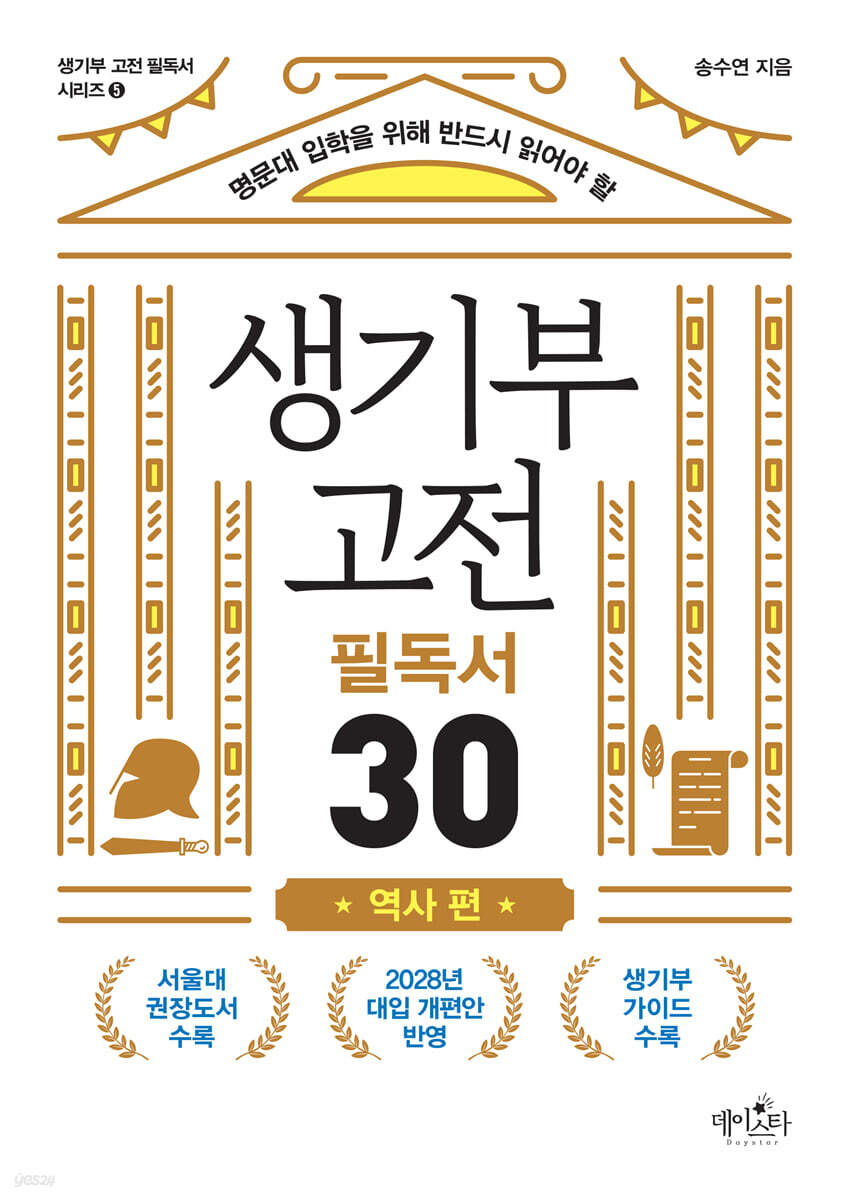
30 Must-Read Classics for the Life and Death Department: History
 |
Description
Book Introduction
A collection of 30 must-read historical classics for all Korean youth.
In line with the drastically changed 2028 college entrance reform plan, not only the special features of the life science department but also in-depth reading activities
A 10-Minute Daily Classic Reading Plan to Develop the Integrated Thinking Skills and Insights Desired by Top-Ranking Universities
The flow of education and college entrance examination systems has been changing rapidly recently.
This also means that the type of talent our society and universities desire is changing.
Universities, especially top-tier universities, now want well-rounded and integrated students who are not only cognitively gifted but also able to actively communicate and collaborate within a community.
How can we cultivate these capabilities? In a rapidly changing world, the fastest way to discover unchanging values, find fundamental questions and answers to solve problems, and cultivate the ability to gain insight into objects and phenomena is through reading, and especially through reading the classics.
The 『30 Essential Readings for the Living Classics』 series was designed to help students develop integrated and holistic capabilities through reading a variety of classics.
Six current teachers who share the importance of classics have carefully selected 180 representative classic works from various fields, including Korean literature, foreign literature, economics, science, history, and philosophy.
This book focuses on recommended or required readings from leading domestic universities, and contains representative works that students must review. In particular, it reflects the changes in the educational field, where the importance of detailed academic abilities and special skills in school records is increasing ahead of the implementation of the 2022 revised curriculum and 2028 college entrance reform plan.
The fifth book in this series, 『30 Must-Read Classics from the Life and Death Book』, contains 30 classic historical books that explore the universal problems of humanity in the past and the wisdom of life, allowing for critical thinking, understanding by connecting them to the present situation, and designing a better future.
This book provides essential concepts and theories for each classic, along with explanations, to help readers understand the era and context. It also explains why the authors of each book wrote them, what they intended to convey through their work, and what criticisms they faced.
It also presents a variety of questions to help you think deeply about how you can apply the historian's message to your own life.
In particular, it introduces research topics and directions that can be utilized in conjunction with the curriculum, as well as specific examples and methods to reflect career activities and special features in the school life record, making it the best way to prepare for the comprehensive student evaluation in conjunction with reading.
In line with the drastically changed 2028 college entrance reform plan, not only the special features of the life science department but also in-depth reading activities
A 10-Minute Daily Classic Reading Plan to Develop the Integrated Thinking Skills and Insights Desired by Top-Ranking Universities
The flow of education and college entrance examination systems has been changing rapidly recently.
This also means that the type of talent our society and universities desire is changing.
Universities, especially top-tier universities, now want well-rounded and integrated students who are not only cognitively gifted but also able to actively communicate and collaborate within a community.
How can we cultivate these capabilities? In a rapidly changing world, the fastest way to discover unchanging values, find fundamental questions and answers to solve problems, and cultivate the ability to gain insight into objects and phenomena is through reading, and especially through reading the classics.
The 『30 Essential Readings for the Living Classics』 series was designed to help students develop integrated and holistic capabilities through reading a variety of classics.
Six current teachers who share the importance of classics have carefully selected 180 representative classic works from various fields, including Korean literature, foreign literature, economics, science, history, and philosophy.
This book focuses on recommended or required readings from leading domestic universities, and contains representative works that students must review. In particular, it reflects the changes in the educational field, where the importance of detailed academic abilities and special skills in school records is increasing ahead of the implementation of the 2022 revised curriculum and 2028 college entrance reform plan.
The fifth book in this series, 『30 Must-Read Classics from the Life and Death Book』, contains 30 classic historical books that explore the universal problems of humanity in the past and the wisdom of life, allowing for critical thinking, understanding by connecting them to the present situation, and designing a better future.
This book provides essential concepts and theories for each classic, along with explanations, to help readers understand the era and context. It also explains why the authors of each book wrote them, what they intended to convey through their work, and what criticisms they faced.
It also presents a variety of questions to help you think deeply about how you can apply the historian's message to your own life.
In particular, it introduces research topics and directions that can be utilized in conjunction with the curriculum, as well as specific examples and methods to reflect career activities and special features in the school life record, making it the best way to prepare for the comprehensive student evaluation in conjunction with reading.
- You can preview some of the book's contents.
Preview
index
Series Preface
Author's Preface
▶ First book - What is History?, E.
H. Carr
▶ Second book - Apology for History, Marc Bloch
▶ Third Book - "Women's History 4", Georges Duby and Michel Perrault
▶ Fourth Book - A Green World History, Clive Ponting
▶ Fifth Book - Sapiens, Yuval Harari
▶ Sixth Book - Records of the Grand Historian, Sima Qian
▶ Seventh Book - "History" by Herodotus
▶ Eighth Book - Upanishads, author unknown
▶ Ninth Book - Samguk Yusa, Ilyeon
▶ Book 10 - The Culture of the Italian Renaissance, by Jacob Burckhardt
▶ Eleventh Book - The Social History of Literature and Art, Arnold Hauser
▶ Book 12 - A History of Western Art, E.
H. Gombrich
▶ Book 13 - The Civilization Process, Norbert Elias
▶ Fourteenth Book - My Cultural Heritage Tour, by Yoo Hong-jun
▶ Fifteenth Book - "Swaemi-rok" by Oh Hee-moon
▶ Book 16 - Letters from Exile, Jeong Yak-yong
▶ Seventeenth Book - The Autobiography of Gandhi, Mahatma Gandhi
▶ Eighteenth Book - 《Anne Frank's Diary/Hellen's Diary》, Anne Frank/Hellen Ver
▶ Nineteenth Book - Man's Search for Meaning, Viktor Frankl
▶ Book 20 - Eichmann in Jerusalem, Hannah Arendt
▶ Book Twenty-First - Orientalism, Edward Said
Book 22 - The Clash of Civilizations, Samuel Huntington
▶ Book 23 - Democracy in America, Alexis de Tocqueville
▶ Book 24 - Discipline and Punish, Michel Foucault
▶ Book Twenty-Fifth - The Age of Revolution, Eric Hobsbawm
▶ Book 26 - "Korean History," by Park Eun-sik
Book Twenty-Seventh - The Chrysanthemum and the Sword, by Ruth Benedict
▶ Book 28 - Arirang, by Nim Wales, Kim San
▶ Book 29 - Baekbeom Ilji, Kim Gu
▶ Book 30 - "Uncle Sooni" by Hyun Ki-young
Author's Preface
▶ First book - What is History?, E.
H. Carr
▶ Second book - Apology for History, Marc Bloch
▶ Third Book - "Women's History 4", Georges Duby and Michel Perrault
▶ Fourth Book - A Green World History, Clive Ponting
▶ Fifth Book - Sapiens, Yuval Harari
▶ Sixth Book - Records of the Grand Historian, Sima Qian
▶ Seventh Book - "History" by Herodotus
▶ Eighth Book - Upanishads, author unknown
▶ Ninth Book - Samguk Yusa, Ilyeon
▶ Book 10 - The Culture of the Italian Renaissance, by Jacob Burckhardt
▶ Eleventh Book - The Social History of Literature and Art, Arnold Hauser
▶ Book 12 - A History of Western Art, E.
H. Gombrich
▶ Book 13 - The Civilization Process, Norbert Elias
▶ Fourteenth Book - My Cultural Heritage Tour, by Yoo Hong-jun
▶ Fifteenth Book - "Swaemi-rok" by Oh Hee-moon
▶ Book 16 - Letters from Exile, Jeong Yak-yong
▶ Seventeenth Book - The Autobiography of Gandhi, Mahatma Gandhi
▶ Eighteenth Book - 《Anne Frank's Diary/Hellen's Diary》, Anne Frank/Hellen Ver
▶ Nineteenth Book - Man's Search for Meaning, Viktor Frankl
▶ Book 20 - Eichmann in Jerusalem, Hannah Arendt
▶ Book Twenty-First - Orientalism, Edward Said
Book 22 - The Clash of Civilizations, Samuel Huntington
▶ Book 23 - Democracy in America, Alexis de Tocqueville
▶ Book 24 - Discipline and Punish, Michel Foucault
▶ Book Twenty-Fifth - The Age of Revolution, Eric Hobsbawm
▶ Book 26 - "Korean History," by Park Eun-sik
Book Twenty-Seventh - The Chrysanthemum and the Sword, by Ruth Benedict
▶ Book 28 - Arirang, by Nim Wales, Kim San
▶ Book 29 - Baekbeom Ilji, Kim Gu
▶ Book 30 - "Uncle Sooni" by Hyun Ki-young
Detailed image

Into the book
When reading a historical classic, you need to go beyond understanding the "content" and delve deeply into the historical context surrounding the era in which the book was written, the author's life, and the facts it covers.
Because historical classics are themselves products of their time and contain the lives of historians, their value can only be fully appreciated if they are fully understood.
Also, it is very important to constantly ask questions and never stop thinking.
History is never separate from our lives, and we must be able to reflect on the meaning and teachings that historical classics offer us today.
--- p.12 From the author's preface
Carr emphasizes the importance of causal analysis in the process of historical research.
He says that historians must analyze the causes and effects of events through evidence (documents) and determine what influence human actions and choices had within them.
In addition, we can see an aspect of history that considers itself as a 'science' that attempts to solve current problems and predict the future through the interpretation of historical materials.
--- p.23 From “What is History”
Ultimately, this book provides crucial insights into how women, despite social oppression, discovered their potential and were able to design a new future based on this.
Women's discovery of their identity was not simply a matter of individual change, but rather an important force that reorganized the social structure.
--- p.45 From “Women’s History 4”
He explored how literature and art evolved in response to social, economic, and political changes, emphasizing that art is not simply the creative product of an individual, but is formed within a social context.
That is, the focus was on how a work of art is born, changes, replaced, and newly realized under what social conditions and what social factors.
This book marked a significant turning point in the study of art history, offering many subsequent scholars a new perspective on understanding art within its social context.
--- p.127 From “The Social History of Literature and Art”
Elias points out that the process of civilization suppresses individual freedom and emotional expression, and suggests that the stress and alienation people experience in modern society may be a result of this suppression.
We need to consider whether the norms and etiquette of modern society are truly bringing us a better life.
--- p.151 From “The Process of Civilization”
How should we remember war? In wars throughout history, there have probably been more "soldiers" like Oh Hee-moon, insignificant but steadfast, living their lives, than great generals or prime ministers.
This is why war should not be recorded only as a national heroic tale.
History must be able to restore and examine the daily lives of those devastated by war, and the lives of those insignificant individuals.
This book focuses on the voices and lives of such individuals, prompting us to think deeply about how we should perceive war.
--- p.172 From "Swaemi-rok"
Kim Gu's book shows how important an individual's beliefs are in permeating life.
He held fast to his beliefs and devoted himself to his people and country.
Reading Baekbeom Ilji today goes beyond simply learning about the history of the past. It is a way to learn with your heart the love, yearning, and earnestness that Kim Gu left behind for true independence and autonomy, as well as his profound philosophy and beliefs.
--- p.333 From "Baekbeom Ilji"
This work brings to mind the concept of public history, an important keyword in recent historical studies.
Public history refers to history that goes beyond academic research or official records and is remembered and shared by all members of society.
Literary works like “Uncle Sooni” are in themselves a new way of recording historical events and serve as important tools for communicating with the public and informing them of history.
Historical literature can evoke deeper empathy in readers by conveying the emotions, pain, and hopes of those who lived through those events, rather than simply describing them.
Because historical classics are themselves products of their time and contain the lives of historians, their value can only be fully appreciated if they are fully understood.
Also, it is very important to constantly ask questions and never stop thinking.
History is never separate from our lives, and we must be able to reflect on the meaning and teachings that historical classics offer us today.
--- p.12 From the author's preface
Carr emphasizes the importance of causal analysis in the process of historical research.
He says that historians must analyze the causes and effects of events through evidence (documents) and determine what influence human actions and choices had within them.
In addition, we can see an aspect of history that considers itself as a 'science' that attempts to solve current problems and predict the future through the interpretation of historical materials.
--- p.23 From “What is History”
Ultimately, this book provides crucial insights into how women, despite social oppression, discovered their potential and were able to design a new future based on this.
Women's discovery of their identity was not simply a matter of individual change, but rather an important force that reorganized the social structure.
--- p.45 From “Women’s History 4”
He explored how literature and art evolved in response to social, economic, and political changes, emphasizing that art is not simply the creative product of an individual, but is formed within a social context.
That is, the focus was on how a work of art is born, changes, replaced, and newly realized under what social conditions and what social factors.
This book marked a significant turning point in the study of art history, offering many subsequent scholars a new perspective on understanding art within its social context.
--- p.127 From “The Social History of Literature and Art”
Elias points out that the process of civilization suppresses individual freedom and emotional expression, and suggests that the stress and alienation people experience in modern society may be a result of this suppression.
We need to consider whether the norms and etiquette of modern society are truly bringing us a better life.
--- p.151 From “The Process of Civilization”
How should we remember war? In wars throughout history, there have probably been more "soldiers" like Oh Hee-moon, insignificant but steadfast, living their lives, than great generals or prime ministers.
This is why war should not be recorded only as a national heroic tale.
History must be able to restore and examine the daily lives of those devastated by war, and the lives of those insignificant individuals.
This book focuses on the voices and lives of such individuals, prompting us to think deeply about how we should perceive war.
--- p.172 From "Swaemi-rok"
Kim Gu's book shows how important an individual's beliefs are in permeating life.
He held fast to his beliefs and devoted himself to his people and country.
Reading Baekbeom Ilji today goes beyond simply learning about the history of the past. It is a way to learn with your heart the love, yearning, and earnestness that Kim Gu left behind for true independence and autonomy, as well as his profound philosophy and beliefs.
--- p.333 From "Baekbeom Ilji"
This work brings to mind the concept of public history, an important keyword in recent historical studies.
Public history refers to history that goes beyond academic research or official records and is remembered and shared by all members of society.
Literary works like “Uncle Sooni” are in themselves a new way of recording historical events and serve as important tools for communicating with the public and informing them of history.
Historical literature can evoke deeper empathy in readers by conveying the emotions, pain, and hopes of those who lived through those events, rather than simply describing them.
--- p.344 From "Uncle Sooni"
Publisher's Review
The secret to developing skills that remain constant despite the changing college entrance exam system: reading the classics.
The fifth book in the "30 Must-Read Classics for the Living" series, selected by current teachers.
《30 Must-Read Classics of Life and Death: History》
The current educational and college entrance examination systems are undergoing significant changes, including the implementation of the high school credit system, integration of liberal arts and sciences, and expansion of the comprehensive student admissions system.
This also means that it has become very important for students to explore their own career paths, choose their subjects, and create their own portfolios when preparing for college entrance exams.
Top universities, in particular, want creative and comprehensive thinkers who can create and demonstrate new value.
Not just cognitive abilities.
We seek talented individuals who are well-developed, including the ability to actively communicate and cooperate within the community.
How can we cultivate these capabilities? In a rapidly changing world, the fastest way to discover unchanging values, find fundamental questions and answers to solve problems, and cultivate the ability to gain insight into objects and phenomena is through reading, and especially through reading the classics.
The "30 Essential Readings for the Living Classics" series was designed to help students develop integrated and holistic capabilities through reading a variety of classics.
This series introduces 180 representative classic works carefully selected by six current teachers who share the importance of classics in various fields, including Korean literature, foreign literature, economics, science, history, and philosophy.
These are representative works that students must review, focusing on recommended and required readings presented by leading domestic universities.
A guide to in-depth study of classic must-reads and the use of the life cycle.
From preparing for school exams to career guidance and tax specials, all in one book.
Above all, this series summarizes the core content of classic must-reads, lowering the psychological hurdles for students to read the classics and allowing them to comfortably accept them.
With detailed explanations, you can prepare for your internal exams, and we have put a lot of effort into ensuring that it goes beyond simple reading and is connected to academics by providing a guide to in-depth exploration activities.
In particular, as the importance of detailed academic abilities and special skills in school records is increasing due to the 2022 revised curriculum and the 2028 college entrance reform plan, we wanted to specifically show the direction of connection with the life history record.
It presents research topics and directions to be explored in connection with classics for each subject, and also introduces specific examples and methods that can be reflected in connection with the specific subjects in the school life record after reading the classics.
This book will help students create their own portfolios by reading classics from various fields and drawing up a roadmap for their school records.
Above all, I hope that it will help you learn the joy of reading and the value of life, and serve as a guide in making choices on your journey toward college entrance.
A selection of 30 classic historical books that foster literacy, critical thinking, and leadership.
History and humanity, life lessons, and follow-up activities for career paths through classics
History is a discipline that understands the present and predicts the future based on the past.
By reading the past from various perspectives, historical classics allow us to explore the roots of the problems we face today, broaden our critical thinking, and gain the insight necessary to proactively resolve them.
《30 Must-Read Classics of the Life and Death Book》 begins with a reflection on what history is, and introduces 30 works that contain various stories about history, from ancient civilizations to Eastern and Western history, culture and art, how to read the times through people, memories and records for human rights and peace, and modern and contemporary Korea.
Each piece begins with an easy-to-understand summary, then explores key concepts you must know, how to apply them in the present, how to utilize them for career and tax purposes, and even provides examples of follow-up activities.
“Reading historical classics is not easy.
But I hope you give it a try, even if it's difficult.
As the author says, “The process of wrestling with the classics is the way to connect deeply with pioneers with advanced experience and develop diverse capabilities,” this book will not only enrich students’ vitality, but will also serve as an excellent guide to help them understand the flow of history and the essence of humanity, develop a historical perspective, and think about the direction they should take in the future.
The fifth book in the "30 Must-Read Classics for the Living" series, selected by current teachers.
《30 Must-Read Classics of Life and Death: History》
The current educational and college entrance examination systems are undergoing significant changes, including the implementation of the high school credit system, integration of liberal arts and sciences, and expansion of the comprehensive student admissions system.
This also means that it has become very important for students to explore their own career paths, choose their subjects, and create their own portfolios when preparing for college entrance exams.
Top universities, in particular, want creative and comprehensive thinkers who can create and demonstrate new value.
Not just cognitive abilities.
We seek talented individuals who are well-developed, including the ability to actively communicate and cooperate within the community.
How can we cultivate these capabilities? In a rapidly changing world, the fastest way to discover unchanging values, find fundamental questions and answers to solve problems, and cultivate the ability to gain insight into objects and phenomena is through reading, and especially through reading the classics.
The "30 Essential Readings for the Living Classics" series was designed to help students develop integrated and holistic capabilities through reading a variety of classics.
This series introduces 180 representative classic works carefully selected by six current teachers who share the importance of classics in various fields, including Korean literature, foreign literature, economics, science, history, and philosophy.
These are representative works that students must review, focusing on recommended and required readings presented by leading domestic universities.
A guide to in-depth study of classic must-reads and the use of the life cycle.
From preparing for school exams to career guidance and tax specials, all in one book.
Above all, this series summarizes the core content of classic must-reads, lowering the psychological hurdles for students to read the classics and allowing them to comfortably accept them.
With detailed explanations, you can prepare for your internal exams, and we have put a lot of effort into ensuring that it goes beyond simple reading and is connected to academics by providing a guide to in-depth exploration activities.
In particular, as the importance of detailed academic abilities and special skills in school records is increasing due to the 2022 revised curriculum and the 2028 college entrance reform plan, we wanted to specifically show the direction of connection with the life history record.
It presents research topics and directions to be explored in connection with classics for each subject, and also introduces specific examples and methods that can be reflected in connection with the specific subjects in the school life record after reading the classics.
This book will help students create their own portfolios by reading classics from various fields and drawing up a roadmap for their school records.
Above all, I hope that it will help you learn the joy of reading and the value of life, and serve as a guide in making choices on your journey toward college entrance.
A selection of 30 classic historical books that foster literacy, critical thinking, and leadership.
History and humanity, life lessons, and follow-up activities for career paths through classics
History is a discipline that understands the present and predicts the future based on the past.
By reading the past from various perspectives, historical classics allow us to explore the roots of the problems we face today, broaden our critical thinking, and gain the insight necessary to proactively resolve them.
《30 Must-Read Classics of the Life and Death Book》 begins with a reflection on what history is, and introduces 30 works that contain various stories about history, from ancient civilizations to Eastern and Western history, culture and art, how to read the times through people, memories and records for human rights and peace, and modern and contemporary Korea.
Each piece begins with an easy-to-understand summary, then explores key concepts you must know, how to apply them in the present, how to utilize them for career and tax purposes, and even provides examples of follow-up activities.
“Reading historical classics is not easy.
But I hope you give it a try, even if it's difficult.
As the author says, “The process of wrestling with the classics is the way to connect deeply with pioneers with advanced experience and develop diverse capabilities,” this book will not only enrich students’ vitality, but will also serve as an excellent guide to help them understand the flow of history and the essence of humanity, develop a historical perspective, and think about the direction they should take in the future.
GOODS SPECIFICS
- Date of issue: December 10, 2024
- Page count, weight, size: 352 pages | 148*210*30mm
- ISBN13: 9791168272583
- ISBN10: 1168272580
You may also like
카테고리
korean


korean

![GQ KOREA Mark (Monthly): December [2025]](http://librairie.coreenne.fr/cdn/shop/files/8ef265dbbfbf186523ed75ba7319009d.jpg?v=1765340328&width=3840)


