

If you call even the nameless
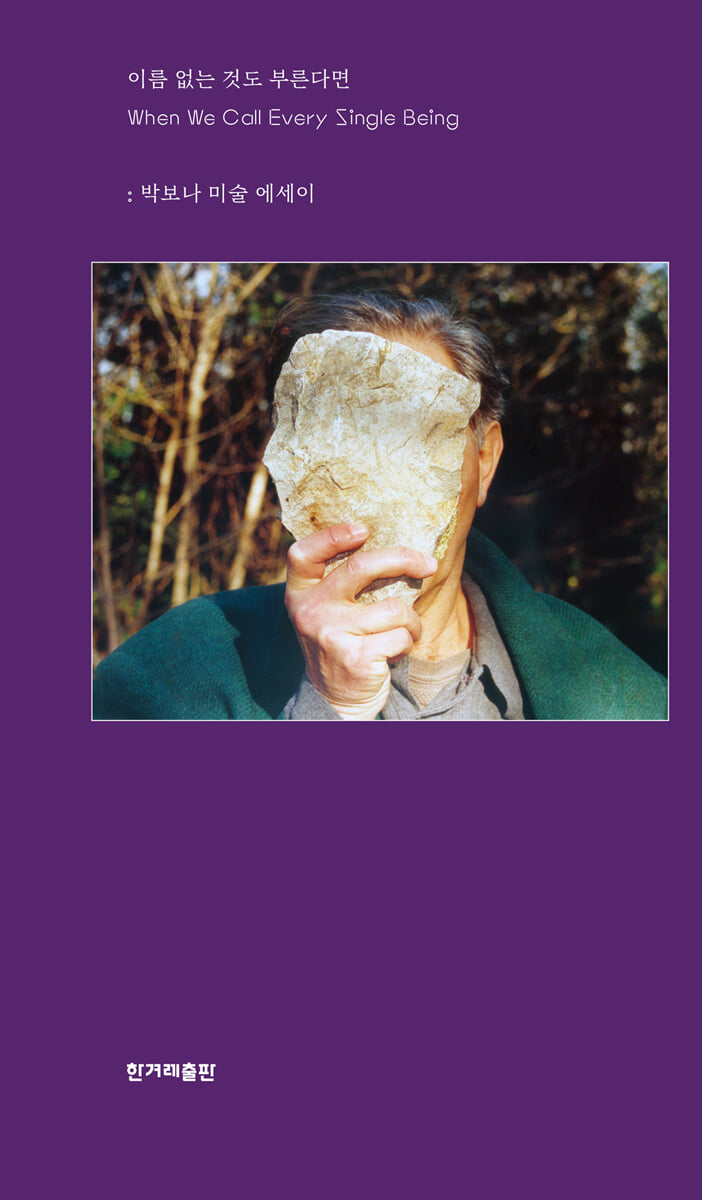 |
Description
Book Introduction
“Only those who love survive”
Trees, cities, birds, tigers, stones, monkeys, poetry…
The imagination that art extends to all beings on this earth
Author Park Bo-na, who received much love for her work, “When Attitude Becomes a Work of Art,” has published her second art essay, “If You Call Even the Nameless One.”
The author, who created a sensation by explaining modern art works through the artist's "attitude," presents a new world of art through "life," a topic he has long wanted to write about.
Even leaving aside the author's book, the prevailing opinion seems to be that modern art is difficult and complex.
For some, the time to freely imagine a work is a fun time of 'thinking', but for others, it is too difficult and cruel.
Perhaps that is why there are many books that skip that process and try to explain and help readers understand the work directly.
Books that encourage readers to take their time and enjoy the pleasure of looking at a work of art, and that allow them to spend that time more freely, are often overlooked.
The book's consideration soon becomes a battle of patience for the readers.
Author Park Bo-na gently allows readers room for interpretation between these two extremes, while also not forgetting to let her own voice be heard.
Not only does it help us easily explain the work by comparing it to the artist's attitude, creativity, and imagination, but it also helps us view art 'sideways' in terms of coexistence and solidarity rather than a vertical relationship (the main theme of 'If You Call the Nameless Thing' is also 'a sideways conversation between art and life').
The interpretation of art, which has been flattened in this way, swells and rises through the author's voice, becoming new particles and reaching the reader.
It becomes a small breathing hole that allows us to move our thoughts and feelings warmly, without being difficult or cruel.
“If You Call Even the Nameless One” is an attempt to call out the “nameless one” to those who are not recognized as subjects.
Moreover, it provides an opportunity to reconsider our attitude of arbitrarily naming and calling everything and trying to define everything arbitrarily.
These days, with COVID-19 and various environmental crises making us more inclined to the word "death" than "life," talking about cherishing life can seem crude, even outdated, like the idealistic thinking of idealists.
However, attempts to understand and become closer to each other across countries and generations are becoming more intense.
Rather, there are diverse movements taking place, including positive changes toward ethical consumption, animal rights, and critical movements against discriminatory views.
In this regard, the book introduces Eunji Jo's performance supporting the lives and rights of animals ([Pigs Are Born to Live Well]) and Jimmy Durham's art installation that seeks to disrupt and break down the distinction between purebreds and mixed breeds ([Breaking the Difference with Stone]).
The author also said that he has always thought about what to do in today's dark and shady world.
As soon as I had the opportunity to write, I decided that I had to talk about sustainable living on Earth, and that's how I completed this book.
Trees, cities, birds, tigers, stones, monkeys, poetry…
The imagination that art extends to all beings on this earth
Author Park Bo-na, who received much love for her work, “When Attitude Becomes a Work of Art,” has published her second art essay, “If You Call Even the Nameless One.”
The author, who created a sensation by explaining modern art works through the artist's "attitude," presents a new world of art through "life," a topic he has long wanted to write about.
Even leaving aside the author's book, the prevailing opinion seems to be that modern art is difficult and complex.
For some, the time to freely imagine a work is a fun time of 'thinking', but for others, it is too difficult and cruel.
Perhaps that is why there are many books that skip that process and try to explain and help readers understand the work directly.
Books that encourage readers to take their time and enjoy the pleasure of looking at a work of art, and that allow them to spend that time more freely, are often overlooked.
The book's consideration soon becomes a battle of patience for the readers.
Author Park Bo-na gently allows readers room for interpretation between these two extremes, while also not forgetting to let her own voice be heard.
Not only does it help us easily explain the work by comparing it to the artist's attitude, creativity, and imagination, but it also helps us view art 'sideways' in terms of coexistence and solidarity rather than a vertical relationship (the main theme of 'If You Call the Nameless Thing' is also 'a sideways conversation between art and life').
The interpretation of art, which has been flattened in this way, swells and rises through the author's voice, becoming new particles and reaching the reader.
It becomes a small breathing hole that allows us to move our thoughts and feelings warmly, without being difficult or cruel.
“If You Call Even the Nameless One” is an attempt to call out the “nameless one” to those who are not recognized as subjects.
Moreover, it provides an opportunity to reconsider our attitude of arbitrarily naming and calling everything and trying to define everything arbitrarily.
These days, with COVID-19 and various environmental crises making us more inclined to the word "death" than "life," talking about cherishing life can seem crude, even outdated, like the idealistic thinking of idealists.
However, attempts to understand and become closer to each other across countries and generations are becoming more intense.
Rather, there are diverse movements taking place, including positive changes toward ethical consumption, animal rights, and critical movements against discriminatory views.
In this regard, the book introduces Eunji Jo's performance supporting the lives and rights of animals ([Pigs Are Born to Live Well]) and Jimmy Durham's art installation that seeks to disrupt and break down the distinction between purebreds and mixed breeds ([Breaking the Difference with Stone]).
The author also said that he has always thought about what to do in today's dark and shady world.
As soon as I had the opportunity to write, I decided that I had to talk about sustainable living on Earth, and that's how I completed this book.
- You can preview some of the book's contents.
Preview
index
Author's Note: If you call even the nameless
Sideways like a tree or grass… Honp
If you continue the sound of the birds… Oscar Santillan
Are you raising an imaginary tiger? Hong Ryu
Breaking down barriers with stones… Jimmy Durham
When telling a story with the imagination of light… Jumana Emil Aboud
Pigs are born to live well… Jo Eun-ji
Divinity in the Eyes of the Monkey… Pierre Huyghe
Hidden behind the vivid image… Park Bo-na
When you have better hearing… Christine Sun Kim
Beyond the quiet scenery… Minjeonggi
People in cities and apartments… Kim Dong-won, Kim Tae-heon, Lee In-gyu
The future of a world driven by poetic imagination… Jeong Seo-young
If we can have a close bond with objects… Fischli & Weiss
A little slower, a little closer… Katie Patterson
Image Credit
Sideways like a tree or grass… Honp
If you continue the sound of the birds… Oscar Santillan
Are you raising an imaginary tiger? Hong Ryu
Breaking down barriers with stones… Jimmy Durham
When telling a story with the imagination of light… Jumana Emil Aboud
Pigs are born to live well… Jo Eun-ji
Divinity in the Eyes of the Monkey… Pierre Huyghe
Hidden behind the vivid image… Park Bo-na
When you have better hearing… Christine Sun Kim
Beyond the quiet scenery… Minjeonggi
People in cities and apartments… Kim Dong-won, Kim Tae-heon, Lee In-gyu
The future of a world driven by poetic imagination… Jeong Seo-young
If we can have a close bond with objects… Fischli & Weiss
A little slower, a little closer… Katie Patterson
Image Credit
Detailed image

Into the book
For nearly two years, we have been plagued by the COVID-19 pandemic, and as we watch disasters like wildfires, floods, and droughts ravage the globe, I have felt a profound sense of life-threatening danger.
Before the final alarm bell sounded, I kept thinking about how I could avoid falling into a deeper swamp, what I could do to have fewer regrets.
Cutting the strings off my mask and throwing them away, or tearing off the labels on plastic bottles and throwing them away, was not enough to shake off the heavy feeling of guilt and helplessness.
While I was worrying about that, I happened to get an opportunity to write more.
So, this time I decided to take a side note and talk about how we can make life on Earth a little more sustainable.
--- p.6
HONF is not particularly interested in the fine arts of painting beautiful pictures or creating sculptures.
Filling a corner of an art gallery blocked by white walls doesn't seem to be very interesting to them.
This creative group is dedicated to moving beyond the museum and actively blurring and interweaving the boundaries between nature and culture, life and art, and creators and viewers.
We strive to connect people from diverse fields and bring even the smallest life forms and materials into our work.
They propose that these different beings be brought together and that they share their experiences and knowledge.
And we seriously ask ourselves how we can live together, and where we can meet and intersect more closely.
--- p.17
Rather than slippery words, the process of exchanging signals with non-human species through air, waves, movement and connection is less 'human' and therefore more inspiring.
While humanity has been shouting with a language of threats and violence filled with pride, Oscar Santillan whispers a moment of coexistence by mixing bird and human signals.
--- p.32
Among Durham's works is a series of still lifes in which a car is crushed by a large rock with eyes and a mouth painted on it.
It may seem like a humorous task, but what it points to is not light.
In this installation, the cars underneath symbolize technology and civilization.
Therefore, the image of a stone shaped like a face crushing a car can be seen as meaning that closed reason and logic should be placed under the feet of open nature.
This means that I will not agree with any calculating and power-centered order that is carried out under the pretext of being rational and efficient.
At that point where the car and the rock come into comical collision, at that exhilarating point where rigid rational concepts and structures crumble to the ground, the author's consistent voice rings out again.
A firm declaration is heard to discard existing principles and standards and pursue a hybrid, schizophrenic individual identity.
--- p.52
While I was closing my eyes and covering my ears, the leachate from the pig buried in the ground flowed out.
The red blood of dead pigs was reflected in the soil of Yeoncheon, just 16 kilometers from the Imjin River, the source of our drinking water.
I met writer Jo Eun-ji the day I saw that news.
To my lament that pigs seem to have come into this world to teach us how foolish humans are, author Eunji Jo replied, “Pigs were born to simply live well, not to do anything for humans.”
To my shame, I was still reciting the wrong human-centered lessons.
right.
Pigs were not born for us, of course.
We were born to live fully as one life and feel happiness.
--- p.80
The core of Pierre Huyghe's work arises from the audience's questioning of this naturalness.
The artist's intentional aesthetic arrangement is intertwined with the beautiful growth of organic life forms, blurring the line between where art begins and where nature ends.
In this chaotic scene, the audience divides and groups things according to arbitrary and capricious criteria.
What was once nature is now viewed as art.
It seems like art now, but I think it was nature after a while.
Indeed, humans define nature as they please.
The audience cannot help but be humble before Pierre Huyghe's artistic ecosystem.
Because nature is not less beautiful than art, nor is art more composed than nature.
The human-centered dichotomous classification of nature and civilization, nature and art feels pathetic.
At the point where this boundary of sharing collapses, the audience can suddenly realize that they too are part of the work, part of nature, and a member of the ecosystem.
--- p.88
The clearer and more detailed the image, the more easily it captivates us.
As the color of the African sun burns redder, and the details of the lion's nose hair become more clearly visible, humans take the place of the lion.
Well-crafted images trick us into believing that what we see is all there is.
By making us think we've seen everything, we avoid trying to know more or asking sharp questions. 〈Kota Kinna Blue 1〉 and 〈1967_2015〉 are trying to tell us that if we close our eyes, we can hear better, and if we try to listen better, we can see new things.
If you doubt a good-looking image, it can go much further than just your monitor.
Rather than discovering wilderness, tropical islands, or miraculous gold mines, we find a human-centered attitude toward nature, the presence of film industry workers, and the sinister plots of dictatorship.
--- p.101
Artist Jeong Seo-young says, “Through my work, I want to create moments where completely unrelated things meet and share the same time and space.”
Here, the moment could be the combination of material and object, the relationship between the artist and the audience, or the encounter between the audience and the work.
These various combinations and disintegrations surrounding Jeong Seo-young's sculptures are not at all inevitable.
They just move randomly and accidentally brush past each other.
In such an unexpected encounter, the author's loose language unfolds its 'broad'** power.
It offers a distinct semiotic interpretation of art and offers a different approach to existing attempts to find answers within rigid discourse.
Jeong Seo-young's expressions leave room for poetry, giving the audience the opportunity to think and interpret them for themselves.
You can breathe freely in the space that the writer has generously provided.
--- p.147
If you think that everyone has a trace of a star, the beings around you will feel more intimate.
I think the reason Katie Patterson drew dead stars might have started from that long and close attraction.
It is a wonder how long and slow the world has been created, how life has been born and spread, how they have met and continued to breathe.
The eternal sharing of stars that have connected you and me, twinkling for a million or a hundred billion years, is dazzling.
I feel the same stars and universe in the warm blood flowing through my body, and I think of the round Earth.
Since the stars began to shine billions of years ago, we were destined to meet on this green planet.
It was a deep relationship that could not exist alone.
Within that tight connection, we live together, breathing in the breath exhaled by the person next to us.
Before the final alarm bell sounded, I kept thinking about how I could avoid falling into a deeper swamp, what I could do to have fewer regrets.
Cutting the strings off my mask and throwing them away, or tearing off the labels on plastic bottles and throwing them away, was not enough to shake off the heavy feeling of guilt and helplessness.
While I was worrying about that, I happened to get an opportunity to write more.
So, this time I decided to take a side note and talk about how we can make life on Earth a little more sustainable.
--- p.6
HONF is not particularly interested in the fine arts of painting beautiful pictures or creating sculptures.
Filling a corner of an art gallery blocked by white walls doesn't seem to be very interesting to them.
This creative group is dedicated to moving beyond the museum and actively blurring and interweaving the boundaries between nature and culture, life and art, and creators and viewers.
We strive to connect people from diverse fields and bring even the smallest life forms and materials into our work.
They propose that these different beings be brought together and that they share their experiences and knowledge.
And we seriously ask ourselves how we can live together, and where we can meet and intersect more closely.
--- p.17
Rather than slippery words, the process of exchanging signals with non-human species through air, waves, movement and connection is less 'human' and therefore more inspiring.
While humanity has been shouting with a language of threats and violence filled with pride, Oscar Santillan whispers a moment of coexistence by mixing bird and human signals.
--- p.32
Among Durham's works is a series of still lifes in which a car is crushed by a large rock with eyes and a mouth painted on it.
It may seem like a humorous task, but what it points to is not light.
In this installation, the cars underneath symbolize technology and civilization.
Therefore, the image of a stone shaped like a face crushing a car can be seen as meaning that closed reason and logic should be placed under the feet of open nature.
This means that I will not agree with any calculating and power-centered order that is carried out under the pretext of being rational and efficient.
At that point where the car and the rock come into comical collision, at that exhilarating point where rigid rational concepts and structures crumble to the ground, the author's consistent voice rings out again.
A firm declaration is heard to discard existing principles and standards and pursue a hybrid, schizophrenic individual identity.
--- p.52
While I was closing my eyes and covering my ears, the leachate from the pig buried in the ground flowed out.
The red blood of dead pigs was reflected in the soil of Yeoncheon, just 16 kilometers from the Imjin River, the source of our drinking water.
I met writer Jo Eun-ji the day I saw that news.
To my lament that pigs seem to have come into this world to teach us how foolish humans are, author Eunji Jo replied, “Pigs were born to simply live well, not to do anything for humans.”
To my shame, I was still reciting the wrong human-centered lessons.
right.
Pigs were not born for us, of course.
We were born to live fully as one life and feel happiness.
--- p.80
The core of Pierre Huyghe's work arises from the audience's questioning of this naturalness.
The artist's intentional aesthetic arrangement is intertwined with the beautiful growth of organic life forms, blurring the line between where art begins and where nature ends.
In this chaotic scene, the audience divides and groups things according to arbitrary and capricious criteria.
What was once nature is now viewed as art.
It seems like art now, but I think it was nature after a while.
Indeed, humans define nature as they please.
The audience cannot help but be humble before Pierre Huyghe's artistic ecosystem.
Because nature is not less beautiful than art, nor is art more composed than nature.
The human-centered dichotomous classification of nature and civilization, nature and art feels pathetic.
At the point where this boundary of sharing collapses, the audience can suddenly realize that they too are part of the work, part of nature, and a member of the ecosystem.
--- p.88
The clearer and more detailed the image, the more easily it captivates us.
As the color of the African sun burns redder, and the details of the lion's nose hair become more clearly visible, humans take the place of the lion.
Well-crafted images trick us into believing that what we see is all there is.
By making us think we've seen everything, we avoid trying to know more or asking sharp questions. 〈Kota Kinna Blue 1〉 and 〈1967_2015〉 are trying to tell us that if we close our eyes, we can hear better, and if we try to listen better, we can see new things.
If you doubt a good-looking image, it can go much further than just your monitor.
Rather than discovering wilderness, tropical islands, or miraculous gold mines, we find a human-centered attitude toward nature, the presence of film industry workers, and the sinister plots of dictatorship.
--- p.101
Artist Jeong Seo-young says, “Through my work, I want to create moments where completely unrelated things meet and share the same time and space.”
Here, the moment could be the combination of material and object, the relationship between the artist and the audience, or the encounter between the audience and the work.
These various combinations and disintegrations surrounding Jeong Seo-young's sculptures are not at all inevitable.
They just move randomly and accidentally brush past each other.
In such an unexpected encounter, the author's loose language unfolds its 'broad'** power.
It offers a distinct semiotic interpretation of art and offers a different approach to existing attempts to find answers within rigid discourse.
Jeong Seo-young's expressions leave room for poetry, giving the audience the opportunity to think and interpret them for themselves.
You can breathe freely in the space that the writer has generously provided.
--- p.147
If you think that everyone has a trace of a star, the beings around you will feel more intimate.
I think the reason Katie Patterson drew dead stars might have started from that long and close attraction.
It is a wonder how long and slow the world has been created, how life has been born and spread, how they have met and continued to breathe.
The eternal sharing of stars that have connected you and me, twinkling for a million or a hundred billion years, is dazzling.
I feel the same stars and universe in the warm blood flowing through my body, and I think of the round Earth.
Since the stars began to shine billions of years ago, we were destined to meet on this green planet.
It was a deep relationship that could not exist alone.
Within that tight connection, we live together, breathing in the breath exhaled by the person next to us.
--- p.171
Publisher's Review
Jo Eun-ji, Jeong Seo-young, Jimmy Durham, Pierre Huyghe, Christine Sun Kim, etc.
The artists' efforts to call out the 'nonexistent name' by breaking, cutting, throwing, and painting.
There has been a steady movement in the art world to portray the ideal as reality rather than mere fantasy.
Break, cut, paint, and.
The artists featured in the book also, when necessary, fiddle with and throw empty bottles and dirt, and through their stories, seek connections with other beings.
The author seeks to show what it means to acknowledge and understand the very existence of art in the world of art, rather than to dismiss its narrow labels (difficult, abstract, resistant).
Moreover, I wrote this book in the hope that readers would look at and feel the work beyond art, rather than looking for something like “art.”
No one has ever defined a dust-free art gallery as a work of art hanging on a white wall.
I never said it wasn't art.
The author wants us to question whether, in a fictional world where people believe there is such a thing as art, the purpose of the authors' actions is really to make art look like art.
If we focus on the imagination that art extends to all beings on this earth, leaving that question aside, we will be able to discover a clearer real world.
A total of 14 authors appear in the book.
It brings together works by Korean writers Eun-ji Jo, Seo-young Jeong, and the author (Bona Park), as well as lesser-known foreign writers such as Honf, Jumana Emile Aboud, Jimmy Durham, Pierre Huyghe, and Christine Sun Kim.
I tried to metaphorically reveal the interconnectedness of life and the autonomy of existence by extracting one keyword from the works of 14 artists and connecting it to the theme of the next chapter.
Within the organic system that connects trees to birds and birds to tigers, readers will discover the value of the authors' imagination and the "sideways conversation" that the author speaks of.
For example, the Indonesian creative group Honf's work, which moves the value of art into the realm of coexistence and help, is just like trees and grass.
Following that story, Ecuadorian artist Oscar Santillan sets out to find the sounds of birds that have lost their homes as the spaces where trees and grass grow are destroyed.
What's next? In the United States, where we travel in search of the sounds of birds, we encounter the works of Hong Ryu and Jimmy Durham, who seek to break down the distinction between purebred and mixed breed.
Pierre Huyghe presents a cool sense of observing humans from the perspective of a monkey (animal), and the author (Park Bona) exposes the greedy lies hidden behind images through a performance using video and sound.
The author tells us that we can discover the truth by slightly twisting the angle of everything we believe we hear and see.
That there is another reality out there.
In the final chapter, “A Little Slower, A Little Closer,” artist Katie Pattison performs a performance of planting a thousand trees in a Norwegian forest.
They say that when the tree is fully grown, it is processed into paper and used to make books.
By then, both the author and we had already passed away.
What does Pattison want to leave behind for future generations? Through his work, "All the Dead Stars," Pattison reveals that the elements left behind by dead stars are the genesis of new life, imprinted within our very beings.
Would you believe that our blood comes from elements of stars that died billions of years ago?
The book begins with a story about trees by Indonesian creative group Honf and ends with a story about trees and stars by Scottish author Katie Paterson.
We are all connected, the authors—and Katie Patterson—want to tell us, a connection that stretches back hundreds of millions of years to the birth and death of stars.
“We were destined to meet on this green planet.” (p. 171)
All hands (life) held by art…
A conversation that is shared sideways with them, not up or down
《If Even the Nameless Call》 is a story about ‘all the hands (beings) that art holds.’
So artists are not afraid to break down and shatter all actions that try to set boundaries and name existence on this earth.
It presents a world of works that are so confusing that it is hard to tell what is nature and what is art in the face of the vain belief in pure blood and the ignorance that divides humans from animals.
It shows how foolish it is to draw boundaries.
The author was unmoved by the editor's suggestion to delete a few words because they were unrealistic.
Those words that have not been erased are hidden everywhere, making the rights of small beings known more loudly.
It was those words that brought their fierce spirit to life.
The performances of countless artists, including the author, are true 'reality' that moves, creates, and acts.
Only the stories of those who act rather than dream can be considered 'reality'.
Artists and the performances they create show us how ignorant the presumptuous thinking of those who have never truly moved is.
The 'side conversation' shared with them will once again narrow the distance between contemporary art and readers.
I wrote this book while pondering the kind words of Father Leonardo Boff: “There is no one in this world who deserves to be left behind or neglected.”
By broadly reading the works of artists who call out the various beings we have arbitrarily pushed away one by one and flexibly connecting them to society, I hope to discuss the issue of survival on this earth together before it is too late.
“I hope that the gestures of writers who call out to those who have lost their names and those who have no name, and my voice reading them, can create a time for you and I to breathe together, just a little longer.”
_From the author's note
The artists' efforts to call out the 'nonexistent name' by breaking, cutting, throwing, and painting.
There has been a steady movement in the art world to portray the ideal as reality rather than mere fantasy.
Break, cut, paint, and.
The artists featured in the book also, when necessary, fiddle with and throw empty bottles and dirt, and through their stories, seek connections with other beings.
The author seeks to show what it means to acknowledge and understand the very existence of art in the world of art, rather than to dismiss its narrow labels (difficult, abstract, resistant).
Moreover, I wrote this book in the hope that readers would look at and feel the work beyond art, rather than looking for something like “art.”
No one has ever defined a dust-free art gallery as a work of art hanging on a white wall.
I never said it wasn't art.
The author wants us to question whether, in a fictional world where people believe there is such a thing as art, the purpose of the authors' actions is really to make art look like art.
If we focus on the imagination that art extends to all beings on this earth, leaving that question aside, we will be able to discover a clearer real world.
A total of 14 authors appear in the book.
It brings together works by Korean writers Eun-ji Jo, Seo-young Jeong, and the author (Bona Park), as well as lesser-known foreign writers such as Honf, Jumana Emile Aboud, Jimmy Durham, Pierre Huyghe, and Christine Sun Kim.
I tried to metaphorically reveal the interconnectedness of life and the autonomy of existence by extracting one keyword from the works of 14 artists and connecting it to the theme of the next chapter.
Within the organic system that connects trees to birds and birds to tigers, readers will discover the value of the authors' imagination and the "sideways conversation" that the author speaks of.
For example, the Indonesian creative group Honf's work, which moves the value of art into the realm of coexistence and help, is just like trees and grass.
Following that story, Ecuadorian artist Oscar Santillan sets out to find the sounds of birds that have lost their homes as the spaces where trees and grass grow are destroyed.
What's next? In the United States, where we travel in search of the sounds of birds, we encounter the works of Hong Ryu and Jimmy Durham, who seek to break down the distinction between purebred and mixed breed.
Pierre Huyghe presents a cool sense of observing humans from the perspective of a monkey (animal), and the author (Park Bona) exposes the greedy lies hidden behind images through a performance using video and sound.
The author tells us that we can discover the truth by slightly twisting the angle of everything we believe we hear and see.
That there is another reality out there.
In the final chapter, “A Little Slower, A Little Closer,” artist Katie Pattison performs a performance of planting a thousand trees in a Norwegian forest.
They say that when the tree is fully grown, it is processed into paper and used to make books.
By then, both the author and we had already passed away.
What does Pattison want to leave behind for future generations? Through his work, "All the Dead Stars," Pattison reveals that the elements left behind by dead stars are the genesis of new life, imprinted within our very beings.
Would you believe that our blood comes from elements of stars that died billions of years ago?
The book begins with a story about trees by Indonesian creative group Honf and ends with a story about trees and stars by Scottish author Katie Paterson.
We are all connected, the authors—and Katie Patterson—want to tell us, a connection that stretches back hundreds of millions of years to the birth and death of stars.
“We were destined to meet on this green planet.” (p. 171)
All hands (life) held by art…
A conversation that is shared sideways with them, not up or down
《If Even the Nameless Call》 is a story about ‘all the hands (beings) that art holds.’
So artists are not afraid to break down and shatter all actions that try to set boundaries and name existence on this earth.
It presents a world of works that are so confusing that it is hard to tell what is nature and what is art in the face of the vain belief in pure blood and the ignorance that divides humans from animals.
It shows how foolish it is to draw boundaries.
The author was unmoved by the editor's suggestion to delete a few words because they were unrealistic.
Those words that have not been erased are hidden everywhere, making the rights of small beings known more loudly.
It was those words that brought their fierce spirit to life.
The performances of countless artists, including the author, are true 'reality' that moves, creates, and acts.
Only the stories of those who act rather than dream can be considered 'reality'.
Artists and the performances they create show us how ignorant the presumptuous thinking of those who have never truly moved is.
The 'side conversation' shared with them will once again narrow the distance between contemporary art and readers.
I wrote this book while pondering the kind words of Father Leonardo Boff: “There is no one in this world who deserves to be left behind or neglected.”
By broadly reading the works of artists who call out the various beings we have arbitrarily pushed away one by one and flexibly connecting them to society, I hope to discuss the issue of survival on this earth together before it is too late.
“I hope that the gestures of writers who call out to those who have lost their names and those who have no name, and my voice reading them, can create a time for you and I to breathe together, just a little longer.”
_From the author's note
GOODS SPECIFICS
- Publication date: December 8, 2021
- Page count, weight, size: 184 pages | 208g | 120*205*7mm
- ISBN13: 9791160406917
- ISBN10: 116040691X
You may also like
카테고리
korean


korean

![GQ KOREA Mark (Monthly): December [2025]](http://librairie.coreenne.fr/cdn/shop/files/8ef265dbbfbf186523ed75ba7319009d.jpg?v=1765340328&width=3840)


