

A fun story about idioms that will keep you reading all night long. Part 2
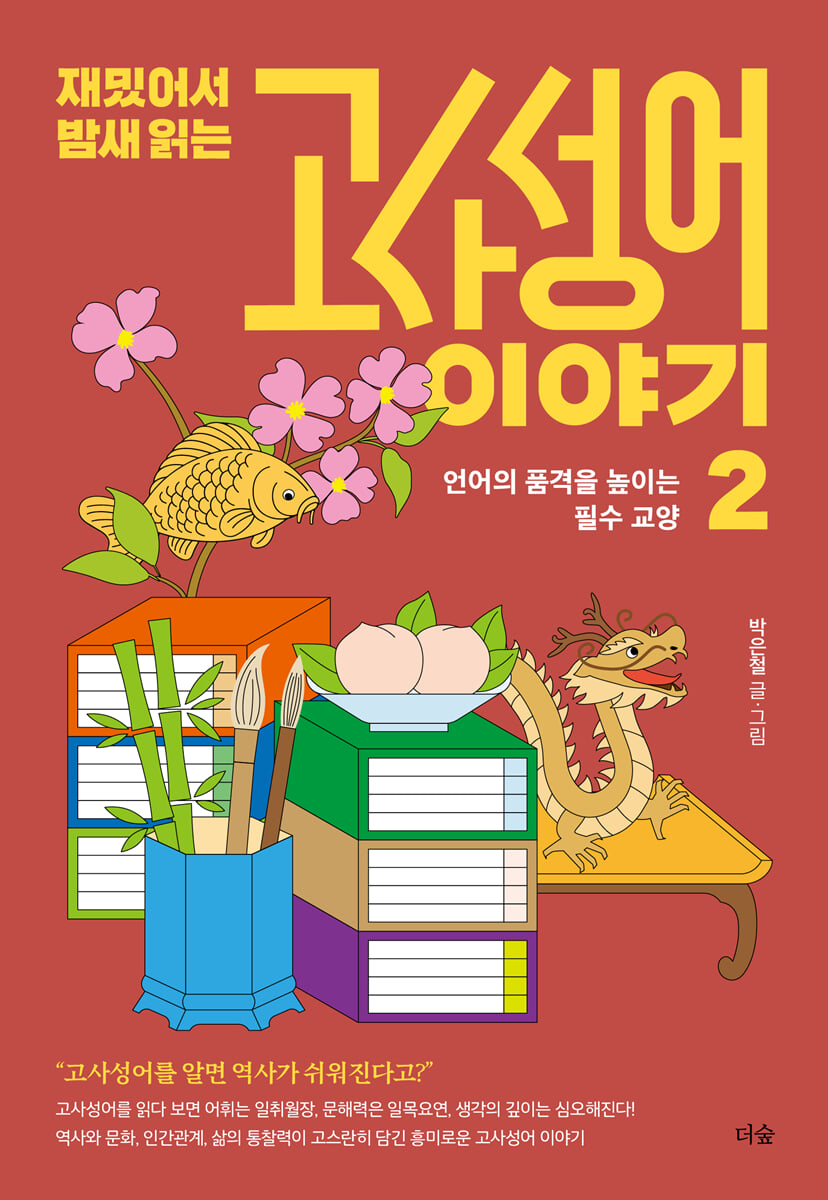 |
Description
Book Introduction
When reading idioms,
Vocabulary improves by leaps and bounds, literacy becomes clear, and the depth of thought becomes profound!
History and culture, human relationships, and wisdom of life
An interesting story full of idioms
Idioms are a treasure trove for understanding history, learning wisdom, and gaining deep insight.
It covers a wide range of fields, including literature, history, and philosophy, and is particularly helpful for young people to develop vocabulary and the ability to quickly understand context.
The [Fun Night] series, which has delivered all the basic knowledge and information of the world through easy-to-understand descriptions and fun stories, meets readers this time with 『Fun Idiom Stories 1 and 2 that will keep you reading all night long』.
This book introduces a total of 240 idioms over two volumes, and it is full of interesting and informative information, including the background and story of each idiom, in-depth knowledge and information, and related idioms that are good to learn together.
Through this, we do not simply have students memorize idioms, but clearly convey the meaning of idioms that they have been familiar with but not properly understood.
It guides readers into the colorful and vivid world of idioms by following the historical context of the idioms, such as the culture, customs, nature, and geography of the time, as well as the history contained in the idioms.
The addition of over 40 witty illustrations further enhances the reading experience.
The author of this book is a Chinese character teacher with 35 years of experience and a principal who also draws cartoons. All of the illustrations in the text were created with great care by the author himself.
To help modern readers understand idioms more quickly and easily, we have used humorous and sensuous illustrations to explain and express them.
In one book, you will encounter a world encompassing language, history, and wisdom.
Vocabulary improves by leaps and bounds, literacy becomes clear, and the depth of thought becomes profound!
History and culture, human relationships, and wisdom of life
An interesting story full of idioms
Idioms are a treasure trove for understanding history, learning wisdom, and gaining deep insight.
It covers a wide range of fields, including literature, history, and philosophy, and is particularly helpful for young people to develop vocabulary and the ability to quickly understand context.
The [Fun Night] series, which has delivered all the basic knowledge and information of the world through easy-to-understand descriptions and fun stories, meets readers this time with 『Fun Idiom Stories 1 and 2 that will keep you reading all night long』.
This book introduces a total of 240 idioms over two volumes, and it is full of interesting and informative information, including the background and story of each idiom, in-depth knowledge and information, and related idioms that are good to learn together.
Through this, we do not simply have students memorize idioms, but clearly convey the meaning of idioms that they have been familiar with but not properly understood.
It guides readers into the colorful and vivid world of idioms by following the historical context of the idioms, such as the culture, customs, nature, and geography of the time, as well as the history contained in the idioms.
The addition of over 40 witty illustrations further enhances the reading experience.
The author of this book is a Chinese character teacher with 35 years of experience and a principal who also draws cartoons. All of the illustrations in the text were created with great care by the author himself.
To help modern readers understand idioms more quickly and easily, we have used humorous and sensuous illustrations to explain and express them.
In one book, you will encounter a world encompassing language, history, and wisdom.
- You can preview some of the book's contents.
Preview
index
preface
Chapter 1 Art and Life
1.
The emptiness after reaching the peak_Hwa-ryong-jeom-jeong
2.
Taking up the sword for peace in the Central Plains_Bang Yak-mu-in
3.
The Aesthetics of Waiting_Great Things Come Late
Chapter 2: An Ancient Fantasy Story
4.
Peach Blossoms Blooming in Paradise_Wu Ling Peach Blossom Garden
5.
Wealth and honor are but a midsummer night's dream_Namga Ilmong
6.
Great foolishness is true wisdom_Foolish old man moves mountains
Chapter 3: Long-Patient Waiting
7.
Haste makes waste_Assistant Manager
8.
To the last letter_Revised
9.
The Wisdom of Knowing Contentment_Snake's Feet
10.
The pain endured to achieve one's goals_Sleeping on firewood and tasting gall
11.
A once-in-a-millennium opportunity
Chapter 4: The Path of Coexistence
12.
The world is one body_Sunmangchihan脣亡齒寒
13.
When you need help, right now_Hakcheolbueo?轍?魚
14.
Even a weak country has a way to survive_Perfect
Chapter 5: Bad Politics, Good Politics
15.
Good politics should be without the presence of politicians_Gobokgyeokyang
16.
The Fear of Harsh Politics_The Fear of Harsh Politics
17.
The sorrow of the people of a ruined country_Macsujitan
18.
Media and Thought Control Against the Times: Burning Books and Burying Confucian Scholars
19.
Trying to do the impossible by force_Yeonmokgueo
20.
Personnel policy that does not fit the status_Gumi Sokcho dog's tail continues to swell
Chapter 6: Don't Get Trapped in a Frame of Thought
21.
Govern the country according to the changing times_Footnote 刻舟求劍
22.
If you know, you won't be afraid_Giwoo杞憂
23.
The foolishness of seeing only what one wants to see_Gunmyeongmusang
24.
Pretense and Clumsy Tolerance_Song Yang-ji-in
25.
Live a life of self-reliance_Handan Zhibo邯鄲之步
26.
Treasuring the common with narrow views_Liaodong Pork
Chapter 7: There are some talented people who stand out.
27.
A person who stands out among the crowd_a crane among a flock of chickens
28.
Those who are prepared, shout out loud._Mao Sui's self-recommendation
29.
A hero has one eye_Dok-an-ryong
30.
Books sell like hotcakes_Luoyang Paper Noble
Chapter 8: What You Must Protect Is Your Heart
31.
Movement is as heavy as Mount Tai_The virtue of the wooden chicken
32.
A trivial and worthless life_nine cows and one hair
33.
Giving silk to thieves to get rid of them_Yang Sang-Gun-Ja
34.
Beware of both excess and deficiency_Excess is as bad as deficiency
35.
Don't be distracted by your current work_Saeonggima
Chapter 9: Deep Thought, Right Action
36.
Dirty Success_Tired? Hemorrhoid-Earning Car
37.
A person who has no shame and no manners_Iron-faced
38.
The time to be filial is now_Feng Shui Jitan
39.
Making your parents happy is filial piety_Banuijihee (The Play of the Spotted Clothes)
40.
The Traitor's Way of Surviving_Pointing at a Deer as if It were a Horse
Appendix_The more the better, the more Idioms You Want to Know
Chapter 1 Art and Life
1.
The emptiness after reaching the peak_Hwa-ryong-jeom-jeong
2.
Taking up the sword for peace in the Central Plains_Bang Yak-mu-in
3.
The Aesthetics of Waiting_Great Things Come Late
Chapter 2: An Ancient Fantasy Story
4.
Peach Blossoms Blooming in Paradise_Wu Ling Peach Blossom Garden
5.
Wealth and honor are but a midsummer night's dream_Namga Ilmong
6.
Great foolishness is true wisdom_Foolish old man moves mountains
Chapter 3: Long-Patient Waiting
7.
Haste makes waste_Assistant Manager
8.
To the last letter_Revised
9.
The Wisdom of Knowing Contentment_Snake's Feet
10.
The pain endured to achieve one's goals_Sleeping on firewood and tasting gall
11.
A once-in-a-millennium opportunity
Chapter 4: The Path of Coexistence
12.
The world is one body_Sunmangchihan脣亡齒寒
13.
When you need help, right now_Hakcheolbueo?轍?魚
14.
Even a weak country has a way to survive_Perfect
Chapter 5: Bad Politics, Good Politics
15.
Good politics should be without the presence of politicians_Gobokgyeokyang
16.
The Fear of Harsh Politics_The Fear of Harsh Politics
17.
The sorrow of the people of a ruined country_Macsujitan
18.
Media and Thought Control Against the Times: Burning Books and Burying Confucian Scholars
19.
Trying to do the impossible by force_Yeonmokgueo
20.
Personnel policy that does not fit the status_Gumi Sokcho dog's tail continues to swell
Chapter 6: Don't Get Trapped in a Frame of Thought
21.
Govern the country according to the changing times_Footnote 刻舟求劍
22.
If you know, you won't be afraid_Giwoo杞憂
23.
The foolishness of seeing only what one wants to see_Gunmyeongmusang
24.
Pretense and Clumsy Tolerance_Song Yang-ji-in
25.
Live a life of self-reliance_Handan Zhibo邯鄲之步
26.
Treasuring the common with narrow views_Liaodong Pork
Chapter 7: There are some talented people who stand out.
27.
A person who stands out among the crowd_a crane among a flock of chickens
28.
Those who are prepared, shout out loud._Mao Sui's self-recommendation
29.
A hero has one eye_Dok-an-ryong
30.
Books sell like hotcakes_Luoyang Paper Noble
Chapter 8: What You Must Protect Is Your Heart
31.
Movement is as heavy as Mount Tai_The virtue of the wooden chicken
32.
A trivial and worthless life_nine cows and one hair
33.
Giving silk to thieves to get rid of them_Yang Sang-Gun-Ja
34.
Beware of both excess and deficiency_Excess is as bad as deficiency
35.
Don't be distracted by your current work_Saeonggima
Chapter 9: Deep Thought, Right Action
36.
Dirty Success_Tired? Hemorrhoid-Earning Car
37.
A person who has no shame and no manners_Iron-faced
38.
The time to be filial is now_Feng Shui Jitan
39.
Making your parents happy is filial piety_Banuijihee (The Play of the Spotted Clothes)
40.
The Traitor's Way of Surviving_Pointing at a Deer as if It were a Horse
Appendix_The more the better, the more Idioms You Want to Know
Detailed image

Into the book
Mencius and the king continued their conversation.
“Will Your Majesty be happy only after starting a war, endangering his soldiers and subjects, and incurring the resentment of the feudal lords?”
"How could that be? I have big dreams I want to achieve in the future."
“Can you tell me that dream?”
When the king only laughed and did not answer, Mencius said:
“Is it because you lack rich and delicious food, fine clothing, good looks and appearance, beautiful music, and favored people that you are going to start a war?”
"no.
“My big dream is not like that.”
Mencius calmly reminded the former king.
“Your Majesty now wishes to expand your territory, obtain the submission of the powerful states of Qin and Chu, and rule the world, subduing the barbarians.
This is no different from climbing a tree to catch fish.
If you climb a tree to look for fish, you will not only not get the fish, but if you pursue hegemonic politics and fail, the country will be destroyed.
Even though my country is strong, it is impossible to subdue other countries with similar national power by force alone.
But, please, your Majesty, administer good government so that all the scholars of the world will want to serve under you.
Make all the farmers of the world want to farm on the king's land and all the merchants want to trade in the king's market.
If everyone in the world wants to walk the path of the king, who would dare to stop the king?”
--- From "Forcing the Impossible_Yeonmokgu-eo"
According to imperial customs passed down from the Spring and Autumn Period, the emperor's close associates attached a sable tail to the side of their hats and a thin decoration resembling a cicada wing to their foreheads.
This was called the Chosun Gwan, and it was a sign of the emperor's favor and trust, and could only be worn with the emperor's permission.
But suddenly, as the number of managers increased and there was a shortage of raccoon tails, they replaced them with dog tails.
People at the time sneered at this sight.
“Since the raccoon is not enough, the dog’s tail takes its place [狗尾續貂].”
The fur of the marten, similar to that of the weasel, is soft and shiny, and was used as the material for high-quality fur and brushes.
It was no comparison to the common, low-quality, useless dog tail hair.
The expression "Gumi Sokcho" (狗尾續貂), which means replacing a raccoon's tail with a dog's tail, is used to describe putting an unqualified person in a high position or increasing the number of official positions unnecessarily.
--- From "Personnel policy that does not fit the status_Gumi Sokcho"
The following story is included in the splendidly published “Yeossi Chunqiu.”
A man from the state of Chu was crossing the Yangtze River in a boat.
He sat on the deck of the boat and ended up dropping the sword he was carrying at his waist into the river.
When the river was too deep to retrieve his sword, he suddenly made a cut in the boat and said,
“This is where my sword slipped.”
When the boat reached the shore, he followed the mark and went into the water to look for the sword, but was laughed at by the people.
Although it is a funny story, it gives us a glimpse into Yeo Buwi's strong intention to open a new era.
The following words are added to the end of this story:
“If you rule the country only with the old laws, you are no different from the swordsmen of the state of Chu.
“If times change but the laws remain the same, how difficult would it be to govern a country?”
The expression ‘刻舟求劍’, which means ‘to carve a boat and seek a sword’, is used as a metaphor for ‘old-fashioned and incompetent people who cannot properly respond to the changing times.’
“Will Your Majesty be happy only after starting a war, endangering his soldiers and subjects, and incurring the resentment of the feudal lords?”
"How could that be? I have big dreams I want to achieve in the future."
“Can you tell me that dream?”
When the king only laughed and did not answer, Mencius said:
“Is it because you lack rich and delicious food, fine clothing, good looks and appearance, beautiful music, and favored people that you are going to start a war?”
"no.
“My big dream is not like that.”
Mencius calmly reminded the former king.
“Your Majesty now wishes to expand your territory, obtain the submission of the powerful states of Qin and Chu, and rule the world, subduing the barbarians.
This is no different from climbing a tree to catch fish.
If you climb a tree to look for fish, you will not only not get the fish, but if you pursue hegemonic politics and fail, the country will be destroyed.
Even though my country is strong, it is impossible to subdue other countries with similar national power by force alone.
But, please, your Majesty, administer good government so that all the scholars of the world will want to serve under you.
Make all the farmers of the world want to farm on the king's land and all the merchants want to trade in the king's market.
If everyone in the world wants to walk the path of the king, who would dare to stop the king?”
--- From "Forcing the Impossible_Yeonmokgu-eo"
According to imperial customs passed down from the Spring and Autumn Period, the emperor's close associates attached a sable tail to the side of their hats and a thin decoration resembling a cicada wing to their foreheads.
This was called the Chosun Gwan, and it was a sign of the emperor's favor and trust, and could only be worn with the emperor's permission.
But suddenly, as the number of managers increased and there was a shortage of raccoon tails, they replaced them with dog tails.
People at the time sneered at this sight.
“Since the raccoon is not enough, the dog’s tail takes its place [狗尾續貂].”
The fur of the marten, similar to that of the weasel, is soft and shiny, and was used as the material for high-quality fur and brushes.
It was no comparison to the common, low-quality, useless dog tail hair.
The expression "Gumi Sokcho" (狗尾續貂), which means replacing a raccoon's tail with a dog's tail, is used to describe putting an unqualified person in a high position or increasing the number of official positions unnecessarily.
--- From "Personnel policy that does not fit the status_Gumi Sokcho"
The following story is included in the splendidly published “Yeossi Chunqiu.”
A man from the state of Chu was crossing the Yangtze River in a boat.
He sat on the deck of the boat and ended up dropping the sword he was carrying at his waist into the river.
When the river was too deep to retrieve his sword, he suddenly made a cut in the boat and said,
“This is where my sword slipped.”
When the boat reached the shore, he followed the mark and went into the water to look for the sword, but was laughed at by the people.
Although it is a funny story, it gives us a glimpse into Yeo Buwi's strong intention to open a new era.
The following words are added to the end of this story:
“If you rule the country only with the old laws, you are no different from the swordsmen of the state of Chu.
“If times change but the laws remain the same, how difficult would it be to govern a country?”
The expression ‘刻舟求劍’, which means ‘to carve a boat and seek a sword’, is used as a metaphor for ‘old-fashioned and incompetent people who cannot properly respond to the changing times.’
--- From "Govern the country according to the changing times_Footnote 9"
Publisher's Review
An idiom that is familiar but whose exact meaning I did not know.
Enhance language quality and broaden knowledge
Volume 2 contains insights into history, culture, human relationships, and life through idioms from various fields and topics, from art and life to ancient fantasy stories, long-suffering and waiting, what constitutes good and bad politics, frameworks of thought, outstanding talent, deep thinking, and right action.
In “Chapter 1 Art and Life,” you will encounter the thoughts and stories of artists and thinkers.
In Hwaryongjeomjeong (畵龍點睛), which means ‘dotting the eyes of a dragon painting,’ you will meet Jang Seung-yo, a hyper-realistic painter who is revered as one of the four great ancestors of Chinese painting.
In the phrase "大器晩成" (大器晩成), which means "a great vessel is made late," the original meaning of "大器晩成" (大器晩成) from the Tao Te Ching by Taoist philosopher Lao Tzu is discussed.
Chapter 2, “Patience and Waiting for a Long Time,” contains the origins and background of countless words we use in our daily lives.
The literal meaning of 'assistance' is 'to help growth', but it is also used to mean 'to encourage something undesirable'.
Introducing the story of the foolish farmer who pulled the rice sprouts upwards to make them grow faster in the “Gongsun Chou” section of the “Mencius,” the author cautiously warns of the potential negative effects of the early education and pre-learning that we face in the educational field today.
In Chapter 8, “The Heart is What Must Be Protected,” the story of Sima Qian, who overcame the sarcasm and contempt of being a eunuch to write China’s greatest historical book, “Records of the Grand Historian,” appears.
Sima Qian wrote a reply to a letter sent by his friend Lin An, in which he described in detail the circumstances of his imprisonment and castration, his dedication to writing the Records of the Grand Historian, and his thoughts on life and death.
The phrase in that text is “nine oxen and one hair” (九牛一毛), which is used to describe something very small among a great many things.
“Even if I had surrendered to the law and been executed at that time, people would have thought I was like one hair lost among nine cows.
So, what is the difference between a being like me and a small creature like a ground squirrel or an ant?
(Omitted) If this history book is preserved in a famous mountain and passed down to future generations and circulated throughout the world, the humiliation I have suffered will be compensated.
If that were the case, what regret would there be even if my body were cut ten thousand times?”
Essential idioms, witty pictures,
Full of knowledge and stories that go one step deeper
An interesting journey of idioms
In addition to the core essential idioms, it provides a wealth of reading material through various structures such as “An Inch Deeper,” “Idioms within Idioms,” and “Chinese Idioms with Similar Meanings.”
"One Inch Deeper" goes beyond the background and origin of idioms and contains interesting knowledge and information across various fields.
For example, in the story of Han Xin and Liu Bang in Dadaikseon (多多益善), Liu Bang's strategy for recruiting talented people is examined, and in the story of Nomajiji (老馬之智), where the Gojuk Kingdom, famous for Bai Yi and Shuji, appears, it is mentioned that although Gojuk Kingdom is recorded as a vassal state of the Yin Dynasty in China, there is evidence through various historical materials and relics that Gojuk Kingdom was a vassal state of Gojoseon.
Also, in the book “Harsh Politics is More Fearsome Than a Tiger” (苛政猛於虎), the origin of the expression “harsh politics is more frightening than a tiger” is discussed, along with the meaning of compatibility and the extinction of tigers in our country.
In “Idioms in Idioms,” we introduce other idioms that appear in the origins of idioms.
For example, in the Song of Four Sides Chu, the phrase "taking the land and coming back" appears together, explaining that the two idioms originated from the same background.
In Daqi Wangyang (多岐亡羊), which means that the paths of learning are many and it is difficult to find the truth, the phrase "ilmobulbal (一毛不拔)", which means "not pulling out even a single hair for others," is also discussed, and it tells us about the extreme altruism and egoism of Mozi and Yang Zi.
This book goes beyond simply introducing idioms and proverbs, offering readers a wealth of learning and entertainment through the historical background, stories of the characters, and timeless wisdom and lessons contained within.
This book, which offers a new approach and depth to idioms, will be an interesting educational resource for both teenagers and adults.
Enhance language quality and broaden knowledge
Volume 2 contains insights into history, culture, human relationships, and life through idioms from various fields and topics, from art and life to ancient fantasy stories, long-suffering and waiting, what constitutes good and bad politics, frameworks of thought, outstanding talent, deep thinking, and right action.
In “Chapter 1 Art and Life,” you will encounter the thoughts and stories of artists and thinkers.
In Hwaryongjeomjeong (畵龍點睛), which means ‘dotting the eyes of a dragon painting,’ you will meet Jang Seung-yo, a hyper-realistic painter who is revered as one of the four great ancestors of Chinese painting.
In the phrase "大器晩成" (大器晩成), which means "a great vessel is made late," the original meaning of "大器晩成" (大器晩成) from the Tao Te Ching by Taoist philosopher Lao Tzu is discussed.
Chapter 2, “Patience and Waiting for a Long Time,” contains the origins and background of countless words we use in our daily lives.
The literal meaning of 'assistance' is 'to help growth', but it is also used to mean 'to encourage something undesirable'.
Introducing the story of the foolish farmer who pulled the rice sprouts upwards to make them grow faster in the “Gongsun Chou” section of the “Mencius,” the author cautiously warns of the potential negative effects of the early education and pre-learning that we face in the educational field today.
In Chapter 8, “The Heart is What Must Be Protected,” the story of Sima Qian, who overcame the sarcasm and contempt of being a eunuch to write China’s greatest historical book, “Records of the Grand Historian,” appears.
Sima Qian wrote a reply to a letter sent by his friend Lin An, in which he described in detail the circumstances of his imprisonment and castration, his dedication to writing the Records of the Grand Historian, and his thoughts on life and death.
The phrase in that text is “nine oxen and one hair” (九牛一毛), which is used to describe something very small among a great many things.
“Even if I had surrendered to the law and been executed at that time, people would have thought I was like one hair lost among nine cows.
So, what is the difference between a being like me and a small creature like a ground squirrel or an ant?
(Omitted) If this history book is preserved in a famous mountain and passed down to future generations and circulated throughout the world, the humiliation I have suffered will be compensated.
If that were the case, what regret would there be even if my body were cut ten thousand times?”
Essential idioms, witty pictures,
Full of knowledge and stories that go one step deeper
An interesting journey of idioms
In addition to the core essential idioms, it provides a wealth of reading material through various structures such as “An Inch Deeper,” “Idioms within Idioms,” and “Chinese Idioms with Similar Meanings.”
"One Inch Deeper" goes beyond the background and origin of idioms and contains interesting knowledge and information across various fields.
For example, in the story of Han Xin and Liu Bang in Dadaikseon (多多益善), Liu Bang's strategy for recruiting talented people is examined, and in the story of Nomajiji (老馬之智), where the Gojuk Kingdom, famous for Bai Yi and Shuji, appears, it is mentioned that although Gojuk Kingdom is recorded as a vassal state of the Yin Dynasty in China, there is evidence through various historical materials and relics that Gojuk Kingdom was a vassal state of Gojoseon.
Also, in the book “Harsh Politics is More Fearsome Than a Tiger” (苛政猛於虎), the origin of the expression “harsh politics is more frightening than a tiger” is discussed, along with the meaning of compatibility and the extinction of tigers in our country.
In “Idioms in Idioms,” we introduce other idioms that appear in the origins of idioms.
For example, in the Song of Four Sides Chu, the phrase "taking the land and coming back" appears together, explaining that the two idioms originated from the same background.
In Daqi Wangyang (多岐亡羊), which means that the paths of learning are many and it is difficult to find the truth, the phrase "ilmobulbal (一毛不拔)", which means "not pulling out even a single hair for others," is also discussed, and it tells us about the extreme altruism and egoism of Mozi and Yang Zi.
This book goes beyond simply introducing idioms and proverbs, offering readers a wealth of learning and entertainment through the historical background, stories of the characters, and timeless wisdom and lessons contained within.
This book, which offers a new approach and depth to idioms, will be an interesting educational resource for both teenagers and adults.
GOODS SPECIFICS
- Date of issue: December 15, 2024
- Page count, weight, size: 284 pages | 444g | 145*210*17mm
- ISBN13: 9791194273103
- ISBN10: 1194273106
You may also like
카테고리
korean


korean

![GQ KOREA Mark (Monthly): December [2025]](http://librairie.coreenne.fr/cdn/shop/files/8ef265dbbfbf186523ed75ba7319009d.jpg?v=1765340328&width=3840)


