

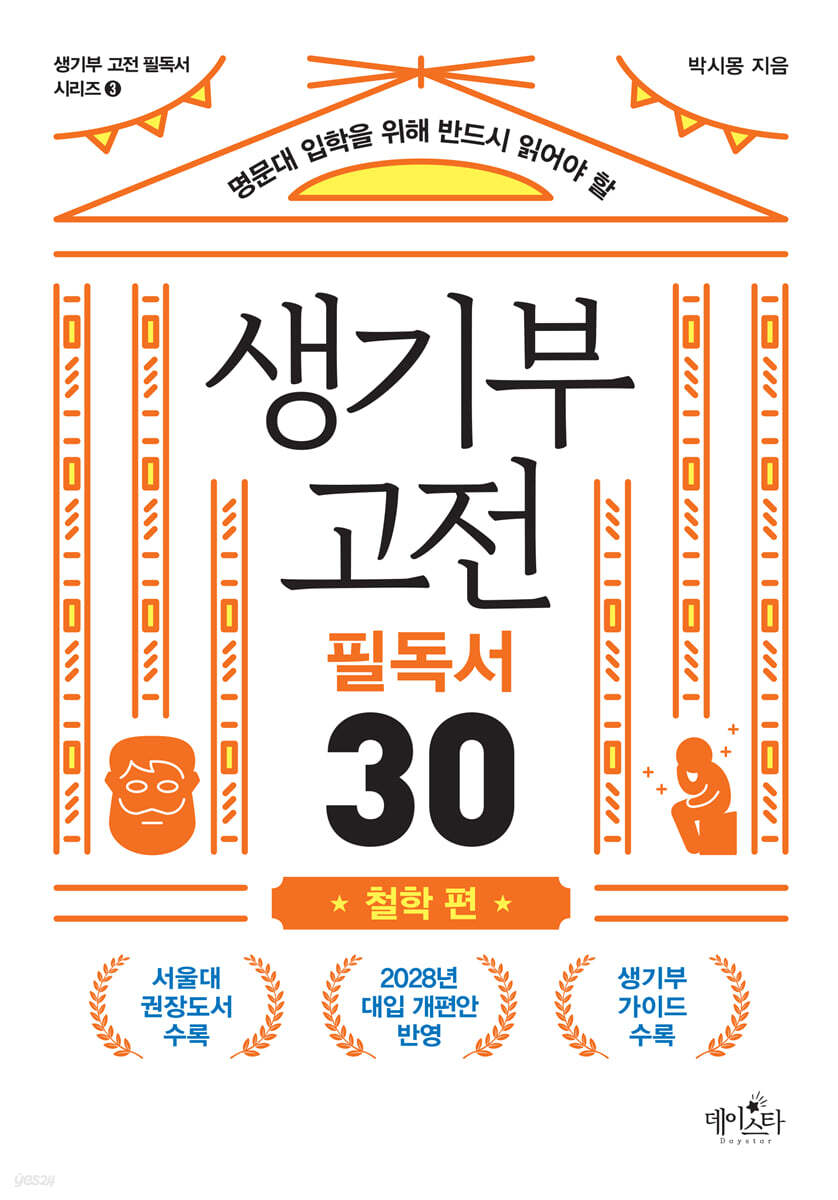
30 Philosophy Books: Must-Read Classics for Life
 |
Description
Book Introduction
A collection of 30 must-read philosophy classics for all Korean youth.
In line with the drastically changed 2028 college entrance reform plan, not only the special features of the life science department but also in-depth reading activities
A 10-Minute Daily Classic Reading Plan to Develop the Integrated Thinking Skills and Insights Desired by Top-Ranking Universities
The flow of education and college entrance examination systems has been changing rapidly recently.
This also means that the type of talent our society and universities desire is changing.
Universities, especially top-tier universities, now want well-rounded and integrated students who are not only cognitively gifted but also able to actively communicate and collaborate within a community.
How can we cultivate these capabilities? In a rapidly changing world, the fastest way to discover unchanging values, find fundamental questions and answers to solve problems, and cultivate the ability to gain insight into objects and phenomena is through reading, and especially through reading the classics.
The 『30 Essential Readings for the Living Classics』 series was designed to help students develop integrated and holistic capabilities through reading a variety of classics.
Six current teachers who share the importance of classics have carefully selected 180 representative classic works from various fields, including Korean literature, foreign literature, economics, science, history, and philosophy.
This book focuses on recommended or required readings from leading domestic universities, and contains representative works that students must review. In particular, it reflects the changes in the educational field, where the importance of detailed academic abilities and special skills in school records is increasing ahead of the implementation of the 2022 revised curriculum and 2028 college entrance reform plan.
The third book in this series, 『30 Philosophy Books: Essential Readings from the Classics of Life』, introduces philosophy, the foundation and root of all learning, in an easy and interesting way through thirty famous philosophical classics.
It contains not only classics of Eastern philosophy such as Confucius's "Analects of Confucius," Yi Hwang's "Seonghak Sipdo," and Yi I's "Seonghak Jipyo," but also classics of Western philosophy such as Plato's "The Republic," Machiavelli's "The Prince," and Mill's "Utilitarianism," allowing for a thorough comparison of how Eastern and Western philosophies differ and in what ways they have influenced each other.
In particular, it introduces research topics and directions that can be utilized in conjunction with the curriculum to enable a three-dimensional reading of each classic, as well as specific examples and methods to reflect career activities and special features in the school life record, making it the best way to prepare for the comprehensive student admissions process in conjunction with reading.
In line with the drastically changed 2028 college entrance reform plan, not only the special features of the life science department but also in-depth reading activities
A 10-Minute Daily Classic Reading Plan to Develop the Integrated Thinking Skills and Insights Desired by Top-Ranking Universities
The flow of education and college entrance examination systems has been changing rapidly recently.
This also means that the type of talent our society and universities desire is changing.
Universities, especially top-tier universities, now want well-rounded and integrated students who are not only cognitively gifted but also able to actively communicate and collaborate within a community.
How can we cultivate these capabilities? In a rapidly changing world, the fastest way to discover unchanging values, find fundamental questions and answers to solve problems, and cultivate the ability to gain insight into objects and phenomena is through reading, and especially through reading the classics.
The 『30 Essential Readings for the Living Classics』 series was designed to help students develop integrated and holistic capabilities through reading a variety of classics.
Six current teachers who share the importance of classics have carefully selected 180 representative classic works from various fields, including Korean literature, foreign literature, economics, science, history, and philosophy.
This book focuses on recommended or required readings from leading domestic universities, and contains representative works that students must review. In particular, it reflects the changes in the educational field, where the importance of detailed academic abilities and special skills in school records is increasing ahead of the implementation of the 2022 revised curriculum and 2028 college entrance reform plan.
The third book in this series, 『30 Philosophy Books: Essential Readings from the Classics of Life』, introduces philosophy, the foundation and root of all learning, in an easy and interesting way through thirty famous philosophical classics.
It contains not only classics of Eastern philosophy such as Confucius's "Analects of Confucius," Yi Hwang's "Seonghak Sipdo," and Yi I's "Seonghak Jipyo," but also classics of Western philosophy such as Plato's "The Republic," Machiavelli's "The Prince," and Mill's "Utilitarianism," allowing for a thorough comparison of how Eastern and Western philosophies differ and in what ways they have influenced each other.
In particular, it introduces research topics and directions that can be utilized in conjunction with the curriculum to enable a three-dimensional reading of each classic, as well as specific examples and methods to reflect career activities and special features in the school life record, making it the best way to prepare for the comprehensive student admissions process in conjunction with reading.
- You can preview some of the book's contents.
Preview
index
Series Preface
Author's Preface
▶ First book - The Analects, Confucius
▶ Second book - Mencius, Mencius
▶ Third book - 《Xunzi》, Xunzi
▶ Fourth book - Han Feizi, Han Feizi
▶ Fifth Book - Tao Te Ching, Lao Tzu
▶ Sixth Book - Zhuangzi, Zhuangzi
▶ Seventh Book - The Four Noble Truths, Ilmok
▶ Eighth Book - 《Zhu Xi's Learning, From the Main Body to Everyday Life》, Joo Gwang-ho
▶ Ninth Book - "The Record of the Practice of the Four Masters" by Wang Yangming
▶ Tenth Book - 《Seonhak Sipdo》, Yi Hwang
▶ Eleventh Book - Seonghakjipyo, Yi I
▶ Book 12 - Apology, Phaedo, Crito, Symposium, Plato
▶ Book 13 - The Republic, Plato
▶ Book 14 - Nicomachean Ethics, Aristotle
▶ Book Fifteen - Pleasure, Epicurus
▶ Book Sixteen - Meditations, Marcus Aurelius
▶ Seventeenth Book - The Prince, Niccolò Machiavelli
▶ Book Eighteen - Treatise on Government, John Locke
▶ Nineteenth Book - The Social Contract, Jean-Jacques Rousseau
▶ Book 20 - Ethics, Benedictus de Spinoza
▶ Book Twenty-First - An Enquiry Concerning Moral Principles, David Hume
▶ Book Twenty-Second - Introduction to the Principles of Morals and Legislation, Jeremy Bentham
▶ Book 23 - Utilitarianism, John Stuart Mill
▶ Book 24 - Groundwork of the Metaphysics of Morals and Critique of Practical Reason, Immanuel Kant
▶ Book Twenty-Fifth - On Liberty, John Stuart Mill
Book 26 - The World as Will and Representation, Arthur Schopenhauer
▶ Book Twenty-Seventh - On the Genealogy of Morality, Friedrich Nietzsche
▶ Book 28 - The Communist Manifesto, Marx, Friedrich Engels
▶ Book 29 - Existentialism is a Humanism, Jean-Paul Sartre
▶ Book 30 - A Theory of Justice, John Rawls
Author's Preface
▶ First book - The Analects, Confucius
▶ Second book - Mencius, Mencius
▶ Third book - 《Xunzi》, Xunzi
▶ Fourth book - Han Feizi, Han Feizi
▶ Fifth Book - Tao Te Ching, Lao Tzu
▶ Sixth Book - Zhuangzi, Zhuangzi
▶ Seventh Book - The Four Noble Truths, Ilmok
▶ Eighth Book - 《Zhu Xi's Learning, From the Main Body to Everyday Life》, Joo Gwang-ho
▶ Ninth Book - "The Record of the Practice of the Four Masters" by Wang Yangming
▶ Tenth Book - 《Seonhak Sipdo》, Yi Hwang
▶ Eleventh Book - Seonghakjipyo, Yi I
▶ Book 12 - Apology, Phaedo, Crito, Symposium, Plato
▶ Book 13 - The Republic, Plato
▶ Book 14 - Nicomachean Ethics, Aristotle
▶ Book Fifteen - Pleasure, Epicurus
▶ Book Sixteen - Meditations, Marcus Aurelius
▶ Seventeenth Book - The Prince, Niccolò Machiavelli
▶ Book Eighteen - Treatise on Government, John Locke
▶ Nineteenth Book - The Social Contract, Jean-Jacques Rousseau
▶ Book 20 - Ethics, Benedictus de Spinoza
▶ Book Twenty-First - An Enquiry Concerning Moral Principles, David Hume
▶ Book Twenty-Second - Introduction to the Principles of Morals and Legislation, Jeremy Bentham
▶ Book 23 - Utilitarianism, John Stuart Mill
▶ Book 24 - Groundwork of the Metaphysics of Morals and Critique of Practical Reason, Immanuel Kant
▶ Book Twenty-Fifth - On Liberty, John Stuart Mill
Book 26 - The World as Will and Representation, Arthur Schopenhauer
▶ Book Twenty-Seventh - On the Genealogy of Morality, Friedrich Nietzsche
▶ Book 28 - The Communist Manifesto, Marx, Friedrich Engels
▶ Book 29 - Existentialism is a Humanism, Jean-Paul Sartre
▶ Book 30 - A Theory of Justice, John Rawls
Detailed image

Into the book
I hope today's students will read more challenging texts.
Rather than reading texts that are difficult to understand because they are dazzling and ornate, I would like to read more texts that are simple and short but have profound and philosophical meanings that make them difficult to understand.
I hope that through this process, you will experience more moments of thought and agony.
(…) Since the student record is an important document that shows the student’s potential and capabilities, it can only be truly meaningful if it records meaningful activities rather than just a simple list of contents.
Philosophical classics are excellent material in that respect.
Because the foundation of all academic disciplines is rooted in philosophy, you have the opportunity to delve deeply into a variety of topics through philosophical classics.
It can soon go beyond the activity of reading books and lead to various activities through multi-faceted convergence projects.
--- p.12 From the author's preface
Zhuangzi argued that the cause of the chaos in society was that people did not realize the truth that 'all things are in harmony'.
According to him, the root of the problem lies in the narrow knowledge and discernment that humans have.
Because of this narrow knowledge and discernment, people lose sight of themselves and their natural nature, become swept away by the world, and live a vain and perverted life.
--- p.67 From "Zhuangzi"
Yi Hwang was renowned as a Neo-Confucian scholar, and his disciples also played important roles in the government and exerted great influence.
Nevertheless, Yi Hwang did not assert his authority in the academic debate with Gi Dae-seung, a scholar much younger than him.
Rather, he is said to have treated Gidae Seung with respect and treated him as an equal for eight years, and to have secretly exchanged letters with him out of fear that Gidae Seung would be attacked.
--- p.108 From “The Ten Paths of Seonghak”
《Seonghakjipyo》 is a comprehensive treatise on sage learning that Yi I presented to King Seonjo in the 8th year of King Seonjo's reign. Through this book, Yi I hoped that King Seonjo would become a sage king, and he wrote this work for the king by pouring in his academic abilities even during the chaotic political situation of the time.
However, in the end, Seonghakjipyo did not provide much help to King Seonjo, and after that, the Sarim faction split into the East and the West, and factional politics began.
--- p.112 From “Seonghakjipyo”
The Republic is a representative work written by Plato, an ancient Greek philosopher and disciple of Socrates.
In this work, the teacher Socrates appears as the subject and protagonist of the conversation.
Consisting of ten volumes, this dialogue explores a wide range of topics, beginning with an exploration of the nature of justice, including the ideal state, the qualities of a ruler, education, and the immortality of the soul.
--- p.133 From "The State"
Plato explains this situation through the allegory of the cave.
Humans in the phenomenal world mistake the shadows on the cave walls for truth and are unable to perceive the truth.
Plato, who views a life that aims for the world of ideas as an ideal life, explains that a philosopher (a figure like Socrates) helps prisoners in chains to break their chains and gain insight into the world of ideas, that is, the world of truth.
--- p.136 From "The Nation"
Furthermore, Machiavelli argues that it is more desirable for a prince to be feared rather than loved by his subjects for the sake of political stability and prosperity of the nation.
He saw love as a fickle emotion, while fear was relatively more stable.
But at the same time, he stressed that the monarch must be careful not to become overly hated by the people.
--- p.179 From "The Prince"
Mill begins to discuss the principle of utility concretely, based on the perspective of qualitative hedonism.
This principle evaluates the moral worth of any action according to its consequences, that is, how much it increases or decreases the well-being of all involved.
The core goal of utilitarianism is to achieve the greatest happiness for the greatest number, which is considered the highest principle to be considered in all moral decisions.
Rather than reading texts that are difficult to understand because they are dazzling and ornate, I would like to read more texts that are simple and short but have profound and philosophical meanings that make them difficult to understand.
I hope that through this process, you will experience more moments of thought and agony.
(…) Since the student record is an important document that shows the student’s potential and capabilities, it can only be truly meaningful if it records meaningful activities rather than just a simple list of contents.
Philosophical classics are excellent material in that respect.
Because the foundation of all academic disciplines is rooted in philosophy, you have the opportunity to delve deeply into a variety of topics through philosophical classics.
It can soon go beyond the activity of reading books and lead to various activities through multi-faceted convergence projects.
--- p.12 From the author's preface
Zhuangzi argued that the cause of the chaos in society was that people did not realize the truth that 'all things are in harmony'.
According to him, the root of the problem lies in the narrow knowledge and discernment that humans have.
Because of this narrow knowledge and discernment, people lose sight of themselves and their natural nature, become swept away by the world, and live a vain and perverted life.
--- p.67 From "Zhuangzi"
Yi Hwang was renowned as a Neo-Confucian scholar, and his disciples also played important roles in the government and exerted great influence.
Nevertheless, Yi Hwang did not assert his authority in the academic debate with Gi Dae-seung, a scholar much younger than him.
Rather, he is said to have treated Gidae Seung with respect and treated him as an equal for eight years, and to have secretly exchanged letters with him out of fear that Gidae Seung would be attacked.
--- p.108 From “The Ten Paths of Seonghak”
《Seonghakjipyo》 is a comprehensive treatise on sage learning that Yi I presented to King Seonjo in the 8th year of King Seonjo's reign. Through this book, Yi I hoped that King Seonjo would become a sage king, and he wrote this work for the king by pouring in his academic abilities even during the chaotic political situation of the time.
However, in the end, Seonghakjipyo did not provide much help to King Seonjo, and after that, the Sarim faction split into the East and the West, and factional politics began.
--- p.112 From “Seonghakjipyo”
The Republic is a representative work written by Plato, an ancient Greek philosopher and disciple of Socrates.
In this work, the teacher Socrates appears as the subject and protagonist of the conversation.
Consisting of ten volumes, this dialogue explores a wide range of topics, beginning with an exploration of the nature of justice, including the ideal state, the qualities of a ruler, education, and the immortality of the soul.
--- p.133 From "The State"
Plato explains this situation through the allegory of the cave.
Humans in the phenomenal world mistake the shadows on the cave walls for truth and are unable to perceive the truth.
Plato, who views a life that aims for the world of ideas as an ideal life, explains that a philosopher (a figure like Socrates) helps prisoners in chains to break their chains and gain insight into the world of ideas, that is, the world of truth.
--- p.136 From "The Nation"
Furthermore, Machiavelli argues that it is more desirable for a prince to be feared rather than loved by his subjects for the sake of political stability and prosperity of the nation.
He saw love as a fickle emotion, while fear was relatively more stable.
But at the same time, he stressed that the monarch must be careful not to become overly hated by the people.
--- p.179 From "The Prince"
Mill begins to discuss the principle of utility concretely, based on the perspective of qualitative hedonism.
This principle evaluates the moral worth of any action according to its consequences, that is, how much it increases or decreases the well-being of all involved.
The core goal of utilitarianism is to achieve the greatest happiness for the greatest number, which is considered the highest principle to be considered in all moral decisions.
--- p.248 From "Utilitarianism"
Publisher's Review
The secret to developing skills that remain constant despite the changing college entrance exam system: reading the classics.
The third book in the "30 Must-Read Classics for the Life Sciences" series, selected by current teachers.
《30 Essential Readings of the Classics of Life and Death: Philosophy》
The current educational and college entrance examination systems are undergoing significant changes, including the implementation of the high school credit system, the integration of liberal arts and sciences, and the expansion of the comprehensive student admissions system.
This also means that it has become very important for students to explore their own career paths, choose their subjects, and create their own portfolios when preparing for college entrance exams.
Top universities, in particular, want creative and comprehensive thinkers who can create and demonstrate new value.
Not just cognitive abilities.
We seek talented individuals who are well-developed, including the ability to actively communicate and cooperate within the community.
How can we cultivate these capabilities? In a rapidly changing world, the fastest way to discover unchanging values, find fundamental questions and answers to solve problems, and cultivate the ability to gain insight into objects and phenomena is through reading, and especially through reading the classics.
The "30 Essential Readings for the Living Classics" series was designed to help students develop integrated and holistic capabilities through reading a variety of classics.
This series introduces 180 representative classic works carefully selected by six current teachers who share the importance of classics in various fields, including Korean literature, foreign literature, economics, science, history, and philosophy.
These are representative works that students must review, focusing on recommended and required readings presented by leading domestic universities.
A guide to in-depth study of classic must-reads and the use of the life cycle.
From preparing for school exams to career guidance and tax specials, all in one book.
Above all, this series summarizes the core content of classic must-reads, lowering the psychological hurdles for students to read the classics and allowing them to comfortably accept them.
With detailed explanations, you can prepare for your internal exams, and we have put a lot of effort into ensuring that it goes beyond simple reading and is connected to academics by providing a guide to in-depth exploration activities.
In particular, as the importance of detailed academic abilities and special skills in school records is increasing due to the 2022 revised curriculum and the 2028 college entrance reform plan, we wanted to specifically show the direction of connection with the life history record.
It presents research topics and directions to be explored in connection with classics for each subject, and also introduces specific examples and methods that can be reflected in connection with the specific subjects in the school life record after reading the classics.
This book will help students create their own portfolios by reading classics from various fields and drawing up a roadmap for their school records.
Above all, I hope that it will help you learn the joy of reading and the value of life, and serve as a guide in making choices on your journey toward college entrance.
From the Analects to the State
It had an impact on politics, economy, national system, etc. of each era.
Learn about the thoughts of Eastern and Western philosophers through 30 classic books.
When we think of 'philosophy', we tend to think of it as a profound and intangible realm of thought, but surprisingly, philosophy is very closely related to our lives.
In particular, this book, “30 Classics of Life and Death: Philosophy Edition,” carefully selected from thirty Eastern and Western classics, compiles the thoughts of philosophers who influenced the politics, economy, and systems of each era, and discusses a large portion of the fundamentals of family and community, as well as social and national systems, such as “how should we live?”, “why is a state organization necessary and what kind of system is ideal?”, and “what virtues are necessary for a monarch and citizens?”
Therefore, the author not only provides a simple and concise interpretation of philosophical thought, but also enhances readers' understanding by including the unique characteristics of each philosopher, their historical background, and their modern significance.
As the preface states, “If you let go of the burden of philosophy and follow the lines of this book, you will soon encounter a broader perspective of thought,” “30 Philosophy Books of the Life and Death Book” will be a friendly and thorough guide on your first journey into reading philosophy.
And through this process, any student will be able to get an idea for their own 'life story using the classics of philosophy.'
The third book in the "30 Must-Read Classics for the Life Sciences" series, selected by current teachers.
《30 Essential Readings of the Classics of Life and Death: Philosophy》
The current educational and college entrance examination systems are undergoing significant changes, including the implementation of the high school credit system, the integration of liberal arts and sciences, and the expansion of the comprehensive student admissions system.
This also means that it has become very important for students to explore their own career paths, choose their subjects, and create their own portfolios when preparing for college entrance exams.
Top universities, in particular, want creative and comprehensive thinkers who can create and demonstrate new value.
Not just cognitive abilities.
We seek talented individuals who are well-developed, including the ability to actively communicate and cooperate within the community.
How can we cultivate these capabilities? In a rapidly changing world, the fastest way to discover unchanging values, find fundamental questions and answers to solve problems, and cultivate the ability to gain insight into objects and phenomena is through reading, and especially through reading the classics.
The "30 Essential Readings for the Living Classics" series was designed to help students develop integrated and holistic capabilities through reading a variety of classics.
This series introduces 180 representative classic works carefully selected by six current teachers who share the importance of classics in various fields, including Korean literature, foreign literature, economics, science, history, and philosophy.
These are representative works that students must review, focusing on recommended and required readings presented by leading domestic universities.
A guide to in-depth study of classic must-reads and the use of the life cycle.
From preparing for school exams to career guidance and tax specials, all in one book.
Above all, this series summarizes the core content of classic must-reads, lowering the psychological hurdles for students to read the classics and allowing them to comfortably accept them.
With detailed explanations, you can prepare for your internal exams, and we have put a lot of effort into ensuring that it goes beyond simple reading and is connected to academics by providing a guide to in-depth exploration activities.
In particular, as the importance of detailed academic abilities and special skills in school records is increasing due to the 2022 revised curriculum and the 2028 college entrance reform plan, we wanted to specifically show the direction of connection with the life history record.
It presents research topics and directions to be explored in connection with classics for each subject, and also introduces specific examples and methods that can be reflected in connection with the specific subjects in the school life record after reading the classics.
This book will help students create their own portfolios by reading classics from various fields and drawing up a roadmap for their school records.
Above all, I hope that it will help you learn the joy of reading and the value of life, and serve as a guide in making choices on your journey toward college entrance.
From the Analects to the State
It had an impact on politics, economy, national system, etc. of each era.
Learn about the thoughts of Eastern and Western philosophers through 30 classic books.
When we think of 'philosophy', we tend to think of it as a profound and intangible realm of thought, but surprisingly, philosophy is very closely related to our lives.
In particular, this book, “30 Classics of Life and Death: Philosophy Edition,” carefully selected from thirty Eastern and Western classics, compiles the thoughts of philosophers who influenced the politics, economy, and systems of each era, and discusses a large portion of the fundamentals of family and community, as well as social and national systems, such as “how should we live?”, “why is a state organization necessary and what kind of system is ideal?”, and “what virtues are necessary for a monarch and citizens?”
Therefore, the author not only provides a simple and concise interpretation of philosophical thought, but also enhances readers' understanding by including the unique characteristics of each philosopher, their historical background, and their modern significance.
As the preface states, “If you let go of the burden of philosophy and follow the lines of this book, you will soon encounter a broader perspective of thought,” “30 Philosophy Books of the Life and Death Book” will be a friendly and thorough guide on your first journey into reading philosophy.
And through this process, any student will be able to get an idea for their own 'life story using the classics of philosophy.'
GOODS SPECIFICS
- Date of issue: December 5, 2024
- Page count, weight, size: 344 pages | 148*210*30mm
- ISBN13: 9791168272521
- ISBN10: 1168272521
You may also like
카테고리
korean


korean

![GQ KOREA Mark (Monthly): December [2025]](http://librairie.coreenne.fr/cdn/shop/files/8ef265dbbfbf186523ed75ba7319009d.jpg?v=1765340328&width=3840)


