

Kim Hong-in Hwaseong
 |
Description
Book Introduction
Harmony: Learning Mars through Sound
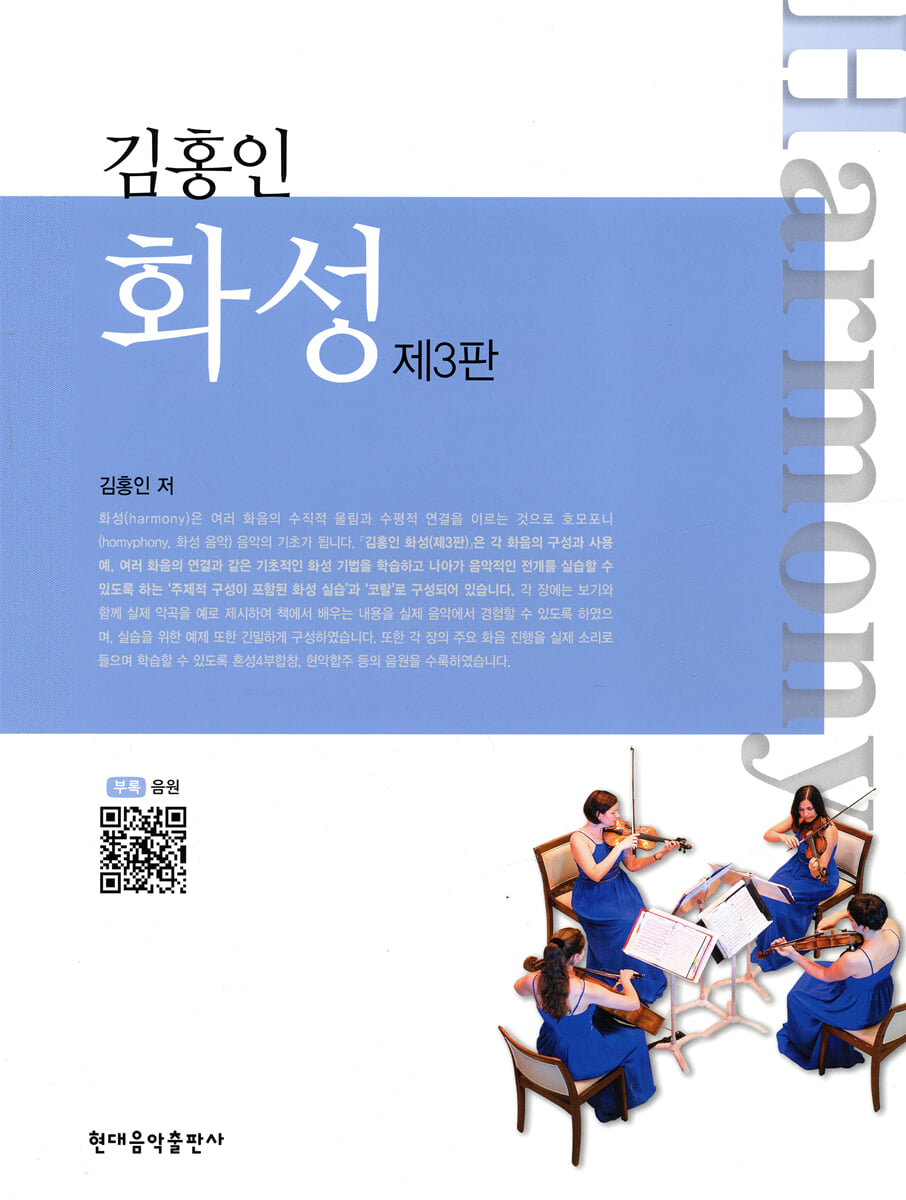
Harmony refers to the vertical resonance and horizontal connection of multiple chords, and is the basis of homophony (harmonic music) music.
"Kim Hong-in's Harmony (3rd Edition)" consists of "Harmony Practice with Thematic Composition" and "Chorale," which allow you to learn basic harmony techniques such as the composition and usage of each chord, and the connection of multiple chords, and further practice musical development.
Each chapter is accompanied by examples of actual music pieces, allowing you to experience what you learn in the book in real music, and examples for practice are also closely organized.
Additionally, audio sources for mixed four-part choir and string ensemble are included so that you can learn the main chord progression of each chapter by listening to the actual sounds.
Harmony refers to the vertical resonance and horizontal connection of multiple chords, and is the basis of homophony (harmonic music) music.
"Kim Hong-in's Harmony (3rd Edition)" consists of "Harmony Practice with Thematic Composition" and "Chorale," which allow you to learn basic harmony techniques such as the composition and usage of each chord, and the connection of multiple chords, and further practice musical development.
Each chapter is accompanied by examples of actual music pieces, allowing you to experience what you learn in the book in real music, and examples for practice are also closely organized.
Additionally, audio sources for mixed four-part choir and string ensemble are included so that you can learn the main chord progression of each chapter by listening to the actual sounds.
- You can preview some of the book's contents.
Preview
index
Chapter 1: Terminology and Rules for Mars Practice
1 Mars, chords, and triads
2 Terms and rules related to the vertical arrangement of chords
3 Terms and rules related to horizontal progression of chords
4 chord progression
Chapter 2 Basic Position Triad
1 Connection of Ⅳ-Ⅰ, Ⅴ-Ⅰ, and Ⅴ-ⅵ
2 Connection of ⅱ-Ⅴ, Ⅳ-Ⅴ, ⅵ-Ⅴ
3 Connection of ⅲ, ⅶ° chords and other basic position triads
4 papers (1)
Chapter 3 First inversion of triads
1 Chord connection including Ⅰ6, Ⅳ6, and Ⅴ6 chords
2 Chord connections including ⅱ6, ⅲ6, ⅵ6, ⅶ°6 chords
Chapter 4 Second inversion of triads
1. Connection of 46 chords: final, transitional, and auxiliary
2 Connection of other 46 chords
Chapter 5: Triads of the Melodic Minor Scale, Minor to Major Triads, and Neapolitan 6th (N6) Chords
1. Connection of three chords by the melodic minor scale
Connection of minor triads in major scale
3 Chord connections including the Neapolitan 6th (N6) chord
Chapter 6: Modulation through Triads
1. Premonitions and the establishment of premonitions
2. Omens of incest
3. Signs of a non-incestuous ancestor
4 Secondary dominant triads, isomorphic progression through triads
Chapter 7 Dominant 7th Chords
1 Basic position V7 chord connection
2 Connection of the inverted V7 chord and the V7 chord with the root note omitted
3 Transposition through V7 chord
4 Secondary Dominant 7th Chords
5. Isomorphic progression through dominant seventh chords
Chapter 8 Non-harmonic sounds (1)
Chapter 9, Part 7, Chords
1 ⅱ7th chord connection
2 Connection of Ⅳ7th chord and ⅵ7th chord
3. Connection of other minor 7th chords
4 Chord progression of a melody with a detailed rhythmic pattern
Chapter 10: Leading Tone 7th Chords and Dominant 9th Chords
1 Connection of the basic position ⅶ°7(ⅶi7) chord
2 Connection of the inverted ⅶ°7(ⅶi7) chord
3 Connection of V9 chords
4 Transposition through ⅶ°7(ⅶi7)·Ⅴ9 chord
5 Secondary leading-tone 7th chord, Secondary dominant 9th chord
6. Identical progression through leading tone 7th chord and dominant 9th chord
Chapter 11 Changed Chords
1 Neapolitan 6th chord
2. A chord with the fifth note raised by a semitone and a chord with the fifth note lowered by a semitone
3. Altered chords including augmented 6th (Ⅰ) -Italian 6th chord-
4. Altered chords with augmented 6th (Ⅱ) - German 6th chord -
5. Changed chords with augmented 6th (Ⅲ) -French 6th chord-
6. Transposition of altered chords including the augmented 6th and other altered chords
Chapter 12 Continuous Sounds
Chapter 13 Non-harmonic sounds (2)
1. Mooring sound
2 pre-stroke
3. Passing sounds and expected sounds
4 Auxiliary sounds·Eshape
Chapter 14: Mars Practice with Thematic Structure
1 Imitation
2 Examples of Mars exercises with thematic structure
Chapter 15: Coral
1 Mars, chords, and triads
2 Terms and rules related to the vertical arrangement of chords
3 Terms and rules related to horizontal progression of chords
4 chord progression
Chapter 2 Basic Position Triad
1 Connection of Ⅳ-Ⅰ, Ⅴ-Ⅰ, and Ⅴ-ⅵ
2 Connection of ⅱ-Ⅴ, Ⅳ-Ⅴ, ⅵ-Ⅴ
3 Connection of ⅲ, ⅶ° chords and other basic position triads
4 papers (1)
Chapter 3 First inversion of triads
1 Chord connection including Ⅰ6, Ⅳ6, and Ⅴ6 chords
2 Chord connections including ⅱ6, ⅲ6, ⅵ6, ⅶ°6 chords
Chapter 4 Second inversion of triads
1. Connection of 46 chords: final, transitional, and auxiliary
2 Connection of other 46 chords
Chapter 5: Triads of the Melodic Minor Scale, Minor to Major Triads, and Neapolitan 6th (N6) Chords
1. Connection of three chords by the melodic minor scale
Connection of minor triads in major scale
3 Chord connections including the Neapolitan 6th (N6) chord
Chapter 6: Modulation through Triads
1. Premonitions and the establishment of premonitions
2. Omens of incest
3. Signs of a non-incestuous ancestor
4 Secondary dominant triads, isomorphic progression through triads
Chapter 7 Dominant 7th Chords
1 Basic position V7 chord connection
2 Connection of the inverted V7 chord and the V7 chord with the root note omitted
3 Transposition through V7 chord
4 Secondary Dominant 7th Chords
5. Isomorphic progression through dominant seventh chords
Chapter 8 Non-harmonic sounds (1)
Chapter 9, Part 7, Chords
1 ⅱ7th chord connection
2 Connection of Ⅳ7th chord and ⅵ7th chord
3. Connection of other minor 7th chords
4 Chord progression of a melody with a detailed rhythmic pattern
Chapter 10: Leading Tone 7th Chords and Dominant 9th Chords
1 Connection of the basic position ⅶ°7(ⅶi7) chord
2 Connection of the inverted ⅶ°7(ⅶi7) chord
3 Connection of V9 chords
4 Transposition through ⅶ°7(ⅶi7)·Ⅴ9 chord
5 Secondary leading-tone 7th chord, Secondary dominant 9th chord
6. Identical progression through leading tone 7th chord and dominant 9th chord
Chapter 11 Changed Chords
1 Neapolitan 6th chord
2. A chord with the fifth note raised by a semitone and a chord with the fifth note lowered by a semitone
3. Altered chords including augmented 6th (Ⅰ) -Italian 6th chord-
4. Altered chords with augmented 6th (Ⅱ) - German 6th chord -
5. Changed chords with augmented 6th (Ⅲ) -French 6th chord-
6. Transposition of altered chords including the augmented 6th and other altered chords
Chapter 12 Continuous Sounds
Chapter 13 Non-harmonic sounds (2)
1. Mooring sound
2 pre-stroke
3. Passing sounds and expected sounds
4 Auxiliary sounds·Eshape
Chapter 14: Mars Practice with Thematic Structure
1 Imitation
2 Examples of Mars exercises with thematic structure
Chapter 15: Coral
Detailed image
.jpg)
Publisher's Review
▶ Go to music playlist
https://youtube.com/playlist?list=PLGCoTTMngGCG-A7ShBbvRy5kG01Yw4zjf
https://youtube.com/playlist?list=PLGCoTTMngGCG-A7ShBbvRy5kG01Yw4zjf
GOODS SPECIFICS
- Publication date: November 30, 2021
- Page count, weight, size: 352 pages | 205*270*20mm
- ISBN13: 9788948312355
- ISBN10: 8948312359
You may also like
카테고리
korean


korean

![GQ KOREA Mark (Monthly): December [2025]](http://librairie.coreenne.fr/cdn/shop/files/8ef265dbbfbf186523ed75ba7319009d.jpg?v=1765340328&width=3840)


