

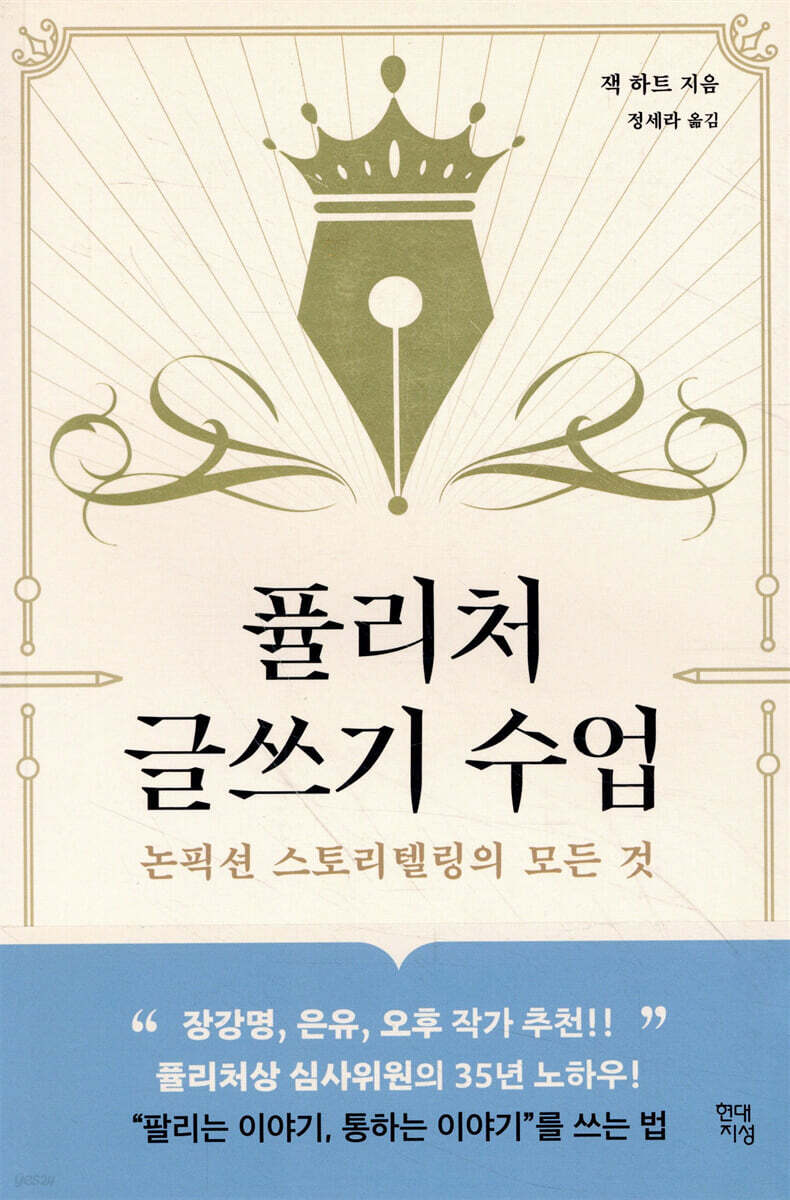
Pulitzer Writing Class
 |
Description
Book Introduction
Turning ordinary material into a story that everyone is excited about
Special writing coaching from a Pulitzer Prize judge!
Recommended by Jang Gang-myeong, Eun-yu, and Oh-hu!
From Aristotle's Poetics
From the latest research in neuroscience on the 'storytelling brain',
"Narrative Nonfiction Skills" Unfold to Captivate Readers
In this book, the author has poured all of his 35 years of writing coaching experience into providing insights that will benefit everyone from beginners to professional writers.
It clearly organizes the things to keep in mind and techniques when researching materials, such as reporting, interviews, and writing composition, making it useful even for inexperienced writers.
Additionally, the author reveals all the know-how he gained from his own trial and error and struggles on how to cook the collected materials into a “well-selling” narrative.
Don't hesitate because the material is ordinary or the writing skills are lacking.
A skilled and passionate writer can tell a good story in any medium.
Even ordinary office workers can create eye-catching plans and reports by adding their own narratives to their proposals.
This book provides useful insights that can be applied across a wide range of areas where storytelling is utilized.
Special writing coaching from a Pulitzer Prize judge!
Recommended by Jang Gang-myeong, Eun-yu, and Oh-hu!
From Aristotle's Poetics
From the latest research in neuroscience on the 'storytelling brain',
"Narrative Nonfiction Skills" Unfold to Captivate Readers
In this book, the author has poured all of his 35 years of writing coaching experience into providing insights that will benefit everyone from beginners to professional writers.
It clearly organizes the things to keep in mind and techniques when researching materials, such as reporting, interviews, and writing composition, making it useful even for inexperienced writers.
Additionally, the author reveals all the know-how he gained from his own trial and error and struggles on how to cook the collected materials into a “well-selling” narrative.
Don't hesitate because the material is ordinary or the writing skills are lacking.
A skilled and passionate writer can tell a good story in any medium.
Even ordinary office workers can create eye-catching plans and reports by adding their own narratives to their proposals.
This book provides useful insights that can be applied across a wide range of areas where storytelling is utilized.
- You can preview some of the book's contents.
Preview
index
Recommendation
Introduction
Chapter 1.
Story
Story is more important than writing skills
The main ingredient of the story
―A series of actions: plot turning point / sympathetic protagonist / ordeal / resolution
The power of story
Chapter 2.
structure
Visualizing the structure
blueprint
Narrative Parabola
―1.
Origin / 2.
Rise (Development) / 3.
Crisis / 4.
Climax (Resolution) / 5.
Descent (Great Chapter)
Chapter 3.
Point of view
Viewpoint character
first person
second person
third person
Camera position, 'stance'
Distance from the target
Chapter 4.
Voice and style
The Secret to Being the #1 Podcaster
First-person perspective and voice
Persona and the Author's Position
How are voice and style different?
Why Hemingway Enjoyed the Game of Metaphors
Create your own voice
Chapter 5.
character
The rise of real-life characters
craving
three-dimensional characters, one-dimensional characters
Direct or indirect character description
Physical characteristics
movements, expressions, and mannerisms
Markers indicating social status
word
anecdote
Purpose of character description
Chapter 6.
scene
Finding the scene from within
Selecting a scene
Description that brings the scene to life
Revealing details
Details that characterize the group
space
Setting shot
texture
atmosphere
Background settings
Bringing the scene to life
Scene building
Chapter 7.
Action
Narrative Opening
continuous motility
The Language of Action
Active voice
Jumping over the starting point
Time display device
speed
commentary
First-person action
Chapter 8.
conversation
inner monologue
Reconstruction of the conversation
Chapter 9.
subject
Topic sentence
The subject is the writer's projection
Find a topic
Chapter 10.
take
infiltration
access
Observation and Reconstruction Narrative
Interview
Characters, scenes, actions, and themes
An eye for storytelling
Chapter 11.
Story narrative
Short story narrative
Feature-length story narrative
Chapter 12.
Commentary Narrative
Chapter 13.
Other narratives
small text
Bookend Narrative
Kyungsoo Pil
Column
First-Person Narrative Issue Essay
documentary film
Podcast
Chapter 14.
Ethical awareness
Difficulty
Betraying trust
The ethics of memoir
speculation
Honest and friendly advice
Undercover reporting
betrayal
Patterns in the imagination
Story structure and style
Touching
Ethical thinking habits
Acknowledgements
Translator's Note
References
Americas
Introduction
Chapter 1.
Story
Story is more important than writing skills
The main ingredient of the story
―A series of actions: plot turning point / sympathetic protagonist / ordeal / resolution
The power of story
Chapter 2.
structure
Visualizing the structure
blueprint
Narrative Parabola
―1.
Origin / 2.
Rise (Development) / 3.
Crisis / 4.
Climax (Resolution) / 5.
Descent (Great Chapter)
Chapter 3.
Point of view
Viewpoint character
first person
second person
third person
Camera position, 'stance'
Distance from the target
Chapter 4.
Voice and style
The Secret to Being the #1 Podcaster
First-person perspective and voice
Persona and the Author's Position
How are voice and style different?
Why Hemingway Enjoyed the Game of Metaphors
Create your own voice
Chapter 5.
character
The rise of real-life characters
craving
three-dimensional characters, one-dimensional characters
Direct or indirect character description
Physical characteristics
movements, expressions, and mannerisms
Markers indicating social status
word
anecdote
Purpose of character description
Chapter 6.
scene
Finding the scene from within
Selecting a scene
Description that brings the scene to life
Revealing details
Details that characterize the group
space
Setting shot
texture
atmosphere
Background settings
Bringing the scene to life
Scene building
Chapter 7.
Action
Narrative Opening
continuous motility
The Language of Action
Active voice
Jumping over the starting point
Time display device
speed
commentary
First-person action
Chapter 8.
conversation
inner monologue
Reconstruction of the conversation
Chapter 9.
subject
Topic sentence
The subject is the writer's projection
Find a topic
Chapter 10.
take
infiltration
access
Observation and Reconstruction Narrative
Interview
Characters, scenes, actions, and themes
An eye for storytelling
Chapter 11.
Story narrative
Short story narrative
Feature-length story narrative
Chapter 12.
Commentary Narrative
Chapter 13.
Other narratives
small text
Bookend Narrative
Kyungsoo Pil
Column
First-Person Narrative Issue Essay
documentary film
Podcast
Chapter 14.
Ethical awareness
Difficulty
Betraying trust
The ethics of memoir
speculation
Honest and friendly advice
Undercover reporting
betrayal
Patterns in the imagination
Story structure and style
Touching
Ethical thinking habits
Acknowledgements
Translator's Note
References
Americas
Detailed image

Into the book
When I was at Northwest Magazine, we were riding the wave of nonfiction storytelling.
It uses a non-fiction storytelling format to cover topics ranging from logging to heart transplants to genetic engineering.
As a writing coach for writers and editors at The Oregonian, I passed on the same writing techniques I developed during my 12 years teaching storytelling theory at the university level.
They successfully applied the theories I taught them to practice.
The Oregonian has won major awards for its storytelling articles on religion, business, music, crime, sports, and more.
An article on international business written by Rich Reed under my direction won the Pulitzer Prize for commentary, and a second article written by Tom Holman and I won the Pulitzer Prize for feature writing.
Michelle Roberts' storytelling article, which passed through my hands, also won the Pulitzer Prize for Breaking News.
Rich Reed and Julie Sullivan, a writer who has worked with me for many years, were part of the investigative team led by Amanda Bennett when they won the Pulitzer Prize Gold Medal, considered the highest honor in journalism, in 2001.
---From the "Introductory Note"
Knowing what to look for is half the battle.
In fact, the basic ingredients for a story are all around us.
You need to learn how to find material in everyday life and develop an eye for storytelling.
If you want to find a really great story, look for the ingredients I'll explain below.
If you want to write a great story, study the techniques explained in this book.
…
The story, rather than the writing style, arouses the reader's interest.
Lisa Kron, who looked at the above scientific studies, said, “If the story is good, poor writing skills can be less damaging than you might think.”
A quick glance at the bestseller list confirms her words.
A claim made 30 years ago by two-time Pulitzer Prize winner John Franklin is now backed up by bestseller lists.
There are many books that are close to being poorly written, but the skill with which they unfold their stories is truly outstanding.
Writers who spend enormous amounts of time and effort polishing words and sentences often miss opportunities to focus on the big story elements that could resonate deeply with readers before they even begin writing.
…
The most common opinion was that the story's power made it impossible to take one's eyes off it.
It creates a strong dramatic tension, and that tension continues until the very end.
One reader said, “I couldn’t put the book down.”
This reaction is a testament to the author's skill in conveying the gravity of the situation and in arranging events in a way that keeps the reader on the edge of their seats.
If you want to keep your readers' attention until the end, you have to infuse your story with power.
---From "Story"
If you really want to know, go to your local bookstore right now and go to the bestseller section.
In any best-selling bookstore, there are bound to be a few books by indifferent novelists who, when approached with a remarkably elegant sentence and asked to dance, show no interest in whether the sentences are elegant or not.
Gene Aureol, the reason Tom Clancy's books sell millions of copies is because they understand story structure so well.
This is what critics who mutilate their sentences overlook.
Pulitzer Prize winner Richard Rose is a brilliant writer and an accomplished nonfiction writer with numerous bestselling books.
He also says that the most important strategy for reaching readers “has little to do with vocabulary skills.”
He explains that mastering structure requires “the ability to frame, the ability to govern the whole.”
However, he lamented, “Writers rarely talk about structure.”
…
Mary Roach says, “I always try to remember that a story has a structure and that everything has to fit into that structure.
“This way, we can avoid the waste of collecting data that will never be used,” he said.
---「Chapter 2.
From "Structure"
When I first started writing, I took metaphors lightly.
But I changed my mind when I heard that Hemingway and Fitzgerald enjoyed playing metaphors while driving around the Spanish countryside in an open-top car.
It is said that when one person points to something on the side of the road, another person immediately uses the word to create a metaphorical expression.
If you failed, you had to take a long sip of Spanish red wine as a penalty.
It's definitely fun to develop a sense of metaphor.
…
Working comfortably and quickly is a much easier way to write.
It is mentally painful to struggle through the first draft, constantly worrying about whether there is a better way to express it.
Above all, this pain kills the author's voice.
People with distinct voices have a different approach.
They often say that the writing process is fun.
For Mary Roach, the entire process of creating a narrative is “a process of weaving facts and entertainment.”
---「Chapter 4.
From "Voice and Style"
Nonfiction writers must find their subjects within themselves.
The world constantly throws various facts at us.
As a nonfiction expert, you should understand at least some of what those facts mean.
John Franklin explained what he meant by "meaning" at the 2001 Nieman Conference on Narrative Journalism:
“I think it’s the shape of the story and what that shape says.
That's not something the writer gets from somewhere.
“It’s something that the writer discovers and extracts from the story.”
Let me share some trade secrets to help you find that "something."
First of all, Tom French says that when he's racking his brain to come up with a title, he focuses on the subject.
“I always think hard about picking out chapter titles, subtitles, and even overall titles.
“That way, all your thoughts converge on what the story is, what the structure and power are,” he said.
“The real subject is not the word, but the sentence,” said Mackey.
“It is a clear and concise sentence that contains the meaning of the story and cannot be shortened any further.”
---「Chapter 9.
Among the “topics”
Among the reporters I've worked with, there are some who always manage to catch great anecdotes, while others, though not particularly impressive, feel as hopeless as trying to catch a whale with a harpoon.
Ken Metzler, author of "The Creative Interview," gives some hints as to why this difference exists.
“To get a story, you have to tell a story.”
This is it! When someone tells us about a trip ruined by a delayed flight, we sympathize by sharing similar anecdotes (like losing a bag or missing a connecting flight).
Just like pouring water into a pump to draw water up, you first tell a story about yourself or the main character, and then ask them to tell you a story about you.
“The X I know is a perfectionist.
He showed me his sock drawer, and it was all rolled up and organized by color! He'd be the same way in his office.
I guarantee it.”
---「Chapter 10.
From "Interview"
Jack Hart meticulously explains not only the aspects of stories we've all heard about in Korean language classes or in reviews of novels, movies, and plays, but also the details we'd never expect until we actually wrote the story ourselves.
How to establish a framework, how to determine the point of view that establishes the distance between the narrator and the stage, how to create a story stage, how to use a voice and style that reveals the author's unique personality, how to find a protagonist and shape him or her into a three-dimensional character, and various methods for collecting writing materials, as well as the daunting ethical concerns that nonfiction inevitably faces.
The familiar has a world we never thought of, and the unfamiliar has the taste of getting to know it.
Anecdotes from inside and outside the newspaper company are added to make reading more enjoyable.
It uses a non-fiction storytelling format to cover topics ranging from logging to heart transplants to genetic engineering.
As a writing coach for writers and editors at The Oregonian, I passed on the same writing techniques I developed during my 12 years teaching storytelling theory at the university level.
They successfully applied the theories I taught them to practice.
The Oregonian has won major awards for its storytelling articles on religion, business, music, crime, sports, and more.
An article on international business written by Rich Reed under my direction won the Pulitzer Prize for commentary, and a second article written by Tom Holman and I won the Pulitzer Prize for feature writing.
Michelle Roberts' storytelling article, which passed through my hands, also won the Pulitzer Prize for Breaking News.
Rich Reed and Julie Sullivan, a writer who has worked with me for many years, were part of the investigative team led by Amanda Bennett when they won the Pulitzer Prize Gold Medal, considered the highest honor in journalism, in 2001.
---From the "Introductory Note"
Knowing what to look for is half the battle.
In fact, the basic ingredients for a story are all around us.
You need to learn how to find material in everyday life and develop an eye for storytelling.
If you want to find a really great story, look for the ingredients I'll explain below.
If you want to write a great story, study the techniques explained in this book.
…
The story, rather than the writing style, arouses the reader's interest.
Lisa Kron, who looked at the above scientific studies, said, “If the story is good, poor writing skills can be less damaging than you might think.”
A quick glance at the bestseller list confirms her words.
A claim made 30 years ago by two-time Pulitzer Prize winner John Franklin is now backed up by bestseller lists.
There are many books that are close to being poorly written, but the skill with which they unfold their stories is truly outstanding.
Writers who spend enormous amounts of time and effort polishing words and sentences often miss opportunities to focus on the big story elements that could resonate deeply with readers before they even begin writing.
…
The most common opinion was that the story's power made it impossible to take one's eyes off it.
It creates a strong dramatic tension, and that tension continues until the very end.
One reader said, “I couldn’t put the book down.”
This reaction is a testament to the author's skill in conveying the gravity of the situation and in arranging events in a way that keeps the reader on the edge of their seats.
If you want to keep your readers' attention until the end, you have to infuse your story with power.
---From "Story"
If you really want to know, go to your local bookstore right now and go to the bestseller section.
In any best-selling bookstore, there are bound to be a few books by indifferent novelists who, when approached with a remarkably elegant sentence and asked to dance, show no interest in whether the sentences are elegant or not.
Gene Aureol, the reason Tom Clancy's books sell millions of copies is because they understand story structure so well.
This is what critics who mutilate their sentences overlook.
Pulitzer Prize winner Richard Rose is a brilliant writer and an accomplished nonfiction writer with numerous bestselling books.
He also says that the most important strategy for reaching readers “has little to do with vocabulary skills.”
He explains that mastering structure requires “the ability to frame, the ability to govern the whole.”
However, he lamented, “Writers rarely talk about structure.”
…
Mary Roach says, “I always try to remember that a story has a structure and that everything has to fit into that structure.
“This way, we can avoid the waste of collecting data that will never be used,” he said.
---「Chapter 2.
From "Structure"
When I first started writing, I took metaphors lightly.
But I changed my mind when I heard that Hemingway and Fitzgerald enjoyed playing metaphors while driving around the Spanish countryside in an open-top car.
It is said that when one person points to something on the side of the road, another person immediately uses the word to create a metaphorical expression.
If you failed, you had to take a long sip of Spanish red wine as a penalty.
It's definitely fun to develop a sense of metaphor.
…
Working comfortably and quickly is a much easier way to write.
It is mentally painful to struggle through the first draft, constantly worrying about whether there is a better way to express it.
Above all, this pain kills the author's voice.
People with distinct voices have a different approach.
They often say that the writing process is fun.
For Mary Roach, the entire process of creating a narrative is “a process of weaving facts and entertainment.”
---「Chapter 4.
From "Voice and Style"
Nonfiction writers must find their subjects within themselves.
The world constantly throws various facts at us.
As a nonfiction expert, you should understand at least some of what those facts mean.
John Franklin explained what he meant by "meaning" at the 2001 Nieman Conference on Narrative Journalism:
“I think it’s the shape of the story and what that shape says.
That's not something the writer gets from somewhere.
“It’s something that the writer discovers and extracts from the story.”
Let me share some trade secrets to help you find that "something."
First of all, Tom French says that when he's racking his brain to come up with a title, he focuses on the subject.
“I always think hard about picking out chapter titles, subtitles, and even overall titles.
“That way, all your thoughts converge on what the story is, what the structure and power are,” he said.
“The real subject is not the word, but the sentence,” said Mackey.
“It is a clear and concise sentence that contains the meaning of the story and cannot be shortened any further.”
---「Chapter 9.
Among the “topics”
Among the reporters I've worked with, there are some who always manage to catch great anecdotes, while others, though not particularly impressive, feel as hopeless as trying to catch a whale with a harpoon.
Ken Metzler, author of "The Creative Interview," gives some hints as to why this difference exists.
“To get a story, you have to tell a story.”
This is it! When someone tells us about a trip ruined by a delayed flight, we sympathize by sharing similar anecdotes (like losing a bag or missing a connecting flight).
Just like pouring water into a pump to draw water up, you first tell a story about yourself or the main character, and then ask them to tell you a story about you.
“The X I know is a perfectionist.
He showed me his sock drawer, and it was all rolled up and organized by color! He'd be the same way in his office.
I guarantee it.”
---「Chapter 10.
From "Interview"
Jack Hart meticulously explains not only the aspects of stories we've all heard about in Korean language classes or in reviews of novels, movies, and plays, but also the details we'd never expect until we actually wrote the story ourselves.
How to establish a framework, how to determine the point of view that establishes the distance between the narrator and the stage, how to create a story stage, how to use a voice and style that reveals the author's unique personality, how to find a protagonist and shape him or her into a three-dimensional character, and various methods for collecting writing materials, as well as the daunting ethical concerns that nonfiction inevitably faces.
The familiar has a world we never thought of, and the unfamiliar has the taste of getting to know it.
Anecdotes from inside and outside the newspaper company are added to make reading more enjoyable.
---From the "Translator's Note"
Publisher's Review
Your storytelling area is activated
A miraculous book!
Cutting-edge brain analysis technology lends credence to the theory that humans are born with a gift for storytelling.
Science writer Steven Holl conducted an experiment where he scanned his own brain with an MRI while he was writing a story, and found that a region the size of a sugar cube in his right frontal lobe actually became active.
Hall called this area the "storytelling area."
Many neuroscientists have discovered similar truths.
Since Steven Holl stepped into the MRI machine, neuroscientists, linguists, and other scientists have conducted hundreds of studies over two decades that have confirmed that “the human brain is hardwired to seek out stories.”
Even more than the author's excellent writing skills, the story stimulates the reader's interest.
Lisa Kron, a story consultant who helps with screenplay adaptations in Hollywood, emphasizes that “story is more important than writing skills.”
Even a quick glance at the bestseller list reveals many books that make you wonder, "Why is this book a bestseller?" However, the author's storytelling skills are truly outstanding.
Yet, many writers still spend so much time and effort polishing words and sentences that they neglect the story elements that truly resonate with readers.
What's your nonfiction like? Is it just a list or collection of bland facts? Is it a well-crafted collection of personal experiences and case studies, but no one reads it, leaving it to gather dust? This book covers the key secrets to crafting a compelling story from any subject matter into compelling content.
The realm of human storytelling will begin to become active.
Most trusted by Pulitzer Prize-winning authors
A writing coach talks nonfiction storytelling.
Author Jack Hart served as editor and writing coach at The Oregonian, a 170-year-old daily newspaper, for a full 25 years.
There, he became known as a leading writing mentor by shifting the paradigm from orthodox articles that faithfully conveyed facts according to the six principles of writing to narrative articles that conveyed facts in a story format.
He constantly developed techniques for arranging events in a way that breathes life into materials that can be found in ordinary situations, keeps readers enthralled and engaged until the very end, and keeps readers on the edge of their seats even when dealing with the same incident.
By introducing novel writing techniques and incorporating "non-fiction storytelling" into investigative articles that had focused solely on conveying facts, the articles came to life and readers were enthusiastic.
Almost any material can be turned into a great story.
It did not discriminate between fields such as religion, business, music, crime, and sports.
Classical music critic David Stubler first used storytelling techniques in a series about a musical prodigy that became a finalist for the Pulitzer Prize.
Author Rich Reed also won a Pulitzer Prize for his first article using nonfiction storytelling techniques.
The story of a woman who was rescued after wandering the jungle for ten days, the realization that she has finally overcome the trauma that has engulfed her life, the tenacious and long story of a police officer tracking down a murderer, the sorrow of neonatal nurses who see babies go to heaven as soon as they are born, a scientist obsessed with his work, an American football player who is no longer sought after…
These were all topics that could have been buried as just ordinary news articles, but through the non-fiction storytelling techniques introduced in this book, they drew empathy and enthusiasm from readers.
Your bland text
From now on, it will be completely different!
To avoid forcing inappropriate material into the framework of storytelling, this book ensures a thorough understanding of well-proven theories dating back to the time of Aristotle.
This is because, in order to write proper non-fiction storytelling, you must fundamentally understand the basic theories that make up a story and the story structure that those theories suggest.
In addition, it details how proven non-fiction storytelling techniques such as plot turning points, captivating structural design, structural visualization, narrative parabolas, stance (camera position) adjustments, abstraction ladders, realistic character design, three-dimensionalization of characters, sensory details, narrative openings, dialogue reconstruction, reporting techniques, and broken link repair are applied, using vivid examples taken from already published books.
Through this course, readers will learn how to write “stories that sell, stories that connect, stories that readers love,” regardless of field, subject matter, or style.
A miraculous book!
Cutting-edge brain analysis technology lends credence to the theory that humans are born with a gift for storytelling.
Science writer Steven Holl conducted an experiment where he scanned his own brain with an MRI while he was writing a story, and found that a region the size of a sugar cube in his right frontal lobe actually became active.
Hall called this area the "storytelling area."
Many neuroscientists have discovered similar truths.
Since Steven Holl stepped into the MRI machine, neuroscientists, linguists, and other scientists have conducted hundreds of studies over two decades that have confirmed that “the human brain is hardwired to seek out stories.”
Even more than the author's excellent writing skills, the story stimulates the reader's interest.
Lisa Kron, a story consultant who helps with screenplay adaptations in Hollywood, emphasizes that “story is more important than writing skills.”
Even a quick glance at the bestseller list reveals many books that make you wonder, "Why is this book a bestseller?" However, the author's storytelling skills are truly outstanding.
Yet, many writers still spend so much time and effort polishing words and sentences that they neglect the story elements that truly resonate with readers.
What's your nonfiction like? Is it just a list or collection of bland facts? Is it a well-crafted collection of personal experiences and case studies, but no one reads it, leaving it to gather dust? This book covers the key secrets to crafting a compelling story from any subject matter into compelling content.
The realm of human storytelling will begin to become active.
Most trusted by Pulitzer Prize-winning authors
A writing coach talks nonfiction storytelling.
Author Jack Hart served as editor and writing coach at The Oregonian, a 170-year-old daily newspaper, for a full 25 years.
There, he became known as a leading writing mentor by shifting the paradigm from orthodox articles that faithfully conveyed facts according to the six principles of writing to narrative articles that conveyed facts in a story format.
He constantly developed techniques for arranging events in a way that breathes life into materials that can be found in ordinary situations, keeps readers enthralled and engaged until the very end, and keeps readers on the edge of their seats even when dealing with the same incident.
By introducing novel writing techniques and incorporating "non-fiction storytelling" into investigative articles that had focused solely on conveying facts, the articles came to life and readers were enthusiastic.
Almost any material can be turned into a great story.
It did not discriminate between fields such as religion, business, music, crime, and sports.
Classical music critic David Stubler first used storytelling techniques in a series about a musical prodigy that became a finalist for the Pulitzer Prize.
Author Rich Reed also won a Pulitzer Prize for his first article using nonfiction storytelling techniques.
The story of a woman who was rescued after wandering the jungle for ten days, the realization that she has finally overcome the trauma that has engulfed her life, the tenacious and long story of a police officer tracking down a murderer, the sorrow of neonatal nurses who see babies go to heaven as soon as they are born, a scientist obsessed with his work, an American football player who is no longer sought after…
These were all topics that could have been buried as just ordinary news articles, but through the non-fiction storytelling techniques introduced in this book, they drew empathy and enthusiasm from readers.
Your bland text
From now on, it will be completely different!
To avoid forcing inappropriate material into the framework of storytelling, this book ensures a thorough understanding of well-proven theories dating back to the time of Aristotle.
This is because, in order to write proper non-fiction storytelling, you must fundamentally understand the basic theories that make up a story and the story structure that those theories suggest.
In addition, it details how proven non-fiction storytelling techniques such as plot turning points, captivating structural design, structural visualization, narrative parabolas, stance (camera position) adjustments, abstraction ladders, realistic character design, three-dimensionalization of characters, sensory details, narrative openings, dialogue reconstruction, reporting techniques, and broken link repair are applied, using vivid examples taken from already published books.
Through this course, readers will learn how to write “stories that sell, stories that connect, stories that readers love,” regardless of field, subject matter, or style.
GOODS SPECIFICS
- Publication date: November 5, 2021
- Page count, weight, size: 480 pages | 692g | 152*225*30mm
- ISBN13: 9791139700169
- ISBN10: 1139700162
You may also like
카테고리
korean


korean

![GQ KOREA Mark (Monthly): December [2025]](http://librairie.coreenne.fr/cdn/shop/files/8ef265dbbfbf186523ed75ba7319009d.jpg?v=1765340328&width=3840)


