

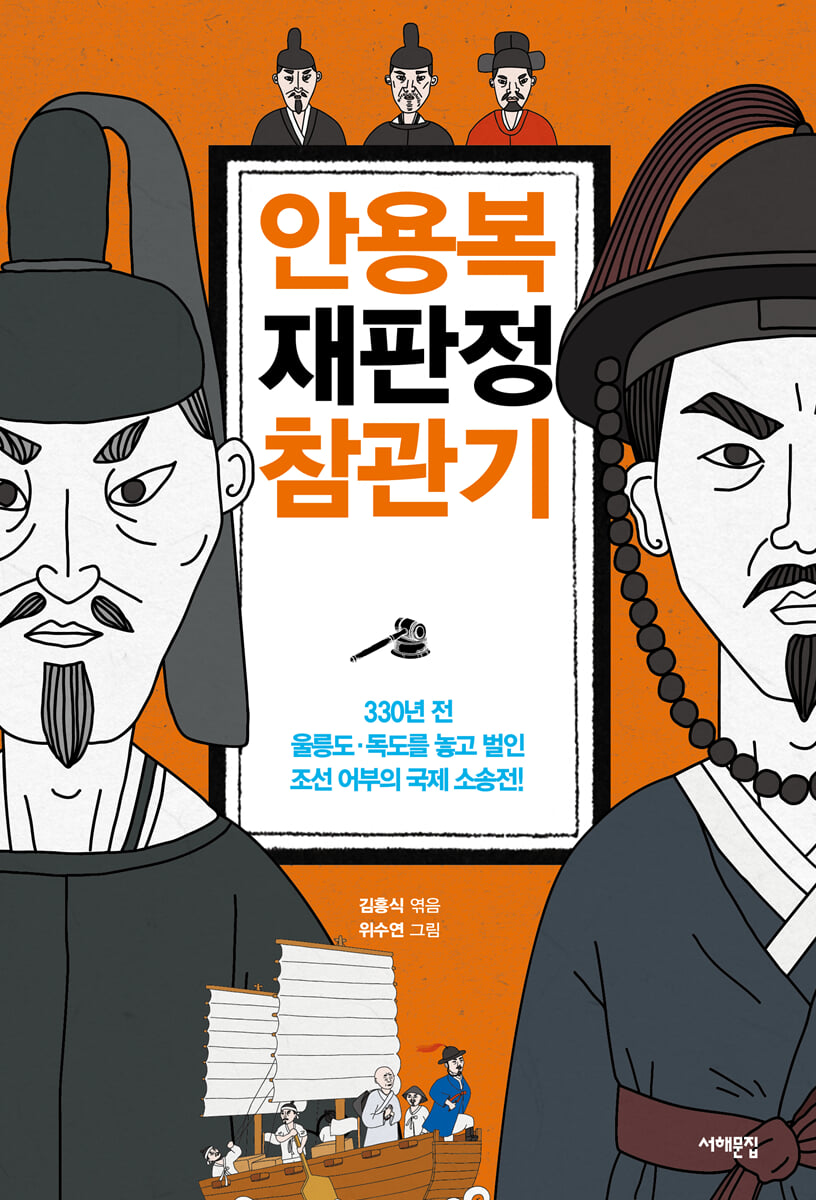
Observing the An Yong-bok trial
 |
Description
Book Introduction
The story of three criminal, civil, and international trials fought by Joseon fisherman An Yong-bok, who traveled back and forth across the East Sea twice, over the ownership of Dokdo and Ulleungdo.
It focuses on the life of An Yong-bok, who served as the defendant, plaintiff, and attorney (lawyer) in each trial, and contains the fierce diplomatic war between the Joseon and Japanese governments over the sovereignty of Dokdo and Ulleungdo.
This is a refreshing legal historical drama that resolves the Dokdo issue, the core of the Korea-Japan conflict, 300 years ahead of schedule, and a human drama depicting the life of An Yong-bok, who is remembered only as a legendary figure.
It focuses on the life of An Yong-bok, who served as the defendant, plaintiff, and attorney (lawyer) in each trial, and contains the fierce diplomatic war between the Joseon and Japanese governments over the sovereignty of Dokdo and Ulleungdo.
This is a refreshing legal historical drama that resolves the Dokdo issue, the core of the Korea-Japan conflict, 300 years ahead of schedule, and a human drama depicting the life of An Yong-bok, who is remembered only as a legendary figure.
- You can preview some of the book's contents.
Preview
index
Introduction ∥ Some Guidelines for Observing the An Yong-bok Trial
●The First Trial ∥ The Butterfly Effect of the Ahn Yong-bok Kidnapping Case
Background: The situation on Ulleungdo in 1692
Incident: Korean fishermen kidnapped by Japan
○ History Spotlight ∥ Names of Ulleungdo and Dokdo / Japanese Administrative System and Place Names
Detention and Interrogation: From Kidnapping Victim to Suspect in Territorial Waters Invasion
First Trial: "The island's name is Ulleungdo."
Second Trial: "We just went to Ulleungdo to catch fish."
Extra-courtroom ① The letter from the governor of Tsushima that changed the course of the trial
Extra-court proceedings ② The Joseon court's discussion of the Ulleungdo issue
○ History Magnifier ∥ Tsushima Domain and Waegwan
Extra-court proceedings ③ Joseon's reply
Extra-judicial Court④ The Second Letter from the Governor of Tsushima
Extra-court proceedings⑤ Joseon's second reply
Off-Court ⑥ A Tight Tug-of-War
The Final Trial: The Edo Shogunate's Witness Interrogation
Sentencing Hearing: "Japanese Sword Harvesting Prohibited"
○ History Spotlight ∥ 1877 Taijōkan Directive: The "Ban on Crossing the Takeshima Islands" Still in Effect 200 Years Later
●Second and Third Trials ∥ Why did An Yong-bok go back to Japan?
Filing of the lawsuit and examination of the parties: "Ulleungdo and Dokdo are territories of Gangwon Province, Joseon."
○ History Spotlight ∥ An Yong-bok declares Dokdo as Joseon territory
Decision: "Matters concerning Korea will be handled solely from Tsushima."
Standing in a Joseon courtroom: The court jury debated An Yong-bok's guilt or innocence.
Sentencing: Death sentence commuted to exile
After the Trial: Strengthening Security Around Ulleungdo
○ History Spotlight ∥ Theory of An Yong-bok in Seonghosaseol
References
●The First Trial ∥ The Butterfly Effect of the Ahn Yong-bok Kidnapping Case
Background: The situation on Ulleungdo in 1692
Incident: Korean fishermen kidnapped by Japan
○ History Spotlight ∥ Names of Ulleungdo and Dokdo / Japanese Administrative System and Place Names
Detention and Interrogation: From Kidnapping Victim to Suspect in Territorial Waters Invasion
First Trial: "The island's name is Ulleungdo."
Second Trial: "We just went to Ulleungdo to catch fish."
Extra-courtroom ① The letter from the governor of Tsushima that changed the course of the trial
Extra-court proceedings ② The Joseon court's discussion of the Ulleungdo issue
○ History Magnifier ∥ Tsushima Domain and Waegwan
Extra-court proceedings ③ Joseon's reply
Extra-judicial Court④ The Second Letter from the Governor of Tsushima
Extra-court proceedings⑤ Joseon's second reply
Off-Court ⑥ A Tight Tug-of-War
The Final Trial: The Edo Shogunate's Witness Interrogation
Sentencing Hearing: "Japanese Sword Harvesting Prohibited"
○ History Spotlight ∥ 1877 Taijōkan Directive: The "Ban on Crossing the Takeshima Islands" Still in Effect 200 Years Later
●Second and Third Trials ∥ Why did An Yong-bok go back to Japan?
Filing of the lawsuit and examination of the parties: "Ulleungdo and Dokdo are territories of Gangwon Province, Joseon."
○ History Spotlight ∥ An Yong-bok declares Dokdo as Joseon territory
Decision: "Matters concerning Korea will be handled solely from Tsushima."
Standing in a Joseon courtroom: The court jury debated An Yong-bok's guilt or innocence.
Sentencing: Death sentence commuted to exile
After the Trial: Strengthening Security Around Ulleungdo
○ History Spotlight ∥ Theory of An Yong-bok in Seonghosaseol
References
Detailed image

Into the book
For a person who is the same inside and out, what matters is not reward or punishment, but intention.
An Yong-bok achieved his goal.
--- p.124
“I am from Dongrae-bu, Gyeongsang-do, Joseon, and my name is An Yong-bok.”
--- p.25
“Ulleungdo is an island with a lot of bamboo.
It is an island belonging to Gangwon-do, Joseon, and is called Jukdo in Japan.
“I have a map of the eight provinces with this information written on it.” An Yong-bok showed off the eight maps of the eight provinces of Joseon that he had in his possession.
This is a map with the names of each region written in Korean.
“The island that Japan calls Songdo refers to an island called Jasan (Dokdo) that belongs to the same Gangwon Province.
This is also recorded on the map of the eight provinces.”
--- p.86
An Yong-bok was a figure from the late Joseon Dynasty and was from Dongrae-bu (Busan).
The dates of birth and death are unknown.
However, according to Japanese records, he was born in the 1650s or 1660s, and is estimated to have been in his mid-30s to early 40s at the time of the incident.
His occupation was a soldier rowing on a warship and a fisherman.
Japanese sources record that he had a sanobi's hopae (identification card), but considering that he was able to communicate in Japanese and his actions before and after the incident, it is difficult to believe this at face value.
--- p.8
Oya's party sent a few men ahead to scout the island without dropping anchor.
There were quite a few abalones and seaweed drying along the coast.
There were also discarded straw sandals, but their appearance was different from Japanese ones.
It was clear that a Korean had crossed over.
--- p.23
So, Oya and his group plan to kidnap them.
“Last year, I warned the North Korean fishermen not to come here again.
But this spring, they came in before us and are interfering with our fishing.
If we leave it as is, our land will be plundered by Koreans.
So, it would be best to take the two of them and report the whole story, and then follow the shogunate’s decision.”
--- p.26
After investigating An Yong-bok and his party and learning the full story of the incident, Japan seeks a diplomatic solution with the Joseon government.
Tsushima Domain, which was the exclusive channel of communication between Joseon and Japan, reacted sensitively to this issue and dispatched an envoy to deliver a letter to the Joseon court.
This opens another courtroom outside the Ahn Yong-bok trial courtroom.
--- p.39
“I, So Yoshitsugu, the Governor of Tsushima, Japan, submit a letter to the Minister of Rites, Hap-ha, of Joseon.
(…) Last year, fishermen from your home country came to Jukdo Island and engaged in fishing activities.
As this was something that should not have happened, the local officials of the home country explained the laws of the country in detail and sent him back after giving him a firm warning not to come back.
(…) In the future, please strictly prohibit North Korean fishing boats from entering Jukdo.
This is to inform you of the Edo shogunate's order."
--- pp.40-41
The governor of Tsushima did not stop at pointing out An Yong-bok's personal violation of the national border, but directly mentioned the issue of sovereignty over Ulleungdo (Takeshima).
Whatever the intention, this strategy expanded the issues in the Ahn Yong-bok trial and served as a catalyst for the trial to unfold in an unexpected way.
--- pp.41-42
The Japanese called Joseon's Ulleungdo Island Jukdo and considered it their land.
With one island having two names and two countries each acting as its owner, conflict is bound to arise.
Therefore, the letter from the governor of Tsushima contained the hidden intention and will to use the An Yong-bok incident as an opportunity to firmly bring jurisdiction over Takeshima back to Japan.
On the other hand, at that time, the Joseon government did not want conflict with Japan.
--- p.49
The kidnapping of An Yong-bok and his party in 1693 escalated into a dispute over Ulleungdo Island between Joseon and Japan.
Initially, the Japanese believed that Koreans had invaded their territorial waters and kidnapped the two men.
The Joseon government, which belatedly realized this fact, tried to cover it up as quietly as possible without making a big deal out of it as An Yong-bok and his party set off on their way back to the country.
To this end, the Joseon government proposed a two-island, two-person policy to the Tsushima clan, stating that "Ulleungdo = Joseon territory, Jukdo = Japanese territory," and attempted to cover up the incident without the intervention of the Japanese shogunate.
On the other hand, Tsushima clan claimed that 'Ulleungdo = Takeshima = Japanese territory' (1 island, 2 people) and wanted to make Ulleungdo a complete Japanese territory.
The intention was to increase both influence over Joseon and the shogunate's trust through these negotiations.
--- p.67
“We didn’t acquire this island in the first place, so it’s absurd to say we’re returning it now.
Therefore, we simply prohibit our people from crossing here to fish.
The shogunate's latest directive contradicts previous directives.
However, it is better to resolve the issue without conflict than to insist on one's own opinion and argue deeply.
Therefore, Japanese people are prohibited from approaching bamboo swords.”
--- p.73
“A few years ago, I came here and designated Ulleungdo and Jasando as Joseon territory, and even received a letter from your country’s official.
But now that you have invaded our territory, what is the right thing to do?”
--- p.109
“I don’t know the details of the Korean’s petition, but since they came to Inaba Province as their destination, it must have something to do with Jukdo.
The shogunate has also been lenient in its judgment and has ordered a ban on crossing the Tokugawa shogunate to the advantage of Joseon. If this petition is accepted without first informing Joseon of this, they will consider it the result of the lawsuit.
So, if you have any petitions in the future, you will have to go to the shogunate, so you will be very embarrassed.”
--- p.103
It was the Byeonbisa's Po Seung-jool who greeted An Yong-bok, who was exiled to Joseon.
The charge was that he crossed the border without permission and caused a disturbance in a neighboring country.
Ironically, this trial record is the very source that vividly explains why An Yong-bok risked his life to cross over to Japan again and what the outcome of his second visit to Japan was.
--- p.106
Governor Shin Yeo-cheol came forward and defended Ahn Yong-bok.
“An Yong-bok’s deeds are truly remarkable, but since he was able to accomplish what the state could not, his merits and faults are mutually exclusive.
“It cannot be determined by one sin.”
Then, Yoon Ji-seon refutes.
“If we do not kill An Yong-bok, the number of treacherous people who cause trouble in other countries will increase.
How can we keep him alive?”
An Yong-bok achieved his goal.
--- p.124
“I am from Dongrae-bu, Gyeongsang-do, Joseon, and my name is An Yong-bok.”
--- p.25
“Ulleungdo is an island with a lot of bamboo.
It is an island belonging to Gangwon-do, Joseon, and is called Jukdo in Japan.
“I have a map of the eight provinces with this information written on it.” An Yong-bok showed off the eight maps of the eight provinces of Joseon that he had in his possession.
This is a map with the names of each region written in Korean.
“The island that Japan calls Songdo refers to an island called Jasan (Dokdo) that belongs to the same Gangwon Province.
This is also recorded on the map of the eight provinces.”
--- p.86
An Yong-bok was a figure from the late Joseon Dynasty and was from Dongrae-bu (Busan).
The dates of birth and death are unknown.
However, according to Japanese records, he was born in the 1650s or 1660s, and is estimated to have been in his mid-30s to early 40s at the time of the incident.
His occupation was a soldier rowing on a warship and a fisherman.
Japanese sources record that he had a sanobi's hopae (identification card), but considering that he was able to communicate in Japanese and his actions before and after the incident, it is difficult to believe this at face value.
--- p.8
Oya's party sent a few men ahead to scout the island without dropping anchor.
There were quite a few abalones and seaweed drying along the coast.
There were also discarded straw sandals, but their appearance was different from Japanese ones.
It was clear that a Korean had crossed over.
--- p.23
So, Oya and his group plan to kidnap them.
“Last year, I warned the North Korean fishermen not to come here again.
But this spring, they came in before us and are interfering with our fishing.
If we leave it as is, our land will be plundered by Koreans.
So, it would be best to take the two of them and report the whole story, and then follow the shogunate’s decision.”
--- p.26
After investigating An Yong-bok and his party and learning the full story of the incident, Japan seeks a diplomatic solution with the Joseon government.
Tsushima Domain, which was the exclusive channel of communication between Joseon and Japan, reacted sensitively to this issue and dispatched an envoy to deliver a letter to the Joseon court.
This opens another courtroom outside the Ahn Yong-bok trial courtroom.
--- p.39
“I, So Yoshitsugu, the Governor of Tsushima, Japan, submit a letter to the Minister of Rites, Hap-ha, of Joseon.
(…) Last year, fishermen from your home country came to Jukdo Island and engaged in fishing activities.
As this was something that should not have happened, the local officials of the home country explained the laws of the country in detail and sent him back after giving him a firm warning not to come back.
(…) In the future, please strictly prohibit North Korean fishing boats from entering Jukdo.
This is to inform you of the Edo shogunate's order."
--- pp.40-41
The governor of Tsushima did not stop at pointing out An Yong-bok's personal violation of the national border, but directly mentioned the issue of sovereignty over Ulleungdo (Takeshima).
Whatever the intention, this strategy expanded the issues in the Ahn Yong-bok trial and served as a catalyst for the trial to unfold in an unexpected way.
--- pp.41-42
The Japanese called Joseon's Ulleungdo Island Jukdo and considered it their land.
With one island having two names and two countries each acting as its owner, conflict is bound to arise.
Therefore, the letter from the governor of Tsushima contained the hidden intention and will to use the An Yong-bok incident as an opportunity to firmly bring jurisdiction over Takeshima back to Japan.
On the other hand, at that time, the Joseon government did not want conflict with Japan.
--- p.49
The kidnapping of An Yong-bok and his party in 1693 escalated into a dispute over Ulleungdo Island between Joseon and Japan.
Initially, the Japanese believed that Koreans had invaded their territorial waters and kidnapped the two men.
The Joseon government, which belatedly realized this fact, tried to cover it up as quietly as possible without making a big deal out of it as An Yong-bok and his party set off on their way back to the country.
To this end, the Joseon government proposed a two-island, two-person policy to the Tsushima clan, stating that "Ulleungdo = Joseon territory, Jukdo = Japanese territory," and attempted to cover up the incident without the intervention of the Japanese shogunate.
On the other hand, Tsushima clan claimed that 'Ulleungdo = Takeshima = Japanese territory' (1 island, 2 people) and wanted to make Ulleungdo a complete Japanese territory.
The intention was to increase both influence over Joseon and the shogunate's trust through these negotiations.
--- p.67
“We didn’t acquire this island in the first place, so it’s absurd to say we’re returning it now.
Therefore, we simply prohibit our people from crossing here to fish.
The shogunate's latest directive contradicts previous directives.
However, it is better to resolve the issue without conflict than to insist on one's own opinion and argue deeply.
Therefore, Japanese people are prohibited from approaching bamboo swords.”
--- p.73
“A few years ago, I came here and designated Ulleungdo and Jasando as Joseon territory, and even received a letter from your country’s official.
But now that you have invaded our territory, what is the right thing to do?”
--- p.109
“I don’t know the details of the Korean’s petition, but since they came to Inaba Province as their destination, it must have something to do with Jukdo.
The shogunate has also been lenient in its judgment and has ordered a ban on crossing the Tokugawa shogunate to the advantage of Joseon. If this petition is accepted without first informing Joseon of this, they will consider it the result of the lawsuit.
So, if you have any petitions in the future, you will have to go to the shogunate, so you will be very embarrassed.”
--- p.103
It was the Byeonbisa's Po Seung-jool who greeted An Yong-bok, who was exiled to Joseon.
The charge was that he crossed the border without permission and caused a disturbance in a neighboring country.
Ironically, this trial record is the very source that vividly explains why An Yong-bok risked his life to cross over to Japan again and what the outcome of his second visit to Japan was.
--- p.106
Governor Shin Yeo-cheol came forward and defended Ahn Yong-bok.
“An Yong-bok’s deeds are truly remarkable, but since he was able to accomplish what the state could not, his merits and faults are mutually exclusive.
“It cannot be determined by one sin.”
Then, Yoon Ji-seon refutes.
“If we do not kill An Yong-bok, the number of treacherous people who cause trouble in other countries will increase.
How can we keep him alive?”
--- p.117
Publisher's Review
The first Joseon vs. Japan courtroom drama in history.
A dispute over the ownership of Dokdo and Ulleungdo
The turbulent struggles of Joseon fisherman An Yong-bok
Defendant Ahn Yong-bok, Plaintiff Ahn Yong-bok, Attorney Ahn Yong-bok
Modern trials are broadly divided into three types.
Criminal trials that punish criminals according to criminal law and civil trials that resolve disputes between individuals or corporations according to civil and commercial law.
Finally, an international court that arbitrates and decides disputes between nations.
The 'An Yong-bok trial' that we will be attending today applies to all three of these.
330 years ago, Joseon fisherman An Yong-bok was tried three times in total.
The first was a criminal trial where he was taken to the Japanese who claimed that Ulleungdo was Japanese territory, and An Yong-bok was a defendant for violating Japanese territorial waters.
The second is a lawsuit filed by An Yong-bok, who claimed that Ulleungdo and Dokdo were Joseon territory and went to Japan to file the lawsuit.
This trial is a civil trial in that it raised the issue of Japanese fishing vessels operating illegally in Korean waters, and at the same time, it has the character of an international trial in that it brought the issue of sovereignty (territorial jurisdiction) over Ulleungdo and Dokdo to public attention.
An Yong-bok served as both a plaintiff and a litigation representative defending Joseon's sovereignty.
The third is another criminal trial after returning home.
In the court of his native Joseon, An Yong-bok faces the threat of capital punishment for crossing the border without government permission and causing a diplomatic disturbance.
Of course, it is difficult to compare a 17th century trial directly with a modern trial.
At the time, there were no sophisticated judicial procedures like those of today, and An Yong-bok did not enjoy full legal rights, including the assistance of a lawyer.
Even the second lawsuit filed by An Yong-bok ended with the plaintiff being expelled without even reaching a trial due to collusion between the local and central Japanese governments, who were afraid of the repercussions.
Therefore, if we interpret a trial only in the dictionary as ‘a judgment made by a court (judge) with jurisdiction to resolve a legal dispute according to procedure,’ then the An Yong-bok trial court is quite different from today’s courts.
However, if we consider the essence of a trial, that is, to 'examine the whole of the human world and determine what is right and wrong,' then this difference is trivial.
An Yong-bok was kidnapped and arrested by the Japanese and Korean governments on charges of territorial waters violation and border crossing, respectively, and after investigation and interrogation, he was either released or exiled.
In the process, he contributed greatly to resolving the territorial issue between Korea and Japan by directly filing a lawsuit, presenting evidence that Korea has sovereignty over Ulleungdo and Dokdo.
In other words, in essence, the An Yong-bok trial court is no different from a modern court.
Furthermore, the first trial, which began with the actions of An Yong-bok, ended not with a punishment for the individual, but with a decision on the sovereignty of Ulleungdo.
This result can be said to be a brilliant achievement of the An Yong-bok trial, which transcended the limitations of modern courts, whose effectiveness is limited to a single case.
The extraordinary life of an ordinary fisherman
Joseon vs. Korea surrounding Dokdo and Ulleungdo
Japan's diplomatic warfare
An Yong-bok was a figure from the late Joseon Dynasty and was from Dongrae-bu (Busan).
The dates of birth and death are unknown.
However, according to Japanese records, he was born in the 1650s or 1660s, and is estimated to have been in his mid-30s to early 40s at the time of the incident.
His occupation was a soldier rowing on a warship and a fisherman.
An Yong-bok went to Japan twice.
His first trip to Japan was in 1693, when he went to Ulleungdo to dig for abalone and seaweed, but was kidnapped by a Japanese fishing boat that claimed the island as Japanese territory.
An Yong-bok, who had been investigated and questioned for six months from Tottori to Tsushima, was repatriated to Joseon that winter.
The second visit to Japan in 1696 was, unlike the previous ones, undertaken by An Yong-bok himself.
During his first trip to Japan, he confirmed that Ulleungdo was Joseon territory and filed a lawsuit directly against Japan with his own purpose, but was deported to Joseon without achieving his goal.
While the Joseon Dynasty punished An Yong-bok for border crossing, it also took this incident as an opportunity to clarify its sovereignty over Ulleungdo and Dokdo through diplomatic warfare with Japan and to begin systematic management.
《A Look at the An Yong-bok Trial》 is a story about the three trials that took place in Japan and Korea as a result of these two visits to Japan.
As previously introduced, An Yong-bok is both a defendant and a plaintiff in each court, and acts as Joseon's legal representative.
What is noteworthy is that he was neither a high-ranking official responsible for state affairs nor a member of the ruling class, the yangban.
There is no record of any unusual national consciousness being revealed.
An Yong-bok was simply a fisherman of the Joseon sea who acted according to reason and made arguments in accordance with common sense.
He was a man who showed kindness by sharing food and goods with the Japanese people as a foreigner, while clearly distinguishing between what was his and what was theirs, and he was a man who knew how to be polite and grateful when he received help.
An Yong-bok's attitude and activities provide considerable food for thought regarding the role of civil society in the Dokdo issue today.
As with all the 'Retrial Observation Series', this book does not judge the right or wrong of either side's arguments.
That is entirely up to you, the readers.
However, this book only helps readers make their own judgment by reconstructing the life of An Yong-bok and the trial process surrounding Ulleungdo and Dokdo as objectively and interestingly as possible.
Now, let us enter the courtroom of An Yong-bok 330 years ago.
The incident began in the waters off Ulleungdo Island, which is famous for having the most unpredictable weather in the East Sea.
A dispute over the ownership of Dokdo and Ulleungdo
The turbulent struggles of Joseon fisherman An Yong-bok
Defendant Ahn Yong-bok, Plaintiff Ahn Yong-bok, Attorney Ahn Yong-bok
Modern trials are broadly divided into three types.
Criminal trials that punish criminals according to criminal law and civil trials that resolve disputes between individuals or corporations according to civil and commercial law.
Finally, an international court that arbitrates and decides disputes between nations.
The 'An Yong-bok trial' that we will be attending today applies to all three of these.
330 years ago, Joseon fisherman An Yong-bok was tried three times in total.
The first was a criminal trial where he was taken to the Japanese who claimed that Ulleungdo was Japanese territory, and An Yong-bok was a defendant for violating Japanese territorial waters.
The second is a lawsuit filed by An Yong-bok, who claimed that Ulleungdo and Dokdo were Joseon territory and went to Japan to file the lawsuit.
This trial is a civil trial in that it raised the issue of Japanese fishing vessels operating illegally in Korean waters, and at the same time, it has the character of an international trial in that it brought the issue of sovereignty (territorial jurisdiction) over Ulleungdo and Dokdo to public attention.
An Yong-bok served as both a plaintiff and a litigation representative defending Joseon's sovereignty.
The third is another criminal trial after returning home.
In the court of his native Joseon, An Yong-bok faces the threat of capital punishment for crossing the border without government permission and causing a diplomatic disturbance.
Of course, it is difficult to compare a 17th century trial directly with a modern trial.
At the time, there were no sophisticated judicial procedures like those of today, and An Yong-bok did not enjoy full legal rights, including the assistance of a lawyer.
Even the second lawsuit filed by An Yong-bok ended with the plaintiff being expelled without even reaching a trial due to collusion between the local and central Japanese governments, who were afraid of the repercussions.
Therefore, if we interpret a trial only in the dictionary as ‘a judgment made by a court (judge) with jurisdiction to resolve a legal dispute according to procedure,’ then the An Yong-bok trial court is quite different from today’s courts.
However, if we consider the essence of a trial, that is, to 'examine the whole of the human world and determine what is right and wrong,' then this difference is trivial.
An Yong-bok was kidnapped and arrested by the Japanese and Korean governments on charges of territorial waters violation and border crossing, respectively, and after investigation and interrogation, he was either released or exiled.
In the process, he contributed greatly to resolving the territorial issue between Korea and Japan by directly filing a lawsuit, presenting evidence that Korea has sovereignty over Ulleungdo and Dokdo.
In other words, in essence, the An Yong-bok trial court is no different from a modern court.
Furthermore, the first trial, which began with the actions of An Yong-bok, ended not with a punishment for the individual, but with a decision on the sovereignty of Ulleungdo.
This result can be said to be a brilliant achievement of the An Yong-bok trial, which transcended the limitations of modern courts, whose effectiveness is limited to a single case.
The extraordinary life of an ordinary fisherman
Joseon vs. Korea surrounding Dokdo and Ulleungdo
Japan's diplomatic warfare
An Yong-bok was a figure from the late Joseon Dynasty and was from Dongrae-bu (Busan).
The dates of birth and death are unknown.
However, according to Japanese records, he was born in the 1650s or 1660s, and is estimated to have been in his mid-30s to early 40s at the time of the incident.
His occupation was a soldier rowing on a warship and a fisherman.
An Yong-bok went to Japan twice.
His first trip to Japan was in 1693, when he went to Ulleungdo to dig for abalone and seaweed, but was kidnapped by a Japanese fishing boat that claimed the island as Japanese territory.
An Yong-bok, who had been investigated and questioned for six months from Tottori to Tsushima, was repatriated to Joseon that winter.
The second visit to Japan in 1696 was, unlike the previous ones, undertaken by An Yong-bok himself.
During his first trip to Japan, he confirmed that Ulleungdo was Joseon territory and filed a lawsuit directly against Japan with his own purpose, but was deported to Joseon without achieving his goal.
While the Joseon Dynasty punished An Yong-bok for border crossing, it also took this incident as an opportunity to clarify its sovereignty over Ulleungdo and Dokdo through diplomatic warfare with Japan and to begin systematic management.
《A Look at the An Yong-bok Trial》 is a story about the three trials that took place in Japan and Korea as a result of these two visits to Japan.
As previously introduced, An Yong-bok is both a defendant and a plaintiff in each court, and acts as Joseon's legal representative.
What is noteworthy is that he was neither a high-ranking official responsible for state affairs nor a member of the ruling class, the yangban.
There is no record of any unusual national consciousness being revealed.
An Yong-bok was simply a fisherman of the Joseon sea who acted according to reason and made arguments in accordance with common sense.
He was a man who showed kindness by sharing food and goods with the Japanese people as a foreigner, while clearly distinguishing between what was his and what was theirs, and he was a man who knew how to be polite and grateful when he received help.
An Yong-bok's attitude and activities provide considerable food for thought regarding the role of civil society in the Dokdo issue today.
As with all the 'Retrial Observation Series', this book does not judge the right or wrong of either side's arguments.
That is entirely up to you, the readers.
However, this book only helps readers make their own judgment by reconstructing the life of An Yong-bok and the trial process surrounding Ulleungdo and Dokdo as objectively and interestingly as possible.
Now, let us enter the courtroom of An Yong-bok 330 years ago.
The incident began in the waters off Ulleungdo Island, which is famous for having the most unpredictable weather in the East Sea.
GOODS SPECIFICS
- Date of issue: October 31, 2024
- Page count, weight, size: 136 pages | 234g | 153*225*9mm
- ISBN13: 9791192988948
- ISBN10: 1192988949
You may also like
카테고리
korean


korean

![GQ KOREA Mark (Monthly): December [2025]](http://librairie.coreenne.fr/cdn/shop/files/8ef265dbbfbf186523ed75ba7319009d.jpg?v=1765340328&width=3840)


