

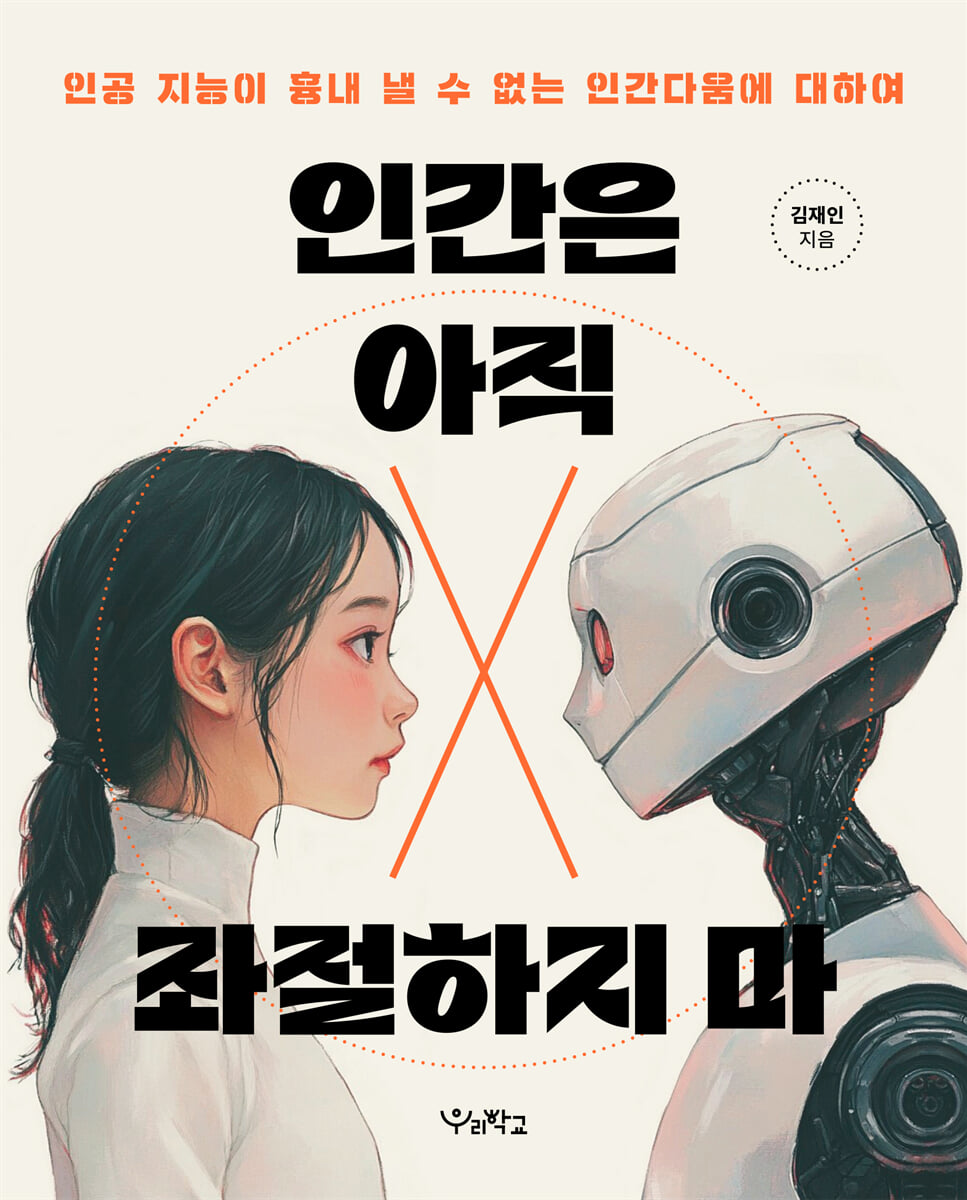
Humans, don't be discouraged yet
 |
Description
Book Introduction
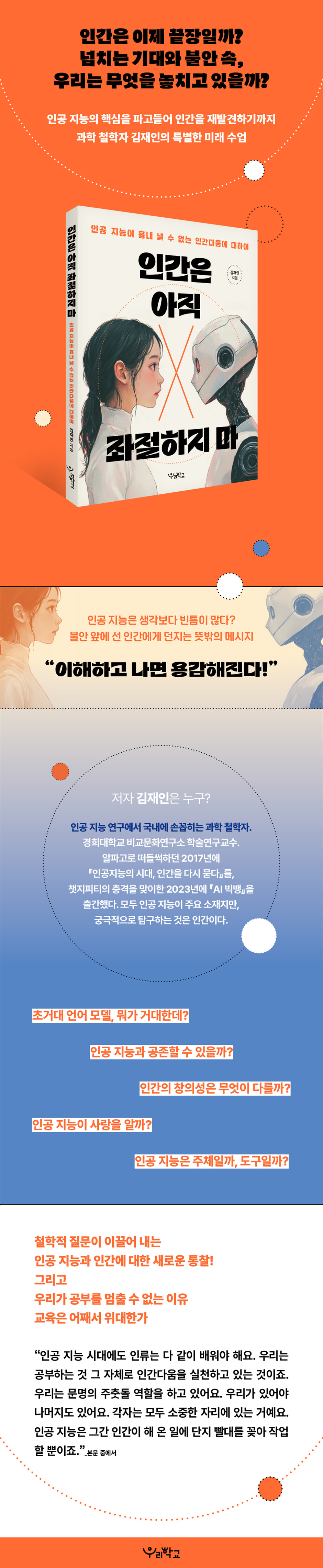
Is humanity finished now?
Amidst overflowing expectations and anxieties, what are we missing?
Digging into the core of artificial intelligence to rediscover humanity.
A Special Future Class by Science Philosopher Kim Jae-in
In the face of artificial intelligence, will humans inevitably become smaller? Philosopher of science Kim Jae-in argues the opposite.
Kim Jae-in, who has established himself as a leading scholar in the study of artificial intelligence, expanding his research to the philosophy of science based on modern philosophy such as Nietzsche and Deleuze, says that the more he compares artificial intelligence with humans, the more his pride as a human grows.
"Humans Don't Frustrate Yet" is a book that contains sharp insights and research on the subject, written in an easy-to-read format that even teenagers can read.
This book covers the fundamentals of the rapidly emerging field of generative artificial intelligence.
It explains the principles of the super-large language model that forms the basis of generative artificial intelligence, and points out the characteristics and limitations of artificial intelligence that has only studied text.
This is followed by a series of compelling analyses, such as how robots differ from the human body, why artificial intelligence lacks discernment, and why artificial intelligence cannot make ethical judgments or artistic evaluations.
It starts with a basic explanation and goes straight to philosophical thinking.
Interestingly, the more we delve into artificial intelligence, the more we discover new human capabilities we never knew existed.
The exhortation at the end of the quest is quite touching.
Author Kim Jae-in explains that humanity has always been collectively creative, and repeatedly emphasizes that we are still practicing humanity through 'education'.
In the age of artificial intelligence, this book is particularly meaningful to young people who want to understand the necessity of studying, as well as to educators and citizens who ponder the meaning of education.
Amidst overflowing expectations and anxieties, what are we missing?
Digging into the core of artificial intelligence to rediscover humanity.
A Special Future Class by Science Philosopher Kim Jae-in
In the face of artificial intelligence, will humans inevitably become smaller? Philosopher of science Kim Jae-in argues the opposite.
Kim Jae-in, who has established himself as a leading scholar in the study of artificial intelligence, expanding his research to the philosophy of science based on modern philosophy such as Nietzsche and Deleuze, says that the more he compares artificial intelligence with humans, the more his pride as a human grows.
"Humans Don't Frustrate Yet" is a book that contains sharp insights and research on the subject, written in an easy-to-read format that even teenagers can read.
This book covers the fundamentals of the rapidly emerging field of generative artificial intelligence.
It explains the principles of the super-large language model that forms the basis of generative artificial intelligence, and points out the characteristics and limitations of artificial intelligence that has only studied text.
This is followed by a series of compelling analyses, such as how robots differ from the human body, why artificial intelligence lacks discernment, and why artificial intelligence cannot make ethical judgments or artistic evaluations.
It starts with a basic explanation and goes straight to philosophical thinking.
Interestingly, the more we delve into artificial intelligence, the more we discover new human capabilities we never knew existed.
The exhortation at the end of the quest is quite touching.
Author Kim Jae-in explains that humanity has always been collectively creative, and repeatedly emphasizes that we are still practicing humanity through 'education'.
In the age of artificial intelligence, this book is particularly meaningful to young people who want to understand the necessity of studying, as well as to educators and citizens who ponder the meaning of education.
- You can preview some of the book's contents.
Preview
index
Entering
Part 1.
Are there any loopholes in generative AI?
1.
Super-large language models, what's so huge about them?
2.
Are AI-generated texts perfect?
3.
Language is only a part of the world
Part 2.
Looking at humans in artificial intelligence
4.
Why are you doing that without any sense!
5.
Could robots become the body of artificial intelligence?
6.
Knowledge but no consciousness?
7.
Why you can't finish a painting even after drawing 1,000 pages
8.
If we leave the judgment to artificial intelligence
Part 3.
What will humans study now?
9.
You want me to keep studying by memorizing?
10.
Mathematics and the Convergent Human
11.
AI is just a MacGyver knife
Part 1.
Are there any loopholes in generative AI?
1.
Super-large language models, what's so huge about them?
2.
Are AI-generated texts perfect?
3.
Language is only a part of the world
Part 2.
Looking at humans in artificial intelligence
4.
Why are you doing that without any sense!
5.
Could robots become the body of artificial intelligence?
6.
Knowledge but no consciousness?
7.
Why you can't finish a painting even after drawing 1,000 pages
8.
If we leave the judgment to artificial intelligence
Part 3.
What will humans study now?
9.
You want me to keep studying by memorizing?
10.
Mathematics and the Convergent Human
11.
AI is just a MacGyver knife
Detailed image
Into the book
Zeus, the god of Greco-Roman mythology, and Hercules, the hero, do not actually exist in this world.
Pinocchio, whose nose grows longer when he lies, and the lovely Anne of Green Gables, both live only in literature and do not live in this real world.
But humans imagine and create it.
And verbalize it.
Then, a super-large language model would not distinguish between fact and fantasy, would not distinguish between encyclopedias and rumors, and would simply treat everything as equal data and learn from it.
--- p.44
Our relationship with artificial intelligence is almost one-sided.
If AI gets angry at me, we won't use it anymore.
So, artificial intelligence will continue to empathize with me and only try to seduce me.
That's not the right way to build a relationship.
--- p.64
Anyone who has ever coded knows that finding bugs is incredibly difficult.
If you make even one mistake, your computer won't work.
To find that one mistake, programmers struggle all night.
Even errors in artificial intelligence need to be found by humans.
Things will never improve without people helping them.
I can't move forward.
Artificial intelligence doesn't solve problems on its own like humans do, and it doesn't go through the process of thinking about it for days and then recovering from it.
It doesn't grow.
--- p.79
The moment a painter enters the history of art is not simply the moment he or she becomes good at painting, or the moment he or she becomes good at what already exists.
It was a moment of trying something new, something that had never been done before, something that no one had ever done before.
The moment a new standard is created, we marvel at it and evaluate that the artist has made a mark on art history, has opened up new horizons.
Finding out exactly that is the key to evaluation.
But artificial intelligence cannot show us these new standards, new horizons, and new perspectives.
It simply finds the most frequent ones that already exist, and those that meet the criteria set by humans.
--- p.92
Throughout human history, there have always been people who played the role of first movers.
In many fields, including politics, ideology, art, science, and technology, history was made by first movers who achieved something and the rest of the people embraced it.
The first judgment, the new judgment, is always the responsibility of humans.
--- p.107
I think of a MacGyver knife.
The MacGyver knife is a multipurpose tool.
It has a knife, saw, awl, screwdriver, and scissors.
It has many functions.
But who uses that sword? People use it.
Even if it can solve many problems, it is not the sword but people who solve them.
ChatGPTI still does not operate on its own as a control tower, that is, as a subject, with any goals and to solve problems.
--- p.139
One of the roles of people on Earth today is to preserve what geniuses have acquired and pass it on to the next generation.
When that kind of reproduction disappears, the geniuses responsible for production will ultimately be nothing.
So while we love, respect, and admire geniuses, we must not forget that the role of ordinary people who notice, share, and pass on the discoveries of geniuses is just as important.
--- p.142
Even in the age of artificial intelligence, humanity must all learn together.
Of course, the subjects taught in school are not all of the knowledge accumulated by mankind.
But it contains a significant portion of the core knowledge that has made humans human.
We are practicing humanity through studying itself.
We are the cornerstone of civilization.
If we are there, the rest will be there too.
Each and every one of us has a precious place.
Pinocchio, whose nose grows longer when he lies, and the lovely Anne of Green Gables, both live only in literature and do not live in this real world.
But humans imagine and create it.
And verbalize it.
Then, a super-large language model would not distinguish between fact and fantasy, would not distinguish between encyclopedias and rumors, and would simply treat everything as equal data and learn from it.
--- p.44
Our relationship with artificial intelligence is almost one-sided.
If AI gets angry at me, we won't use it anymore.
So, artificial intelligence will continue to empathize with me and only try to seduce me.
That's not the right way to build a relationship.
--- p.64
Anyone who has ever coded knows that finding bugs is incredibly difficult.
If you make even one mistake, your computer won't work.
To find that one mistake, programmers struggle all night.
Even errors in artificial intelligence need to be found by humans.
Things will never improve without people helping them.
I can't move forward.
Artificial intelligence doesn't solve problems on its own like humans do, and it doesn't go through the process of thinking about it for days and then recovering from it.
It doesn't grow.
--- p.79
The moment a painter enters the history of art is not simply the moment he or she becomes good at painting, or the moment he or she becomes good at what already exists.
It was a moment of trying something new, something that had never been done before, something that no one had ever done before.
The moment a new standard is created, we marvel at it and evaluate that the artist has made a mark on art history, has opened up new horizons.
Finding out exactly that is the key to evaluation.
But artificial intelligence cannot show us these new standards, new horizons, and new perspectives.
It simply finds the most frequent ones that already exist, and those that meet the criteria set by humans.
--- p.92
Throughout human history, there have always been people who played the role of first movers.
In many fields, including politics, ideology, art, science, and technology, history was made by first movers who achieved something and the rest of the people embraced it.
The first judgment, the new judgment, is always the responsibility of humans.
--- p.107
I think of a MacGyver knife.
The MacGyver knife is a multipurpose tool.
It has a knife, saw, awl, screwdriver, and scissors.
It has many functions.
But who uses that sword? People use it.
Even if it can solve many problems, it is not the sword but people who solve them.
ChatGPTI still does not operate on its own as a control tower, that is, as a subject, with any goals and to solve problems.
--- p.139
One of the roles of people on Earth today is to preserve what geniuses have acquired and pass it on to the next generation.
When that kind of reproduction disappears, the geniuses responsible for production will ultimately be nothing.
So while we love, respect, and admire geniuses, we must not forget that the role of ordinary people who notice, share, and pass on the discoveries of geniuses is just as important.
--- p.142
Even in the age of artificial intelligence, humanity must all learn together.
Of course, the subjects taught in school are not all of the knowledge accumulated by mankind.
But it contains a significant portion of the core knowledge that has made humans human.
We are practicing humanity through studying itself.
We are the cornerstone of civilization.
If we are there, the rest will be there too.
Each and every one of us has a precious place.
--- p.144
Publisher's Review
Are there so many loopholes in artificial intelligence?
Before artificial intelligence takes over everything,
A story that must be deeply engraved in our hearts as 'humans'
“Understanding makes you brave!”
Many people are becoming frustrated with the advancement of artificial intelligence, which is like a 'Big Bang'.
Even teenagers are starting to question why they should continue studying.
This is because the learning capabilities of artificial intelligence are so overwhelming.
To these people, Kim Jae-in, a rare Korean philosopher of science who has been conducting research on artificial intelligence for over a decade based on modern philosophy, delivers an unexpected message.
The so-called superior generative artificial intelligence has numerous flaws, and the unique humanity of humans is something that artificial intelligence can never match.
The reasons are very diverse and specific.
In "Humans, Don't Be Frustrated Yet," author Kim Jae-in first analyzes the limitations of the massive language models that are the basis of widely known generative artificial intelligence, such as ChatGPiT and Midjourney.
Even the largest language models can't tell the difference between fact and fiction, or between great literature and blog posts.
Also, although they have learned numerous human languages, paradoxically, because they have only learned human languages, they cannot understand the world that is not contained in language.
Is the love expressed in human language the entirety of human experience? Generative AI will never understand the gap between the two.
The list of 'gaps' in artificial intelligence goes on and on.
Artificial intelligence can generate countless images, but it has no ability to evaluate the best of them.
When it comes to 'evaluation', the key is to have the eye to discover something new and something that didn't exist before, but all artificial intelligence can do is find things that meet existing standards.
Can an artist who only paints the same paintings as existing ones truly be called a true artist? Furthermore, no matter how many functions AI possesses, it cannot be its own agent.
So the author compares artificial intelligence to a MacGyver knife.
It can do a lot of things, but it's still just a tool.
Humanity: Artificial Intelligence Will Never Know
The 'courage' to treat AI as a tool
To achieve this, we must not neglect the 'study'
So even in the age of artificial intelligence, there is still a lot of work for humans to do.
You could say that it has increased because of artificial intelligence.
Because in order to find and correct the gaps and errors in artificial intelligence, we need to know it in greater depth.
Author Kim Jae-in emphasizes the importance of studying to young people.
In particular, in preparation for the coming era of convergence, we emphasize the three key areas: mathematics, writing, and memorization.
This is because mathematics is essential for acquiring the "extended literacy" needed in the age of artificial intelligence, extensive knowledge is essential for igniting the spark of creativity, and writing is essential for fostering the power of independent thought.
And it emphasizes the importance of learning.
What is important in human creativity is not the discovery of a single genius, per se.
More importantly, there are countless people who continue to learn and pass on the discovery to future generations so that it is not forgotten.
One discovery spread widely, and then someone else surpassed it, and that's how far humanity has come.
That is why humans constantly study, and why we cannot stop studying even in the age of artificial intelligence.
Before artificial intelligence takes over everything,
A story that must be deeply engraved in our hearts as 'humans'
“Understanding makes you brave!”
Many people are becoming frustrated with the advancement of artificial intelligence, which is like a 'Big Bang'.
Even teenagers are starting to question why they should continue studying.
This is because the learning capabilities of artificial intelligence are so overwhelming.
To these people, Kim Jae-in, a rare Korean philosopher of science who has been conducting research on artificial intelligence for over a decade based on modern philosophy, delivers an unexpected message.
The so-called superior generative artificial intelligence has numerous flaws, and the unique humanity of humans is something that artificial intelligence can never match.
The reasons are very diverse and specific.
In "Humans, Don't Be Frustrated Yet," author Kim Jae-in first analyzes the limitations of the massive language models that are the basis of widely known generative artificial intelligence, such as ChatGPiT and Midjourney.
Even the largest language models can't tell the difference between fact and fiction, or between great literature and blog posts.
Also, although they have learned numerous human languages, paradoxically, because they have only learned human languages, they cannot understand the world that is not contained in language.
Is the love expressed in human language the entirety of human experience? Generative AI will never understand the gap between the two.
The list of 'gaps' in artificial intelligence goes on and on.
Artificial intelligence can generate countless images, but it has no ability to evaluate the best of them.
When it comes to 'evaluation', the key is to have the eye to discover something new and something that didn't exist before, but all artificial intelligence can do is find things that meet existing standards.
Can an artist who only paints the same paintings as existing ones truly be called a true artist? Furthermore, no matter how many functions AI possesses, it cannot be its own agent.
So the author compares artificial intelligence to a MacGyver knife.
It can do a lot of things, but it's still just a tool.
Humanity: Artificial Intelligence Will Never Know
The 'courage' to treat AI as a tool
To achieve this, we must not neglect the 'study'
So even in the age of artificial intelligence, there is still a lot of work for humans to do.
You could say that it has increased because of artificial intelligence.
Because in order to find and correct the gaps and errors in artificial intelligence, we need to know it in greater depth.
Author Kim Jae-in emphasizes the importance of studying to young people.
In particular, in preparation for the coming era of convergence, we emphasize the three key areas: mathematics, writing, and memorization.
This is because mathematics is essential for acquiring the "extended literacy" needed in the age of artificial intelligence, extensive knowledge is essential for igniting the spark of creativity, and writing is essential for fostering the power of independent thought.
And it emphasizes the importance of learning.
What is important in human creativity is not the discovery of a single genius, per se.
More importantly, there are countless people who continue to learn and pass on the discovery to future generations so that it is not forgotten.
One discovery spread widely, and then someone else surpassed it, and that's how far humanity has come.
That is why humans constantly study, and why we cannot stop studying even in the age of artificial intelligence.
GOODS SPECIFICS
- Date of issue: October 18, 2024
- Page count, weight, size: 144 pages | 226g | 152*188*9mm
- ISBN13: 9791167552969
You may also like
카테고리
korean


korean

![GQ KOREA Mark (Monthly): December [2025]](http://librairie.coreenne.fr/cdn/shop/files/8ef265dbbfbf186523ed75ba7319009d.jpg?v=1765340328&width=3840)


