

One day I died
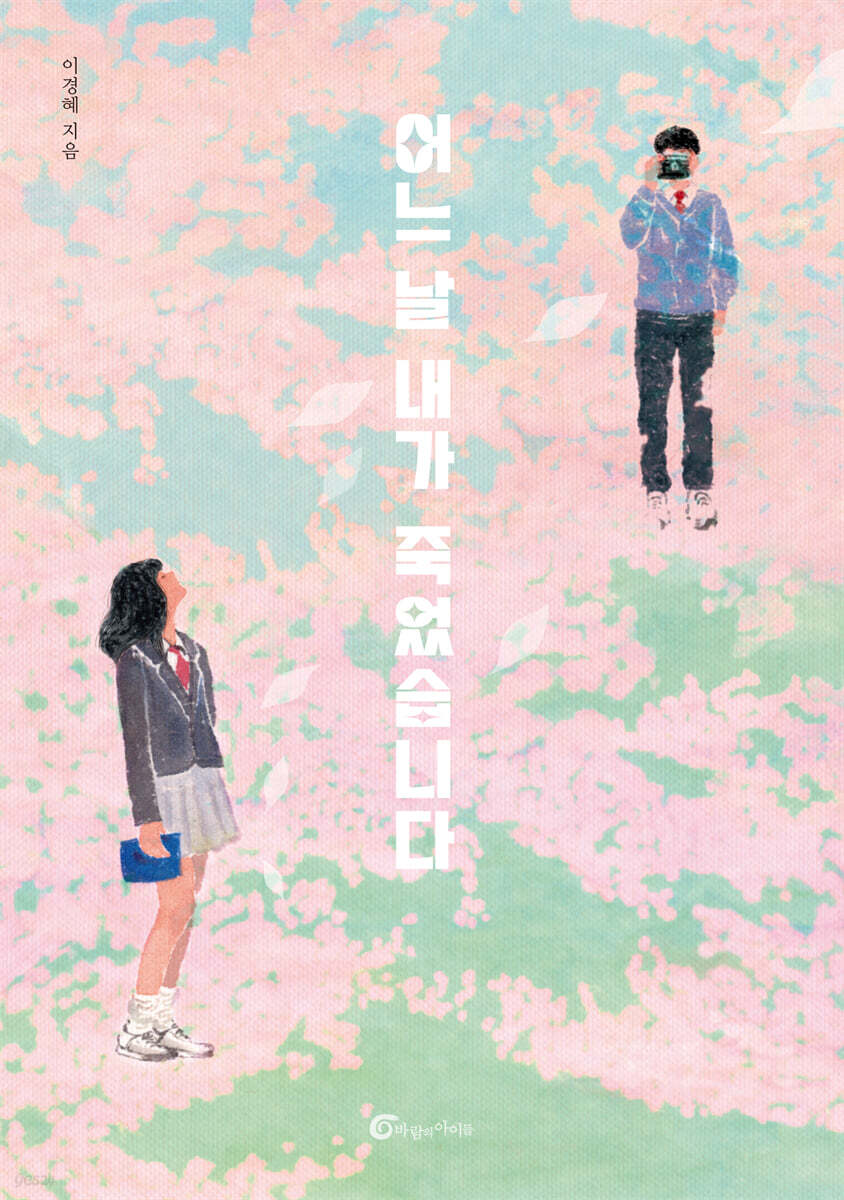 |
Description
Book Introduction
Youth, Their Own Stories - The Work That Heralded the Beginning of Young Adult Novels
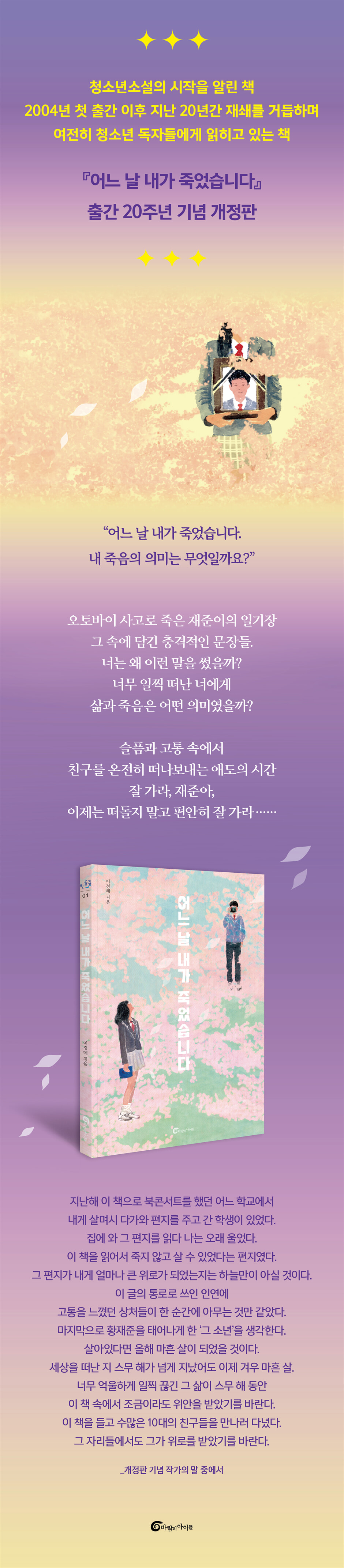
『One Day I Died』 20th Anniversary Revised Edition Released!
"One Day I Died" is the first youth novel written by author Lee Kyung-hye, who was writing children's stories at the time, in 2004.
At the time, the genre name ‘Young Adult Novel’ was unfamiliar, so it was initially introduced under the name ‘Middle School Novel.’
In the past, teenagers were not treated as separate readers, so teenagers who graduated from elementary school were left bewildered and had no choice but to read adult books.
Now, 20 years later, most bookstores have a dedicated section for young adult books, and there are adult readers who enjoy reading young adult novels.
A representative work that played a central role in establishing young adult fiction as a proper genre today, and a book that continues to be reprinted and read by young readers.
A revised edition of "One Day I Died" is being published to commemorate its 20th anniversary.
The protagonist and narrator of this work is middle school student Jin Yu-mi. Yu-mi is a 'flirty' schoolgirl who wears her uniform skirt short, has pierced ears, and wears makeup.
He is also a confident teenager who fully understands and does not care about how his family circumstances, including his parents' divorce, his mother's remarriage, and his younger brother with a different last name, may appear to others.
To Yumi, who also smokes, her other friends of the same age only appear to be 'extreme cowards and pathetic model students.'
When Yumi hears a harsh comment at her new school, saying, "When you grow up, you'll end up a bar girl," because she has pierced ears, she responds to her homeroom teacher, "You have pierced ears too, don't you? Do you go to bars too?"
Another main character, Jaejun, is Yumi's only best friend and a 'male friend' who shows interest and affection for her.
The story begins with Jaejun dying in a motorcycle accident and Yumi receiving Jaejun's diary from his mother.
The blue diary that Yumi gave Jaejun as a gift on Christmas, when they consoled each other for their failed unrequited love.
However, Yumi is so shocked by the sentence written on the first page of Jaejun's diary that she can no longer easily turn the pages.
“One day I died.
"What is the meaning of my death?" Did Jaejun perhaps foresee his own death? Perhaps there was some intention or plan behind Jaejun's death? Did Jaejun have difficulties and pains I didn't know about? Yumi, who painfully but with difficulty reads Jaejun's diary, finally reaches a deep insight into Jaejun's life that she had never known about.
『One Day I Died』 20th Anniversary Revised Edition Released!
"One Day I Died" is the first youth novel written by author Lee Kyung-hye, who was writing children's stories at the time, in 2004.
At the time, the genre name ‘Young Adult Novel’ was unfamiliar, so it was initially introduced under the name ‘Middle School Novel.’
In the past, teenagers were not treated as separate readers, so teenagers who graduated from elementary school were left bewildered and had no choice but to read adult books.
Now, 20 years later, most bookstores have a dedicated section for young adult books, and there are adult readers who enjoy reading young adult novels.
A representative work that played a central role in establishing young adult fiction as a proper genre today, and a book that continues to be reprinted and read by young readers.
A revised edition of "One Day I Died" is being published to commemorate its 20th anniversary.
The protagonist and narrator of this work is middle school student Jin Yu-mi. Yu-mi is a 'flirty' schoolgirl who wears her uniform skirt short, has pierced ears, and wears makeup.
He is also a confident teenager who fully understands and does not care about how his family circumstances, including his parents' divorce, his mother's remarriage, and his younger brother with a different last name, may appear to others.
To Yumi, who also smokes, her other friends of the same age only appear to be 'extreme cowards and pathetic model students.'
When Yumi hears a harsh comment at her new school, saying, "When you grow up, you'll end up a bar girl," because she has pierced ears, she responds to her homeroom teacher, "You have pierced ears too, don't you? Do you go to bars too?"
Another main character, Jaejun, is Yumi's only best friend and a 'male friend' who shows interest and affection for her.
The story begins with Jaejun dying in a motorcycle accident and Yumi receiving Jaejun's diary from his mother.
The blue diary that Yumi gave Jaejun as a gift on Christmas, when they consoled each other for their failed unrequited love.
However, Yumi is so shocked by the sentence written on the first page of Jaejun's diary that she can no longer easily turn the pages.
“One day I died.
"What is the meaning of my death?" Did Jaejun perhaps foresee his own death? Perhaps there was some intention or plan behind Jaejun's death? Did Jaejun have difficulties and pains I didn't know about? Yumi, who painfully but with difficulty reads Jaejun's diary, finally reaches a deep insight into Jaejun's life that she had never known about.
- You can preview some of the book's contents.
Preview
index
Prologue 9
Blue Cover Diary 18
That Spring Day When Cherry Blossoms Bloomed 36
Finally turning the cover 71
I wasn't supposed to be your friend 102
Date with the Teacher 115
You're still by my side 134
Farewell 155
Author's Note 182
Celebrating the 50th printing 187
Revised Edition Author's Note 191
Blue Cover Diary 18
That Spring Day When Cherry Blossoms Bloomed 36
Finally turning the cover 71
I wasn't supposed to be your friend 102
Date with the Teacher 115
You're still by my side 134
Farewell 155
Author's Note 182
Celebrating the 50th printing 187
Revised Edition Author's Note 191
Detailed image
.jpg)
Into the book
At that time, Jaejun flew up through the empty street.
Like a free bird, at incredible speed.
And it fell and broke.
Like a broken brick, in an unbelievable way.
The night deepens, but death does not come… …
Jaejun died on the spot.
--- p.17
Even when I become an adult and old, you will still remain that immature boy in that place. Even when I become a girl, a woman, an aunt, and a grandmother, you will still remain that innocent boy. You fool, you bad guy, why did you ride a motorcycle that you can't ride? Why didn't you tell me that I wouldn't let you ride? You bad guy, you should have listened to your friend, you bad guy...
--- p.34
If there is a god, I want to twist his neck… …
I muttered and spat out the anger that was welling up in my chest.
Why did God create death for humans? If he had to, why did he create such an unjust death instead of taking them away one by one in the order they were born?
--- p.69
I don't think that if it's not a bad thing for an adult to do, it's not a bad thing for a child to do.
If it's bad for a child to do something, it's still bad for an adult to do something.
So, I think that rules like “don’t pierce your ears” should be abolished.
But when they are young, they don't have the ability to take responsibility for their actions, so I think the school needs to protect them in some way.
It may seem a bit overprotective, but I think dyeing your hair or piercing your ears is a sign of being a bad student.
That's why I'm blocking it.
--- p.75
I felt like I was dead and alive again.
Then, suddenly, I thought it would be fun to live in this world as if I were playing dead.
So I look at everything as if I were already dead.
How precious and different would everything seem if I did that? So, from now on, I'm going to pretend to be dead and live.
--- p.92
My mother is also a prison to me.
It seems like I'm free to do everything, but that means I have to make my own decisions.
That means I have to take responsibility for everything.
Instead of having to rebel, I have to take responsibility.
That's another prison.
In the end, all parents may be like prisons to their children.
Like a free bird, at incredible speed.
And it fell and broke.
Like a broken brick, in an unbelievable way.
The night deepens, but death does not come… …
Jaejun died on the spot.
--- p.17
Even when I become an adult and old, you will still remain that immature boy in that place. Even when I become a girl, a woman, an aunt, and a grandmother, you will still remain that innocent boy. You fool, you bad guy, why did you ride a motorcycle that you can't ride? Why didn't you tell me that I wouldn't let you ride? You bad guy, you should have listened to your friend, you bad guy...
--- p.34
If there is a god, I want to twist his neck… …
I muttered and spat out the anger that was welling up in my chest.
Why did God create death for humans? If he had to, why did he create such an unjust death instead of taking them away one by one in the order they were born?
--- p.69
I don't think that if it's not a bad thing for an adult to do, it's not a bad thing for a child to do.
If it's bad for a child to do something, it's still bad for an adult to do something.
So, I think that rules like “don’t pierce your ears” should be abolished.
But when they are young, they don't have the ability to take responsibility for their actions, so I think the school needs to protect them in some way.
It may seem a bit overprotective, but I think dyeing your hair or piercing your ears is a sign of being a bad student.
That's why I'm blocking it.
--- p.75
I felt like I was dead and alive again.
Then, suddenly, I thought it would be fun to live in this world as if I were playing dead.
So I look at everything as if I were already dead.
How precious and different would everything seem if I did that? So, from now on, I'm going to pretend to be dead and live.
--- p.92
My mother is also a prison to me.
It seems like I'm free to do everything, but that means I have to make my own decisions.
That means I have to take responsibility for everything.
Instead of having to rebel, I have to take responsibility.
That's another prison.
In the end, all parents may be like prisons to their children.
--- p.146
Publisher's Review
"May the sad story of death become the foundation for a brighter life, the strength to enjoy more precious moments of life."
The story, which begins with a perplexing question, traces the life and death of the enigmatic Jaejun, while also covering Yumi's process of mourning the loss of her beloved friend.
As it turned out, the phrase 'One day I died' was Jaejun's way of looking at his daily life in a new way.
Taking a cue from 'corpse play', I thought about what each day that I could not live would mean to the dead, and wrote down my reflections from that day in a diary.
The diary contains everyday stories such as the love and responsibility he feels for his family, his strong friendship with Yumi, and his excitement for his unrequited love, Sohee. Through the diary, Yumi confirms that Jaejun lived each day more faithfully and passionately than anyone else.
If the accident hadn't happened, it would have been better if Jaejun had stayed by Yumi's side, but Yumi, who was left alone, finds great comfort in the fact that Jaejun had done his best in life while he was alive.
And only then can he accept Jaejun's death and look straight at his own problems.
The early 2000s were a time when teenage motorcyclists were emerging as a serious social problem.
In fact, the author is said to have conceived this work in 2001 after hearing of the death of a boy and feeling heartbroken to commemorate the boy whose name and face he did not know.
Although the story begins with the death of a boy, it contains, as the author says, 'the story of young souls who disappeared one day.'
At a time when motorcycle accidents were considered the misdeeds of some delinquent students and young men, the author sought to interpret the special meaning and emotions contained in them.
The author asserts that "if it's not a bad thing for an adult to do, it's not a bad thing for a child to do, and if it's a bad thing for a child to do, it's a bad thing for an adult to do."
It was considered groundbreaking at the time to feature a female middle school student who wears makeup and smokes and a male middle school student who dies in a motorcycle accident as the main characters.
This was possible because society and the older generation believed that children, too, had a voice, a way to speak, and a story to tell, while judging, criticizing, and guiding the younger generation by their own standards.
When we consider that young adult novels began to capture the voices of those involved in the 'here and now,' it becomes clearer that 'One Day I Died' contributed to the establishment of the young adult novel genre.
As it was written 20 years ago, it accurately portrays the oppressive reality of the school environment at the time, including regulations on hair and dress, and teachers' abusive language in the name of discipline, as well as various social prejudices. It also faithfully depicts the concerns and desires of teenagers at the time.
Like all classics, it also serves as a socio-cultural folklore, but the emotions, thoughts, and actions of each character contain universal human stories that continue to this day.
How many of the problems Yumi and Jaejun faced 20 years ago have been resolved now?
20 years is a long time, enough for a person to be born and reach adulthood.
The young readers who read the first edition of this book will now be parents and entering the adult generation.
We finally have a young adult novel that can be shared across generations.
For this revised edition, the author expressed his hope that “the sad story of death can become the foundation for a bright life, and can give us the strength to enjoy more precious moments in life.”
What message is more important to young readers than to live life to the fullest and to cherish it?
This is probably why “One Day I Died” has been read consistently for 20 years.
The story, which begins with a perplexing question, traces the life and death of the enigmatic Jaejun, while also covering Yumi's process of mourning the loss of her beloved friend.
As it turned out, the phrase 'One day I died' was Jaejun's way of looking at his daily life in a new way.
Taking a cue from 'corpse play', I thought about what each day that I could not live would mean to the dead, and wrote down my reflections from that day in a diary.
The diary contains everyday stories such as the love and responsibility he feels for his family, his strong friendship with Yumi, and his excitement for his unrequited love, Sohee. Through the diary, Yumi confirms that Jaejun lived each day more faithfully and passionately than anyone else.
If the accident hadn't happened, it would have been better if Jaejun had stayed by Yumi's side, but Yumi, who was left alone, finds great comfort in the fact that Jaejun had done his best in life while he was alive.
And only then can he accept Jaejun's death and look straight at his own problems.
The early 2000s were a time when teenage motorcyclists were emerging as a serious social problem.
In fact, the author is said to have conceived this work in 2001 after hearing of the death of a boy and feeling heartbroken to commemorate the boy whose name and face he did not know.
Although the story begins with the death of a boy, it contains, as the author says, 'the story of young souls who disappeared one day.'
At a time when motorcycle accidents were considered the misdeeds of some delinquent students and young men, the author sought to interpret the special meaning and emotions contained in them.
The author asserts that "if it's not a bad thing for an adult to do, it's not a bad thing for a child to do, and if it's a bad thing for a child to do, it's a bad thing for an adult to do."
It was considered groundbreaking at the time to feature a female middle school student who wears makeup and smokes and a male middle school student who dies in a motorcycle accident as the main characters.
This was possible because society and the older generation believed that children, too, had a voice, a way to speak, and a story to tell, while judging, criticizing, and guiding the younger generation by their own standards.
When we consider that young adult novels began to capture the voices of those involved in the 'here and now,' it becomes clearer that 'One Day I Died' contributed to the establishment of the young adult novel genre.
As it was written 20 years ago, it accurately portrays the oppressive reality of the school environment at the time, including regulations on hair and dress, and teachers' abusive language in the name of discipline, as well as various social prejudices. It also faithfully depicts the concerns and desires of teenagers at the time.
Like all classics, it also serves as a socio-cultural folklore, but the emotions, thoughts, and actions of each character contain universal human stories that continue to this day.
How many of the problems Yumi and Jaejun faced 20 years ago have been resolved now?
20 years is a long time, enough for a person to be born and reach adulthood.
The young readers who read the first edition of this book will now be parents and entering the adult generation.
We finally have a young adult novel that can be shared across generations.
For this revised edition, the author expressed his hope that “the sad story of death can become the foundation for a bright life, and can give us the strength to enjoy more precious moments in life.”
What message is more important to young readers than to live life to the fullest and to cherish it?
This is probably why “One Day I Died” has been read consistently for 20 years.
GOODS SPECIFICS
- Date of issue: October 10, 2024
- Page count, weight, size: 196 pages | 278g | 148*210*9mm
- ISBN13: 9791162102350
You may also like
카테고리
korean


korean

![GQ KOREA Mark (Monthly): December [2025]](http://librairie.coreenne.fr/cdn/shop/files/8ef265dbbfbf186523ed75ba7319009d.jpg?v=1765340328&width=3840)


