

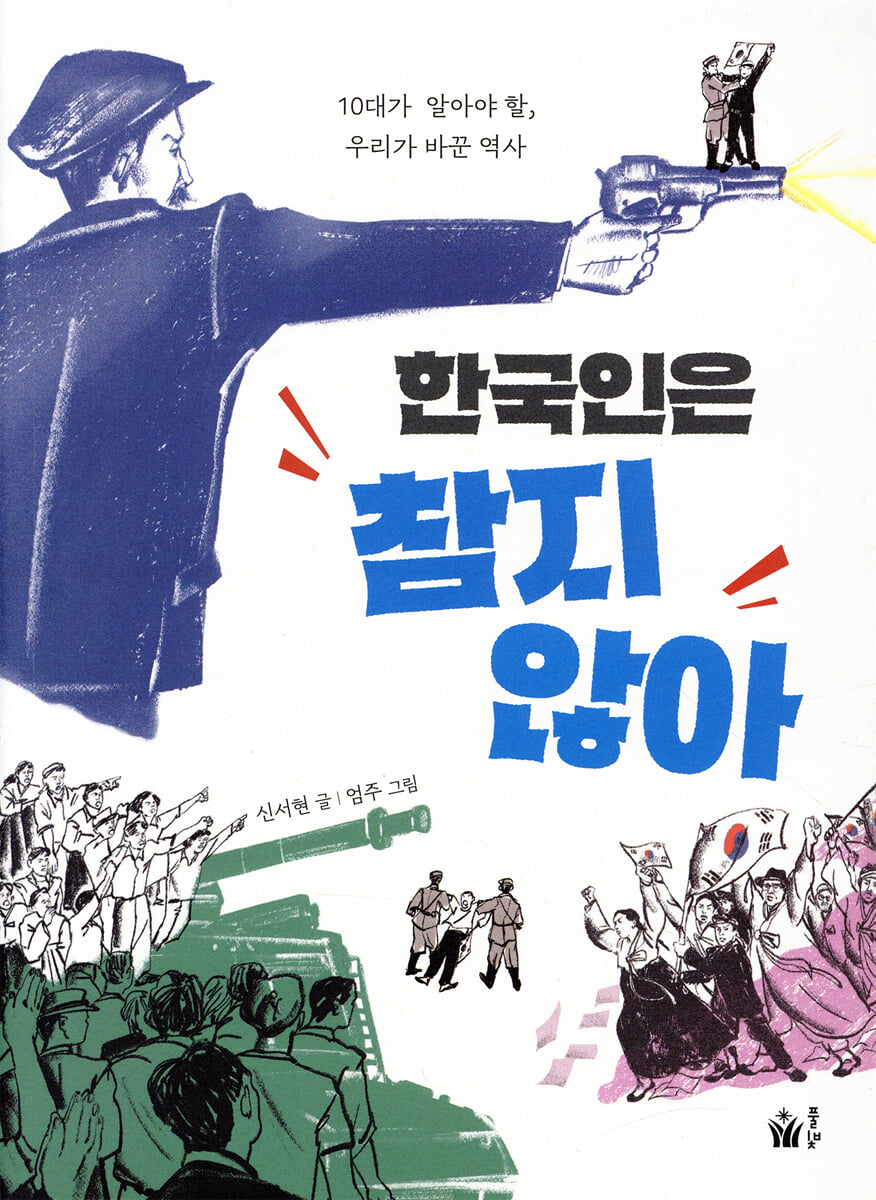
Koreans don't tolerate it
 |
Description
Book Introduction
Donghak Peasant Revolution, March 1st Movement, April 19th Revolution, May 18th Democratization Movement… History created by 'unbearable' Koreans! The Korean spirit of resistance changes history! Donghak Peasant Revolution, anti-Japanese resistance, March 1st Movement, April 19th Revolution, May 18th Democratization Movement, June Democracy Movement, Candlelight Vigils… … . If we look at the major events in our country's history, there are commonalities. This is an incident where everyone came together to resist something that was not right. The March 1st Movement was an event in which the entire nation came together to shout “Long live independence” while saying, “We will no longer tolerate Japan’s inhumane colonial rule!” The June Democracy Movement was also an event that brought about democratization with the participation of citizens across the country, chanting, “We will no longer tolerate military dictatorship!” And the candlelight vigils of 2016-2017 brought together the largest number of people in our country’s history with the spirit of, “We will no longer tolerate the regression of democracy!” and led to the impeachment of the president. In other words, it can be said that Koreans have a keen sense of justice. What's more interesting is that this keen sense isn't just for myself. People in our country cannot tolerate their own injustice, but they cannot tolerate others' injustice either. So, the social belief that we should know how to resist what is wrong and that everyone will join us in this resistance has been ingrained in our hearts for a long time. It is as if the Hongik Ingan spirit that runs through the genes of Koreans is expressed when a crisis strikes the community. In the winter of 2016, the renowned American foreign policy magazine Foreign Policy observed the peaceful weekly candlelight vigils and remarked, “Koreans have mastered the art of resistance.” This book, "Koreans Don't Endure," examines the process through which "unendurable" Koreans mastered the art of resistance through the Imjin Righteous Army, Donghak Peasant Revolution, Anti-Japanese Righteous Army, March 1st Movement, Gwangju Student Independence Movement, April 19 Revolution, May 18 Democratization Movement, June Democracy Movement, and Candlelight Protests. How have we, the Korean people, who have never been patient, fought back when crises struck? |
- You can preview some of the book's contents.
Preview
index
The Joseon people will not tolerate it_ Imjin Righteous Army 12
Peasants Won't Stand It_Donghak Peasant Movement 26
I will not tolerate Japanese invasion_ Anti-Japanese volunteer army 42
No more colonial rule_ March 1st Movement 60
Students Won't Stand It_ Gwangju Student Independence Movement 76
We will not tolerate election fraud_ April 19 Revolution 86
Gwangju citizens will not tolerate it_ May 18 Democratization Movement 98
No More Military Dictatorship_ June Democracy Movement 112
We Can't Tolerate Democracy's Retreat_ Candlelight Vigil 124
Peasants Won't Stand It_Donghak Peasant Movement 26
I will not tolerate Japanese invasion_ Anti-Japanese volunteer army 42
No more colonial rule_ March 1st Movement 60
Students Won't Stand It_ Gwangju Student Independence Movement 76
We will not tolerate election fraud_ April 19 Revolution 86
Gwangju citizens will not tolerate it_ May 18 Democratization Movement 98
No More Military Dictatorship_ June Democracy Movement 112
We Can't Tolerate Democracy's Retreat_ Candlelight Vigil 124
Detailed image

Into the book
At the end of the Joseon Dynasty, there came a time when farmers appeared as proud protagonists of history.
The peasants who had only shed tears under the harsh taxes and tyranny gradually grew and emerged as a powerful force calling for social reform.
(Omitted) The peasants' struggle changed the political situation in East Asia and even eliminated the caste system that had lasted for thousands of years.
This huge event is the Donghak Peasant Revolution.
---p.27 From “The Peasants Won’t Endure_ The Donghak Peasant Movement”
The March 1st Movement was an event that discovered the power of ordinary people.
Although the 33 national representatives wrote the Declaration of Independence and presented the movement's major principles, the March 1st Movement was planned, executed, and spread entirely by ordinary people.
Through this, people learned that the independence movement was not just for special people.
---p.75 From "I Can't Stand Colonial Rule_ March 1st Movement"
Koreans knew very well what would happen if they resisted Japan through the Donghak Peasant Revolution and the Righteous Army War.
Nevertheless, participating in the March 1st Movement was because it placed the nation above any other values.
This experience created a tradition of our people acting together in pursuit of a common goal, a tradition that continued through subsequent independence movements, the April 19 Revolution, the June Democracy Movement, and the candlelight vigils of the 2000s.
---p.76 From "I Can't Stand Colonial Rule_ March 1st Movement"
The April 19 Revolution broke the corrupt regime.
And he rebuilt the broken democracy.
Through this, it was clearly shown that the sovereignty of the country lies with the people.
Until then, in our history, there had never been an instance where ordinary people participated in politics and overthrew a government.
---p.97 From "I Will Not Tolerate Election Fraud_ April 19 Revolution"
The April 19 Revolution can be summarized as the first victory of democracy in the Republic of Korea achieved by all citizens.
This first victory gave us confidence that whenever democracy is in crisis, the people can come together and win.
That's why it's written in the constitution.
Let's not forget the spirit of April 19th and carry it on.
“We, the people of the Republic of Korea, resplendent with a long history and tradition, inherit the legitimacy of the Provisional Government of the Republic of Korea established through the March 1st Movement and the democratic ideals of the April 19th Revolution that resisted injustice….”
The peasants who had only shed tears under the harsh taxes and tyranny gradually grew and emerged as a powerful force calling for social reform.
(Omitted) The peasants' struggle changed the political situation in East Asia and even eliminated the caste system that had lasted for thousands of years.
This huge event is the Donghak Peasant Revolution.
---p.27 From “The Peasants Won’t Endure_ The Donghak Peasant Movement”
The March 1st Movement was an event that discovered the power of ordinary people.
Although the 33 national representatives wrote the Declaration of Independence and presented the movement's major principles, the March 1st Movement was planned, executed, and spread entirely by ordinary people.
Through this, people learned that the independence movement was not just for special people.
---p.75 From "I Can't Stand Colonial Rule_ March 1st Movement"
Koreans knew very well what would happen if they resisted Japan through the Donghak Peasant Revolution and the Righteous Army War.
Nevertheless, participating in the March 1st Movement was because it placed the nation above any other values.
This experience created a tradition of our people acting together in pursuit of a common goal, a tradition that continued through subsequent independence movements, the April 19 Revolution, the June Democracy Movement, and the candlelight vigils of the 2000s.
---p.76 From "I Can't Stand Colonial Rule_ March 1st Movement"
The April 19 Revolution broke the corrupt regime.
And he rebuilt the broken democracy.
Through this, it was clearly shown that the sovereignty of the country lies with the people.
Until then, in our history, there had never been an instance where ordinary people participated in politics and overthrew a government.
---p.97 From "I Will Not Tolerate Election Fraud_ April 19 Revolution"
The April 19 Revolution can be summarized as the first victory of democracy in the Republic of Korea achieved by all citizens.
This first victory gave us confidence that whenever democracy is in crisis, the people can come together and win.
That's why it's written in the constitution.
Let's not forget the spirit of April 19th and carry it on.
“We, the people of the Republic of Korea, resplendent with a long history and tradition, inherit the legitimacy of the Provisional Government of the Republic of Korea established through the March 1st Movement and the democratic ideals of the April 19th Revolution that resisted injustice….”
---p.98 From “I Will Not Tolerate Election Fraud_ April 19 Revolution”
Publisher's Review
How did Korean resistance change history?
They say that the repetition of history creates one's attitude toward life.
Throughout our long history, we Koreans have faced many crises and established a life attitude of uniting and fighting together to protect our community.
And through this, we have been making the world a better place little by little.
The events that appear in this book are also the result of such an attitude toward life.
While there are thrilling moments of success, such as the April 19 Revolution, the June Democracy Movement, and the candlelight vigils, most of the scenes presented in this book are marred by failure, tears, and sighs.
But the failure at that time was not a permanent failure, which is why we exist now.
Resistance brought to light the problems that the corrupt had been hiding.
And made it so that it could never be covered again.
The unjust sacrifices of those who resisted also led those who were merely onlookers to join the resistance.
As if passing a baton, previous events influenced the next, and even though it was slow and tedious, the problem was eventually solved little by little.
Even if we take one step forward and then retreat two steps, history will eventually silently advance three or four steps forward again as a reaction.
Through resistance, people have gradually created a better world.
We protected the country from foreign powers, abolished the caste system, overthrew the absolute monarchy in which rulers wielded power at will, freed ourselves from colonial rule, achieved democratization, limited the workday to eight hours, and eliminated all forms of discrimination.
But there are still many problems around us that need to be solved.
It is now up to us, living in the present, to make the world a little better.
How can an ordinary person like me, neither Yi Sun-sin nor Kim Gu, change the world? You'll find out as you read this book.
That all the important changes in our history were brought about by ordinary, good people working together.
“The 16 million citizens who gathered in the square for five months came from different regions, ideologies, ages, and genders, but they all had one thing in common.
That is, we must protect democracy.
Therefore, if anything happens in the future that undermines democracy, citizens will come out into the square again, and we must be prepared for tremendous resistance.
As always, Koreans will not tolerate it.” (From ‘No More Military Dictatorship_ June Democracy Struggle’ on page 136)
They say that the repetition of history creates one's attitude toward life.
Throughout our long history, we Koreans have faced many crises and established a life attitude of uniting and fighting together to protect our community.
And through this, we have been making the world a better place little by little.
The events that appear in this book are also the result of such an attitude toward life.
While there are thrilling moments of success, such as the April 19 Revolution, the June Democracy Movement, and the candlelight vigils, most of the scenes presented in this book are marred by failure, tears, and sighs.
But the failure at that time was not a permanent failure, which is why we exist now.
Resistance brought to light the problems that the corrupt had been hiding.
And made it so that it could never be covered again.
The unjust sacrifices of those who resisted also led those who were merely onlookers to join the resistance.
As if passing a baton, previous events influenced the next, and even though it was slow and tedious, the problem was eventually solved little by little.
Even if we take one step forward and then retreat two steps, history will eventually silently advance three or four steps forward again as a reaction.
Through resistance, people have gradually created a better world.
We protected the country from foreign powers, abolished the caste system, overthrew the absolute monarchy in which rulers wielded power at will, freed ourselves from colonial rule, achieved democratization, limited the workday to eight hours, and eliminated all forms of discrimination.
But there are still many problems around us that need to be solved.
It is now up to us, living in the present, to make the world a little better.
How can an ordinary person like me, neither Yi Sun-sin nor Kim Gu, change the world? You'll find out as you read this book.
That all the important changes in our history were brought about by ordinary, good people working together.
“The 16 million citizens who gathered in the square for five months came from different regions, ideologies, ages, and genders, but they all had one thing in common.
That is, we must protect democracy.
Therefore, if anything happens in the future that undermines democracy, citizens will come out into the square again, and we must be prepared for tremendous resistance.
As always, Koreans will not tolerate it.” (From ‘No More Military Dictatorship_ June Democracy Struggle’ on page 136)
GOODS SPECIFICS
- Date of issue: September 20, 2024
- Page count, weight, size: 138 pages | 212g | 153*210*9mm
- ISBN13: 9791161729442
- ISBN10: 1161729445
You may also like
카테고리
korean


korean

![GQ KOREA Mark (Monthly): December [2025]](http://librairie.coreenne.fr/cdn/shop/files/8ef265dbbfbf186523ed75ba7319009d.jpg?v=1765340328&width=3840)


