

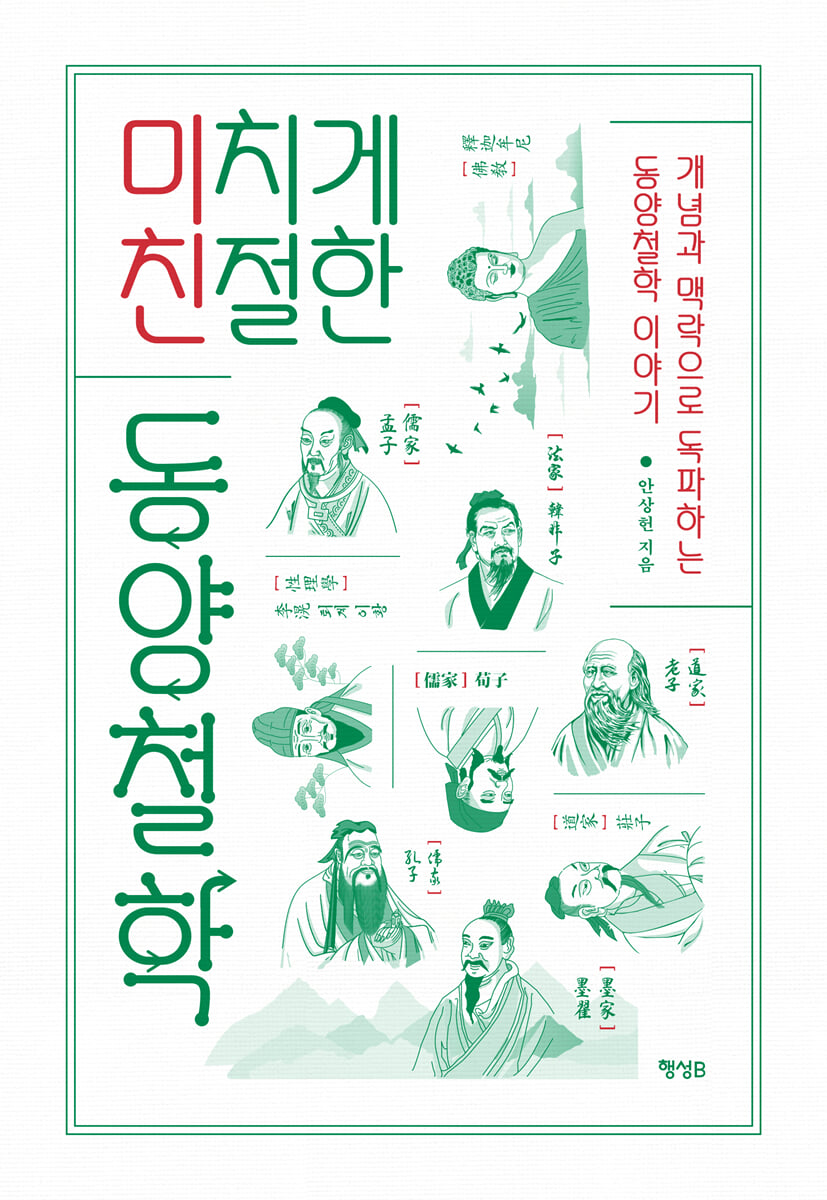
Crazy-Friendly Oriental Philosophy
 |
Description
Book Introduction
Laozi, Confucius, Zhuangzi, Mencius, Neo-Confucianism, Han Feizi, Buddhism
Eastern philosophy in one volume
The names of Eastern philosophers such as Confucius, Mencius, Zhuangzi, and Han Feizi are familiar.
However, not many people look into and understand the ideas they created and practiced.
Because I think it's complicated and difficult, I can't even think about becoming close to it.
《Crazy Kind Eastern Philosophy》 contains the philosophies that have supported East Asia, including Confucianism, Taoism, Legalism, Neo-Confucianism, and Buddhism, in an easily understandable way.
What makes Eastern philosophy distinct from Western philosophy is that it presents realistic solutions to life.
The Taoism of Lao-tzu and Zhuang-tzu views humans as part of nature and leads them to let go of their greed.
The 'Confucianism' of Confucius and Mencius suggests the ability to live in a community, that is, the social path.
Han Feizi's 'Legalist' presents the principles of organizational operation.
The philosophical religion 'Buddhism' contains logical thinking that seeks out the cause of suffering and reveals solutions.
This book provides a friendly explanation of Eastern philosophy, which has shaped the spirit of East Asia, using specific examples and literature to help readers grasp the context.
It helps us understand the flow of Eastern philosophy, while also serving as a guide for looking back on the present and looking into the future.
Eastern philosophy in one volume
The names of Eastern philosophers such as Confucius, Mencius, Zhuangzi, and Han Feizi are familiar.
However, not many people look into and understand the ideas they created and practiced.
Because I think it's complicated and difficult, I can't even think about becoming close to it.
《Crazy Kind Eastern Philosophy》 contains the philosophies that have supported East Asia, including Confucianism, Taoism, Legalism, Neo-Confucianism, and Buddhism, in an easily understandable way.
What makes Eastern philosophy distinct from Western philosophy is that it presents realistic solutions to life.
The Taoism of Lao-tzu and Zhuang-tzu views humans as part of nature and leads them to let go of their greed.
The 'Confucianism' of Confucius and Mencius suggests the ability to live in a community, that is, the social path.
Han Feizi's 'Legalist' presents the principles of organizational operation.
The philosophical religion 'Buddhism' contains logical thinking that seeks out the cause of suffering and reveals solutions.
This book provides a friendly explanation of Eastern philosophy, which has shaped the spirit of East Asia, using specific examples and literature to help readers grasp the context.
It helps us understand the flow of Eastern philosophy, while also serving as a guide for looking back on the present and looking into the future.
- You can preview some of the book's contents.
Preview
index
introduction
Part 1: Lao Tzu, The Path of Inaction and Nature
Lecture 1.
What is Tao?
Lecture 2.
To do everything without doing anything
3rd lecture.
Surprising Ways to Increase Life Satisfaction
Semifinals.
The true meaning of emptiness
Lecture 5.
Beyond knowledge to brightness
Lecture 6.
Even if you just grill the fish well
Lesson 7.
The Age of Laozi, the Spirit of Confucius
Part 2: The Way of Confucius, the Way of Man
Quarterfinals.
Sell me to save the world
Lesson 9.
The core of Confucius: Causality and Propriety
Lesson 10.
Why Philosophy Is Necessary: A Philosophy That Shines in Times of Trouble
Lesson 11.
The Way of Confucius can be expressed in four characters: self-restraint, obedience, and propriety.
Lecture 12.
Learn how to focus your studies from a master of study.
Lesson 13.
How to Get Along with People: Confucius's Theory of Relationships
Lesson 14.
The Old Future, Coming Out of Confucius
Part 3: The Jangja, the Path to a Free Life
Lesson 15.
From Jeongjeoji to Bungjeongmanri
Round of 16.
Is living a useless life a good life?
Lesson 17.
Wandering around, forgetting about life
Round of 18.
How to avoid being lured by the lure of a salary or promotion
Lesson 19.
Living confidently and in my own way
Part 4: Mencius, The Path of a Brave Man
Lesson 20.
Mencius and his times
Lesson 21.
Mencius's Flag, Wangdo Politics
Lecture 22.
The people are the foundation, the basis of revolution.
Lesson 23.
People are inherently good: the theory of human nature and the debate over human nature
24th round.
Hoyeonjigi: The Secret to a Stable, Confident Life
Lesson 25.
Yangzhou, Mohism, and Mencius
Lecture 26.
The Way of Taoism, the Way of Confucianism
Part 5: Neo-Confucianism, the Path of the Scholars
Lesson 27.
Studying Abroad Meets Power
Lesson 28.
What is Neo-Confucianism?
Lesson 29.
The Secret to Studying: Understanding Things and Cultivating Great Knowledge
Lesson 30.
The Land of Neo-Confucianism: The Philosophical Debate of Joseon
Lesson 31.
Living Philosophy, Dead Philosophy
Part 6: Learning the Path of Human Management from Han Feizi
Round of 32.
Han Feizi, Synthesizing Legalism
Lesson 33.
Why the master is kind to his servant
Lecture 34.
What is Legalism?
Lesson 35.
Why a tiger can subdue a dog
Round of 36.
Three, the monarch's carriage
Lesson 37.
The Light and Shadow of Legalism
Part 7: Buddhism: The Path to a Happy Life Beyond Suffering
Lecture 38.
Siddhartha, speaking of the philosophy of liberation
Lesson 39.
The Eight Right Paths to Liberation
Lesson 40.
Buddhist worldview: What is dependent origination?
Lecture 41.
There is nothing? Impermanence, no-self, emptiness
Lecture 42.
Karma and reincarnation, there is no reincarnation
Lecture 43.
The meaning of compassion and generosity: Love brings happiness
Lecture 44.
Igodeukrak, the path to eternal happiness
Conclusion
References
Search
Part 1: Lao Tzu, The Path of Inaction and Nature
Lecture 1.
What is Tao?
Lecture 2.
To do everything without doing anything
3rd lecture.
Surprising Ways to Increase Life Satisfaction
Semifinals.
The true meaning of emptiness
Lecture 5.
Beyond knowledge to brightness
Lecture 6.
Even if you just grill the fish well
Lesson 7.
The Age of Laozi, the Spirit of Confucius
Part 2: The Way of Confucius, the Way of Man
Quarterfinals.
Sell me to save the world
Lesson 9.
The core of Confucius: Causality and Propriety
Lesson 10.
Why Philosophy Is Necessary: A Philosophy That Shines in Times of Trouble
Lesson 11.
The Way of Confucius can be expressed in four characters: self-restraint, obedience, and propriety.
Lecture 12.
Learn how to focus your studies from a master of study.
Lesson 13.
How to Get Along with People: Confucius's Theory of Relationships
Lesson 14.
The Old Future, Coming Out of Confucius
Part 3: The Jangja, the Path to a Free Life
Lesson 15.
From Jeongjeoji to Bungjeongmanri
Round of 16.
Is living a useless life a good life?
Lesson 17.
Wandering around, forgetting about life
Round of 18.
How to avoid being lured by the lure of a salary or promotion
Lesson 19.
Living confidently and in my own way
Part 4: Mencius, The Path of a Brave Man
Lesson 20.
Mencius and his times
Lesson 21.
Mencius's Flag, Wangdo Politics
Lecture 22.
The people are the foundation, the basis of revolution.
Lesson 23.
People are inherently good: the theory of human nature and the debate over human nature
24th round.
Hoyeonjigi: The Secret to a Stable, Confident Life
Lesson 25.
Yangzhou, Mohism, and Mencius
Lecture 26.
The Way of Taoism, the Way of Confucianism
Part 5: Neo-Confucianism, the Path of the Scholars
Lesson 27.
Studying Abroad Meets Power
Lesson 28.
What is Neo-Confucianism?
Lesson 29.
The Secret to Studying: Understanding Things and Cultivating Great Knowledge
Lesson 30.
The Land of Neo-Confucianism: The Philosophical Debate of Joseon
Lesson 31.
Living Philosophy, Dead Philosophy
Part 6: Learning the Path of Human Management from Han Feizi
Round of 32.
Han Feizi, Synthesizing Legalism
Lesson 33.
Why the master is kind to his servant
Lecture 34.
What is Legalism?
Lesson 35.
Why a tiger can subdue a dog
Round of 36.
Three, the monarch's carriage
Lesson 37.
The Light and Shadow of Legalism
Part 7: Buddhism: The Path to a Happy Life Beyond Suffering
Lecture 38.
Siddhartha, speaking of the philosophy of liberation
Lesson 39.
The Eight Right Paths to Liberation
Lesson 40.
Buddhist worldview: What is dependent origination?
Lecture 41.
There is nothing? Impermanence, no-self, emptiness
Lecture 42.
Karma and reincarnation, there is no reincarnation
Lecture 43.
The meaning of compassion and generosity: Love brings happiness
Lecture 44.
Igodeukrak, the path to eternal happiness
Conclusion
References
Search
Into the book
What exactly was Lao Tzu trying to say in Chapter 1 of the Tao Te Ching? Broadly speaking, he seems to be talking about the vast Tao of the universe.
But in this vast and infinite universe, we humans are so small.
(Omitted) Humans do not know whether the universe has an end or what happens when they die.
The Tao, the principle that moves the vast universe, cannot be captured by human words or thoughts, and people fight and quarrel with each other, clinging to the small and trivial knowledge that appears before their eyes.
Lao Tzu is talking about the big idea of looking at the universe.
--- 「Lecture 1.
From "What is Tao?"
It is significant to examine Lao-tzu and Confucius together.
(Omitted) Lao Tzu advised following the Tao, the law of nature.
Confucius speaks of the way of humanity, not the way of nature.
Of course, the human way that Confucius speaks of is the cause and effect and propriety bestowed by heaven, that is, nature.
Both speak of the Way of nature, but they differ in the content of the Way.
(Omitted) While Laozi pursued a life of inaction, becoming one with nature, Confucius emphasized the artificiality of cultivation and effort for a moral life within a social community.
Lao Tzu expresses his rejection of material civilization, but Confucius seeks to correct civilization.
That doesn't mean that Laozi and Confucius are completely different.
It is all based on the laws of heaven and nature.
Above all, they are fundamentally similar in that they are both philosophies that seek a good life.
How to overcome the chaos of the Spring and Autumn Period and the Warring States Period? This was the question Laozi and Confucius faced, but the solutions and answers they arrived at differed.
It's a good thing the answers are different.
Thanks to this, we have two solutions: Taoism and Confucianism.
--- 「Lecture 7.
From "The Age of Laozi, the Spirit of Confucius"
The era in which Confucius lived was the end of the Spring and Autumn Period.
The war was endless, and those in power were busy squeezing the blood of the people to fill their own bellies.
Philosophy is closely related to the times.
Because philosophy is born from the effort to respond to the problems of the times.
This is also why we must look at the times while examining Confucius and his philosophy.
--- "Quarterfinals.
From “Sell Me to Save the World”
If humanity is the mind, then courtesy is the action.
If the person is the content, then the example is the form.
If humanity is humanity, then example is its manifestation.
The collapse of causality means that the heart to care for and cherish others, the attitude that humans should maintain, has collapsed.
Confucius analyzed that the Spring and Autumn Period and the Warring States Period were chaotic due to the breakdown of causality and propriety.
--- 「Lecture 9.
From "Confucius's Core, Causality and Propriety"
Confucius said, “If we do not pursue the same path, we will not work together.”
The point is, don't work with people who think differently.
Just because harmony is important doesn't mean you have to accept everyone.
If your philosophies are different, it's better to go your own way.
Anyone who has ever worked with someone they don't get along with because they think it will make them money will say the same thing.
“I knew this would happen,” “I should have stopped then.” To live a happy life, you need to spend a lot of time with like-minded people.
If we each go our own way, there will be no reason to hate each other.
“The customs of the village are beautiful.
“How can one be wise if one does not choose and stay in a good village?” 『Analects』, “Lee Ren”
--- 「Lecture 13.
How to get along with people, from Confucius's theory of relationships
If Lao-tzu's Tao Te Ching is a poem, then Zhuangzi is a story.
If the Tao of Laozi is abstract and metaphysical, the Tao of Zhuangzi is concrete and has a strong epistemological character.
Laozi has a prominent political and philosophical aspect, while Zhuangzi has a strong individualistic tendency.
Of course, this difference is not felt much.
Because we are based on the way of nature.
Living in accordance with the natural order of things is what Laozi and Zhuangzi have in common.
--- 「Lecture 15.
From Jeongjeoji to Bungjeongmanri
Why does Zhuangzi tell the story of Kun and Beng? Beng represents a free-spirited world that transcends ordinary human thought.
Cicadas and sparrows are people obsessed with common sense.
They think that the world they live in is everything.
(Omitted) ‘Fly high and see far’, ‘Escape from the well.’ This is the core of Zhuangzi’s epistemology.
Because the main message of Zhuangzi is to break out of the narrow frame of mind and see the wider world.
In that sense, the intestines are related to breaking.
You cannot think bigger and enter a wider world without breaking away from what came before.
--- 「Lecture 15.
From "From Jeongjeoji to Bungjeongmanri"
‘What should we do in troubled times?’ This was Mencius’s concern.
Mencius declares the reconstruction of Confucius based on his own learning and experience.
He refined Confucius's theories and added his own style to complete them into a solid philosophy.
We call the core of this philosophy ‘kingly politics.’
Mencius was the one who took bold steps forward, seeking an opportunity to pacify the world by planting the flag of royal politics.
--- 「Lecture 20.
From "Mencius and His Times"
Mencius uses the example of a person saving a child who fell into a well (幼子入井, yujaipjeong) as the basis for the theory of human nature being good.
Everyone has a heart that cannot bear to turn a blind eye to the suffering of others.
(Omitted) Mencius said that a person's good heart is something innate and given by heaven.
So it is nature.
This is where the 'four ends' appear.
Compassion is the clue to benevolence, shame is the clue to righteousness, courtesy is the clue to propriety, and knowing right and wrong is the clue to wisdom.
Four clues are evidence that a person is good.
These are the ‘benevolence, propriety, wisdom’ that Mencius defined as the fundamental principles of humanity.
Great kings practiced benevolence, righteousness, propriety, and wisdom.
That is why he was able to rule the world.
The way of Mencius is to be true to one's own nature according to the laws of heaven.
--- 「Lecture 23.
From "People are inherently good, the theory of human nature and the debate on human nature"
When Gongsun Chu asked Mencius what he excelled at as a teacher, Mencius replied, “He is good at understanding others and cultivating courage.”
What does Mencius mean by the "magnificent spirit" (浩然之氣)? Mencius himself said it was difficult to describe in words, but if we were to conceptualize it, it could be described as the "broad and generous spirit" a person harbors within their hearts.
If you break down the Chinese characters, it can be understood as ‘ho (浩)’ meaning wide, ‘yeon (然)’ meaning so, and ‘vast energy that fills the world.’
--- 「Round 24.
From "Hoyeonjigi, the secret to a confident and unwavering life"
The four seasons cycle: spring, summer, fall, and winter.
Day and night repeat as the sun rises, the sun sets, the moon rises, and the moon sets.
Life is born, grows, and dies.
What principles govern the creation, transformation, and destruction of all things? In Neo-Confucianism, this is understood as "li (理, 理)" (Principle).
The principles and laws that flow behind nature and human life are li.
As the Chinese characters say, it is the law of all things in the world.
--- 「Lecture 28.
From "What is Neo-Confucianism?"
Joseon was a country of Neo-Confucianism.
Jeong Do-jeon's 『Joseon Gyeonggukjeon』 not only provided the foundational laws of Joseon, but also became an important framework that defined the way the king, his subjects, and the people lived.
At that time, the Joseon Dynasty envisioned by Jeong Do-jeon was one in which the divine power would control the royal power and lead state affairs.
The idea was to leave politics to the nobles and have the king just stamp his seal of approval.
This plan faced a crisis when Jeong Do-jeon was removed by Yi Bang-won, but as the country was founded on Neo-Confucianism, the supremacy of divine power over royal authority was maintained.
--- 「Lecture 30.
From “The Land of Neo-Confucianism, the Philosophical Debate of Joseon”
Any new knowledge or philosophy goes through three stages.
It first appears as a symbol of social problem solving, then becomes widely used, and finally disappears into obscurity.
The emergence of a new philosophy means that there are problems in life and ways to solve them have emerged.
Then, as time goes by, the philosophy that was helping us solve problems ends up causing problems or becoming the problems themselves.
--- 「Lecture 31.
From “Living Philosophy, Dead Philosophy”
The Legalists, represented by Han Feizi, scratched the itch of the rulers of the Warring States Period.
This was because the main theme of Han Feizi's thought was to view the weakening of royal authority as the cause of chaos and disorder and to pursue social stability through strengthening the monarchy.
It was believed that by utilizing the means of rewards and punishments through objective laws based on the power of a strong monarch, the chaotic times could be pacified.
In that respect, Han Feizi's ideas can be said to be in line with the needs of the times, namely the need for objective rule according to law and a strong centralized system for waging war.
--- 「Round 32.
From "Han Feizi, Synthesizing Legalism"
Harsh politics, this is the shadow of Legalism.
The Jin Dynasty applied strict laws while mobilizing the people to build the Great Wall.
Those who ran away or neglected their duties were brutally killed.
The fall of the Jin Dynasty was due to the continued use of old methods even though circumstances had changed.
The Han Dynasty, which drove out the Qin Dynasty and became the new ruler of the world, accepted Confucianism.
Because I saw the evils of Legalism with my own eyes.
That doesn't mean that Legalism has disappeared.
After that, the rulers based their thinking on Legalism and utilized Confucianism.
While nominally promoting Confucian ideals, in reality they controlled and oppressed the people through law.
This is not much different from our current politics.
--- 「Lecture 37.
From “The Light and Shadow of the Legalists”
Among the world's many religions, Buddhism is the most philosophical.
The reason is that it digs deep into the fundamental problems of life, finds the problem, and then logically explains the cause and how to deal with it.
Life is suffering. The cause of suffering is desire and attachment. To be free from desire, one must practice in the right way. Through practice and diligence, one can attain enlightenment and liberation.
This is the basic logic of Buddhism.
--- 「Round 38.
From "Siddhartha, Speaking on the Philosophy of Liberation"
In a state of ignorance without wisdom, people perceive and discern the world through actions and experiences.
Discrimination is the result of external contact through the sense organs, which creates feelings of good and bad, and the desire to pursue the good and avoid the bad.
Even after you get what you want, you still have this obsession with wanting more, which makes you believe that what you want is actually there.
We live through the suffering of aging and death, believing that we and all things have their own reality.
Siddhartha realized this law of dependent origination and explained the reason for the suffering in life through dependent causality.
Ignorance of smoke and selflessness leads to accumulated actions, which ultimately result in labor and death.
In that sense, ignorance is an important object that must be overcome to reach enlightenment and liberation.
Because only by properly understanding the process of the twelve links of dependent origination can we uncover the cause of suffering and escape from that vicious cycle.
But in this vast and infinite universe, we humans are so small.
(Omitted) Humans do not know whether the universe has an end or what happens when they die.
The Tao, the principle that moves the vast universe, cannot be captured by human words or thoughts, and people fight and quarrel with each other, clinging to the small and trivial knowledge that appears before their eyes.
Lao Tzu is talking about the big idea of looking at the universe.
--- 「Lecture 1.
From "What is Tao?"
It is significant to examine Lao-tzu and Confucius together.
(Omitted) Lao Tzu advised following the Tao, the law of nature.
Confucius speaks of the way of humanity, not the way of nature.
Of course, the human way that Confucius speaks of is the cause and effect and propriety bestowed by heaven, that is, nature.
Both speak of the Way of nature, but they differ in the content of the Way.
(Omitted) While Laozi pursued a life of inaction, becoming one with nature, Confucius emphasized the artificiality of cultivation and effort for a moral life within a social community.
Lao Tzu expresses his rejection of material civilization, but Confucius seeks to correct civilization.
That doesn't mean that Laozi and Confucius are completely different.
It is all based on the laws of heaven and nature.
Above all, they are fundamentally similar in that they are both philosophies that seek a good life.
How to overcome the chaos of the Spring and Autumn Period and the Warring States Period? This was the question Laozi and Confucius faced, but the solutions and answers they arrived at differed.
It's a good thing the answers are different.
Thanks to this, we have two solutions: Taoism and Confucianism.
--- 「Lecture 7.
From "The Age of Laozi, the Spirit of Confucius"
The era in which Confucius lived was the end of the Spring and Autumn Period.
The war was endless, and those in power were busy squeezing the blood of the people to fill their own bellies.
Philosophy is closely related to the times.
Because philosophy is born from the effort to respond to the problems of the times.
This is also why we must look at the times while examining Confucius and his philosophy.
--- "Quarterfinals.
From “Sell Me to Save the World”
If humanity is the mind, then courtesy is the action.
If the person is the content, then the example is the form.
If humanity is humanity, then example is its manifestation.
The collapse of causality means that the heart to care for and cherish others, the attitude that humans should maintain, has collapsed.
Confucius analyzed that the Spring and Autumn Period and the Warring States Period were chaotic due to the breakdown of causality and propriety.
--- 「Lecture 9.
From "Confucius's Core, Causality and Propriety"
Confucius said, “If we do not pursue the same path, we will not work together.”
The point is, don't work with people who think differently.
Just because harmony is important doesn't mean you have to accept everyone.
If your philosophies are different, it's better to go your own way.
Anyone who has ever worked with someone they don't get along with because they think it will make them money will say the same thing.
“I knew this would happen,” “I should have stopped then.” To live a happy life, you need to spend a lot of time with like-minded people.
If we each go our own way, there will be no reason to hate each other.
“The customs of the village are beautiful.
“How can one be wise if one does not choose and stay in a good village?” 『Analects』, “Lee Ren”
--- 「Lecture 13.
How to get along with people, from Confucius's theory of relationships
If Lao-tzu's Tao Te Ching is a poem, then Zhuangzi is a story.
If the Tao of Laozi is abstract and metaphysical, the Tao of Zhuangzi is concrete and has a strong epistemological character.
Laozi has a prominent political and philosophical aspect, while Zhuangzi has a strong individualistic tendency.
Of course, this difference is not felt much.
Because we are based on the way of nature.
Living in accordance with the natural order of things is what Laozi and Zhuangzi have in common.
--- 「Lecture 15.
From Jeongjeoji to Bungjeongmanri
Why does Zhuangzi tell the story of Kun and Beng? Beng represents a free-spirited world that transcends ordinary human thought.
Cicadas and sparrows are people obsessed with common sense.
They think that the world they live in is everything.
(Omitted) ‘Fly high and see far’, ‘Escape from the well.’ This is the core of Zhuangzi’s epistemology.
Because the main message of Zhuangzi is to break out of the narrow frame of mind and see the wider world.
In that sense, the intestines are related to breaking.
You cannot think bigger and enter a wider world without breaking away from what came before.
--- 「Lecture 15.
From "From Jeongjeoji to Bungjeongmanri"
‘What should we do in troubled times?’ This was Mencius’s concern.
Mencius declares the reconstruction of Confucius based on his own learning and experience.
He refined Confucius's theories and added his own style to complete them into a solid philosophy.
We call the core of this philosophy ‘kingly politics.’
Mencius was the one who took bold steps forward, seeking an opportunity to pacify the world by planting the flag of royal politics.
--- 「Lecture 20.
From "Mencius and His Times"
Mencius uses the example of a person saving a child who fell into a well (幼子入井, yujaipjeong) as the basis for the theory of human nature being good.
Everyone has a heart that cannot bear to turn a blind eye to the suffering of others.
(Omitted) Mencius said that a person's good heart is something innate and given by heaven.
So it is nature.
This is where the 'four ends' appear.
Compassion is the clue to benevolence, shame is the clue to righteousness, courtesy is the clue to propriety, and knowing right and wrong is the clue to wisdom.
Four clues are evidence that a person is good.
These are the ‘benevolence, propriety, wisdom’ that Mencius defined as the fundamental principles of humanity.
Great kings practiced benevolence, righteousness, propriety, and wisdom.
That is why he was able to rule the world.
The way of Mencius is to be true to one's own nature according to the laws of heaven.
--- 「Lecture 23.
From "People are inherently good, the theory of human nature and the debate on human nature"
When Gongsun Chu asked Mencius what he excelled at as a teacher, Mencius replied, “He is good at understanding others and cultivating courage.”
What does Mencius mean by the "magnificent spirit" (浩然之氣)? Mencius himself said it was difficult to describe in words, but if we were to conceptualize it, it could be described as the "broad and generous spirit" a person harbors within their hearts.
If you break down the Chinese characters, it can be understood as ‘ho (浩)’ meaning wide, ‘yeon (然)’ meaning so, and ‘vast energy that fills the world.’
--- 「Round 24.
From "Hoyeonjigi, the secret to a confident and unwavering life"
The four seasons cycle: spring, summer, fall, and winter.
Day and night repeat as the sun rises, the sun sets, the moon rises, and the moon sets.
Life is born, grows, and dies.
What principles govern the creation, transformation, and destruction of all things? In Neo-Confucianism, this is understood as "li (理, 理)" (Principle).
The principles and laws that flow behind nature and human life are li.
As the Chinese characters say, it is the law of all things in the world.
--- 「Lecture 28.
From "What is Neo-Confucianism?"
Joseon was a country of Neo-Confucianism.
Jeong Do-jeon's 『Joseon Gyeonggukjeon』 not only provided the foundational laws of Joseon, but also became an important framework that defined the way the king, his subjects, and the people lived.
At that time, the Joseon Dynasty envisioned by Jeong Do-jeon was one in which the divine power would control the royal power and lead state affairs.
The idea was to leave politics to the nobles and have the king just stamp his seal of approval.
This plan faced a crisis when Jeong Do-jeon was removed by Yi Bang-won, but as the country was founded on Neo-Confucianism, the supremacy of divine power over royal authority was maintained.
--- 「Lecture 30.
From “The Land of Neo-Confucianism, the Philosophical Debate of Joseon”
Any new knowledge or philosophy goes through three stages.
It first appears as a symbol of social problem solving, then becomes widely used, and finally disappears into obscurity.
The emergence of a new philosophy means that there are problems in life and ways to solve them have emerged.
Then, as time goes by, the philosophy that was helping us solve problems ends up causing problems or becoming the problems themselves.
--- 「Lecture 31.
From “Living Philosophy, Dead Philosophy”
The Legalists, represented by Han Feizi, scratched the itch of the rulers of the Warring States Period.
This was because the main theme of Han Feizi's thought was to view the weakening of royal authority as the cause of chaos and disorder and to pursue social stability through strengthening the monarchy.
It was believed that by utilizing the means of rewards and punishments through objective laws based on the power of a strong monarch, the chaotic times could be pacified.
In that respect, Han Feizi's ideas can be said to be in line with the needs of the times, namely the need for objective rule according to law and a strong centralized system for waging war.
--- 「Round 32.
From "Han Feizi, Synthesizing Legalism"
Harsh politics, this is the shadow of Legalism.
The Jin Dynasty applied strict laws while mobilizing the people to build the Great Wall.
Those who ran away or neglected their duties were brutally killed.
The fall of the Jin Dynasty was due to the continued use of old methods even though circumstances had changed.
The Han Dynasty, which drove out the Qin Dynasty and became the new ruler of the world, accepted Confucianism.
Because I saw the evils of Legalism with my own eyes.
That doesn't mean that Legalism has disappeared.
After that, the rulers based their thinking on Legalism and utilized Confucianism.
While nominally promoting Confucian ideals, in reality they controlled and oppressed the people through law.
This is not much different from our current politics.
--- 「Lecture 37.
From “The Light and Shadow of the Legalists”
Among the world's many religions, Buddhism is the most philosophical.
The reason is that it digs deep into the fundamental problems of life, finds the problem, and then logically explains the cause and how to deal with it.
Life is suffering. The cause of suffering is desire and attachment. To be free from desire, one must practice in the right way. Through practice and diligence, one can attain enlightenment and liberation.
This is the basic logic of Buddhism.
--- 「Round 38.
From "Siddhartha, Speaking on the Philosophy of Liberation"
In a state of ignorance without wisdom, people perceive and discern the world through actions and experiences.
Discrimination is the result of external contact through the sense organs, which creates feelings of good and bad, and the desire to pursue the good and avoid the bad.
Even after you get what you want, you still have this obsession with wanting more, which makes you believe that what you want is actually there.
We live through the suffering of aging and death, believing that we and all things have their own reality.
Siddhartha realized this law of dependent origination and explained the reason for the suffering in life through dependent causality.
Ignorance of smoke and selflessness leads to accumulated actions, which ultimately result in labor and death.
In that sense, ignorance is an important object that must be overcome to reach enlightenment and liberation.
Because only by properly understanding the process of the twelve links of dependent origination can we uncover the cause of suffering and escape from that vicious cycle.
--- 「Lecture 40.
From the Buddhist worldview: What is dependent origination?
From the Buddhist worldview: What is dependent origination?
Publisher's Review
Eastern Philosophy: A Guide to "How to Live"
Since ancient times, the East has dreamed of an ideal life with a warm and fulfilling stomach.
Even now, the life people want is no different.
The reason why classics are meaningful is because they discovered human nature and the principles of the world in a historical context of turmoil and presented solutions to life based on them.
The result is the philosophies of Taoism, Confucianism, Legalism, and Buddhism that represent the East.
In that sense, Eastern philosophy is a concrete guide that answers the question, "How should we live?"
Confucianism, Taoism, Legalism, etc. have different perspectives on people and the world.
If we could examine their thoughts structurally, it would be of great help in broadening our perspectives on humanity and the world.
-From the preface
Laozi and Zhuangzi's "Taoism," a philosophy of naturalness and freedom
Lao-tzu, known for his work Tao Te Ching, and Zhuang-tzu, known for his work The Butterfly Dream, are thinkers who are receiving renewed attention in the complex 21st century.
The 'Taoism' they speak of views humans as a part of nature and pursues a life that follows the natural order.
It started with Laozi, and Liezi and Zhuangzi continued the 'Taoist' philosophy.
In Parts 1 and 3, we will learn about Taoist philosophy through the Tao Te Ching and the Zhuangzi, which represent the Taoist philosophy (Laozi and Zhuangzi).
The core of Taoism is ‘Tao’.
If the Tao of Lao-tzu is abstract, the Tao of Zhuang-tzu has a strong concrete character.
Laozi is prominent in political and philosophical aspects, while Zhuangzi also contains individualistic tendencies.
However, living in accordance with the natural order of things is something that Laozi and Zhuangzi have in common.
『Crazy Kind Eastern Philosophy』 guides readers to understand the philosophies of thinkers from various perspectives by pointing out the similarities and differences within the same ideology.
Confucius and Mencius' "Confucianism": A Philosophy of the Power of Living in Community
Confucius and Mencius are often referred to as the 'Confucian and Mencius Thoughts'.
And the philosophy they proposed is called 'Confucianism' or 'Confucianism'.
Parts 2 and 4 take a closer look at the philosophies of Confucius and Mencius.
Confucianism teaches us the spirit necessary for communal living.
Although there was a gap of about 100 years between the lives of the two men, their connection was so strong that it could be said that Mencius inherited Confucius's philosophy.
Confucius provides specific instructions on what individuals and leaders should do in a chaotic world, while also explaining in detail the etiquette and principles of living together.
This is why Confucius's philosophy, including the Analects, is considered the bible of human relationships and management and is still loved today.
Mencius refined Confucius's theories to create his own style, which is called 'kingly politics.'
The core of royal politics, in which the monarch practices virtue and enriches the lives of the people, is the idea of the leader leading by example, a thought that is meaningful even from a modern perspective.
Mencius also presents the concept of human nature, such as the theory of human nature being good.
Although Xunzi's 'theory of human nature as evil' was in conflict with Mencius's opinion, both theories of human nature as good and human nature as evil agreed on the point that we must cultivate human goodness to create a world where we can live well.
In this way, Confucianism and Mencius's thought suggest the attitude and social path necessary for living together.
"Crazy Kind Eastern Philosophy" makes it easier to understand Confucius's thought by using abundant events and literature, and also comparing it with Western philosophy.
Neo-Confucianism: A Philosophy That Has Lost Its Problem-Solving Ability
In Part 5, we will examine Neo-Confucianism, which supplements the metaphysical aspects of Confucianism and Mencius's thought.
Neo-Confucianism, called 'New Confucianism', became the guiding philosophy of the newly founded Joseon Dynasty, but later became dogmatic, lost its practicality, and became an obstacle to development.
We will learn how the Neo-Confucianism we are familiar with was born and how it evolved through the history of Joseon.
We will examine the process by which philosophy becomes a school of thought, and schools become factions, causing conflict, by looking at familiar figures, ideas, and events such as Yi I, Yi Hwang, the Three Bonds and Five Relationships, and the Four Emotions and Seven Emotions debate.
Han Feizi's "Legalism": A Philosophy of Organizational Management
In Part 6, we examine the philosophy of Han Feizi, a representative of the Legalists.
Legalism can be said to be the philosophy with the most striking practicality among Eastern philosophies.
While Confucianism sought to extend family ethics to society, Legalism emphasized that family and social ethics were different.
The logic is that family is love, and organization is profit.
Legalism presents principles for running organizations and nations based on a selfish view of human nature, and is equally applicable to modern organizational management.
But there is a shadow of cold politics in Legalism.
This book explores both the light and shadow of Legalism.
Buddhism, a philosophical religion, reveals the causes of life's suffering.
Buddhism has a stronger philosophical character than any other religion.
Buddhism contains logical thinking in the process of finding the root cause of life's suffering and finding a solution to it.
In Part 7, the content of the enlightenment that Siddhartha Gautama attained is approached philosophically to enable a clear understanding of Buddhist doctrine.
It is no exaggeration to say that all philosophy was born for human happiness.
Part 7 leads us to think together about what true happiness and freedom are based on Buddhist philosophy.
Since ancient times, the East has dreamed of an ideal life with a warm and fulfilling stomach.
Even now, the life people want is no different.
The reason why classics are meaningful is because they discovered human nature and the principles of the world in a historical context of turmoil and presented solutions to life based on them.
The result is the philosophies of Taoism, Confucianism, Legalism, and Buddhism that represent the East.
In that sense, Eastern philosophy is a concrete guide that answers the question, "How should we live?"
Confucianism, Taoism, Legalism, etc. have different perspectives on people and the world.
If we could examine their thoughts structurally, it would be of great help in broadening our perspectives on humanity and the world.
-From the preface
Laozi and Zhuangzi's "Taoism," a philosophy of naturalness and freedom
Lao-tzu, known for his work Tao Te Ching, and Zhuang-tzu, known for his work The Butterfly Dream, are thinkers who are receiving renewed attention in the complex 21st century.
The 'Taoism' they speak of views humans as a part of nature and pursues a life that follows the natural order.
It started with Laozi, and Liezi and Zhuangzi continued the 'Taoist' philosophy.
In Parts 1 and 3, we will learn about Taoist philosophy through the Tao Te Ching and the Zhuangzi, which represent the Taoist philosophy (Laozi and Zhuangzi).
The core of Taoism is ‘Tao’.
If the Tao of Lao-tzu is abstract, the Tao of Zhuang-tzu has a strong concrete character.
Laozi is prominent in political and philosophical aspects, while Zhuangzi also contains individualistic tendencies.
However, living in accordance with the natural order of things is something that Laozi and Zhuangzi have in common.
『Crazy Kind Eastern Philosophy』 guides readers to understand the philosophies of thinkers from various perspectives by pointing out the similarities and differences within the same ideology.
Confucius and Mencius' "Confucianism": A Philosophy of the Power of Living in Community
Confucius and Mencius are often referred to as the 'Confucian and Mencius Thoughts'.
And the philosophy they proposed is called 'Confucianism' or 'Confucianism'.
Parts 2 and 4 take a closer look at the philosophies of Confucius and Mencius.
Confucianism teaches us the spirit necessary for communal living.
Although there was a gap of about 100 years between the lives of the two men, their connection was so strong that it could be said that Mencius inherited Confucius's philosophy.
Confucius provides specific instructions on what individuals and leaders should do in a chaotic world, while also explaining in detail the etiquette and principles of living together.
This is why Confucius's philosophy, including the Analects, is considered the bible of human relationships and management and is still loved today.
Mencius refined Confucius's theories to create his own style, which is called 'kingly politics.'
The core of royal politics, in which the monarch practices virtue and enriches the lives of the people, is the idea of the leader leading by example, a thought that is meaningful even from a modern perspective.
Mencius also presents the concept of human nature, such as the theory of human nature being good.
Although Xunzi's 'theory of human nature as evil' was in conflict with Mencius's opinion, both theories of human nature as good and human nature as evil agreed on the point that we must cultivate human goodness to create a world where we can live well.
In this way, Confucianism and Mencius's thought suggest the attitude and social path necessary for living together.
"Crazy Kind Eastern Philosophy" makes it easier to understand Confucius's thought by using abundant events and literature, and also comparing it with Western philosophy.
Neo-Confucianism: A Philosophy That Has Lost Its Problem-Solving Ability
In Part 5, we will examine Neo-Confucianism, which supplements the metaphysical aspects of Confucianism and Mencius's thought.
Neo-Confucianism, called 'New Confucianism', became the guiding philosophy of the newly founded Joseon Dynasty, but later became dogmatic, lost its practicality, and became an obstacle to development.
We will learn how the Neo-Confucianism we are familiar with was born and how it evolved through the history of Joseon.
We will examine the process by which philosophy becomes a school of thought, and schools become factions, causing conflict, by looking at familiar figures, ideas, and events such as Yi I, Yi Hwang, the Three Bonds and Five Relationships, and the Four Emotions and Seven Emotions debate.
Han Feizi's "Legalism": A Philosophy of Organizational Management
In Part 6, we examine the philosophy of Han Feizi, a representative of the Legalists.
Legalism can be said to be the philosophy with the most striking practicality among Eastern philosophies.
While Confucianism sought to extend family ethics to society, Legalism emphasized that family and social ethics were different.
The logic is that family is love, and organization is profit.
Legalism presents principles for running organizations and nations based on a selfish view of human nature, and is equally applicable to modern organizational management.
But there is a shadow of cold politics in Legalism.
This book explores both the light and shadow of Legalism.
Buddhism, a philosophical religion, reveals the causes of life's suffering.
Buddhism has a stronger philosophical character than any other religion.
Buddhism contains logical thinking in the process of finding the root cause of life's suffering and finding a solution to it.
In Part 7, the content of the enlightenment that Siddhartha Gautama attained is approached philosophically to enable a clear understanding of Buddhist doctrine.
It is no exaggeration to say that all philosophy was born for human happiness.
Part 7 leads us to think together about what true happiness and freedom are based on Buddhist philosophy.
GOODS SPECIFICS
- Date of issue: August 30, 2024
- Page count, weight, size: 352 pages | 148*215*30mm
- ISBN13: 9791164712717
- ISBN10: 1164712713
You may also like
카테고리
korean


korean

![GQ KOREA Mark (Monthly): December [2025]](http://librairie.coreenne.fr/cdn/shop/files/8ef265dbbfbf186523ed75ba7319009d.jpg?v=1765340328&width=3840)


