

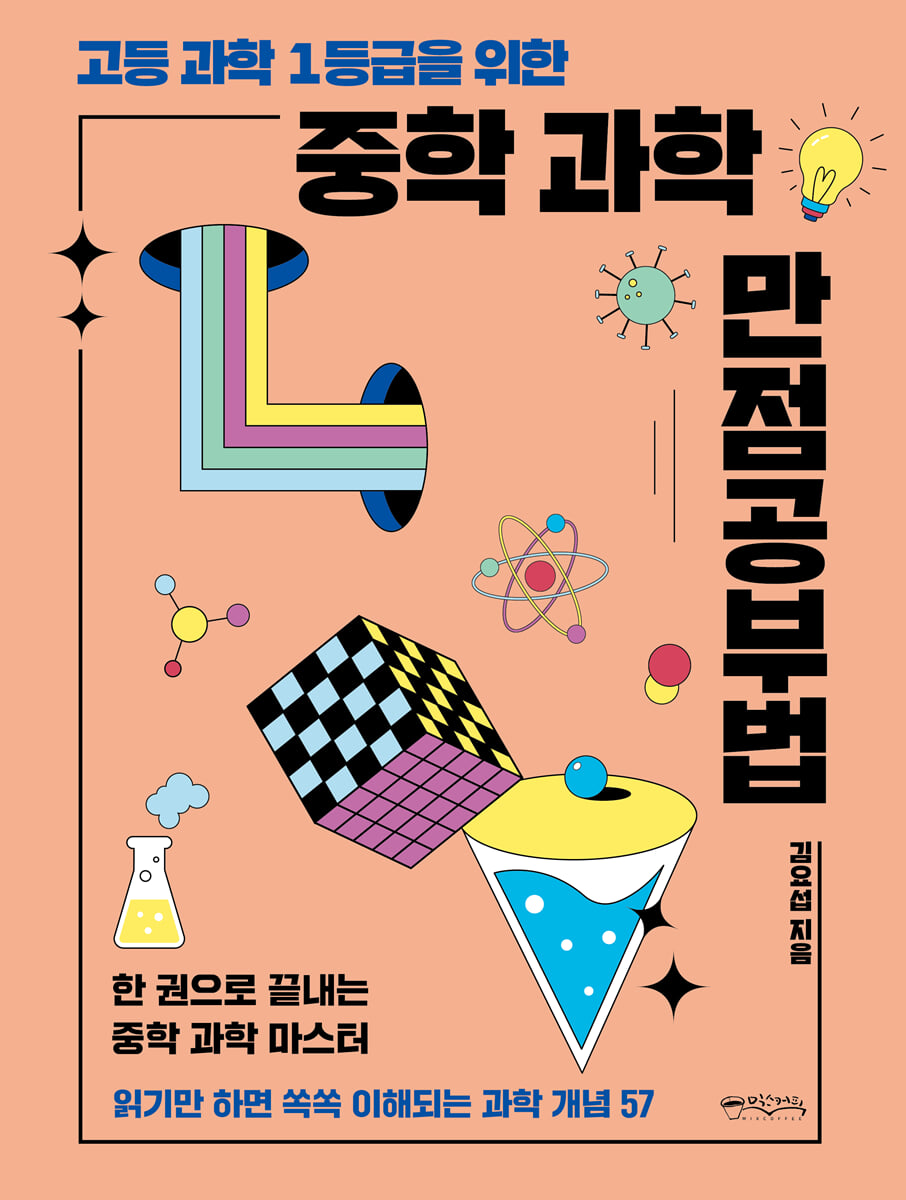
A perfect middle school science study method for achieving a top grade in high school science
 |
Description
Book Introduction
You can grasp middle school science concepts with just one read.
Science Teacher K's Interesting and Fun Science Class
The importance of integrated science has increased with the 2028 college entrance exam reform.
As the college entrance system is being reformed, it is important to lay a solid foundation during middle school to prepare for integrated science in middle and high school grades and college entrance exams, as it will be reflected in the college entrance exam regardless of whether it is humanities or science.
"How can I quickly improve my science grades?" To excel in advanced science subjects, you need to first grasp the concepts.
This book explains essential terms for middle school science and applies them to various situations.
If science feels difficult, you can learn scientific concepts in a fun way with this book.
The author, a current middle school teacher, runs the YouTube channel [Science Teacher K] and produces and shares videos suitable for middle school science classes.
The author states that he "structured the book to inspire students to love science, be curious, and explore the world." Let's experience the engaging lessons of Science Teacher K, featured in the EBS documentary [Educational Project: Korea, Education is Hope] as "a science class more fun than a game."
Science Teacher K's Interesting and Fun Science Class
The importance of integrated science has increased with the 2028 college entrance exam reform.
As the college entrance system is being reformed, it is important to lay a solid foundation during middle school to prepare for integrated science in middle and high school grades and college entrance exams, as it will be reflected in the college entrance exam regardless of whether it is humanities or science.
"How can I quickly improve my science grades?" To excel in advanced science subjects, you need to first grasp the concepts.
This book explains essential terms for middle school science and applies them to various situations.
If science feels difficult, you can learn scientific concepts in a fun way with this book.
The author, a current middle school teacher, runs the YouTube channel [Science Teacher K] and produces and shares videos suitable for middle school science classes.
The author states that he "structured the book to inspire students to love science, be curious, and explore the world." Let's experience the engaging lessons of Science Teacher K, featured in the EBS documentary [Educational Project: Korea, Education is Hope] as "a science class more fun than a game."
- You can preview some of the book's contents.
Preview
index
Author's Note
Note
PART 1 Earth
The Structure of the Earth's Interior: Secrets of the Earth's Interior Revealed by Scientists
The Creation of Rocks_The Birth and Reincarnation of Stones
Types of Rocks_Three Types of Stones That Contain the History of the Earth
Minerals_Substances that make up stones
Earth's Water: Humanity's Lifeline, the Importance of Water Resources
Currents and Tides: The Mystery of Seawater Movement and Tides
Atmospheric circulation and ocean currents: the forces that create the flow of seawater
Atmosphere - the invisible layer surrounding the Earth
The mystery created by clouds and rain_water vapor
The Secret of the Air Mass That Creates Seasons
PART 2 Matter and Particles
Atoms and Elements: A Vast World Made of Tiny Grains
The Structure of the Atom: Amazing Discoveries, the World Inside the Atom
Types of Elements_How to organize elements with similar properties
Molecules_A world made with molecules
Properties of Matter_How to Find Out the Identity of a Matter
Separation of mixtures_The science of separating mixed substances
Changes in the state of matter: solid, liquid, and gaseous states determined by the movement of particles
Changes in State and Heat Energy_The Effects of Changes in State of Matter on the Surroundings
Gas pressure - invisible but always moving gas particles
Pressure and Wind_The pressure difference that creates wind
Volume of a gas_The volume of a gas affected by temperature and pressure
Evaporation and Diffusion: How to Explain the Movement of Gas Particles
PART 3 POWER AND ENERGY
Force_Power as discussed in science
Gravity: The Secret of Weight in Everyday Life
Elasticity: The Secret of Objects Returning to Their Original State
Friction: The Secret of the Force That Opposes Motion
Buoyancy: The Secret to Making Objects Float
Waves: The Story of Vibrations Around Us
The Color of Light_The Mystery of Colors That Get Brighter the More You Mix Them
The Secret of Reflection: The Science Hidden in Mirrors
Refraction: The Secret of Refraction: The Science Hidden in Lenses
Work and Energy Movement interpreted as work and energy
Mechanical energy_energy that moves an object
Thermal Energy: The Secret That Determines the Temperature of a Material
Heat Transfer_3 Ways Heat Transfers
Electrical Energy: The Mystery of Electron Movement
Resistance and Ohm's Law: The Property That Opposes the Flow of Electricity
Conversion of Energy - The Unchanging Fact: Conservation of Energy
PART 4 LIFE
Biodiversity_The defense shield of the ecosystem
Natural Selection: The Importance of Mutation and the Law of Survival
Photosynthesis: How to survive with only light, water, and carbon dioxide
Plant Breathing_Plants Breathe Too
Transpiration_Water management of plants
Breathing: How We Get Energy
Digestion: How We Absorb Nutrients
Circulation: How we move substances through our bodies
Excretion: How we excrete waste
Stimulus_The process by which we perceive sensations
Response: The process by which we act upon a stimulus
Hormones: How Our Body Maintains a Constant State
Genetics: Why We Look Like Our Parents
PART 5 Universe
Moon's motion_The moon orbiting the Earth
Planets of the solar system_Planet orbiting the sun
Sun_The closest star to Earth
Birth of a Star_Nebula, the Cradle of Stars
Star Clusters and Galaxies
The Birth and End of the Universe: The Mysteries of the Universe and the Big Bang Theory
References
Note
PART 1 Earth
The Structure of the Earth's Interior: Secrets of the Earth's Interior Revealed by Scientists
The Creation of Rocks_The Birth and Reincarnation of Stones
Types of Rocks_Three Types of Stones That Contain the History of the Earth
Minerals_Substances that make up stones
Earth's Water: Humanity's Lifeline, the Importance of Water Resources
Currents and Tides: The Mystery of Seawater Movement and Tides
Atmospheric circulation and ocean currents: the forces that create the flow of seawater
Atmosphere - the invisible layer surrounding the Earth
The mystery created by clouds and rain_water vapor
The Secret of the Air Mass That Creates Seasons
PART 2 Matter and Particles
Atoms and Elements: A Vast World Made of Tiny Grains
The Structure of the Atom: Amazing Discoveries, the World Inside the Atom
Types of Elements_How to organize elements with similar properties
Molecules_A world made with molecules
Properties of Matter_How to Find Out the Identity of a Matter
Separation of mixtures_The science of separating mixed substances
Changes in the state of matter: solid, liquid, and gaseous states determined by the movement of particles
Changes in State and Heat Energy_The Effects of Changes in State of Matter on the Surroundings
Gas pressure - invisible but always moving gas particles
Pressure and Wind_The pressure difference that creates wind
Volume of a gas_The volume of a gas affected by temperature and pressure
Evaporation and Diffusion: How to Explain the Movement of Gas Particles
PART 3 POWER AND ENERGY
Force_Power as discussed in science
Gravity: The Secret of Weight in Everyday Life
Elasticity: The Secret of Objects Returning to Their Original State
Friction: The Secret of the Force That Opposes Motion
Buoyancy: The Secret to Making Objects Float
Waves: The Story of Vibrations Around Us
The Color of Light_The Mystery of Colors That Get Brighter the More You Mix Them
The Secret of Reflection: The Science Hidden in Mirrors
Refraction: The Secret of Refraction: The Science Hidden in Lenses
Work and Energy Movement interpreted as work and energy
Mechanical energy_energy that moves an object
Thermal Energy: The Secret That Determines the Temperature of a Material
Heat Transfer_3 Ways Heat Transfers
Electrical Energy: The Mystery of Electron Movement
Resistance and Ohm's Law: The Property That Opposes the Flow of Electricity
Conversion of Energy - The Unchanging Fact: Conservation of Energy
PART 4 LIFE
Biodiversity_The defense shield of the ecosystem
Natural Selection: The Importance of Mutation and the Law of Survival
Photosynthesis: How to survive with only light, water, and carbon dioxide
Plant Breathing_Plants Breathe Too
Transpiration_Water management of plants
Breathing: How We Get Energy
Digestion: How We Absorb Nutrients
Circulation: How we move substances through our bodies
Excretion: How we excrete waste
Stimulus_The process by which we perceive sensations
Response: The process by which we act upon a stimulus
Hormones: How Our Body Maintains a Constant State
Genetics: Why We Look Like Our Parents
PART 5 Universe
Moon's motion_The moon orbiting the Earth
Planets of the solar system_Planet orbiting the sun
Sun_The closest star to Earth
Birth of a Star_Nebula, the Cradle of Stars
Star Clusters and Galaxies
The Birth and End of the Universe: The Mysteries of the Universe and the Big Bang Theory
References
Into the book
Now you should be able to express scientific terms in real-life applications.
‘Scientific knowledge and understanding’ is one of the major goals of middle school science education.
It will also play an important role in school studies.
Every chapter in this book has a “This is how it works in real life.”
It contains methods for applying and interpreting the scientific knowledge you have learned to real life.
If you've read this entire book and have a good grasp of the scientific terminology, you might be able to skip over this section and write your own story.
To get the most out of this book, try creating your own story from every topic in the book.
I'm really looking forward to seeing how each person interprets the world through science, based on their own experiences and thoughts.
--- p.14
So what about clouds? The troposphere, where we live, is said to have a temperature that decreases with increasing altitude.
The air near the surface is relatively hot and can hold a lot of water vapor.
Additionally, the troposphere is said to be an active convection zone, with hot air rising and cold air sinking, causing air to mix up and down.
Convection causes hot air with a lot of water vapor to rise from near the surface.
The air gets colder and colder, and the amount of water vapor it can hold decreases.
As the air rises, its temperature decreases and eventually the water vapor returns to the form of water droplets.
In places that are too high, the temperature is low, so water droplets freeze and turn into ice crystals.
These ice crystals are called 'ice crystals'.
--- p.58
In real life, melting ice is thawing, melting icicles is solidification, boiling water is vaporization, and steam is liquefaction.
You might think that sublimation is not something that can be easily seen.
Dry ice shrinking and disappearing, frost forming suddenly from water vapor without any water droplets, and ice in your freezer getting smaller over time are all examples of sublimation.
--- p.105
Buoyancy can be experienced in many ways in everyday life.
For example, when swimming, there is a phenomenon where the body floats in the water.
Beginners to swimming often find it difficult to float because they are unable to utilize the volume of water they are submerged in.
If you get into the right position and are evenly submerged in the water, you will have sufficient buoyancy and be able to float well.
Another example is a helium balloon.
Helium is a gas lighter than air, and helium balloons gain buoyancy in the air and fly into the sky.
This property of floating in the air is why you can carry helium balloons around in amusement parks.
--- p.154
Different substances have different degrees of electron affinity.
For example, plastic likes electrons and attracts a lot of them, while fur is good at sending electrons away.
So when you rub plastic and fur, electrons move from the fur to the plastic.
When electrons move like this, the object becomes charged.
- Plastic that has gained electrons with a positive charge becomes negatively charged, and conversely, fur that has lost electrons with a negative charge becomes positively charged.
--- p.203
(X) Blood carries only oxygen and carbon dioxide.
(O) Blood carries various substances, including oxygen and carbon dioxide, as well as nutrients, hormones, and waste products, helping our body's metabolic processes.
(X) Blood is made up of only ‘blood’.
(O) The blood we call 'blood' is made up of blood cells (red blood cells, white blood cells, platelets) and plasma, each of which has a different role.
‘Scientific knowledge and understanding’ is one of the major goals of middle school science education.
It will also play an important role in school studies.
Every chapter in this book has a “This is how it works in real life.”
It contains methods for applying and interpreting the scientific knowledge you have learned to real life.
If you've read this entire book and have a good grasp of the scientific terminology, you might be able to skip over this section and write your own story.
To get the most out of this book, try creating your own story from every topic in the book.
I'm really looking forward to seeing how each person interprets the world through science, based on their own experiences and thoughts.
--- p.14
So what about clouds? The troposphere, where we live, is said to have a temperature that decreases with increasing altitude.
The air near the surface is relatively hot and can hold a lot of water vapor.
Additionally, the troposphere is said to be an active convection zone, with hot air rising and cold air sinking, causing air to mix up and down.
Convection causes hot air with a lot of water vapor to rise from near the surface.
The air gets colder and colder, and the amount of water vapor it can hold decreases.
As the air rises, its temperature decreases and eventually the water vapor returns to the form of water droplets.
In places that are too high, the temperature is low, so water droplets freeze and turn into ice crystals.
These ice crystals are called 'ice crystals'.
--- p.58
In real life, melting ice is thawing, melting icicles is solidification, boiling water is vaporization, and steam is liquefaction.
You might think that sublimation is not something that can be easily seen.
Dry ice shrinking and disappearing, frost forming suddenly from water vapor without any water droplets, and ice in your freezer getting smaller over time are all examples of sublimation.
--- p.105
Buoyancy can be experienced in many ways in everyday life.
For example, when swimming, there is a phenomenon where the body floats in the water.
Beginners to swimming often find it difficult to float because they are unable to utilize the volume of water they are submerged in.
If you get into the right position and are evenly submerged in the water, you will have sufficient buoyancy and be able to float well.
Another example is a helium balloon.
Helium is a gas lighter than air, and helium balloons gain buoyancy in the air and fly into the sky.
This property of floating in the air is why you can carry helium balloons around in amusement parks.
--- p.154
Different substances have different degrees of electron affinity.
For example, plastic likes electrons and attracts a lot of them, while fur is good at sending electrons away.
So when you rub plastic and fur, electrons move from the fur to the plastic.
When electrons move like this, the object becomes charged.
- Plastic that has gained electrons with a positive charge becomes negatively charged, and conversely, fur that has lost electrons with a negative charge becomes positively charged.
--- p.203
(X) Blood carries only oxygen and carbon dioxide.
(O) Blood carries various substances, including oxygen and carbon dioxide, as well as nutrients, hormones, and waste products, helping our body's metabolic processes.
(X) Blood is made up of only ‘blood’.
(O) The blood we call 'blood' is made up of blood cells (red blood cells, white blood cells, platelets) and plasma, each of which has a different role.
--- p.260
Publisher's Review
Even children who have difficulty studying science
57 Science Concepts You Can Understand Just by Reading
In elementary school, science was considered a fun subject, requiring students to conduct various experiments and observe plants and animals. However, as students advance in grade level, the scope expands and the amount of material they need to memorize increases, leading to many students finding science difficult.
This book divides the book into parts such as ‘Earth’, ‘Matter and Particles’, ‘Force and Energy’, ‘Life’, and ‘Universe’, and explains each concept.
The title is structured as 'Scientific Terms: Explanation', first looking at scientific terms, and then adding questions and explanations to stimulate curiosity about the terms in 'What does it mean?'
Then, the meaning of the term was explained in 'Let me explain it a little more'.
Lastly, we have organized the meanings of terms into 'Things We Need to Know' so that you can see them at a glance and memorize them.
In addition, 'This is how it is applied in real life' contains methods for applying scientific knowledge to real life and interpreting it, and 'Don't misunderstand' even includes cautions to correct misconceptions that may arise while studying.
If you can spark your curiosity about science and apply it to your daily life through this book, which includes fun illustrations, you will be able to kill two birds with one stone: fun and learning.
Middle school curriculum 'Perfect Score Study Method' series
Let's master the core contents of each subject!
A solid foundation in secondary education can reduce the difficulties experienced in higher education.
The 'Perfect Study Method' series for middle school subjects, including 'Middle School Science Perfect Score Study Method for a Grade 1 in Advanced Science', was designed for students who are having difficulty studying middle school subjects.
The curriculum is organized in an easy-to-understand manner to help even beginners learn without difficulty.
Master the core content of each subject with previously published Korean, English, and Math series.
57 Science Concepts You Can Understand Just by Reading
In elementary school, science was considered a fun subject, requiring students to conduct various experiments and observe plants and animals. However, as students advance in grade level, the scope expands and the amount of material they need to memorize increases, leading to many students finding science difficult.
This book divides the book into parts such as ‘Earth’, ‘Matter and Particles’, ‘Force and Energy’, ‘Life’, and ‘Universe’, and explains each concept.
The title is structured as 'Scientific Terms: Explanation', first looking at scientific terms, and then adding questions and explanations to stimulate curiosity about the terms in 'What does it mean?'
Then, the meaning of the term was explained in 'Let me explain it a little more'.
Lastly, we have organized the meanings of terms into 'Things We Need to Know' so that you can see them at a glance and memorize them.
In addition, 'This is how it is applied in real life' contains methods for applying scientific knowledge to real life and interpreting it, and 'Don't misunderstand' even includes cautions to correct misconceptions that may arise while studying.
If you can spark your curiosity about science and apply it to your daily life through this book, which includes fun illustrations, you will be able to kill two birds with one stone: fun and learning.
Middle school curriculum 'Perfect Score Study Method' series
Let's master the core contents of each subject!
A solid foundation in secondary education can reduce the difficulties experienced in higher education.
The 'Perfect Study Method' series for middle school subjects, including 'Middle School Science Perfect Score Study Method for a Grade 1 in Advanced Science', was designed for students who are having difficulty studying middle school subjects.
The curriculum is organized in an easy-to-understand manner to help even beginners learn without difficulty.
Master the core content of each subject with previously published Korean, English, and Math series.
GOODS SPECIFICS
- Date of issue: August 8, 2024
- Page count, weight, size: 328 pages | 548g | 170*225*20mm
- ISBN13: 9791170435600
- ISBN10: 1170435602
You may also like
카테고리
korean


korean

![GQ KOREA Mark (Monthly): December [2025]](http://librairie.coreenne.fr/cdn/shop/files/8ef265dbbfbf186523ed75ba7319009d.jpg?v=1765340328&width=3840)


