

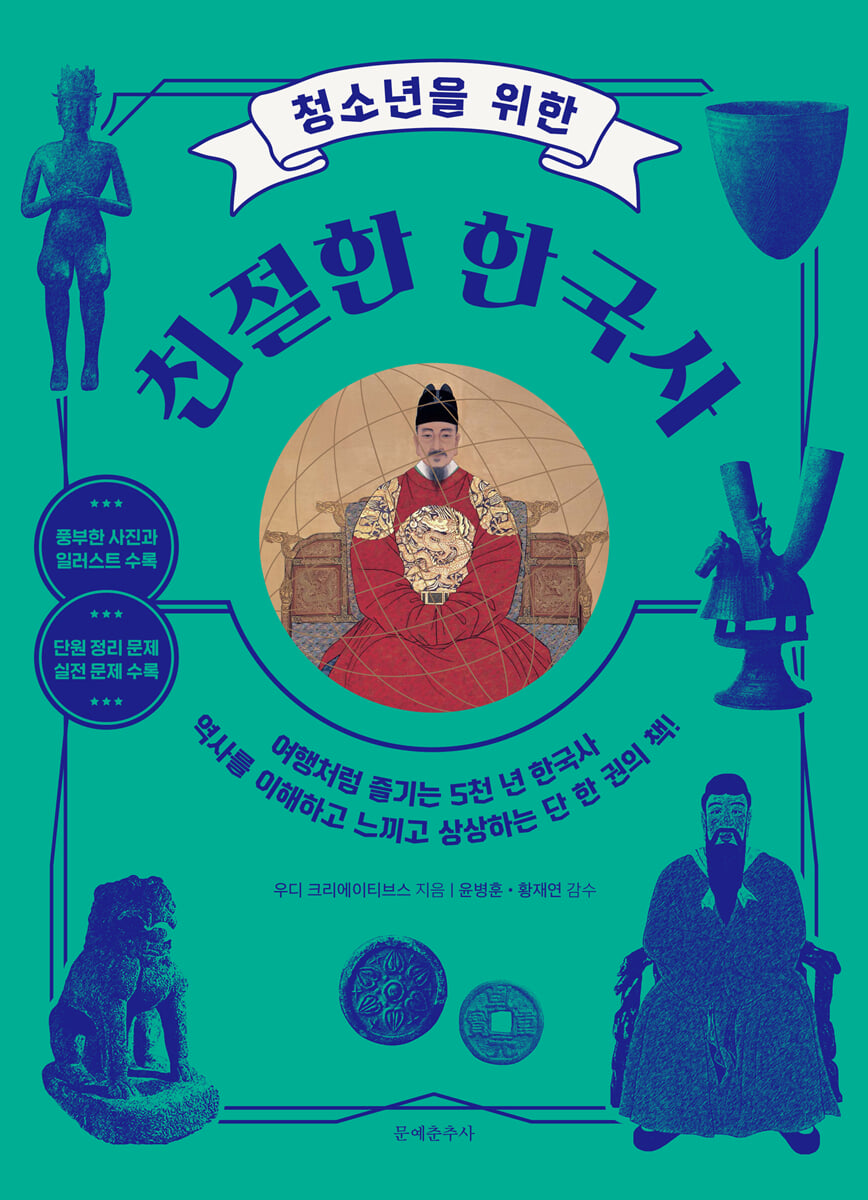
Friendly Korean History for Youth
 |
Description
Book Introduction
Five thousand years of struggle, living and breathing in a single volume
Enjoy Korean history like a trip or a movie!
Contains abundant photos and illustrations
Includes unit summary problems and practice problems
"A Friendly Korean History for Youth" is a book for young people that immerses them in a film-like narrative, from the footsteps of our ancestors who struggled on the Korean Peninsula in prehistoric times to the turbulent modern history.
How can we teach history to young people, who shake their heads at the mere mention of history, in a way they can understand, feel, and imagine? How can we help them solve history problems without memorizing? This is the result of our deep consideration.
As you read this book, you will come to understand the results through the background or causes of historical events.
A cause produces an effect, and an effect produces another cause, which leads to another event.
Events that were fragmented in textbooks and reference books are now linked together to form a story.
You can understand history just by reading the story without having to memorize it by underlining it.
If you understand history through this flow, countless things you had to memorize will come into your head and you'll say, "Ah, that's right!"
Of course, simply explaining history as a story and understanding its flow won't solve all the difficulties young people have with history, but if they can develop a perspective that enjoys history, that's enough.
This one book, which contains the core of the entire history, will help young people properly understand our history and learn lessons from it as a narrative that illuminates 'this very moment.'
Enjoy Korean history like a trip or a movie!
Contains abundant photos and illustrations
Includes unit summary problems and practice problems
"A Friendly Korean History for Youth" is a book for young people that immerses them in a film-like narrative, from the footsteps of our ancestors who struggled on the Korean Peninsula in prehistoric times to the turbulent modern history.
How can we teach history to young people, who shake their heads at the mere mention of history, in a way they can understand, feel, and imagine? How can we help them solve history problems without memorizing? This is the result of our deep consideration.
As you read this book, you will come to understand the results through the background or causes of historical events.
A cause produces an effect, and an effect produces another cause, which leads to another event.
Events that were fragmented in textbooks and reference books are now linked together to form a story.
You can understand history just by reading the story without having to memorize it by underlining it.
If you understand history through this flow, countless things you had to memorize will come into your head and you'll say, "Ah, that's right!"
Of course, simply explaining history as a story and understanding its flow won't solve all the difficulties young people have with history, but if they can develop a perspective that enjoys history, that's enough.
This one book, which contains the core of the entire history, will help young people properly understand our history and learn lessons from it as a narrative that illuminates 'this very moment.'
- You can preview some of the book's contents.
Preview
index
Part 1: Prehistoric Culture and the Formation of Ancient States
1.
Prehistoric Culture of Our Country 16
01 Paleolithic Culture of Manchuria and the Korean Peninsula
02 Neolithic Culture of Manchuria and the Korean Peninsula
2.
Korea's Bronze Age Culture and Gojoseon 24
01 Our country's Bronze Age culture
02 The Founding and Development of Gojoseon
3.
The Growth of the Iron Age Countries 32
01 Development of Iron Age Culture
02 Several countries founded on the basis of the Iron Age culture
Part 2: Three Kingdoms and Gaya
1.
Goguryeo, which commanded the continent, 40
01 The Establishment of Goguryeo
02 The growth of Goguryeo
03 Development of Goguryeo
04 Goguryeo's Golden Age
2.
Baekje, the land of exquisite art 52
01 The Founding and Development of Baekje
02 Baekje's Crisis and Efforts for Revival
3.
The Iron Kingdom, Gaya 58
01 Gaya, which ruled the Gyeongsangnam-do region
02 The Founding of Gaya
03 Development of Gaya
04 Gaya's Crisis
4.
Silla, which unified the three kingdoms in 69
01 The establishment and growth of Silla
02 Development of Silla
5.
Culture of the Three Kingdoms and Gaya 77
01 Religion and Academics of the Three Kingdoms Period
02 Life of the Three Kingdoms and Gaya People
Part 3: The North-South States Period and the Later Three Kingdoms Period
1.
Unified Silla 84
01 King Munmu and King Sinmun, who strengthened royal authority
02 Culture of Unified Silla
03 How did the people of Unified Silla live?
04 Social Unrest in the Late Silla Dynasty and the Later Three Kingdoms Period
2.
Balhae, the kingdom of the East Sea, 98
01 Balhae regains Goguryeo territory
02 Balhae's Culture
3.
Later Three Kingdoms Period 107
01 The Three Kingdoms period begins again
02 Unification of the Later Three Kingdoms and the Founding of Goryeo
Part 4: The Establishment and Transformation of Goryeo
1.
The Founding of Goryeo and Political Changes 116
01 Taejo's policies
02 Gwangjong's policy
03 King Seongjong, Implementing Confucian Politics
2.
Goryeo's Foreign Relations 132
01 Early Goryeo, Goryeo's Relations with Neighboring Countries
02 Korea in the World
03 Life and culture of the people of the Goryeo Dynasty
3.
The Military Regime and the Mongol Invasion 143
01 The warriors who ruled the country with swords
02 Mongol invasion and Goryeo's resistance
4.
Attempt at Reform 157
01 Under Mongol rule
02 King Gongmin's attempt to rebuild the collapsing Goryeo Dynasty
03 The Falling Goryeo Dynasty
Part 5: The Establishment and Development of Joseon
1.
People Who Laid the Foundation for a New Nation 174
01 The Fall of Goryeo
02 Taejo Lee Seong-gye, founder of Joseon
03 Taejong, who laid the foundation for Joseon
04 The Great King Sejong
2.
Achieving Stability through Confucian Order 189
01 The disappearance of the king who would continue the achievements
02 Begin to create a national governing system
03 King Seongjong, who completed the Joseon Dynasty's legal code
04 The foundation that was laid with great effort is shaking.
3.
Overcoming the Imjin and Qing Invasions 199
01 Ancestors and factional politics
02 The Imjin War broke out
03 King Gwanghae tried to overcome domestic and international difficulties
04 The Byeongja Horan and the Jeongmyo Horan
Part 6: Changes in Joseon Society
1.
The Development of Factional Politics 214
01 The degeneration of factional politics
02 Movement to overcome factionalism
2.
People Who Tried to Reestablish Joseon 220
01 Overcoming the damage of war
02 Development of common people's culture
03 King Jeongjo dreams of reform in Hwaseong
3.
Mars 240: Hope and Frustration
01 The first meaning of Mars
02 The Second Meaning of Mars
03 The Third Meaning of Mars
4.
Sedo Politics and Peasant Uprisings 250
01 The rise of factional politics
Part 7: The Establishment of a Modern State and the National Movement
1.
Establishment of the Nation-State 260
01 Opening of Joseon
02 Promotion of modern reforms
2.
Japanese Invasion of National Sovereignty and the National Movement 275
01 Eulsa Treaty
02 National Sovereignty Defense Movement
03 Japanese colonial rule
04 March 1st Movement and the Provisional Government of the Republic of Korea
3.
The Provisional Government of the Republic of Korea established by the March 1st Movement 289
01 National Movement after the March 1st Movement
02 Provisional Government of the Republic of Korea
03 Breaking through the darkness of colonialism and moving toward independence
04 Domestic situation
05 People who tried to preserve the spirit of the nation
06 Preparing for Liberation
Part 8: Liberation and Division
1.
Liberation and Another Foreign Power 320
01 Efforts to establish a government
02 Establishment of the Government of the Republic of Korea
2.
Korean War 336
01 The Korean Peninsula on the brink of war
02 The scars of war
Part 9 The Republic of Korea is a democratic republic.
1.
April 19 Revolution 350
01 Corrupt dictatorship
02 The people rise up and judge the corrupt Syngman Rhee regime.
2.
Democracy as a Pawn for Industrialization 362
01 May 16 Military Coup
02 Economic development through blood, sweat, and tears
03 Steps Towards Dictatorship
04 Dazzling Economic Development and Its Shadows
05 The End of the Dictatorship
3.
Yearning and Despair for Democracy 382
01 From winter to winter again
02 Reclaiming Democracy with the Power of the People
03 Constitutional Amendment for Direct Presidential Election and the Spread of Democracy
04 South Korea Overcoming Crisis and Moving Forward
Answer 404
1.
Prehistoric Culture of Our Country 16
01 Paleolithic Culture of Manchuria and the Korean Peninsula
02 Neolithic Culture of Manchuria and the Korean Peninsula
2.
Korea's Bronze Age Culture and Gojoseon 24
01 Our country's Bronze Age culture
02 The Founding and Development of Gojoseon
3.
The Growth of the Iron Age Countries 32
01 Development of Iron Age Culture
02 Several countries founded on the basis of the Iron Age culture
Part 2: Three Kingdoms and Gaya
1.
Goguryeo, which commanded the continent, 40
01 The Establishment of Goguryeo
02 The growth of Goguryeo
03 Development of Goguryeo
04 Goguryeo's Golden Age
2.
Baekje, the land of exquisite art 52
01 The Founding and Development of Baekje
02 Baekje's Crisis and Efforts for Revival
3.
The Iron Kingdom, Gaya 58
01 Gaya, which ruled the Gyeongsangnam-do region
02 The Founding of Gaya
03 Development of Gaya
04 Gaya's Crisis
4.
Silla, which unified the three kingdoms in 69
01 The establishment and growth of Silla
02 Development of Silla
5.
Culture of the Three Kingdoms and Gaya 77
01 Religion and Academics of the Three Kingdoms Period
02 Life of the Three Kingdoms and Gaya People
Part 3: The North-South States Period and the Later Three Kingdoms Period
1.
Unified Silla 84
01 King Munmu and King Sinmun, who strengthened royal authority
02 Culture of Unified Silla
03 How did the people of Unified Silla live?
04 Social Unrest in the Late Silla Dynasty and the Later Three Kingdoms Period
2.
Balhae, the kingdom of the East Sea, 98
01 Balhae regains Goguryeo territory
02 Balhae's Culture
3.
Later Three Kingdoms Period 107
01 The Three Kingdoms period begins again
02 Unification of the Later Three Kingdoms and the Founding of Goryeo
Part 4: The Establishment and Transformation of Goryeo
1.
The Founding of Goryeo and Political Changes 116
01 Taejo's policies
02 Gwangjong's policy
03 King Seongjong, Implementing Confucian Politics
2.
Goryeo's Foreign Relations 132
01 Early Goryeo, Goryeo's Relations with Neighboring Countries
02 Korea in the World
03 Life and culture of the people of the Goryeo Dynasty
3.
The Military Regime and the Mongol Invasion 143
01 The warriors who ruled the country with swords
02 Mongol invasion and Goryeo's resistance
4.
Attempt at Reform 157
01 Under Mongol rule
02 King Gongmin's attempt to rebuild the collapsing Goryeo Dynasty
03 The Falling Goryeo Dynasty
Part 5: The Establishment and Development of Joseon
1.
People Who Laid the Foundation for a New Nation 174
01 The Fall of Goryeo
02 Taejo Lee Seong-gye, founder of Joseon
03 Taejong, who laid the foundation for Joseon
04 The Great King Sejong
2.
Achieving Stability through Confucian Order 189
01 The disappearance of the king who would continue the achievements
02 Begin to create a national governing system
03 King Seongjong, who completed the Joseon Dynasty's legal code
04 The foundation that was laid with great effort is shaking.
3.
Overcoming the Imjin and Qing Invasions 199
01 Ancestors and factional politics
02 The Imjin War broke out
03 King Gwanghae tried to overcome domestic and international difficulties
04 The Byeongja Horan and the Jeongmyo Horan
Part 6: Changes in Joseon Society
1.
The Development of Factional Politics 214
01 The degeneration of factional politics
02 Movement to overcome factionalism
2.
People Who Tried to Reestablish Joseon 220
01 Overcoming the damage of war
02 Development of common people's culture
03 King Jeongjo dreams of reform in Hwaseong
3.
Mars 240: Hope and Frustration
01 The first meaning of Mars
02 The Second Meaning of Mars
03 The Third Meaning of Mars
4.
Sedo Politics and Peasant Uprisings 250
01 The rise of factional politics
Part 7: The Establishment of a Modern State and the National Movement
1.
Establishment of the Nation-State 260
01 Opening of Joseon
02 Promotion of modern reforms
2.
Japanese Invasion of National Sovereignty and the National Movement 275
01 Eulsa Treaty
02 National Sovereignty Defense Movement
03 Japanese colonial rule
04 March 1st Movement and the Provisional Government of the Republic of Korea
3.
The Provisional Government of the Republic of Korea established by the March 1st Movement 289
01 National Movement after the March 1st Movement
02 Provisional Government of the Republic of Korea
03 Breaking through the darkness of colonialism and moving toward independence
04 Domestic situation
05 People who tried to preserve the spirit of the nation
06 Preparing for Liberation
Part 8: Liberation and Division
1.
Liberation and Another Foreign Power 320
01 Efforts to establish a government
02 Establishment of the Government of the Republic of Korea
2.
Korean War 336
01 The Korean Peninsula on the brink of war
02 The scars of war
Part 9 The Republic of Korea is a democratic republic.
1.
April 19 Revolution 350
01 Corrupt dictatorship
02 The people rise up and judge the corrupt Syngman Rhee regime.
2.
Democracy as a Pawn for Industrialization 362
01 May 16 Military Coup
02 Economic development through blood, sweat, and tears
03 Steps Towards Dictatorship
04 Dazzling Economic Development and Its Shadows
05 The End of the Dictatorship
3.
Yearning and Despair for Democracy 382
01 From winter to winter again
02 Reclaiming Democracy with the Power of the People
03 Constitutional Amendment for Direct Presidential Election and the Spread of Democracy
04 South Korea Overcoming Crisis and Moving Forward
Answer 404
Detailed image
.jpg)
Publisher's Review
If you enjoy it with excitement like a trip,
A fascinating history book that you can memorize without having to memorize it!
The most important thing in history is understanding the characters, the setting, the action, and the outcome.
Like a movie, like a novel.
So, instead of summarizing the main points in a clear manner, this book unfolds the story in a tangled manner.
History is understood as if it were a river flowing through countless interconnected links: the link connecting Jumong, who founded Goguryeo, and Onjo, who founded Baekje; the link connecting Taejong Yi Bang-won and Prince Sejo Suyang; the link connecting King Sejong, who created Hangul, and Ju Si-gyeong, who resisted Japan's policy of ethnic annihilation.
Just as you cannot understand a flowing river by cutting it into pieces, you can only understand history by reading its flow.
This book helps us understand history by showing the flow of history.
It is a fascinating history book that can be memorized without having to memorize it because of its compressed, urgent, and concise narrative.
The summary questions for each unit were added to help students review what they have read rather than to prepare for the exam.
History is not a museum legacy that we can forget, but a living, moving mirror that constantly reflects the present moment.
As historian Toynbee said, “history is a dialogue between the past and the present,” in order to live the best life possible in this moment, we must have a sincere and earnest conversation with the past that reflects our present.
《Friendly Korean History for Youth》 will open up an exciting chapter in that conversation.
A fascinating history book that you can memorize without having to memorize it!
The most important thing in history is understanding the characters, the setting, the action, and the outcome.
Like a movie, like a novel.
So, instead of summarizing the main points in a clear manner, this book unfolds the story in a tangled manner.
History is understood as if it were a river flowing through countless interconnected links: the link connecting Jumong, who founded Goguryeo, and Onjo, who founded Baekje; the link connecting Taejong Yi Bang-won and Prince Sejo Suyang; the link connecting King Sejong, who created Hangul, and Ju Si-gyeong, who resisted Japan's policy of ethnic annihilation.
Just as you cannot understand a flowing river by cutting it into pieces, you can only understand history by reading its flow.
This book helps us understand history by showing the flow of history.
It is a fascinating history book that can be memorized without having to memorize it because of its compressed, urgent, and concise narrative.
The summary questions for each unit were added to help students review what they have read rather than to prepare for the exam.
History is not a museum legacy that we can forget, but a living, moving mirror that constantly reflects the present moment.
As historian Toynbee said, “history is a dialogue between the past and the present,” in order to live the best life possible in this moment, we must have a sincere and earnest conversation with the past that reflects our present.
《Friendly Korean History for Youth》 will open up an exciting chapter in that conversation.
GOODS SPECIFICS
- Date of issue: August 31, 2024
- Page count, weight, size: 408 pages | 872g | 170*235*25mm
- ISBN13: 9788976046765
- ISBN10: 8976046765
You may also like
카테고리
korean


korean

![GQ KOREA Mark (Monthly): December [2025]](http://librairie.coreenne.fr/cdn/shop/files/8ef265dbbfbf186523ed75ba7319009d.jpg?v=1765340328&width=3840)


