

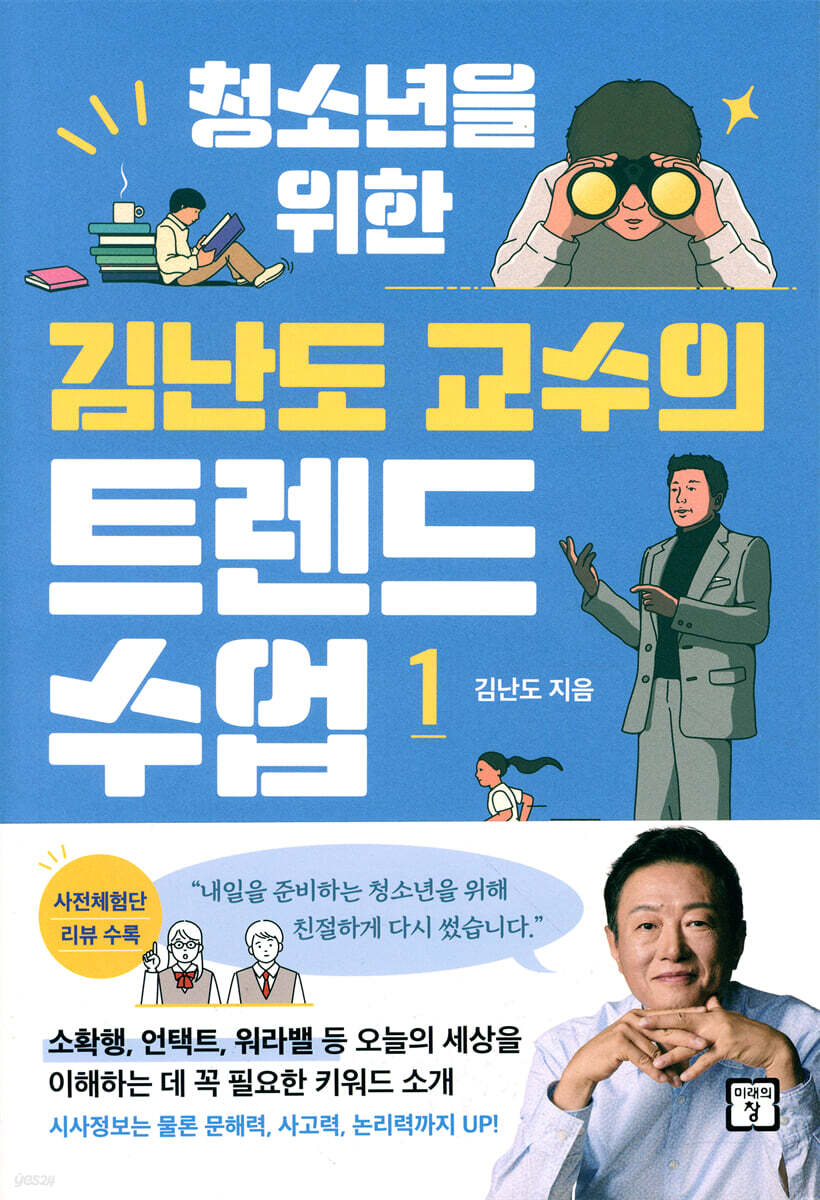
Professor Kim Nan-do's Trend Class for Youth 1
 |
Description
Book Introduction
Korea's #1 trend magazine, Trend Korea, is back with a youth edition!
"Rewritten with kindness for young people preparing for tomorrow."
'Trend Korea Youth Edition' is launched for teenagers, the generation that leads trends.
The Trend Korea series, which has focused on trend research for 16 years, has selected 7 keywords that are considered particularly important to our youth from among the 160 trend keywords announced so far, and rewritten them for easy reading.
This monumental first book contains seven trends: 'Minute Society, Average Disappearance, Homo Prompt, Untact, Work-Life Balance, Small Happiness, and Fair Society.'
These trends are keywords that best reflect the changes in our current society, and they are also the key words that will play a crucial role in helping young readers lead the future.
Here we also add a detailed lecture on why we need to know trends and how to interpret them.
It is packed with information, including a "Thought Sharing" page, a question corner that helps readers organize their thoughts and expand their thinking skills, and reviews from a pre-book review group that has read the book in advance.
A trend is a concept that is clearly different from a simple fad or a meme.
It has a very close and direct impact on our lives today, as it changes the way people earn money, meet and form relationships, and even live.
Now it's time for the young readers who will lead tomorrow to actively embody the trends.
In this complex economic and social climate, let's use this book as a tool to decide on a career path and plan for the future.
You will be able to become one of the top 10 students, equipped with not only current affairs information but also literacy, analytical skills, and logical thinking.
"Rewritten with kindness for young people preparing for tomorrow."
'Trend Korea Youth Edition' is launched for teenagers, the generation that leads trends.
The Trend Korea series, which has focused on trend research for 16 years, has selected 7 keywords that are considered particularly important to our youth from among the 160 trend keywords announced so far, and rewritten them for easy reading.
This monumental first book contains seven trends: 'Minute Society, Average Disappearance, Homo Prompt, Untact, Work-Life Balance, Small Happiness, and Fair Society.'
These trends are keywords that best reflect the changes in our current society, and they are also the key words that will play a crucial role in helping young readers lead the future.
Here we also add a detailed lecture on why we need to know trends and how to interpret them.
It is packed with information, including a "Thought Sharing" page, a question corner that helps readers organize their thoughts and expand their thinking skills, and reviews from a pre-book review group that has read the book in advance.
A trend is a concept that is clearly different from a simple fad or a meme.
It has a very close and direct impact on our lives today, as it changes the way people earn money, meet and form relationships, and even live.
Now it's time for the young readers who will lead tomorrow to actively embody the trends.
In this complex economic and social climate, let's use this book as a tool to decide on a career path and plan for the future.
You will be able to become one of the top 10 students, equipped with not only current affairs information but also literacy, analytical skills, and logical thinking.
- You can preview some of the book's contents.
Preview
index
Entering
1.
Why we need to know trends
Trends, why are they getting attention?
How to Discover the True Meaning of Trends
Preparing for predictions! Gathering data
There are different types of trends?
The Trend Korea team's unique prediction method
Trends, a window to the world!
2.
minute-by-minute society
Time over money
1 day, 1 hour, 1 minute, 1 second
'Cost-effectiveness' rather than 'cost-effectiveness'
I want to know the ending quickly
From the ownership economy to the experience economy
Time Thief's Trap
3.
Average missing
Why is the average necessary?
Three Reasons Why the Average Disappears
A society where individuals and their individual tastes are more important than the collective
South Korea is moving beyond the 'correct answer society'
Opportunities have expanded, and the choice is yours!
4.
Homo Prompt
The turning point of the AI era
2% less artificial intelligence
The emergence of the homo prompt
The winner of the drawing contest was an AI?
A rising career: Prompt Engineer
Human vs.
artificial intelligence
Why drama writers went on strike
Human-only capabilities become more important
5.
Untact
A daily life where non-face-to-face interaction is the norm
From 'contact' to 'untact'
Technological advancements and cost reductions
I hate it when people recognize me!
The Paradox of the Hyperconnected Age
Living in a Contactless World
'Untact' is ultimately for people.
6.
Work-life balance
The Birth of the 'Work-Life Balance Generation'
The company isn't everything!
New values for work and life
A generation with freedom to quit and change jobs
The Two Faces of Work-Life Balance
Work-life balance vs.
Workable
7.
small happiness
An unhappy Republic of Korea
Happiness isn't something grand.
Occam, Lagom, Hygge
Wellness, healing, YOLO, and small happiness
Happiness is here now!
Became Korea's most popular keyword
Small but certain happiness isn't everything
8.
fair society
The one thing that Incheon Airport doesn't have
Same competition, same rules! That's fair play.
Honjul vs.
Money? Want fairness in consumption?
I really hate team play
Subjective factors and fairness
The more equal society becomes, the more we want fairness?
Technological innovation, giving wings to fairness!
Preview and share your thoughts
1.
Why we need to know trends
Trends, why are they getting attention?
How to Discover the True Meaning of Trends
Preparing for predictions! Gathering data
There are different types of trends?
The Trend Korea team's unique prediction method
Trends, a window to the world!
2.
minute-by-minute society
Time over money
1 day, 1 hour, 1 minute, 1 second
'Cost-effectiveness' rather than 'cost-effectiveness'
I want to know the ending quickly
From the ownership economy to the experience economy
Time Thief's Trap
3.
Average missing
Why is the average necessary?
Three Reasons Why the Average Disappears
A society where individuals and their individual tastes are more important than the collective
South Korea is moving beyond the 'correct answer society'
Opportunities have expanded, and the choice is yours!
4.
Homo Prompt
The turning point of the AI era
2% less artificial intelligence
The emergence of the homo prompt
The winner of the drawing contest was an AI?
A rising career: Prompt Engineer
Human vs.
artificial intelligence
Why drama writers went on strike
Human-only capabilities become more important
5.
Untact
A daily life where non-face-to-face interaction is the norm
From 'contact' to 'untact'
Technological advancements and cost reductions
I hate it when people recognize me!
The Paradox of the Hyperconnected Age
Living in a Contactless World
'Untact' is ultimately for people.
6.
Work-life balance
The Birth of the 'Work-Life Balance Generation'
The company isn't everything!
New values for work and life
A generation with freedom to quit and change jobs
The Two Faces of Work-Life Balance
Work-life balance vs.
Workable
7.
small happiness
An unhappy Republic of Korea
Happiness isn't something grand.
Occam, Lagom, Hygge
Wellness, healing, YOLO, and small happiness
Happiness is here now!
Became Korea's most popular keyword
Small but certain happiness isn't everything
8.
fair society
The one thing that Incheon Airport doesn't have
Same competition, same rules! That's fair play.
Honjul vs.
Money? Want fairness in consumption?
I really hate team play
Subjective factors and fairness
The more equal society becomes, the more we want fairness?
Technological innovation, giving wings to fairness!
Preview and share your thoughts
Detailed image
.jpg)
Into the book
Changes that continually change the way people live are called 'trends'.
For example, the emergence of artificial intelligence is changing the ranking of desirable jobs, or the way companies work is changing as the way we think about fairness changes.
--- p.6
In fact, trends are not surprise events that suddenly fall from the sky one day.
Rather, it is closer to a wave that is slowly rising in the minds of the general public, that is, we consumers.
The values and meanings of culture that we perceive tend to change little by little as we live.
A trend is born when that wave of change moves from one person to many, from one group to a larger group.
--- pp.32-33
Travel destinations that are off-limits to everyone, rare and unique foods, and special services available only to a select few.
These days, these are objects of show.
What travel, delicious food, and hot places have in common is that they all require time.
If you want to go on a trip, especially an overseas trip, you usually need to spend about 5 days.
Even if you go only twice a year, it's already been more than 10 days.
Nowadays, money alone cannot buy luxury.
--- pp.56-57
But today, there is no standard by which we can confidently say, “This is average.”
As we have seen above, this is because the values that make up the average are each multipolar, polarized, and unipolar.
People who used to mainly buy items worth 10,000 won are now thrifty and sometimes even boldly buying items worth 10,000 won.
There has come a day when it would not be surprising if someone who always bought convenience store ramen were to buy a hotel shaved ice that costs over 100,000 won, or an omakase (cooked to order) that is even more expensive.
--- pp.78-79
The fact that the word 'Homo', meaning human, is written first in the Homo prompt means that human abilities have become that important.
Knowledge of humanities, such as history, philosophy, and language, is becoming increasingly important, as is knowledge of computer science itself, such as programming and machine learning.
--- p.114
People who feel uncomfortable with other people paying attention to them even for a moment use self-checkout machines at supermarkets and bookstores.
It's like something big would happen if other people found out what I bought or which book I bought.
This society of anonymity, where no one knows who is who, no one knows who is who, and no one knows who is who, is a major characteristic of our times.
--- p.132
For the work-life balance generation, who hope to "earn a decent income and live comfortably," nothing is more important than maintaining a balance between work and leisure activities.
They don't enjoy their hobbies after they have finished their work perfectly.
Instead, I quickly finish my work to enjoy my hobbies.
For the work-life balance generation, a life with regular work hours and evening meals is not an option, but a value they must protect.
--- pp.155-156
The magnitude of happiness derived from a very special experience, such as traveling abroad, may not be that different from the small happiness of spending a day reading your favorite book in the library.
The small, precious moments you share with the people next to you right now are the 'small but certain happiness' that will make your daily life happy.
--- pp.185-156
Everyone recognizes the fairness of objective tests, but no one can say for sure that objective tests are a "better method" than subjective tests.
Multiple-choice tests are a way to eliminate the noise of evaluation, conduct evaluations quickly and effectively, or conduct them at low cost. However, they are insufficient for discovering hidden talent.
Moreover, without other ways for each student to express their creativity and develop their own unique ideas, all students are forced to study in a rigid manner to get good scores on multiple-choice tests.
For example, the emergence of artificial intelligence is changing the ranking of desirable jobs, or the way companies work is changing as the way we think about fairness changes.
--- p.6
In fact, trends are not surprise events that suddenly fall from the sky one day.
Rather, it is closer to a wave that is slowly rising in the minds of the general public, that is, we consumers.
The values and meanings of culture that we perceive tend to change little by little as we live.
A trend is born when that wave of change moves from one person to many, from one group to a larger group.
--- pp.32-33
Travel destinations that are off-limits to everyone, rare and unique foods, and special services available only to a select few.
These days, these are objects of show.
What travel, delicious food, and hot places have in common is that they all require time.
If you want to go on a trip, especially an overseas trip, you usually need to spend about 5 days.
Even if you go only twice a year, it's already been more than 10 days.
Nowadays, money alone cannot buy luxury.
--- pp.56-57
But today, there is no standard by which we can confidently say, “This is average.”
As we have seen above, this is because the values that make up the average are each multipolar, polarized, and unipolar.
People who used to mainly buy items worth 10,000 won are now thrifty and sometimes even boldly buying items worth 10,000 won.
There has come a day when it would not be surprising if someone who always bought convenience store ramen were to buy a hotel shaved ice that costs over 100,000 won, or an omakase (cooked to order) that is even more expensive.
--- pp.78-79
The fact that the word 'Homo', meaning human, is written first in the Homo prompt means that human abilities have become that important.
Knowledge of humanities, such as history, philosophy, and language, is becoming increasingly important, as is knowledge of computer science itself, such as programming and machine learning.
--- p.114
People who feel uncomfortable with other people paying attention to them even for a moment use self-checkout machines at supermarkets and bookstores.
It's like something big would happen if other people found out what I bought or which book I bought.
This society of anonymity, where no one knows who is who, no one knows who is who, and no one knows who is who, is a major characteristic of our times.
--- p.132
For the work-life balance generation, who hope to "earn a decent income and live comfortably," nothing is more important than maintaining a balance between work and leisure activities.
They don't enjoy their hobbies after they have finished their work perfectly.
Instead, I quickly finish my work to enjoy my hobbies.
For the work-life balance generation, a life with regular work hours and evening meals is not an option, but a value they must protect.
--- pp.155-156
The magnitude of happiness derived from a very special experience, such as traveling abroad, may not be that different from the small happiness of spending a day reading your favorite book in the library.
The small, precious moments you share with the people next to you right now are the 'small but certain happiness' that will make your daily life happy.
--- pp.185-156
Everyone recognizes the fairness of objective tests, but no one can say for sure that objective tests are a "better method" than subjective tests.
Multiple-choice tests are a way to eliminate the noise of evaluation, conduct evaluations quickly and effectively, or conduct them at low cost. However, they are insufficient for discovering hidden talent.
Moreover, without other ways for each student to express their creativity and develop their own unique ideas, all students are forced to study in a rigid manner to get good scores on multiple-choice tests.
--- p.208
Publisher's Review
Only by developing an eye for trends can we prepare for a new future!
Smart Trend Lessons for Young Readers
These days, we hear the word 'trend' a lot.
Phrases like “You’re really trend-savvy!” or “You don’t know the trends that well…” are becoming more and more common.
What exactly is a "trend"? Why do people so eagerly seek to understand it? The answers to these questions can be found in this book.
This is an introductory book on trends, written by Professor Kim Nan-do, the leading author of the Trend Korea series, the number one trend book in Korea, and who has been researching trends in our society since 2004, and has been friendly and attentive to teenagers.
Trends are large-scale movements that change the way people live and the direction our society is moving.
For example, the emergence of artificial intelligence is changing the ranking of desired jobs, or the way companies work is changing as people's perceptions of fairness change.
Ultimately, you need to be able to read trends sharply to adapt and grow with change.
Now it is the turn of the youth, the protagonists of the future generation.
Ride the wave of rapidly changing trends and create your own tomorrow!
Untact, small but certain happiness, homo prompt, minute-by-minute society…
From 'steady trends' to 'latest trends',
I'll explain everything in one book.
Fast food kiosks and unmanned stores have become a common sight in Korea, but even in 2018, when the keyword "untact" first appeared, it wasn't a given.
The same goes for the 'small but certain happiness' trend.
After being introduced by Trend Korea, it became a huge craze and eventually succeeded in becoming Korea's favorite keyword.
In "Professor Kim Nan-do's Trend Class for Youth 1," we analyze where and how these now-in-our-life "mega trends" originated, and we meta-examine the contexts through which they have become consistently beloved trends.
It is a new interpretation of the 'trends' that young people take for granted in the context of 'current affairs'.
Here, we introduce real-time trends that are heating up today's society, such as 'Homo Prompt' and 'Minute Society', leading young people into the world of true trends.
This is the world's friendliest gift set, allowing you to learn about steady and cutting-edge trends in one book.
Literacy, thinking, and logical thinking LEVEL UP!
A shortcut to becoming a leading teenager
Although teenagers are the generation that most actively creates and enjoys trends, they have been easily excluded from serious discourse on 'trends'.
This means that until now, there has been no outlet that conveys the stories of the public's desires and psychology behind trends, the social waves triggered by trends, and the economic outlook, all in a way that is accessible to teenagers.
Professor Kim Nan-do personally took the lead and prepared a ‘trend shortcut’ for teenagers.
There's no better way to delve deeper into trends and understand the social and economic implications behind them.
In the process of publishing the book, we focused especially on developing the literacy, logical thinking, and insight into current affairs of young people.
Not only did we add a 'Sharing Thoughts' corner that examines timely questions related to each keyword, we also meticulously included answers and reviews from the Youth Dictionary Review Group, which will open up tomorrow.
The goal is to help them move beyond simply being ‘teenagers who are up to date with trends’ to becoming ‘teenagers who lead the flow of trends.’
Now, let's use this book as a guidebook to understand our society and as a weapon to prepare for entrance exam interviews and essays.
With Professor Kim Nan-do, the undisputed number one trend expert in Korea, you can evolve into a trendy talent who will lead the future.
Vivid reviews from readers who have already read this book!
Actually, I thought that trends and fads were helpful to know, but I never thought about why they were helpful, and I wasn't really interested in trends in general.
However, after reading Chapter 1: Why We Need to Know Trends, and especially the sentences "Trends are a window into our society" and "All issues are rooted in trends," I think I will become more interested in trends in the future.
― Kim Ha-ni, 6th grade, Daejeon Sangdae Elementary School
Trend!
I used to think it was just a trend that I had to keep up with, but after reading the sample book for Professor Kim Nan-do's Trend Class for Youth 1, I realized that it is essential knowledge that is absolutely necessary to understand modern society.
I hope that young people will read this book and take the time to organize their thoughts on trends.
I previewed the sample book, and I think that when the full book comes out, I will be reading this book with my son and sharing our thoughts.
― Kim Yeon-jae, mother of Heo Geon, a sixth-grade student at Bojeong Elementary School
Smart Trend Lessons for Young Readers
These days, we hear the word 'trend' a lot.
Phrases like “You’re really trend-savvy!” or “You don’t know the trends that well…” are becoming more and more common.
What exactly is a "trend"? Why do people so eagerly seek to understand it? The answers to these questions can be found in this book.
This is an introductory book on trends, written by Professor Kim Nan-do, the leading author of the Trend Korea series, the number one trend book in Korea, and who has been researching trends in our society since 2004, and has been friendly and attentive to teenagers.
Trends are large-scale movements that change the way people live and the direction our society is moving.
For example, the emergence of artificial intelligence is changing the ranking of desired jobs, or the way companies work is changing as people's perceptions of fairness change.
Ultimately, you need to be able to read trends sharply to adapt and grow with change.
Now it is the turn of the youth, the protagonists of the future generation.
Ride the wave of rapidly changing trends and create your own tomorrow!
Untact, small but certain happiness, homo prompt, minute-by-minute society…
From 'steady trends' to 'latest trends',
I'll explain everything in one book.
Fast food kiosks and unmanned stores have become a common sight in Korea, but even in 2018, when the keyword "untact" first appeared, it wasn't a given.
The same goes for the 'small but certain happiness' trend.
After being introduced by Trend Korea, it became a huge craze and eventually succeeded in becoming Korea's favorite keyword.
In "Professor Kim Nan-do's Trend Class for Youth 1," we analyze where and how these now-in-our-life "mega trends" originated, and we meta-examine the contexts through which they have become consistently beloved trends.
It is a new interpretation of the 'trends' that young people take for granted in the context of 'current affairs'.
Here, we introduce real-time trends that are heating up today's society, such as 'Homo Prompt' and 'Minute Society', leading young people into the world of true trends.
This is the world's friendliest gift set, allowing you to learn about steady and cutting-edge trends in one book.
Literacy, thinking, and logical thinking LEVEL UP!
A shortcut to becoming a leading teenager
Although teenagers are the generation that most actively creates and enjoys trends, they have been easily excluded from serious discourse on 'trends'.
This means that until now, there has been no outlet that conveys the stories of the public's desires and psychology behind trends, the social waves triggered by trends, and the economic outlook, all in a way that is accessible to teenagers.
Professor Kim Nan-do personally took the lead and prepared a ‘trend shortcut’ for teenagers.
There's no better way to delve deeper into trends and understand the social and economic implications behind them.
In the process of publishing the book, we focused especially on developing the literacy, logical thinking, and insight into current affairs of young people.
Not only did we add a 'Sharing Thoughts' corner that examines timely questions related to each keyword, we also meticulously included answers and reviews from the Youth Dictionary Review Group, which will open up tomorrow.
The goal is to help them move beyond simply being ‘teenagers who are up to date with trends’ to becoming ‘teenagers who lead the flow of trends.’
Now, let's use this book as a guidebook to understand our society and as a weapon to prepare for entrance exam interviews and essays.
With Professor Kim Nan-do, the undisputed number one trend expert in Korea, you can evolve into a trendy talent who will lead the future.
Vivid reviews from readers who have already read this book!
Actually, I thought that trends and fads were helpful to know, but I never thought about why they were helpful, and I wasn't really interested in trends in general.
However, after reading Chapter 1: Why We Need to Know Trends, and especially the sentences "Trends are a window into our society" and "All issues are rooted in trends," I think I will become more interested in trends in the future.
― Kim Ha-ni, 6th grade, Daejeon Sangdae Elementary School
Trend!
I used to think it was just a trend that I had to keep up with, but after reading the sample book for Professor Kim Nan-do's Trend Class for Youth 1, I realized that it is essential knowledge that is absolutely necessary to understand modern society.
I hope that young people will read this book and take the time to organize their thoughts on trends.
I previewed the sample book, and I think that when the full book comes out, I will be reading this book with my son and sharing our thoughts.
― Kim Yeon-jae, mother of Heo Geon, a sixth-grade student at Bojeong Elementary School
GOODS SPECIFICS
- Date of issue: July 9, 2024
- Page count, weight, size: 224 pages | 338g | 140*203*14mm
- ISBN13: 9791193638286
- ISBN10: 1193638283
You may also like
카테고리
korean


korean

![GQ KOREA Mark (Monthly): December [2025]](http://librairie.coreenne.fr/cdn/shop/files/8ef265dbbfbf186523ed75ba7319009d.jpg?v=1765340328&width=3840)


