

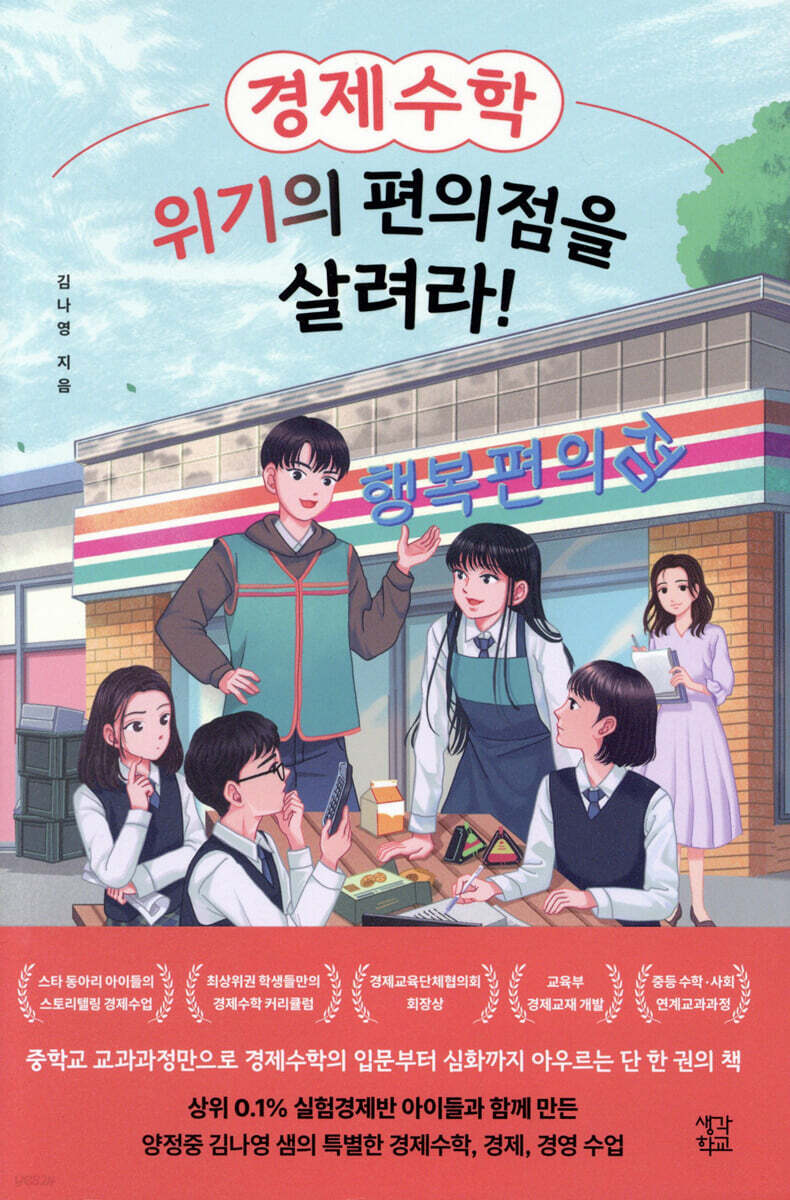
Economic Mathematics: Save Convenience Stores in Crisis!
 |
Description
Book Introduction
Learn the core of "Economic Mathematics" with just the secondary course! The only book that explains the triangle of economics, mathematics, and management in real life. Economics and Math Concepts You Must Learn in Your Teenage Years ★★★★★ If you know "Economic Mathematics," you'll master both economics and mathematics! ★★★★★ This book is designed to help young people understand mathematics, economics, and business concepts, learn economics from introductory to advanced levels using only the middle school curriculum, and prepare for the high school credit system that will change in 2025. The author, Nayoung Kim, has been in charge of developing economic and financial education for youth at the Ministry of Education, the Ministry of Strategy and Finance, and the Seoul Metropolitan Office of Education. She has also demonstrated to youth the connection between economics, reality, and mathematics through her long-time experience running Yang Jeong-jung's star club, "Experimental Economics Class." In particular, this book minimizes the use of difficult formulas and uses a storytelling method to capture the interest of young people in order to show that economic thinking is mathematical thinking. In particular, through the story of the five musketeers of Rainbow Middle School, students can naturally learn economics, mathematics, and economic concepts from the text, and the teacher's own economics and management lectures and mathematical concepts that can help readers understand the text are introduced, clearly pointing out even the parts that readers may have missed while reading the story. In particular, this book allows you to understand the psychology of managers and consumers and interpret its foundation mathematically, even if you only know the secondary school curriculum. Stories about mathematics, economics, and management moving together like a triangle also stimulate the intellectual curiosity of young people. In this book, the Rainbow Middle School friends begin to find a way to rationally maximize the convenience store's profits in order to save the Happy Convenience Store, which is filled with their friendships and memories. The five who became CEOs of a convenience store learn the basics of economics and management, including consumer psychology, product selection, pricing, optimal order quantity, optimal display, and events. Throughout the process, the five musketeers gradually acquire economic mathematics concepts. At this time, we learn that everything in our daily lives, including functions and prices, inequalities and choices, probability and finance, proportions and trade, which felt completely unrelated to reality, are actually based on mathematics. This book will help you think systematically about economic mathematics, management, and economics, and will also help you fully understand unfamiliar terms and concepts. We teach young people who dream of starting their own businesses how to make their ideas come to life, and help them see the world from a broader perspective by covering economics and mathematics. This book was written by an author who personally taught middle school students, based on the practical questions of young people, so it will be useful to teachers and parents in the field. |
- You can preview some of the book's contents.
Preview
index
To the readers of this book: Let's find the mathematics hidden in economic principles in real life.
Introducing the Rainbow Middle School friends
Entering our hideout, the Happy Convenience Store between school and academy
Chapter 1: Strangely, when you go there, you feel like buying something.
There's a secret to convenience store item placement that we don't know about.
We are the convenience store trio
Why is the drink I want always inside?
The Golden Zone, a hellhole that's hard to escape from
Nayoung Sam's mini lecture on economics and management?
┗Consumer psychology: The magic of convenience stores that leads us to purchase
Math hidden in the economy?
┗Cylinders and square columns, wasted space ultimately increases costs
Chapter 2 Why the heck can't I buy the limited edition?
The more you lack, the more you want to have.
It would be nice if they sold it a little more generously.
The more desperate you are, the higher the price goes up.
Why it's easy to get scammed
Nayoung Sam's mini lecture on economics and management?
┗Demand Fluctuations: Why the Things I Want Are Always Expensive
Math hidden in the economy?
┗Demand, the function between the quantity desired to buy and the price
Chapter 3: Making Your Own Dishes at a Convenience Store Self-Cooking Bar
They say that if you respect people's tastes, it will sell better.
Modishumers who enjoy their own unique experiences
Convenience store mango bingsu, would you like to try it?
How we deal with black consumers
It's also unfair to just cry out loud
Nayoung Sam's mini lecture on economics and management?
Opportunity cost: There is always a sacrifice behind every choice.
Math hidden in the economy?
┗Percentage, if you understand it well, the product will become cheaper
Chapter 4: The world looks different when you actually start working
Youth labor: something you can only understand by experiencing it yourself
I didn't know it would be this hard for a middle school student to work
There's a lot you can learn from working
The perspectives of buyers and sellers are different.
Have you heard of the convenience store that saves children?
Ordering ice cream is no easy task.
Nayoung Sam's mini lecture on economics and management?
┗Labor, a necessary condition for the flow of money and goods
Math hidden in the economy?
┗Supply, the relationship between price and quantity to be sold
Chapter 5: Can We Beat Unmanned Convenience Stores?
Let's start with a price discount.
I thought customers would flock if there was a discount.
It can't go on like this, so let's find a way.
Ideas to earn more by selling more
Nayoung Sam's mini lecture on economics and management?
┗Price, the interaction of supply and demand
Math hidden in the economy?
┗Equilibrium price, mathematical expression of the invisible hand
Chapter 6: Convenience Stores Have a Way to Survive: Let's Increase Profits
We need our own differentiation strategy
Stop compensating for shortcomings and maximize your strengths.
Wouldn't it be great if we held a cooking contest?
Our Top 5 Recipes, Who Knew They'd Be This Popular
So pricing is this difficult
Nayoung Sam's mini lecture on economics and management?
┗Product Development, Creating Your Own Innovation
Math hidden in the economy?
┗Opportunity costs are also included in production costs and product prices?
Chapter 7: We Can Do It, We Became CEOs of Happy Convenience Stores
See everything from problems to solutions at a glance through the management process.
Everything changes when you see it through the CEO's eyes.
Find seasonal items: masks in spring, hand fans in summer.
What happens when a convenience store manager goes to Japan?
Math increases my satisfaction
Nayoung Sam's mini lecture on economics and management?
┗Let's learn the basics of management, operation, and management methods.
Math hidden in the economy?
┗Decision-making: Numbers guide us to wise choices.
Chapter 8: The Real Crisis We Face: Investment Is Needed to Recover
Can Crowdfunding Solve This?
The prettier it is, the better it sells
Capturing people's hearts with eco-bags
Funding Achieved! The Busiest Five CEOs
Nayoung Sam's mini lecture on economics and management?
┗Funding, helping people grow their businesses
Math hidden in the economy?
┗Investment, the most important thing is growth potential
Chapter 9: From Branding to Promotion with Our Unique Characteristics
The Five Convenience Store CEOs' Guide to Understanding Customers
Are you saying that a biscuit we collaborated on is coming out?
People are excited because it's rare
No one eats the same thing every day.
Get to know your customers through sales and inventory checks
Nayoung Sam's mini lecture on economics and management?
┗Brand, what value does it have?
Math hidden in the economy?
┗Dito consumption, I want to buy the same thing as you
Chapter 10: K-Gimbap is trending. Should we try exporting it?
A business plan is essential to make your dreams come true.
But how should I write it?
I work with a food company on food development.
I hope our attempt will be successful.
Nayoung Sam's mini lecture on economics and management?
┗Check out business ideas, from bright hopes to risk factors.
Math hidden in the economy?
┗Production and Sales: Our Future as Seen in Graphs
Chapter 11: To enter the US market, you need to know the exchange rate as much as you need to know how to make kimbap.
Imports and exports are two sides of the same coin.
There's marketing even on the popcorn menu.
Finally exporting K-kimbap
What do overseas consumers like?
Nayoung Sam's Mini Lecture on Economics and Management⑪
┗The dollar and won: the dilemma of rising and falling prices
Mathematics Hidden in the Economy⑪
┗Overseas direct purchase, money moves flexibly
The more chapters are sold, the lower the production cost.
The Five Musketeers' Concerns for Building a Global Company
If it sells well, should we produce more?
When costs rise, we must find alternatives.
Nayoung Sam's Mini Lecture on Economics and Management⑫
┗Innate Internationalization: What Teenagers Need to Know About Overseas Market Expansion
Mathematics Hidden in the Economy⑫
┗Economies of scale: as production increases, costs decrease.
What are my friends who were convenience store CEOs doing now?
Appendix 1: We Need Entrepreneurship, Challenge, and Innovation Too
Appendix 2 Business Plan Form
Introducing the Rainbow Middle School friends
Entering our hideout, the Happy Convenience Store between school and academy
Chapter 1: Strangely, when you go there, you feel like buying something.
There's a secret to convenience store item placement that we don't know about.
We are the convenience store trio
Why is the drink I want always inside?
The Golden Zone, a hellhole that's hard to escape from
Nayoung Sam's mini lecture on economics and management?
┗Consumer psychology: The magic of convenience stores that leads us to purchase
Math hidden in the economy?
┗Cylinders and square columns, wasted space ultimately increases costs
Chapter 2 Why the heck can't I buy the limited edition?
The more you lack, the more you want to have.
It would be nice if they sold it a little more generously.
The more desperate you are, the higher the price goes up.
Why it's easy to get scammed
Nayoung Sam's mini lecture on economics and management?
┗Demand Fluctuations: Why the Things I Want Are Always Expensive
Math hidden in the economy?
┗Demand, the function between the quantity desired to buy and the price
Chapter 3: Making Your Own Dishes at a Convenience Store Self-Cooking Bar
They say that if you respect people's tastes, it will sell better.
Modishumers who enjoy their own unique experiences
Convenience store mango bingsu, would you like to try it?
How we deal with black consumers
It's also unfair to just cry out loud
Nayoung Sam's mini lecture on economics and management?
Opportunity cost: There is always a sacrifice behind every choice.
Math hidden in the economy?
┗Percentage, if you understand it well, the product will become cheaper
Chapter 4: The world looks different when you actually start working
Youth labor: something you can only understand by experiencing it yourself
I didn't know it would be this hard for a middle school student to work
There's a lot you can learn from working
The perspectives of buyers and sellers are different.
Have you heard of the convenience store that saves children?
Ordering ice cream is no easy task.
Nayoung Sam's mini lecture on economics and management?
┗Labor, a necessary condition for the flow of money and goods
Math hidden in the economy?
┗Supply, the relationship between price and quantity to be sold
Chapter 5: Can We Beat Unmanned Convenience Stores?
Let's start with a price discount.
I thought customers would flock if there was a discount.
It can't go on like this, so let's find a way.
Ideas to earn more by selling more
Nayoung Sam's mini lecture on economics and management?
┗Price, the interaction of supply and demand
Math hidden in the economy?
┗Equilibrium price, mathematical expression of the invisible hand
Chapter 6: Convenience Stores Have a Way to Survive: Let's Increase Profits
We need our own differentiation strategy
Stop compensating for shortcomings and maximize your strengths.
Wouldn't it be great if we held a cooking contest?
Our Top 5 Recipes, Who Knew They'd Be This Popular
So pricing is this difficult
Nayoung Sam's mini lecture on economics and management?
┗Product Development, Creating Your Own Innovation
Math hidden in the economy?
┗Opportunity costs are also included in production costs and product prices?
Chapter 7: We Can Do It, We Became CEOs of Happy Convenience Stores
See everything from problems to solutions at a glance through the management process.
Everything changes when you see it through the CEO's eyes.
Find seasonal items: masks in spring, hand fans in summer.
What happens when a convenience store manager goes to Japan?
Math increases my satisfaction
Nayoung Sam's mini lecture on economics and management?
┗Let's learn the basics of management, operation, and management methods.
Math hidden in the economy?
┗Decision-making: Numbers guide us to wise choices.
Chapter 8: The Real Crisis We Face: Investment Is Needed to Recover
Can Crowdfunding Solve This?
The prettier it is, the better it sells
Capturing people's hearts with eco-bags
Funding Achieved! The Busiest Five CEOs
Nayoung Sam's mini lecture on economics and management?
┗Funding, helping people grow their businesses
Math hidden in the economy?
┗Investment, the most important thing is growth potential
Chapter 9: From Branding to Promotion with Our Unique Characteristics
The Five Convenience Store CEOs' Guide to Understanding Customers
Are you saying that a biscuit we collaborated on is coming out?
People are excited because it's rare
No one eats the same thing every day.
Get to know your customers through sales and inventory checks
Nayoung Sam's mini lecture on economics and management?
┗Brand, what value does it have?
Math hidden in the economy?
┗Dito consumption, I want to buy the same thing as you
Chapter 10: K-Gimbap is trending. Should we try exporting it?
A business plan is essential to make your dreams come true.
But how should I write it?
I work with a food company on food development.
I hope our attempt will be successful.
Nayoung Sam's mini lecture on economics and management?
┗Check out business ideas, from bright hopes to risk factors.
Math hidden in the economy?
┗Production and Sales: Our Future as Seen in Graphs
Chapter 11: To enter the US market, you need to know the exchange rate as much as you need to know how to make kimbap.
Imports and exports are two sides of the same coin.
There's marketing even on the popcorn menu.
Finally exporting K-kimbap
What do overseas consumers like?
Nayoung Sam's Mini Lecture on Economics and Management⑪
┗The dollar and won: the dilemma of rising and falling prices
Mathematics Hidden in the Economy⑪
┗Overseas direct purchase, money moves flexibly
The more chapters are sold, the lower the production cost.
The Five Musketeers' Concerns for Building a Global Company
If it sells well, should we produce more?
When costs rise, we must find alternatives.
Nayoung Sam's Mini Lecture on Economics and Management⑫
┗Innate Internationalization: What Teenagers Need to Know About Overseas Market Expansion
Mathematics Hidden in the Economy⑫
┗Economies of scale: as production increases, costs decrease.
What are my friends who were convenience store CEOs doing now?
Appendix 1: We Need Entrepreneurship, Challenge, and Innovation Too
Appendix 2 Business Plan Form
Detailed image

Into the book
What math is in economics? The bottles we drink are cylindrical.
However, milk is often stored in a square cylindrical shape.
Why is that? It's a mix of economics and mathematics.
Furthermore, it is also applicable in more specialized economic fields such as predicting people's preferences and purchasing demands, determining prices, predicting production costs, and determining production volume.
--- p.7
“You said you came here to buy drinks?”
"huh."
“But you grabbed the nachos and popcorn first, not the drink.”
"right.
But why is that?”
When I asked, puzzled by Junwoo's words, Junwoo raised his index finger and made the number 1 and said.
“This is the secret of the convenience store display case!”
“Oh, I heard that too.
“I put the drink inside on purpose!”
Kyungho said.
"that's right.
“They say that drinks are the best-selling items in convenience stores, so they put them at the very back.”
--- p.32
“I said that because the convenience store food that Kyungho made last time looked delicious.
“These days, the trend is modish consumers!”
“Modisumer?”
Kiyeon answered my question.
“Yes, modisumer is a compound word of modify and consumer, and it refers to a consumer who enjoys his or her own unique experience.
“Kyungho is just like Modishumer!”
Kiyeon said she bought it herself and held out three triangle kimbap, three cup rice noodles, cheese strings, and crab meat.
“Last time I saw you, you did it like this!”
--- p.73
While looking at the sales ledger, Kiyeon was discussing with the boss about increasing ice cream orders, but was worried.
I thought that if I ordered more of the more expensive strawberry plum sorbet and displayed it, customers would buy more.
If expensive items sell a lot, it will be profitable for the convenience store.
But in reality, Viva Big's sales were 20% higher than Strawberry Sorbet's.
Even if the price is low, if it sells well, it seems similar to the profit from selling strawberry sorbet.
Kiyeon suddenly became curious.
'How on earth should I order ice cream so that the convenience store profits?'
However, milk is often stored in a square cylindrical shape.
Why is that? It's a mix of economics and mathematics.
Furthermore, it is also applicable in more specialized economic fields such as predicting people's preferences and purchasing demands, determining prices, predicting production costs, and determining production volume.
--- p.7
“You said you came here to buy drinks?”
"huh."
“But you grabbed the nachos and popcorn first, not the drink.”
"right.
But why is that?”
When I asked, puzzled by Junwoo's words, Junwoo raised his index finger and made the number 1 and said.
“This is the secret of the convenience store display case!”
“Oh, I heard that too.
“I put the drink inside on purpose!”
Kyungho said.
"that's right.
“They say that drinks are the best-selling items in convenience stores, so they put them at the very back.”
--- p.32
“I said that because the convenience store food that Kyungho made last time looked delicious.
“These days, the trend is modish consumers!”
“Modisumer?”
Kiyeon answered my question.
“Yes, modisumer is a compound word of modify and consumer, and it refers to a consumer who enjoys his or her own unique experience.
“Kyungho is just like Modishumer!”
Kiyeon said she bought it herself and held out three triangle kimbap, three cup rice noodles, cheese strings, and crab meat.
“Last time I saw you, you did it like this!”
--- p.73
While looking at the sales ledger, Kiyeon was discussing with the boss about increasing ice cream orders, but was worried.
I thought that if I ordered more of the more expensive strawberry plum sorbet and displayed it, customers would buy more.
If expensive items sell a lot, it will be profitable for the convenience store.
But in reality, Viva Big's sales were 20% higher than Strawberry Sorbet's.
Even if the price is low, if it sells well, it seems similar to the profit from selling strawberry sorbet.
Kiyeon suddenly became curious.
'How on earth should I order ice cream so that the convenience store profits?'
--- p.104
Publisher's Review
The core of 《Economic Mathematics》 covered in the secondary school curriculum!
You can learn the triangle of economics, mathematics, and management with this one book.
Economics and Math Concepts You Must Learn in Your Teenage Years ★★★★★
If you know "Economic Mathematics," you'll master both economics and mathematics! ★★★★★
This book is designed to help young people understand mathematics, economics, and business concepts, learn economics from introductory to advanced levels using only the middle school curriculum, and prepare for the high school credit system that will change in 2025.
The author, Nayoung Kim, has been in charge of developing economic and financial education for youth at the Ministry of Education, the Ministry of Strategy and Finance, and the Seoul Metropolitan Office of Education. She has also demonstrated to youth the connection between economics, reality, and mathematics through her long-time experience running Yang Jeong-jung's star club, "Experimental Economics Class."
In particular, this book minimizes the use of difficult formulas and uses a storytelling method to capture the interest of young people in order to show that economic thinking is mathematical thinking.
In particular, through the story of the five musketeers of Rainbow Middle School, students can naturally learn economics, mathematics, and economic concepts from the text, and the teacher's own economics and management lectures and mathematical concepts that can help readers understand the text are introduced, clearly pointing out even the parts that readers may have missed while reading the story.
In particular, this book allows you to understand the psychology of managers and consumers and interpret its foundation mathematically, even if you only know the secondary school curriculum.
Stories about mathematics, economics, and management moving together like a triangle also stimulate the intellectual curiosity of young people.
In this book, the Rainbow Middle School friends begin to find a way to rationally maximize the convenience store's profits in order to save the Happy Convenience Store, which is filled with their friendships and memories.
The five who became CEOs of a convenience store learn the basics of economics and management, including consumer psychology, product selection, pricing, optimal order quantity, optimal display, and events. Throughout the process, the five musketeers gradually acquire economic mathematics concepts.
At this time, we learn that everything in our daily lives, including functions and prices, inequalities and choices, probability and finance, proportions and trade, which felt completely unrelated to reality, are actually based on mathematics.
This book will help you think systematically about economic mathematics, management, and economics, and will also help you fully understand unfamiliar terms and concepts.
We teach young people who dream of starting their own businesses how to make their ideas come to life, and help them see the world from a broader perspective by covering economics and mathematics.
This book was written by an author who personally taught middle school students, based on the practical questions of young people, so it will be useful to teachers and parents in the field.
Learning mathematical thinking while solving real-world problems,
The first 《Economics and Mathematics》 class of the top five students at Rainbow Middle School!
Convenience stores can be found everywhere around us.
For teenagers, convenience stores are places where they can stop by with friends after class or grab a quick bite to eat during breaks at the academy.
The author examines the economic activities taking place in convenience stores, the most familiar space for young people.
Not only convenience stores, but all human actions are connected to the economy.
What to eat when we wake up in the morning, what clothes to wear, whether to walk to school or take the bus—all of these things involve choices, and these choices themselves are connected to our economic activities, namely the concept of "opportunity cost."
Through convenience stores, teenagers learn about economic principles and mathematics contained within convenience store displays.
The bottles we drink from are cylindrical, but milk is stored in square cylindrical bottles.
This is a volume unit that 6th graders learn, and through this concept, they can fully understand space and display costs.
By providing a sense of economic mathematics through the most basic mathematics, this book enables young people, the main consumers of convenience stores, to view consumption from the perspective of economic activity.
Find a way to reasonably maximize convenience store profits!
In order to save Happy Convenience Store, which is in crisis due to the emergence of unmanned convenience stores, the five main characters of Rainbow Musketeers work with teacher Kim Na-young to figure out a way to revive the convenience store.
The biggest solution to this difficulty is economic mathematics.
Five convenience store CEOs use linear functions to gauge demand, observing the enthusiasm of people for limited-edition snacks.
We also observe how sales vary depending on the product price, and we express the function in various ways to find the equilibrium price that suits the product.
The five convenience store chains use discount strategies to gain an edge in competition with unmanned convenience stores.
Sales increased, but ultimately, you found that it led to losses.
After realizing that high sales do not lead to profits, the Five Musketeers begin to predict consumer purchases based on price and sales.
If you can't use the discounts that consumers react to first, you need a 'differentiation strategy' unique to Happy Convenience Store.
Instead of compensating for shortcomings, they actively seek out the unique strengths of Happy Convenience Store.
A simple self-cooking bar and a space where friends can sit and chat were unique features of Happy Convenience Store.
Additionally, Happy Convenience Store is preparing events to communicate with more consumers, not just school and academy friends.
In this process, the five members of Rainbow Middle School look into crowdfunding to secure the necessary investment funds for the Happy Convenience Store.
As you study investing, understand the concepts of stocks and bonds, and read about how to calculate investment returns, you will naturally acquire financial literacy.
From product manufacturing to export
Learn the powerful uses of economic mathematics!
By leveraging consumer psychology to drive purchases, calculating appropriate prices and adjusting orders based on fluctuations in demand, the five convenience store owners gradually master the economy, markets, and the mathematics of logical analysis. As CEOs, the five convenience store owners observe the world through the eyes of business leaders and experience profound changes.
Through management processes, we analyze problems, analyze seasonal products sold at convenience stores, and organize displays and events.
After that, I went on a trip to Japan with my parents and analyzed the convenience stores there and learned various strategies to attract consumers' convenience.
We can see that the decision to purchase as many different products as possible within one's own limitations is ultimately connected to the concept of inequality.
Afterwards, in order to revive Happy Convenience Store, the five musketeers stimulated the psychology of consumers with various events such as flat-rate tickets and coupons, and promoted Happy Convenience Store through crowdfunding. They also created a collaboration product at the suggestion of a snack company.
As they create products together, they realize the importance of creating their own brand.
The five musketeers, who learned through Chan, who went to study abroad, that K-kimbap was popular in the United States, decided to export kimbap.
However, exporting is not possible through will alone.
To make your dreams come true, write a business plan and identify the hopes and risks.
The Five Musketeers learn about export strategies and things to keep in mind when conducting overseas trade while confirming the popularity of K-Gimbap.
Knowing that it is difficult to import bulgogi, they use a substitute, tofu, and respond flexibly to market conditions.
In order to predict demand and determine production volume, they learn the concept of exchange rates through the dollar and won.
Through exports, money moves flexibly according to market conditions, and through imports, we can also see the global economic trends reflected in exchange rates.
Finally, the book explains the difficult concept of economies of scale to young people.
For young people who are unsure whether it is okay to expand production facilities if kimbap sells well, or whether costs will double if production volume doubles, we talk about the magic of economics, where production costs decrease as production volume increases, using variable and fixed costs, and the mathematical calculations that make it possible.
You can experience it while reading
Management tips for teenagers!
The greatest strength of this book is its storytelling.
As teenagers read the story of the Rainbow Middle School convenience store 5, they ponder what choices they would make if they were in their position.
Additionally, they actively utilize the upper elementary school and middle school curriculum to solve problems.
For readers curious about the content of economic mathematics, this book helps them learn the framework and basic concepts of economic mathematics, and provides readers with a vivid experience as if they were running a convenience store.
The mathematical skills that are at the core of 'economic mathematics' are useful not only for convenience stores but also for discovering your own problems and solutions.
Readers who find economic mathematics daunting and mathematics itself difficult can review the basic concepts once again, and readers who want to learn more about the structure and concepts of economic mathematics can deepen their learning.
In the future, the usefulness of economic mathematics in youth financial education will increase even more.
Learning social studies and mathematics together in this process is the core of the integrated curriculum.
"Economics and Mathematics: Save Convenience Stores in Crisis!" was written after teaching middle school students and listening directly to their questions. It is a must-read for both teachers and parents preparing for the high school credit system.
You can learn the triangle of economics, mathematics, and management with this one book.
Economics and Math Concepts You Must Learn in Your Teenage Years ★★★★★
If you know "Economic Mathematics," you'll master both economics and mathematics! ★★★★★
This book is designed to help young people understand mathematics, economics, and business concepts, learn economics from introductory to advanced levels using only the middle school curriculum, and prepare for the high school credit system that will change in 2025.
The author, Nayoung Kim, has been in charge of developing economic and financial education for youth at the Ministry of Education, the Ministry of Strategy and Finance, and the Seoul Metropolitan Office of Education. She has also demonstrated to youth the connection between economics, reality, and mathematics through her long-time experience running Yang Jeong-jung's star club, "Experimental Economics Class."
In particular, this book minimizes the use of difficult formulas and uses a storytelling method to capture the interest of young people in order to show that economic thinking is mathematical thinking.
In particular, through the story of the five musketeers of Rainbow Middle School, students can naturally learn economics, mathematics, and economic concepts from the text, and the teacher's own economics and management lectures and mathematical concepts that can help readers understand the text are introduced, clearly pointing out even the parts that readers may have missed while reading the story.
In particular, this book allows you to understand the psychology of managers and consumers and interpret its foundation mathematically, even if you only know the secondary school curriculum.
Stories about mathematics, economics, and management moving together like a triangle also stimulate the intellectual curiosity of young people.
In this book, the Rainbow Middle School friends begin to find a way to rationally maximize the convenience store's profits in order to save the Happy Convenience Store, which is filled with their friendships and memories.
The five who became CEOs of a convenience store learn the basics of economics and management, including consumer psychology, product selection, pricing, optimal order quantity, optimal display, and events. Throughout the process, the five musketeers gradually acquire economic mathematics concepts.
At this time, we learn that everything in our daily lives, including functions and prices, inequalities and choices, probability and finance, proportions and trade, which felt completely unrelated to reality, are actually based on mathematics.
This book will help you think systematically about economic mathematics, management, and economics, and will also help you fully understand unfamiliar terms and concepts.
We teach young people who dream of starting their own businesses how to make their ideas come to life, and help them see the world from a broader perspective by covering economics and mathematics.
This book was written by an author who personally taught middle school students, based on the practical questions of young people, so it will be useful to teachers and parents in the field.
Learning mathematical thinking while solving real-world problems,
The first 《Economics and Mathematics》 class of the top five students at Rainbow Middle School!
Convenience stores can be found everywhere around us.
For teenagers, convenience stores are places where they can stop by with friends after class or grab a quick bite to eat during breaks at the academy.
The author examines the economic activities taking place in convenience stores, the most familiar space for young people.
Not only convenience stores, but all human actions are connected to the economy.
What to eat when we wake up in the morning, what clothes to wear, whether to walk to school or take the bus—all of these things involve choices, and these choices themselves are connected to our economic activities, namely the concept of "opportunity cost."
Through convenience stores, teenagers learn about economic principles and mathematics contained within convenience store displays.
The bottles we drink from are cylindrical, but milk is stored in square cylindrical bottles.
This is a volume unit that 6th graders learn, and through this concept, they can fully understand space and display costs.
By providing a sense of economic mathematics through the most basic mathematics, this book enables young people, the main consumers of convenience stores, to view consumption from the perspective of economic activity.
Find a way to reasonably maximize convenience store profits!
In order to save Happy Convenience Store, which is in crisis due to the emergence of unmanned convenience stores, the five main characters of Rainbow Musketeers work with teacher Kim Na-young to figure out a way to revive the convenience store.
The biggest solution to this difficulty is economic mathematics.
Five convenience store CEOs use linear functions to gauge demand, observing the enthusiasm of people for limited-edition snacks.
We also observe how sales vary depending on the product price, and we express the function in various ways to find the equilibrium price that suits the product.
The five convenience store chains use discount strategies to gain an edge in competition with unmanned convenience stores.
Sales increased, but ultimately, you found that it led to losses.
After realizing that high sales do not lead to profits, the Five Musketeers begin to predict consumer purchases based on price and sales.
If you can't use the discounts that consumers react to first, you need a 'differentiation strategy' unique to Happy Convenience Store.
Instead of compensating for shortcomings, they actively seek out the unique strengths of Happy Convenience Store.
A simple self-cooking bar and a space where friends can sit and chat were unique features of Happy Convenience Store.
Additionally, Happy Convenience Store is preparing events to communicate with more consumers, not just school and academy friends.
In this process, the five members of Rainbow Middle School look into crowdfunding to secure the necessary investment funds for the Happy Convenience Store.
As you study investing, understand the concepts of stocks and bonds, and read about how to calculate investment returns, you will naturally acquire financial literacy.
From product manufacturing to export
Learn the powerful uses of economic mathematics!
By leveraging consumer psychology to drive purchases, calculating appropriate prices and adjusting orders based on fluctuations in demand, the five convenience store owners gradually master the economy, markets, and the mathematics of logical analysis. As CEOs, the five convenience store owners observe the world through the eyes of business leaders and experience profound changes.
Through management processes, we analyze problems, analyze seasonal products sold at convenience stores, and organize displays and events.
After that, I went on a trip to Japan with my parents and analyzed the convenience stores there and learned various strategies to attract consumers' convenience.
We can see that the decision to purchase as many different products as possible within one's own limitations is ultimately connected to the concept of inequality.
Afterwards, in order to revive Happy Convenience Store, the five musketeers stimulated the psychology of consumers with various events such as flat-rate tickets and coupons, and promoted Happy Convenience Store through crowdfunding. They also created a collaboration product at the suggestion of a snack company.
As they create products together, they realize the importance of creating their own brand.
The five musketeers, who learned through Chan, who went to study abroad, that K-kimbap was popular in the United States, decided to export kimbap.
However, exporting is not possible through will alone.
To make your dreams come true, write a business plan and identify the hopes and risks.
The Five Musketeers learn about export strategies and things to keep in mind when conducting overseas trade while confirming the popularity of K-Gimbap.
Knowing that it is difficult to import bulgogi, they use a substitute, tofu, and respond flexibly to market conditions.
In order to predict demand and determine production volume, they learn the concept of exchange rates through the dollar and won.
Through exports, money moves flexibly according to market conditions, and through imports, we can also see the global economic trends reflected in exchange rates.
Finally, the book explains the difficult concept of economies of scale to young people.
For young people who are unsure whether it is okay to expand production facilities if kimbap sells well, or whether costs will double if production volume doubles, we talk about the magic of economics, where production costs decrease as production volume increases, using variable and fixed costs, and the mathematical calculations that make it possible.
You can experience it while reading
Management tips for teenagers!
The greatest strength of this book is its storytelling.
As teenagers read the story of the Rainbow Middle School convenience store 5, they ponder what choices they would make if they were in their position.
Additionally, they actively utilize the upper elementary school and middle school curriculum to solve problems.
For readers curious about the content of economic mathematics, this book helps them learn the framework and basic concepts of economic mathematics, and provides readers with a vivid experience as if they were running a convenience store.
The mathematical skills that are at the core of 'economic mathematics' are useful not only for convenience stores but also for discovering your own problems and solutions.
Readers who find economic mathematics daunting and mathematics itself difficult can review the basic concepts once again, and readers who want to learn more about the structure and concepts of economic mathematics can deepen their learning.
In the future, the usefulness of economic mathematics in youth financial education will increase even more.
Learning social studies and mathematics together in this process is the core of the integrated curriculum.
"Economics and Mathematics: Save Convenience Stores in Crisis!" was written after teaching middle school students and listening directly to their questions. It is a must-read for both teachers and parents preparing for the high school credit system.
GOODS SPECIFICS
- Date of issue: February 11, 2024
- Page count, weight, size: 276 pages | 424g | 140*210*17mm
- ISBN13: 9791191360998
- ISBN10: 1191360997
You may also like
카테고리
korean


korean

![GQ KOREA Mark (Monthly): December [2025]](http://librairie.coreenne.fr/cdn/shop/files/8ef265dbbfbf186523ed75ba7319009d.jpg?v=1765340328&width=3840)


