

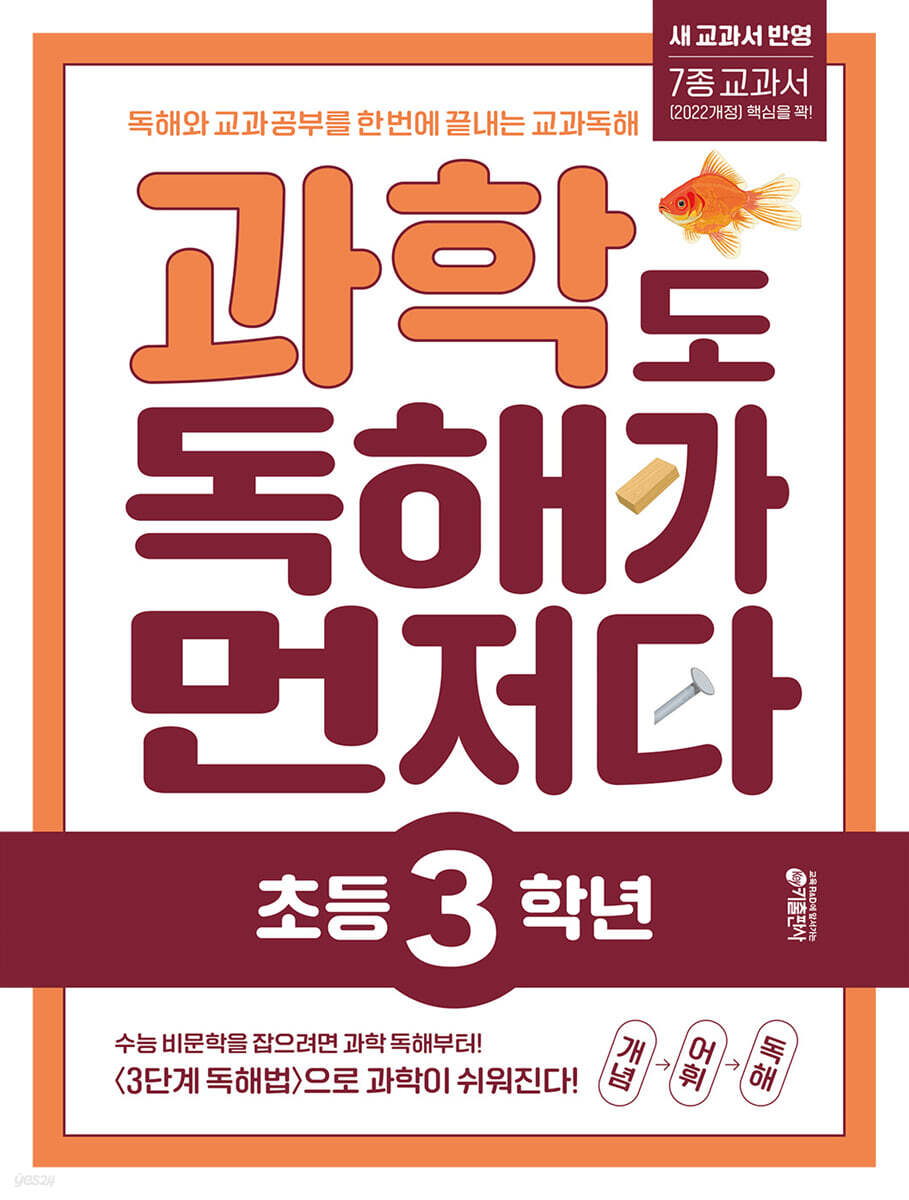
Reading comes first in science, third grade
 |
Description
Book Introduction
Revised edition fully reflecting the 2022 curriculum published!
『Science is also about reading first』 has been changed to make it easier to study.
Reflecting the 2022 revised textbook! Contains the exact contents of the revised textbook.
Catch the essentials of the seven textbooks in one go!
Study in the exact order of the textbook chapters! You can study in the textbook order.
『Science Reading Comes First _ 3rd Grade Elementary School』 is a reading comprehension program that completes reading comprehension and textbook study at the same time.
〉 Grasp the concepts and easily understand the textbook! We've included illustrations that help you understand complex textbook concepts at a glance.
〉 Build solid reading comprehension with the 3-step reading method! This method is designed to help you solidify your reading comprehension skills in three steps: concept, vocabulary, and reading comprehension.
〉 Study your subjects and improve your reading comprehension skills together! With the Science 1st and 2nd semester textbooks all in one volume, you can complete both your subject and reading comprehension studies at the same time.
『Science is also about reading first』 has been changed to make it easier to study.
Reflecting the 2022 revised textbook! Contains the exact contents of the revised textbook.
Catch the essentials of the seven textbooks in one go!
Study in the exact order of the textbook chapters! You can study in the textbook order.
『Science Reading Comes First _ 3rd Grade Elementary School』 is a reading comprehension program that completes reading comprehension and textbook study at the same time.
〉 Grasp the concepts and easily understand the textbook! We've included illustrations that help you understand complex textbook concepts at a glance.
〉 Build solid reading comprehension with the 3-step reading method! This method is designed to help you solidify your reading comprehension skills in three steps: concept, vocabulary, and reading comprehension.
〉 Study your subjects and improve your reading comprehension skills together! With the Science 1st and 2nd semester textbooks all in one volume, you can complete both your subject and reading comprehension studies at the same time.
- You can preview some of the book's contents.
Preview
index
[3rd year, 1st semester]
Unit 1: Power and Our Life
01 Let's compare the force required to push and pull objects.
02 How do you compare the weight of objects using horizontal grip?
03 How do you compare the weight of objects using a scale?
04 How to use levers and inclined planes?
Confirmation learning
Unit 2 Animal Life
01 How can animals be classified?
02 How do the appearance and lifestyle of animals differ depending on their environment?
Confirmation learning
Unit 3: Plant Life
01 How can we classify plants based on the shape of their leaves?
02 How do plant characteristics differ depending on where you live?
Confirmation learning
Unit 4: The Life Cycle of Living Things
01 What kind of life cycle does a cabbage white butterfly go through?
02 What conditions are necessary for seeds to sprout and plants to grow?
03 How does the lifespan vary depending on the animal?
04 How does the life cycle differ depending on the plant?
Confirmation learning
[3rd year, 2nd semester]
Unit 1 Objects and Matter
01 How do properties differ depending on the type of substance?
02 What properties do solids, liquids, and gases have?
Confirmation learning
Unit 2 Earth and the Ocean
01 What does the Earth's surface look like?
02 What kind of terrain is there on the beach?
Confirmation learning
Unit 3: Properties of Sound
01 What are the loudness and pitch of sound?
02 How can we reduce the noise around us?
Confirmation learning
Unit 4: The Life Cycle of Living Things
01 What is an infectious disease?
02 How can we prevent infectious diseases?
Confirmation learning
Answer and explanation
Unit 1: Power and Our Life
01 Let's compare the force required to push and pull objects.
02 How do you compare the weight of objects using horizontal grip?
03 How do you compare the weight of objects using a scale?
04 How to use levers and inclined planes?
Confirmation learning
Unit 2 Animal Life
01 How can animals be classified?
02 How do the appearance and lifestyle of animals differ depending on their environment?
Confirmation learning
Unit 3: Plant Life
01 How can we classify plants based on the shape of their leaves?
02 How do plant characteristics differ depending on where you live?
Confirmation learning
Unit 4: The Life Cycle of Living Things
01 What kind of life cycle does a cabbage white butterfly go through?
02 What conditions are necessary for seeds to sprout and plants to grow?
03 How does the lifespan vary depending on the animal?
04 How does the life cycle differ depending on the plant?
Confirmation learning
[3rd year, 2nd semester]
Unit 1 Objects and Matter
01 How do properties differ depending on the type of substance?
02 What properties do solids, liquids, and gases have?
Confirmation learning
Unit 2 Earth and the Ocean
01 What does the Earth's surface look like?
02 What kind of terrain is there on the beach?
Confirmation learning
Unit 3: Properties of Sound
01 What are the loudness and pitch of sound?
02 How can we reduce the noise around us?
Confirmation learning
Unit 4: The Life Cycle of Living Things
01 What is an infectious disease?
02 How can we prevent infectious diseases?
Confirmation learning
Answer and explanation
Detailed image

Publisher's Review
* Why should science students also study reading comprehension?
As the grade level increases, the content covered in 'science' textbooks becomes more in-depth and diverse.
So, 'science' can feel increasingly difficult and daunting.
There are many new scientific concepts and vocabulary, so it is difficult to understand the contents of the textbook at once.
To study 'science' easily and enjoyably, you need to first learn important concepts and vocabulary, and then practice reading comprehension.
Reading practice isn't just for Korean language subjects.
Even science, which has many unfamiliar concepts and vocabulary to read, requires reading practice.
With the step-by-step reading practice of 『Science Begins with Reading』, the difficult subject of 'science' becomes easy and fun!
* Why do we need to learn science concepts and vocabulary?
‘Science’ is a subject where the basics are important, like mathematics.
Because the concepts are tightly connected and the depth and breadth of the content expands as the grade level advances, it is difficult to understand the later content if you do not understand the earlier content.
So, it is important to properly understand each and every concept from the beginning when learning ‘science’.
Studying science becomes easier when you learn concepts that are well organized and systematic with pictures.
'In science, understanding concepts is more important than anything else.
Even unfamiliar and difficult subject matter can be easily understood if you just grasp the concept.
The systematic concept learning of 『Science is also about reading first』 will clearly organize the concept of 'science' that was once confusing!
Composition and Features
Complete the 3 stages of concept - vocabulary - reading comprehension
[Concept] Easy with pictures
1.
Grasp the concept with a picture
You can grasp key concepts at a glance and memorize them in chunks of pictures.
2.
Let's summarize the concept in one sentence!
You can clearly summarize the key concept in one sentence.
[Vocabulary] Smart with sentences
3.
Know the meaning of concept vocabulary
You can learn the exact meaning of vocabulary through pictures and explanations.
4.
Let's solidify the concept with sentences!
You can solidify the concepts by putting vocabulary directly into sentences.
[Reading] Read + Write for sure
5.
Read the text and check the key concepts
· You can preview the key concepts covered in the text using paragraph summaries.
· By organizing the content scattered across multiple pages of the textbook into a single text, you can clearly understand the core concepts, grasp the structure of the text, and read effectively.
6.
Improve your reading comprehension!
· Vocabulary engraving: You can engrav the vocabulary you learned in ‘Vocabulary Grab’ once again in the reading passage.
· Reading correctly: You can develop your ability to ‘understand facts’ by reading the text accurately.
· Deep reading: You can develop your 'inferential understanding' skills by reading in connection with the text.
7.
Write a summary of the structure
· Write a summary [short answer]: You can organize the content of the text in a coherent manner by filling in the appropriate vocabulary in the structured diagram.
8.
Learn to write descriptively!
· Writing in summary [Descriptive]: You can internalize what you have learned by organizing it into sentences or connecting it to real life.
As the grade level increases, the content covered in 'science' textbooks becomes more in-depth and diverse.
So, 'science' can feel increasingly difficult and daunting.
There are many new scientific concepts and vocabulary, so it is difficult to understand the contents of the textbook at once.
To study 'science' easily and enjoyably, you need to first learn important concepts and vocabulary, and then practice reading comprehension.
Reading practice isn't just for Korean language subjects.
Even science, which has many unfamiliar concepts and vocabulary to read, requires reading practice.
With the step-by-step reading practice of 『Science Begins with Reading』, the difficult subject of 'science' becomes easy and fun!
* Why do we need to learn science concepts and vocabulary?
‘Science’ is a subject where the basics are important, like mathematics.
Because the concepts are tightly connected and the depth and breadth of the content expands as the grade level advances, it is difficult to understand the later content if you do not understand the earlier content.
So, it is important to properly understand each and every concept from the beginning when learning ‘science’.
Studying science becomes easier when you learn concepts that are well organized and systematic with pictures.
'In science, understanding concepts is more important than anything else.
Even unfamiliar and difficult subject matter can be easily understood if you just grasp the concept.
The systematic concept learning of 『Science is also about reading first』 will clearly organize the concept of 'science' that was once confusing!
Composition and Features
Complete the 3 stages of concept - vocabulary - reading comprehension
[Concept] Easy with pictures
1.
Grasp the concept with a picture
You can grasp key concepts at a glance and memorize them in chunks of pictures.
2.
Let's summarize the concept in one sentence!
You can clearly summarize the key concept in one sentence.
[Vocabulary] Smart with sentences
3.
Know the meaning of concept vocabulary
You can learn the exact meaning of vocabulary through pictures and explanations.
4.
Let's solidify the concept with sentences!
You can solidify the concepts by putting vocabulary directly into sentences.
[Reading] Read + Write for sure
5.
Read the text and check the key concepts
· You can preview the key concepts covered in the text using paragraph summaries.
· By organizing the content scattered across multiple pages of the textbook into a single text, you can clearly understand the core concepts, grasp the structure of the text, and read effectively.
6.
Improve your reading comprehension!
· Vocabulary engraving: You can engrav the vocabulary you learned in ‘Vocabulary Grab’ once again in the reading passage.
· Reading correctly: You can develop your ability to ‘understand facts’ by reading the text accurately.
· Deep reading: You can develop your 'inferential understanding' skills by reading in connection with the text.
7.
Write a summary of the structure
· Write a summary [short answer]: You can organize the content of the text in a coherent manner by filling in the appropriate vocabulary in the structured diagram.
8.
Learn to write descriptively!
· Writing in summary [Descriptive]: You can internalize what you have learned by organizing it into sentences or connecting it to real life.
GOODS SPECIFICS
- Date of issue: January 20, 2025
- Page count, weight, size: 192 pages | 210*277*12mm
- ISBN13: 9791165263935
- ISBN10: 1165263939
- Reference book for grades: 3rd grade elementary school
- KC Certification: Certification Type: Conformity Confirmation
You may also like
카테고리
korean


korean

![GQ KOREA Mark (Monthly): December [2025]](http://librairie.coreenne.fr/cdn/shop/files/8ef265dbbfbf186523ed75ba7319009d.jpg?v=1765340328&width=3840)


