

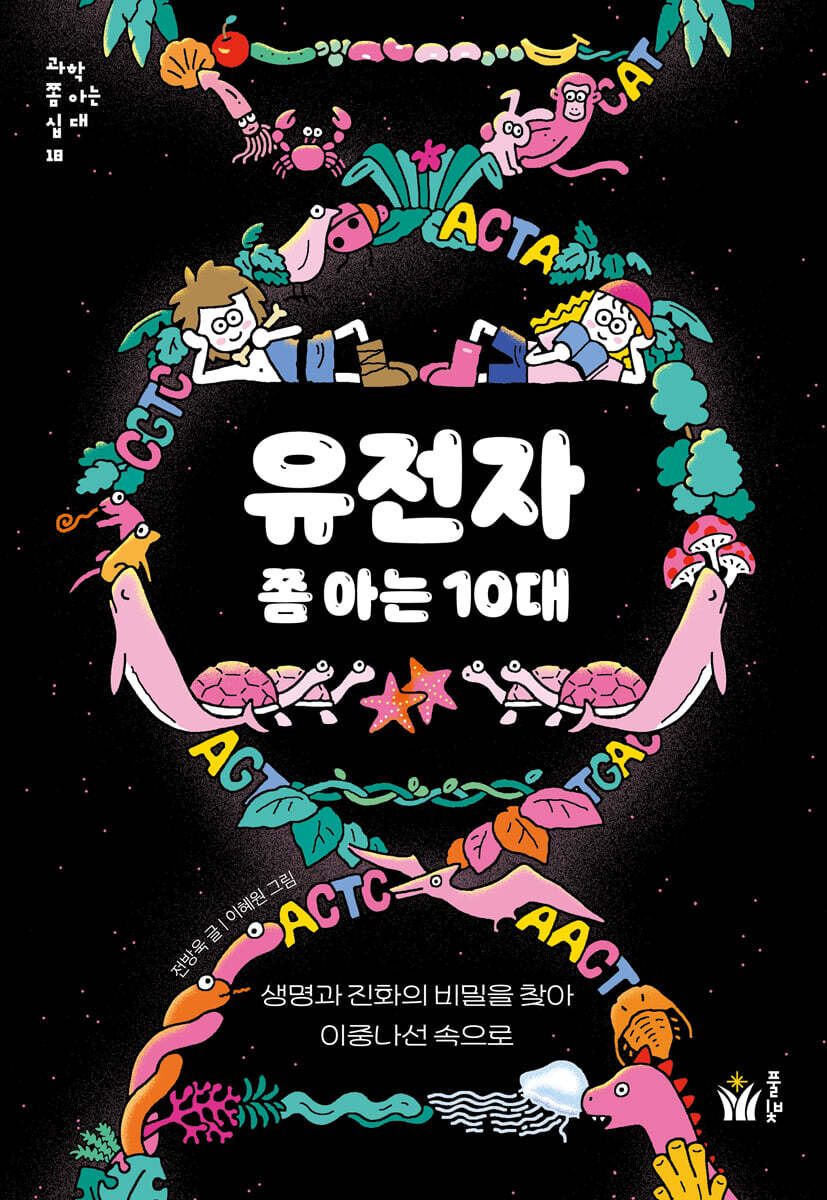
A teenager who knows a little about genes
 |
Description
Book Introduction
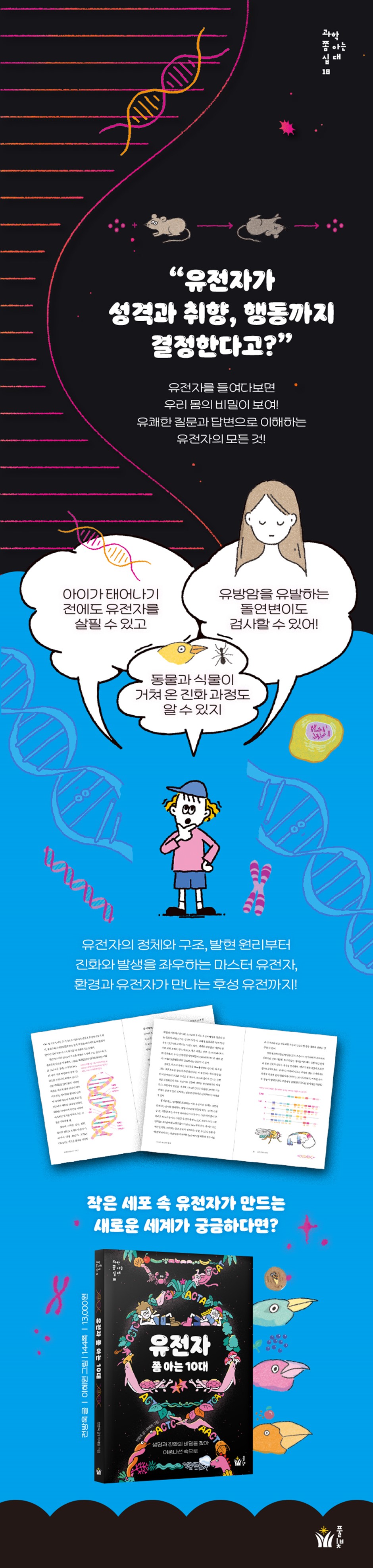
“Everything in my body is written in my genes?”
Everything You Need to Know About Genes with Fun Questions and Answers
Dive into the double helix to discover the secrets of life and evolution!
Genetic testing, once costing millions of won, is now available at a low cost, and we live in an era where vaccines and treatments developed using genetic engineering are extending healthy lives.
However, understanding genetics, which has become so closely related to our daily lives, is still not easy.
Although terms such as chromosomes, DNA, and mitosis are familiar, it is difficult to see at a glance the diverse and complex functions of genes that occur as life is born and grows.
《10 Things You Need to Know About Genes》 is a science book that provides an easy and fun way to look at the development of genetics from Mendel 150 years ago to the present day.
The author, Professor Jeon Bang-wook, wrote this book to help young people understand everything about genes by answering their questions, rather than by spoon-feeding them difficult scientific terms and theories.
The most important feature of this book is that it makes it easy and quick to understand scientific theories that we may have learned in school or heard about in the news, but whose principles we do not clearly understand.
Questions such as why genetic phenomena occur, where the factors that cause heredity are located, and what the substance containing genetic factors looks like naturally lead to various experiments by geneticists.
Reading about Mendel's pea hybridization experiments, Morgan's fruit fly experiments, and Meselson and Stahl's DNA replication experiment, which was called "the most beautiful experiment in biology," it is easy to see the progress of genetic research along with the perseverance, passion, and ideas that were incorporated into the scientists' experiments.
Everything You Need to Know About Genes with Fun Questions and Answers
Dive into the double helix to discover the secrets of life and evolution!
Genetic testing, once costing millions of won, is now available at a low cost, and we live in an era where vaccines and treatments developed using genetic engineering are extending healthy lives.
However, understanding genetics, which has become so closely related to our daily lives, is still not easy.
Although terms such as chromosomes, DNA, and mitosis are familiar, it is difficult to see at a glance the diverse and complex functions of genes that occur as life is born and grows.
《10 Things You Need to Know About Genes》 is a science book that provides an easy and fun way to look at the development of genetics from Mendel 150 years ago to the present day.
The author, Professor Jeon Bang-wook, wrote this book to help young people understand everything about genes by answering their questions, rather than by spoon-feeding them difficult scientific terms and theories.
The most important feature of this book is that it makes it easy and quick to understand scientific theories that we may have learned in school or heard about in the news, but whose principles we do not clearly understand.
Questions such as why genetic phenomena occur, where the factors that cause heredity are located, and what the substance containing genetic factors looks like naturally lead to various experiments by geneticists.
Reading about Mendel's pea hybridization experiments, Morgan's fruit fly experiments, and Meselson and Stahl's DNA replication experiment, which was called "the most beautiful experiment in biology," it is easy to see the progress of genetic research along with the perseverance, passion, and ideas that were incorporated into the scientists' experiments.
- You can preview some of the book's contents.
Preview
index
Entering the world of genes
1.
In Mendel's Garden
The Science of Peas: Genetics: More Complex Than You Think | Mendel Lives
2.
chromosome, gene, DNA
Genes and Chromosomes┃Drosophila Cells┃Genes and Genetic Diseases┃One Gene, One Enzyme┃One Gene, One Protein
3. The identity of DNA
Genetic Material DNA┃The Structure of DNA┃The Problem Child Watson
4.
Expression and regulation of genetic information
DNA Packaging┃DNA Replication┃Gene Expression┃Gene Expression Regulation┃The Strange World of Epigenetics
5.
human genetics
Can humans be experimental subjects? ┃Family genetic history, family tree┃Genetic diseases known for a long time┃Various cases of genetic diseases┃Genetic diseases and genetic testing┃Ethical issues of genetic testing┃DTC genetic testing┃The Angelina Jolie effect
6.
Genes and Development
Inductive signals that awaken cells' roles┃Morphogenesis that establishes the body's axis┃Master regulatory genes┃What is evolutionary developmental biology?┃Developmental genes that shape life
7.
Genes and Evolution
What a shame, Darwin! ┃Finch's beak┃Genome comparison┃Paleogene genome
8.
The power of genes
The Selfish Gene┃The Genes Are to Blame┃Do Genes Determine Behavior?┃Genetics or Environment?
Key References
1.
In Mendel's Garden
The Science of Peas: Genetics: More Complex Than You Think | Mendel Lives
2.
chromosome, gene, DNA
Genes and Chromosomes┃Drosophila Cells┃Genes and Genetic Diseases┃One Gene, One Enzyme┃One Gene, One Protein
3. The identity of DNA
Genetic Material DNA┃The Structure of DNA┃The Problem Child Watson
4.
Expression and regulation of genetic information
DNA Packaging┃DNA Replication┃Gene Expression┃Gene Expression Regulation┃The Strange World of Epigenetics
5.
human genetics
Can humans be experimental subjects? ┃Family genetic history, family tree┃Genetic diseases known for a long time┃Various cases of genetic diseases┃Genetic diseases and genetic testing┃Ethical issues of genetic testing┃DTC genetic testing┃The Angelina Jolie effect
6.
Genes and Development
Inductive signals that awaken cells' roles┃Morphogenesis that establishes the body's axis┃Master regulatory genes┃What is evolutionary developmental biology?┃Developmental genes that shape life
7.
Genes and Evolution
What a shame, Darwin! ┃Finch's beak┃Genome comparison┃Paleogene genome
8.
The power of genes
The Selfish Gene┃The Genes Are to Blame┃Do Genes Determine Behavior?┃Genetics or Environment?
Key References
Detailed image
Into the book
Living organisms produce thousands of different types of proteins, each with a unique role.
Enzymes are one of them.
And the various proteins that play a role in causing reactions, such as enzymes, biosignals, receptors, and antibodies, are all derived from genes.
In other words, genes were the blueprints for how to make proteins. Genes, a segment of DNA, carried the information for proteins in a way that cells could read through a process called encoding.
--- 「2.
Among “chromosomes, genes, and DNA”
Mendel's pioneering research demonstrated that hereditary factors, later identified as genes, were distinct entities.
Morgan, Biddle, and Tatum then proved the function of the gene experimentally, and Garrod proved it medically.
Geneticist Richard Goldschmidt recalled the development of classical genetics up to the 1950s as a scientific leap comparable to "Copernicus, Kepler, and Newton's explanations of celestial motion, Galileo's experiments, and Darwin's establishment of the theory of evolution."
--- 「2.
Among “chromosomes, genes, and DNA”
In April 1953, Watson and Crick surprised the scientific community by publishing a simple one-page paper.
In this paper, they presented a model of the DNA molecule, which is the double helix DNA model that has become the symbol of molecular biology to this day.
Even now, 70 years later, this DNA model remains central to modern biology.
The genetic factors Mendel thought of and the factors on the chromosome discovered by Morgan were both made of DNA.
From a chemical standpoint, the DNA we inherit from our parents is our first inheritance.
So, DNA, the genetic material, can be said to be the most monumental material of our time.
--- From "3. The Identity of DNA"
Did you know that in a chess game, the king can't leave the palace? He's a crucial piece that determines the outcome of the game, so he can't move it carelessly. The same goes for DNA. The genetic information it carries is so crucial that it can't leave the nucleus of a cell.
However, proteins responsible for the structure and function of cells can only be made outside the nucleus.
So DNA uses single-stranded RNA to carry genetic information outside the nucleus into the cytoplasm.
The RNA that plays this role is called mRNA, which is a combination of the letter m from messenger, meaning delivery person.
--- 「4.
From “Expression and Regulation of Genetic Information”
Although there are uncertainties, the basic workings of epigenetics provide a scientific explanation of how environmentally transmitted genetic changes are induced.
There is ample evidence in animals and even humans that environmental factors shape health and disease through epigenetic mechanisms that mediate the interaction between genes and the environment.
According to geneticist Moshe Szyf, epigenetics is the physiological mechanism by which the genome senses the world and changes itself.
--- 「4.
From “Expression and Regulation of Genetic Information”
Most mutations are neutral or harmful to an organism, but some mutations can be beneficial in certain environments.
Rare mutations provide the raw material for evolution.
In either case, mutations serve as a source of variation upon which natural selection can act during the evolutionary process, ultimately leading to the emergence of new species.
If the replication and repair of the genome were perfect and mutations did not occur, there would be no evolution or the emergence of new species.
The balance between the precision of replication and repair processes and the random, albeit low-probability, mutations has driven the evolution of species over long periods of time, leading to the rich diversity of species seen on Earth today.
--- 「7.
From “Genes and Evolution”
We easily fall into genetic determinism, the idea that our genes determine every characteristic of our mind or body.
I think it's probably because some media outlets and even scholars are promoting this idea.
Of course, it is now being discovered that traits that were previously thought to be primarily caused by the environment are influenced by genetics.
But as we've seen, genes don't determine all of these traits.
I hope we don't forget that the environment can influence a person's characteristics just as much as genes, and even influence heredity.
Enzymes are one of them.
And the various proteins that play a role in causing reactions, such as enzymes, biosignals, receptors, and antibodies, are all derived from genes.
In other words, genes were the blueprints for how to make proteins. Genes, a segment of DNA, carried the information for proteins in a way that cells could read through a process called encoding.
--- 「2.
Among “chromosomes, genes, and DNA”
Mendel's pioneering research demonstrated that hereditary factors, later identified as genes, were distinct entities.
Morgan, Biddle, and Tatum then proved the function of the gene experimentally, and Garrod proved it medically.
Geneticist Richard Goldschmidt recalled the development of classical genetics up to the 1950s as a scientific leap comparable to "Copernicus, Kepler, and Newton's explanations of celestial motion, Galileo's experiments, and Darwin's establishment of the theory of evolution."
--- 「2.
Among “chromosomes, genes, and DNA”
In April 1953, Watson and Crick surprised the scientific community by publishing a simple one-page paper.
In this paper, they presented a model of the DNA molecule, which is the double helix DNA model that has become the symbol of molecular biology to this day.
Even now, 70 years later, this DNA model remains central to modern biology.
The genetic factors Mendel thought of and the factors on the chromosome discovered by Morgan were both made of DNA.
From a chemical standpoint, the DNA we inherit from our parents is our first inheritance.
So, DNA, the genetic material, can be said to be the most monumental material of our time.
--- From "3. The Identity of DNA"
Did you know that in a chess game, the king can't leave the palace? He's a crucial piece that determines the outcome of the game, so he can't move it carelessly. The same goes for DNA. The genetic information it carries is so crucial that it can't leave the nucleus of a cell.
However, proteins responsible for the structure and function of cells can only be made outside the nucleus.
So DNA uses single-stranded RNA to carry genetic information outside the nucleus into the cytoplasm.
The RNA that plays this role is called mRNA, which is a combination of the letter m from messenger, meaning delivery person.
--- 「4.
From “Expression and Regulation of Genetic Information”
Although there are uncertainties, the basic workings of epigenetics provide a scientific explanation of how environmentally transmitted genetic changes are induced.
There is ample evidence in animals and even humans that environmental factors shape health and disease through epigenetic mechanisms that mediate the interaction between genes and the environment.
According to geneticist Moshe Szyf, epigenetics is the physiological mechanism by which the genome senses the world and changes itself.
--- 「4.
From “Expression and Regulation of Genetic Information”
Most mutations are neutral or harmful to an organism, but some mutations can be beneficial in certain environments.
Rare mutations provide the raw material for evolution.
In either case, mutations serve as a source of variation upon which natural selection can act during the evolutionary process, ultimately leading to the emergence of new species.
If the replication and repair of the genome were perfect and mutations did not occur, there would be no evolution or the emergence of new species.
The balance between the precision of replication and repair processes and the random, albeit low-probability, mutations has driven the evolution of species over long periods of time, leading to the rich diversity of species seen on Earth today.
--- 「7.
From “Genes and Evolution”
We easily fall into genetic determinism, the idea that our genes determine every characteristic of our mind or body.
I think it's probably because some media outlets and even scholars are promoting this idea.
Of course, it is now being discovered that traits that were previously thought to be primarily caused by the environment are influenced by genetics.
But as we've seen, genes don't determine all of these traits.
I hope we don't forget that the environment can influence a person's characteristics just as much as genes, and even influence heredity.
--- 「8.
From "The Power of Genes"
From "The Power of Genes"
Publisher's Review
Just a drop of saliva is all it takes! From genetic testing made simple.
Epigenetics, where genes change depending on the environment
Into a new world created by genes in tiny cells!
Classical genetics, which began with Mendel's discovery of the laws of heredity, advanced to molecular genetics with the discovery of DNA, a genetic material made up of multiple molecules.
Since then, genetics has continued to advance, going beyond peas and fruit flies to examine human genes and even uncovering the secrets of ancient humans who lived in the distant past.
《Teenagers Who Know a Little About Genes》 goes beyond simply exploring scientists from previous eras to introduce the latest genetics that will be even more important to the next generation.
Genetic testing, which allows us to look into a baby's genes using just a piece of cell taken from the amniotic fluid before birth, is a remarkable achievement in modern genetics.
This allows us to identify mutant genes in advance and prevent genetic diseases with a high probability of occurrence.
A representative example is the BRCA1 mutation test that causes breast cancer.
Direct-to-consumer (DTC) genetic testing, where consumers directly request genetic testing without going through a medical institution, is no longer unfamiliar.
The book not only provides an easy-to-understand introduction to the new culture and industry created by genes, but also does not overlook the ethical concerns that arise from genetic research.
For example, it covers various perspectives on genetics, including discussions on whether a pregnancy can be terminated when a genetic disease is confirmed through a birth point test, and how to deal with the anxiety and discrimination that patients must endure for the rest of their lives when they are diagnosed with a disease gene that cannot be treated through a direct-to-consumer (DTC) genetic test.
Is my love of spicy food due to my genes or my environment?
Genes determine personality, tastes, and even behavior?
A Genetic Story of the Future for Teenagers
The more we know about genes, the greater their influence seems to be.
The fact that there are genes that influence personality, tastes, and behavior greatly helps us understand the evolution and mystery of life, including humans. However, there are also concerns that genes may not completely determine our future lives.
However, the author says, “As genetic research becomes more active and we learn more about genes, it becomes clearer what genes can and cannot do,” and that, as the example of epigenetics shows, the surrounding environment and habits can sometimes have a greater influence on our lives than genes.
《Teenagers Who Know a Little About Genes》 not only provides scientific knowledge about genes, but also introduces the latest scientific trends that allow us to view genes correctly, thereby raising our knowledge of genetics and genes to a level where we are 'a little familiar with' them.
Epigenetics, where genes change depending on the environment
Into a new world created by genes in tiny cells!
Classical genetics, which began with Mendel's discovery of the laws of heredity, advanced to molecular genetics with the discovery of DNA, a genetic material made up of multiple molecules.
Since then, genetics has continued to advance, going beyond peas and fruit flies to examine human genes and even uncovering the secrets of ancient humans who lived in the distant past.
《Teenagers Who Know a Little About Genes》 goes beyond simply exploring scientists from previous eras to introduce the latest genetics that will be even more important to the next generation.
Genetic testing, which allows us to look into a baby's genes using just a piece of cell taken from the amniotic fluid before birth, is a remarkable achievement in modern genetics.
This allows us to identify mutant genes in advance and prevent genetic diseases with a high probability of occurrence.
A representative example is the BRCA1 mutation test that causes breast cancer.
Direct-to-consumer (DTC) genetic testing, where consumers directly request genetic testing without going through a medical institution, is no longer unfamiliar.
The book not only provides an easy-to-understand introduction to the new culture and industry created by genes, but also does not overlook the ethical concerns that arise from genetic research.
For example, it covers various perspectives on genetics, including discussions on whether a pregnancy can be terminated when a genetic disease is confirmed through a birth point test, and how to deal with the anxiety and discrimination that patients must endure for the rest of their lives when they are diagnosed with a disease gene that cannot be treated through a direct-to-consumer (DTC) genetic test.
Is my love of spicy food due to my genes or my environment?
Genes determine personality, tastes, and even behavior?
A Genetic Story of the Future for Teenagers
The more we know about genes, the greater their influence seems to be.
The fact that there are genes that influence personality, tastes, and behavior greatly helps us understand the evolution and mystery of life, including humans. However, there are also concerns that genes may not completely determine our future lives.
However, the author says, “As genetic research becomes more active and we learn more about genes, it becomes clearer what genes can and cannot do,” and that, as the example of epigenetics shows, the surrounding environment and habits can sometimes have a greater influence on our lives than genes.
《Teenagers Who Know a Little About Genes》 not only provides scientific knowledge about genes, but also introduces the latest scientific trends that allow us to view genes correctly, thereby raising our knowledge of genetics and genes to a level where we are 'a little familiar with' them.
GOODS SPECIFICS
- Date of issue: December 20, 2023
- Page count, weight, size: 144 pages | 230g | 140*203*10mm
- ISBN13: 9791161729039
- ISBN10: 1161729038
You may also like
카테고리
korean


korean

![GQ KOREA Mark (Monthly): December [2025]](http://librairie.coreenne.fr/cdn/shop/files/8ef265dbbfbf186523ed75ba7319009d.jpg?v=1765340328&width=3840)


