

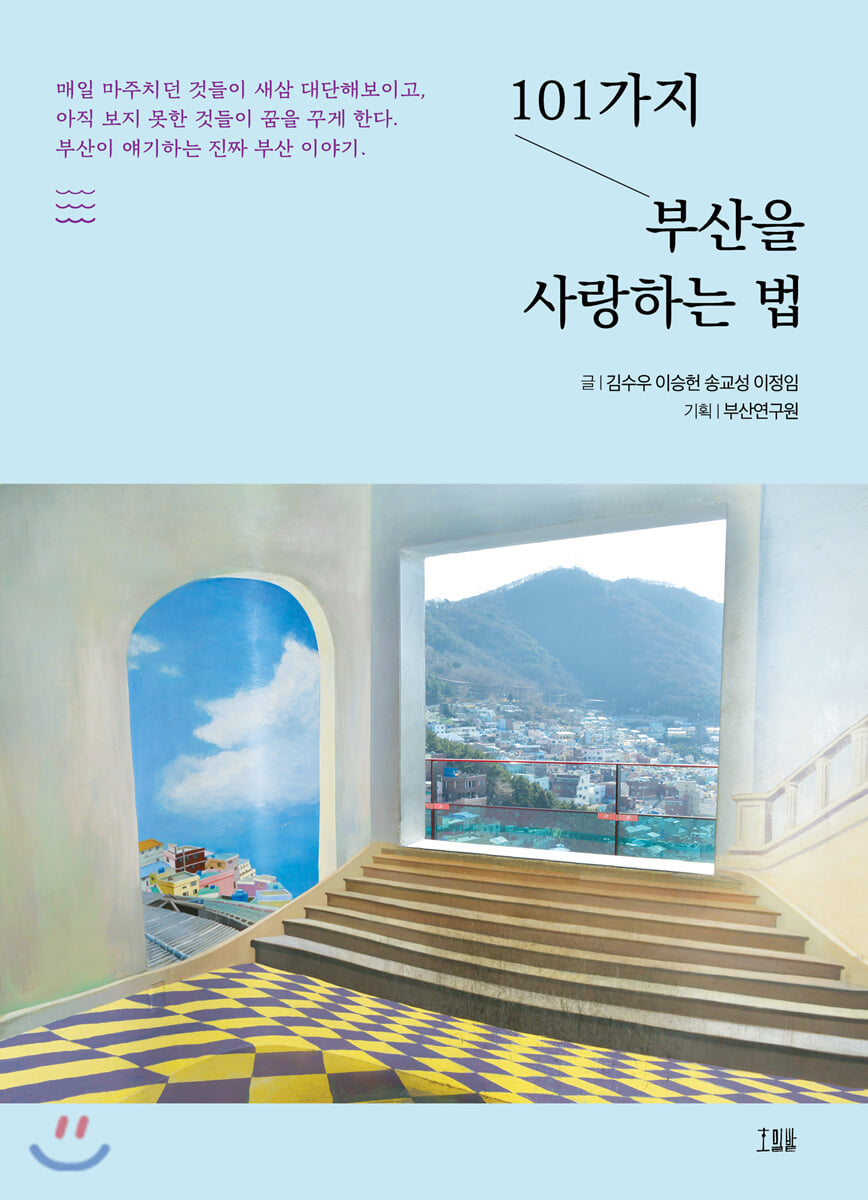
101 Ways to Love Busan
 |
Description
Book Introduction
“The things I encounter every day seem amazing in a new way,
“Things we haven’t seen yet make us dream.”
- The real story of Busan, told by Busan
A guidebook has been published that truly shows the true nature and essence of the beautiful city of Busan.
Beyond simply providing information for eating and enjoying, this book captures the daily life and emotions of the city of Busan, offering us 101 unique experiences.
Busan is a city that is full of stories all year round, with its abundant food, festivals, and places imprinted with scenes from our modern history, not to mention the ocean that comes to mind when you think of Busan. It is too good to be considered a mere tourist attraction.
Isn't there a way to discover and widely publicize Busan's true charm?
The Busan Research Institute, with this critical awareness in mind, has planned and prepared for one year and six months, and now presents a book that comprehensively explores Busan's treasured sites from a humanistic perspective.
This book is not just a travel guide.
It contains many stories and places that can be said to be the inner workings of Busan.
Each location was selected through a nationwide site recommendation contest, a citizen discovery group comprised of Busan citizens, and expert discussions, taking into consideration various factors such as generation, region, history, and symbolism.
While many attempts to promote Busan have focused on introducing various places such as Busan's famous landmarks, restaurants, and cafes, "101 Ways to Love Busan" highlights its uniqueness by adding place experiences, including space.
These are places in Busan that are ‘ordinary yet special.’
“Things we haven’t seen yet make us dream.”
- The real story of Busan, told by Busan
A guidebook has been published that truly shows the true nature and essence of the beautiful city of Busan.
Beyond simply providing information for eating and enjoying, this book captures the daily life and emotions of the city of Busan, offering us 101 unique experiences.
Busan is a city that is full of stories all year round, with its abundant food, festivals, and places imprinted with scenes from our modern history, not to mention the ocean that comes to mind when you think of Busan. It is too good to be considered a mere tourist attraction.
Isn't there a way to discover and widely publicize Busan's true charm?
The Busan Research Institute, with this critical awareness in mind, has planned and prepared for one year and six months, and now presents a book that comprehensively explores Busan's treasured sites from a humanistic perspective.
This book is not just a travel guide.
It contains many stories and places that can be said to be the inner workings of Busan.
Each location was selected through a nationwide site recommendation contest, a citizen discovery group comprised of Busan citizens, and expert discussions, taking into consideration various factors such as generation, region, history, and symbolism.
While many attempts to promote Busan have focused on introducing various places such as Busan's famous landmarks, restaurants, and cafes, "101 Ways to Love Busan" highlights its uniqueness by adding place experiences, including space.
These are places in Busan that are ‘ordinary yet special.’
- You can preview some of the book's contents.
Preview
index
prolog
Preface
Recommendation
Part 1 - The Trembling of Deviance, That Place in Busan Calls Me
01.
Entering Oryukdo Lighthouse on a boat
02.
An observation deck extending into the sea - Namhang Sea Road
03.
Dongbaek Island - Where Red Camellia and Blue Sea Meet
04.
A glimpse into ancient thought - Bongraesan Mountain in Yeongdo
05.
Korea's first beach - Songdo
06.
The ultimate coastal beauty of Busan - Igidae (二妓臺)
07.
Reading Eternity on the Nakdong River Sandbar - Amisan Observatory
08.
Ecological and Cultural Experiences in the City - Hwamyeong Arboretum and Gijang Ahopsan Forest
09.
Moonlight Hill Forest Trail - Moontan Road
10.
Dreaming in harmony between nature and man-made worlds - Dadaepo Beach
11.
Between the Blue Snake and the Blue Sand - Cheongsapo
12.
Bokbyeongsan Reservoir, filled with the sounds of birds chirping - Busan Meteorological Observatory
13.
Hwangnyeongsan and Geumnyeonsan mountains in the city center, offering panoramic views of Busan.
14.
Taejongdae, a blue cliff facing the Pacific Ocean
15.
Thinking about the source of water - Seongjigok Reservoir (Children's Grand Park)
16.
Eulsukdo Migratory Bird Park - Where Nature's Mysteries Dwell
Part 2 - Encountering Busan's unique identity
17.
A hundred years of time preserved in Oeyangpo Village
18.
A Look into Life in the Temporary Capital - The Provisional Capital Memorial Hall
19.
The Refugee's Stepped Alley - Ibagu-gil 168 Steps
20.
Peace on the Graveyard - UN Memorial Cemetery and Peace Park
21.
Miss the person you miss - Forty Steps
22.
Coexistence of the Living and the Dead - Tombstone Culture Village
23.
Teaching Humanity Through One Person's Life - Jang Gi-ryeo's Sharing Center
24.
Only Love Saves - Father Lee Tae-seok's Birthplace and Memorial Hall
25.
Democracy Park and the Democracy Movement Memorial Hall, where the democratic spirit of the citizens is embedded.
26.
The Seed of Reconciliation - The Grave of Dr. Lee Su-hyeon
27.
A Journey into History - Bokcheon Museum
28.
Immerse Yourself in the Sound of the Evening Bell - Beomeosa Temple
29.
A Treasure Trove of National Spirit - Baeksan Memorial Hall/Hansung 1918
30.
Witness to Modern Korean History - Yongdusan Park
31.
Circuit of Memory - Yeonsan Tombs
32.
Dongrae Villa: A Glamorous Resort in the Dark Ages
33.
Geumjeongsanseong Fortress, the largest stone fortress wall in Korea
Part 3 - Exciting encounters, falling in love with Busan's unique charm
34.
Where Busan's passion gathers - Sajik Baseball Stadium
35.
Busan's Trend Barometer - Gwangalli Beach
36.
Jagalchi Market - Where all things port gather
37.
A fresh morning begins at Busan Joint Fish Market
38.
Songjeong Beach - Surfing all year round
39.
The Spectacular Transformation of an Abandoned Factory - F1963
40.
Guide to the Sea - National Maritime Museum
41.
Prepared for ARMYs around the world - Busan BTS Mecca Tour
42.
Busan's breathing hole in the sea - Port
43.
If you have a yard, you can survive - Haenyeo Village
44.
A Moment of Emotion Driven by the Korean Wave - One Asia Festival
45.
Bupyeong Market - A Wave of People
46.
A place where day and night are different - Minrak Waterside Park
47.
Where modern and contemporary times coexist - from downtown to Yeongdo Bridge
48.
Enjoy the romance of the sea by day and jazz by night - Jazz Club Tour
49.
Dazzling, Light, and Thrilling Busan - Urban Fishing
50.
A spacious meadow in the city - Busan Citizens Park
Part 4 - Feel the warmth of Busan, a space for humanities and thought.
51.
Silent Jeongjung-dong - Lee Ufan Space
52.
An Escape from the Everyday - In Search of the Roots of Film
53.
Spatial volume created by wire structures - Kiss Wire Center
54.
Embracing Eulsukdo - Busan Museum of Contemporary Art
55.
Under a huge roof, a festival unfolds - the Film Hall
56.
Cinema/People/Tech - Corner Theater
57.
Yosan Literature Museum - Demonstrating a Sense of Literature's Mission
58.
Namcheon Cathedral - 60m of stained glass light projection
59.
Romanesque-style modern architecture of the Anglican Church of Korea - Busan Cathedral
60.
Books on the Road, Roads in Books - Bosudong Book Alley
61.
Cultural Empathy, a Relaxing Space in the City - Sujeong (formerly Jeongrangak)
62.
Creating a White Wave in the Heart - White Wave Road
63.
Secrets Behind the Heavy Shipyard Gates - Kangkang Art Village
64.
Hearing the Voices of Things - Baeknyeon Seowon
65.
The only mystery library - Kim Seong-jong Mystery Literature Museum
66.
The Soul Becomes Transparent - Haein Bookstore
67.
Teaching How to Dream - Indigo Bookstore
Part 5 - As long as you remember, the scent will not fade.
68.
An eco-friendly guesthouse in the mountains - Cheonmasan Eco House
69.
Laval Hotel, elegantly built next to Yeongdo Bridge
70.
Wonderland - Culture Alley
71.
Ananti Cove - a space open to non-guests
72.
People Who Discover Busan - Travel Squad and Pink Loader
73.
A public bathhouse embracing Namhang - Songdo Haesupia
74.
A Unique Journey - How to Travel Busan by City Bus
75.
A collection filled with the spirit of kindness - Aloysius Family Center
76.
The steeper the slope, the tighter the shoulders - Gamcheon Culture Village
77.
Beautiful Starlight - Hocheon Village
78.
Capsule-style mini rooms - Hotel 1
79.
Driving over the sea - Busan's Grand Bridge
80.
A must-have for Busan tourism - Yacht tours
81.
Dive into the Winter Sea! - Haeundae Polar Bear Festival
82.
Racecourse with a park - Let's Run Park Busan-Gyeongnam
83.
The Transformation of a Small House on a Mountaintop - Ibagu Camp
84.
Overlooking all the textures of Busan - Park Hyatt Busan
Part 6 - Falling in love with Busan again, one bite at a time
85.
A Sip of the Passion of a World Champion Barista - Momos Coffee
86.
100 Years of Time Engraved in Bricks - Baekje Hospital (Brown Hands Cafe)
87.
A Busan Food Stall Tour that Holds Your Steps
88.
The Origins of Busan Milmyeon - Naeho Naengmyeon and Uam Somak Village
89.
Busan's signature dish, pork soup, embodying the sorrows of refugees
90.
The True Taste of Beer in Busan - Craft Beer
91.
Awesome view from any seat - Wave On Coffee
92.
Stubborn elegance and traditional taste, natural fresh fish - Sujeonggung
93.
A cafe embracing Geumjeongsan Mountain - The Farm 471
94.
A new version of the fish cake factory - Samjin Fish Cake Experience History Museum
95.
The "Gamseong" of Youth: Where Tools Turn into Coffee - Jeonpo Cafe Street
96.
Shape your heart like a Wandang - Wandang Tour
97.
A taste for space proliferation - Shingi Industry
98.
A Sweet Bread-Burning Tour - Namcheon-dong Bakery Street
99.
The enemy house at the top of the mountain road - Choryang 1941
100.
A view that tastes better than the taste - Merciel
101.
The Taste of the Mountain - Sanseong Village and Geumjeongsanseong Makgeolli
Citizen excavation team
Epilogue
Preface
Recommendation
Part 1 - The Trembling of Deviance, That Place in Busan Calls Me
01.
Entering Oryukdo Lighthouse on a boat
02.
An observation deck extending into the sea - Namhang Sea Road
03.
Dongbaek Island - Where Red Camellia and Blue Sea Meet
04.
A glimpse into ancient thought - Bongraesan Mountain in Yeongdo
05.
Korea's first beach - Songdo
06.
The ultimate coastal beauty of Busan - Igidae (二妓臺)
07.
Reading Eternity on the Nakdong River Sandbar - Amisan Observatory
08.
Ecological and Cultural Experiences in the City - Hwamyeong Arboretum and Gijang Ahopsan Forest
09.
Moonlight Hill Forest Trail - Moontan Road
10.
Dreaming in harmony between nature and man-made worlds - Dadaepo Beach
11.
Between the Blue Snake and the Blue Sand - Cheongsapo
12.
Bokbyeongsan Reservoir, filled with the sounds of birds chirping - Busan Meteorological Observatory
13.
Hwangnyeongsan and Geumnyeonsan mountains in the city center, offering panoramic views of Busan.
14.
Taejongdae, a blue cliff facing the Pacific Ocean
15.
Thinking about the source of water - Seongjigok Reservoir (Children's Grand Park)
16.
Eulsukdo Migratory Bird Park - Where Nature's Mysteries Dwell
Part 2 - Encountering Busan's unique identity
17.
A hundred years of time preserved in Oeyangpo Village
18.
A Look into Life in the Temporary Capital - The Provisional Capital Memorial Hall
19.
The Refugee's Stepped Alley - Ibagu-gil 168 Steps
20.
Peace on the Graveyard - UN Memorial Cemetery and Peace Park
21.
Miss the person you miss - Forty Steps
22.
Coexistence of the Living and the Dead - Tombstone Culture Village
23.
Teaching Humanity Through One Person's Life - Jang Gi-ryeo's Sharing Center
24.
Only Love Saves - Father Lee Tae-seok's Birthplace and Memorial Hall
25.
Democracy Park and the Democracy Movement Memorial Hall, where the democratic spirit of the citizens is embedded.
26.
The Seed of Reconciliation - The Grave of Dr. Lee Su-hyeon
27.
A Journey into History - Bokcheon Museum
28.
Immerse Yourself in the Sound of the Evening Bell - Beomeosa Temple
29.
A Treasure Trove of National Spirit - Baeksan Memorial Hall/Hansung 1918
30.
Witness to Modern Korean History - Yongdusan Park
31.
Circuit of Memory - Yeonsan Tombs
32.
Dongrae Villa: A Glamorous Resort in the Dark Ages
33.
Geumjeongsanseong Fortress, the largest stone fortress wall in Korea
Part 3 - Exciting encounters, falling in love with Busan's unique charm
34.
Where Busan's passion gathers - Sajik Baseball Stadium
35.
Busan's Trend Barometer - Gwangalli Beach
36.
Jagalchi Market - Where all things port gather
37.
A fresh morning begins at Busan Joint Fish Market
38.
Songjeong Beach - Surfing all year round
39.
The Spectacular Transformation of an Abandoned Factory - F1963
40.
Guide to the Sea - National Maritime Museum
41.
Prepared for ARMYs around the world - Busan BTS Mecca Tour
42.
Busan's breathing hole in the sea - Port
43.
If you have a yard, you can survive - Haenyeo Village
44.
A Moment of Emotion Driven by the Korean Wave - One Asia Festival
45.
Bupyeong Market - A Wave of People
46.
A place where day and night are different - Minrak Waterside Park
47.
Where modern and contemporary times coexist - from downtown to Yeongdo Bridge
48.
Enjoy the romance of the sea by day and jazz by night - Jazz Club Tour
49.
Dazzling, Light, and Thrilling Busan - Urban Fishing
50.
A spacious meadow in the city - Busan Citizens Park
Part 4 - Feel the warmth of Busan, a space for humanities and thought.
51.
Silent Jeongjung-dong - Lee Ufan Space
52.
An Escape from the Everyday - In Search of the Roots of Film
53.
Spatial volume created by wire structures - Kiss Wire Center
54.
Embracing Eulsukdo - Busan Museum of Contemporary Art
55.
Under a huge roof, a festival unfolds - the Film Hall
56.
Cinema/People/Tech - Corner Theater
57.
Yosan Literature Museum - Demonstrating a Sense of Literature's Mission
58.
Namcheon Cathedral - 60m of stained glass light projection
59.
Romanesque-style modern architecture of the Anglican Church of Korea - Busan Cathedral
60.
Books on the Road, Roads in Books - Bosudong Book Alley
61.
Cultural Empathy, a Relaxing Space in the City - Sujeong (formerly Jeongrangak)
62.
Creating a White Wave in the Heart - White Wave Road
63.
Secrets Behind the Heavy Shipyard Gates - Kangkang Art Village
64.
Hearing the Voices of Things - Baeknyeon Seowon
65.
The only mystery library - Kim Seong-jong Mystery Literature Museum
66.
The Soul Becomes Transparent - Haein Bookstore
67.
Teaching How to Dream - Indigo Bookstore
Part 5 - As long as you remember, the scent will not fade.
68.
An eco-friendly guesthouse in the mountains - Cheonmasan Eco House
69.
Laval Hotel, elegantly built next to Yeongdo Bridge
70.
Wonderland - Culture Alley
71.
Ananti Cove - a space open to non-guests
72.
People Who Discover Busan - Travel Squad and Pink Loader
73.
A public bathhouse embracing Namhang - Songdo Haesupia
74.
A Unique Journey - How to Travel Busan by City Bus
75.
A collection filled with the spirit of kindness - Aloysius Family Center
76.
The steeper the slope, the tighter the shoulders - Gamcheon Culture Village
77.
Beautiful Starlight - Hocheon Village
78.
Capsule-style mini rooms - Hotel 1
79.
Driving over the sea - Busan's Grand Bridge
80.
A must-have for Busan tourism - Yacht tours
81.
Dive into the Winter Sea! - Haeundae Polar Bear Festival
82.
Racecourse with a park - Let's Run Park Busan-Gyeongnam
83.
The Transformation of a Small House on a Mountaintop - Ibagu Camp
84.
Overlooking all the textures of Busan - Park Hyatt Busan
Part 6 - Falling in love with Busan again, one bite at a time
85.
A Sip of the Passion of a World Champion Barista - Momos Coffee
86.
100 Years of Time Engraved in Bricks - Baekje Hospital (Brown Hands Cafe)
87.
A Busan Food Stall Tour that Holds Your Steps
88.
The Origins of Busan Milmyeon - Naeho Naengmyeon and Uam Somak Village
89.
Busan's signature dish, pork soup, embodying the sorrows of refugees
90.
The True Taste of Beer in Busan - Craft Beer
91.
Awesome view from any seat - Wave On Coffee
92.
Stubborn elegance and traditional taste, natural fresh fish - Sujeonggung
93.
A cafe embracing Geumjeongsan Mountain - The Farm 471
94.
A new version of the fish cake factory - Samjin Fish Cake Experience History Museum
95.
The "Gamseong" of Youth: Where Tools Turn into Coffee - Jeonpo Cafe Street
96.
Shape your heart like a Wandang - Wandang Tour
97.
A taste for space proliferation - Shingi Industry
98.
A Sweet Bread-Burning Tour - Namcheon-dong Bakery Street
99.
The enemy house at the top of the mountain road - Choryang 1941
100.
A view that tastes better than the taste - Merciel
101.
The Taste of the Mountain - Sanseong Village and Geumjeongsanseong Makgeolli
Citizen excavation team
Epilogue
Into the book
Even though I only took one step across, I felt like I had entered a primitive time when no human footsteps had ever set foot on it.
A road runs along the island's waist, and the bizarrely shaped rocks carved and eroded by the waves clearly show the traces of a long time gone by.
As you climb the steep, zigzagging stairs, you will come across a white lighthouse building.
Beneath the floating building is an open plaza facing the vast ocean.
The strong sea breeze makes a strange sound, and the silvery ripples of the sea are wonderful.
As the sun sets, I fall into a state of ecstasy.
I feel anew that I am small in front of the majesty of nature.
--- p.25
If you go down a little bit from here along the fork in the road, you will be directly connected to the abandoned Donghae Nambu Line railroad.
If you continue walking straight in the direction you were walking, you will reach the pretty port village of Cheongsapo. If you turn and walk in the opposite direction, you will reach Mipo, the end of Haeundae Beach.
The most attractive course is to walk halfway along the dirt trail of Muntan Road and then return to Mipo from the turnaround point at the fork in the road.
Walking along, enjoying the refreshing sight of the vast ocean, and gradually seeing the rhythmic combination of the city and the sea is enough to inspire admiration.
--- p.50
To experience the mystery of Eulsukdo Island more deeply, you must go to the exploration experience center at the southernmost tip.
This was formerly a storage facility where sewage generated in the city was collected for ocean dumping.
A massive NIMBY facility, a sort of garbage can, was located right next to this natural migratory bird paradise.
The concrete wall, which still has traces of the polluted area, was preserved, and the remaining surrounding environment was transformed into a small park with beautiful landscaping.
Standing here gives me a strange feeling.
--- p.71
The 'wave riding' cheering that spread to people all over the world began at Sajik Baseball Stadium.
The cheering tools made of newspaper and orange plastic bags are also very creative and unique.
The cheers and unique chants radiate energy that can scare opposing players.
It's especially thrilling when the stands are full.
Some people don't care about the outcome of the game, but rather go to the baseball stadium for the joy of cheering.
--- p.127
The building, which was once the former factory of Korea Iron and Steel, has been completely transformed into a complex building with cultural and commercial functions.
It has become a place of completely new content, making it hard to believe that it was once an abandoned factory.
The space is enriched by incorporating modern design and functionality without erasing the rough traces of time.
As you enter the main entrance, there is a courtyard with an open sky in the middle.
As in our traditional Korean houses, the buildings surround the building and a courtyard is placed in the middle.
It is a multi-functional space used for relaxation and various events.
The setting of the old factory materials and the reeds blooming in abundance here and there also harmonizes exquisitely.
--- p.142
If we stop the mind's work and carefully observe how relationships interact, we can hear the conversation of things with dignity and peace, tension and balance.
Relationships arise when various elements come together and coexist, and it is within these relationships that expressions are created.
The 'modest' dimension of artist Lee Ufan is connected to the relational meaning of 'ethical' and leads us to the aesthetic and transcendent world of 'sublimity' or 'eternity'.
The endless wait seeps into my body.
--- p.180
The film hall has two huge roofs.
They are called the 'Big Loop' and the 'Small Loop' and are a whopping 162.5m and 120m long, respectively.
The underside of the roof is curved and various pattern images created by 40,000 LED lights dance.
Looking down at it, it seems similar to the national flags fluttering in the sky on sports day.
The lighting display, which appears to flutter in the wind, adds to the excitement of the festival.
--- p.191
I park my yacht near the Gwangan Bridge pier and look back at the city I used to live in.
It feels fresh and strange.
The layers of a bustling, busy city overlap like still cuts from a movie.
The sea and the river, the sky and the sunset, and even the stars and the moon at night overlap in layers.
As the city lights come on one by one and the scenic lights of Gwangan Bridge turn on, the fantasy is maximized, and the night view of the splendid Marine City rising suddenly in front of the sea even evokes a sense of emotion.
--- p.267
The history of Busan pork soup, which is as popular as the number of snack bars in Busan, is not that long.
While Miryang had already had pork soup restaurants since the 1940s, Busan's pork soup originated from the Korean War and the influence of North Korean refugees. Halmae Gukbap, made famous by an appearance on "Wednesday Food Talk," was opened in 1956 by Choi Soon-bok, a Pyongyang native, in front of the former Samhwa Rubber Factory in Beomil-dong.
Shin Chang Gukbap, famous for its clear broth, was opened in 1969 by Seo Hye-ja (79) after seeing an old woman from North Korea selling sundae gukbap at the Gukje Market over her shoulder.
Afterwards, noodle restaurants opened throughout Busan, focusing on markets and transportation hubs where people and goods came and went. You can still find old pork soup restaurants in places like Bupyeong Kkangtong Market, Jobang, and Seomyeon Market, where refugees traded daily necessities.
--- p.294
When you think of raw fish, images of cheap, plentiful, and boisterous food come to mind.
In particular, Busan's raw fish restaurants specialize in the way people gather together to eat a lot.
So, when thinking of a restaurant with a refined or classy atmosphere, a high-end Japanese restaurant is always recommended over a raw fish restaurant.
The Sujeong Palace is the perfect place to treat distinguished guests with high-quality cuisine.
You can eat in a course meal, and it has private rooms, so it is a good place for a quiet gathering such as a meeting.
There is also a banquet hall, making it suitable for gatherings such as wedding receptions or first birthday parties with a view of the ocean.
The name of Sujeong Palace comes from Sujeong-dong in Dong-gu.
As the name suggests, which contains Busan's history, let's treat our special guests to the deep flavors of Busan.
A road runs along the island's waist, and the bizarrely shaped rocks carved and eroded by the waves clearly show the traces of a long time gone by.
As you climb the steep, zigzagging stairs, you will come across a white lighthouse building.
Beneath the floating building is an open plaza facing the vast ocean.
The strong sea breeze makes a strange sound, and the silvery ripples of the sea are wonderful.
As the sun sets, I fall into a state of ecstasy.
I feel anew that I am small in front of the majesty of nature.
--- p.25
If you go down a little bit from here along the fork in the road, you will be directly connected to the abandoned Donghae Nambu Line railroad.
If you continue walking straight in the direction you were walking, you will reach the pretty port village of Cheongsapo. If you turn and walk in the opposite direction, you will reach Mipo, the end of Haeundae Beach.
The most attractive course is to walk halfway along the dirt trail of Muntan Road and then return to Mipo from the turnaround point at the fork in the road.
Walking along, enjoying the refreshing sight of the vast ocean, and gradually seeing the rhythmic combination of the city and the sea is enough to inspire admiration.
--- p.50
To experience the mystery of Eulsukdo Island more deeply, you must go to the exploration experience center at the southernmost tip.
This was formerly a storage facility where sewage generated in the city was collected for ocean dumping.
A massive NIMBY facility, a sort of garbage can, was located right next to this natural migratory bird paradise.
The concrete wall, which still has traces of the polluted area, was preserved, and the remaining surrounding environment was transformed into a small park with beautiful landscaping.
Standing here gives me a strange feeling.
--- p.71
The 'wave riding' cheering that spread to people all over the world began at Sajik Baseball Stadium.
The cheering tools made of newspaper and orange plastic bags are also very creative and unique.
The cheers and unique chants radiate energy that can scare opposing players.
It's especially thrilling when the stands are full.
Some people don't care about the outcome of the game, but rather go to the baseball stadium for the joy of cheering.
--- p.127
The building, which was once the former factory of Korea Iron and Steel, has been completely transformed into a complex building with cultural and commercial functions.
It has become a place of completely new content, making it hard to believe that it was once an abandoned factory.
The space is enriched by incorporating modern design and functionality without erasing the rough traces of time.
As you enter the main entrance, there is a courtyard with an open sky in the middle.
As in our traditional Korean houses, the buildings surround the building and a courtyard is placed in the middle.
It is a multi-functional space used for relaxation and various events.
The setting of the old factory materials and the reeds blooming in abundance here and there also harmonizes exquisitely.
--- p.142
If we stop the mind's work and carefully observe how relationships interact, we can hear the conversation of things with dignity and peace, tension and balance.
Relationships arise when various elements come together and coexist, and it is within these relationships that expressions are created.
The 'modest' dimension of artist Lee Ufan is connected to the relational meaning of 'ethical' and leads us to the aesthetic and transcendent world of 'sublimity' or 'eternity'.
The endless wait seeps into my body.
--- p.180
The film hall has two huge roofs.
They are called the 'Big Loop' and the 'Small Loop' and are a whopping 162.5m and 120m long, respectively.
The underside of the roof is curved and various pattern images created by 40,000 LED lights dance.
Looking down at it, it seems similar to the national flags fluttering in the sky on sports day.
The lighting display, which appears to flutter in the wind, adds to the excitement of the festival.
--- p.191
I park my yacht near the Gwangan Bridge pier and look back at the city I used to live in.
It feels fresh and strange.
The layers of a bustling, busy city overlap like still cuts from a movie.
The sea and the river, the sky and the sunset, and even the stars and the moon at night overlap in layers.
As the city lights come on one by one and the scenic lights of Gwangan Bridge turn on, the fantasy is maximized, and the night view of the splendid Marine City rising suddenly in front of the sea even evokes a sense of emotion.
--- p.267
The history of Busan pork soup, which is as popular as the number of snack bars in Busan, is not that long.
While Miryang had already had pork soup restaurants since the 1940s, Busan's pork soup originated from the Korean War and the influence of North Korean refugees. Halmae Gukbap, made famous by an appearance on "Wednesday Food Talk," was opened in 1956 by Choi Soon-bok, a Pyongyang native, in front of the former Samhwa Rubber Factory in Beomil-dong.
Shin Chang Gukbap, famous for its clear broth, was opened in 1969 by Seo Hye-ja (79) after seeing an old woman from North Korea selling sundae gukbap at the Gukje Market over her shoulder.
Afterwards, noodle restaurants opened throughout Busan, focusing on markets and transportation hubs where people and goods came and went. You can still find old pork soup restaurants in places like Bupyeong Kkangtong Market, Jobang, and Seomyeon Market, where refugees traded daily necessities.
--- p.294
When you think of raw fish, images of cheap, plentiful, and boisterous food come to mind.
In particular, Busan's raw fish restaurants specialize in the way people gather together to eat a lot.
So, when thinking of a restaurant with a refined or classy atmosphere, a high-end Japanese restaurant is always recommended over a raw fish restaurant.
The Sujeong Palace is the perfect place to treat distinguished guests with high-quality cuisine.
You can eat in a course meal, and it has private rooms, so it is a good place for a quiet gathering such as a meeting.
There is also a banquet hall, making it suitable for gatherings such as wedding receptions or first birthday parties with a view of the ocean.
The name of Sujeong Palace comes from Sujeong-dong in Dong-gu.
As the name suggests, which contains Busan's history, let's treat our special guests to the deep flavors of Busan.
--- p.303
Publisher's Review
There is not just one way to love something.
101 ways to love Busan, the ever-changing and mysterious city!
World-famous cities such as New York, London, Paris, and Tokyo all promote their charms to the world through booklets called '101 Things to Do'.
In English-speaking culture, the number '101' also means 'basic', so this number is used in the title of the book to signify a basic book for understanding a city.
The book is divided into six parts: nature, history, culture, art, memories, and food.
In Part 1, we introduce Busan's scenic spots, such as the sea, mountains, rivers, and parks, as befitting a city known as Sampojihyang (the land of three embraces).
Part 2, which explores Busan's identity, offers a glimpse into the historical, cultural, and social aura that permeates the city.
In Part 3, you can experience the unique charm of Busan, such as Sajik Baseball Stadium and Jagalchi Market, as well as the splendid transformation of an abandoned factory, F1963, and Minrak Waterside Park, a place where day and night are different. In Part 4, you can encounter the aspects of Busan as a city of humanities and thought, such as Lee Ufan Space, Yosan Literature Museum, Namcheon Cathedral, and Bosudong Book Alley.
Part 5 introduces places and events where you can enjoy unique experiences, such as Gamcheon Culture Village, Daeyeon-dong Cultural Alley, Busan's bridges, and Cheonmasan Eco House. Part 6 introduces Busan's representative foods, from traditional to modern, and the various stories behind them.
Dr. Hyung-Kyun Kim, who planned “101 Ways to Love Busan,” said, “This book will serve as a guide that will give people who currently live in Busan the joy of discovering something new while feeling familiar, and that will make people who visit Busan want to come back again.” He added, “I hope this will be a useful book that can provide a time of healing for people who are tired from COVID-19.”
The book was written by poets, architects, cultural planners, and novelists, taking into account the selection value and experience characteristics.
Kim Su-woo, head of the writing community 'Baeknyeon Eoseowon', Lee Seung-heon, professor of interior architecture at Dongmyeong University, Song Kyo-seong, director of the knowledge sharing office at Plan B Cultural Arts Cooperative, and novelist Lee Jeong-im were in charge.
101 ways to love Busan, the ever-changing and mysterious city!
World-famous cities such as New York, London, Paris, and Tokyo all promote their charms to the world through booklets called '101 Things to Do'.
In English-speaking culture, the number '101' also means 'basic', so this number is used in the title of the book to signify a basic book for understanding a city.
The book is divided into six parts: nature, history, culture, art, memories, and food.
In Part 1, we introduce Busan's scenic spots, such as the sea, mountains, rivers, and parks, as befitting a city known as Sampojihyang (the land of three embraces).
Part 2, which explores Busan's identity, offers a glimpse into the historical, cultural, and social aura that permeates the city.
In Part 3, you can experience the unique charm of Busan, such as Sajik Baseball Stadium and Jagalchi Market, as well as the splendid transformation of an abandoned factory, F1963, and Minrak Waterside Park, a place where day and night are different. In Part 4, you can encounter the aspects of Busan as a city of humanities and thought, such as Lee Ufan Space, Yosan Literature Museum, Namcheon Cathedral, and Bosudong Book Alley.
Part 5 introduces places and events where you can enjoy unique experiences, such as Gamcheon Culture Village, Daeyeon-dong Cultural Alley, Busan's bridges, and Cheonmasan Eco House. Part 6 introduces Busan's representative foods, from traditional to modern, and the various stories behind them.
Dr. Hyung-Kyun Kim, who planned “101 Ways to Love Busan,” said, “This book will serve as a guide that will give people who currently live in Busan the joy of discovering something new while feeling familiar, and that will make people who visit Busan want to come back again.” He added, “I hope this will be a useful book that can provide a time of healing for people who are tired from COVID-19.”
The book was written by poets, architects, cultural planners, and novelists, taking into account the selection value and experience characteristics.
Kim Su-woo, head of the writing community 'Baeknyeon Eoseowon', Lee Seung-heon, professor of interior architecture at Dongmyeong University, Song Kyo-seong, director of the knowledge sharing office at Plan B Cultural Arts Cooperative, and novelist Lee Jeong-im were in charge.
GOODS SPECIFICS
- Date of issue: July 20, 2020
- Page count, weight, size: 344 pages | 604g | 152*210*20mm
- ISBN13: 9791197022272
- ISBN10: 1197022279
You may also like
카테고리
korean


korean

![GQ KOREA Mark (Monthly): December [2025]](http://librairie.coreenne.fr/cdn/shop/files/8ef265dbbfbf186523ed75ba7319009d.jpg?v=1765340328&width=3840)


