

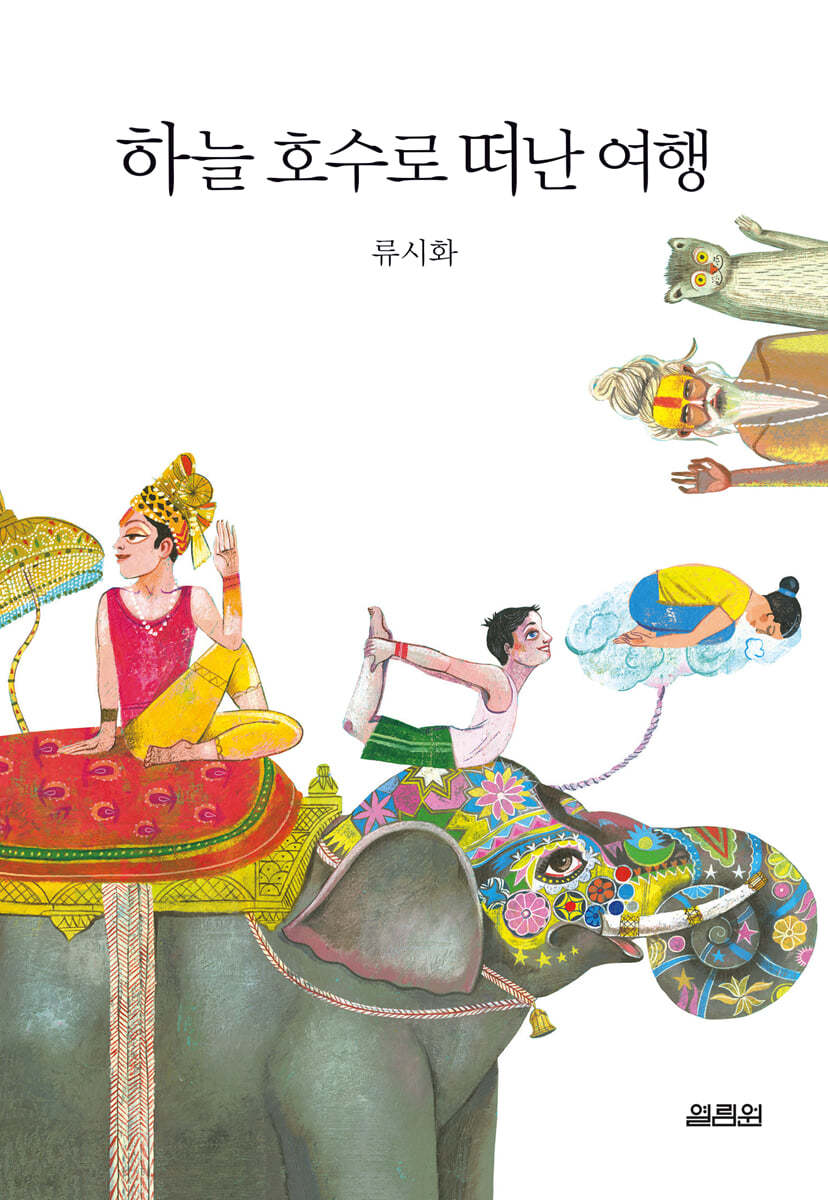
A Journey to Sky Lake
 |
Description
Book Introduction
A revised edition of [A Journey to Sky Lake], a steady seller that sold 500,000 copies by word of mouth for 18 years.
India, a country fraught with problems, has given birth to countless Buddhas and has attracted a diverse range of people, from Tripitaka to hippies, to a spiritual magnetism that invites the ultimate journey.
Where will you travel when you are gripped by life's fundamental questions?
A collection of quirky, original, and humorous anecdotes from a poet who traveled to India to find out the purpose of life and who he was.
A long-haired, solitary traveler encounters unexpected teachers and moving resonances in the caves of the Himalayas, the Ganges River, and the vast plains… .
The world we see through the poet's eyes and heart makes us reflect on ourselves and reminds us of what is most precious in life.
Even after closing the book, it leaves a lingering impression that resonates even after several years have passed.
It not only shows us India, but also makes us reflect on our lives.
India, a country fraught with problems, has given birth to countless Buddhas and has attracted a diverse range of people, from Tripitaka to hippies, to a spiritual magnetism that invites the ultimate journey.
Where will you travel when you are gripped by life's fundamental questions?
A collection of quirky, original, and humorous anecdotes from a poet who traveled to India to find out the purpose of life and who he was.
A long-haired, solitary traveler encounters unexpected teachers and moving resonances in the caves of the Himalayas, the Ganges River, and the vast plains… .
The world we see through the poet's eyes and heart makes us reflect on ourselves and reminds us of what is most precious in life.
Even after closing the book, it leaves a lingering impression that resonates even after several years have passed.
It not only shows us India, but also makes us reflect on our lives.
- You can preview some of the book's contents.
Preview
index
A Poem for Travelers
Revised edition to be free and happy wherever you are
The Happiness of the Poor
A Journey to Sky Lake
480 won worth of blessings
The disappearance of a civilized person
Three Mantras
Beautiful Thief
Where we came from, what we are, and where we are going
Ten coconuts
At the concert hall
Everyone lives under a round sky
The Saint and the Butterfly
pee
Blue Bus of the Soul
Ganges Restaurant
The old man playing the flute
The Fool and the Wise Man
three oranges
life
You can go to India without shoes.
Lost at 2 a.m.
Traveling with a dog
Toilet paper, trains, and happiness
On the way to Tagore House
The train is leaving
Mr. Singh
What did you learn today?
Let's go to my house
In my previous life, I lived in India.
empty stomach
Namaskar
Good Morning India
Indian Quote 1: Without tears in the eyes, there is no rainbow in the soul.
Indian Quote 2: The more you give up, the more you gain.
Indian Quotes 3 / No Problem Meditation
Revised edition to be free and happy wherever you are
The Happiness of the Poor
A Journey to Sky Lake
480 won worth of blessings
The disappearance of a civilized person
Three Mantras
Beautiful Thief
Where we came from, what we are, and where we are going
Ten coconuts
At the concert hall
Everyone lives under a round sky
The Saint and the Butterfly
pee
Blue Bus of the Soul
Ganges Restaurant
The old man playing the flute
The Fool and the Wise Man
three oranges
life
You can go to India without shoes.
Lost at 2 a.m.
Traveling with a dog
Toilet paper, trains, and happiness
On the way to Tagore House
The train is leaving
Mr. Singh
What did you learn today?
Let's go to my house
In my previous life, I lived in India.
empty stomach
Namaskar
Good Morning India
Indian Quote 1: Without tears in the eyes, there is no rainbow in the soul.
Indian Quote 2: The more you give up, the more you gain.
Indian Quotes 3 / No Problem Meditation
Into the book
When I asked the amount, Charu waved his hand again and bragged.
“Give me as much money as you want.
“I have no problem.”
When I asked with a serious expression on my face if it would be okay if I gave him just 1 rupee (30 won), Charu shouted,
“No problem!”
Then Charu added confidently.
If it makes me happy to give you just one rupee, then do it.
Since I was already his friend, what was important to him was not money but my happiness.
And I asked for not just a momentary happiness, but enough money to make myself, the one who gave the money, happy for a long time.
Clever Charu, mean Charu, ugly Charu… … .
Even after leaving Chennai, the impression of Charu lingered for a long time.
Charu, who lived a life of nothing, yet ran into the world shouting, "No problem!" and blowing his rubber trumpet! To me, who possessed so much yet still couldn't shake off obsession and possessions, he was an unforgettable and wonderful teacher.
--- From "The Happiness of the Poor" on page 30
I lay on a wooden bed that was about to break, looking up at the sky through a large hole in the ceiling.
Stars streamed through the hole like meteors.
The entire universe was flowing over the village of Kuri, the banyan tree, and the house of the old man who had stolen five rupees.
One by one, shooting stars fell, drawing diagonal lines over the earthen houses of warm people who had nothing but were never poor.
I began to think that we, who live on earth, might also be stars that have embarked on a long journey from that lake in the sky.
I loved the hole-in-the-wall room where I could gaze at the stars until I fell asleep.
--- From "A Journey to Sky Lake, Page 43"
“I have come to impart to you three mantras.
If you remember these three mantras, you will not need anyone else as your teacher.
You will come to realize that your most perfect teacher is yourself.”
He reached out through the car window, placed his hand on my head, and uttered three mantras.
“The first mantra is this:
Be honest with yourself.
Compromise with everyone in the world, but never with yourself.
Then no one will have power over you.
The second mantra is this:
When happy or sad things come, remember that they too will soon pass away.
Remember that nothing lasts forever.
Then, no matter what happens, you will not lose your peace of mind.
The third mantra is this:
If someone comes to you asking for help, don't tell them that God will help them.
“You step forward and help as if God did not exist.”
“Give me as much money as you want.
“I have no problem.”
When I asked with a serious expression on my face if it would be okay if I gave him just 1 rupee (30 won), Charu shouted,
“No problem!”
Then Charu added confidently.
If it makes me happy to give you just one rupee, then do it.
Since I was already his friend, what was important to him was not money but my happiness.
And I asked for not just a momentary happiness, but enough money to make myself, the one who gave the money, happy for a long time.
Clever Charu, mean Charu, ugly Charu… … .
Even after leaving Chennai, the impression of Charu lingered for a long time.
Charu, who lived a life of nothing, yet ran into the world shouting, "No problem!" and blowing his rubber trumpet! To me, who possessed so much yet still couldn't shake off obsession and possessions, he was an unforgettable and wonderful teacher.
--- From "The Happiness of the Poor" on page 30
I lay on a wooden bed that was about to break, looking up at the sky through a large hole in the ceiling.
Stars streamed through the hole like meteors.
The entire universe was flowing over the village of Kuri, the banyan tree, and the house of the old man who had stolen five rupees.
One by one, shooting stars fell, drawing diagonal lines over the earthen houses of warm people who had nothing but were never poor.
I began to think that we, who live on earth, might also be stars that have embarked on a long journey from that lake in the sky.
I loved the hole-in-the-wall room where I could gaze at the stars until I fell asleep.
--- From "A Journey to Sky Lake, Page 43"
“I have come to impart to you three mantras.
If you remember these three mantras, you will not need anyone else as your teacher.
You will come to realize that your most perfect teacher is yourself.”
He reached out through the car window, placed his hand on my head, and uttered three mantras.
“The first mantra is this:
Be honest with yourself.
Compromise with everyone in the world, but never with yourself.
Then no one will have power over you.
The second mantra is this:
When happy or sad things come, remember that they too will soon pass away.
Remember that nothing lasts forever.
Then, no matter what happens, you will not lose your peace of mind.
The third mantra is this:
If someone comes to you asking for help, don't tell them that God will help them.
“You step forward and help as if God did not exist.”
--- From "Three Mantras on Page 61"
Publisher's Review
Life is not a problem to be solved, but a mystery to be traveled.
When we travel to an unfamiliar place,
Not to see a new world
To open new eyes to see the world.
A book that needs no explanation
A steady seller for 18 years, selling 500,000 copies through word of mouth
India, a country fraught with problems, has given birth to countless Buddhas and has attracted a diverse range of people, from Tripitaka to hippies, to a spiritual magnetism that invites the ultimate journey.
When you're gripped by life's fundamental questions, where will you go on your journey? Discover the quirky, whimsical, and humorous anecdotes of a poet who journeyed to India to discover the purpose of life and "who am I?"
A long-haired, solitary traveler encounters unexpected teachers and moving resonances in the caves of the Himalayas, the Ganges River, and the vast plains…
The world we see through the eyes and heart of a poet makes us reflect on ourselves and reminds us of what is most precious in life.
Even after closing the book, it leaves a lingering impression that resonates even after several years have passed.
It not only shows us India, but also makes us reflect on our lives.
Life is not a problem to be solved, but a mystery to be traveled.
There is a wall between the world and me.
We have to get through it.
That is the gift of travel.
In the preface to this revised edition, published 18 years after the first edition, the author quotes Marcel Proust: "We set out on a journey not to see new worlds, but to have new eyes to see the world."
The author then says:
“As a poet, I also try to convey the beautiful world I see.
About the encounters that moved me and helped my soul grow.
About an experience that opened my eyes to a new way of looking at the world.
That is the direction of my writing."
It is not about reinforcing prejudice through travel, but about breaking prejudice through travel.
It is an important criterion for people and for travel.
The reason this book has been loved for so long is because it is not just an interesting travelogue, but a record of breaking down prejudices and stereotypes, encountering the world, and meeting people.
The poet's sensibility and open mind can be felt everywhere.
The travelogue that sparked the Indian travel boom
A poet's journey through India, filled with humor and lessons, written every year.
Like any other country, Indian society is riddled with problems. This book contains a series of brilliant essays, each one a gem, that depict, with humor and wit, the human side of the society that cannot be seen by those who only look at it.
It is not a superficial journey, but a journey that penetrates human life and fundamental goodness.
Books about India sometimes exaggerate the harshness of the journey, but this book doesn't just list hardships; it tells of encounters that shatter one's preconceptions and foolishness, and experiences that cross spiritual thresholds.
Poet Ryu Si-hwa's humorous and moving travelogue of India, which makes us think about the precious things we have lost, has been translated in Japan, France, China, and Taiwan, and is being translated in the United States, Italy, and Spain.
Now that the day has dawned, it's time to set off on our journey.
Time disappears into the thoughts of the past
Like a bird looking into the gap of eternity
I have to leave
I will never come back again
I'll just walk out of that world
I once wanted a life like a flame and a death like the wind.
Open the door of dawn
Blessed are those who set out on a journey.
A star that has not yet fallen asleep
Shining on your pale face
You pass under the sleepy trees
Like a young snake just waking up, I must wander alone through the dawn.
It's time to end the dream of life
Stop confining yourself in the moment
Stop tying yourself down to illusions that break like paper flowers.
Now that the day has dawned, I must take the sleepless pillow off my bedside table.
Oh, morning, leave behind the world that sleeps in lies
A morning when I set out alone to the land of eternity where flags flutter
He who owns nothing
Or happy are those who set out on a journey to love enough
Your soul is still transparent
By loving, I will not be afraid of getting hurt because of it.
The life you have lived
It's a life you haven't lived
Now to reach your door you must
You'll have to knock on countless doors that won't open.
To meet yourself
I must ask for directions from every signpost.
The road points to another road
The tree of the world will be your guesthouse.
The stars will look at you through the perforated blanket
You are asleep in a strange country
Dream in your native language
-A poem for travelers
A traveler was boarding a train in India when the ticket inspector asked him to show his ticket.
The foreign traveler searched through his pants pockets and backpack, but he could not find the ticket.
As he panicked and panicked, the ticket inspector gave him some advice.
“People usually put their tickets in their shirt pockets, so why don’t you check there?”
Then the traveler said:
“That place won’t do.
“If you check there and there is no sign, then your last hope is gone.”
When I first set out for India 25 years ago, many people, thirsting for the truth of life, flocked to India from both the East and the West.
They sought meditation centers and gurus to find answers to fundamental questions that conventional religions and philosophies could not provide.
I too arrived at Mumbai airport at 1 am to meet my guru, Rajneesh (later renamed 'Osho').
The meditation center in Poona, a five-hour train ride from Mumbai, was filled with the enthusiasm of seekers from all over the world.
We listened to the teacher's lectures every day, learned meditation, and exchanged information about other spiritual teachers.
One day, I heard from a German friend that there was a great teacher outside Mumbai, so I went there alone.
With many serious questions in mind.
But when I actually met him, I found out that although he was a kind and compassionate teacher, he could barely speak English, and I was a beginner in Hindi.
There was no one to interpret for me.
In the end, I couldn't even take the question out of my pocket and could only nod off while listening to his conversation with his Indian disciples.
Instead of returning to Puna, I stayed in the village for a few days, preferring to wander aimlessly through the quiet countryside, where buffalo roamed, free from the tight schedule of the meditation center, rather than with the old master.
With peacock-eyed children as his ardent followers.
So, I enjoyed a walk in the morning, attended darshan (a personal meeting with the teacher) in the afternoon, and just dozed off.
A few days passed, and it was time to return to the meditation center. I packed my backpack and went to see the teacher one last time.
As I was saying goodbye and turning around, he called out to me.
He picked up a few peppermints from the table in front of him and gave them to me, speaking in English.
“Be happy!”
To me, who was seeking profound truths to solve life's fundamental problems, those words were just kind advice, and I left that place, thinking it was just an old man's wise words.
I waved goodbye enthusiastically to the children who were more upset than me.
After that, I traveled to India every year and met many gurus, sadhus, monks and pandits (scholars).
And as time went by, I realized that their words and teachings, all the metaphysical answers humans have discovered, all came back to that one word.
“Be happy wherever you are!”
No matter where I travel, what I pursue, or who I am with, the question that matters is, 'Am I happy?'
And that happiness had to be not temporary, but a happiness that brightened every corner of my heart.
Indians call such happiness 'bliss' (anand).
It is called ‘a blessing from God.’
And that happiness comes from freedom of mind.
On every journey I ask myself:
"Am I happy? Am I truly free? Is the ticket to happiness stored deep within my heart?"
That is the question I am asking myself as I publish the revised edition of my first travelogue of India.
It's unsettling to ride a train without a ticket.
Moreover, most train journeys in India are long distances lasting over tens of hours, and ticket inspectors have sharp eyes.
Without the sign of 'happiness', the trip would be ruined.
(syncopation)
The Portuguese poet Fernando Pessoa said:
“The depicted field should be greener than the actual green.
When describing a country you have traveled to, it should be more beautiful than the actual scenery.” As a poet, I also try to convey the beautiful world I have seen.
About the encounters that moved me and helped my soul grow.
About an experience that opened my eyes to a new way of looking at the world.
That is the direction of my writing.
The India you experience may be different from this India.
Everyone's travel map is different.
Therefore, each traveler has his or her own India.
Just as each person has their own world.
And I think each of those worlds is consistently fascinating and challenging.
It is true that when you go to India, your outlook on life and death changes.
So, 'What have you learned, and how has your outlook on life changed?' That is the question travel poses to us.
People who have traveled to India have a lot of advice for first-time visitors.
A long list of 'things to watch out for' is listed.
Beware of the water, beware of the mango lassi at the guesthouses and lassi shops, beware of the Indian men, and beware of the rickshaw pullers in front of the train station.
It is a dangerous country where crime and robbery run rampant.
I, too, often advise, 'Be careful.'
Above all, looking at the world through one's own ideas and prejudices.
As humanist Koh Mi-sook said, “True travel is about experiencing heterogeneous encounters, physical transformations, and crossing a threshold.”
What advice would you give to a soul preparing to be born into this world? What stories and experiences would you share about this world? Of course, you would spend all night discussing the things that novice souls should be wary of on planet Earth.
Perhaps it will tell you not to be born into this painful and dangerous world.
And of course, wouldn't you say there are many beautiful things in this world and beautiful people waiting everywhere? The truth is that the world will show us different things depending on how we view it.
That travel to this world is the greatest gift from God.
How many beautiful people have I met on this journey? How beautiful was the journey? And how much effort have I put into being beautiful to others? That's what I have to say when I finish my journey.
"A Journey to the Sky Lake" is my story.
If we meet on the streets of India, we might share a cup of chai.
- From the preface to the revised edition written by the author
When we travel to an unfamiliar place,
Not to see a new world
To open new eyes to see the world.
A book that needs no explanation
A steady seller for 18 years, selling 500,000 copies through word of mouth
India, a country fraught with problems, has given birth to countless Buddhas and has attracted a diverse range of people, from Tripitaka to hippies, to a spiritual magnetism that invites the ultimate journey.
When you're gripped by life's fundamental questions, where will you go on your journey? Discover the quirky, whimsical, and humorous anecdotes of a poet who journeyed to India to discover the purpose of life and "who am I?"
A long-haired, solitary traveler encounters unexpected teachers and moving resonances in the caves of the Himalayas, the Ganges River, and the vast plains…
The world we see through the eyes and heart of a poet makes us reflect on ourselves and reminds us of what is most precious in life.
Even after closing the book, it leaves a lingering impression that resonates even after several years have passed.
It not only shows us India, but also makes us reflect on our lives.
Life is not a problem to be solved, but a mystery to be traveled.
There is a wall between the world and me.
We have to get through it.
That is the gift of travel.
In the preface to this revised edition, published 18 years after the first edition, the author quotes Marcel Proust: "We set out on a journey not to see new worlds, but to have new eyes to see the world."
The author then says:
“As a poet, I also try to convey the beautiful world I see.
About the encounters that moved me and helped my soul grow.
About an experience that opened my eyes to a new way of looking at the world.
That is the direction of my writing."
It is not about reinforcing prejudice through travel, but about breaking prejudice through travel.
It is an important criterion for people and for travel.
The reason this book has been loved for so long is because it is not just an interesting travelogue, but a record of breaking down prejudices and stereotypes, encountering the world, and meeting people.
The poet's sensibility and open mind can be felt everywhere.
The travelogue that sparked the Indian travel boom
A poet's journey through India, filled with humor and lessons, written every year.
Like any other country, Indian society is riddled with problems. This book contains a series of brilliant essays, each one a gem, that depict, with humor and wit, the human side of the society that cannot be seen by those who only look at it.
It is not a superficial journey, but a journey that penetrates human life and fundamental goodness.
Books about India sometimes exaggerate the harshness of the journey, but this book doesn't just list hardships; it tells of encounters that shatter one's preconceptions and foolishness, and experiences that cross spiritual thresholds.
Poet Ryu Si-hwa's humorous and moving travelogue of India, which makes us think about the precious things we have lost, has been translated in Japan, France, China, and Taiwan, and is being translated in the United States, Italy, and Spain.
Now that the day has dawned, it's time to set off on our journey.
Time disappears into the thoughts of the past
Like a bird looking into the gap of eternity
I have to leave
I will never come back again
I'll just walk out of that world
I once wanted a life like a flame and a death like the wind.
Open the door of dawn
Blessed are those who set out on a journey.
A star that has not yet fallen asleep
Shining on your pale face
You pass under the sleepy trees
Like a young snake just waking up, I must wander alone through the dawn.
It's time to end the dream of life
Stop confining yourself in the moment
Stop tying yourself down to illusions that break like paper flowers.
Now that the day has dawned, I must take the sleepless pillow off my bedside table.
Oh, morning, leave behind the world that sleeps in lies
A morning when I set out alone to the land of eternity where flags flutter
He who owns nothing
Or happy are those who set out on a journey to love enough
Your soul is still transparent
By loving, I will not be afraid of getting hurt because of it.
The life you have lived
It's a life you haven't lived
Now to reach your door you must
You'll have to knock on countless doors that won't open.
To meet yourself
I must ask for directions from every signpost.
The road points to another road
The tree of the world will be your guesthouse.
The stars will look at you through the perforated blanket
You are asleep in a strange country
Dream in your native language
-A poem for travelers
A traveler was boarding a train in India when the ticket inspector asked him to show his ticket.
The foreign traveler searched through his pants pockets and backpack, but he could not find the ticket.
As he panicked and panicked, the ticket inspector gave him some advice.
“People usually put their tickets in their shirt pockets, so why don’t you check there?”
Then the traveler said:
“That place won’t do.
“If you check there and there is no sign, then your last hope is gone.”
When I first set out for India 25 years ago, many people, thirsting for the truth of life, flocked to India from both the East and the West.
They sought meditation centers and gurus to find answers to fundamental questions that conventional religions and philosophies could not provide.
I too arrived at Mumbai airport at 1 am to meet my guru, Rajneesh (later renamed 'Osho').
The meditation center in Poona, a five-hour train ride from Mumbai, was filled with the enthusiasm of seekers from all over the world.
We listened to the teacher's lectures every day, learned meditation, and exchanged information about other spiritual teachers.
One day, I heard from a German friend that there was a great teacher outside Mumbai, so I went there alone.
With many serious questions in mind.
But when I actually met him, I found out that although he was a kind and compassionate teacher, he could barely speak English, and I was a beginner in Hindi.
There was no one to interpret for me.
In the end, I couldn't even take the question out of my pocket and could only nod off while listening to his conversation with his Indian disciples.
Instead of returning to Puna, I stayed in the village for a few days, preferring to wander aimlessly through the quiet countryside, where buffalo roamed, free from the tight schedule of the meditation center, rather than with the old master.
With peacock-eyed children as his ardent followers.
So, I enjoyed a walk in the morning, attended darshan (a personal meeting with the teacher) in the afternoon, and just dozed off.
A few days passed, and it was time to return to the meditation center. I packed my backpack and went to see the teacher one last time.
As I was saying goodbye and turning around, he called out to me.
He picked up a few peppermints from the table in front of him and gave them to me, speaking in English.
“Be happy!”
To me, who was seeking profound truths to solve life's fundamental problems, those words were just kind advice, and I left that place, thinking it was just an old man's wise words.
I waved goodbye enthusiastically to the children who were more upset than me.
After that, I traveled to India every year and met many gurus, sadhus, monks and pandits (scholars).
And as time went by, I realized that their words and teachings, all the metaphysical answers humans have discovered, all came back to that one word.
“Be happy wherever you are!”
No matter where I travel, what I pursue, or who I am with, the question that matters is, 'Am I happy?'
And that happiness had to be not temporary, but a happiness that brightened every corner of my heart.
Indians call such happiness 'bliss' (anand).
It is called ‘a blessing from God.’
And that happiness comes from freedom of mind.
On every journey I ask myself:
"Am I happy? Am I truly free? Is the ticket to happiness stored deep within my heart?"
That is the question I am asking myself as I publish the revised edition of my first travelogue of India.
It's unsettling to ride a train without a ticket.
Moreover, most train journeys in India are long distances lasting over tens of hours, and ticket inspectors have sharp eyes.
Without the sign of 'happiness', the trip would be ruined.
(syncopation)
The Portuguese poet Fernando Pessoa said:
“The depicted field should be greener than the actual green.
When describing a country you have traveled to, it should be more beautiful than the actual scenery.” As a poet, I also try to convey the beautiful world I have seen.
About the encounters that moved me and helped my soul grow.
About an experience that opened my eyes to a new way of looking at the world.
That is the direction of my writing.
The India you experience may be different from this India.
Everyone's travel map is different.
Therefore, each traveler has his or her own India.
Just as each person has their own world.
And I think each of those worlds is consistently fascinating and challenging.
It is true that when you go to India, your outlook on life and death changes.
So, 'What have you learned, and how has your outlook on life changed?' That is the question travel poses to us.
People who have traveled to India have a lot of advice for first-time visitors.
A long list of 'things to watch out for' is listed.
Beware of the water, beware of the mango lassi at the guesthouses and lassi shops, beware of the Indian men, and beware of the rickshaw pullers in front of the train station.
It is a dangerous country where crime and robbery run rampant.
I, too, often advise, 'Be careful.'
Above all, looking at the world through one's own ideas and prejudices.
As humanist Koh Mi-sook said, “True travel is about experiencing heterogeneous encounters, physical transformations, and crossing a threshold.”
What advice would you give to a soul preparing to be born into this world? What stories and experiences would you share about this world? Of course, you would spend all night discussing the things that novice souls should be wary of on planet Earth.
Perhaps it will tell you not to be born into this painful and dangerous world.
And of course, wouldn't you say there are many beautiful things in this world and beautiful people waiting everywhere? The truth is that the world will show us different things depending on how we view it.
That travel to this world is the greatest gift from God.
How many beautiful people have I met on this journey? How beautiful was the journey? And how much effort have I put into being beautiful to others? That's what I have to say when I finish my journey.
"A Journey to the Sky Lake" is my story.
If we meet on the streets of India, we might share a cup of chai.
- From the preface to the revised edition written by the author
GOODS SPECIFICS
- Date of issue: September 17, 2015
- Page count, weight, size: 268 pages | 364g | 131*189*20mm
- ISBN13: 9788970639468
- ISBN10: 8970639462
You may also like
카테고리
korean


korean

![GQ KOREA Mark (Monthly): December [2025]](http://librairie.coreenne.fr/cdn/shop/files/8ef265dbbfbf186523ed75ba7319009d.jpg?v=1765340328&width=3840)


