

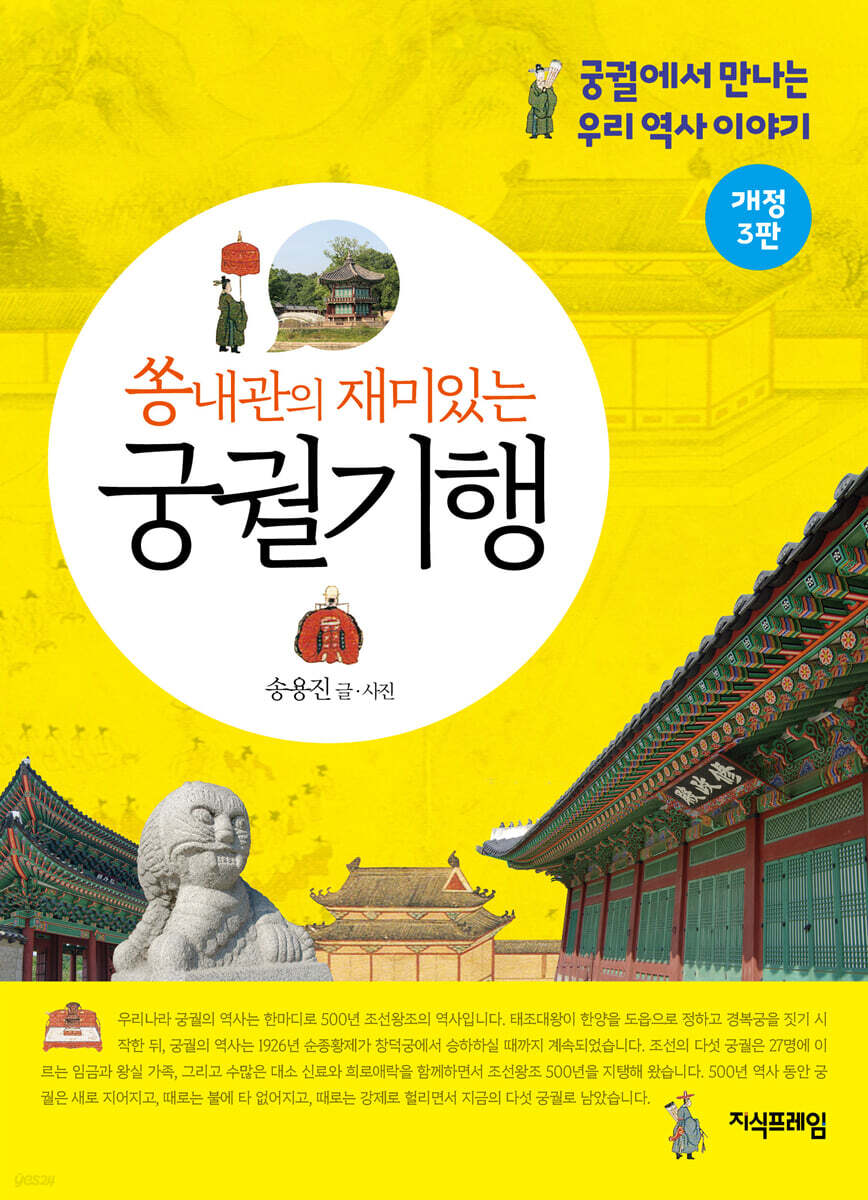
Song Eunuch's Interesting Palace Tour
 |
Description
Book Introduction
The most beloved palace guidebook since its first publication in 2005.
A revised third edition with additional stories of restored palaces published in 2023!
Since its first publication in April 2005, "Eunuch Song's Interesting Palace Tour" (Youth Book of the Year, Booktasse Recommended Book) has been a steady seller, gaining immense popularity among readers. Now in its third revised edition! It includes new content about the palace buildings that have been restored in the 14 years since the 2009 revised edition, and it has been reorganized with easy and fun explanations that are lower in level than the previous content, making it accessible to both teenagers and adults.
This is the ultimate palace guide that reveals everything about our palaces that are close by but not well known.
A revised third edition with additional stories of restored palaces published in 2023!
Since its first publication in April 2005, "Eunuch Song's Interesting Palace Tour" (Youth Book of the Year, Booktasse Recommended Book) has been a steady seller, gaining immense popularity among readers. Now in its third revised edition! It includes new content about the palace buildings that have been restored in the 14 years since the 2009 revised edition, and it has been reorganized with easy and fun explanations that are lower in level than the previous content, making it accessible to both teenagers and adults.
This is the ultimate palace guide that reveals everything about our palaces that are close by but not well known.
- You can preview some of the book's contents.
Preview
index
Opening remarks
Part 1.
Please hurry up and prepare to enter the palace!
Chapter 1.
A palace for all people
ㆍ What does palace mean?
ㆍThere is only one king, but why are there multiple palaces?
ㆍ Seoul's four main gates, five grand palaces, and Jongmyo Shrine
ㆍ Examining the structure of the palace
ㆍ How were the palace buildings built?
Chapter 2.
The history of the palace is the history of Joseon.
ㆍ Gyeongbokgung Palace, the best palace in Joseon
ㆍ Changdeokgung Palace, the main palace of the late Joseon Dynasty
Changgyeonggung Palace, which tells the story of a history of humiliation
Gyeonghee Palace, a palace that almost disappeared completely
ㆍ Deoksugung Palace's real name, Gyeongungung Palace
ㆍ Resting place for the royal family, the back garden
Chapter 3.
Preserve the ancestral shrine and the shrine
ㆍ Royal shrine, Jongmyo
Sajikdan, a place where sacrifices were made to the god of land and grain
Part 2.
The palace gates are open!
Chapter 1.
I applaud Haetae's hard work.
ㆍ The entrance to the palace and a symbol of integrity and innocence
ㆍHaetae statue returning to its original location
Chapter 2.
The main gate and Geumcheon of Gyeongbokgung Palace
ㆍGwanghwamun, the main gate of Gyeongbokgung Palace
ㆍ A fake Gwanghwamun made of concrete
ㆍ The palace of Gyeongbokgung Palace comes to life
ㆍEastern cross and western cross
ㆍ The four main gates of Gyeongbokgung Palace - Geonchunmun, Yeongchumun, Gwanghwamun, and Sinmumun
ㆍ Revival of Heungryemun
ㆍ Yeongjegyo Bridge at Gyeongbokgung Palace, which has found its place
Chapter 3.
The main gate and Geumcheon of Changdeokgung Palace
Donhwamun, which has protected the Joseon Dynasty for a long time
ㆍ Changdeokgung Palace Geumcheongyo Bridge, still strong after 600 years
Chapter 4.
The main gate and Geumcheon of Changgyeonggung Palace
ㆍ Shape of a crane taking flight, Honghwamun
ㆍOkcheon Bridge at Changgyeonggung Palace, where natural water flows
Chapter 5.
The main gate and Geumcheon of Gyeonghee Palace
ㆍ Heunghwamun Gate, which has yet to find its place
ㆍGeumcheongyo Bridge at Gyeonghuigung Palace, now a decoration at the Seoul Museum of History
Chapter 6.
Deoksugung Palace's main gate and Geumcheon
ㆍ Daehanmun, which was promoted to the main gate
ㆍ A pond with all sides blocked, Deoksugung Geumcheon
Part 3 | Side Story Area | Your Majesty, come and take me!
Chapter 1.
Calling all civil and military officials! - Jeongjeon
ㆍ Functions and roles of power outages
ㆍ Symbol of the Joseon Dynasty - Geunjeongjeon Hall of Gyeongbokgung Palace
ㆍ The representative main hall of the late Joseon Dynasty - Injeongjeon Hall of Changdeokgung Palace
ㆍ The oldest existing main hall - Myeongjeongjeon Hall in Changgyeonggung Palace
ㆍ The revived Jeongjeon Hall - Sungjeongjeon Hall of Gyeonghee Palace
ㆍ The Grand Palace of the Korean Empire - Junghwajeon Hall at Deoksugung Palace
Chapter 2.
May you govern wisely! - Pyeonjeon
ㆍ Function and role of the side dish
Think and Think Again! - Sajeongjeon Hall, Gyeongbokgung Palace
Released from the military control zone - Jibokjae, Gyeongbokgung Palace
ㆍ Politics of Generosity - Seonjeongjeon Hall in Changdeokgung Palace
Sad History, Half-Restored - Munjeongjeon Hall at Changgyeonggung Palace
ㆍ Lonely interior - Gyeonghee Palace's Jajeongjeon Hall
ㆍ Emperor Gojong's office space - Deoksugung Junmyeongdang, Seogeodang, Deokhongjeon, and Jungmyeongjeon
Chapter 3.
I submit a request to Your Majesty - The Cabinet Secretary
ㆍ Government offices within the palace, Gwannaegaksa
ㆍ A place where Joseon's talented people gathered - Gyeongbokgung Palace's Gwolnaegaksa
Restored government offices - Gwolnaegaksa, Changdeokgung Palace
ㆍGwaneogaksa, the royal residence of Changgyeonggung Palace, which was once a zoo
ㆍ Gyeonghee Palace's Gwannaegaksa, now a museum
ㆍDeoksugung Palace's Gwannaegaksa, where even a trace has disappeared
Part 4.
|Civil War Area| Abduct the Queen!
Chapter 1.
Your Majesty, please take a dip! - Sedimentation
ㆍ Well-shaped sedimentation - Gangnyeongjeon Hall in Gyeongbokgung Palace
ㆍ The sleeping quarters built by demolishing Gangnyeongjeon - Huijeongdang in Changdeokgung Palace
ㆍ A bedroom without ondol - Changgyeonggung Palace's Hwangyeongjeon Hall
ㆍ Daejeon Remains in the Painting - Gyeonghuigung Palace's Yungbokjeon Hall
ㆍ Suspicious fire - Hamnyeongjeon Hall, Deoksugung Palace
Chapter 2.
Please correct the discipline of the inner court! - Junggungjeon
ㆍ The owner of the palace, the queen mother
ㆍ The innermost palace - Gyeongbokgung Palace's Gyotaejeon Hall
ㆍ The Empress's Bedroom - Daejojeon Hall, Changdeokgung Palace
ㆍ The Queen Mother's Resting Place - Gyeonghungak Pavilion, Changdeokgung Palace
ㆍ The main palace with a pond - Tongmyeongjeon Hall of Changgyeonggung Palace
ㆍ The Junggungjeon, of which only photographs remain - Gyeonghee Palace's Hoesangjeon
ㆍ Junggungjeon, where the concubines lived - Deoksugung Jeokjodang
Chapter 3.
I ate Daebi Mama - Daebijeon
ㆍ The Daebijeon where the Queen Dowager resided
ㆍ A place with a beautiful flower wall - Gyeongbokgung Palace's Jagyeongjeon Hall
ㆍ The Lost Queen's Hall - Hamwonjeon Hall at Changdeokgung Palace
ㆍ The highest Daebijeon - Jagyeongdang, Changgyeonggung Palace
Chapter 4.
Crown Prince, please! - Donggungjeon
ㆍ Donggungjeon, where you can get a glimpse into the Crown Prince's life
ㆍ The sold Donggungjeon - Jaseondang and Bihyeongak in Gyeongbokgung Palace
Donggungjeon, the royal palace that served as a watchtower - Jungheedang in Changdeokgung Palace
ㆍ The classroom of the crown prince who became a member of the royal family - Seongjeonggak in Changdeokgung Palace
Chapter 5.
Honor the spirits of the former kings - Binjeon and Seonwonjeon
ㆍ Seonwonjeon Hall, which houses portraits of previous kings
Taewonjeon Hall, filled with the royal family's sorrow
ㆍ The site of the National Folk Museum - Seonwonjeon Hall at Gyeongbokgung Palace
ㆍ Two Seonwonjeon Halls in One Palace - Changdeokgung Seonwonjeon Hall
ㆍ The place where King Yeongjo's portrait was kept - Taenyeongjeon Hall, Gyeonghuigung Palace
ㆍ Seonwonjeon Hall disappeared along with the Korean Empire - Seonwonjeon Hall at Deoksugung Palace
Chapter 6.
This is a palace filled with the joys and sorrows of history.
ㆍ Halls around Heungbokjeon Hall in Gyeongbokgung Palace - Jipkyeongdang, Hamhwadang
ㆍ Small palace within the palace - Gyeongbokgung Palace and Geoncheonggung Palace
ㆍ A place where the lives of concubines are embedded - Yeongchunheon and Jibokheon at Changgyeonggung Palace
ㆍ The last resting place of the royal family - Nakseonjae, Seokbokheon, and Sugangjae of Changdeokgung Palace
ㆍ A symbol of modernization - Deoksugung Seokjojeon
Part 5.
|Sponsorship Area| Shake off your worries!
Chapter 1.
Gyeongbokgung Palace's rear garden
Gyeonghoeru Pavilion with eleven miscellaneous statues
ㆍ Small artificial mountain of the Nine Palaces - Amisan
ㆍ Simple yet magnificent - Hyangwonjeong
ㆍ The area outside Sinmumun Gate - Gyeongmudae, Naenongpo
Chapter 2.
The rear garden of Changdeokgung Palace
ㆍ The appearance of a traveler dipping his feet in water - Buyongjeong
ㆍLibrary within the sponsorship - Eosumun, Juhapru, Seohyanggak
ㆍ The stage of the past examination - Film Hall, Chundangdae
ㆍ Books that Crown Prince Hyomyeong read - Uidugak, Gioheon
ㆍ A place with beautiful lotus flowers and a gate that prevents aging - Immortal Gate and Aeryeonjeong Pavilion
ㆍ A nobleman's house with ninety-nine rooms inside the palace - Yeongyeongdang
ㆍPond shaped like the Korean Peninsula - Gwanramji, Gwanramjeong, Seungjaejeong
ㆍ A pavilion within a pavilion - Jondeokjeong, Pyumusa
ㆍ Clear water without any impurities - Cheongsimjeong and Dolgeobuk
ㆍ The top of the support - Neungheojeong, Chwigyujeong
ㆍ A place where time has stopped - Okryucheon area
Chapter 3.
The rear gardens of Changgyeonggung Palace, Gyeonghuigung Palace, and Deoksugung Palace
ㆍ A place to pray for a good harvest - Chundangji Pond in Changgyeonggung Palace
ㆍ A place to meet talented people - Haminjeong Pavilion in Changgyeonggung Palace
ㆍ A place deeply related to silkworms - Gwandeokjeong Pavilion in Changgyeonggung Palace
ㆍ The large greenhouse in the rear garden of Changgyeonggung Palace
Gyeonghee Palace's only rear garden - Hwanghakjeong
ㆍ The scent of Emperor Gojong's coffee - Jeonggwanheon in Deoksugung Palace
ㆍ The state guest house of the Korean Empire - Dondeokjeon Hall of Deoksugung Palace
Part 6.
Palace tour with Eunuch Song
Chapter 1.
Gyeongbokgung Palace
Chapter 2.
Changdeokgung Palace
Chapter 3.
Changgyeonggung Palace
Chapter 4.
Gyeonghee Palace
Chapter 5.
Deoksugung Palace
Part 1.
Please hurry up and prepare to enter the palace!
Chapter 1.
A palace for all people
ㆍ What does palace mean?
ㆍThere is only one king, but why are there multiple palaces?
ㆍ Seoul's four main gates, five grand palaces, and Jongmyo Shrine
ㆍ Examining the structure of the palace
ㆍ How were the palace buildings built?
Chapter 2.
The history of the palace is the history of Joseon.
ㆍ Gyeongbokgung Palace, the best palace in Joseon
ㆍ Changdeokgung Palace, the main palace of the late Joseon Dynasty
Changgyeonggung Palace, which tells the story of a history of humiliation
Gyeonghee Palace, a palace that almost disappeared completely
ㆍ Deoksugung Palace's real name, Gyeongungung Palace
ㆍ Resting place for the royal family, the back garden
Chapter 3.
Preserve the ancestral shrine and the shrine
ㆍ Royal shrine, Jongmyo
Sajikdan, a place where sacrifices were made to the god of land and grain
Part 2.
The palace gates are open!
Chapter 1.
I applaud Haetae's hard work.
ㆍ The entrance to the palace and a symbol of integrity and innocence
ㆍHaetae statue returning to its original location
Chapter 2.
The main gate and Geumcheon of Gyeongbokgung Palace
ㆍGwanghwamun, the main gate of Gyeongbokgung Palace
ㆍ A fake Gwanghwamun made of concrete
ㆍ The palace of Gyeongbokgung Palace comes to life
ㆍEastern cross and western cross
ㆍ The four main gates of Gyeongbokgung Palace - Geonchunmun, Yeongchumun, Gwanghwamun, and Sinmumun
ㆍ Revival of Heungryemun
ㆍ Yeongjegyo Bridge at Gyeongbokgung Palace, which has found its place
Chapter 3.
The main gate and Geumcheon of Changdeokgung Palace
Donhwamun, which has protected the Joseon Dynasty for a long time
ㆍ Changdeokgung Palace Geumcheongyo Bridge, still strong after 600 years
Chapter 4.
The main gate and Geumcheon of Changgyeonggung Palace
ㆍ Shape of a crane taking flight, Honghwamun
ㆍOkcheon Bridge at Changgyeonggung Palace, where natural water flows
Chapter 5.
The main gate and Geumcheon of Gyeonghee Palace
ㆍ Heunghwamun Gate, which has yet to find its place
ㆍGeumcheongyo Bridge at Gyeonghuigung Palace, now a decoration at the Seoul Museum of History
Chapter 6.
Deoksugung Palace's main gate and Geumcheon
ㆍ Daehanmun, which was promoted to the main gate
ㆍ A pond with all sides blocked, Deoksugung Geumcheon
Part 3 | Side Story Area | Your Majesty, come and take me!
Chapter 1.
Calling all civil and military officials! - Jeongjeon
ㆍ Functions and roles of power outages
ㆍ Symbol of the Joseon Dynasty - Geunjeongjeon Hall of Gyeongbokgung Palace
ㆍ The representative main hall of the late Joseon Dynasty - Injeongjeon Hall of Changdeokgung Palace
ㆍ The oldest existing main hall - Myeongjeongjeon Hall in Changgyeonggung Palace
ㆍ The revived Jeongjeon Hall - Sungjeongjeon Hall of Gyeonghee Palace
ㆍ The Grand Palace of the Korean Empire - Junghwajeon Hall at Deoksugung Palace
Chapter 2.
May you govern wisely! - Pyeonjeon
ㆍ Function and role of the side dish
Think and Think Again! - Sajeongjeon Hall, Gyeongbokgung Palace
Released from the military control zone - Jibokjae, Gyeongbokgung Palace
ㆍ Politics of Generosity - Seonjeongjeon Hall in Changdeokgung Palace
Sad History, Half-Restored - Munjeongjeon Hall at Changgyeonggung Palace
ㆍ Lonely interior - Gyeonghee Palace's Jajeongjeon Hall
ㆍ Emperor Gojong's office space - Deoksugung Junmyeongdang, Seogeodang, Deokhongjeon, and Jungmyeongjeon
Chapter 3.
I submit a request to Your Majesty - The Cabinet Secretary
ㆍ Government offices within the palace, Gwannaegaksa
ㆍ A place where Joseon's talented people gathered - Gyeongbokgung Palace's Gwolnaegaksa
Restored government offices - Gwolnaegaksa, Changdeokgung Palace
ㆍGwaneogaksa, the royal residence of Changgyeonggung Palace, which was once a zoo
ㆍ Gyeonghee Palace's Gwannaegaksa, now a museum
ㆍDeoksugung Palace's Gwannaegaksa, where even a trace has disappeared
Part 4.
|Civil War Area| Abduct the Queen!
Chapter 1.
Your Majesty, please take a dip! - Sedimentation
ㆍ Well-shaped sedimentation - Gangnyeongjeon Hall in Gyeongbokgung Palace
ㆍ The sleeping quarters built by demolishing Gangnyeongjeon - Huijeongdang in Changdeokgung Palace
ㆍ A bedroom without ondol - Changgyeonggung Palace's Hwangyeongjeon Hall
ㆍ Daejeon Remains in the Painting - Gyeonghuigung Palace's Yungbokjeon Hall
ㆍ Suspicious fire - Hamnyeongjeon Hall, Deoksugung Palace
Chapter 2.
Please correct the discipline of the inner court! - Junggungjeon
ㆍ The owner of the palace, the queen mother
ㆍ The innermost palace - Gyeongbokgung Palace's Gyotaejeon Hall
ㆍ The Empress's Bedroom - Daejojeon Hall, Changdeokgung Palace
ㆍ The Queen Mother's Resting Place - Gyeonghungak Pavilion, Changdeokgung Palace
ㆍ The main palace with a pond - Tongmyeongjeon Hall of Changgyeonggung Palace
ㆍ The Junggungjeon, of which only photographs remain - Gyeonghee Palace's Hoesangjeon
ㆍ Junggungjeon, where the concubines lived - Deoksugung Jeokjodang
Chapter 3.
I ate Daebi Mama - Daebijeon
ㆍ The Daebijeon where the Queen Dowager resided
ㆍ A place with a beautiful flower wall - Gyeongbokgung Palace's Jagyeongjeon Hall
ㆍ The Lost Queen's Hall - Hamwonjeon Hall at Changdeokgung Palace
ㆍ The highest Daebijeon - Jagyeongdang, Changgyeonggung Palace
Chapter 4.
Crown Prince, please! - Donggungjeon
ㆍ Donggungjeon, where you can get a glimpse into the Crown Prince's life
ㆍ The sold Donggungjeon - Jaseondang and Bihyeongak in Gyeongbokgung Palace
Donggungjeon, the royal palace that served as a watchtower - Jungheedang in Changdeokgung Palace
ㆍ The classroom of the crown prince who became a member of the royal family - Seongjeonggak in Changdeokgung Palace
Chapter 5.
Honor the spirits of the former kings - Binjeon and Seonwonjeon
ㆍ Seonwonjeon Hall, which houses portraits of previous kings
Taewonjeon Hall, filled with the royal family's sorrow
ㆍ The site of the National Folk Museum - Seonwonjeon Hall at Gyeongbokgung Palace
ㆍ Two Seonwonjeon Halls in One Palace - Changdeokgung Seonwonjeon Hall
ㆍ The place where King Yeongjo's portrait was kept - Taenyeongjeon Hall, Gyeonghuigung Palace
ㆍ Seonwonjeon Hall disappeared along with the Korean Empire - Seonwonjeon Hall at Deoksugung Palace
Chapter 6.
This is a palace filled with the joys and sorrows of history.
ㆍ Halls around Heungbokjeon Hall in Gyeongbokgung Palace - Jipkyeongdang, Hamhwadang
ㆍ Small palace within the palace - Gyeongbokgung Palace and Geoncheonggung Palace
ㆍ A place where the lives of concubines are embedded - Yeongchunheon and Jibokheon at Changgyeonggung Palace
ㆍ The last resting place of the royal family - Nakseonjae, Seokbokheon, and Sugangjae of Changdeokgung Palace
ㆍ A symbol of modernization - Deoksugung Seokjojeon
Part 5.
|Sponsorship Area| Shake off your worries!
Chapter 1.
Gyeongbokgung Palace's rear garden
Gyeonghoeru Pavilion with eleven miscellaneous statues
ㆍ Small artificial mountain of the Nine Palaces - Amisan
ㆍ Simple yet magnificent - Hyangwonjeong
ㆍ The area outside Sinmumun Gate - Gyeongmudae, Naenongpo
Chapter 2.
The rear garden of Changdeokgung Palace
ㆍ The appearance of a traveler dipping his feet in water - Buyongjeong
ㆍLibrary within the sponsorship - Eosumun, Juhapru, Seohyanggak
ㆍ The stage of the past examination - Film Hall, Chundangdae
ㆍ Books that Crown Prince Hyomyeong read - Uidugak, Gioheon
ㆍ A place with beautiful lotus flowers and a gate that prevents aging - Immortal Gate and Aeryeonjeong Pavilion
ㆍ A nobleman's house with ninety-nine rooms inside the palace - Yeongyeongdang
ㆍPond shaped like the Korean Peninsula - Gwanramji, Gwanramjeong, Seungjaejeong
ㆍ A pavilion within a pavilion - Jondeokjeong, Pyumusa
ㆍ Clear water without any impurities - Cheongsimjeong and Dolgeobuk
ㆍ The top of the support - Neungheojeong, Chwigyujeong
ㆍ A place where time has stopped - Okryucheon area
Chapter 3.
The rear gardens of Changgyeonggung Palace, Gyeonghuigung Palace, and Deoksugung Palace
ㆍ A place to pray for a good harvest - Chundangji Pond in Changgyeonggung Palace
ㆍ A place to meet talented people - Haminjeong Pavilion in Changgyeonggung Palace
ㆍ A place deeply related to silkworms - Gwandeokjeong Pavilion in Changgyeonggung Palace
ㆍ The large greenhouse in the rear garden of Changgyeonggung Palace
Gyeonghee Palace's only rear garden - Hwanghakjeong
ㆍ The scent of Emperor Gojong's coffee - Jeonggwanheon in Deoksugung Palace
ㆍ The state guest house of the Korean Empire - Dondeokjeon Hall of Deoksugung Palace
Part 6.
Palace tour with Eunuch Song
Chapter 1.
Gyeongbokgung Palace
Chapter 2.
Changdeokgung Palace
Chapter 3.
Changgyeonggung Palace
Chapter 4.
Gyeonghee Palace
Chapter 5.
Deoksugung Palace
Into the book
If you look at the map of Seoul now, there are five palaces: Gyeongbokgung Palace, Changdeokgung Palace, Changgyeonggung Palace, Deoksugung Palace, and Gyeonghuigung Palace.
But isn't it strange? In any era, there's only one king, so why are there five palaces? Clearly, there's only one king.
But wouldn't it be unsettling if there were only one space for the supreme ruler of a nation? Even in a palace, epidemics and fires could still occur.
---From "There is only one king, but why are there multiple palaces?"
Nowadays, it is common to plant grass when creating a home garden, but during the Joseon Dynasty, grass was mainly used to cover graves rather than for home landscaping.
So why are there so many lawns in the palaces now? It's because most of our palace buildings were torn down and sold during the Japanese colonial period.
The Japanese cover the empty lot with grass.
It was made like a park.
From our perspective, the building has disappeared and grass has been spread to cover the grave, so it feels like a palace tomb.
Isn't that so sad and unfortunate?
---From "How were the palace buildings built?"
After King Taejo, his son King Taejong and his grandson King Sejong, more buildings were built within Gyeongbokgung Palace, and Gyeongbokgung Palace developed into the main palace of Joseon.
But there were also crises.
Unfortunately, in 1553, during the reign of King Myeongjong, most of the buildings at Gyeongbokgung Palace were reduced to ashes due to a major fire that occurred for the first time in 150 years.
Fortunately, almost all of the buildings were restored the following year, 1554, but this was not the end of Gyeongbokgung Palace's twists and turns.
After that, there were many events that changed the fate of the palace.
In particular, the Imjin War was a very big event.
When the Japanese invasion of 1592 broke out, Gyeongbokgung Palace was completely burned down.
---From "Gyeongbokgung Palace, the Best Palace in Joseon"
When King Taejo founded the Joseon Dynasty, Gyeongbokgung Palace was the only palace.
As explained earlier, there must be at least two palaces to prepare for emergencies.
During the reign of King Taejong, the son of King Taejo, Changdeokgung Palace was completed to the east of Gyeongbokgung Palace.
Initially, Changdeokgung was a small palace that served as a supporting palace to Gyeongbokgung Palace.
However, it is said that King Taejong, who built Changdeokgung Palace, spent more time there than at Gyeongbokgung Palace.
Perhaps, since it was a palace built in his own time, he would have more affection for it?
---From “Changdeokgung Palace, the main palace of the late Joseon Dynasty”
Changgyeonggung Palace, like other palaces, was completely destroyed during the Japanese colonial period.
However, while the other palaces retained their names, Changgyeonggung Palace was renamed to Changgyeongwon and turned into a zoo and botanical garden.
In 1907, the Japanese demolished all the buildings in the southern part of Changgyeonggung Palace and built cages for monkeys, elephants, and tigers.
It became a zoo.
And that's not all.
The cute little ponds in the rear garden of Changgyeonggung Palace are combined to create a large lake, and the area around it is turned into a botanical garden.
And throughout the palace, sakura (cherry blossoms), Japan's national flower, were planted.
---From “Changgyeonggung Palace, Telling the History of Humiliation”
The fall of Gyeonghee Palace accelerated as the full-scale Japanese colonial period began.
The Japanese built their own school here, tore down buildings and built roads.
Most of the buildings that remained were sold to other places.
Even the Hoesangjeon was used as a Japanese school dormitory for about 10 years starting in 1911, and the main gate, Heunghwamun, is used as the main gate of the shrine of Ito Hirobumi on Namsan.
After that, it was used as the main gate of the hotel, but was recently moved back near the site of Gyeonghee Palace.
Gyeonghee Palace, which was dismantled and sold in pieces like this, was eventually completely dismantled in the 1920s, leaving only some of the walls.
---From "Gyeonghee Palace, the Palace That Almost Disappeared Completely"
The Japanese and pro-Japanese factions, who were uncomfortable with Emperor Gojong's continued assertion of his will for independence during the Japanese colonial period, forced him into retirement and made it impossible for him to leave Gyeongungung Palace.
They were under surveillance for almost 24 hours.
And the pro-Japanese collaborators gave the retired Emperor Gojong the honorific title of ‘Deoksu’ (a name given as a sign of respect).
Deoksu means 'to live a long time' in Chinese characters.
After that, Emperor Gojong was called 'His Majesty Deoksu', and Emperor Gojong's palace, Gyeongungung, naturally became Deoksugung.
However, some argue that the name Deoksu should not be used because Japan illegally stole our national sovereignty, and that Deoksugung Palace should be called by its original name, Gyeongungung Palace.
But isn't it strange? In any era, there's only one king, so why are there five palaces? Clearly, there's only one king.
But wouldn't it be unsettling if there were only one space for the supreme ruler of a nation? Even in a palace, epidemics and fires could still occur.
---From "There is only one king, but why are there multiple palaces?"
Nowadays, it is common to plant grass when creating a home garden, but during the Joseon Dynasty, grass was mainly used to cover graves rather than for home landscaping.
So why are there so many lawns in the palaces now? It's because most of our palace buildings were torn down and sold during the Japanese colonial period.
The Japanese cover the empty lot with grass.
It was made like a park.
From our perspective, the building has disappeared and grass has been spread to cover the grave, so it feels like a palace tomb.
Isn't that so sad and unfortunate?
---From "How were the palace buildings built?"
After King Taejo, his son King Taejong and his grandson King Sejong, more buildings were built within Gyeongbokgung Palace, and Gyeongbokgung Palace developed into the main palace of Joseon.
But there were also crises.
Unfortunately, in 1553, during the reign of King Myeongjong, most of the buildings at Gyeongbokgung Palace were reduced to ashes due to a major fire that occurred for the first time in 150 years.
Fortunately, almost all of the buildings were restored the following year, 1554, but this was not the end of Gyeongbokgung Palace's twists and turns.
After that, there were many events that changed the fate of the palace.
In particular, the Imjin War was a very big event.
When the Japanese invasion of 1592 broke out, Gyeongbokgung Palace was completely burned down.
---From "Gyeongbokgung Palace, the Best Palace in Joseon"
When King Taejo founded the Joseon Dynasty, Gyeongbokgung Palace was the only palace.
As explained earlier, there must be at least two palaces to prepare for emergencies.
During the reign of King Taejong, the son of King Taejo, Changdeokgung Palace was completed to the east of Gyeongbokgung Palace.
Initially, Changdeokgung was a small palace that served as a supporting palace to Gyeongbokgung Palace.
However, it is said that King Taejong, who built Changdeokgung Palace, spent more time there than at Gyeongbokgung Palace.
Perhaps, since it was a palace built in his own time, he would have more affection for it?
---From “Changdeokgung Palace, the main palace of the late Joseon Dynasty”
Changgyeonggung Palace, like other palaces, was completely destroyed during the Japanese colonial period.
However, while the other palaces retained their names, Changgyeonggung Palace was renamed to Changgyeongwon and turned into a zoo and botanical garden.
In 1907, the Japanese demolished all the buildings in the southern part of Changgyeonggung Palace and built cages for monkeys, elephants, and tigers.
It became a zoo.
And that's not all.
The cute little ponds in the rear garden of Changgyeonggung Palace are combined to create a large lake, and the area around it is turned into a botanical garden.
And throughout the palace, sakura (cherry blossoms), Japan's national flower, were planted.
---From “Changgyeonggung Palace, Telling the History of Humiliation”
The fall of Gyeonghee Palace accelerated as the full-scale Japanese colonial period began.
The Japanese built their own school here, tore down buildings and built roads.
Most of the buildings that remained were sold to other places.
Even the Hoesangjeon was used as a Japanese school dormitory for about 10 years starting in 1911, and the main gate, Heunghwamun, is used as the main gate of the shrine of Ito Hirobumi on Namsan.
After that, it was used as the main gate of the hotel, but was recently moved back near the site of Gyeonghee Palace.
Gyeonghee Palace, which was dismantled and sold in pieces like this, was eventually completely dismantled in the 1920s, leaving only some of the walls.
---From "Gyeonghee Palace, the Palace That Almost Disappeared Completely"
The Japanese and pro-Japanese factions, who were uncomfortable with Emperor Gojong's continued assertion of his will for independence during the Japanese colonial period, forced him into retirement and made it impossible for him to leave Gyeongungung Palace.
They were under surveillance for almost 24 hours.
And the pro-Japanese collaborators gave the retired Emperor Gojong the honorific title of ‘Deoksu’ (a name given as a sign of respect).
Deoksu means 'to live a long time' in Chinese characters.
After that, Emperor Gojong was called 'His Majesty Deoksu', and Emperor Gojong's palace, Gyeongungung, naturally became Deoksugung.
However, some argue that the name Deoksu should not be used because Japan illegally stole our national sovereignty, and that Deoksugung Palace should be called by its original name, Gyeongungung Palace.
---From "The Real Name of Deoksugung Palace, Gyeongungung Palace"
Publisher's Review
The friendliest palace guide
When it comes to the word 'palace', many people still tend to think of it as a place where the king enjoyed luxury and a great place for taking pictures.
But is a palace really like that? "Eunuch Song's Interesting Palace Tour" is a guidebook that covers everything from basic knowledge about our palaces to detailed explanations of their functions and history in each area.
To help people understand the palace, the author, Eunuch Song, who claims to know the palace best, never passes up a single stone slab or tile from the palace.
It carefully reveals the wisdom of our ancestors and the beautiful beauty of the palace hidden within.
Especially when explaining the sites of important historical events, such as Gwanghwamun and Hyangwonjeong in Gyeongbokgung Palace, which were restored in recent years, and Dondeokjeon in Deoksugung Palace, he expresses sadness and anger, and even the joys and sorrows of our palaces.
Encountering History Through the Palace
This book is divided into six parts.
〈Part 1.
In “Please hurry up and prepare to enter the palace!”, we will learn basic common sense about our palace, and in “Part 2.
In “Open the Palace Gates!”, the story unfolds with explanations of the main gates and Geumcheon of the five palaces (Gyeongbokgung, Changdeokgung, Changgyeonggung, Gyeonghuigung, and Deoksugung).
Next, Part 3.
External Story Area - Your Majesty, come and take me!〉 〈Part 4.
Civil War Area - The Queen Mother, please!〉 〈Part 5.
In “Sponsorship - Shake off your worries!”, the palace is divided into each area and explained by era and function.
Of course, in this process, the author does not stop at simply explaining the palace's functions.
Through the turbulent history of the Joseon Dynasty, including the Imjin War, and the pain of the palace being thoroughly destroyed and distorted during the Japanese colonial period, it conveys the heartbreaking truth of history that we, living in this era, have forgotten.
A solid palace tour guide in one volume
When you go to the palace, you have no idea where to start and what to see.
It is not easy to get a satisfactory explanation for each palace building.
Because of this, even when people go to the palace, they often end up just admiring the beauty of the exterior.
To address these concerns of readers, Part 6 of ‘Eunuch Song’s Interesting Palace Tour’ includes ‘Palace Tour with Eunuch Song.’
From the palace entrance to the last gate, it contains detailed explanations of not only the existing and restored buildings, but also the numerous plaques you encounter within the palace grounds, and even the former palace buildings now covered with lawn, making it a guidebook worthy of its time.
Through this, we have designed it so that you can have a true palace tour that you can feel and think about with your heart, rather than just seeing the palace with your eyes.
When it comes to the word 'palace', many people still tend to think of it as a place where the king enjoyed luxury and a great place for taking pictures.
But is a palace really like that? "Eunuch Song's Interesting Palace Tour" is a guidebook that covers everything from basic knowledge about our palaces to detailed explanations of their functions and history in each area.
To help people understand the palace, the author, Eunuch Song, who claims to know the palace best, never passes up a single stone slab or tile from the palace.
It carefully reveals the wisdom of our ancestors and the beautiful beauty of the palace hidden within.
Especially when explaining the sites of important historical events, such as Gwanghwamun and Hyangwonjeong in Gyeongbokgung Palace, which were restored in recent years, and Dondeokjeon in Deoksugung Palace, he expresses sadness and anger, and even the joys and sorrows of our palaces.
Encountering History Through the Palace
This book is divided into six parts.
〈Part 1.
In “Please hurry up and prepare to enter the palace!”, we will learn basic common sense about our palace, and in “Part 2.
In “Open the Palace Gates!”, the story unfolds with explanations of the main gates and Geumcheon of the five palaces (Gyeongbokgung, Changdeokgung, Changgyeonggung, Gyeonghuigung, and Deoksugung).
Next, Part 3.
External Story Area - Your Majesty, come and take me!〉 〈Part 4.
Civil War Area - The Queen Mother, please!〉 〈Part 5.
In “Sponsorship - Shake off your worries!”, the palace is divided into each area and explained by era and function.
Of course, in this process, the author does not stop at simply explaining the palace's functions.
Through the turbulent history of the Joseon Dynasty, including the Imjin War, and the pain of the palace being thoroughly destroyed and distorted during the Japanese colonial period, it conveys the heartbreaking truth of history that we, living in this era, have forgotten.
A solid palace tour guide in one volume
When you go to the palace, you have no idea where to start and what to see.
It is not easy to get a satisfactory explanation for each palace building.
Because of this, even when people go to the palace, they often end up just admiring the beauty of the exterior.
To address these concerns of readers, Part 6 of ‘Eunuch Song’s Interesting Palace Tour’ includes ‘Palace Tour with Eunuch Song.’
From the palace entrance to the last gate, it contains detailed explanations of not only the existing and restored buildings, but also the numerous plaques you encounter within the palace grounds, and even the former palace buildings now covered with lawn, making it a guidebook worthy of its time.
Through this, we have designed it so that you can have a true palace tour that you can feel and think about with your heart, rather than just seeing the palace with your eyes.
GOODS SPECIFICS
- Date of issue: June 26, 2023
- Page count, weight, size: 340 pages | 152*210*30mm
- ISBN13: 9791198221315
- ISBN10: 1198221313
You may also like
카테고리
korean


korean

![GQ KOREA Mark (Monthly): December [2025]](http://librairie.coreenne.fr/cdn/shop/files/8ef265dbbfbf186523ed75ba7319009d.jpg?v=1765340328&width=3840)


