

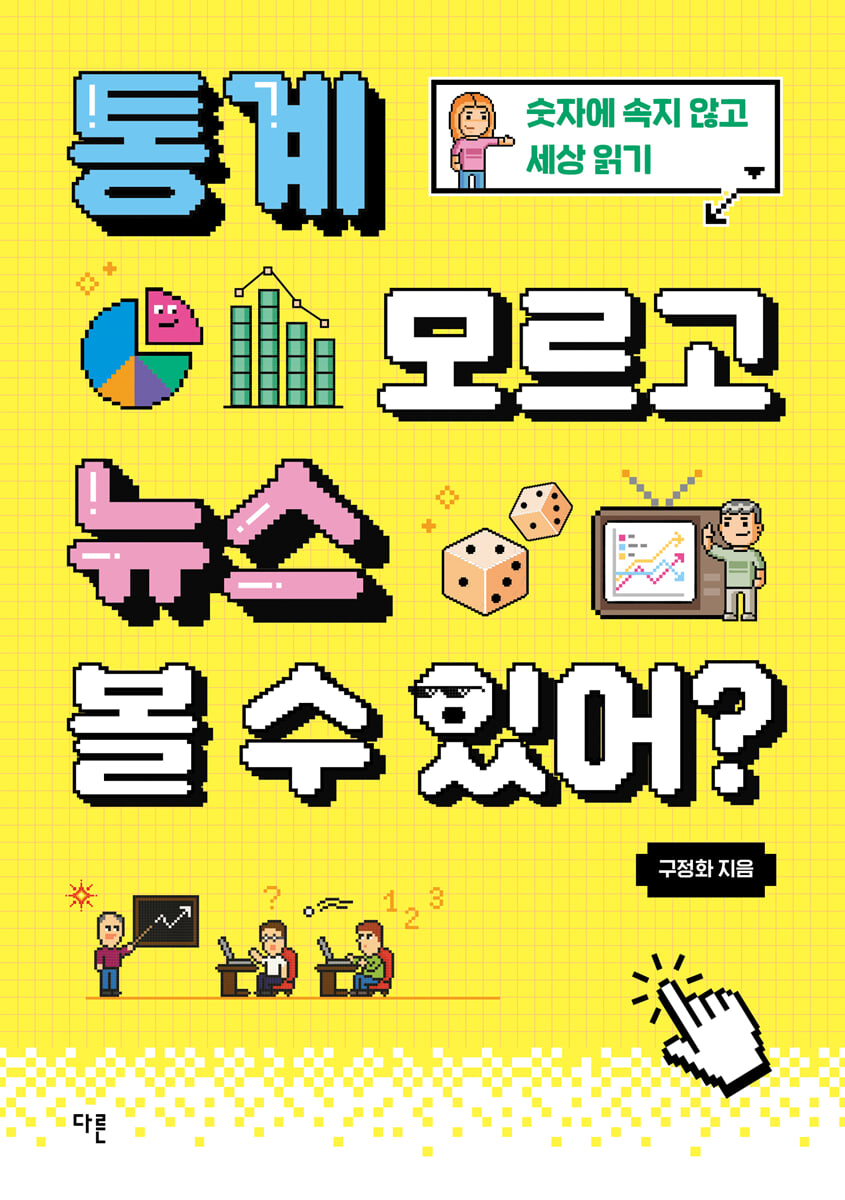
Can you watch the news without knowing statistics?
 |
Description
Book Introduction
The world is analyzed and predicted by statistics!
Stories of statistics that live in everyday life, from society and culture to politics and economics.
If you know 'statistics', you can see how the world works!
A world-class statistics study for teenagers
Do you feel dizzy just by looking at the word "statistics"? From people who say they can't trust graphs on the news to those who question what statistics have to do with them, we see a wide range of attitudes toward statistics.
But we already live in a world made up of statistics.
Examples are endless: weekly chart rankings on music streaming sites, presidential elections and opinion polls, and youth unemployment graphs.
"Can You Watch the News Without Knowing Statistics?" is a book that informs us of the importance of statistics that are close to us.
To achieve this, the story unfolds through the lens of middle school student Jeong-hwa. It explores topics such as why the ranking announcements on a TV audition program became controversial, whether comparing average scores from last year and this year's CSAT is meaningful, and what sabermetric strategies utilize statistics in baseball games. The series selects material from daily news and poses a variety of questions.
By introducing statistics in this way, Junghwa directly examines the news and asks questions, making it easier to learn statistics.
Additionally, at the end of each chapter, we included questions for further consideration in the “Let’s Discuss” box.
This will be a time to think about and organize how we can apply what we have learned from reading the book in our real life.
- You can preview some of the book's contents.
Preview
index
Entering_What do statistics mean to us?
SECTION 1 ENTERTAINMENT & SPORTS
How were the rankings of audition programs manipulated?
The need for accurate statistics
Why are there so many rich celebrities?
_Population and Sample
Virtual human Rosie becomes a commercial model
The Fourth Industrial Revolution and Big Data
Will a certain baseball player's value increase if he transfers to another team?
_Sabermetrics
SECTION 2 Society & Culture
Will this year's CSAT average score rise compared to last year?
_Mean, median, and mode
Annual lottery sales reach 6 trillion won... What do people expect?
_Probability and Expected Value
Why is crime among illegal immigrants on the rise?
_Number of criminals and criminal rate
The demographic cliff: The era of South Korea's disappearance is coming.
_Birth rate and birth rate
SECTION 3 Politics & Economy
Is our country's economic growth rate 1% or -1%?
_Economic growth rate and rate of increase/decrease
Is the 2016 US presidential election all red?
_Visualization of statistics
The presidential election: The ongoing controversy over opinion poll bias
_Public opinion polls and margin of error
Soaring youth unemployment, the economy in turmoil…
Economically active population and unemployment rate
Let's use statistics to predict the future.
Curriculum linkage
References
SECTION 1 ENTERTAINMENT & SPORTS
How were the rankings of audition programs manipulated?
The need for accurate statistics
Why are there so many rich celebrities?
_Population and Sample
Virtual human Rosie becomes a commercial model
The Fourth Industrial Revolution and Big Data
Will a certain baseball player's value increase if he transfers to another team?
_Sabermetrics
SECTION 2 Society & Culture
Will this year's CSAT average score rise compared to last year?
_Mean, median, and mode
Annual lottery sales reach 6 trillion won... What do people expect?
_Probability and Expected Value
Why is crime among illegal immigrants on the rise?
_Number of criminals and criminal rate
The demographic cliff: The era of South Korea's disappearance is coming.
_Birth rate and birth rate
SECTION 3 Politics & Economy
Is our country's economic growth rate 1% or -1%?
_Economic growth rate and rate of increase/decrease
Is the 2016 US presidential election all red?
_Visualization of statistics
The presidential election: The ongoing controversy over opinion poll bias
_Public opinion polls and margin of error
Soaring youth unemployment, the economy in turmoil…
Economically active population and unemployment rate
Let's use statistics to predict the future.
Curriculum linkage
References
Into the book
When conducting a survey, the population refers to the entire group that is being surveyed.
A sample is a group selected instead of the entire population to be surveyed, and is a part that can represent the population.
In actual research, when the entire population is surveyed, it is called a census survey, and when a sample is selected and surveyed, it is called a sample survey.
Nowadays, it is more common to conduct sample surveys rather than census surveys.
If the representativeness of the population is well maintained, a sample survey can have the same effect as a survey of the population.
--- From "SECTION 1 Entertainment & Sports 'Why are there so many rich celebrities?'"
Compared to conventional statistics, big data differs primarily in the capacity of the data itself.
However, when utilizing big data, statistical principles are often utilized.
Basically, statistics is the process of examining data and organizing the situation or characteristics of a group into numbers.
In this process, we classify the similarities and differences between the data, that is, the material.
In this respect, the use of big data is similar to the principles of statistics.
While statistics are basically expressed in numbers, big data reveals its results in various ways, such as images or text.
--- From "SECTION 1 Entertainment & Sports 'Virtual Human Rosie Becomes CF Model'"
Let's consider the arithmetic mean of the income of all households in a country.
But what if the income of the top 5% of wealthy households is disproportionately high compared to other households? Can the arithmetic mean accurately reflect the average income of the country's citizens? In this case, understanding the characteristics of a given group solely through the arithmetic mean makes it difficult to properly understand the characteristics of its members.
We fall into the trap of the average, which is the misconception that the arithmetic mean represents the group.
--- From "SECTION 2 Society & Culture 'This year's CSAT average score, up from last year?'"
People who express hate towards foreigners and illegal immigrants often present specific data to make it seem like they are stating facts.
A typical example is the use of statistics.
There is a hidden intention behind using statistics to appear value-neutral.
However, as we have seen before, if you do not use numbers or ratios accurately in statistics, you will end up telling lies or distorting stories that are not true.
--- From "SECTION 2 Society & Culture: 'Illegal Immigrant Crimes on the Rise, Why?'"
Let's look at our country's economic growth rate. Looking at the graph on the right, we see that, except for 1998 and 2020, when the IMF foreign exchange crisis occurred, the economic growth rate has been higher than zero in all years.
In the 1990s, it was over 10%, but these days, it is generally lower than 3%.
It is true that the economic growth rate has decreased compared to the past, but this is because the size of our country's economy has grown significantly.
This is because the previous year's GDP, which serves as the denominator, has been increasing.
So, just because the economic growth rate has decreased compared to the past, it does not mean that there has been no growth.
You can see that it is growing, but its size is decreasing.
In this case, the news sometimes reports that 'economic growth is slowing down.'
--- From "SECTION 3 Politics & Economy 'Is our country's economic growth rate 1% or -1%?'"
What matters in politics is not the approval rating over a five-year period, but who won the presidential or parliamentary election and what the approval rating was at that time.
However, the information in the graph on the right only compares 1995, 2000, 2005, 2010, 2015, and 2020, and Party A's approval rating has been high since 2000.
Therefore, even though Party B actually won the election, looking only at the presented graph would lead one to misunderstand that Party A received more public support at all times.
By selecting only the data that is favorable to you and removing the unfavorable data to create a graph, you can distort the statistics.
This should also be considered false information.
A sample is a group selected instead of the entire population to be surveyed, and is a part that can represent the population.
In actual research, when the entire population is surveyed, it is called a census survey, and when a sample is selected and surveyed, it is called a sample survey.
Nowadays, it is more common to conduct sample surveys rather than census surveys.
If the representativeness of the population is well maintained, a sample survey can have the same effect as a survey of the population.
--- From "SECTION 1 Entertainment & Sports 'Why are there so many rich celebrities?'"
Compared to conventional statistics, big data differs primarily in the capacity of the data itself.
However, when utilizing big data, statistical principles are often utilized.
Basically, statistics is the process of examining data and organizing the situation or characteristics of a group into numbers.
In this process, we classify the similarities and differences between the data, that is, the material.
In this respect, the use of big data is similar to the principles of statistics.
While statistics are basically expressed in numbers, big data reveals its results in various ways, such as images or text.
--- From "SECTION 1 Entertainment & Sports 'Virtual Human Rosie Becomes CF Model'"
Let's consider the arithmetic mean of the income of all households in a country.
But what if the income of the top 5% of wealthy households is disproportionately high compared to other households? Can the arithmetic mean accurately reflect the average income of the country's citizens? In this case, understanding the characteristics of a given group solely through the arithmetic mean makes it difficult to properly understand the characteristics of its members.
We fall into the trap of the average, which is the misconception that the arithmetic mean represents the group.
--- From "SECTION 2 Society & Culture 'This year's CSAT average score, up from last year?'"
People who express hate towards foreigners and illegal immigrants often present specific data to make it seem like they are stating facts.
A typical example is the use of statistics.
There is a hidden intention behind using statistics to appear value-neutral.
However, as we have seen before, if you do not use numbers or ratios accurately in statistics, you will end up telling lies or distorting stories that are not true.
--- From "SECTION 2 Society & Culture: 'Illegal Immigrant Crimes on the Rise, Why?'"
Let's look at our country's economic growth rate. Looking at the graph on the right, we see that, except for 1998 and 2020, when the IMF foreign exchange crisis occurred, the economic growth rate has been higher than zero in all years.
In the 1990s, it was over 10%, but these days, it is generally lower than 3%.
It is true that the economic growth rate has decreased compared to the past, but this is because the size of our country's economy has grown significantly.
This is because the previous year's GDP, which serves as the denominator, has been increasing.
So, just because the economic growth rate has decreased compared to the past, it does not mean that there has been no growth.
You can see that it is growing, but its size is decreasing.
In this case, the news sometimes reports that 'economic growth is slowing down.'
--- From "SECTION 3 Politics & Economy 'Is our country's economic growth rate 1% or -1%?'"
What matters in politics is not the approval rating over a five-year period, but who won the presidential or parliamentary election and what the approval rating was at that time.
However, the information in the graph on the right only compares 1995, 2000, 2005, 2010, 2015, and 2020, and Party A's approval rating has been high since 2000.
Therefore, even though Party B actually won the election, looking only at the presented graph would lead one to misunderstand that Party A received more public support at all times.
By selecting only the data that is favorable to you and removing the unfavorable data to create a graph, you can distort the statistics.
This should also be considered false information.
--- From "SECTION 3 Politics & Economy 'Will the 2016 US Presidential Election Be All Red?'"
Publisher's Review
"Today's Statistics"
Population and sample, probability and expected value, margin of error…
Statistical concepts learned naturally while watching the news
Statistics are a very good tool when trying to persuade someone.
As a result, it can often be seen in news and newspaper articles explaining complex social issues or natural phenomena.
Statistics are used in every corner of our lives, but it's easy to shake your head and avoid them because of the unfamiliar terms.
"Can You Watch the News Without Knowing Statistics?" presents core statistical concepts, organized into chapters on Entertainment & Sports, Society & Culture, and Politics & Economics, as if reading a real news story. It helps readers connect statistics to the world we live in, exploring topics like the truth behind the image of wealthy celebrities on TV, the hidden probabilities and expected values of lottery winnings, and the pitfalls of comparing global economic growth rates.
Reading this book will naturally broaden your perspective on the world, asking questions like, "What will the future of statistics be like in the era of the Fourth Industrial Revolution, where virtual humans are becoming commercial models?" and "Is there hate behind the concerns and fears about crimes committed by illegal immigrants?"
Important terms and explanations are highlighted with a highlighter so you can find, read, and organize them at a glance.
The "Just a Minute!" segments, placed throughout the text, offer a fun and engaging story, including the reasons why a famous American magazine failed and the statistical strategies behind the baseball movie "Moneyball."
Becoming a Statistics Blind Person vs. Using Statistics Properly
How to make the numbers work for you
Statistics are expressed in numbers, but it is actually people who present those numbers and make claims.
Therefore, the meaning of the number changes depending on the thoughts or perspective of the person using it.
This means that depending on how statistics are used, they can either be good data or plausible fake news.
This can be seen, for example, in the presidential election opinion polls.
Even though the surveys were conducted on the same date, the approval ratings for each candidate announced by each research institute are different.
Different types of questions lead to different answers.
However, the article only presents the percentage of responses as a headline, and the candidates also only use statistics that are favorable to them.
There is something more important than knowing statistics in your head.
It's important to find the data to find out exactly what it is, know what statistics it contains, and not miss out on the questions you need to ask.
This is why this book is written in a way that asks a list of questions from the perspective of teenagers and considers the answers.
If you use statistics properly, you can predict the future based on current statistics.
This is because the consciousness and thoughts of people living in the present become the driving force that creates the future.
The world we will live in in the future is a world where data is a resource.
This book will help me develop the ability to identify, critically analyze, and think critically about the information I need.
Population and sample, probability and expected value, margin of error…
Statistical concepts learned naturally while watching the news
Statistics are a very good tool when trying to persuade someone.
As a result, it can often be seen in news and newspaper articles explaining complex social issues or natural phenomena.
Statistics are used in every corner of our lives, but it's easy to shake your head and avoid them because of the unfamiliar terms.
"Can You Watch the News Without Knowing Statistics?" presents core statistical concepts, organized into chapters on Entertainment & Sports, Society & Culture, and Politics & Economics, as if reading a real news story. It helps readers connect statistics to the world we live in, exploring topics like the truth behind the image of wealthy celebrities on TV, the hidden probabilities and expected values of lottery winnings, and the pitfalls of comparing global economic growth rates.
Reading this book will naturally broaden your perspective on the world, asking questions like, "What will the future of statistics be like in the era of the Fourth Industrial Revolution, where virtual humans are becoming commercial models?" and "Is there hate behind the concerns and fears about crimes committed by illegal immigrants?"
Important terms and explanations are highlighted with a highlighter so you can find, read, and organize them at a glance.
The "Just a Minute!" segments, placed throughout the text, offer a fun and engaging story, including the reasons why a famous American magazine failed and the statistical strategies behind the baseball movie "Moneyball."
Becoming a Statistics Blind Person vs. Using Statistics Properly
How to make the numbers work for you
Statistics are expressed in numbers, but it is actually people who present those numbers and make claims.
Therefore, the meaning of the number changes depending on the thoughts or perspective of the person using it.
This means that depending on how statistics are used, they can either be good data or plausible fake news.
This can be seen, for example, in the presidential election opinion polls.
Even though the surveys were conducted on the same date, the approval ratings for each candidate announced by each research institute are different.
Different types of questions lead to different answers.
However, the article only presents the percentage of responses as a headline, and the candidates also only use statistics that are favorable to them.
There is something more important than knowing statistics in your head.
It's important to find the data to find out exactly what it is, know what statistics it contains, and not miss out on the questions you need to ask.
This is why this book is written in a way that asks a list of questions from the perspective of teenagers and considers the answers.
If you use statistics properly, you can predict the future based on current statistics.
This is because the consciousness and thoughts of people living in the present become the driving force that creates the future.
The world we will live in in the future is a world where data is a resource.
This book will help me develop the ability to identify, critically analyze, and think critically about the information I need.
GOODS SPECIFICS
- Publication date: December 6, 2022
- Page count, weight, size: 228 pages | 372g | 148*210*14mm
- ISBN13: 9791156335177
- ISBN10: 1156335175
You may also like
카테고리
korean


korean

![GQ KOREA Mark (Monthly): December [2025]](http://librairie.coreenne.fr/cdn/shop/files/8ef265dbbfbf186523ed75ba7319009d.jpg?v=1765340328&width=3840)


