

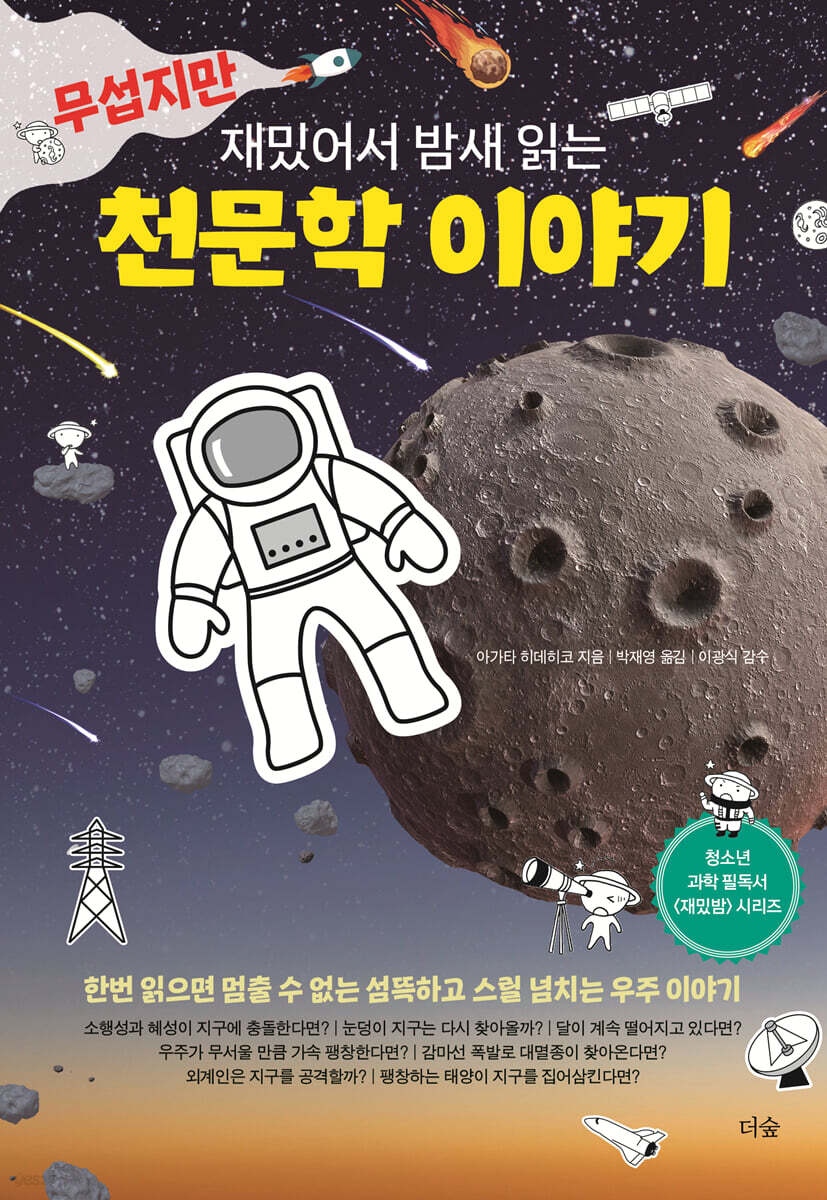
A scary but fun astronomy story that will have you reading all night long
 |
Description
Book Introduction
Why is space so scary and yet so fascinating?
Threaded with the theme of horror
A chilling and thrilling astronomy story
At the 23rd World Knowledge Forum held on September 21, 2022, Robert Zubrin, President of the Mars Society, declared that we have entered an era of great space exploration.
In addition, the first rocket launch attempt of the manned lunar exploration Artemis project, which resumed after 50 years, was made this year, Korea's first lunar probe Danuri was successfully launched, and space observations by NASA's ultra-high-resolution James Webb Telescope were successful.
The recently published "Scary but Fun Astronomy Stories You'll Read All Night" fully captures the growing public interest and aspirations of the space age through thrilling and engaging stories.
Why is space both frightening and fascinating? Since time immemorial, humanity has felt a mixture of fear and wonder at the unexplained celestial bodies and cosmic phenomena that surround us: meteors (craters) that suddenly fall from the sky, long-tailed comets, incredibly bright supernovae, and unexpected midday solar eclipses.
This book explores a wide range of cosmic phenomena, from our solar system to galaxies outside our galaxy, in an easy and fun way, with the theme of 'fear', which may be a 'defense instinct' hidden in our genes (DNA).
What if an asteroid or comet collides with Earth? What if the universe expands at a frightening rate? What if a gamma-ray burst causes a mass extinction? What if Snowball Earth returns? What if aliens attack Earth? What if the expanding sun swallows Earth? As you explore these thrilling and exhilarating questions, you'll find yourself marveling at the wonders of the universe.
Moreover, in-depth knowledge and information will provide students studying space and those who are interested in space with opportunities to approach the future more closely.
.
Threaded with the theme of horror
A chilling and thrilling astronomy story
At the 23rd World Knowledge Forum held on September 21, 2022, Robert Zubrin, President of the Mars Society, declared that we have entered an era of great space exploration.
In addition, the first rocket launch attempt of the manned lunar exploration Artemis project, which resumed after 50 years, was made this year, Korea's first lunar probe Danuri was successfully launched, and space observations by NASA's ultra-high-resolution James Webb Telescope were successful.
The recently published "Scary but Fun Astronomy Stories You'll Read All Night" fully captures the growing public interest and aspirations of the space age through thrilling and engaging stories.
Why is space both frightening and fascinating? Since time immemorial, humanity has felt a mixture of fear and wonder at the unexplained celestial bodies and cosmic phenomena that surround us: meteors (craters) that suddenly fall from the sky, long-tailed comets, incredibly bright supernovae, and unexpected midday solar eclipses.
This book explores a wide range of cosmic phenomena, from our solar system to galaxies outside our galaxy, in an easy and fun way, with the theme of 'fear', which may be a 'defense instinct' hidden in our genes (DNA).
What if an asteroid or comet collides with Earth? What if the universe expands at a frightening rate? What if a gamma-ray burst causes a mass extinction? What if Snowball Earth returns? What if aliens attack Earth? What if the expanding sun swallows Earth? As you explore these thrilling and exhilarating questions, you'll find yourself marveling at the wonders of the universe.
Moreover, in-depth knowledge and information will provide students studying space and those who are interested in space with opportunities to approach the future more closely.
.
- You can preview some of the book's contents.
Preview
index
Part 1: The Terror of the Universe Around Us - The Dangerous Solar System
Meteorites fall every night
The fear of mass extinction caused by asteroid and comet collisions
The day space debris pours out
The fear of radiation pouring down from the sun
A future in space where superflares burn everything out
Everyday threats from the sun
Martians attacked Earth?
The Fear of a Warming Earth - Is There a Future for Humanity?
Will the Ice Age Snowball Earth Return?
The fear of not being able to see the stars in the sky
The moon is falling? No, the moon is still falling!
Part 2: Space is full of dangers - The horrors of the world of stars and galaxies
Why on earth is space so scary?
What happens when you approach a black hole?
A supernova explosion that will occur someday
mass extinction caused by a gamma-ray burst
Will aliens attack Earth?
The expanding sun swallows the Earth?
Is the Universe a Dark World? The Mystery of Dark Matter
What is dark energy, which determines the fate of the universe?
Part 3: The Not-So-Bright Future of the Universe - The Terrifying World of Cosmology
Andromeda Galaxy Collides with the Milky Way?
The universe is expanding at a frightening rate
How many years will the universe last?
The 11-dimensional universe and the multiverse are not one.
We don't even know the size of the universe
How long will our loneliness last?
Future Timeline of the Universe
In conclusion
Reviewer's note
References and Photo Sources
Meteorites fall every night
The fear of mass extinction caused by asteroid and comet collisions
The day space debris pours out
The fear of radiation pouring down from the sun
A future in space where superflares burn everything out
Everyday threats from the sun
Martians attacked Earth?
The Fear of a Warming Earth - Is There a Future for Humanity?
Will the Ice Age Snowball Earth Return?
The fear of not being able to see the stars in the sky
The moon is falling? No, the moon is still falling!
Part 2: Space is full of dangers - The horrors of the world of stars and galaxies
Why on earth is space so scary?
What happens when you approach a black hole?
A supernova explosion that will occur someday
mass extinction caused by a gamma-ray burst
Will aliens attack Earth?
The expanding sun swallows the Earth?
Is the Universe a Dark World? The Mystery of Dark Matter
What is dark energy, which determines the fate of the universe?
Part 3: The Not-So-Bright Future of the Universe - The Terrifying World of Cosmology
Andromeda Galaxy Collides with the Milky Way?
The universe is expanding at a frightening rate
How many years will the universe last?
The 11-dimensional universe and the multiverse are not one.
We don't even know the size of the universe
How long will our loneliness last?
Future Timeline of the Universe
In conclusion
Reviewer's note
References and Photo Sources
Detailed image

Into the book
How many people have died unluckily from being struck by falling meteors? Every few years, news of someone dying from a meteor strike in places like Africa or South America comes through.
However, if you check the credibility of the news source, you cannot know if it is all true, and to date, throughout the long history of mankind, no one has actually died from being hit by a meteorite.
(……) Where in the world are most meteorites found? It’s Antarctica.
Antarctica is covered entirely with white ice, so if a rock is found on it, it is likely to be a meteorite.
So, in Japan, the place that owns the largest number of meteorites is not the National Museum of Nature and Science or the National Astronomical Observatory of Japan, but the Polar Research Institute (Tachikawa City, Tokyo), which operates the South Pole base.
On the other hand, as in Antarctica, the probability of finding and collecting meteorites is high even in desert areas that are devoid of vegetation or rocks and covered with fine sand.
---From "Meteorites Fall Every Night"
Several internet-related companies, including Google, are independently pursuing plans, and among them, SpaceX, an American company led by Elon Musk, has launched numerous communication satellites.
SpaceX plans to launch a total of 12,000 small communication satellites on Falcon 9 rockets through the Starlink project.
(……) This plan has already begun, and on May 24, 2019, the first 60 Starlink satellites were launched.
These Starlink satellites cross the sky with brightness ranging from magnitude 2 to magnitude 8.
If you look up at the night sky, the starry sky will be a mess due to the light emitted from countless artificial satellites.
Typically, satellites move like airplanes in the night sky, reflecting sunlight as the sun sets or as it rises.
Airplanes have their wings flashing, but satellites usually don't flash, but move slowly across the starry sky like shooting stars.
If the number of artificial satellites continues to increase at this rate, it will not only hinder astronomical observations, but we may also lose the culture and right to enjoy the starry sky.
---From "The Fear of Not Being able to See the Stars in the Sky"
Why do people fear space? First, let's consider the fear we feel when looking at stars.
While some people are moved by the beauty of the star-filled sky, there are also quite a few who find the star-filled sky frightening.
Some people worry that stars will fall from the sky, while others fear that the vast universe will swallow them up.
Knowing astronomy might at least eliminate such worries, but the instinctive fear of the dark that you feel when you continue to gaze at the night sky alone in a deserted place will never completely disappear.
If you think about it, it's not the starry sky that's scary, but the darkness on earth that's scary.
---From "Why is space so scary?"
What would happen if we approached a black hole? This is a question that continues to fascinate many people.
(……) A black hole is a very strong gravitational singularity, so even just approaching it will cause a strong tidal force.
This force has the effect of pulling and stretching our bodies with a strong gravitational pull, as evidenced by the ebb and flow of the tides.
As we approach a black hole, our bodies continue to elongate.
Eventually, it breaks down to the level of elementary particles and becomes a single line, which is absorbed into the black hole.
However, as we know from the theory of relativity, time will flow slowly when approaching a black hole due to its strong gravity, and when we reach the singularity, even the concept of time will disappear.
_From 〈What if you approach a black hole?〉
Life on Earth, which is thought to have originated about 3.8 billion years ago, has experienced several mass extinctions throughout Earth's history.
(……) When examining the strata of a valley in Argentina, fossils of both deep-sea and shallow-sea creatures were found in strata older than 444 million years, whereas when examining strata from a new era after the mass extinction, only fossils of deep-sea creatures were found.
This means that only shallow sea creatures were affected by the mass extinction.
This is because there are differences in the amount of radiation absorbed by water before it reaches the deep sea.
This could be the strongest superflare from the Sun, but it is also possible that the radiation was released by a supernova explosion near the Solar System.
---From "The Supernova Explosion That Will Occur Someday"
The sun is now in its mid-40s, equivalent to a human lifespan.
For people, it is the time when they are most active and productive.
The Sun's actual age is 4.6 billion years, which is an incredibly long lifespan compared to other creatures on Earth, including humans.
In theory, the Sun is expected to shine for about 10 billion years.
However, there is no certainty that it will remain stable at the same brightness.
When the Sun becomes a red giant in about 5 billion years, it will undergo irregular fluctuations and become a star with unstable radiation.
By that time, the Sun, which has become a giant, will be emitting powerful energy, causing the Earth's surface temperature to rise and the unstable solar radiation to make the Earth a planet in which life cannot exist.
In the case of an aging and unstable sun, explosions occur frequently on its surface, making the current stable environment a thing of the past.
If that happens, not only will unstable solar radiation occur, but the most threatening thing to life on Earth will happen.
---From "The expanding sun swallows the Earth?"
Let's compare the 13.8 billion years since the universe was born to one year.
The Big Bang occurred on January 1st, our galaxy was born on Valentine's Day, February 14th, and the Earth was born 4.6 billion years ago on August 31st.
In late September, life emerged on Earth.
Around December 28th to 30th, dinosaurs walked.
At around 8 p.m. on December 31st, the apes (Australopithecus) finally appeared, and just four hours later, it was here today.
If we calculate it that way, even if we live to be 90, we will only have known the world for 0.2 seconds.
---From "Andromeda Galaxy Collides with the Milky Way?"
What would happen if the universe expanded further? For humans living on Earth, this vast expansion of the universe seems unrelated to our lives.
While it continues to expand, it will certainly remain in its current state, but in the distant future, perhaps hundreds of billions of years from now, the universe could cool down completely and lose energy.
In other words, the universe will end someday.
Dark energy is what is accelerating the expansion of the universe, but as mentioned earlier, modern science has not been able to figure out what this dark energy is.
Ultimately, we cannot even predict whether the amount of dark energy will remain constant, continue to increase, or decrease in the future.
So, the future of space is still a world of imagination, but many possibilities are being raised about it.
---From "How many years will the universe last?"
The universe is currently experiencing a very interesting time.
A once-in-a-hundred-year opportunity has arrived in the field of astronomy, which began deciphering messages from the heavens over 5,000 years ago.
In addition to the messages that have been transmitted since ancient times, such as light and radio waves, a new type of gravitational wave sent from the sky was detected for the first time in 2015.
This marks the beginning of multi-messenger astronomy.
Meanwhile, the search for life outside Earth has reached its peak.
For over 50 centuries, humanity has been deciphering letters sent from heaven, and the time is finally coming when we can send letters to heaven.
Astronomy has attempted to provide an answer to the questions, "Who are we? Where are we going?"
400 years ago, humanity experienced the Copernican paradigm shift from an Earth-centered universe to a Sun-centered universe.
We may experience another major paradigm shift in the near future.
Communication with intelligent life is no longer a dream.
To put it in extreme terms, it's like a Star Wars world.
(……) Space has been an object of intellectual curiosity for mankind since ancient times.
This is why astronomy is called 'the science of all' or 'the philosophy of science'.
In recent years, interest in space has grown into a tool (culture) for healing people's hearts and providing hope for the future, that is, for realizing personal happiness.
Astronomy is not only interesting as an academic discipline, but as a culture, it will become increasingly useful in achieving personal happiness.
---From "How long will our loneliness last?"
For the ancients, wasn't astronomy a means of communication? In other words, it helped people determine the season, time, and location when they planned to meet again. Astronomy was likely a crucial tool in connecting people and fostering humanity.
In the future, the means of communication with intelligent life forms (aliens) could be astronomy to find celestial bodies, mathematics = digital signals = IT technology to exchange information, and music to convey feelings to each other.
If so, then for us, who live in a present society that connects the past and the future, astronomy, mathematics, and music are important as common knowledge for all of humanity and as means of cultural communication between ourselves and others.
Like music and internet culture, stars and space may be familiar and essential to all modern people.
---From "How long will our loneliness last?"
Anyone who has seen much of space and thought about it for a long time will feel to their bones how precariously humanity is surviving in this universe.
I think we are living in this present world thanks to a combination of incredible luck and countless coincidences.
But space is a more violent place than we think.
66 million years ago, an asteroid with a diameter of 10 kilometers struck the Yucatan Peninsula in Mexico, causing the extinction of 75 percent of terrestrial animals, including the once mighty dinosaurs.
Scientists estimate that such an asteroid could hit Earth once every 50 million years.
However, if you check the credibility of the news source, you cannot know if it is all true, and to date, throughout the long history of mankind, no one has actually died from being hit by a meteorite.
(……) Where in the world are most meteorites found? It’s Antarctica.
Antarctica is covered entirely with white ice, so if a rock is found on it, it is likely to be a meteorite.
So, in Japan, the place that owns the largest number of meteorites is not the National Museum of Nature and Science or the National Astronomical Observatory of Japan, but the Polar Research Institute (Tachikawa City, Tokyo), which operates the South Pole base.
On the other hand, as in Antarctica, the probability of finding and collecting meteorites is high even in desert areas that are devoid of vegetation or rocks and covered with fine sand.
---From "Meteorites Fall Every Night"
Several internet-related companies, including Google, are independently pursuing plans, and among them, SpaceX, an American company led by Elon Musk, has launched numerous communication satellites.
SpaceX plans to launch a total of 12,000 small communication satellites on Falcon 9 rockets through the Starlink project.
(……) This plan has already begun, and on May 24, 2019, the first 60 Starlink satellites were launched.
These Starlink satellites cross the sky with brightness ranging from magnitude 2 to magnitude 8.
If you look up at the night sky, the starry sky will be a mess due to the light emitted from countless artificial satellites.
Typically, satellites move like airplanes in the night sky, reflecting sunlight as the sun sets or as it rises.
Airplanes have their wings flashing, but satellites usually don't flash, but move slowly across the starry sky like shooting stars.
If the number of artificial satellites continues to increase at this rate, it will not only hinder astronomical observations, but we may also lose the culture and right to enjoy the starry sky.
---From "The Fear of Not Being able to See the Stars in the Sky"
Why do people fear space? First, let's consider the fear we feel when looking at stars.
While some people are moved by the beauty of the star-filled sky, there are also quite a few who find the star-filled sky frightening.
Some people worry that stars will fall from the sky, while others fear that the vast universe will swallow them up.
Knowing astronomy might at least eliminate such worries, but the instinctive fear of the dark that you feel when you continue to gaze at the night sky alone in a deserted place will never completely disappear.
If you think about it, it's not the starry sky that's scary, but the darkness on earth that's scary.
---From "Why is space so scary?"
What would happen if we approached a black hole? This is a question that continues to fascinate many people.
(……) A black hole is a very strong gravitational singularity, so even just approaching it will cause a strong tidal force.
This force has the effect of pulling and stretching our bodies with a strong gravitational pull, as evidenced by the ebb and flow of the tides.
As we approach a black hole, our bodies continue to elongate.
Eventually, it breaks down to the level of elementary particles and becomes a single line, which is absorbed into the black hole.
However, as we know from the theory of relativity, time will flow slowly when approaching a black hole due to its strong gravity, and when we reach the singularity, even the concept of time will disappear.
_From 〈What if you approach a black hole?〉
Life on Earth, which is thought to have originated about 3.8 billion years ago, has experienced several mass extinctions throughout Earth's history.
(……) When examining the strata of a valley in Argentina, fossils of both deep-sea and shallow-sea creatures were found in strata older than 444 million years, whereas when examining strata from a new era after the mass extinction, only fossils of deep-sea creatures were found.
This means that only shallow sea creatures were affected by the mass extinction.
This is because there are differences in the amount of radiation absorbed by water before it reaches the deep sea.
This could be the strongest superflare from the Sun, but it is also possible that the radiation was released by a supernova explosion near the Solar System.
---From "The Supernova Explosion That Will Occur Someday"
The sun is now in its mid-40s, equivalent to a human lifespan.
For people, it is the time when they are most active and productive.
The Sun's actual age is 4.6 billion years, which is an incredibly long lifespan compared to other creatures on Earth, including humans.
In theory, the Sun is expected to shine for about 10 billion years.
However, there is no certainty that it will remain stable at the same brightness.
When the Sun becomes a red giant in about 5 billion years, it will undergo irregular fluctuations and become a star with unstable radiation.
By that time, the Sun, which has become a giant, will be emitting powerful energy, causing the Earth's surface temperature to rise and the unstable solar radiation to make the Earth a planet in which life cannot exist.
In the case of an aging and unstable sun, explosions occur frequently on its surface, making the current stable environment a thing of the past.
If that happens, not only will unstable solar radiation occur, but the most threatening thing to life on Earth will happen.
---From "The expanding sun swallows the Earth?"
Let's compare the 13.8 billion years since the universe was born to one year.
The Big Bang occurred on January 1st, our galaxy was born on Valentine's Day, February 14th, and the Earth was born 4.6 billion years ago on August 31st.
In late September, life emerged on Earth.
Around December 28th to 30th, dinosaurs walked.
At around 8 p.m. on December 31st, the apes (Australopithecus) finally appeared, and just four hours later, it was here today.
If we calculate it that way, even if we live to be 90, we will only have known the world for 0.2 seconds.
---From "Andromeda Galaxy Collides with the Milky Way?"
What would happen if the universe expanded further? For humans living on Earth, this vast expansion of the universe seems unrelated to our lives.
While it continues to expand, it will certainly remain in its current state, but in the distant future, perhaps hundreds of billions of years from now, the universe could cool down completely and lose energy.
In other words, the universe will end someday.
Dark energy is what is accelerating the expansion of the universe, but as mentioned earlier, modern science has not been able to figure out what this dark energy is.
Ultimately, we cannot even predict whether the amount of dark energy will remain constant, continue to increase, or decrease in the future.
So, the future of space is still a world of imagination, but many possibilities are being raised about it.
---From "How many years will the universe last?"
The universe is currently experiencing a very interesting time.
A once-in-a-hundred-year opportunity has arrived in the field of astronomy, which began deciphering messages from the heavens over 5,000 years ago.
In addition to the messages that have been transmitted since ancient times, such as light and radio waves, a new type of gravitational wave sent from the sky was detected for the first time in 2015.
This marks the beginning of multi-messenger astronomy.
Meanwhile, the search for life outside Earth has reached its peak.
For over 50 centuries, humanity has been deciphering letters sent from heaven, and the time is finally coming when we can send letters to heaven.
Astronomy has attempted to provide an answer to the questions, "Who are we? Where are we going?"
400 years ago, humanity experienced the Copernican paradigm shift from an Earth-centered universe to a Sun-centered universe.
We may experience another major paradigm shift in the near future.
Communication with intelligent life is no longer a dream.
To put it in extreme terms, it's like a Star Wars world.
(……) Space has been an object of intellectual curiosity for mankind since ancient times.
This is why astronomy is called 'the science of all' or 'the philosophy of science'.
In recent years, interest in space has grown into a tool (culture) for healing people's hearts and providing hope for the future, that is, for realizing personal happiness.
Astronomy is not only interesting as an academic discipline, but as a culture, it will become increasingly useful in achieving personal happiness.
---From "How long will our loneliness last?"
For the ancients, wasn't astronomy a means of communication? In other words, it helped people determine the season, time, and location when they planned to meet again. Astronomy was likely a crucial tool in connecting people and fostering humanity.
In the future, the means of communication with intelligent life forms (aliens) could be astronomy to find celestial bodies, mathematics = digital signals = IT technology to exchange information, and music to convey feelings to each other.
If so, then for us, who live in a present society that connects the past and the future, astronomy, mathematics, and music are important as common knowledge for all of humanity and as means of cultural communication between ourselves and others.
Like music and internet culture, stars and space may be familiar and essential to all modern people.
---From "How long will our loneliness last?"
Anyone who has seen much of space and thought about it for a long time will feel to their bones how precariously humanity is surviving in this universe.
I think we are living in this present world thanks to a combination of incredible luck and countless coincidences.
But space is a more violent place than we think.
66 million years ago, an asteroid with a diameter of 10 kilometers struck the Yucatan Peninsula in Mexico, causing the extinction of 75 percent of terrestrial animals, including the once mighty dinosaurs.
Scientists estimate that such an asteroid could hit Earth once every 50 million years.
---From "The Supervisor's Note"
Publisher's Review
If you follow the thrill and thrill,
Learn the core of the universe's story from past to present.
This book consists of three chapters.
Chapter 1 unfolds a chilling yet compelling tale of a perilous solar system.
It deals with the fear of mass extinction caused by asteroid and comet collisions, and also addresses the serious problem of space debris discarded by humans, which is no longer a fictional story.
Stories of the daily threats from the sun, the closest and most important celestial body to Earth, or the fear of radiation from the sun, keep us on edge.
Chapter 2 deals with the horrors of the stars and the galaxy world.
It addresses the questions and fears about space that have long captivated humanity, including the reasons why humans fear space, the eerie and mysterious story of black holes, and the story of life beyond Earth.
Also, the historical story of a supernova explosion that could send gamma rays exceeding the lethal dose to humanity if it happens once, the story that Earth could become a death planet if the 4.6 billion year old sun becomes unstable, and the terrifying existence of dark energy whose identity is unknown and determines the fate of the universe, etc. tell the story of the past of the universe and our eerie future that could occur at any time.
Chapter 3 contains the concepts of cosmology that have been studied and developed to date, as well as predictions about the frightening future of the universe.
The universe originally had 11 dimensions, and the string theory, which states that the dimensions were made up of strings like long rubber bands, and that the strings that were folded when the universe began; the concept of '宇' meaning infinite expansion of space and '宙' representing infinite time; astrobiology, which studies the existence of life outside of Earth; philosophical concerns such as why we should study astronomy; and the future timeline of the universe, which boldly predicts the fears expected in the future, go one step further from interesting stories about the universe and enable scientific knowledge and philosophical thinking.
In addition, it contains rich and informative information and common sense about astronomy, including stories of astronomers who developed astronomical theories, recent astronomical issues such as the Artemis Project and Elon Musk's Space X, movies and dramas such as Interstellar and Your Name, and even oral traditions.
Science for all, called the philosophy of the scientific world
Why You Should Study Astronomy
The author says he gets asked, 'What good is astronomy?'
Astronomy is one of the oldest disciplines, with a history of over 5,000 years, along with music, arithmetic, and geometry, and knowing the positions and movements of stars has been essential to the development of civilization.
Moreover, the universe itself was a religion, and humanity looked up at the starry sky and asked itself, "Who am I? Where am I?"
In this way, the universe has been an object that stimulates humanity's intellectual curiosity, and that is why astronomy is called 'everyone's science' and 'the philosophy of the scientific community.'
In recent years, interest in space has grown into a tool for healing people's minds and achieving personal happiness.
Astronomy is gradually moving beyond science and becoming more accessible to the public.
Astronomy provides a perspective that allows us to think in larger terms.
The author argues that by seeking to understand the universe, we can see the future, and by discovering and recognizing principles such as the "human principle" within the "cosmic principle" of astronomy, we will be able to live more peacefully and well.
For humanity, which survived the mass extinction 66 million years ago, astronomy is a means of communication connecting celestial bodies, the universe, and the Earth.
If you try to understand the value of astronomy, the celestial bodies and the universe will not only approach you with fear, but also with familiarity and invaluable value.
GOODS SPECIFICS
- Publication date: October 12, 2022
- Page count, weight, size: 196 pages | 318g | 145*210*20mm
- ISBN13: 9791192444253
- ISBN10: 1192444256
You may also like
카테고리
korean


korean

![GQ KOREA Mark (Monthly): December [2025]](http://librairie.coreenne.fr/cdn/shop/files/8ef265dbbfbf186523ed75ba7319009d.jpg?v=1765340328&width=3840)


