

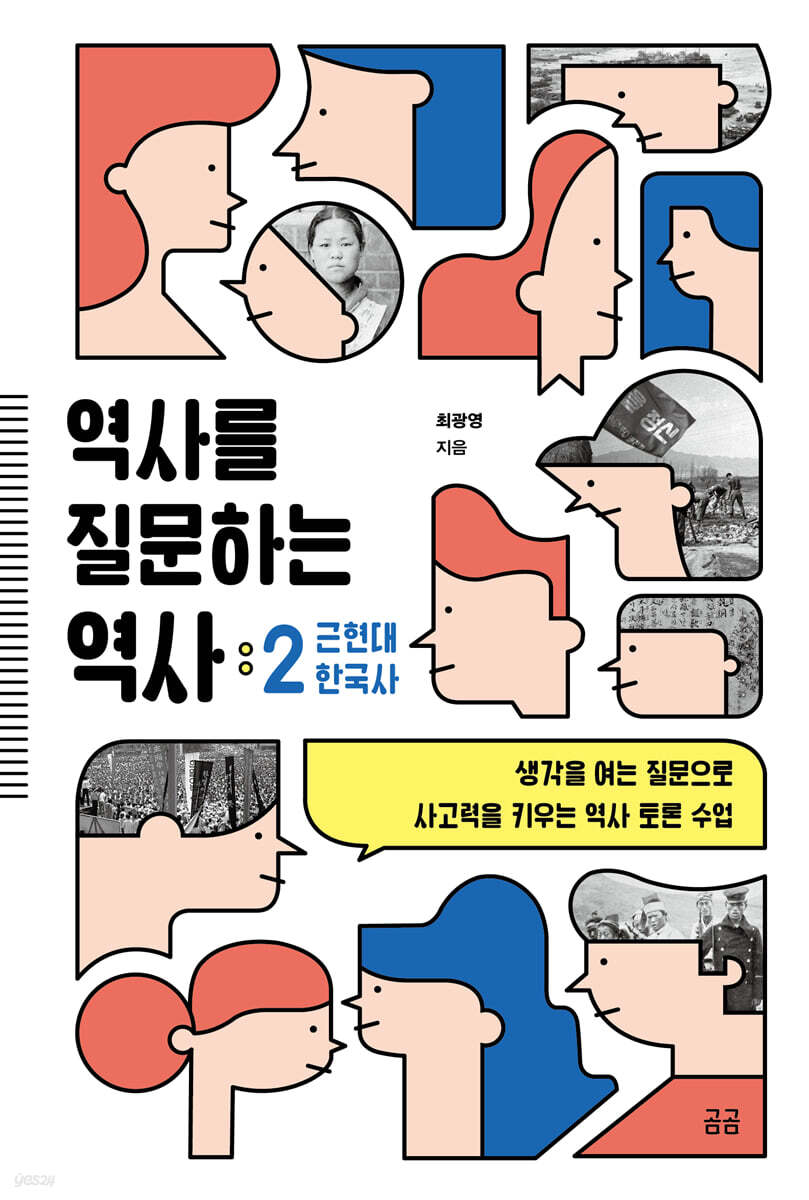
History Questioning History 2: Modern and Contemporary Korean History
 |
Description
Book Introduction
A living, breathing history class where discussion comes to life!
“Fresh and shocking.
It's even so much fun!”
“A history class that fosters thinking skills!”
“I learned why I study history.”
“Hearing the opinions of friends I hadn't considered broadened my perspective.”
Although criticism of passive learning of history has been raised for a long time, history is still often perceived as a subject to be memorized.
If history class feels like a time for memorization, it will be difficult to build sufficient motivation or interest in studying.
Moreover, no matter how effective a memorization technique is, knowledge that is not closely connected to my current experiences will quickly evaporate.
So how can we make studying history a little more enjoyable and internalize it? Couldn't we fundamentally rethink our approach to history?
The "History Questioning History" series, written by a middle school history teacher, argues that questions that lead to a critical look at existing history can be an alternative.
When we reexamine the historical terms we have become accustomed to and discover connections between past events and our present-day society, history becomes a living present, not a past unrelated to me.
This book is a history textbook that explores Korean history through questions that arise from a history class that proceeds through lively discussions.
These fascinating and fresh questions, never seen in textbooks, will remind us that history is not a complete narrative, but rather a constantly being reinterpreted and constructed. They will help us study history in a way that breathes life into the past rather than fossilizing it.
Let's understand the flow of history through representative questions from each era, consisting of Volume 1, Pre-Modern, and Volume 2, Modern and Contemporary, and experience the joy of interpreting history on our own by following keywords that can foster critical thinking skills such as power, justice, and meritocracy.
“Fresh and shocking.
It's even so much fun!”
“A history class that fosters thinking skills!”
“I learned why I study history.”
“Hearing the opinions of friends I hadn't considered broadened my perspective.”
Although criticism of passive learning of history has been raised for a long time, history is still often perceived as a subject to be memorized.
If history class feels like a time for memorization, it will be difficult to build sufficient motivation or interest in studying.
Moreover, no matter how effective a memorization technique is, knowledge that is not closely connected to my current experiences will quickly evaporate.
So how can we make studying history a little more enjoyable and internalize it? Couldn't we fundamentally rethink our approach to history?
The "History Questioning History" series, written by a middle school history teacher, argues that questions that lead to a critical look at existing history can be an alternative.
When we reexamine the historical terms we have become accustomed to and discover connections between past events and our present-day society, history becomes a living present, not a past unrelated to me.
This book is a history textbook that explores Korean history through questions that arise from a history class that proceeds through lively discussions.
These fascinating and fresh questions, never seen in textbooks, will remind us that history is not a complete narrative, but rather a constantly being reinterpreted and constructed. They will help us study history in a way that breathes life into the past rather than fossilizing it.
Let's understand the flow of history through representative questions from each era, consisting of Volume 1, Pre-Modern, and Volume 2, Modern and Contemporary, and experience the joy of interpreting history on our own by following keywords that can foster critical thinking skills such as power, justice, and meritocracy.
index
The introduction, "Questions" and "Doubts," will help you create your own perspective.
1.
Has imperialism ended?
2.
Are the people and the elite in conflict?
3.
Are the volunteers righteous soldiers?
4.
Did modern schools give people opportunities?
5.
Does Yu Gwan-sun represent the March 1st Movement?
6.
Can the War of Independence become a proud part of history?
7.
Was the Japanese colonial period a time when the Japanese ruled over the Korean people?
8.
On August 15, 1945, were the people of the Korean Peninsula liberated?
9.
What should we remember from the Korean War?
10.
Was the Republic of Korea a democratic republic?
11.
Who was 'Let's Live Well' meant for?
12.
What has the country of speed and efficiency sacrificed?
13.
In June 1987, was democratization in South Korea completed?
References
Image source
Detailed image
.jpg)
Into the book
The Righteous Army is a movement that showed that even ordinary people are the masters of their country.
Moreover, the Righteous Army, which fought against the enemy with the determination to die for a nation in crisis and a collapsing community, resonates deeply with us today.
But we need to think about how we will remember the volunteer army.
Despite the determination to join the army with a righteous heart, discrimination based on social status still existed within the army.
What kind of country and justice did the volunteers seek to protect? ---From Volume 2, "Are the volunteers righteous soldiers?"
Students move according to a schedule and their way of thinking changes accordingly.
They say, 'You have to use your time wisely.'
But what does it mean to use your time "well"? Perhaps the criterion for judging it is whether it "contributes to economic activity."
How does this concept of time change people's perceptions? … In this way of thinking, can helping or caring for others be considered a worthwhile act? ---From "Volume 2, [Did Modern Schools Give People Opportunities?]"
Often, we remember historical events by identifying them with specific people.
For example, the Imjin War was attributed to Yi Sun-sin, and the Battle of Bongodong was attributed to Hong Beom-do.
But the more we remember the historical event of the March 1st Movement through the lens of a specific figure, Yu Gwan-sun, won't the numerous other key figures of the March 1st Movement, as discussed above, be forgotten? --- From "Volume 2, [Does Yu Gwan-sun Represent the March 1st Movement?]"
From the mid-1960s, when the welfare system was fully implemented, until the end of the Chun Doo-hwan regime in 1987, a small number of highly skilled workers and highly educated people were given priority for welfare.
For most of the workers we looked at in Chapter 13, as well as for the homeless and other vulnerable people in need of social welfare services, welfare was a thing of the distant future.
Because providing welfare benefits to the underprivileged was considered 'inefficient'.
Can we really call welfare "welfare" if it provides benefits to those judged to be helpful to national development, but does not apply to the underprivileged who are deemed unhelpful?
Moreover, the Righteous Army, which fought against the enemy with the determination to die for a nation in crisis and a collapsing community, resonates deeply with us today.
But we need to think about how we will remember the volunteer army.
Despite the determination to join the army with a righteous heart, discrimination based on social status still existed within the army.
What kind of country and justice did the volunteers seek to protect? ---From Volume 2, "Are the volunteers righteous soldiers?"
Students move according to a schedule and their way of thinking changes accordingly.
They say, 'You have to use your time wisely.'
But what does it mean to use your time "well"? Perhaps the criterion for judging it is whether it "contributes to economic activity."
How does this concept of time change people's perceptions? … In this way of thinking, can helping or caring for others be considered a worthwhile act? ---From "Volume 2, [Did Modern Schools Give People Opportunities?]"
Often, we remember historical events by identifying them with specific people.
For example, the Imjin War was attributed to Yi Sun-sin, and the Battle of Bongodong was attributed to Hong Beom-do.
But the more we remember the historical event of the March 1st Movement through the lens of a specific figure, Yu Gwan-sun, won't the numerous other key figures of the March 1st Movement, as discussed above, be forgotten? --- From "Volume 2, [Does Yu Gwan-sun Represent the March 1st Movement?]"
From the mid-1960s, when the welfare system was fully implemented, until the end of the Chun Doo-hwan regime in 1987, a small number of highly skilled workers and highly educated people were given priority for welfare.
For most of the workers we looked at in Chapter 13, as well as for the homeless and other vulnerable people in need of social welfare services, welfare was a thing of the distant future.
Because providing welfare benefits to the underprivileged was considered 'inefficient'.
Can we really call welfare "welfare" if it provides benefits to those judged to be helpful to national development, but does not apply to the underprivileged who are deemed unhelpful?
---From Volume 2, [What Has the Country of Speed and Efficiency Sacrificed?]
Publisher's Review
This is a historical question I've never heard before!
- Has history always progressed?
The same incident has different names in different countries?
Is it a small elite that drives history?
Have modernization and globalization made us freer?
The series "History Questioning History" examines the general history of Korean history by asking 14 questions about pre-modern history (Volume 1) and 13 questions about modern and contemporary history (Volume 2).
The questions in each volume reflect the concerns of the two authors, both current history teachers, who have been engaged in sometimes exciting, sometimes intense, discussions in their classrooms for many years.
The questions addressed in this book lead us to question and challenge the historical common sense and textbook narratives we have taken for granted.
The questions 'question the belief that history is constantly progressing', 'explore how specific historical events are viewed differently depending on one's perspective', and 'make us consider who should be illuminated by history, even within the same era'.
For example, the author guides readers to reexamine the roughly compressed historical narrative of the Neolithic Revolution by asking the question, “Did agriculture and animal husbandry improve human life?” (Chapter 1, Volume 1).
By examining research data and case studies to see if the optimistic portrayal of agriculture and livestock overlooks diverse life forms and the trajectories of change, we invite readers to critically consider the linear historical perspective presupposed by these historical narratives.
In 'Are the Righteous Army Righteous Soldiers?' (Volume 2, Chapter 3), we examine the invisible aspects of the Righteous Army, which symbolizes national pride.
Despite the abolition of the caste system, the limitations of the Righteous Army organization, which clung to male-centered Confucian values, prompt us to redefine the social justice we should pursue. Furthermore, it encourages us to consider the responsibility of the state for failing to protect its members in times of crisis, which lies behind the Righteous Army's activities.
Facing questions that present such diverse perspectives and engaging learners in their own historical interpretation opens up the possibility of learning historical knowledge in a fun way without memorization.
When historical conventions that were once considered correct are relativized through the process of questioning and doubting, boring history is transformed into the living, breathing history of today.
In fact, students who participated in the authors' history discussion classes unanimously said that history became more interesting.
The course evaluations written by students after attending the class included comments such as, “It was the first time I studied history without feeling like I didn’t want to do it,” and “It was refreshing and shocking.
There are many positive reviews about the class, such as “It’s even fun!”
Studying history makes writing and speaking fun
- Tell me what you think!
As an active participant, not a passive observer
Interpreting and arranging historical facts
The joy of expressing my thoughts through speech and writing
Before delving into the questions posed in each chapter, an introductory text is provided that outlines the flow of Korean history.
This is a device designed to help readers easily understand the text by first reading the historical events and background that the question primarily addresses.
Additionally, the 'Tell Us What You Think' corner, which appears after the main text of each chapter, contains a variety of opinions from young people.
Another unique and advantageous aspect of this book is that it allows us to examine what history looks like as interpreted by the vivid voices of today's youth, through the opinions students have accumulated through direct discussions in actual classroom settings.
Students critically reflect on facts omitted or exaggerated in conventional historical narratives, reimagine history from the perspectives of the socially disadvantaged, and actively seek ways to use past history as a springboard to solve present-day problems.
It contains ethical concerns and concrete proposals for pioneering tomorrow's history without being trapped in the past.
Readers of this book will also be able to broaden their understanding of others by comparing their own thoughts with those of their peers, and devise ways to proactively address today's problems.
Additionally, in this book, you can encounter new historical materials not found in textbooks, such as 'Excavation site of Neolithic Age remains' and 'Gymnastics class of Ewha Haktang students'.
From historical sites to people, the diverse materials themselves offer new possibilities for interpretation and help us understand the historical context in an integrated way.
Through "History Questioning History," young readers will not only develop their thinking skills but also experience the joy of expressing their thoughts verbally and in writing.
I hope that more readers will be able to experience 'communication, organizing their own opinions and sharing them with others' as participants in history rather than as observers.
- Has history always progressed?
The same incident has different names in different countries?
Is it a small elite that drives history?
Have modernization and globalization made us freer?
The series "History Questioning History" examines the general history of Korean history by asking 14 questions about pre-modern history (Volume 1) and 13 questions about modern and contemporary history (Volume 2).
The questions in each volume reflect the concerns of the two authors, both current history teachers, who have been engaged in sometimes exciting, sometimes intense, discussions in their classrooms for many years.
The questions addressed in this book lead us to question and challenge the historical common sense and textbook narratives we have taken for granted.
The questions 'question the belief that history is constantly progressing', 'explore how specific historical events are viewed differently depending on one's perspective', and 'make us consider who should be illuminated by history, even within the same era'.
For example, the author guides readers to reexamine the roughly compressed historical narrative of the Neolithic Revolution by asking the question, “Did agriculture and animal husbandry improve human life?” (Chapter 1, Volume 1).
By examining research data and case studies to see if the optimistic portrayal of agriculture and livestock overlooks diverse life forms and the trajectories of change, we invite readers to critically consider the linear historical perspective presupposed by these historical narratives.
In 'Are the Righteous Army Righteous Soldiers?' (Volume 2, Chapter 3), we examine the invisible aspects of the Righteous Army, which symbolizes national pride.
Despite the abolition of the caste system, the limitations of the Righteous Army organization, which clung to male-centered Confucian values, prompt us to redefine the social justice we should pursue. Furthermore, it encourages us to consider the responsibility of the state for failing to protect its members in times of crisis, which lies behind the Righteous Army's activities.
Facing questions that present such diverse perspectives and engaging learners in their own historical interpretation opens up the possibility of learning historical knowledge in a fun way without memorization.
When historical conventions that were once considered correct are relativized through the process of questioning and doubting, boring history is transformed into the living, breathing history of today.
In fact, students who participated in the authors' history discussion classes unanimously said that history became more interesting.
The course evaluations written by students after attending the class included comments such as, “It was the first time I studied history without feeling like I didn’t want to do it,” and “It was refreshing and shocking.
There are many positive reviews about the class, such as “It’s even fun!”
Studying history makes writing and speaking fun
- Tell me what you think!
As an active participant, not a passive observer
Interpreting and arranging historical facts
The joy of expressing my thoughts through speech and writing
Before delving into the questions posed in each chapter, an introductory text is provided that outlines the flow of Korean history.
This is a device designed to help readers easily understand the text by first reading the historical events and background that the question primarily addresses.
Additionally, the 'Tell Us What You Think' corner, which appears after the main text of each chapter, contains a variety of opinions from young people.
Another unique and advantageous aspect of this book is that it allows us to examine what history looks like as interpreted by the vivid voices of today's youth, through the opinions students have accumulated through direct discussions in actual classroom settings.
Students critically reflect on facts omitted or exaggerated in conventional historical narratives, reimagine history from the perspectives of the socially disadvantaged, and actively seek ways to use past history as a springboard to solve present-day problems.
It contains ethical concerns and concrete proposals for pioneering tomorrow's history without being trapped in the past.
Readers of this book will also be able to broaden their understanding of others by comparing their own thoughts with those of their peers, and devise ways to proactively address today's problems.
Additionally, in this book, you can encounter new historical materials not found in textbooks, such as 'Excavation site of Neolithic Age remains' and 'Gymnastics class of Ewha Haktang students'.
From historical sites to people, the diverse materials themselves offer new possibilities for interpretation and help us understand the historical context in an integrated way.
Through "History Questioning History," young readers will not only develop their thinking skills but also experience the joy of expressing their thoughts verbally and in writing.
I hope that more readers will be able to experience 'communication, organizing their own opinions and sharing them with others' as participants in history rather than as observers.
GOODS SPECIFICS
- Publication date: October 3, 2022
- Page count, weight, size: 256 pages | 354g | 135*200*20mm
- ISBN13: 9791160808834
- ISBN10: 116080883X
You may also like
카테고리
korean


korean

![GQ KOREA Mark (Monthly): December [2025]](http://librairie.coreenne.fr/cdn/shop/files/8ef265dbbfbf186523ed75ba7319009d.jpg?v=1765340328&width=3840)


