

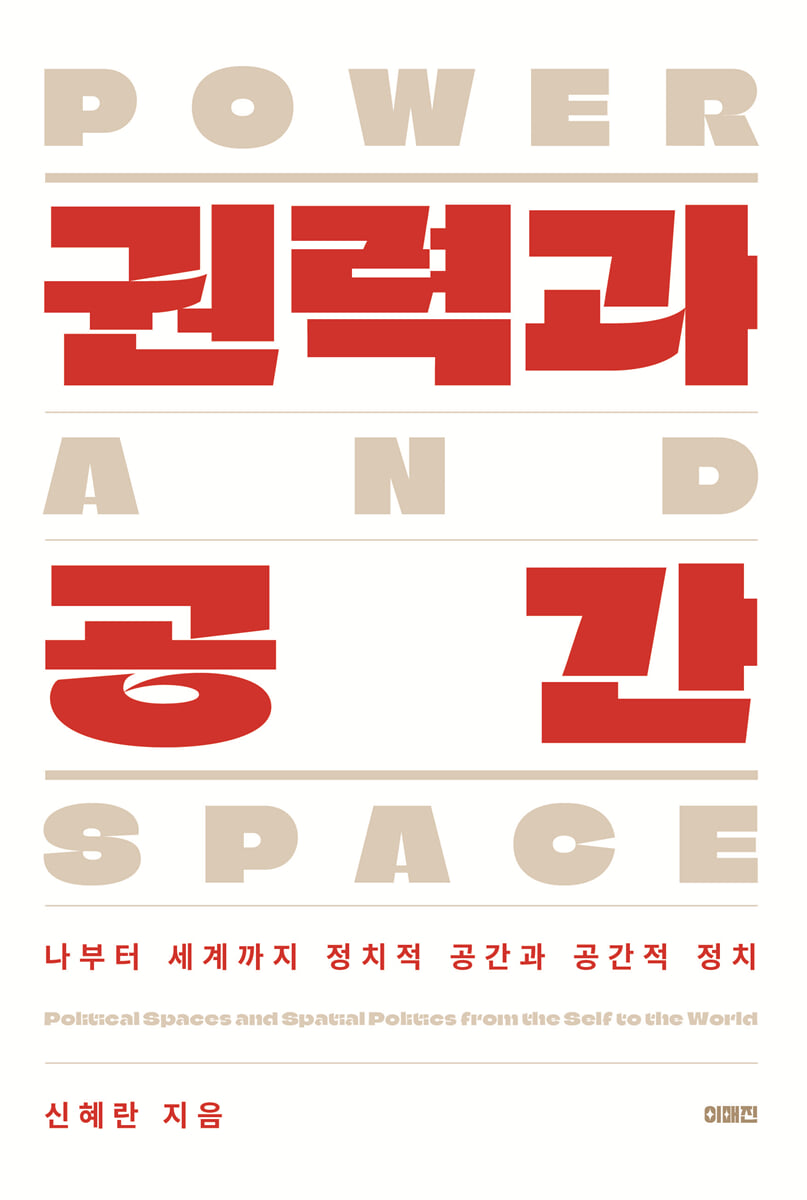
Power and Space
 |
Description
Book Introduction
From Gyms to Martial Law: A Geographer's Deep Look at Korean Society
The president who believed in feng shui was impeached by citizens who came out to the square, and in early elections, all kinds of promises surrounding space were rampant.
I wake up in a bedroom decorated to my own taste, go to the gym to work out, arrive at work, finish my work, stop by a hot place for a meal, go to the square to express my political opinions, then return home, look at my phone, and then fall asleep.
What is the space where our lives begin, continue, and end? What is the relationship between space and power?
"Power and Space" is a new book written by Professor Shin Hye-ran of the Department of Geography at Seoul National University, who has analyzed cities, space, and geography with simple, intuitive pictures and clear logic.
Shin Hye-ran, who examines space, power, and politics based on 29 keywords and 100 illustrations, including body, gym, house, village, city, festival, religion, memory, election, transportation, new town, water, marriage immigration, North Korean defectors, island, feng shui, happiness, miners, gender, multiculturalism, geopolitics, resistance space, nuclear, martial law, and plaza, talks about political space and spatial politics using the social space of Korea as a stage.
As politics and power are elements that shape individual lives and collective societies, we should critically understand the relationship between power and space to find possibilities for creating better places.
We encourage you to challenge the spatial order we have taken for granted, practice creating desirable places, and imagine spaces that will make our lives and society better places.
The president who believed in feng shui was impeached by citizens who came out to the square, and in early elections, all kinds of promises surrounding space were rampant.
I wake up in a bedroom decorated to my own taste, go to the gym to work out, arrive at work, finish my work, stop by a hot place for a meal, go to the square to express my political opinions, then return home, look at my phone, and then fall asleep.
What is the space where our lives begin, continue, and end? What is the relationship between space and power?
"Power and Space" is a new book written by Professor Shin Hye-ran of the Department of Geography at Seoul National University, who has analyzed cities, space, and geography with simple, intuitive pictures and clear logic.
Shin Hye-ran, who examines space, power, and politics based on 29 keywords and 100 illustrations, including body, gym, house, village, city, festival, religion, memory, election, transportation, new town, water, marriage immigration, North Korean defectors, island, feng shui, happiness, miners, gender, multiculturalism, geopolitics, resistance space, nuclear, martial law, and plaza, talks about political space and spatial politics using the social space of Korea as a stage.
As politics and power are elements that shape individual lives and collective societies, we should critically understand the relationship between power and space to find possibilities for creating better places.
We encourage you to challenge the spatial order we have taken for granted, practice creating desirable places, and imagine spaces that will make our lives and society better places.
- You can preview some of the book's contents.
Preview
index
The Space of Power and the Power of Space
Part 1 Me and Us
Chapter 1: The Politics of the Body - The Beginning and End of My Space
Chapter 2: The Gym - Building Your Body, Creating Your Own Space
Chapter 3: Homes, Power, and Capital: Real Estate Politics and Spatial Strategy
Chapter 4: Building a Village - From the Saemaul Movement to Carrot Market
Chapter 5: When the City Calls Artists - Tools or Actors in the Age of Cultural Economy
Chapter 6: After the Festival - Local Festivals and the Presence of Power
Chapter 7: Spatial Strategies of Religion: Between Placemaking and Placemaking
Chapter 8: The Territorialization of Memory: Why Memory Space Becomes a Battleground
Chapter 9: Urban Space - The Politics of Separation and Integration
Part 2: State and Society
Chapter 1: Election - A Hot Spot Where Space and Politics Meet
Chapter 2: Transportation - Participatory Governance Surrounding the Network
Chapter 3: New Towns - An Uneasy Experiment Between Dream and Reality
Chapter 4: Songdo's Story - A City That Became a Brand
Chapter 5: Water - Selective Communication and Strategic Silence
Chapter 6 Marriage Migration - Between Broker Matchmaking and Hard Labor
Chapter 7: The North Korean Defector Ecosystem: Drawing Boundaries and Building Infrastructure
Chapter 8: Islands - Spatial Strategies for Separate Spaces
Chapter 9: Feng Shui and the Power of Space - Belief, Control, and the Boundaries of Placemaking
Part 3 Me and the World
Chapter 1: The Spatial Politics of Happiness - Happiness in Northern Europe, Happiness in Central and South America, Happiness in Korea
Chapter 2: Taebaek and the Miners of Padok - Cities and Individuals Swayed by Capital and the State
Chapter 3 ○○ City - Inside and Outside of Urban Identity Politics
Chapter 4: Gendering Mobility: Spatial Strategies Surrounding Labor and Adaptation
Chapter 5: Multicultural Spatial Politics: Changes Surrounding Immigrant Places and Educational Spaces
Chapter 6 Geopolitics - For Power, or About Power
Chapter 7: Spaces of Resistance - Identity, Occupation, and the Digital
Chapter 8: Nuclear Jungle Politics: Future Space and Risk Perception
Chapter 9: Martial Law and Resistance: The Spatial Politics of Bordering and Infrastructure Building
Conclusion: Rethinking Power and Space
References
Search
Part 1 Me and Us
Chapter 1: The Politics of the Body - The Beginning and End of My Space
Chapter 2: The Gym - Building Your Body, Creating Your Own Space
Chapter 3: Homes, Power, and Capital: Real Estate Politics and Spatial Strategy
Chapter 4: Building a Village - From the Saemaul Movement to Carrot Market
Chapter 5: When the City Calls Artists - Tools or Actors in the Age of Cultural Economy
Chapter 6: After the Festival - Local Festivals and the Presence of Power
Chapter 7: Spatial Strategies of Religion: Between Placemaking and Placemaking
Chapter 8: The Territorialization of Memory: Why Memory Space Becomes a Battleground
Chapter 9: Urban Space - The Politics of Separation and Integration
Part 2: State and Society
Chapter 1: Election - A Hot Spot Where Space and Politics Meet
Chapter 2: Transportation - Participatory Governance Surrounding the Network
Chapter 3: New Towns - An Uneasy Experiment Between Dream and Reality
Chapter 4: Songdo's Story - A City That Became a Brand
Chapter 5: Water - Selective Communication and Strategic Silence
Chapter 6 Marriage Migration - Between Broker Matchmaking and Hard Labor
Chapter 7: The North Korean Defector Ecosystem: Drawing Boundaries and Building Infrastructure
Chapter 8: Islands - Spatial Strategies for Separate Spaces
Chapter 9: Feng Shui and the Power of Space - Belief, Control, and the Boundaries of Placemaking
Part 3 Me and the World
Chapter 1: The Spatial Politics of Happiness - Happiness in Northern Europe, Happiness in Central and South America, Happiness in Korea
Chapter 2: Taebaek and the Miners of Padok - Cities and Individuals Swayed by Capital and the State
Chapter 3 ○○ City - Inside and Outside of Urban Identity Politics
Chapter 4: Gendering Mobility: Spatial Strategies Surrounding Labor and Adaptation
Chapter 5: Multicultural Spatial Politics: Changes Surrounding Immigrant Places and Educational Spaces
Chapter 6 Geopolitics - For Power, or About Power
Chapter 7: Spaces of Resistance - Identity, Occupation, and the Digital
Chapter 8: Nuclear Jungle Politics: Future Space and Risk Perception
Chapter 9: Martial Law and Resistance: The Spatial Politics of Bordering and Infrastructure Building
Conclusion: Rethinking Power and Space
References
Search
Into the book
I want to talk about a very political space now, ultimately about spatial politics.
It is also a story about the space of power and the power of space.
It is not a stable, hierarchical power, but a power whose existence is determined and changed through endlessly fluctuating interactions.
Politics and power are not negative elements, but rather inevitable and natural parts of our lives and society.
In particular, the process of becoming the master of one's own life and expanding one's freedom of choice through creating a desirable place, rather than a territorial battle to take what belongs to others, is the essence of political space and spatial politics.
--- p.17
Politics within the gym is also fierce.
In any place, people tend to enter and feel that they belong there and are welcome.
The gym is a place where we expose our bodies and become conscious of our own and other people's bodies. Unlike a cafe, where we don't talk to each other or bow our heads, we see our own bodies or other people's bodies reflected in the mirror.
As much as InBody, there is ‘NunBody’ (a compound word of ‘Nun’ and ‘InBody’).
It is also important to check the changes in your body reflected in the mirror, because in the gym, everyone can see everyone else's body.
--- p.38
The bottom line is that no pledges are made within the campaign during the presidential election period.
It will take a long time for politicians and professors to dream of sharing the same space.
The candidate should look into the polymaths and policy innovators with whom he has been close over the years.
Because the presidential campaign is large and the election process is fast-paced, it is possible to stay outside the camp unofficially.
Once you build up a sense of camaraderie and dream of the same space, the rest doesn't really matter.
--- p.132
Of the over 30,000 North Korean defectors, more than 70 percent are women.
These days, it's over 90 percent.
Why are most North Korean defectors women? Middle-aged and older North Korean female defectors are typical.
In the mid to late 1990s, when I was in my 20s and early 30s, I experienced the Arduous March and the informal economic activity of the market.
She believed the rumors spread by the broker that she could make a lot of money by working in China for a short time, so she went to China using illegal means, met a rural Chinese man introduced by the broker, got married, and then worked for a Korean company.
He followed a route set up by a broker introduced by a Korean and went to Laos or Thailand, where he stayed as an illegal resident before coming to Korea.
--- p.188
Resistance against martial law unfolds in multiple layers, across physical, institutional, symbolic, everyday, and digital spaces.
It is an active attempt to create an alternative space that shakes up the spatial order controlled by power and creates a new spatial order.
Although the physical control of martial law was not as effective as in the 1980s, this time around, groups sympathizing with martial law emerged, occupying spaces as if they were resistance forces and demonstrating their collective power.
The mob that attacked the Western District Court was an extreme example of a rebellion against the rule of law.
--- p.318
I started from the premise that 'space is political and politics is spatial.'
From my body to the world, every space we inhabit is permeated by power, and various layers of politics intervene in the process of creating and transforming that space.
The question of who defines the character of a space, names it, occupies it, how it is used, to whom it is open and whom it excludes, is inherently political.
From body building in the gym to the transformation of urban space, the state's control of space through martial law, movement and regulation surrounding national borders, and the global geopolitics of migration, space is not simply a physical backdrop; it is a site where power relations are constantly constructed and reconstructed, and it is both the power relations themselves and the source of power.
It is also a story about the space of power and the power of space.
It is not a stable, hierarchical power, but a power whose existence is determined and changed through endlessly fluctuating interactions.
Politics and power are not negative elements, but rather inevitable and natural parts of our lives and society.
In particular, the process of becoming the master of one's own life and expanding one's freedom of choice through creating a desirable place, rather than a territorial battle to take what belongs to others, is the essence of political space and spatial politics.
--- p.17
Politics within the gym is also fierce.
In any place, people tend to enter and feel that they belong there and are welcome.
The gym is a place where we expose our bodies and become conscious of our own and other people's bodies. Unlike a cafe, where we don't talk to each other or bow our heads, we see our own bodies or other people's bodies reflected in the mirror.
As much as InBody, there is ‘NunBody’ (a compound word of ‘Nun’ and ‘InBody’).
It is also important to check the changes in your body reflected in the mirror, because in the gym, everyone can see everyone else's body.
--- p.38
The bottom line is that no pledges are made within the campaign during the presidential election period.
It will take a long time for politicians and professors to dream of sharing the same space.
The candidate should look into the polymaths and policy innovators with whom he has been close over the years.
Because the presidential campaign is large and the election process is fast-paced, it is possible to stay outside the camp unofficially.
Once you build up a sense of camaraderie and dream of the same space, the rest doesn't really matter.
--- p.132
Of the over 30,000 North Korean defectors, more than 70 percent are women.
These days, it's over 90 percent.
Why are most North Korean defectors women? Middle-aged and older North Korean female defectors are typical.
In the mid to late 1990s, when I was in my 20s and early 30s, I experienced the Arduous March and the informal economic activity of the market.
She believed the rumors spread by the broker that she could make a lot of money by working in China for a short time, so she went to China using illegal means, met a rural Chinese man introduced by the broker, got married, and then worked for a Korean company.
He followed a route set up by a broker introduced by a Korean and went to Laos or Thailand, where he stayed as an illegal resident before coming to Korea.
--- p.188
Resistance against martial law unfolds in multiple layers, across physical, institutional, symbolic, everyday, and digital spaces.
It is an active attempt to create an alternative space that shakes up the spatial order controlled by power and creates a new spatial order.
Although the physical control of martial law was not as effective as in the 1980s, this time around, groups sympathizing with martial law emerged, occupying spaces as if they were resistance forces and demonstrating their collective power.
The mob that attacked the Western District Court was an extreme example of a rebellion against the rule of law.
--- p.318
I started from the premise that 'space is political and politics is spatial.'
From my body to the world, every space we inhabit is permeated by power, and various layers of politics intervene in the process of creating and transforming that space.
The question of who defines the character of a space, names it, occupies it, how it is used, to whom it is open and whom it excludes, is inherently political.
From body building in the gym to the transformation of urban space, the state's control of space through martial law, movement and regulation surrounding national borders, and the global geopolitics of migration, space is not simply a physical backdrop; it is a site where power relations are constantly constructed and reconstructed, and it is both the power relations themselves and the source of power.
--- p.323
Publisher's Review
From My Body to the World: A Guide to Space, Power, and Politics with 29 Keywords and 100 Illustrations
The beginning is ‘me’ and ‘body’.
‘We’, where ‘I’ gather, advance to a wider ‘society’ and ‘nation’, and meet ‘I’ and the ‘world’ again.
In this way, space becomes wider, deeper, and more diverse.
In the process, various theorists and concepts are utilized, including Michel Foucault, from whom the title of this book is borrowed, Henri Lefebvre, and David Harvey, and spaces and places of different sizes and characteristics appear, such as Seoul, Taebaek, Gwangju, Songdo, Ansan, Jeju, Okinawa, Edinburgh, Can Tho, the United States, Vietnam, Costa Rica, Mexico, and Denmark.
Non-human animals living in the tidal flats, sexual minorities who are still discriminated against and invisible, ethnic Koreans from China who crossed the border, and Vietnamese women who immigrated through marriage are gaining voice.
Geographer Shin Hye-ran, who has studied cities, expands the boundaries drawn by geography by connecting private places and personal experiences with public spaces and social politics.
While going to the gym, he thinks about the politics of the body, goes beyond letters and numbers to capture the three dimensions of power in the field where the power struggle takes place, revisits Taebaek, where he wrote his master's thesis, after becoming a professor, to examine the city and individuals swayed by capital and the state, and compares the martial law he experienced in Busan in 1979 as a child with the martial law he faced as an adult in Seoul in 2024, contemplating the politics of plazas and spaces. Chapter 9 of Part 3, "Martial Law and Resistance," is particularly suggestive.
The control and resistance that power exerts through space overlaps entirely with the drawing of boundaries and building infrastructure, which are the core methods of structuring and reconstructing society and space.
Martial law, which seeks to rule by isolating, focuses on drawing boundaries, while resistance, which seeks to break boundaries and build solidarity, focuses on building infrastructure.
To richly interpret the dynamics revealed in the process of interactions between power, space, and actors unfolding in the realm of life, Shin Hye-ran appropriately employs qualitative research methods such as in-depth interviews, participant observation, and focus group interviews.
I also always strive to capture vivid scenes and convey clear concepts by utilizing imagery mapping research methods and drawing pictures myself.
From Space to Place - Rethinking Power Here and Now
The process of transforming an abstract and uniform 'space' into a 'place' imbued with concrete meaning and identity gains true meaning not when it is the result of a unilateral exercise of power, but when diverse actors participate and cooperate.
Considering nonhuman animals before planning a new airport, transforming parks and plazas meant for the accumulation of achievements into spaces for lingering and communicating, creating and cultivating places that reflect local history and culture, helping marginalized people find their place and voice in the process, and creating environmentally sustainable spaces are all part of placemaking and a political practice surrounding space and power.
In this way, space can be a means of control and exclusion, but also a foundation for coexistence and solidarity.
So, we need to look at power and space again here and now.
The beginning is ‘me’ and ‘body’.
‘We’, where ‘I’ gather, advance to a wider ‘society’ and ‘nation’, and meet ‘I’ and the ‘world’ again.
In this way, space becomes wider, deeper, and more diverse.
In the process, various theorists and concepts are utilized, including Michel Foucault, from whom the title of this book is borrowed, Henri Lefebvre, and David Harvey, and spaces and places of different sizes and characteristics appear, such as Seoul, Taebaek, Gwangju, Songdo, Ansan, Jeju, Okinawa, Edinburgh, Can Tho, the United States, Vietnam, Costa Rica, Mexico, and Denmark.
Non-human animals living in the tidal flats, sexual minorities who are still discriminated against and invisible, ethnic Koreans from China who crossed the border, and Vietnamese women who immigrated through marriage are gaining voice.
Geographer Shin Hye-ran, who has studied cities, expands the boundaries drawn by geography by connecting private places and personal experiences with public spaces and social politics.
While going to the gym, he thinks about the politics of the body, goes beyond letters and numbers to capture the three dimensions of power in the field where the power struggle takes place, revisits Taebaek, where he wrote his master's thesis, after becoming a professor, to examine the city and individuals swayed by capital and the state, and compares the martial law he experienced in Busan in 1979 as a child with the martial law he faced as an adult in Seoul in 2024, contemplating the politics of plazas and spaces. Chapter 9 of Part 3, "Martial Law and Resistance," is particularly suggestive.
The control and resistance that power exerts through space overlaps entirely with the drawing of boundaries and building infrastructure, which are the core methods of structuring and reconstructing society and space.
Martial law, which seeks to rule by isolating, focuses on drawing boundaries, while resistance, which seeks to break boundaries and build solidarity, focuses on building infrastructure.
To richly interpret the dynamics revealed in the process of interactions between power, space, and actors unfolding in the realm of life, Shin Hye-ran appropriately employs qualitative research methods such as in-depth interviews, participant observation, and focus group interviews.
I also always strive to capture vivid scenes and convey clear concepts by utilizing imagery mapping research methods and drawing pictures myself.
From Space to Place - Rethinking Power Here and Now
The process of transforming an abstract and uniform 'space' into a 'place' imbued with concrete meaning and identity gains true meaning not when it is the result of a unilateral exercise of power, but when diverse actors participate and cooperate.
Considering nonhuman animals before planning a new airport, transforming parks and plazas meant for the accumulation of achievements into spaces for lingering and communicating, creating and cultivating places that reflect local history and culture, helping marginalized people find their place and voice in the process, and creating environmentally sustainable spaces are all part of placemaking and a political practice surrounding space and power.
In this way, space can be a means of control and exclusion, but also a foundation for coexistence and solidarity.
So, we need to look at power and space again here and now.
GOODS SPECIFICS
- Date of issue: May 18, 2025
- Page count, weight, size: 340 pages | 430g | 148*220*20mm
- ISBN13: 9791155311530
- ISBN10: 1155311531
You may also like
카테고리
korean


korean

![GQ KOREA Mark (Monthly): December [2025]](http://librairie.coreenne.fr/cdn/shop/files/8ef265dbbfbf186523ed75ba7319009d.jpg?v=1765340328&width=3840)


