

21st Century Taxi Driver
 |
Description
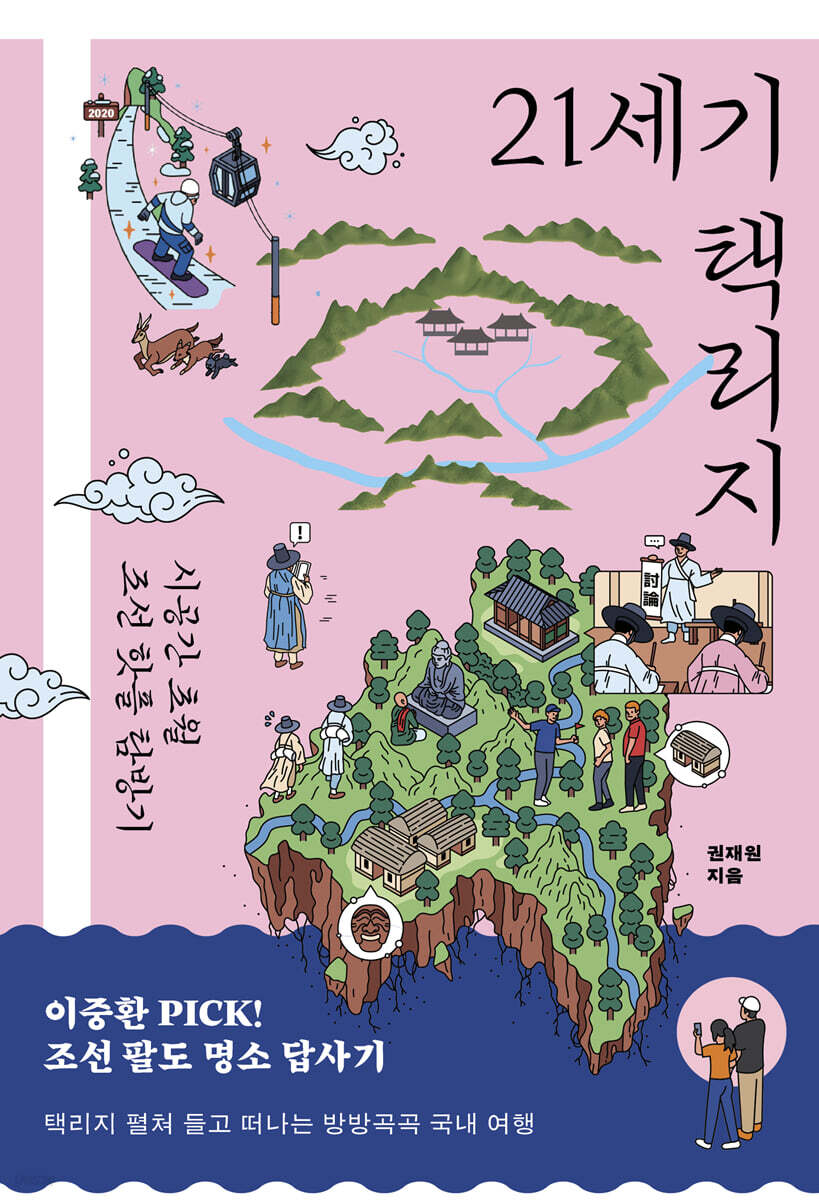
Book Introduction
From 18th century records to today's appearance
A comprehensive look at our land's geography, history, and culture.
It'll be more fun than you think, right?
Following in Lee Jung-hwan's footsteps, the K-Tour is a journey of discovery.
This book explains the diverse characteristics of each region of Korea within the context of geography, economy, culture, and history, starting from the descriptions in 『Taekriji』, a representative human geography book of the Joseon Dynasty, to the present day.
Starting with Pyeongchang, Jeongseon, and Taebaek in Gangwon-do and Andong in Gyeongsangbuk-do, we will look at twelve regions that are great for travel in each of the twelve months of the year, and five of those regions will be expanded to include unfamiliar yet interesting nearby regions through the 'Domestic Travel In-Depth Class' section.
While the world of young people has become noticeably smaller during the pandemic, the world's interest in our country has grown like never before.
Now is the time to take a closer look at the unique characteristics of our land, including its history, culture, and natural environment.
Why did Cheongsong in North Gyeongsang Province, lacking both local specialties and an industrial base, expel factories and instead host a prison? Is the Yeongdong region in Gangwon Province, a summer retreat beloved by our ancestors, now so beloved that it's now in crisis? What is the secret behind Gwangju in Honam overcoming a history of discrimination and marginalization to become a city of light? Hundreds of years after Lee Jung-hwan's "Taekriji," fascinating and poignant stories abound across our country.
By following these stories that enhance the resolution of the map in your head, both young readers and adult readers interested in domestic travel will gain a deeper understanding of our land's geography, history, and culture.
A comprehensive look at our land's geography, history, and culture.
It'll be more fun than you think, right?
Following in Lee Jung-hwan's footsteps, the K-Tour is a journey of discovery.
This book explains the diverse characteristics of each region of Korea within the context of geography, economy, culture, and history, starting from the descriptions in 『Taekriji』, a representative human geography book of the Joseon Dynasty, to the present day.
Starting with Pyeongchang, Jeongseon, and Taebaek in Gangwon-do and Andong in Gyeongsangbuk-do, we will look at twelve regions that are great for travel in each of the twelve months of the year, and five of those regions will be expanded to include unfamiliar yet interesting nearby regions through the 'Domestic Travel In-Depth Class' section.
While the world of young people has become noticeably smaller during the pandemic, the world's interest in our country has grown like never before.
Now is the time to take a closer look at the unique characteristics of our land, including its history, culture, and natural environment.
Why did Cheongsong in North Gyeongsang Province, lacking both local specialties and an industrial base, expel factories and instead host a prison? Is the Yeongdong region in Gangwon Province, a summer retreat beloved by our ancestors, now so beloved that it's now in crisis? What is the secret behind Gwangju in Honam overcoming a history of discrimination and marginalization to become a city of light? Hundreds of years after Lee Jung-hwan's "Taekriji," fascinating and poignant stories abound across our country.
By following these stories that enhance the resolution of the map in your head, both young readers and adult readers interested in domestic travel will gain a deeper understanding of our land's geography, history, and culture.
- You can preview some of the book's contents.
Preview
index
Areas covered in this book
Introduction: Before you go on a trip
january.
From Black to White and Back to Green - Pyeongchang, Jeongseon, and Taebaek in Gangwon Province
february.
In Search of the Lost Spirit of the Scholar - Andong, Gyeongsangbuk-do
In-depth domestic travel class.
Mysterious Geology Dictionary - Cheongsong, Gyeongsangbuk-do
March.
Tongyeong, Gyeongsangnam-do: A City That Captures the Hearts of Artists
In-depth domestic travel class.
Lee Jung-hwan's 'Favorite Pick' - Jinju, Gyeongsangnam-do
april.
The fragrance of flowers spreads east and west along the Seomjin River - Gurye, Jeollanam-do and Hadong, Gyeongsangnam-do
In-depth domestic travel class.
From Barren Rock Island to Treasure Island - Namhae, Gyeongsangnam-do
May.
The Symbiotic Relationship of Historical Sites and Hip Downtown Districts - Gyeongju, Gyeongsangbuk-do
In-depth domestic travel class.
The Baekje Cultural Sphere: Gongju and Buyeo, South Chungcheong Province
June.
Gwangju, a city shining with democracy and the Biennale - Honam Province
July.
Chuncheon, Gangwon Province, the youngest city in the metropolitan area with extraordinary growth
August.
The best vacation spot recognized by our ancestors - Yeongdong region, Gangwon-do
September.
The History of the Korean Peninsula Flowing Along the Hantan River - Cheorwon, Gangwon-do
october.
Naepo, South Chungcheong Province: A Trade "Inssa" Region with 2,000 Years of History
November.
Korea's Mesopotamia is right here - Gunsan, Iksan, and Jeonju in North Jeolla Province
december.
Sunrise and sunset in one place - Ganghwa, Incheon
In-depth domestic travel class.
What is the largest island on the Korean Peninsula? - Geoje, Gyeongsangnam-do
Outgoing Post: Now it's time to go and see for yourself!
Source of the illustration
Introduction: Before you go on a trip
january.
From Black to White and Back to Green - Pyeongchang, Jeongseon, and Taebaek in Gangwon Province
february.
In Search of the Lost Spirit of the Scholar - Andong, Gyeongsangbuk-do
In-depth domestic travel class.
Mysterious Geology Dictionary - Cheongsong, Gyeongsangbuk-do
March.
Tongyeong, Gyeongsangnam-do: A City That Captures the Hearts of Artists
In-depth domestic travel class.
Lee Jung-hwan's 'Favorite Pick' - Jinju, Gyeongsangnam-do
april.
The fragrance of flowers spreads east and west along the Seomjin River - Gurye, Jeollanam-do and Hadong, Gyeongsangnam-do
In-depth domestic travel class.
From Barren Rock Island to Treasure Island - Namhae, Gyeongsangnam-do
May.
The Symbiotic Relationship of Historical Sites and Hip Downtown Districts - Gyeongju, Gyeongsangbuk-do
In-depth domestic travel class.
The Baekje Cultural Sphere: Gongju and Buyeo, South Chungcheong Province
June.
Gwangju, a city shining with democracy and the Biennale - Honam Province
July.
Chuncheon, Gangwon Province, the youngest city in the metropolitan area with extraordinary growth
August.
The best vacation spot recognized by our ancestors - Yeongdong region, Gangwon-do
September.
The History of the Korean Peninsula Flowing Along the Hantan River - Cheorwon, Gangwon-do
october.
Naepo, South Chungcheong Province: A Trade "Inssa" Region with 2,000 Years of History
November.
Korea's Mesopotamia is right here - Gunsan, Iksan, and Jeonju in North Jeolla Province
december.
Sunrise and sunset in one place - Ganghwa, Incheon
In-depth domestic travel class.
What is the largest island on the Korean Peninsula? - Geoje, Gyeongsangnam-do
Outgoing Post: Now it's time to go and see for yourself!
Source of the illustration
Detailed image
.jpg)
Into the book
More than 200 years have passed since 『Taekriji』 was written.
Many regions of our country have undergone and are continuing to undergo significant changes in their social, cultural, and natural environments.
Even in the Joseon Dynasty, there was a proverb that said that the mountains and rivers change in 10 years, but in the 21st century, it may be changing every year.
If we examine how the landscapes of the various regions that Lee Jung-hwan observed have changed today and why, we may be able to rediscover the unique charm of each region.
--- p.23 From “Introduction: Before Going on a Trip”
The scholars of the Andong region were recognized for their academic depth compared to those of the central regions such as Seoul and Hoseo, but they were evaluated as being ignorant of world affairs and lacking in political ability.
Politics is sometimes about compromise and adapting to reality, but the scholars of this region stubbornly held on to the principles of Confucius and Mencius, and often ended up being labeled as hardliners or incurring the king's wrath.
Although Joseon selected officials through a civil service examination system that evaluated Confucian qualities, it was not a society so naive as to appoint officials to positions where practical ability and political prowess were important solely based on Confucian qualities.
In this respect, the region's 'Confucianism' was naive, and Lee Jung-hwan sharply criticized this very point.
--- p.56-57 「February.
In search of the lost scholarly spirit - Andong, Gyeongsangbuk-do)
The population, which was not large to begin with, has been drained, and as of 2024, the population of Cheongsong County barely exceeds 20,000.
In an area larger than Seoul, there are fewer people living there than in one of Seoul's dongs.
In such cases, most local governments seek to revitalize the economy, create jobs, and increase the population by attracting industrial facilities, especially manufacturing plants.
However, Cheongsong County chose the opposite path.
They declared that they would never build a factory.
Not only factories, but even livestock farms were banned.
What on earth could be the reason?
Cheongsong County has a relatively small population and no significant industrial facilities in a large area, so its air and water are cleaner than anywhere else in the country. This is because the county chose to preserve its pristine nature instead of bringing in a few factories.
--- p.73-74 “Domestic Travel Advanced Class.”
From "Mysterious Geology Dictionary - Cheongsong, Gyeongsangbuk-do"
Even Gyeongju, which has become a mecca for young people, has an unavoidable fate.
It's fat loss.
Gyeongju City's population peaked at 290,000 in 1994 and has been steadily declining since, falling below 250,000 by 2023.
It has decreased by more than 10 percent.
Except for Yonggang-dong, Dongcheon-dong, and Hwangseong-dong, where new towns such as apartment complexes have been built, the entire city of Gyeongju is facing a crisis of local extinction.
As the overall population declines, the concentration of population in new towns ultimately means that old towns will become desolate.
--- p.157 「May.
From "The Symbiotic Relationship Between Historical Sites and Hip Downtown Areas - Gyeongju, Gyeongsangbuk-do"
Looking at the story so far, it seems like Gwangju is a city full of sorrow.
But the reality is completely different.
Despite its painful history, it boasts a relaxed and warm urban atmosphere and calls itself a melting pot of democratic spirit.
Mudeungsan Mountain, a symbol of Gwangju, is round without any sharp edges.
'Mudeung' is a Buddhist term that refers to a state where equality is so taken for granted that even the concept of equality has disappeared. Looking at the shape of the mountain, one is amazed and wonders if it deserves such a name.
The atmosphere of Gwangju also resembles that of Mt. Mudeung.
The city is round, leisurely and stylish.
--- p.186 「June.
From "Gwangju, a city shining with democracy and the biennale - Honam region"
It is true that having a lot of tourists is good for the local economy.
However, if too many tourists flock to a place to handle, the local industrial structure becomes distorted.
80 percent of Gangneung City's population is engaged in self-employed businesses that depend on tourists, such as restaurants and lodging.
The tourism industry is very sensitive to trends, so when trends change, there is a high risk that the city's economy will collapse in an instant.
In fact, Gangneung's population rapidly decreased in 2020-2021, when the tourism industry was in a slump due to COVID-19.
--- p.219-220 「August.
From "The best vacation spot recognized by our ancestors - Yeongdong region, Gangwon-do"
Through Asan Bay, Mokji State exchanged with countries in the north, south, and west, including Nakrang, Wa, and mainland China, and introduced advanced civilizations.
Thanks to that, the first Iron Age civilization was developed on the Korean Peninsula.
The name Naepo also originated from this time.
Looking at Asan Bay, it appears to extend deep into the land, like the mouth of a large river.
So, most of the ports formed in Asan Bay were built deep inland rather than on the shore, which is where the name Naepo, meaning ‘port within the land’, came from.
--- p.246 「October.
From "Naepo region of South Chungcheong Province, a region with a 2,000-year history of trade"
Unfortunately, both King Mu's grand palace and Mireuksa Temple are now in ruins.
All that remains are the desolate site of Mireuksa Temple, its foundation stone, and the Mireuksa Temple Stone Pagoda.
However, if we add a little imagination to this, we can easily guess the splendid national power of Baekje.
This would have been impossible without the high productivity of the plains around Iksan, Gunsan, and Wanju.
Many regions of our country have undergone and are continuing to undergo significant changes in their social, cultural, and natural environments.
Even in the Joseon Dynasty, there was a proverb that said that the mountains and rivers change in 10 years, but in the 21st century, it may be changing every year.
If we examine how the landscapes of the various regions that Lee Jung-hwan observed have changed today and why, we may be able to rediscover the unique charm of each region.
--- p.23 From “Introduction: Before Going on a Trip”
The scholars of the Andong region were recognized for their academic depth compared to those of the central regions such as Seoul and Hoseo, but they were evaluated as being ignorant of world affairs and lacking in political ability.
Politics is sometimes about compromise and adapting to reality, but the scholars of this region stubbornly held on to the principles of Confucius and Mencius, and often ended up being labeled as hardliners or incurring the king's wrath.
Although Joseon selected officials through a civil service examination system that evaluated Confucian qualities, it was not a society so naive as to appoint officials to positions where practical ability and political prowess were important solely based on Confucian qualities.
In this respect, the region's 'Confucianism' was naive, and Lee Jung-hwan sharply criticized this very point.
--- p.56-57 「February.
In search of the lost scholarly spirit - Andong, Gyeongsangbuk-do)
The population, which was not large to begin with, has been drained, and as of 2024, the population of Cheongsong County barely exceeds 20,000.
In an area larger than Seoul, there are fewer people living there than in one of Seoul's dongs.
In such cases, most local governments seek to revitalize the economy, create jobs, and increase the population by attracting industrial facilities, especially manufacturing plants.
However, Cheongsong County chose the opposite path.
They declared that they would never build a factory.
Not only factories, but even livestock farms were banned.
What on earth could be the reason?
Cheongsong County has a relatively small population and no significant industrial facilities in a large area, so its air and water are cleaner than anywhere else in the country. This is because the county chose to preserve its pristine nature instead of bringing in a few factories.
--- p.73-74 “Domestic Travel Advanced Class.”
From "Mysterious Geology Dictionary - Cheongsong, Gyeongsangbuk-do"
Even Gyeongju, which has become a mecca for young people, has an unavoidable fate.
It's fat loss.
Gyeongju City's population peaked at 290,000 in 1994 and has been steadily declining since, falling below 250,000 by 2023.
It has decreased by more than 10 percent.
Except for Yonggang-dong, Dongcheon-dong, and Hwangseong-dong, where new towns such as apartment complexes have been built, the entire city of Gyeongju is facing a crisis of local extinction.
As the overall population declines, the concentration of population in new towns ultimately means that old towns will become desolate.
--- p.157 「May.
From "The Symbiotic Relationship Between Historical Sites and Hip Downtown Areas - Gyeongju, Gyeongsangbuk-do"
Looking at the story so far, it seems like Gwangju is a city full of sorrow.
But the reality is completely different.
Despite its painful history, it boasts a relaxed and warm urban atmosphere and calls itself a melting pot of democratic spirit.
Mudeungsan Mountain, a symbol of Gwangju, is round without any sharp edges.
'Mudeung' is a Buddhist term that refers to a state where equality is so taken for granted that even the concept of equality has disappeared. Looking at the shape of the mountain, one is amazed and wonders if it deserves such a name.
The atmosphere of Gwangju also resembles that of Mt. Mudeung.
The city is round, leisurely and stylish.
--- p.186 「June.
From "Gwangju, a city shining with democracy and the biennale - Honam region"
It is true that having a lot of tourists is good for the local economy.
However, if too many tourists flock to a place to handle, the local industrial structure becomes distorted.
80 percent of Gangneung City's population is engaged in self-employed businesses that depend on tourists, such as restaurants and lodging.
The tourism industry is very sensitive to trends, so when trends change, there is a high risk that the city's economy will collapse in an instant.
In fact, Gangneung's population rapidly decreased in 2020-2021, when the tourism industry was in a slump due to COVID-19.
--- p.219-220 「August.
From "The best vacation spot recognized by our ancestors - Yeongdong region, Gangwon-do"
Through Asan Bay, Mokji State exchanged with countries in the north, south, and west, including Nakrang, Wa, and mainland China, and introduced advanced civilizations.
Thanks to that, the first Iron Age civilization was developed on the Korean Peninsula.
The name Naepo also originated from this time.
Looking at Asan Bay, it appears to extend deep into the land, like the mouth of a large river.
So, most of the ports formed in Asan Bay were built deep inland rather than on the shore, which is where the name Naepo, meaning ‘port within the land’, came from.
--- p.246 「October.
From "Naepo region of South Chungcheong Province, a region with a 2,000-year history of trade"
Unfortunately, both King Mu's grand palace and Mireuksa Temple are now in ruins.
All that remains are the desolate site of Mireuksa Temple, its foundation stone, and the Mireuksa Temple Stone Pagoda.
However, if we add a little imagination to this, we can easily guess the splendid national power of Baekje.
This would have been impossible without the high productivity of the plains around Iksan, Gunsan, and Wanju.
--- p.263 「November.
Is Korea's Mesopotamia right here? Among the areas of Gunsan, Iksan, and Jeonju in North Jeolla Province
Is Korea's Mesopotamia right here? Among the areas of Gunsan, Iksan, and Jeonju in North Jeolla Province
Publisher's Review
From geography to physiology, humanity, and arithmetic
A detailed look at Joseon's 'hot places'
What does it look like today?
『Taekriji』, a human geography book written in 1751 by Lee Jung-hwan, a scholar who traveled the country in search of a ‘good village to live in.’
Through 『Taekriji』, which evaluates and explains the famous regions of the eight provinces of Joseon based on geography (natural environment), physiology (industry and transportation), human nature (culture and emotions), and landscape (scenery), we can understand the appearance of the Korean Peninsula at that time, as well as the values and lifestyles of its people.
But what do those places look like today? With the vast majority of the population concentrated in cities, including the Seoul metropolitan area, do we truly understand the Korean Peninsula's appearance over the past 200 years since the publication of "Taekriji"?
The whole world is paying attention to South Korea thanks to the Korean Wave.
But in reality, we do not know much about the unique history, culture, and environment of this land.
In particular, the younger generation, who experienced the pandemic at a time when they should have been experiencing the unique characteristics of various regions of our country, has limited domestic travel experience and thus, their interest in our country has diminished.
But the cultural power that captivates the world comes from an understanding of our own uniqueness.
This is why I recommend "21st Century Taxi Drivers," which vividly conveys the unique characteristics and charm of each region of our country, to today's youth who are at risk of being trapped in a narrow and closed world.
From 18th century records to today's appearance...
A land that is rewritten across time and space on this land
This book selects twelve of the most storied regions in Korea from among the numerous regions covered by Lee Jung-hwan in 『Taekriji』, and introduces them one by one from January to December.
The itinerary begins with a look at the Pyeongchang, Jeongseon, and Taebaek regions of Gangwon-do in January, the main season for winter sports; in April, when spring flowers are in full bloom, the scent of flowers flows along the Seomjin River at the foot of Jirisan Mountain, the Gurye region of Jeollanam-do and Hadong region of Gyeongsangnam-do; in August, when the rainy season ends and the scorching heat begins, the Yeongdong region of Gangwon-do, which attracts the most vacationers in the country; and in December, when the year ends, Ganghwa in Incheon, where you can see the last sunset of the year and the first sunrise of the new year all in one place.
Each month, we travel to a great destination and explore the unique geographic, economic, cultural, and historical characteristics of that region, delving into the charms of each region that are both familiar and colorful yet novel.
The 'Domestic Travel In-Depth Class' section introduces other regions that are geographically adjacent to the monthly travel destination or have historical connections, making them ideal for exploring together.
The main characters are Cheongsong in Gyeongsangbuk-do, which banned the construction of factories and livestock farms and established a prison to overcome the crisis of local extinction; Gongju and Buyeo in Chungcheongnam-do, the center of the Baekje cultural sphere that evokes a vague sense of nostalgia, unlike Gyeongju, the capital of Silla; and Geoje in Gyeongsangnam-do, which boasts the second largest area and population in Korea after Jeju Island and has been called the “City of Ships” since the Three Kingdoms period.
Following the stories from all over the place
A comprehensive look at our land's geography, history, and culture.
Today, with the metropolitan area's population exceeding half of the total population, most non-metropolitan areas are at risk of local extinction due to a declining youth population.
In the process of hastily implementing tourist attraction projects to revive the local economy that has lost its vitality, the tourism products that lack uniqueness and depth sometimes leave a negative impression.
With even the news focusing solely on stories from the metropolitan area, youth and young adults desperately need opportunities to hear stories from diverse regions and imagine life outside of Seoul.
The author of this book, Jae-won Kwon, is a former middle school social studies teacher who taught social studies for over 30 years and a veteran writer who has written social studies books for young people in various fields such as history, geography, and economics. He presents interesting and vivid stories that cross the time and space of the Korean Peninsula, allowing readers to rediscover the diverse charms of each region of our country.
Pyeongchang, Jeongseon, and Taebaek in Gangwon Province, which appear in January, are meccas for winter sports today, but they also hold many stories of the past, having been a coal mining town in the modern era and a top-quality timber production area during the Joseon Dynasty.
Meanwhile, Jeonju in Gyeongsangbuk-do, which we will look at in May, is suffering from the crisis of regional extinction, making its name as the thousand-year-old capital of Silla seem meaningless, and Gunsan, Iksan, and Wanju, which were once the largest granary in the country in November, are hanging their fate on the Saemangeum reclamation project, which has been adrift for 20 years.
If we peel back just one layer of the superficial appearance, we find that this land is still full of colorful and exciting stories that we never knew about before.
By following the author's guidance and traveling to every corner, you will naturally gain a deeper understanding of local communities and experience the diverse charms of our country.
A detailed look at Joseon's 'hot places'
What does it look like today?
『Taekriji』, a human geography book written in 1751 by Lee Jung-hwan, a scholar who traveled the country in search of a ‘good village to live in.’
Through 『Taekriji』, which evaluates and explains the famous regions of the eight provinces of Joseon based on geography (natural environment), physiology (industry and transportation), human nature (culture and emotions), and landscape (scenery), we can understand the appearance of the Korean Peninsula at that time, as well as the values and lifestyles of its people.
But what do those places look like today? With the vast majority of the population concentrated in cities, including the Seoul metropolitan area, do we truly understand the Korean Peninsula's appearance over the past 200 years since the publication of "Taekriji"?
The whole world is paying attention to South Korea thanks to the Korean Wave.
But in reality, we do not know much about the unique history, culture, and environment of this land.
In particular, the younger generation, who experienced the pandemic at a time when they should have been experiencing the unique characteristics of various regions of our country, has limited domestic travel experience and thus, their interest in our country has diminished.
But the cultural power that captivates the world comes from an understanding of our own uniqueness.
This is why I recommend "21st Century Taxi Drivers," which vividly conveys the unique characteristics and charm of each region of our country, to today's youth who are at risk of being trapped in a narrow and closed world.
From 18th century records to today's appearance...
A land that is rewritten across time and space on this land
This book selects twelve of the most storied regions in Korea from among the numerous regions covered by Lee Jung-hwan in 『Taekriji』, and introduces them one by one from January to December.
The itinerary begins with a look at the Pyeongchang, Jeongseon, and Taebaek regions of Gangwon-do in January, the main season for winter sports; in April, when spring flowers are in full bloom, the scent of flowers flows along the Seomjin River at the foot of Jirisan Mountain, the Gurye region of Jeollanam-do and Hadong region of Gyeongsangnam-do; in August, when the rainy season ends and the scorching heat begins, the Yeongdong region of Gangwon-do, which attracts the most vacationers in the country; and in December, when the year ends, Ganghwa in Incheon, where you can see the last sunset of the year and the first sunrise of the new year all in one place.
Each month, we travel to a great destination and explore the unique geographic, economic, cultural, and historical characteristics of that region, delving into the charms of each region that are both familiar and colorful yet novel.
The 'Domestic Travel In-Depth Class' section introduces other regions that are geographically adjacent to the monthly travel destination or have historical connections, making them ideal for exploring together.
The main characters are Cheongsong in Gyeongsangbuk-do, which banned the construction of factories and livestock farms and established a prison to overcome the crisis of local extinction; Gongju and Buyeo in Chungcheongnam-do, the center of the Baekje cultural sphere that evokes a vague sense of nostalgia, unlike Gyeongju, the capital of Silla; and Geoje in Gyeongsangnam-do, which boasts the second largest area and population in Korea after Jeju Island and has been called the “City of Ships” since the Three Kingdoms period.
Following the stories from all over the place
A comprehensive look at our land's geography, history, and culture.
Today, with the metropolitan area's population exceeding half of the total population, most non-metropolitan areas are at risk of local extinction due to a declining youth population.
In the process of hastily implementing tourist attraction projects to revive the local economy that has lost its vitality, the tourism products that lack uniqueness and depth sometimes leave a negative impression.
With even the news focusing solely on stories from the metropolitan area, youth and young adults desperately need opportunities to hear stories from diverse regions and imagine life outside of Seoul.
The author of this book, Jae-won Kwon, is a former middle school social studies teacher who taught social studies for over 30 years and a veteran writer who has written social studies books for young people in various fields such as history, geography, and economics. He presents interesting and vivid stories that cross the time and space of the Korean Peninsula, allowing readers to rediscover the diverse charms of each region of our country.
Pyeongchang, Jeongseon, and Taebaek in Gangwon Province, which appear in January, are meccas for winter sports today, but they also hold many stories of the past, having been a coal mining town in the modern era and a top-quality timber production area during the Joseon Dynasty.
Meanwhile, Jeonju in Gyeongsangbuk-do, which we will look at in May, is suffering from the crisis of regional extinction, making its name as the thousand-year-old capital of Silla seem meaningless, and Gunsan, Iksan, and Wanju, which were once the largest granary in the country in November, are hanging their fate on the Saemangeum reclamation project, which has been adrift for 20 years.
If we peel back just one layer of the superficial appearance, we find that this land is still full of colorful and exciting stories that we never knew about before.
By following the author's guidance and traveling to every corner, you will naturally gain a deeper understanding of local communities and experience the diverse charms of our country.
GOODS SPECIFICS
- Date of issue: March 14, 2025
- Page count, weight, size: 304 pages | 470g | 140*205*19mm
- ISBN13: 9791193378380
- ISBN10: 1193378389
You may also like
카테고리
korean


korean

![GQ KOREA Mark (Monthly): December [2025]](http://librairie.coreenne.fr/cdn/shop/files/8ef265dbbfbf186523ed75ba7319009d.jpg?v=1765340328&width=3840)


