

North Korean Geography for Inter-Korean Exchange and Cooperation 2
 |
Description
Book Introduction
What was the geography like during the times of Baek Seok and Yun Dong-ju?
Poets Baek Seok and Yun Dong-ju lived during the colonial period, but freely traveled between the north and south of the Korean Peninsula, China, and Japan.
It was this land, the entire Korean Peninsula, that raised them.
We know about the agonizing times they lived through, but we know little about the land that raised them, the intact Korean Peninsula.
We live without being fully aware that our 'geography' is divided.
As the South and the North were cut off at the waist, both sides became cramped and stuffy, and in particular, South Korea ended up like an island.
We have lost the continent's climate.
Baek Seok, Yun Dong-ju, Na Hye-seok, Kang Kyung-ae, and others lived as Koreans, Asians, and global citizens, setting foot on not only our land but also on Chinese and Japanese lands.
These poets and writers are our pride and treasures that Asia has nurtured together.
I want to reconnect with our history and our geography.
I hope that this book will usher in a new era of geography in which the South and the North travel back and forth.
Poets Baek Seok and Yun Dong-ju lived during the colonial period, but freely traveled between the north and south of the Korean Peninsula, China, and Japan.
It was this land, the entire Korean Peninsula, that raised them.
We know about the agonizing times they lived through, but we know little about the land that raised them, the intact Korean Peninsula.
We live without being fully aware that our 'geography' is divided.
As the South and the North were cut off at the waist, both sides became cramped and stuffy, and in particular, South Korea ended up like an island.
We have lost the continent's climate.
Baek Seok, Yun Dong-ju, Na Hye-seok, Kang Kyung-ae, and others lived as Koreans, Asians, and global citizens, setting foot on not only our land but also on Chinese and Japanese lands.
These poets and writers are our pride and treasures that Asia has nurtured together.
I want to reconnect with our history and our geography.
I hope that this book will usher in a new era of geography in which the South and the North travel back and forth.
- You can preview some of the book's contents.
Preview
index
Publisher's Note | A History of North-South Encounters Begins with "North Korean Geography."
Editor | Discoveries in North Korea Open New Paths for Us
Haeju-si, South Hwanghae Province
Location and topography / Climate / Administrative districts and population / Transportation / History and culture / Travel / Industry / Education / People / Exchange and cooperation
A New Path - Yun Dong-ju
Ongjin County, South Hwanghae Province
Location and topography / Climate / Administrative districts and population / Transportation / History and culture / Industry / Education / People / Exchange and cooperation
Young Fish ─ Kwon Tae-eung
Gwail County, South Hwanghae Province
Location and topography / Climate / Administrative districts and population / Transportation / History and culture / Travel / Industry / Education / People / Exchange and cooperation
Road - Kim So-wol
Suncheon City, South Pyongan Province
Location and topography / Climate / Administrative districts and population / Transportation / History and culture / Industry / Education / People / Exchange and cooperation
Mom, Sister ─ Kim So-wol
Sariwon City, North Hwanghae Province
Location and topography / Climate / Administrative districts and population / Transportation / History and culture / Travel / Industry / Education / People / Exchange and cooperation
Longing - Lee Yong-ak
Wonsan-si, Gangwon-do
Location and topography / Climate / Administrative districts and population / Transportation / History and culture / Travel / Industry / Education / People / Exchange and cooperation
Comrades in the North - Kwon Tae-eung
Gangwon-do Sepo-gun
Location and topography / Climate / Administrative districts and population / Transportation / History and culture / Travel / Industry / Education / Exchange and cooperation
Okryu-dong - Jeong Ji-yong
Gosung-gun, Gangwon-do
Location and topography / Climate / Administrative districts and population / Transportation / History and culture / Travel / Industry / Education / Exchange and cooperation
Attachment
Climate graph (14 regions) / North Korea's railway network / References / Photo copyright
Editor | Discoveries in North Korea Open New Paths for Us
Haeju-si, South Hwanghae Province
Location and topography / Climate / Administrative districts and population / Transportation / History and culture / Travel / Industry / Education / People / Exchange and cooperation
A New Path - Yun Dong-ju
Ongjin County, South Hwanghae Province
Location and topography / Climate / Administrative districts and population / Transportation / History and culture / Industry / Education / People / Exchange and cooperation
Young Fish ─ Kwon Tae-eung
Gwail County, South Hwanghae Province
Location and topography / Climate / Administrative districts and population / Transportation / History and culture / Travel / Industry / Education / People / Exchange and cooperation
Road - Kim So-wol
Suncheon City, South Pyongan Province
Location and topography / Climate / Administrative districts and population / Transportation / History and culture / Industry / Education / People / Exchange and cooperation
Mom, Sister ─ Kim So-wol
Sariwon City, North Hwanghae Province
Location and topography / Climate / Administrative districts and population / Transportation / History and culture / Travel / Industry / Education / People / Exchange and cooperation
Longing - Lee Yong-ak
Wonsan-si, Gangwon-do
Location and topography / Climate / Administrative districts and population / Transportation / History and culture / Travel / Industry / Education / People / Exchange and cooperation
Comrades in the North - Kwon Tae-eung
Gangwon-do Sepo-gun
Location and topography / Climate / Administrative districts and population / Transportation / History and culture / Travel / Industry / Education / Exchange and cooperation
Okryu-dong - Jeong Ji-yong
Gosung-gun, Gangwon-do
Location and topography / Climate / Administrative districts and population / Transportation / History and culture / Travel / Industry / Education / Exchange and cooperation
Attachment
Climate graph (14 regions) / North Korea's railway network / References / Photo copyright
Publisher's Review
In accordance with the 'Act on Inter-Korean Exchange and Cooperation', it was created to prepare for a new era of mutual exchange and cooperation!
It was planned by the 'National Inter-Korean Exchange and Cooperation Local Government Council' (Standing Co-Chairman, Nam-gu District Mayor Kim Byeong-nae, Gwangju Metropolitan City).
This council was formed to discuss policies among local government heads across the country who hope for a new leap forward for the Republic of Korea and the establishment of peace on the Korean Peninsula.
The purpose is to promote exchanges between the South and the North at the local government level and to contribute to national reconciliation and cooperation through such mutual communication and exchange.
Let's read an excerpt from the book's preface.
“So far, the role of local governments has not been significant in the meetings between the South and the North.
However, in the future, various types of meetings between cities in the North and South must be actively held in accordance with the unique characteristics of each region.
Local governments can directly conduct inter-Korean exchange and cooperation projects with North Korea in accordance with the Inter-Korean Exchange and Cooperation Act.
The day will surely come when citizens can travel comfortably between cities in the North and neighboring towns, as if they were traveling to a neighboring town.
You can take a bus from Mokpo to Sinuiju on National Route 1, passing through Paju, Kaesong, and Pyongyang to Sinuiju.
The day when we can freely travel across the Yalu River, through Eurasia, and all the way to Europe will become a reality, not a dream.
"North Korean Geography," jointly produced by local governments across the country, is the first step in preparing for the encounter between the peoples of North and South Korea, determining which regions of North Korea to interact with and what content to cover."
A richly contextual geography book covering the past and present of North Korea.
As the editorial notes, we have been apart for 80 years, but before that, we lived together for thousands, even tens of thousands of years.
We have a common memory, a common history, a common geography.
We live short-sighted, only aware of the current era of division and the previous colonial era, but our memories and our history have been accumulated layer by layer since long ago.
The sum total of that accumulation is our identity.
Looking into North Korea is like looking into our own identity.
This book is an open book that seeks to move forward by faithfully recording the region's past and present.
North Korea: How much do we know?
Jeju Island, the southernmost island in our country, has a very unique landscape that gives it an exotic feel.
The same goes for the area around Baekdu Mountain in the north and the Gaema Plateau.
It offers otherworldly scenery, no less awe-inspiring than the Tibetan Plateau.
Although our country is small, it has diverse climates due to its diverse terrain.
Although it is said that there are four distinct seasons, in reality, the climate is so diverse, dynamic, and interesting that it is hard to describe it as such.
Not only is the South and the North different, but the East and West coasts are also different, and the climate on both sides of the mountain ranges is noticeably different, so it often feels like a different world.
This book will help educated readers realize their previous indifference to our geography.
This book was written after investigating and researching the North Korean region from the perspective of regional geography.
Unlike previous books on North Korea that focused on Pyongyang, this book covers the provinces of North Korea.
It contains 15 diverse regions of North Korea, including Sinuiju City, Junggang County, Samjiyon City, Kimchaek City, Sinpo City, Haeju City, Gwail County, Sunchon City, Sepo County, and Goseong County.
This book takes a big step closer to the reality of North Korea.
Although this is a multi-volume project, we designed it so that you can picture the entirety of North Korea by opening and reading just one book.
Guides you to think within a geographically rich context.
Discoveries in North Korea also open new avenues for us.
A publishing business that lays the infrastructure to expand channels and pave the way for inter-Korean meetings.
For the South and the North to meet and interact, they need to know something about their partners.
A project was launched to systematically organize the characteristics of each region by selecting a region in North Korea and investigating its location, topography, climate, administrative districts and population, transportation, history and culture, industry, education, people, and exchange and cooperation cases.
This is an information booklet to prepare for an era of exchange and cooperation, where local governments, private organizations, companies, schools, large organizations, and small clubs visit and cooperate with one another.
This project is a project to build infrastructure to broaden and pave the way for inter-Korean meetings.
The fruits of the first year's work are compiled into two volumes.
The North Korean Geography project is expected to continue steadily for the next ten years.
A team of experts including scholars, editors, writers, and designers
We formed a team of editors, writers, and designers with extensive experience in North Korean studies, geography education, and urban administration, as well as long-time North Korean content experts. We worked closely with them from the planning meeting through to the final printing process.
Writing a book about North Korea is a difficult undertaking without expertise and an extraordinary amount of patience.
Because it was an area that was not well produced, the editors could not help but feel a greater sense of mission.
80 years after the division, I approached this with the mindset that it was truly a once-in-a-lifetime opportunity.
There were many moments when I had to recall the aesthetics of moderation and encourage myself, while going through tedious hours of meetings and discussions, and rereading and reviewing the written manuscript over and over again.
In this time of great suffering, the definitive 『North Korean Geography』 was born.
A scholarly and educational book, with a friendly narrative and a beautiful design that combines maps and photographs.
For each region, we have included a map produced by our compilation office, and for provincial capitals, we have provided a detailed map of the city center.
The first page of each region shows a map of the province it belongs to along with a brief introduction.
We need both a macro and a micro perspective.
Contextual and relational thinking are essential to us now, both temporally and spatially, historically and geographically.
We have provided a wealth of photos showing the current state of the place.
I did my best to vividly show the people who have lived, are living, and will live.
We have been drawn closer to our neighbors, who are both similar and different from us.
There will be many places you want to travel to and touch right away.
In addition to photographs and maps, engaging narratives and optimized editorial design lead readers on a journey through our history and geography.
This is a bright and radiant geography book that will shine in the hands of cultured readers.
* Introduction to included areas
- The seven regions included in Volume 1 (Sinuiju City, Junggang County, Samjiyon City, Chongjin City, Kimchaek City, Sinpo City, and Hamhung City) are distant regions belonging to North Pyongan Province, Chagang Province, Ryanggang Province (Ryanggang Province), North Hamgyong Province, and South Hamgyong Province.
These are regions whose importance has been highlighted in modern times.
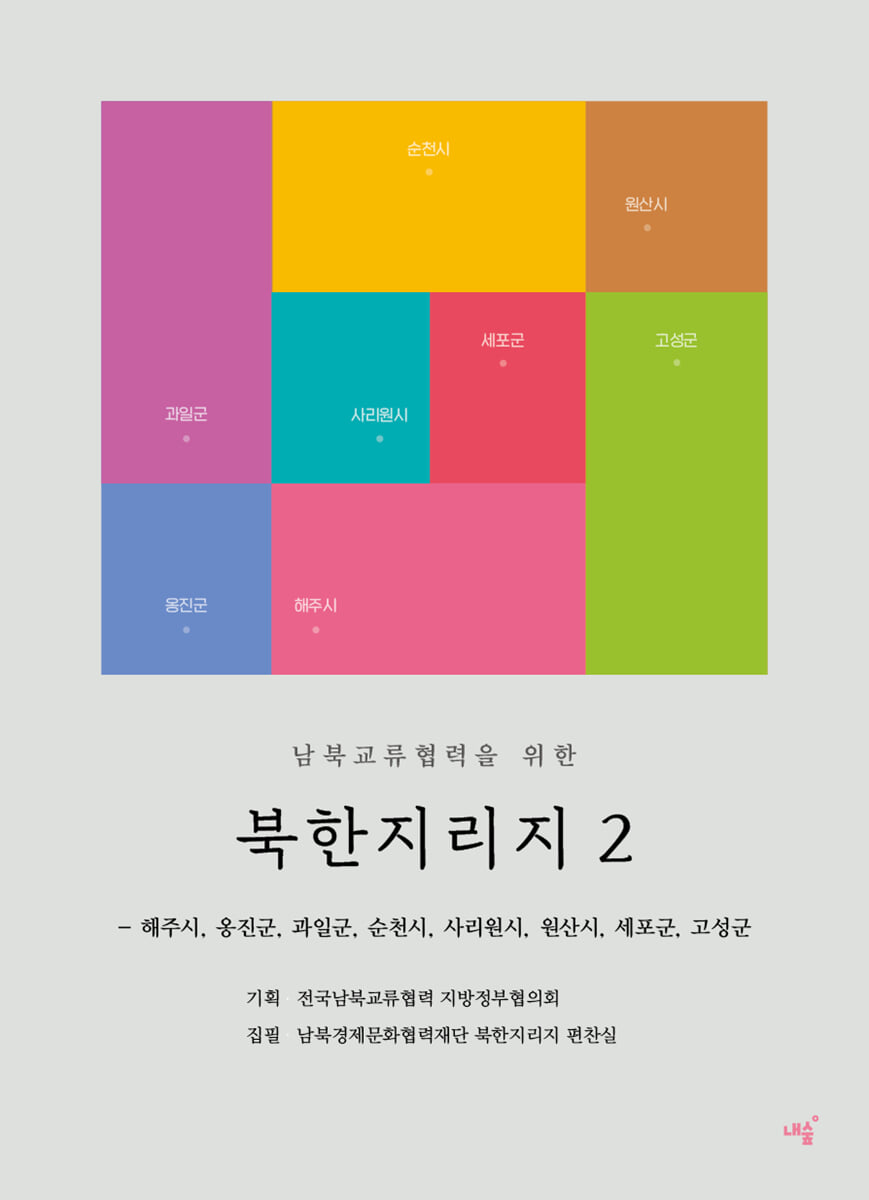
- Volume 2 contains 8 regions (Haeju-si, Ongjin-gun, Gwail-gun, Suncheon-si, Sariwon-si, Wonsan-si, Sepo-gun, and Goseong-gun).
These are the regions close to us: South Hwanghae Province, South Pyongan Province, North Hwanghae Province, and Kangwon Province.
It starts from Haeju in the West Sea and ends at Gosung-gun and Haegeumgang in the East Sea.
- Most of the books on North Korea so far have been centered on Pyongyang, but this collection is unique in that it covers the city and county levels.
These distinctive strengths will allow us to see North Korea in a richer context and open up new horizons of understanding.
It was planned by the 'National Inter-Korean Exchange and Cooperation Local Government Council' (Standing Co-Chairman, Nam-gu District Mayor Kim Byeong-nae, Gwangju Metropolitan City).
This council was formed to discuss policies among local government heads across the country who hope for a new leap forward for the Republic of Korea and the establishment of peace on the Korean Peninsula.
The purpose is to promote exchanges between the South and the North at the local government level and to contribute to national reconciliation and cooperation through such mutual communication and exchange.
Let's read an excerpt from the book's preface.
“So far, the role of local governments has not been significant in the meetings between the South and the North.
However, in the future, various types of meetings between cities in the North and South must be actively held in accordance with the unique characteristics of each region.
Local governments can directly conduct inter-Korean exchange and cooperation projects with North Korea in accordance with the Inter-Korean Exchange and Cooperation Act.
The day will surely come when citizens can travel comfortably between cities in the North and neighboring towns, as if they were traveling to a neighboring town.
You can take a bus from Mokpo to Sinuiju on National Route 1, passing through Paju, Kaesong, and Pyongyang to Sinuiju.
The day when we can freely travel across the Yalu River, through Eurasia, and all the way to Europe will become a reality, not a dream.
"North Korean Geography," jointly produced by local governments across the country, is the first step in preparing for the encounter between the peoples of North and South Korea, determining which regions of North Korea to interact with and what content to cover."
A richly contextual geography book covering the past and present of North Korea.
As the editorial notes, we have been apart for 80 years, but before that, we lived together for thousands, even tens of thousands of years.
We have a common memory, a common history, a common geography.
We live short-sighted, only aware of the current era of division and the previous colonial era, but our memories and our history have been accumulated layer by layer since long ago.
The sum total of that accumulation is our identity.
Looking into North Korea is like looking into our own identity.
This book is an open book that seeks to move forward by faithfully recording the region's past and present.
North Korea: How much do we know?
Jeju Island, the southernmost island in our country, has a very unique landscape that gives it an exotic feel.
The same goes for the area around Baekdu Mountain in the north and the Gaema Plateau.
It offers otherworldly scenery, no less awe-inspiring than the Tibetan Plateau.
Although our country is small, it has diverse climates due to its diverse terrain.
Although it is said that there are four distinct seasons, in reality, the climate is so diverse, dynamic, and interesting that it is hard to describe it as such.
Not only is the South and the North different, but the East and West coasts are also different, and the climate on both sides of the mountain ranges is noticeably different, so it often feels like a different world.
This book will help educated readers realize their previous indifference to our geography.
This book was written after investigating and researching the North Korean region from the perspective of regional geography.
Unlike previous books on North Korea that focused on Pyongyang, this book covers the provinces of North Korea.
It contains 15 diverse regions of North Korea, including Sinuiju City, Junggang County, Samjiyon City, Kimchaek City, Sinpo City, Haeju City, Gwail County, Sunchon City, Sepo County, and Goseong County.
This book takes a big step closer to the reality of North Korea.
Although this is a multi-volume project, we designed it so that you can picture the entirety of North Korea by opening and reading just one book.
Guides you to think within a geographically rich context.
Discoveries in North Korea also open new avenues for us.
A publishing business that lays the infrastructure to expand channels and pave the way for inter-Korean meetings.
For the South and the North to meet and interact, they need to know something about their partners.
A project was launched to systematically organize the characteristics of each region by selecting a region in North Korea and investigating its location, topography, climate, administrative districts and population, transportation, history and culture, industry, education, people, and exchange and cooperation cases.
This is an information booklet to prepare for an era of exchange and cooperation, where local governments, private organizations, companies, schools, large organizations, and small clubs visit and cooperate with one another.
This project is a project to build infrastructure to broaden and pave the way for inter-Korean meetings.
The fruits of the first year's work are compiled into two volumes.
The North Korean Geography project is expected to continue steadily for the next ten years.
A team of experts including scholars, editors, writers, and designers
We formed a team of editors, writers, and designers with extensive experience in North Korean studies, geography education, and urban administration, as well as long-time North Korean content experts. We worked closely with them from the planning meeting through to the final printing process.
Writing a book about North Korea is a difficult undertaking without expertise and an extraordinary amount of patience.
Because it was an area that was not well produced, the editors could not help but feel a greater sense of mission.
80 years after the division, I approached this with the mindset that it was truly a once-in-a-lifetime opportunity.
There were many moments when I had to recall the aesthetics of moderation and encourage myself, while going through tedious hours of meetings and discussions, and rereading and reviewing the written manuscript over and over again.
In this time of great suffering, the definitive 『North Korean Geography』 was born.
A scholarly and educational book, with a friendly narrative and a beautiful design that combines maps and photographs.
For each region, we have included a map produced by our compilation office, and for provincial capitals, we have provided a detailed map of the city center.
The first page of each region shows a map of the province it belongs to along with a brief introduction.
We need both a macro and a micro perspective.
Contextual and relational thinking are essential to us now, both temporally and spatially, historically and geographically.
We have provided a wealth of photos showing the current state of the place.
I did my best to vividly show the people who have lived, are living, and will live.
We have been drawn closer to our neighbors, who are both similar and different from us.
There will be many places you want to travel to and touch right away.
In addition to photographs and maps, engaging narratives and optimized editorial design lead readers on a journey through our history and geography.
This is a bright and radiant geography book that will shine in the hands of cultured readers.
* Introduction to included areas
- The seven regions included in Volume 1 (Sinuiju City, Junggang County, Samjiyon City, Chongjin City, Kimchaek City, Sinpo City, and Hamhung City) are distant regions belonging to North Pyongan Province, Chagang Province, Ryanggang Province (Ryanggang Province), North Hamgyong Province, and South Hamgyong Province.
These are regions whose importance has been highlighted in modern times.
- Volume 2 contains 8 regions (Haeju-si, Ongjin-gun, Gwail-gun, Suncheon-si, Sariwon-si, Wonsan-si, Sepo-gun, and Goseong-gun).
These are the regions close to us: South Hwanghae Province, South Pyongan Province, North Hwanghae Province, and Kangwon Province.
It starts from Haeju in the West Sea and ends at Gosung-gun and Haegeumgang in the East Sea.
- Most of the books on North Korea so far have been centered on Pyongyang, but this collection is unique in that it covers the city and county levels.
These distinctive strengths will allow us to see North Korea in a richer context and open up new horizons of understanding.
GOODS SPECIFICS
- Date of issue: February 25, 2025
- Page count, weight, size: 384 pages | 152*210*30mm
- ISBN13: 9791199113824
- ISBN10: 1199113824
You may also like
카테고리
korean


korean

![GQ KOREA Mark (Monthly): December [2025]](http://librairie.coreenne.fr/cdn/shop/files/8ef265dbbfbf186523ed75ba7319009d.jpg?v=1765340328&width=3840)


