

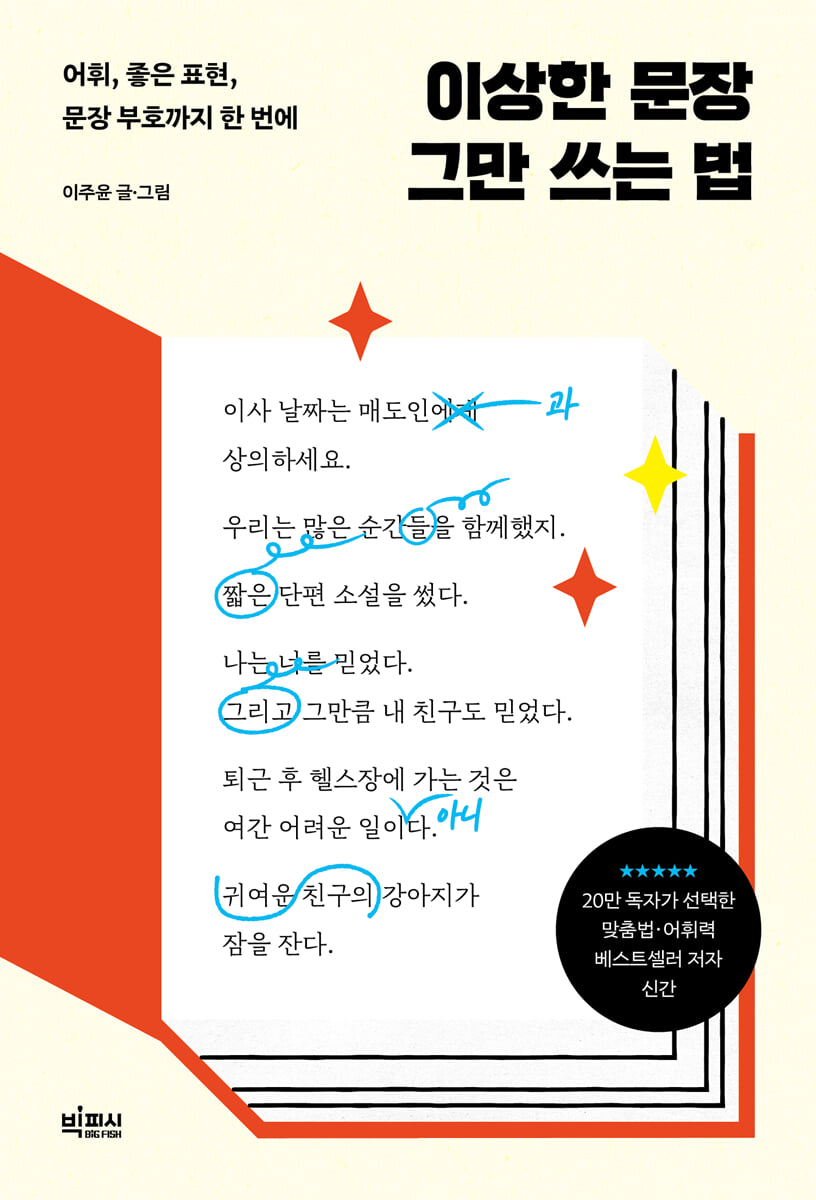
How to stop writing weird sentences
 |
Description
Book Introduction
“When I write it, my sentences feel awkward somewhere. Is this okay?”
A writing skill reorganization project for those who want to write better sentences.
Clear, at-a-glance reports, trustworthy collaboration emails, and eye-catching social media thumbnails.
What they have in common is none other than ‘grammar power.’
In these days when we have more opportunities to communicate through writing, writing skills are becoming more than just the ability to express oneself; they are becoming the most important competitive edge for effective work, relationships, and communication.
Yet, many people feel that there is something wrong with the sentences they write, but they do not know what the problem is or how to fix it.
"How to Stop Using Weird Sentences" is a book written for such adults.
Author Lee Ju-yoon, who published bestselling books on spelling and writing, has compiled the writing skills she has acquired over 14 years of writing experience into one book.
From using particles correctly to advanced techniques for writing your own sentences.
I thought I knew it, but when I actually looked at it, it pointed out sentence habits that I didn't know about and generously taught me how to write better sentences.
If you've never been confident in your writing, have relied on AI or spell checkers to write, or have never felt your writing was clear, this book will help you turn your "writing skills" into a solid weapon.
A writing skill reorganization project for those who want to write better sentences.
Clear, at-a-glance reports, trustworthy collaboration emails, and eye-catching social media thumbnails.
What they have in common is none other than ‘grammar power.’
In these days when we have more opportunities to communicate through writing, writing skills are becoming more than just the ability to express oneself; they are becoming the most important competitive edge for effective work, relationships, and communication.
Yet, many people feel that there is something wrong with the sentences they write, but they do not know what the problem is or how to fix it.
"How to Stop Using Weird Sentences" is a book written for such adults.
Author Lee Ju-yoon, who published bestselling books on spelling and writing, has compiled the writing skills she has acquired over 14 years of writing experience into one book.
From using particles correctly to advanced techniques for writing your own sentences.
I thought I knew it, but when I actually looked at it, it pointed out sentence habits that I didn't know about and generously taught me how to write better sentences.
If you've never been confident in your writing, have relied on AI or spell checkers to write, or have never felt your writing was clear, this book will help you turn your "writing skills" into a solid weapon.
- You can preview some of the book's contents.
Preview
index
Introduction│To you who often feels shabby before a sentence
Part 1.
Vocabulary techniques that enhance the taste of writing
Beginner Edition│Techniques to Awaken Your Vocabulary Sense
The assistant 'particle' of a sentence
If you investigate whether the investigation is an investigation or not, everything will come out!
The more you take out, the better '-eul'
Don't do it.
No, I can't!
'-deul' that stirs up the reader
Where is that?
nine squid legs
Is this word wrong?
This word is different?
Intermediate Level│The Art of Accurate Vocabulary Usage
It was what it was
My life's goal is to think creatively
A 'dependent noun' that needs something to lean on
The two-faced 'as much as'
Units that enhance the taste of writing
Is that really Seoul dialect?
The use of abbreviations is a national rule
Manager Kim, that guy
Advanced Edition│The Skill of Mature Language Sense
Father goes into the bag
What color is skin?
2nd year middle school level
I like rat raccoon
Part 2.
Sentence skills that expand thoughts
Beginner's Guide│The Art of Organizing Tangled Sentences
No~ What's wrong???
The bones of a sentence
If you keep decorating and decorating, you'll end up with a mess
Even sentences are drunk?
I wrote it as I was told to write it like I said
The power of short sentences learned through misunderstandings
When connecting sentences, use the 'dovetail' method.
Intermediate Level│The Art of Writing Sophisticated Sentences
Creating Full HD-quality sentences
The only way to get along is to have a good rapport
No long-distance relationships
The eye that recognizes a match made in heaven
When will the phrase 'bamboo shoots after a long day' become a common expression?
Advanced Edition│The Art of Captivating Writing Skills
Why the nagging to "be sincere" doesn't work
I'm studying 'there is'
Korean tenses are a hundred times easier than English.
Is the sentence written incorrectly?
The Three Musketeers of Translation That Make Our Language Bland
If you've studied this far, you're almost done.
She turned the last page of the book.
Part 1.
Vocabulary techniques that enhance the taste of writing
Beginner Edition│Techniques to Awaken Your Vocabulary Sense
The assistant 'particle' of a sentence
If you investigate whether the investigation is an investigation or not, everything will come out!
The more you take out, the better '-eul'
Don't do it.
No, I can't!
'-deul' that stirs up the reader
Where is that?
nine squid legs
Is this word wrong?
This word is different?
Intermediate Level│The Art of Accurate Vocabulary Usage
It was what it was
My life's goal is to think creatively
A 'dependent noun' that needs something to lean on
The two-faced 'as much as'
Units that enhance the taste of writing
Is that really Seoul dialect?
The use of abbreviations is a national rule
Manager Kim, that guy
Advanced Edition│The Skill of Mature Language Sense
Father goes into the bag
What color is skin?
2nd year middle school level
I like rat raccoon
Part 2.
Sentence skills that expand thoughts
Beginner's Guide│The Art of Organizing Tangled Sentences
No~ What's wrong???
The bones of a sentence
If you keep decorating and decorating, you'll end up with a mess
Even sentences are drunk?
I wrote it as I was told to write it like I said
The power of short sentences learned through misunderstandings
When connecting sentences, use the 'dovetail' method.
Intermediate Level│The Art of Writing Sophisticated Sentences
Creating Full HD-quality sentences
The only way to get along is to have a good rapport
No long-distance relationships
The eye that recognizes a match made in heaven
When will the phrase 'bamboo shoots after a long day' become a common expression?
Advanced Edition│The Art of Captivating Writing Skills
Why the nagging to "be sincere" doesn't work
I'm studying 'there is'
Korean tenses are a hundred times easier than English.
Is the sentence written incorrectly?
The Three Musketeers of Translation That Make Our Language Bland
If you've studied this far, you're almost done.
She turned the last page of the book.
Detailed image

Into the book
You can put aside the prejudice that studying sentences is rigid and boring.
It's a bit embarrassing for me to say this myself, but my specialty is explaining things in an easy and fun way.
We've melted your sentence knowledge into exciting episodes, so enjoy them with peace of mind.
If you want to gradually check your writing skills by solving practice problems from beginner to advanced level, if you don't think your sentences are wrong but feel discouraged by well-written articles, if you want to study how to write correctly but don't know where or how to start, everyone is welcome.
--- From the "Introductory Note"
If you're interested in writing, you've probably heard the advice to avoid sentences with too much frivolity.
When you use 'thing', useless words are bound to follow.
In that case, try erasing the 'thing' and its accompanying words.
If the meaning of a sentence doesn't change even after deleting it, then it should be removed, right?
--- From "What Was Was"
You often use the word "ssehada" when the mood is bad, right? The standard Korean for this word is "ssahada."
In fact, this word only means 'to be' and has nothing to do with 'atmosphere'.
If you use the word 'ssehada' in standard Korean, you can replace it with expressions like 'It doesn't feel right? It feels uneasy? It's strange.' Please refer to this.
The word that surprised me the most was definitely 'surprise'.
Often, when we say something to surprise someone, we say 'surprise', but this is a dialect.
The correct spelling is 'surprise'.
--- From "Is that really Seoul dialect?"
Sentences must be written clearly so that the reader does not misunderstand.
Otherwise, even if you read the same sentence, you may perceive it differently.
The sentence, 'The mother watched her son sing while cooking' is somewhat ambiguous.
You might think, 'The mother watched her son sing while cooking,' or you might think, 'The son sang while cooking.'
If a statement is not directly related to the statement that follows, use a comma to indicate this.
--- "What's wrong???"
Reading a text full of generic words is like watching a low-quality video.
Even if you know what they're saying, it's hard to recall the scene clearly.
It goes without saying that sentences like this won't capture the reader's attention. If you want to convey your message clearly, try replacing general words with specific ones.
So, what I'm saying is that a 'snack restaurant' is better than a 'store', and a 'poetry collection' is better than a 'book'.
--- From "Creating Full HD-Level Sentences"
In sentences where an action is performed, the 'object of the action' is emphasized more than the 'subject of the action'.
As a result, the subject of the action does not stand out.
While these sentences might be useful when raising children, they are not so useful when writing.
If you repeatedly use sentences that do not highlight the subject of the action, your writing will likely become muddled.
If you want to write clearly, use sentences that are subject to action only when absolutely necessary.
As we get closer to the end, the story becomes more challenging.
You're not giving up on reading a book just before you finish it, are you? Oh, the bookshelf is closed.
The book will be disappointing.
It's a bit embarrassing for me to say this myself, but my specialty is explaining things in an easy and fun way.
We've melted your sentence knowledge into exciting episodes, so enjoy them with peace of mind.
If you want to gradually check your writing skills by solving practice problems from beginner to advanced level, if you don't think your sentences are wrong but feel discouraged by well-written articles, if you want to study how to write correctly but don't know where or how to start, everyone is welcome.
--- From the "Introductory Note"
If you're interested in writing, you've probably heard the advice to avoid sentences with too much frivolity.
When you use 'thing', useless words are bound to follow.
In that case, try erasing the 'thing' and its accompanying words.
If the meaning of a sentence doesn't change even after deleting it, then it should be removed, right?
--- From "What Was Was"
You often use the word "ssehada" when the mood is bad, right? The standard Korean for this word is "ssahada."
In fact, this word only means 'to be' and has nothing to do with 'atmosphere'.
If you use the word 'ssehada' in standard Korean, you can replace it with expressions like 'It doesn't feel right? It feels uneasy? It's strange.' Please refer to this.
The word that surprised me the most was definitely 'surprise'.
Often, when we say something to surprise someone, we say 'surprise', but this is a dialect.
The correct spelling is 'surprise'.
--- From "Is that really Seoul dialect?"
Sentences must be written clearly so that the reader does not misunderstand.
Otherwise, even if you read the same sentence, you may perceive it differently.
The sentence, 'The mother watched her son sing while cooking' is somewhat ambiguous.
You might think, 'The mother watched her son sing while cooking,' or you might think, 'The son sang while cooking.'
If a statement is not directly related to the statement that follows, use a comma to indicate this.
--- "What's wrong???"
Reading a text full of generic words is like watching a low-quality video.
Even if you know what they're saying, it's hard to recall the scene clearly.
It goes without saying that sentences like this won't capture the reader's attention. If you want to convey your message clearly, try replacing general words with specific ones.
So, what I'm saying is that a 'snack restaurant' is better than a 'store', and a 'poetry collection' is better than a 'book'.
--- From "Creating Full HD-Level Sentences"
In sentences where an action is performed, the 'object of the action' is emphasized more than the 'subject of the action'.
As a result, the subject of the action does not stand out.
While these sentences might be useful when raising children, they are not so useful when writing.
If you repeatedly use sentences that do not highlight the subject of the action, your writing will likely become muddled.
If you want to write clearly, use sentences that are subject to action only when absolutely necessary.
As we get closer to the end, the story becomes more challenging.
You're not giving up on reading a book just before you finish it, are you? Oh, the bookshelf is closed.
The book will be disappointing.
--- From "Is the sentence written incorrectly?"
Publisher's Review
My sentences feel awkward somewhere. Where should I start?
What we need now is not some grand writing secret.
The power to recognize and use 'strange sentences' correctly!
Clear, at-a-glance reports, trustworthy collaboration emails, and eye-catching social media thumbnails.
The common secret to all of this is none other than ‘writing skills.’
These days, with more and more people communicating through writing rather than face-to-face conversation, writing skills are becoming more than just the ability to express oneself; they are becoming the most important competitive edge for success in work, relationships, and communication.
Yet, many people today feel that there is something wrong with the sentences they write, but they are unable to figure out what the problem is or how to fix it.
"How to Stop Using Weird Sentences" is a book written for such adults.
Author Lee Ju-yoon, the bestselling author of spelling and writing books such as “Minimum Spelling for Adults Today” and “A Handwritten Book for Those Who Want to Write Better Sentences,” has compiled the sentence techniques she personally acquired through 14 years of writing into one book.
From words you used without knowing they were incorrect to advanced techniques for writing sentences that are unique to others.
We thought we knew it, but when we actually looked at it, we were unaware of our 'strange' sentence habits, and it generously teaches us how to use correct sentences.
“Less out, write straight, make it easy to solve, make it imaginable!”
40 Sentence Skills to Transform Beginner to Expert
This book is divided into two parts that cover how to write better with better sentences.
First, in Part 1, ‘Vocabulary Techniques that Bring Out the Flavor of Writing,’ we introduce accurate and classy vocabulary usage.
It covers everything from particles that we use daily but often make mistakes to expressions that replace words that discriminate against race, gender, and the weak, reminding us that good sentences begin with the right vocabulary.
We have included appendices of ‘Easily Misunderstood Vocabulary’ and ‘Confusing Vocabulary’ to help you properly organize the correct vocabulary.
Part 2, “Sentence Techniques for Expanding Thought,” covers how to refine sentence structure to make it clear and precise.
Emphasizes the power of short sentences and provides tips for writing your own sentences using the 'show' rather than 'tell' technique.
In particular, the correct use of expressions that are easy to make mistakes with and the correct use of sentences with the right 'kungjjak' are techniques that will not embarrass the reader and increase the reliability of my writing, so if you didn't know them well before, you should correct them now.
This book, composed of author Lee Ju-yoon's signature humorous and flavorful explanations, abundant examples, and memorable illustrations, is easy to understand even after reading it once.
At the end of each chapter, we've included a summary of the principles and practice problems to help you solidify the sentence techniques covered in this book.
“Today’s sentences determine tomorrow’s reputation and favorability?”
The moment I change my sentences, the depth of my thoughts also changes.
* I'm afraid of making spelling mistakes or using outdated words.
* I always worry that I might be writing an epitaph without realizing it.
* I have felt shabby when comparing my sentences to well-written ones.
* When writing emails or reports, I want to convey my intentions clearly and easily.
* I want to be recognized as someone who writes well and says, “You’re a good writer.”
Is there a sentence in the above list that resonates with you? Fundamentally, writing is meant to be read by someone.
That is why sentences tend to become the face of the writer.
If you compare a piece that is full of misspellings, doesn't match the intended meaning, and uses discriminatory vocabulary with a piece that is considerate of the other person with a rich vocabulary and easy expressions, the latter leaves an overwhelmingly better impression.
This effort to refine my sentences is the easiest way to win the other person's favor.
It also cultivates the ability to clearly organize one's thoughts. While we live in an age where AI and spell checkers can polish our writing, we can't always rely on them to write and communicate with others.
Let's make 'writing skills' a solid weapon through this book.
This book will serve as a faithful pacemaker for anyone just starting out in writing.
What we need now is not some grand writing secret.
The power to recognize and use 'strange sentences' correctly!
Clear, at-a-glance reports, trustworthy collaboration emails, and eye-catching social media thumbnails.
The common secret to all of this is none other than ‘writing skills.’
These days, with more and more people communicating through writing rather than face-to-face conversation, writing skills are becoming more than just the ability to express oneself; they are becoming the most important competitive edge for success in work, relationships, and communication.
Yet, many people today feel that there is something wrong with the sentences they write, but they are unable to figure out what the problem is or how to fix it.
"How to Stop Using Weird Sentences" is a book written for such adults.
Author Lee Ju-yoon, the bestselling author of spelling and writing books such as “Minimum Spelling for Adults Today” and “A Handwritten Book for Those Who Want to Write Better Sentences,” has compiled the sentence techniques she personally acquired through 14 years of writing into one book.
From words you used without knowing they were incorrect to advanced techniques for writing sentences that are unique to others.
We thought we knew it, but when we actually looked at it, we were unaware of our 'strange' sentence habits, and it generously teaches us how to use correct sentences.
“Less out, write straight, make it easy to solve, make it imaginable!”
40 Sentence Skills to Transform Beginner to Expert
This book is divided into two parts that cover how to write better with better sentences.
First, in Part 1, ‘Vocabulary Techniques that Bring Out the Flavor of Writing,’ we introduce accurate and classy vocabulary usage.
It covers everything from particles that we use daily but often make mistakes to expressions that replace words that discriminate against race, gender, and the weak, reminding us that good sentences begin with the right vocabulary.
We have included appendices of ‘Easily Misunderstood Vocabulary’ and ‘Confusing Vocabulary’ to help you properly organize the correct vocabulary.
Part 2, “Sentence Techniques for Expanding Thought,” covers how to refine sentence structure to make it clear and precise.
Emphasizes the power of short sentences and provides tips for writing your own sentences using the 'show' rather than 'tell' technique.
In particular, the correct use of expressions that are easy to make mistakes with and the correct use of sentences with the right 'kungjjak' are techniques that will not embarrass the reader and increase the reliability of my writing, so if you didn't know them well before, you should correct them now.
This book, composed of author Lee Ju-yoon's signature humorous and flavorful explanations, abundant examples, and memorable illustrations, is easy to understand even after reading it once.
At the end of each chapter, we've included a summary of the principles and practice problems to help you solidify the sentence techniques covered in this book.
“Today’s sentences determine tomorrow’s reputation and favorability?”
The moment I change my sentences, the depth of my thoughts also changes.
* I'm afraid of making spelling mistakes or using outdated words.
* I always worry that I might be writing an epitaph without realizing it.
* I have felt shabby when comparing my sentences to well-written ones.
* When writing emails or reports, I want to convey my intentions clearly and easily.
* I want to be recognized as someone who writes well and says, “You’re a good writer.”
Is there a sentence in the above list that resonates with you? Fundamentally, writing is meant to be read by someone.
That is why sentences tend to become the face of the writer.
If you compare a piece that is full of misspellings, doesn't match the intended meaning, and uses discriminatory vocabulary with a piece that is considerate of the other person with a rich vocabulary and easy expressions, the latter leaves an overwhelmingly better impression.
This effort to refine my sentences is the easiest way to win the other person's favor.
It also cultivates the ability to clearly organize one's thoughts. While we live in an age where AI and spell checkers can polish our writing, we can't always rely on them to write and communicate with others.
Let's make 'writing skills' a solid weapon through this book.
This book will serve as a faithful pacemaker for anyone just starting out in writing.
GOODS SPECIFICS
- Date of issue: November 10, 2025
- Page count, weight, size: 308 pages | 374g | 128*188*18mm
- ISBN13: 9791199491731
- ISBN10: 119949173X
You may also like
카테고리
korean


korean

![GQ KOREA Mark (Monthly): December [2025]](http://librairie.coreenne.fr/cdn/shop/files/8ef265dbbfbf186523ed75ba7319009d.jpg?v=1765340328&width=3840)


