

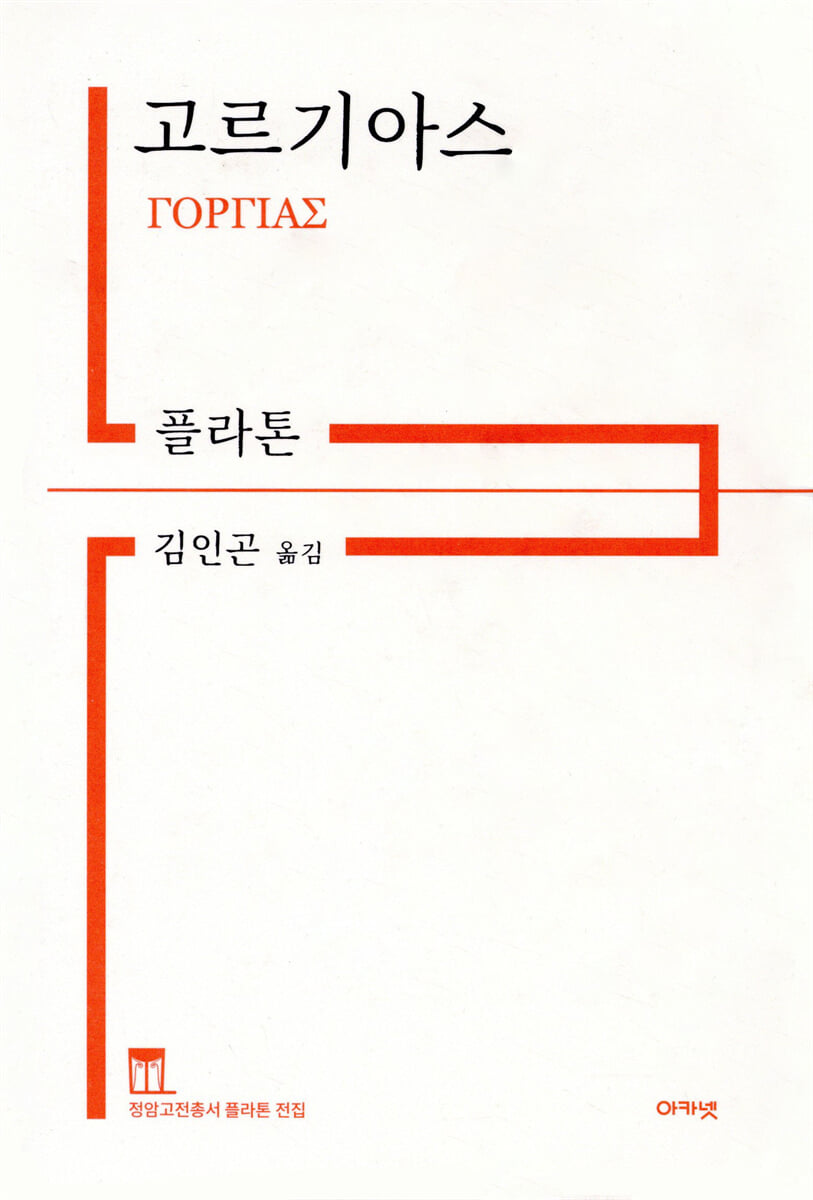
Gorgias
 |
Description
Book Introduction
A philosophical reflection on human nature's pursuit of power, authority, pleasure, and happiness.
A dialogue that most clearly reveals the value and meaning of Plato's philosophy.
Plato's Gorgias begins with the subject of oratory, but quickly moves on to questions of morality and politics, and is fundamentally concerned with questions of happiness and the way of life.
The subject of oratory is not treated superficially or secondary, but is closely and intricately interwoven with the issues of morality and happiness.
The reason Plato took up the art of rhetoric as a political art was because it was a powerful means of achieving a happy life that the common people of the time desired.
Along with these external aspects, there are direct reasons why Plato might have placed importance on the problem of rhetoric.
Speeches have the power to “lead the soul with words,” that is, the power of persuasion, allowing the speaker to guide the thoughts and ideas of the public in the direction he desires. This is an extremely important issue for Plato, who believed that the mission of politicians was to care for the souls of citizens, that is, to make them virtuous.
Moreover, oratory allows one to exercise political influence and power by captivating the public through the power of persuasion and gaining their support.
Plato was fully aware of the dangers of the influence and power of rhetoric, and so he sought to criticize the rhetoric offered by the contemporary Sophists, led by Gorgias, and the political life it aimed for.
Plato believed that the salvation of the Athenians depended on the establishment of a new oratory and the emergence of morally upright orators (politicians).
Although Gorgias is a work from nearly 2,400 years ago, it still serves as a valuable guide for examining political and moral issues today.
The human nature of pursuing power and authority has not changed much from the past to the present, and Plato's perspective on the problem is right on the mark.
A dialogue that most clearly reveals the value and meaning of Plato's philosophy.
Plato's Gorgias begins with the subject of oratory, but quickly moves on to questions of morality and politics, and is fundamentally concerned with questions of happiness and the way of life.
The subject of oratory is not treated superficially or secondary, but is closely and intricately interwoven with the issues of morality and happiness.
The reason Plato took up the art of rhetoric as a political art was because it was a powerful means of achieving a happy life that the common people of the time desired.
Along with these external aspects, there are direct reasons why Plato might have placed importance on the problem of rhetoric.
Speeches have the power to “lead the soul with words,” that is, the power of persuasion, allowing the speaker to guide the thoughts and ideas of the public in the direction he desires. This is an extremely important issue for Plato, who believed that the mission of politicians was to care for the souls of citizens, that is, to make them virtuous.
Moreover, oratory allows one to exercise political influence and power by captivating the public through the power of persuasion and gaining their support.
Plato was fully aware of the dangers of the influence and power of rhetoric, and so he sought to criticize the rhetoric offered by the contemporary Sophists, led by Gorgias, and the political life it aimed for.
Plato believed that the salvation of the Athenians depended on the establishment of a new oratory and the emergence of morally upright orators (politicians).
Although Gorgias is a work from nearly 2,400 years ago, it still serves as a valuable guide for examining political and moral issues today.
The human nature of pursuing power and authority has not changed much from the past to the present, and Plato's perspective on the problem is right on the mark.
index
Publishing the 'Jeongam Classics Series' 5
With the new publication of the 'Jeongamhakdang Plato Complete Works',
Work content classification 14
Character 16
Note 23
Text 25
Note 217
Work Guide 319
Reference 375
Search
Korean-Greek 383
Greek-Korean 406
Proper noun 419
Translator's Note 423
With the new publication of the 'Jeongamhakdang Plato Complete Works',
Work content classification 14
Character 16
Note 23
Text 25
Note 217
Work Guide 319
Reference 375
Search
Korean-Greek 383
Greek-Korean 406
Proper noun 419
Translator's Note 423
Into the book
In terms of its subject matter, content structure, and method of development, the Gorgias displays a greater complexity and diversity than any of the earlier dialogues.
While the topic is rhetoric, the issues of morality and happiness are organically linked, and the format is such that the discussion is passed on to three interlocutors in turn, deepening its breadth and depth.
Here, short, dry question-and-answer conversations and passionate, long-winded speeches are interwoven in a structured manner, and the roles of questioner and answerer are sometimes reversed, and the discussion proceeds in a way that involves individual question-and-answer sessions, exquisitely controlling the overall atmosphere and pace of the discussion.
Above all, it is striking that Socrates, who serves as the moderator of the discussion, shows a different side.
The Socrates we are familiar with in the early dialogues is the one who insists on a precise definition of the subject matter, persistently asks questions while maintaining the position of ignorance, putting those who try to answer in a difficult situation, and then ends the discussion without offering any solution or direction.
In the Gorgias, the process of defining oratory in the beginning shows the typical Socratic question-and-answer style of discussion, but the atmosphere changes as the discussion continues with Polus and Callicles.
Socrates actively expresses his thoughts and positions, and his tone is sometimes firm and confident.
While the topic is rhetoric, the issues of morality and happiness are organically linked, and the format is such that the discussion is passed on to three interlocutors in turn, deepening its breadth and depth.
Here, short, dry question-and-answer conversations and passionate, long-winded speeches are interwoven in a structured manner, and the roles of questioner and answerer are sometimes reversed, and the discussion proceeds in a way that involves individual question-and-answer sessions, exquisitely controlling the overall atmosphere and pace of the discussion.
Above all, it is striking that Socrates, who serves as the moderator of the discussion, shows a different side.
The Socrates we are familiar with in the early dialogues is the one who insists on a precise definition of the subject matter, persistently asks questions while maintaining the position of ignorance, putting those who try to answer in a difficult situation, and then ends the discussion without offering any solution or direction.
In the Gorgias, the process of defining oratory in the beginning shows the typical Socratic question-and-answer style of discussion, but the atmosphere changes as the discussion continues with Polus and Callicles.
Socrates actively expresses his thoughts and positions, and his tone is sometimes firm and confident.
--- From "Work Guide"
GOODS SPECIFICS
- Publication date: February 25, 2021
- Format: Hardcover book binding method guide
- Page count, weight, size: 432 pages | 128*188*30mm
- ISBN13: 9788957337219
- ISBN10: 8957337210
You may also like
카테고리
korean


korean

![ELLE 엘르 스페셜 에디션 A형 : 12월 [2025]](http://librairie.coreenne.fr/cdn/shop/files/b8e27a3de6c9538896439686c6b0e8fb.jpg?v=1766436872&width=3840)


