

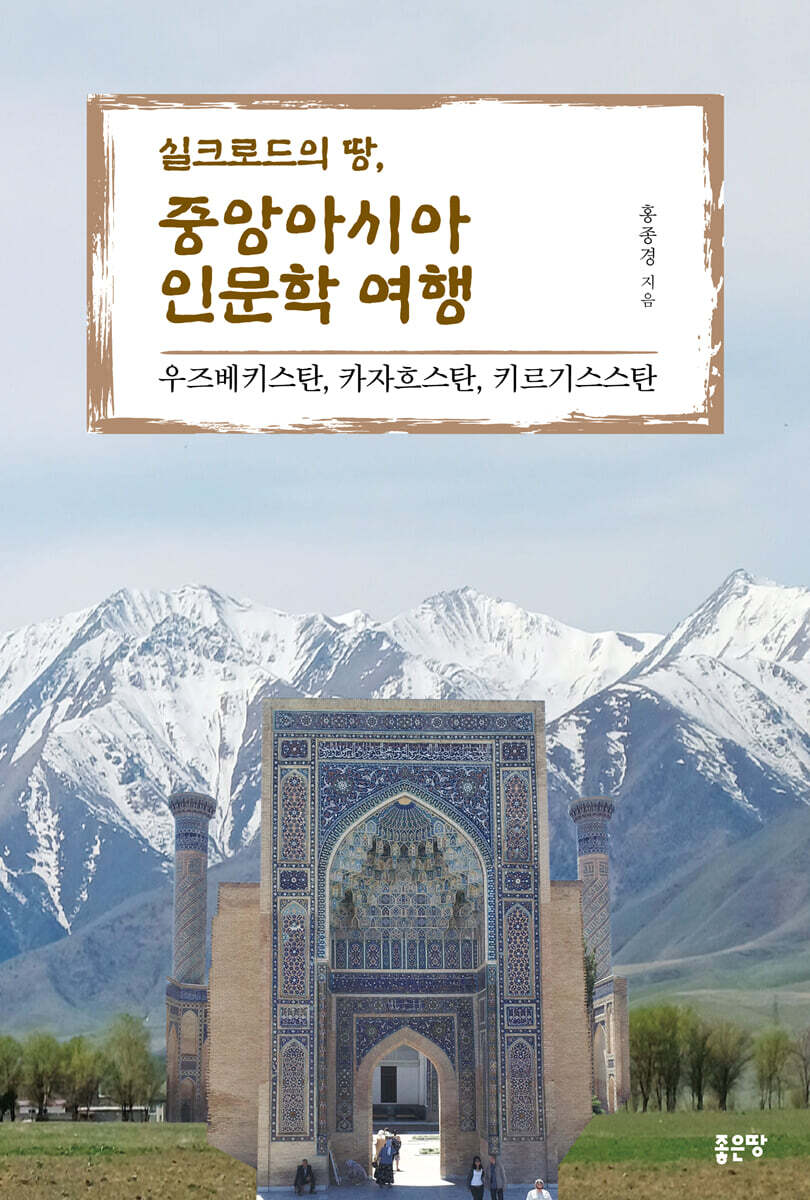
A Humanities Journey through Central Asia, the Land of the Silk Road
 |
Description
Book Introduction
This book was written to provide an enjoyable journey through Central Asia, a region still unfamiliar to us, with a humanistic understanding of the major countries and cities that once existed on the Silk Road, the "Road to Prosperity."
Moreover, this book contains a journey toward new discoveries.
The author, a former diplomat, traveled to Central Asian countries and cities along the ancient Silk Road, experiencing a broadening of his previously closed range of thoughts and perceptions.
So the author wrote this book to share the valuable experience he felt with others.
In this way, "A Humanities Journey through Central Asia, the Land of the Silk Road" will provide readers who wish to travel to this region, still unfamiliar and unfamiliar to us, with the opportunity to understand and experience its history and culture, thereby making their trips more meaningful and fulfilling.
And through the author's vivid experiences and insights, this book will guide readers into a new world of perception and offer the true joy of discovery.
Moreover, this book contains a journey toward new discoveries.
The author, a former diplomat, traveled to Central Asian countries and cities along the ancient Silk Road, experiencing a broadening of his previously closed range of thoughts and perceptions.
So the author wrote this book to share the valuable experience he felt with others.
In this way, "A Humanities Journey through Central Asia, the Land of the Silk Road" will provide readers who wish to travel to this region, still unfamiliar and unfamiliar to us, with the opportunity to understand and experience its history and culture, thereby making their trips more meaningful and fulfilling.
And through the author's vivid experiences and insights, this book will guide readers into a new world of perception and offer the true joy of discovery.
- You can preview some of the book's contents.
Preview
index
As we begin our journey through the humanities of Central Asia,
The Silk Road, a path of cultural exchange between East and West
The development of the Silk Road by Zhang Qian of the Han Dynasty
Oasis cities of Central Asia
Note
Part 1 Uzbekistan
Uzbekistan, the center of the Silk Road
Samarkand
Afrasiab Museum
Mural depicting an envoy from the Korean Peninsula (West Wall) / Which country is the envoy? / Mural with distinct Tang Dynasty colors (North Wall) / Procession to a Zoroastrian temple (South Wall) / Silk Road Friendship and Cooperation Monument / Sogdians / Exchanges between Goguryeo and Silla with the Western Regions
Samarkand, the political, economic, and cultural center of the Timurid Empire
The beautiful madrasas of Registan Square
Ulugh Beg Madrasah/Shirdor Madrasah/Tilakari Madrasah
Mosques and mausoleums of Samarkand
Amir Timur Grand Mosque/Bibi-Khanym Mausoleum/Shah-i-Zinda/Gur-Amir/Daniyar Khoja Mausoleum
Scientific and technological advancements during the Timurid Empire and the European Renaissance
Ulugh Beg's Observatory / Astronomy of the Timurid Empire that Influenced Joseon / Al-Kashi, the 'Jang Yeong-sil of the Timurid Empire' / The Dark Ages of the Islamic World and the Renaissance in Europe
Islamic miniature painting reached its peak during the Timurid Empire.
Yusuf and Zulayha/Bahram Gur, who resided in the Green Palace/Building the Kawarnaq Palace
A performance showcasing the diversity of Uzbek culture
Bukhara
Bukhara, a city of religion, scholarship, culture, and art
World-renowned figures from Bukhara/Bukhara's contributions to the development of Sufism and Islam
Bukhara, built with a typical triple-layered structure in Central Asia
Bukhara city center
Rabihauz/Nadir Divanbegi Madrasah/Bukhara Dance/Adras and Khan Atlas/Kukeldash Madrasah/Traditional Handicrafts of Bukhara/Bukhara School Miniature Paintings/Taqi/Magoki Atori Mosque/Ulugh Beg Madrasah/Abdulaziz Khan Madrasah/Mir Arab Madrasah/Kalyan Minaret and Kalyan Mosque/Chor Minor Madrasah
Bukhara Citadel
Registan Square/Ark Citadel/Bolokhauz Mosque
Bukhara suburbs
Sitarai Mohihosa Palace/Ismail Samani Mausoleum/Chashma Job/Saffron Tea
Top 3 Foods I Tasted in Bukhara
Hiba
Persian-Khwarezm Empire
The Formation of the Khwarazm Empire / Jalal al-Din Menguberdi, the "Hero of the Great Mongol Rebellion" / The Battle of the Indus River with Genghis Khan
Formation of the Khiva Khanate
Itchan Kala, a UNESCO World Heritage Site
Ata Darvaza / Kalta Minor Minaret / Muhammad Amin Khan Madrasa / Kunya Arq / Square in front of Rahim Khan Madrasa / Juma Mosque / Islamic Khoja Madrasa Minaret / Pahlaban Mahmud Mausoleum / Tash Hawley Palace / Romantic nights in Khiva and Uzbek wine / The Nurullabay Palace's detached quarters
Top 3 Foods I Tasted in Khiva
Tashkent
Tashkent, where the ancient Stone Kingdom existed
Tashkent's new city center, home to museums and art galleries
National Museum of Timur History/National Museum of Fine Arts/National Museum of Applied Arts/Alisher Navoi Literature Museum and Jo Myung-hee Literature Memorial Hall/Navoi Opera and Ballet Theatre/Broadway Street Gallery/Minor Mosque
Papier-Mache Detailed Jewelry Box
Tashkent's Old Town Transforms into an Islamic Holy Land
Hazrati Imam Religious and Historical Complex/Abu Bakr Kafal Shashi Mausoleum/Tilla Sheikh Mosque/Mu'i Muborak Madrasah/Barakhan Madrasah/Chorsu Bazaar
Lunch at Chorsu Bazaar
Part 2 Kyrgyzstan
Kyrgyzstan, the 'Switzerland of Central Asia'
Bishkek
Ala-Too Square, the heart of Bishkek
Manas, the legendary hero of Kyrgyzstan / The Presidential Palace, the site of the 'Tulip Revolution'
Alarca National Park
National Museum of History with the Golden Mask
Golden mask/bronze?/excavated cross designs from the Shamsi ruins
Statues in Bishkek that tell the story of Kyrgyzstan
Statues of Lenin, Marx, and Engels; Toktogul, the "Great Kyrgyz Artist"; Kurmandzhan Datka, a symbol of Kyrgyz women; and Chingiz Aitmatov, the great writer.
The World's Most Beautiful Love Story: Jamila
Representative folk crafts of Kyrgyzstan
The custom of Kalpak and Pyeondu used by Alakiyiz and Shirdak/Heavenly Grandson
Bishkek, where European culture coexists
Kyrgyz National Art Museum/Chuikov House Museum/National Opera and Ballet Theater/Statues of World-Class Ballet Dancers/European Cuisine in Bishkek
Kyrgyzstan's open Islamic culture
Tokmok area (Balasagun, Saeyeop)
Balasagun, the capital of the Karakhan Khaganate
Burana Tower/Karakhan Khaganate/Pioneers of Turkic Cultural Development/Stone Statues 'Eruption'
Crossroads of the Silk Road, Ssaeyeop
The arena of competition between the Turkic, Tibetan, and Tang dynasties/General Gao Xianzhi's conquest of Dalhaebu/ Gao Xianzhi, who became the "King of the Silk Road"/ Archaeological excavations at Suyeopseong/ Suyeopseong, the birthplace of Li Bai/ The meeting between the monk Xuanzang and the Western Turkic Khagan
General Go Seon-ji's 'Tangulyeong Route Strategy': A Shining Light in World War History
Issyk-Kul Lake
Issyk-Kul, a natural lake
The Pearl of the Tian Shan/Ancient Civilization in Lake Issyk-Kul
Cholpon-Ata Open-Air Petroglyph Museum
Issyk-Kul Lake as seen from the resort town
Part 3 Kazakhstan
Kazakhstan, the land of nomads who pioneered the "steppe road"
Almaty
Independence Monument, where you can see Kazakhstan's history at a glance
Queen Tomyris, who captured Cyrus the Great of Persia/Three Great Figures of Kazakhstan
Petroglyphs, the pinnacle of prehistoric plastic art
Similarity between the horse figures in the Tamgaly petroglyphs/petrocarpments of the Bronze Age, when human-centered depictions began, and the Cheonmado
National Museum of Kazakhstan
The discovery of the "Golden Man" astonished the world of archaeology. Similarities between the Silla royal tomb and the Kazakhstan kurgan.
Silla's exchanges with northern nomadic peoples through the Silk Road
Borovoe artifacts and the Golden Sword from Gyerim-ro No. 14/Kazakhstan Kurgan and glass cups excavated from Silla royal tombs/Questions difficult to explain through mere exchange/Kurgan construction methods and the eastward movement of gold culture/Are the Silla Kim royal family descendants of the Huns?
The Issyk Kurgan where the 'Golden Man' was discovered
National Museum of Transplant History and Culture and Korea Silk Road Friendship and Cooperation Monument
People who led Kazakhstan's modernization
Abai Kunanbaiuli, the 'founder of Kazakh literature'; Mukhtar Auezov, the 'Shakespeare of Kazakhstan'; and Akhmet Baitursinov, the 'national teacher'
Kasteev National Art Museum, Kazakhstan's largest art museum
Kashcheev/Gulfairus Ismayirova/Gallimbaeva Aisha Garipovna/Abram Cherkassky
Ballet, a symbol of Kazakhstan's social reform
Kazakhstan's first professional dancer, Sara Zyenkulova, and third-generation Koryo-saram ballerinas Lyudmila Li and Tatyana Ten
Koryo people in Kazakhstan
Koryo-saram Identity/Koryo Theater/Statue of Viktor Tsoi, the "Legend of Russian Rock"
The Ascension Cathedral in Almaty, which was completely undamaged by the great earthquake
Major Silk Road cities during the Kazakh Khanate
The Switched Fates of Sairam and Shymkent
Otrar, a strategic point on the Silk Road
Aristan Bab Mausoleum/Otrar with a Sad History/Otrar Archaeological Museum
Holy City, Turkestan
The ancient, dark-beige Karavansaray complex/Kazakhstan's traditional cuisine/The roots of the Kazakh Khanate, the Golden Horde/The mausoleum of the great Islamic leader Ahmed Yasawi
Sauran remains in ruins
Sauran, who supplied bricks and tiles for the construction of the Yasawi Mausoleum
A Beautiful Performance at the 'Caravan Sarai Complex'
Taraz, one of the ancient international trade hubs
Black Mountain (黑山) seen on the way to Taraz/Aisha Bibi Mausoleum/Taraz, a city with over 2,000 years of history/Karakhan Mausoleum/Kone Taraz Archaeological Park/Talas Castle
The Battle of Talas Revisited on the banks of the Talas River
The Battle of Talas, with no detailed historical records, and the final chapter of the Goryeo Dynasty, which makes us realize the limitations of a foreign general.
Epilogue
Appendix: Finding Proper Nouns
The Silk Road, a path of cultural exchange between East and West
The development of the Silk Road by Zhang Qian of the Han Dynasty
Oasis cities of Central Asia
Note
Part 1 Uzbekistan
Uzbekistan, the center of the Silk Road
Samarkand
Afrasiab Museum
Mural depicting an envoy from the Korean Peninsula (West Wall) / Which country is the envoy? / Mural with distinct Tang Dynasty colors (North Wall) / Procession to a Zoroastrian temple (South Wall) / Silk Road Friendship and Cooperation Monument / Sogdians / Exchanges between Goguryeo and Silla with the Western Regions
Samarkand, the political, economic, and cultural center of the Timurid Empire
The beautiful madrasas of Registan Square
Ulugh Beg Madrasah/Shirdor Madrasah/Tilakari Madrasah
Mosques and mausoleums of Samarkand
Amir Timur Grand Mosque/Bibi-Khanym Mausoleum/Shah-i-Zinda/Gur-Amir/Daniyar Khoja Mausoleum
Scientific and technological advancements during the Timurid Empire and the European Renaissance
Ulugh Beg's Observatory / Astronomy of the Timurid Empire that Influenced Joseon / Al-Kashi, the 'Jang Yeong-sil of the Timurid Empire' / The Dark Ages of the Islamic World and the Renaissance in Europe
Islamic miniature painting reached its peak during the Timurid Empire.
Yusuf and Zulayha/Bahram Gur, who resided in the Green Palace/Building the Kawarnaq Palace
A performance showcasing the diversity of Uzbek culture
Bukhara
Bukhara, a city of religion, scholarship, culture, and art
World-renowned figures from Bukhara/Bukhara's contributions to the development of Sufism and Islam
Bukhara, built with a typical triple-layered structure in Central Asia
Bukhara city center
Rabihauz/Nadir Divanbegi Madrasah/Bukhara Dance/Adras and Khan Atlas/Kukeldash Madrasah/Traditional Handicrafts of Bukhara/Bukhara School Miniature Paintings/Taqi/Magoki Atori Mosque/Ulugh Beg Madrasah/Abdulaziz Khan Madrasah/Mir Arab Madrasah/Kalyan Minaret and Kalyan Mosque/Chor Minor Madrasah
Bukhara Citadel
Registan Square/Ark Citadel/Bolokhauz Mosque
Bukhara suburbs
Sitarai Mohihosa Palace/Ismail Samani Mausoleum/Chashma Job/Saffron Tea
Top 3 Foods I Tasted in Bukhara
Hiba
Persian-Khwarezm Empire
The Formation of the Khwarazm Empire / Jalal al-Din Menguberdi, the "Hero of the Great Mongol Rebellion" / The Battle of the Indus River with Genghis Khan
Formation of the Khiva Khanate
Itchan Kala, a UNESCO World Heritage Site
Ata Darvaza / Kalta Minor Minaret / Muhammad Amin Khan Madrasa / Kunya Arq / Square in front of Rahim Khan Madrasa / Juma Mosque / Islamic Khoja Madrasa Minaret / Pahlaban Mahmud Mausoleum / Tash Hawley Palace / Romantic nights in Khiva and Uzbek wine / The Nurullabay Palace's detached quarters
Top 3 Foods I Tasted in Khiva
Tashkent
Tashkent, where the ancient Stone Kingdom existed
Tashkent's new city center, home to museums and art galleries
National Museum of Timur History/National Museum of Fine Arts/National Museum of Applied Arts/Alisher Navoi Literature Museum and Jo Myung-hee Literature Memorial Hall/Navoi Opera and Ballet Theatre/Broadway Street Gallery/Minor Mosque
Papier-Mache Detailed Jewelry Box
Tashkent's Old Town Transforms into an Islamic Holy Land
Hazrati Imam Religious and Historical Complex/Abu Bakr Kafal Shashi Mausoleum/Tilla Sheikh Mosque/Mu'i Muborak Madrasah/Barakhan Madrasah/Chorsu Bazaar
Lunch at Chorsu Bazaar
Part 2 Kyrgyzstan
Kyrgyzstan, the 'Switzerland of Central Asia'
Bishkek
Ala-Too Square, the heart of Bishkek
Manas, the legendary hero of Kyrgyzstan / The Presidential Palace, the site of the 'Tulip Revolution'
Alarca National Park
National Museum of History with the Golden Mask
Golden mask/bronze?/excavated cross designs from the Shamsi ruins
Statues in Bishkek that tell the story of Kyrgyzstan
Statues of Lenin, Marx, and Engels; Toktogul, the "Great Kyrgyz Artist"; Kurmandzhan Datka, a symbol of Kyrgyz women; and Chingiz Aitmatov, the great writer.
The World's Most Beautiful Love Story: Jamila
Representative folk crafts of Kyrgyzstan
The custom of Kalpak and Pyeondu used by Alakiyiz and Shirdak/Heavenly Grandson
Bishkek, where European culture coexists
Kyrgyz National Art Museum/Chuikov House Museum/National Opera and Ballet Theater/Statues of World-Class Ballet Dancers/European Cuisine in Bishkek
Kyrgyzstan's open Islamic culture
Tokmok area (Balasagun, Saeyeop)
Balasagun, the capital of the Karakhan Khaganate
Burana Tower/Karakhan Khaganate/Pioneers of Turkic Cultural Development/Stone Statues 'Eruption'
Crossroads of the Silk Road, Ssaeyeop
The arena of competition between the Turkic, Tibetan, and Tang dynasties/General Gao Xianzhi's conquest of Dalhaebu/ Gao Xianzhi, who became the "King of the Silk Road"/ Archaeological excavations at Suyeopseong/ Suyeopseong, the birthplace of Li Bai/ The meeting between the monk Xuanzang and the Western Turkic Khagan
General Go Seon-ji's 'Tangulyeong Route Strategy': A Shining Light in World War History
Issyk-Kul Lake
Issyk-Kul, a natural lake
The Pearl of the Tian Shan/Ancient Civilization in Lake Issyk-Kul
Cholpon-Ata Open-Air Petroglyph Museum
Issyk-Kul Lake as seen from the resort town
Part 3 Kazakhstan
Kazakhstan, the land of nomads who pioneered the "steppe road"
Almaty
Independence Monument, where you can see Kazakhstan's history at a glance
Queen Tomyris, who captured Cyrus the Great of Persia/Three Great Figures of Kazakhstan
Petroglyphs, the pinnacle of prehistoric plastic art
Similarity between the horse figures in the Tamgaly petroglyphs/petrocarpments of the Bronze Age, when human-centered depictions began, and the Cheonmado
National Museum of Kazakhstan
The discovery of the "Golden Man" astonished the world of archaeology. Similarities between the Silla royal tomb and the Kazakhstan kurgan.
Silla's exchanges with northern nomadic peoples through the Silk Road
Borovoe artifacts and the Golden Sword from Gyerim-ro No. 14/Kazakhstan Kurgan and glass cups excavated from Silla royal tombs/Questions difficult to explain through mere exchange/Kurgan construction methods and the eastward movement of gold culture/Are the Silla Kim royal family descendants of the Huns?
The Issyk Kurgan where the 'Golden Man' was discovered
National Museum of Transplant History and Culture and Korea Silk Road Friendship and Cooperation Monument
People who led Kazakhstan's modernization
Abai Kunanbaiuli, the 'founder of Kazakh literature'; Mukhtar Auezov, the 'Shakespeare of Kazakhstan'; and Akhmet Baitursinov, the 'national teacher'
Kasteev National Art Museum, Kazakhstan's largest art museum
Kashcheev/Gulfairus Ismayirova/Gallimbaeva Aisha Garipovna/Abram Cherkassky
Ballet, a symbol of Kazakhstan's social reform
Kazakhstan's first professional dancer, Sara Zyenkulova, and third-generation Koryo-saram ballerinas Lyudmila Li and Tatyana Ten
Koryo people in Kazakhstan
Koryo-saram Identity/Koryo Theater/Statue of Viktor Tsoi, the "Legend of Russian Rock"
The Ascension Cathedral in Almaty, which was completely undamaged by the great earthquake
Major Silk Road cities during the Kazakh Khanate
The Switched Fates of Sairam and Shymkent
Otrar, a strategic point on the Silk Road
Aristan Bab Mausoleum/Otrar with a Sad History/Otrar Archaeological Museum
Holy City, Turkestan
The ancient, dark-beige Karavansaray complex/Kazakhstan's traditional cuisine/The roots of the Kazakh Khanate, the Golden Horde/The mausoleum of the great Islamic leader Ahmed Yasawi
Sauran remains in ruins
Sauran, who supplied bricks and tiles for the construction of the Yasawi Mausoleum
A Beautiful Performance at the 'Caravan Sarai Complex'
Taraz, one of the ancient international trade hubs
Black Mountain (黑山) seen on the way to Taraz/Aisha Bibi Mausoleum/Taraz, a city with over 2,000 years of history/Karakhan Mausoleum/Kone Taraz Archaeological Park/Talas Castle
The Battle of Talas Revisited on the banks of the Talas River
The Battle of Talas, with no detailed historical records, and the final chapter of the Goryeo Dynasty, which makes us realize the limitations of a foreign general.
Epilogue
Appendix: Finding Proper Nouns
Publisher's Review
《A Humanities Journey through Central Asia, the Land of the Silk Road》 guides readers into an unknown world.
This book is not a simple travelogue; it sheds new light on the historical significance and charm of the Silk Road through a humanistic exploration that encompasses past and present.
The Silk Road evokes images of mystery and fascination for many.
The Silk Road, once a route for the exchange of wealth, culture, art, and religion, is now a forgotten route, but this book vividly brings back to life its ancient glory and complex history.
The story of the fierce competition and battles between nations and peoples to secure the Silk Road, and the crucial role our ancestors played in the process, leaves a deep impression on readers.
The author first became acquainted with the Silk Road while serving as Consul General in Istanbul, and later explored various aspects of the Silk Road while supporting the 'Korea Silk Road Project.'
This book is based on the in-depth knowledge and experience he gained through domestic and international seminars and field trips, as well as his recent numerous trips to Central Asia.
This book is written in the form of a travelogue focusing on the oasis cities of Uzbekistan, Kazakhstan, and Kyrgyzstan, and is rich in images and annotations to make it easy and enjoyable for readers.
Explanations are added for proper nouns that may be unfamiliar, and the 'Find Proper Nouns' section in the appendix helps readers understand the content more easily.
《The Land of the Silk Road: A Humanistic Journey through Central Asia》 guides readers along a path of knowledge connecting past and present, equipping them with a humanistic understanding of the region for a pleasant and comfortable journey.
For those who wish to understand the history and culture of the Silk Road and travel through the region, this book will be a valuable guide.
This book is not a simple travelogue; it sheds new light on the historical significance and charm of the Silk Road through a humanistic exploration that encompasses past and present.
The Silk Road evokes images of mystery and fascination for many.
The Silk Road, once a route for the exchange of wealth, culture, art, and religion, is now a forgotten route, but this book vividly brings back to life its ancient glory and complex history.
The story of the fierce competition and battles between nations and peoples to secure the Silk Road, and the crucial role our ancestors played in the process, leaves a deep impression on readers.
The author first became acquainted with the Silk Road while serving as Consul General in Istanbul, and later explored various aspects of the Silk Road while supporting the 'Korea Silk Road Project.'
This book is based on the in-depth knowledge and experience he gained through domestic and international seminars and field trips, as well as his recent numerous trips to Central Asia.
This book is written in the form of a travelogue focusing on the oasis cities of Uzbekistan, Kazakhstan, and Kyrgyzstan, and is rich in images and annotations to make it easy and enjoyable for readers.
Explanations are added for proper nouns that may be unfamiliar, and the 'Find Proper Nouns' section in the appendix helps readers understand the content more easily.
《The Land of the Silk Road: A Humanistic Journey through Central Asia》 guides readers along a path of knowledge connecting past and present, equipping them with a humanistic understanding of the region for a pleasant and comfortable journey.
For those who wish to understand the history and culture of the Silk Road and travel through the region, this book will be a valuable guide.
GOODS SPECIFICS
- Date of issue: July 29, 2024
- Page count, weight, size: 364 pages | 152*225*30mm
- ISBN13: 9791138833868
- ISBN10: 113883386X
You may also like
카테고리
korean


korean

![GQ KOREA Mark (Monthly): December [2025]](http://librairie.coreenne.fr/cdn/shop/files/8ef265dbbfbf186523ed75ba7319009d.jpg?v=1765340328&width=3840)


